kottke.org posts about video
A copy of the letter written and signed by Albert Einstein in 1939 warning President Franklin Roosevelt of the possibility of Nazi Germany building nuclear weapons is up for auction next week at Christie’s. The estimate is $4-6 million.
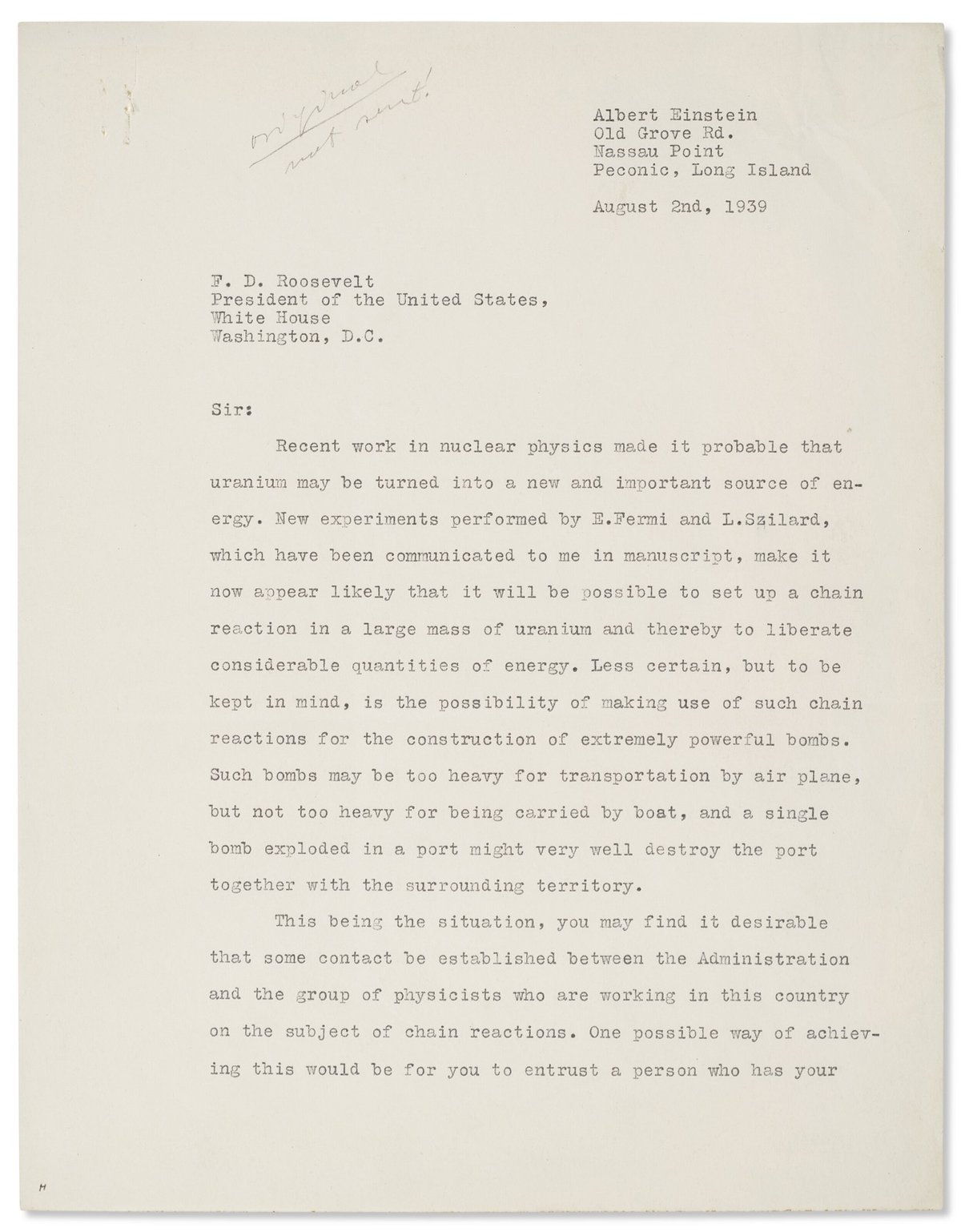
The present letter is based directly on the content that Einstein dictated in German. Leo Szilard then translated the text into English and dictated it in turn to a Columbia University typist. Unsure of the level of detail to present to the chief executive, Szilard also made a longer version that recommended specific administrative steps the President could take to support uranium research. The longer version was the one delivered to the White House. It has rested, since 1945, in the permanent collection of the Franklin D. Roosevelt Library at Hyde Park, New York and has been referenced in myriad histories and biographies. It is arguably the single-most influential letter of the twentieth century. Leo Szilard retained the original version of that historic communication and it is offered here, together with Einstein’s handwritten letter to Szilard transmitting both signed letters addressed to the President of the United States.
The letter reads in part:
Recent work in nuclear physics made it probable that uranium may be turned into a new and important source of energy. New Experiments performed by E. Fermi and L. Szilard, which have been communicated to me in manuscript, make it now appear likely that it will be possible to set up a chain reaction in a large mass of uranium and thereby to liberate considerable quantities of energy. Less certain, but to be kept in mind, is the possibility of making use of such chain reactions for the construction of extremely powerful bombs.
Nuclear weapons historian Stephen Schwartz writes more about the letter on Bluesky:
On August 15, Szilard mailed the letter to prominent economist Alexander Sachs, who had formerly worked for Roosevelt, after trying and failing (at Sach’s suggestion) to get Charles Lindbergh to personally deliver the letter to the president.
Sachs did not immediately reach out to Roosevelt. Then, on September 1, Hitler invaded Poland and Roosevelt became preoccupied with the war. Sachs finally met with Roosevelt on October 11, bringing not only the letter but scientific reports and papers provided by Szilard.
The letter is being sold by the estate of late Microsoft co-founder Paul Allen. The series of Allen auctions also include notable items like an Apple I computer, an Enigma machine, a Cray-1 supercomputer, a NASA flight suit worn by Buzz Aldrin, and a cool-ass meteorite.
I don’t remember how I happened upon them, but I’ve been enjoying Lane 8’s seasonal mixtapes for the past few years — good upbeat music to work to.
He’s been doing these for 11 years. The Denver DJs mixes are available on Soundcloud, YouTube, and Apple Music. The fall 2024 mix should be out very soon!
I’d never heard this before: in a long jump competition in 1974, Tuariki Delamere did a full front flip during a jump in an attempt to fly further.
The idea of a front flip in long jump had been talked about for years. Experts believed it could help jumpers go further by using the body’s natural rotation to boost momentum. The flip would turn the jumper’s upward motion into forward motion, potentially adding crucial inches to the jump.
This Wired article delves deeper into the physics of the somersault jump:
Delamere’s technique might have added significant distance to long jumps. Many experts think it could have broken the 30-foot mark. (The world record is 29 feet, 4 inches.) But he was never given the chance, because the sporting authorities said it was too dangerous. Evidently they’d never seen gymnastics or ski jumping.
That’s right, the flip technique was quickly banned and never used in competition again. Come on, bring it back!
The folks at Kurzgesagt have done a few time travel videos now, but this one is notable for its concise, intuitive explanation and visualization of our constant speed through spacetime (special relativity).
Everything in our universe moves at the speed of light through four dimensional spacetime. Your speed through spacetime is the sum of your separate speeds through time and space. It is impossible for you to stay still. Even if you are not moving through space dimensions, you are moving through the time dimension, blasting face first into the future.
You can slow down in the time dimension, by moving faster through the space dimensions but in total, you will always move at the speed of light through spacetime.
And you can “trade” moving through space for moving through time: “Move faster through space, go slower in time. Move slower through space, go faster in time.” Or as a commenter put it:
Your speed is constant. So the faster you move through the space dimensions, the slower you move through the time dimension, and vice versa.
Not sure this textual explanation makes as much sense as the visualization in the video, so maybe just watch that? Oh, and check out the sources for the video.
Here’s a newly released remix of The Postal Service’s The District Sleeps Alone Tonight by Sylvan Esso. In addition to YouTube, it’s also available on several other sites. (via sippey)
Amazon’s series The Rings of Power hasn’t gotten great reviews and Evan Puschak hypothesizes that, unlike movies, TV is not the right medium to tell Tolkien’s stories.
I’m skeptical that the Lord of the Rings, or any other story from Tolkien’s mythology, can really work as a TV series. It’s a square peg round hole situation. TV as a form just doesn’t play to the strengths of Tolkien’s vision.
In my XOXO post on Monday, I said that Nolen Royalty, the creator of One Million Checkboxes, had told “one of the wackiest internet nerd stories I’ve ever heard”. Well, Royalty has now put that story online, both in the form of a blog post and a YouTube video:
I panicked. There were URLs in my database! There were URLs pointing to catgirls.win in my database!! Something was very very wrong.
I assumed I’d been hacked. I poured over my logs, looking for evidence of an intrusion. I read and re-read my code, searching for how somebody could be stuffing strings into a database that should have just contained 0s and 1s.
I couldn’t find anything. My access logs looked fine. My (very simple) code was ok. My heart rate increased. My girlfriend patiently waited for me to join her for dinner. And then — wait.
Wait!
I saw it.
It’s a great story — read/watch the whole thing. It reminds me of the palimpsest (layered communication) that the aliens use to communicate with Earth in Carl Sagan’s Contact (and the 1997 movie). Not only because of the in-game message left for Royalty but for the way that there turned out to be many ways to “play” or “beat” OMCB.
I just got back from the XOXO Festival and one of things that happened was that Taylor Ramos and Tony Zhou showed their new short film The Second and their first new Every Frame A Painting video essay in eight years!! And now the video essay is on YouTube:
It’s a quick one about the sustained two-shot, a type of shot that was used a lot in the olden days but still has its uses today — and gives actors room to actually act.
So happy to see Ramos and Zhou back at it. I’m not sure if I should even say this, but they indicated during their XOXO appearance that there will be more to come (in fewer than 8 years).
Here’s my post about them shuttering the channel and a few of my favorite videos of theirs.
Conservation biologist Tim Shields is trying to save the Mojave Desert’s desert tortoise population, which is under threat from ravens, an invasive species brought to the area by habitat-encroaching humans. Working with an engineer, he’s trying to train the ravens to leave the tortoises alone — their work is the subject of the short documentary Eco-Hack!
Together, they embarked on what Shields calls a campaign of “aversive training” for ravens, which, among the various threats to desert tortoises, he says seemed like the easiest to address. They set about booby-trapping the desert to train the birds to leave the tortoises alone. Their methods seem like a sophisticated version of sitting in the driveway and burning ants with a magnifying glass: placing laser emitters on terrestrial rovers; building and deploying 3-D-printed fake tortoises laced with artificial grape flavoring, which ravens evidently hate. They give their creations proud retro names: the Techno-Tort, the Blastoluxe. “The idea is just to make the haunted landscape where there’s just no relief from the surprises, and all the surprises are bad,” Shields says of the ravens, one of the collective nouns for which is, fittingly, an “unkindness.”
Amazing image at the 10:35 mark of the video btw.
As one of the top trials riders in the world, Danny MacAskill can certainly do a wheelie. In this fun video, he does wheelies all over the place, joined by a bunch of friends. The behind-the-scenes video is just as fun. And I watched the “how to do a wheelie” companion video with interest because I’ve never been able to do a wheelie on a bike for more than a couple of seconds and it’s probably time to learn — even though a manual would be more useful for mountain biking. (via the kid should see this)
The different kinds of sounds that carmakers have had to come up with to make EVs audible to pedestrians, bikers, and other drivers are wild: orchestras, pitch-shifted didgeridoos, gas car noises.
For over a century, the internal combustion engine powered vehicles with an intricate combination of moving parts and tiny explosions. That combustion process inevitably made noise, and that noise came to define the background soundscape of our roads, cities, and day-to-day life. But as hybrids and EVs became increasingly mainstream — and more of their near-silent electric motors filled the streets — it became clear that silent vehicles didn’t fit in the ecosystem we’d built around cars.
Spearheaded by associations of the blind and visually impaired, legislation eventually began to require electric vehicles to emit an artificial engine noise out of hidden external speakers. These hidden speaker systems, called “Acoustic Vehicle Alerting Systems” — or AVAS — had to meet certain sonic criteria. But they were also a blank slate for sound designers to decide how the cars of the future should sound.
Reminder: cities aren’t noisy, cars are.
I’ve been enjoying watching these livestreams of watering holes in the arid regions of Namibia. As I’m looking now, there appear to be some zebras and giraffes hanging out — previous sightings include hyenas, ostriches, cheetahs, wildebeest, oryx, and even honey badgers. You can find more cams and archived footage at @NamibiaCam.
The Howtown crew explains how food manufacturers, the USDA, and food label services figure out how many calories are in the foods we eat. Spoiler: it’s not just a matter of burning food to see how much energy is produced — different nutrients are absorbed more or less efficiently by the body so you need to measure the output and compare it to the input.
And don’t forget to check the comments for Joss Fong’s banana oat blobs.
Humans are the first and, to our knowledge, only entities on Earth to develop general intelligence, which has allowed us to dominate and alter the planet in a way and at a speed that no other entity has managed. Now, some people are working towards building an artificial general intelligence. So what happens when humans are matched or even far outclassed by this new general intelligence?
Such an intelligence explosion might lead to a true superintelligent entity. We don’t know what such a being would look like, what its motives or goals would be, what would go on in its inner world. We could be as laughably stupid to a superintelligence as squirrels are to us. Unable to even comprehend its way of thinking.
This hypothetical scenario keeps many people up at night. Humanity is the only example we have of an animal becoming smarter than all others — and we have not been kind to what we perceive as less intelligent beings. AGI might be the last invention of humanity.
The musician Nick Cave was on The Late Show with Stephen Colbert earlier this week (full interview) and he read a letter from his Red Hand Files, an AMA project where fans write in with questions and he answers them. The question was:
Following the last few years I’m feeling empty and more cynical than ever. I’m losing faith in other people, and I’m scared to pass these feelings to my little son. Do you still believe in Us (human beings)?
In a lovely letter in response (which he reads in the video above), Cave writes that “much of my early life was spent holding the world and the people in it in contempt” and that “it took a devastation to understand the idea of mortal value, and it took a devastation to find hope”. That devastation was the death of his 15-year-old son in 2015, which he talks more about in this interview and in this book. Cave’s response concludes:
Unlike cynicism, hopefulness is hard-earned, makes demands upon us, and can often feel like the most indefensible and lonely place on Earth. Hopefulness is not a neutral position either. It is adversarial. It is the warrior emotion that can lay waste to cynicism. Each redemptive or loving act, as small as you like, Valerio, such as reading to your little boy, or showing him a thing you love, or singing him a song, or putting on his shoes, keeps the devil down in the hole. It says the world and its inhabitants have value and are worth defending. It says the world is worth believing in. In time, we come to find that it is so.
I promise, your day will be better if you take a few minutes to watch or read this letter. And the entire interview is worth watching as well — there is no better interviewer on the topic of loss and grief than Stephen Colbert.
Newer posts
Older posts




Socials & More