kottke.org posts about video
Let’s say you’ve got a bunch of books that need to be sorted alphabetically by author. What’s the fastest way to accomplish this task? Luckily, efficient sorting is a problem that’s been studied extensively in computer science and this TED-Ed video walks us through three possible sorts: bubble sort, insertion sort, and quicksort.
For more on sorting, check out Sorting Algorithms Visualized, sorting techniques visualized through Eastern European folk dancing, and a site where you can compare many different sorting algorithms with each other. (via the kid should see this)
“Barbaric.” A “nightmare of vulgarity.” “Monstrous.” “A violent mess.” “The work of a madman.” Those are just some of the reactions that Henri Matisse’s Dance received after its public debut in 1910. In this video, Evan Puschak shares How Matisse Revolutionized Color In Art with this painting and other Fauvist work.
In 1888, the Eastman Kodak Company rolled out a new camera and a new slogan. “You press the button, we do the rest.” To say this moment revolutionized photography would be an understatement. But this story isn’t just about Kodak. It’s about what happens when a powerful technology, originally only understood by a select few, can suddenly fit in your hand.
And then, fast-forwarding to the 90s and 00s, Kodak gradually, then suddenly, missed a similar shift that further democratized photography: the move to digital.
Last week, I posted about the discovery of a “new” piece of music by Wolfgang Amadeus Mozart.
A previously unknown piece of music composed by Wolfgang Amadeus Mozart when he was probably in his early teens has been uncovered at a library in Germany.
The piece dates to the mid to late 1760s and consists of seven miniature movements for a string trio lasting about 12 minutes, the Leipzig municipal libraries said in a statement on Thursday.
Via Smithsonian Magazine, here’s the one of the first public performances of the rediscovered work:
Researchers say the music fits stylistically with other works from the 1760s, when Mozart was between the ages of 10 and 13. Ulrich Leisinger, head of research at the foundation, tells Deutsche Presse-Agentur (DPA) that the young composer was no longer creating pieces that sounded like this one by the time he was in his late teens.
In his early years, however, Mozart wrote many chamber works like Serenade in C, which his father recorded on a list of his son’s compositions. Many of these works were thought to have been lost to history, as Leisinger says in the statement. Fortunately, this particular piece was saved — thanks to the composer’s sister.
“It looks as if — thanks to a series of favorable circumstances — a complete string trio has survived in Leipzig,” Leisinger adds. “The source was evidently Mozart’s sister, and so it is tempting to think that she preserved the work as a memento of her brother. Perhaps he wrote the trio specially for her.”
(via open culture)
In coastal cities in Iceland, including on the Vestmannaeyjar archipelago, it’s common to see people out at night, hunting for baby puffins (called pufflings). Once they’re caught, they’re chucked off of cliffs the next day and fly out to sea:
From NPR:
Many residents of Vestmannaeyjar spend a few weeks in August and September collecting wayward pufflings that have crashed into town after mistaking human lights for the moon. Releasing the fledglings at the cliffs the following day sets them on the correct path.
This human tradition has become vital to the survival of puffins, Rodrigo A. Martínez Catalán of Náttúrustofa Suðurlands [South Iceland Nature Research Center] told NPR. A pair of puffins – which mate for life – only incubate one egg per season and don’t lay eggs every year.
“If you have one failed generation after another after another after another,” Catalán said, “the population is through, pretty much.”
Jessica Bishopp’s meditative short film follows a pair of teen girls and their friends as they drive around in the middle of the night collecting pufflings.
Interspersed with the puffling search are brief moments of the quotidian: we see Selma talking to her friends about acrylic nails and also braiding her younger sister’s hair. These scenes illustrate how the teens’ environmental action is only a part of a larger routine of caretaking, revealing a world in which environmental protection is both normal and necessary. “I think it’s important that we tell alternative stories of girlhood, and it’s not led by trauma or romance,” Bishopp said. The girls show themselves to be responsible stewards. They are also in the midst of their own coming of age, and they’re aware of the parallel between their own experiences and those of the birds, who are separating from their parents.
For his first movie since 2019’s Parasite, filmmaker Bong Joon-ho is coming out with a sci-fi dark comedy film called Mickey 17. The trailer is above and the synopsis from Wikipedia is:
Wanting to get out of Earth, Mickey Barnes signs up to be an “expendable”: a disposable employee where after one iteration dies, a new body is regenerated with most of their memories intact. After one of his “multiples”, Mickey 17, unintentionally survived a human expedition to colonize the ice world Niflheim, he goes head-to-head with a new multiple, Mickey 18.
Mickey 17 will be out in theaters in late January. I found the trailer for this from Aaron Stewart-Ahn, who says:
David Zaslav’s Warner Bros has been trying to bury Bong Joon-ho’s sci-fi follow up to Parasite for over a year now, refused to let it play Cannes, and is now dumping it in January. Rumors are Robert Pattinson’s weirdo performance also bothered them which to me means it must be friggin’ awesome.
Per Wikipedia, production wrapped in late 2022 so yeah, it sounds like they didn’t know what to do with it.
Apollo 13: Survival is a documentary film that uses original footage and interviews to tell the story of NASA’s Apollo 13 mission, what went wrong, and how the astronauts returned safely to Earth. It’s now playing on Netflix.
In a collaboration with Red Bull & Prada (uh, ok) and with the help of the Polish State Railways, Dawid Godziek rode a mountain bike on a ramps course on top of a moving train, performing tricks & flips between cars. The train and rider moved at the same speed in opposite directions, which made it seem as though, from the perspective of someone on the ground next to the train, that the rider is nearly horizontally stationary.
The result is trippy & counterintuitive and also a demonstration of Newton’s laws of motion & frames of reference. But since Godziek was not riding in a vacuum, there were some real world details to contend with:
We observed something interesting — the lack of air resistance. In theory, this could have made it easier, but the opposite was true. The air resistance creates a tunnel that somehow keeps me in a straight line and doesn’t allow me to shift right or left. Luckily on the recordings we had, the headwind gave me artificial air resistance, which helped me to get a feel for the flight on classic hops. On the tests, the wind was blowing weaker or in a different direction, making shooting tricks difficult. Not bad, right? We’re always complaining about air resistance, and when it wasn’t there, we found that it was impossible to fly without it.
See also Mythbusters shooting a soccer ball out of the back of a moving truck.
The Great Ball Contraption is a class of machines built with Lego that transport small balls from place to place in many different ways.
The otherwise pointless handling of balls, and the myriad ways this is accomplished, gives great ball contraptions the impression of a Rube Goldberg machine.
These machines can be quite large and elaborate and are displayed at Lego events around the world. Here’s a recent GBC at an event in Japan:
It’s worth watching for a bit for the ingenuity and all of the different mechanisms for moving objects around — plus, it’s mesmerizing. And it obviously reminds me of Chris Burden’s Metropolis II.
You can build your own Great Ball Contraption (or team up with others to do so) with the rules & resources listed here.
See also 20 Mechanical Principles Combined in a Useless Lego Machine, Treasure Trove of Over 1700 Mechanical Animations, Five Hundred and Seven Mechanical Movements, and Gears and Other Mechanical Things.
From British Pathé, a short film clip from 1928 of men racing on penny farthing bikes. See also clips from 1936 and 1937 races.
Most of the crowd seems to have come to see them fall off, but in the end it turns out to be such a great race that when they come round on the third lap, the excitement runs higher than the bicycle.
Oh and Penny Farthing Racing is Still a Thing.
James Earl Jones did many things during his long career, including acting as Verizon’s pitchman. As part of a 2005 promotion, Jones recited Edgar Allan Poe’s The Raven in that amazing rumbly voice of his, reprising his earlier performance on The Simpsons. Here’s the full version on Soundcloud, including his introduction — “he wrote about murder, torture, and being buried alive”:
As part of the same promotion, he also apparently recorded a recitation of the Gettysburg Address, but I cannot locate a copy of that anywhere.1 However, he did recite part of the Gettysburg Address, along with fragments of other Lincoln speeches, in a performance of Aaron Copland’s Lincoln Portrait with the Seattle Symphony Orchestra:
Jones also read Frederick Douglass’s speech What to the Slave is 4th of July?:
And some Walt Whitman:
And excerpts from Martin Luther King, Jr.’s Letter from a Birmingham Jail:
And some Othello at the Obama White House:
Well, I don’t know how I missed this, but the fantastic HBO series My Brilliant Friend is back for its fourth and final season. The series is based on Elena Ferrante’s Neapolitan novels and this season covers the events of the fourth book, The Story of the Lost Child.
I love My Brilliant Friend — it’s one of my all-time favorites and might be the best show you’re not watching. I agree completely with Clare Thorp’s description of it as “criminally underrated”.
As the trailer above shows, the previous two lead actors (who were excellent) have been replaced by older ones, a change I’m a little apprehensive about, but everything else about the show has been pitch perfect so I’m gonna trust the process. From an NPR piece on the new season:
“This child is you, when you were a child,” Maiorino recalled her friend Alessia saying about the novel’s titular protagonist and sometimes antagonist Lila. Like Lila and her friend Lenù, Maiorino is from Naples and stayed in the south, while her friend left to study in the north of the country, get married and have children.
Art has now truly imitated life for Maiorino, who plays Lila in the fourth season of the series.
New episodes of My Brilliant Friend started airing on HBO last night and will drop every Monday for the next 10 weeks. Go check it out!
For some reason, this is a full-length version of Radiohead’s OK Computer by @shonkywonkydonkey that uses his voice for everything (vocals, drums, guitar, etc.) I don’t exactly know if I like this, but it is interesting. (via sippey)
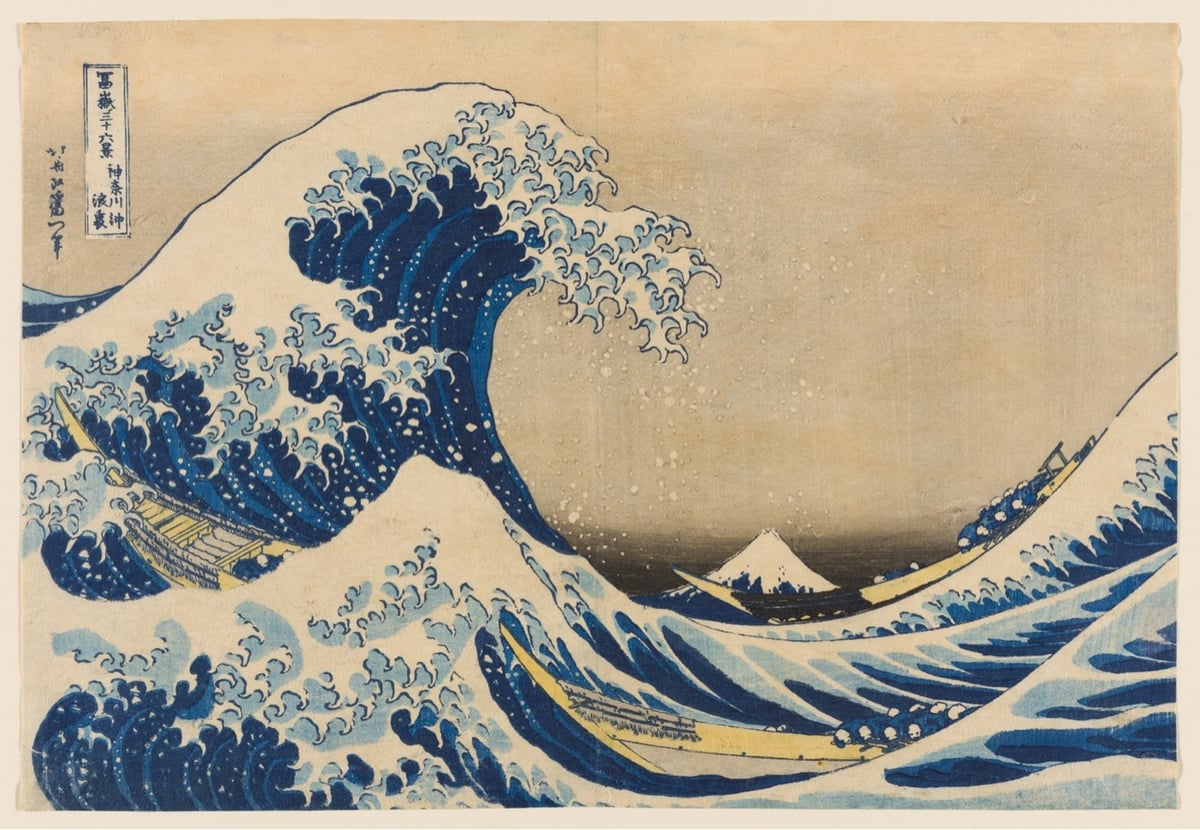
The Art Institute of Chicago has three copies of Katsushika Hokusai’s iconic work The Great Wave Off Kanagawa in its collection and one of them has been removed from storage and is back on display in the museum until Jan 6, 2025.
The Great Wave has not been on view in the Art Institute galleries for five years because, like all prints, it is susceptible to light damage and must rest a minimum of five years between showings to preserve its colors and vibrance.
Here’s a video of the print being removed from storage as well as a brief comparison of their three prints:
For other places you can see The Great Wave on display, check out Great Wave Today.
For his 2012-13 piece The Obstruction of Action by the Existence of Form, artist R. Eric McMaster built a hockey rink less than 1/10th the size of a regulation rink and had two full hockey teams play what has to be the most frustrating game of hockey ever. This is definitely a metaphor for something but I don’t quite know what.
Newer posts
Older posts






Socials & More