kottke.org posts about video
For this video, freelance animator Nick Murray Willis took the audio from football commentators and made these little animated vignettes to go along with each line. Here’s a sample:
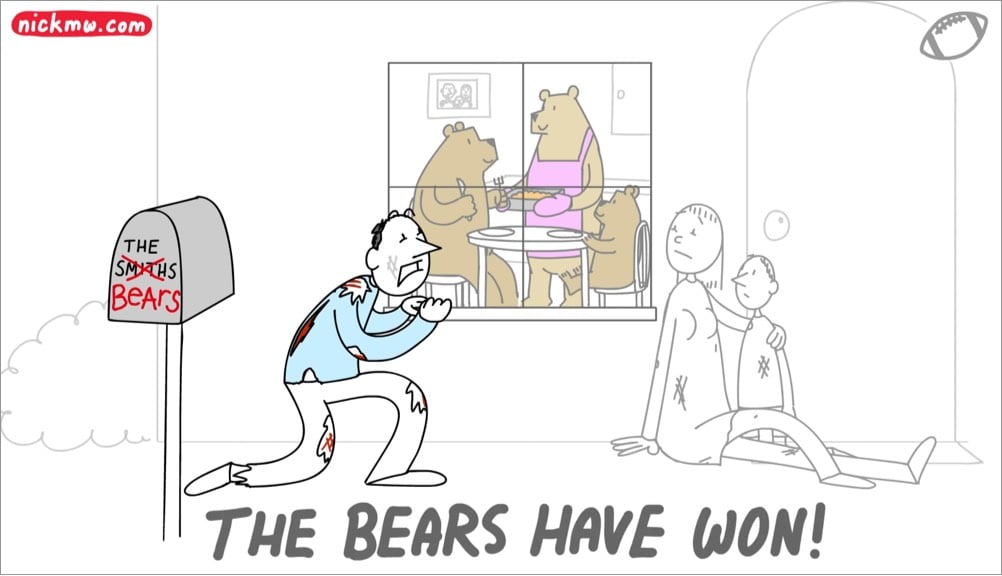
My only complaint about this video is that it was over too quickly. Luckily Willis has done the same thing in videos for NBA, soccer, movie lines, etc.
Meet the spider-tailed horned viper, native to western Iran. As the name suggests, the snake has a tail that, when moved about in the right way, looks like a spider crawling on a rock. The crawling “spider” attracts small birds who eat insects…and then the viper eats the birds:
Sweeeeeeet Fancy Moses! If an animal with venomous snake jaws on one end and a spider on the other isn’t everyone’s idea of a nightmare animal, I don’t know what is.
But what an incredible evolutionary adaptation. This mimicry is right up there with the bee orchid. (via @jasonfried)
Light is fast! In a recent series of animations, planetary scientist James O’Donoghue demonstrates just how fast light is…and also how far away even our closest celestial neighbors are. Light, moving at 186,000 mi/sec, can circle the Earth 7.5 times per second and here’s what that looks like:
It can also travel from the surface of the Earth to the surface of the Moon in ~1.3 seconds, like so:
That seems both really fast and not that fast somehow. Now check out light traveling the 34 million miles to Mars in a pokey 3 minutes:
And Mars is close! If O’Donoghue made a real-time animation of light traveling to Pluto, the video would last over 5 hours. The animation for the closest undisputed galaxy, Seque 1, would last 75,000 years and 2.5 million years for the Andromeda galaxy animation. The farthest-known objects from Earth are more than 13 billion light years away. Light is slow!
See also The Leisurely Pace of Light Speed.
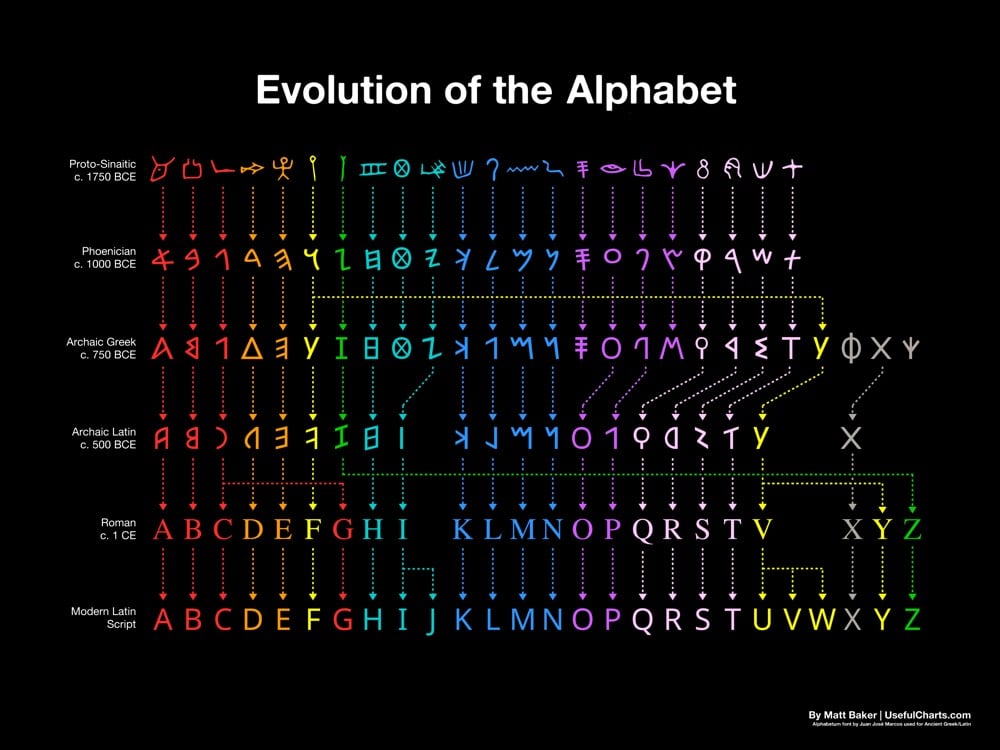
From Matt Baker of UsefulCharts, this chart traces the evolution of our familiar alphabet from its Proto-Sinaitic roots circa 1850-1550 BC. It’s tough to see how the pictographic forms of the original script evolved into our letters; aside from the T and maybe M & O, there’s little resemblance. Prints are available. (via the morning news)
Update: Baker recently did an updated version of the alphabet evolution chart.
Mountain Monks is a short film by Fritz Schumann about a group of Japanese monks called the Yamabushi who regularly commune with nature to get in touch with their true selves.
The Yamabushi in northern Japan practice a once forbidden ancient religion. While their tradition is at risk of disappearing, it offers a way for those seeking a different path in Japan’s society.
Walking barefoot through rivers, meditating under waterfalls and spending the nights on mountaintops — that is the way of the Yamabushi. They walk into the forest to die and be born again.
You may remember another short film by Schumann that I posted last year about Hoshi Ryokan, a 1300-year-old family-run hotel in central Japan. (via laughing squid)
Moon Rivas, a cyborg artist, has sensors implanted in her feet that vibrate whenever an earthquake is detected anywhere in the world. A dancer and choreographer, Rivas uses the randomly occurring vibrations to perform dance pieces like “Waiting for Earthquakes”. This video from Quartz gives a good overview of Rivas’ art and process (back when an implant was located in her arm instead of her feet).
CNN and Bloomberg both have recently updated reports on Rivas’ work.
Ribas then transforms that data into dance or music, often incorporating elements of spontaneity and uncertainty. For example, the movements in the dance “Waiting for Earthquakes,” in which the artist stands perfectly still until seismic activity occurs, can take many shapes.
“I’m a dancer and a choreographer, so I wanted to experience movement in a deeper way,” she explains. “Whenever there is an earthquake, I move according to the intensity of the earthquake. It’s a bit like a duet between the earth and myself. Earth is actually the choreographer of the piece and I’m just imitating the data that she gives.”
Her partner Neil Harbisson is also a cyborg. He was born colorblind but is outfitted with an antenna implanted in his head that vibrates when it detects colors. (via @boletrone)
Something incredible happened during the super blood wolf moon eclipse that took place on Sunday night: a meteorite struck the moon during the eclipse and it was captured on video, the first time this has ever happened.
Jose Maria Madiedo at the University of Huelva in Spain has confirmed that the impact is genuine. For years, he and his colleagues have been hoping to observe a meteorite impact on the moon during a lunar eclipse, but the brightness of these events can make that very difficult — lunar meteorite impacts have been filmed before, but not during an eclipse.
The 4K video of the impact above was taken by amateur astronomer Deep Sky Dude in Texas…he notes the impact happening at 10:41pm CST. I couldn’t find any confirmation on this, but the impact looks bright enough that it may have been visible with the naked eye if you were paying sufficient attention to the right area at the right time.
Phil Plait has a bunch more info on the impact. If the impact site can be accurately determined, NASA will attempt to send the Lunar Reconnaissance Orbiter to get photos of it.
Interestingly, I talked to Noah Petro, Project Scientist for LRO, and he noted that the impact may have created secondary craters, smaller ones made by debris blown out by the main impact. Those will spread out over a larger area, and are easier to spot, so it’s possible that even with a rough location known beforehand the crater can be found. Also, fresh craters look distinct from older ones — they’re brighter, and have a bright fresh splash pattern around them — so once it’s in LRO’s sights it should be relatively easy to spot.
It’s not clear how big the crater will be. I’ve seen some estimates that the rock that hit was probably no more than a dozen kilograms or so, and the crater will be probably 10 meters across. That’s small, but hopefully its freshness will make it stand out.
In 1960, the National Film Board of Canada released a short documentary called Universe. The film follows the work of astronomer Donald MacRae at an observatory in Ontario, which is accompanied a special effects-heavy tour of the solar system, galaxy, and universe: “a vast, awe-inspiring picture of the universe as it would appear to a voyager through space”. Universe was nominated for an Oscar in 1961 and also caught the eye of Stanley Kubrick, who used it as inspiration for 2001: A Space Odyssey.
“Stanley had seen the National Film Board movie Universe.” Most of the crew on 2001 were familiar with the Canadian production, made by filmmakers Colin Low and Roman Kroitor, all having seen it at the early stages of 2001’s production, it being “required watching” at the insistence of Kubrick himself, who had seen the documentary “almost 100 times”, “until the sprockets wore out,” 2001 special effects supervisor Con Pedersen remembers.
Kubrick was so taken by the depiction of the celestial objects in the film that he hired the co-director and a special effects technician from Universe to work on 2001. The narrator of Universe, Douglas Rain, also became a integral part of Kubrick’s masterpiece. After ditching the idea that 2001 would be narrated by Rain — “as more film cut together, it became apparent narration was not needed” — Kubrick chose Rain as the now-iconic voice of HAL 9000.
After finally excising the narrator altogether, he simply made Rain the voice of HAL, liking his “bland mid-Atlantic accent”. The decision was entirely Kubrick’s, who had become concerned with the character of the computer. “Kubrick was having,” Rain says, “a problem with the computer. ‘I think I made him too emotional and too human,’ he said. ‘I’m having trouble with what I’ve got in the can. Would you consider doing his voice?’ So we decided on the voice of the computer.”
But back to Universe, which is a marvelous little film (even though it asserts at one point that “it is reasonably certain” that Mars contains vegetation). I love the early sequence of the astronomer setting up his telescope — the way he walks along inside of it and then casually lifts it up into place. It’s really just a bigger version of the small reflector that I have, not any more complicated than a couple of mirrors pointed in the right direction. It’s incredible what we humans have learned about the universe simply by collecting ancient starshine with polished lenses and mirrors. (via clayton cubitt)
This commercial from Mexican airline AeroMexico cleverly reminds some Americans of the melting pot nature of our nation, where even “white” folks living near the border share significant amounts of DNA with those in Mexico. According to this piece in Adweek, the ad features non-actors and their actual DNA test results.
For those wondering how legit the scenarios shown in the ad are, Agost Carreño says it’s all real and that each person featured in the video was a non-actor who did have a 23andMe DNA test done in advance of the reveal.
Update: A possible inspiration for the AeroMexico video is The DNA Journey commercial by travel search engine Momondo:
The folks in that commercial may seem a bit naive about how DNA and ancestry works, but I took the 23andMe DNA test many years ago and was also surprised to find a few significant possible geographic outliers (British/Irish, Dutch) that were not accounted for in the handed-down family genealogy. (via @rudhraigh)
Featuring the ideas of cheese expert Paul Kindstedt, this TED-Ed video is a quick animated look at the history of cheese and cheesemaking over the last 10000 years.
The best indication of ancient cheese-making lies in pottery fragments that migrating peoples left behind as they moved to new locations. Neolithic peoples sometimes stored cheese and butter in pottery vessels, which left embedded residues of milkfat in the pottery. Even after thousands of years, these ancient milkfat residues can be identified by sophisticated archaeochemical techniques. By following the pottery trail, it is possible to reconstruct the movement of Neolithic cheesemakers out of the Fertile Crescent into northwest Turkey, and then westwards to Europe, where cheese-making evolved into countless new varieties, and eastwards to the Eurasian steppes. With respect to Africa, it is still unclear whether cheese-making arrived from the Fertile Crescent or developed independently there.
Kindstedt is the author of Cheese and Culture: A History of Cheese and its Place in Western Civilization and is based at the University of Vermont, not too far from where I live in VT, land of plentiful hyper-local cheeses…the nearest cheese-making dairy is 1/4 mile from my house. Some of Kindstedt’s recent research uses techniques like x-ray diffractometry to study stuff like crystal formation and packing density in cheeses, which takes me back to my research days in college studying the structure of glass. What a fun thing, to discover a whole new vector into cheese appreciation! (via open culture)
Comics fans and the internet at large have been enchanted by the new author of the classic Nancy comic, Olivia Jaimes. This comic from Sunday shows why:
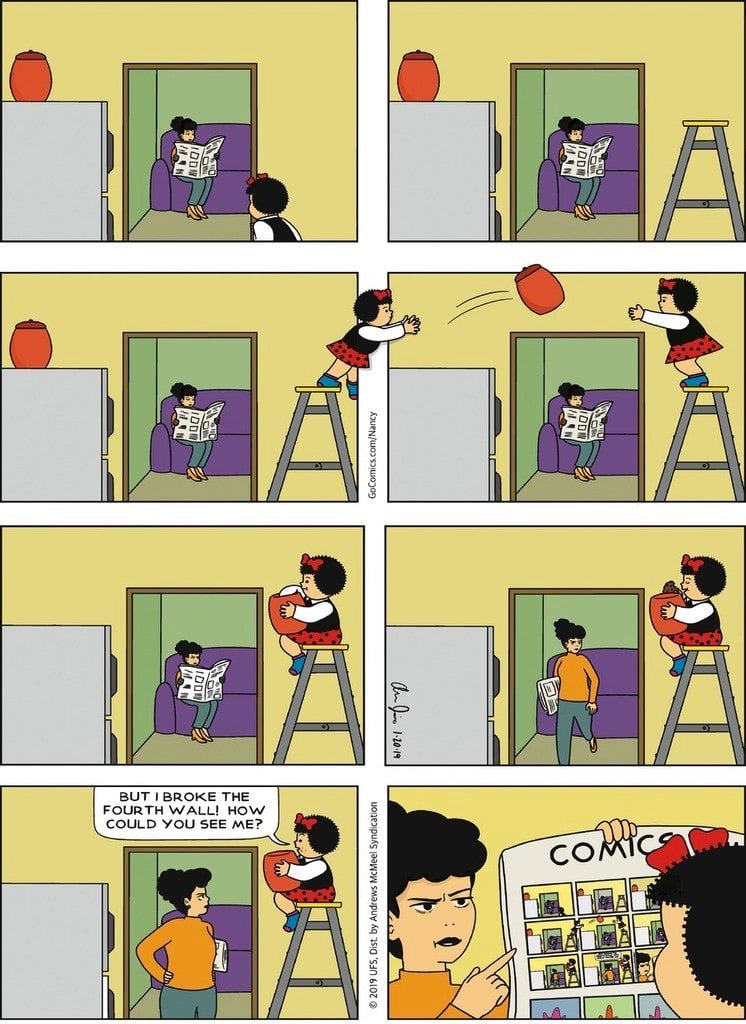
If you check out the thread for the comic on Twitter, there are several instances of comics that mess with time and space like this, but the final panel by Jaimes is particularly strong. I definitely Laughed Out Loud.
Update: Delta’s current onboard safety video takes place within the illustrated world of the seat-back safety card and contains several instances of fourth-wall breaking.
Spinning disks of ice can form naturally in slow-moving parts of streams and rivers. What happens is a large chunk of ice gets caught in a quiet part of the river and then is spun and shaped into a circle by the nearby current.
In the video above, Tina Radel captured a particularly huge ice circle in the Presumpscot River in Westbrook, Maine…it’s about 100 yards across!
A couple of years ago, a smaller ice circle was observed in Washington and “went viral”:
The Westbrook ice circle isn’t that much smaller than the world’s largest man-made ice circle, which was fashioned in Maine last year and turned into a carousel by attaching several outboard motors to it.
For more than a year now, Jon Lefkovitz has been making short videos of iconic scenes from films backed by the same musical score, a short clip of “Canis Lupus” from Alexandre Desplat’s Fantastic Mr. Fox score. Here’s Groundhog Day, 2001: A Space Odyssey, Jurassic Park (featuring a great example of the Spielberg Face), and the beautiful 2-minute shot from Big Night:
Each clip is between 30 seconds and 2 minutes 30 seconds long. Here’s the whole playlist.
Yesterday on Twitter, Guillermo del Toro shared “10 personal musings about ROMA”, the film by Alfonso Cuarón that just won best film at the Critics’ Choice awards. It is also a tiny masterclass in how to watch a film.
1) The opening shot suggests that earth (the shit-infested ground) and heaven (the plane) are irreconcilably far even if they are joined — momentarily — and revealed, by water (the reflection). All truths in ROMA are revealed by water.
2) These planes of existence, like the separation within classes in the household cannot be broached. The moments the family comes “closer” are fleeting… “She saved our lives” is promptly followed by “Can you make me a banana shake?”
This bit in particular makes me want to watch the whole thing again:
In every sense, ROMA is a Fresco, a Mural, not a portrait. Not only the way it is lensed but the way it “scrolls” with long lateral dollies. The audio visual information (context, social unrest, factions & politics / morals of the time) exists within the frame to be read.
If you haven’t seen it, I highly recommend Roma. It’s still showing in a few theaters but is also available on Netflix.
In a Nutshell is a mesmerizing stop motion animation directed by Fabio Friedli that attempts to sum up the entire world in just five minutes, “from a seed to war, from meat to love, from indifference to apocalypse”. This is very very well done. (via waxy)
Newer posts
Older posts





Socials & More