kottke.org posts about video
In their latest video, Kurzgesagt asks: “Is Organic Really Better? Healthy Food or Trendy Scam?” Using the results of dozens of studies (their extensive list of sources is here), they examine the evidence that organic food is better for our health and for the environment than food produced by conventional methods (with artificial pesticides, fertilizers, etc.). The result is pretty much a toss-up. Their ultimate conclusion: eating more fruits and vegetables of any kind and buying local food that is in season is a better option than eating organic. (Note: the video and studies they used seem to cover only organic produce and not meat. That comparison might have a different outcome.)
In 1995, Fred Rompelberg set the record for the fastest speed on a bicycle: 167 mph. In September 2018, drafting behind the same custom-made dragster that Rompelberg used to set his record, Denise Mueller-Korenek smashed that record by almost 17 mph.
Mueller-Korenek mounted a specially equipped bike with a massive gear and tethered it to a race car, which then accelerated to 100-plus mph-the velocity necessary for the rider to turn over the cranks on her own volition. Then she unhooked from the car and stayed in the slipstream, smashing the pedals around to hit the highest speed possible under her own power.
Her speed on her final mile on the Bonneville Salt Flats was 183.93 mph. This short film from WSJ shows how Mueller-Korenek became the world’s fastest human on a bike. The salty maelstrom whipped up as she pushed past 180 is incredible. Tough. As. Nails.
This gave me a solid laugh this morning: perhaps the most local local commercial I’ve ever seen. Jemele Hill called it “the worst-best commercial I’ve ever seen”.
The ad was filmed by comedy duo Rhett & Link for Roller Kingdom in Reno, NV, so the whole thing is definitely tongue-in-cheek…but still worth watching. (via @jemelehill)
I don’t know about you, but my house was blanketed with VHS tapes. The tapes were filled with episodes of Star Trek and movies meticulously taped from network TV without commercials — you had a to be a real Johnny-on-the-spot with the pause button or you’d miss a few post-commercial seconds of Chevy Chase’s antics in the G-rated version of National Lampoon’s Vacation. This video is a quick two-minute ode to the colorfully designed cases those tapes were sold in. Total memory bomb seeing these again.
This is mesmerizing to watch for a few minutes: a time lapse map of weather activity across the entire US in 2018. I was thinking it would be instructive to see this sped up a bit more, that perhaps different patterns might reveal themselves, and then I remembered that you can control the playback speed on YouTube videos…just click the gear icon. I think I like the 2X version better. (via @DesignObserver)
For Vox, Cleo Abram explains why game designers use triangles when designing 3D animated games (and not, say, circles or rectangles).
Triangles are a key part of how these gorgeous, detailed games appear on your screen — the hidden heroes we should all thank as we play. This simple shape helps keep the number of computations needed for each detail as low as possible, allowing the player’s computer to process these elaborate games.
I like how the arms race among game developers to create more and more realistic objects out of smaller and smaller triangles mirrors the process in differential calculus of finding the slope of a curve by — wait for it — using smaller and smaller triangles. The game designers are going to have a problem truly getting to infinitesimally small triangles though…
For years, Mongolian folk metal band The Hu have been honing their distinctive brand of heavy metal, combining the Western musical form with traditional instruments and throat singing. From an NPR piece on the band:
Mongolian rock combines traditional Mongolian instruments, like a horsehead fiddle (morin khuur), Jew’s harp (tumur khuur) and Mongolian guitar (tovshuur) with the pounding bass and drums of rock.
It also involves singing in a guttural way known as throat singing while throwing heads back and forth reminiscent of the headbanging of ’80s heavy metal bands like Metallica. Those who study Mongolian music believe one reason The Hu has proved so popular with outsiders is this combining of modern and historical and Eastern and Western elements.
The group’s music videos take a bit to get going, but once the music starts, it’s pretty cool. (via open culture)
In this video, Luke Palmer makes a surprisingly compelling case that Bong Joon-ho’s Snowpiercer is actually a sequel to the beloved 1971 film Willy Wonka & the Chocolate Factory. (Spoilers for both films to follow.) The main idea is that Charlie Bucket inherits the Wonka fortune and grows up to be Wilford, who builds the train to save humanity.
They’re both two movies about groups of people that work their way through a large fantastic structure. One-by-one, a person from the group is removed in each room until one person makes it to the very end, who then found out that the entire thing was a test because a wealthy industrialist needed to find a new successor.
I love this, but I wouldn’t go so far as saying it’s a sequel. A reboot maybe or an homage. (via @mulegirl)
At the TEDWomen 2017 conference, cognitive scientist Lera Boroditsky gave a talk on how different languages affect how their speakers think about the world. It ended up being the most viewed online TED Talk in 2018. Boroditsky’s first example of how language shapes thought is the directional thinking of the Kuuk Thaayorre people of Australia.
I’ll start with an example from an Aboriginal community in Australia that I had the chance to work with. These are the Kuuk Thaayorre people. They live in Pormpuraaw at the very west edge of Cape York. What’s cool about Kuuk Thaayorre is, in Kuuk Thaayorre, they don’t use words like “left” and “right,” and instead, everything is in cardinal directions: north, south, east and west. And when I say everything, I really mean everything. You would say something like, “Oh, there’s an ant on your southwest leg.” Or, “Move your cup to the north-northeast a little bit.” In fact, the way that you say “hello” in Kuuk Thaayorre is you say, “Which way are you going?” And the answer should be, “North-northeast in the far distance. How about you?”
So imagine as you’re walking around your day, every person you greet, you have to report your heading direction.
In this artfully made short film by Esteban Arrangoiz, we meet Julio César Cú Cámara, “a man who has found long lasting contentment in a dirty job: diving into the sewers and water treatment plants of Mexico City to clear blockages and reduce the risk of floods”.
As Arrangoiz writes, “Mexico is undergoing multiple crises: humanitarian, corruption, garbage. This film shows us how through his work, a human being is capable of finding beauty, pleasure and the essence of his humanity inside the detritus. This moves me, gives me hope and compels me to make movies. I think Mexico needs stories like these.”
As he’s diving, Cámara narrates his experience:
I imagine here feels like being in outer space. I feel alone in space, just like I’m alone at the bottom of the sump, under the sewage waters. And I feel good. I feel the pressure of the water. I feel like it’s embracing me. I feel like the water is holding me. The water is protecting me, a little. And I don’t want to stop feeling this.
The opening sequence, of Cámara in his diving suit being lowered into a sewage reservoir, is amazing, like something out of a 70s sci-fi film.
Update: From Edible Geography, a transcript of a talk by Cámara as well as some Q&A with the audience.
I’m fascinated by the job that I do. Even though not many people see it or know about it, I believe we do a very important job for all of us. Sometimes you can’t stop the pumping plant or you can’t dig up the street and get to the sewage pipes from the surface. That’s when we come in. It’s a very satisfying job. I like knowing that I am part of a system working to help keep the city safe.
Before they hit it big with Licensed to Ill in 1986, the Beastie Boys were a punk rock quartet experimenting with rap. In this footage from 1983, the band performs their very first hit song, Cooky Puss, at The Kitchen in NYC. They all look so impossibly young (Ad-Rock is only 17) and sound really uneven, like they’re performing in a high school talent show.
Here’s the full set they played that night; the band sounds a lot more confident playing their punk/rock repertoire (which included “Cum On Feel the Noize”):
It’s amazing that this footage exists. You can literally see the changeover in the group’s focus from the musical genre of their youth (which was on the wane a bit) to something newer (rap), weirder (fratty white-boy rap), and eventually unique and amazing (Paul’s Boutique).
Compare with a 17-year-old LL Cool J playing to an audience of ~120 people in a small-town Maine gymnasium and a 17-year-old Notorious BIG freestyling on a street corner in Bed-Stuy. (via open culture)
In this lovely short film by Noah Sheldon, we meet Wo Guo Jie, a migrant worker from rural China who makes a living in Shanghai collecting styrofoam boxes and reselling them at a wholesale fish market. Even though styrofoam is a relatively light material, she packs so much of it onto her bike that the front wheel bounces off the ground as she motors slowly down the street, unable to see anything but what’s right in front of her.
My hometown is all farmland, there are no factories. During the winter there is nothing to do so people work elsewhere. Now everyone has left to go find work. No one farms anymore. It’s rare for me to get a chance to go home. Sometimes I don’t even go back once a year. When my son was younger, around 7 or 8 years old, I came home and he refused to call me ‘Mom’. He didn’t recognize me because I hadn’t been home for 3 years. I take each day as it comes. I haven’t thought too much about the future.
(via @rmpenguino)
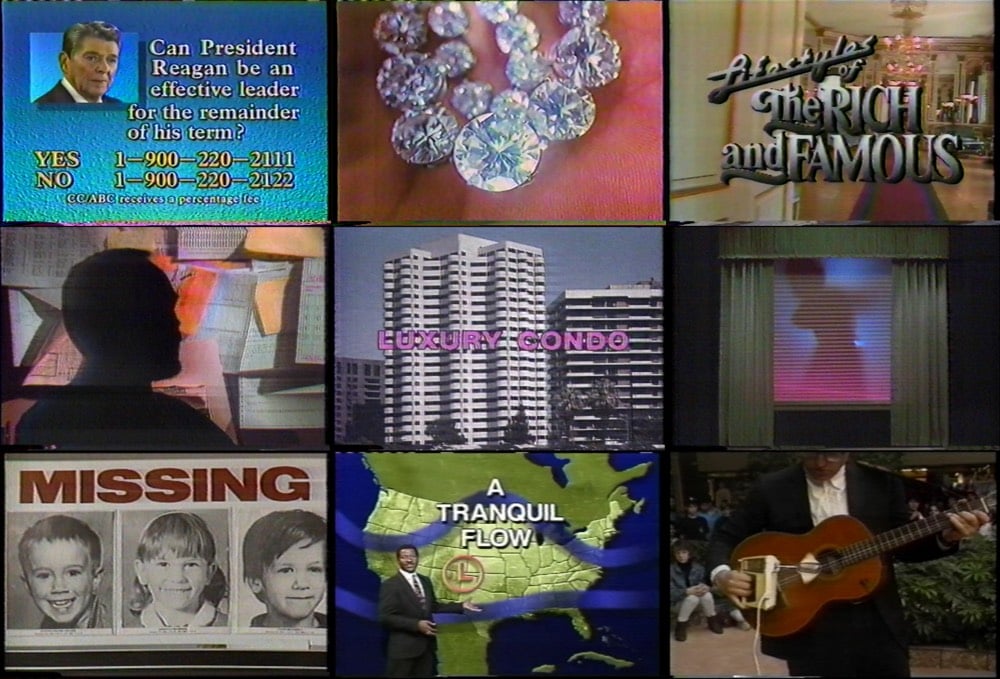
In 1979, a woman named Marion Stokes started recording live television and didn’t stop for more than 33 years. Director Matt Wolf is making a movie about Stokes and her archive.
Marion Stokes was secretly recording television twenty-four hours a day for thirty years. It started in 1979 with the Iranian Hostage Crisis at the dawn of the twenty-four hour news cycle. It ended on December 14, 2012 while the Sandy Hook massacre played on television as Marion passed away. In between, Marion recorded on 70,000 VHS tapes, capturing revolutions, lies, wars, triumphs, catastrophes, bloopers, talk shows, and commercials that tell us who we were, and show how television shaped the world of today.
The Internet Archive is supposedly archiving them and putting them online (so says this 2013 Fast Company article) but there’s no evidence that any of the videos are live on the site. (Rights issues? Budget?) In the meantime, you can check out this Tumblr has a collection of stills from the Stokes tapes.
Over the course of two years, metalsmith Seth Gould built a project he calls Coffer, a gorgeous wrought iron puzzle box. Gould made the box from scratch — he forged the metal, machined the bolts, everything!
The majority of pieces, including the bolts, levers, and staples, are made from wrought iron, a material I use primarily for its working properties (enjoyable to forge and file). Wrought iron is no longer manufactured, so each piece needed to be forged from salvaged material. The forging is done using a coal forge, hammer, anvil, and power hammer. Once the pieces are forged as close to their finished shape as possible, I move to the bench to refine the surface and shape with a file. The final touch is a bit of file embellishment.
I mean, look at this intricate deliciousness:

The video above is a short film of Gould making his box filmed by Jesse Beecher. The soundtrack cleverly incorporates the sounds of the workshop (sawing, hammering, flames) into the music, resulting in a particularly artful making-of film. (via colossal)
Update: The box made by Gould is called an armada box.
An iron-bound strongbox for storing valuables in the 16th and 17th centuries, often with a large, complicated lock on the underside of the lid. Some were for the use of officers at sea, and would have been bolted to the deck of the owner’s cabin. Usually of German make, the chests could be anything from a few inches to 6ft (1.8m) long. The name itself was a fanciful Victorian invention recalling chests imagined to be used by the Spanish Armada.
Swiss artist Zimoun makes large-scale sound sculptures out of simple materials like cardboard boxes, wires, washers, tiny motors, and sticks of wood. Here are a few of his works (sound on, obviously):
I would love to see one of these installations in person sometime.
Newer posts
Older posts





Socials & More