kottke.org posts about video
Watch as two players from the Japanese national soccer team try to score against 55 kids.
The kids had two opportunities to stop the pro players, once with 33 players and the second time with 55 players. This didn’t turn out how I expected, given how a similar stunt involving fencing ended.
This was posted on Marginal Revolution a few days ago and garnered several interesting comments about how much better professional athletes are than us regular folk. Here are a few:
Rugby: I played against an international player once. Watching him play, I’d seen a chap who ran in straight lines, a strong tackler with a weak kick. Playing against him revealed him to be skillful, agile and possessed of a howitzer kick.
Back in the 1980s a friend was watching a pickup basketball game in Boston and reported what happened when a player from the Celtics showed up. He was so much faster, more athletic, and more agile than the other players that it seemed like he was playing a different sport. The player turned out to be Scott Wedman, who by that time was old and slow by NBA standards, and mainly hung around the 3-point line to shoot outside shots after the defense had collapsed on Bird, McHale, et al. But compared to non-NBA players, he was Michael Jordan (or LeBron James).
My U-19 team (we were very good by local standards) had a practice with the New Zealand All Blacks, who were on some sort of tour. It was like they were from a different planet. I stood no chance of containing, or conversely getting past, the smallest of them under almost any circumstance.
Back in the olden thymes I was a pretty good baseball player. Early in my high school career I got the chance to catch a AAA pitcher. I went into thinking I would have no trouble. The first pitch was on top of me so fast I was knocked off balance. It took a bunch of pass balls before I got used to how to handle his breaking stuff.
The result in the video might also shed some light on the question of choosing to fight one horse-sized duck or 100 duck-sized horses.
This is intense: video from one of the riders during the sprint finish of stage 5 of the Tour de Suisse.
I don’t know how all of those riders are working that hard so close together without constantly crashing into each other. The number of “I’ve got my bike slightly in front of your bike now move the hell over” moves shown in the video reminded me of how NYC taxi drivers negotiate the streets of Manhattan. (via @polarben)
For a Visa commercial, Errol Morris gathers a number of Nobel Peace Prize winners and nominees (including Lech Walesa) to talk about how important it is for their countries to beat the crap out of the other countries in the World Cup.
Two quotes in the video caught my ear:
Sport is a continuation of war by other means.
Look, football isn’t life or death. It’s much more important than that.
The first is a riff on Prussian general Carl von Clausewitz’s aphorism “War is the continuation of Politik by other means”. Clausewitz also devised the concept of “the fog of war”, which Morris used for the title of a film. The second is a paraphrase of a quote by legendary football coach Bill Shankly:
Some people believe football is a matter of life and death, I am very disappointed with that attitude. I can assure you it is much, much more important than that.
Aatish Bhatia noticed a plant in his backyard whose leaves naturally repelled water. He took a sample to a friend who had access to a high-speed camera and an electron microscope to investigate what made the leaves so hydrophobic.
But how does a leaf become superhydrophobic? The trick to this, Janine explained, is that the water isn’t really sitting on the surface. A superhydrophobic surface is a little like a bed of nails. The nails touch the water, but there are gaps in between them. So there’s fewer points of contact, which means the surface can’t tug on the water as much, and so the drop stays round.
The leaf is so water repellant that drops of water bounce right off of it:
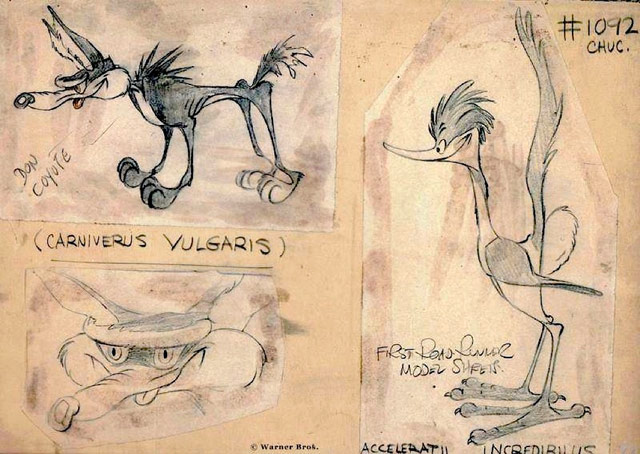
From the official Chuck Jones Tumblr, an early sketch of the Road Runner and Coyote by Jones.
Also by Jones, how to draw Bugs Bunny:
(via @peeweeherman)
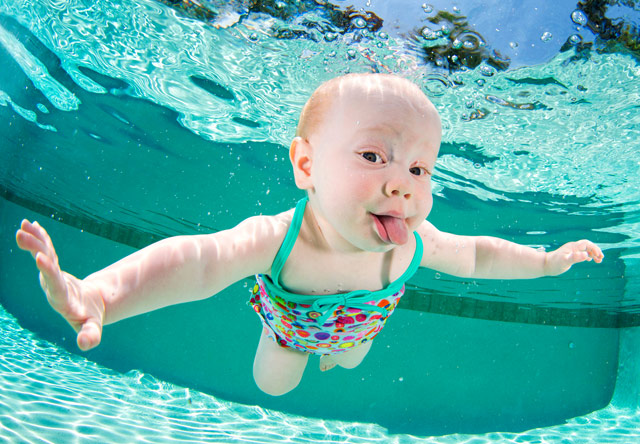
The NY Times has a bunch of photos by Seth Casteel of babies undergoing infant survival swim training.
Zoe was being introduced to “self-rescue,” in which babies are taught to hold their breath underwater, kick their feet, turn over to float on their backs and rest until help arrives.
The self-rescue idea is pretty amazing. You take kids who can’t talk and can barely walk and teach them how to float on their backs. I didn’t really believe it until I saw it:
Bonus summer PSA: drowning doesn’t look like drowning.
The center of the population of the United States has been moving steadily west and south since 1790. This video shows the progression until 2010:
You can step through the animation yourself on the US Census Bureau site. It’s interesting to see how even the changes are…there was one big jump from 1850 to 1860 and a slow down in westward migration from 1890 to 1940, but other than that, it shifted west about 40-50 miles each decade.
Here’s Louis C.K. at 20 years old doing a stand-up routine in Boston in 1987.
Thankfully, he got better. A lot better. Even 3-4 years later he was better…and wait, is that Phil Hartman in the audience at ~2:45?! (via open culture)
Great short film about how ILM’s groundbreaking visual effects came to be used in Jurassic Park.
When Spielberg originally conceived the movie, he was going to use stop-motion dinosaurs. ILM was tasked with providing motion blur to make them look more realistic. But in their spare time, a few engineers made a fully digital T. Rex skeleton and when the producers saw it, they flipped out and scrapped the stop-motion entirely. Fun story.
Kwe’Shaun Parker is a 6’2” high-school sophomore and recently threw down one of the sickest dunks of the year:
Dang! I mean, DANG! Here’s Parker last year as a freshman doing some equally amazing stuff:
(via @cory_arcangel)
I saw the trailer for the new Planet of the Apes movie last night and it looks amazing, but that’s not what I came to talk about. A recent paper shows that chimps do better in some strategy games than humans.
Chimps play the cat and mouse game very well. First, the chimps converge on the Nash Equilibrium strategies. In one set of games the Nash equilibrium strategies had randomization frequencies of .5, .75 and .8 and the chimps played .5, .73 and .79. Second, when payoffs change the chimps adapt their strategies very quickly simply by observation of outcomes.
Camerer et al. also tested humans in similar games and they found that humans often deviate from NE play and they adjust their strategies more slowly when payoffs change, i.e. they learn more slowly! The only thing that Camerer didn’t do was to play humans against chimps in the same game. That would have been awesome!
But that’s nothing compared to this video of a chimp remembering the placement of nine numbers on a screen after seeing them for less than a quarter of a second:
That’s a literal jaw-dropper there.
Anthony Richardson is back, offering his British commentary on American sports. This time it’s hockey:
Mary Poppins, look how small the goals are, the size of a matchbox guarded by an overzealous beekeeper.
See also Bad British NFL commentary and Bad British baseball commentary.
A short film by Douglas Gautrand about how his mom came to own a motorcycle. It all starts with his grandfathers…
From Stephen Locke, a time lapse video of thunderstorm supercells forming near Climax, Kansas.
Jiminy, that’s breathtaking. I didn’t know there was so much rotation involved in thunderstorms…the entire cloud structure is rotating. (via bad astronomy)
Video of the growth of London from Roman times to the present, with a focus on the structures that have been protected from each era.
London was the most populous city in the world from the 1830s, a title it took from Beijing, until the 1920s, when New York City took the crown.
From 2009, the Royal Shakespeare Company’s modern-dress production of Hamlet, featuring David Tennant as Hamlet and Patrick Stewart as Claudius.
The site the BBC produced for the show contains more information on the production. (via @mulegirl)
Professional dancers from the Washington Ballet show off their most difficult moves, filmed in slow motion.
(via colossal)
Yesterday I posted a video looking at the influence of Akira Kurosawa on Star Wars. Well, Michael Heilemann has posted an amazing feature-length exploration of Star Wars and the films that influenced it.
It’s not Heilemann talking about anything…it’s a sort of meta-Star Wars comprised of dozens of elements from other films that influenced Lucas in making it. For instance, here’s the opening crawl from Forbidden Planet (1956):
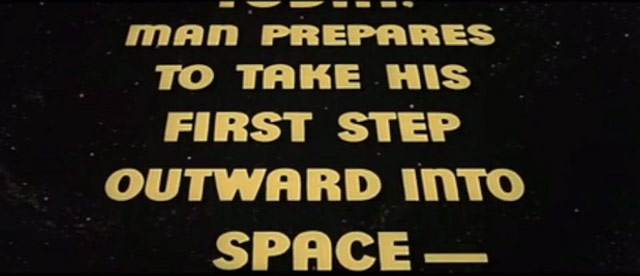
Heilemann also includes a crawl from a 1936 Flash Gordan serial. For more, check out Kitbashed, particularly the extensive ebook on Star Wars sources.
Steven Johnson has been working on a six-part series for PBS called How We Got to Now. (There’s a companion book as well.) The series is due in October but the trailer dropped today:
And here’s a snippet of one of the episodes about railway time. I’m quite looking forward to this series; Johnson and I cover similar ground in our work with similar sensibilities. I’m always cribbing stuff from his writing and using his frameworks to think things through and just from the trailer, I counted at least three things I’ve covered on kottke.org in the past: Hedy Lamarr, urban sanitation, and Jacbo Riis (not to mention all sorts of stuff about time).
Nine-year old Sabre Norris started skating three years ago because she couldn’t have a bike. Here she lands her first 540 after 74 straight failed attempts.
My favorite trick is a 540. I watched Lyn-Z Adams Hawkins do it on the internet, and I just had to do it. That was my 75th attempt of the day. Every time I tried one and didn’t land it I put a rock on the table. It ended up being my 75th rock. I was frothing. I did some 720s too. Not proper. I called it 540 to revert to splat. I didn’t cry though. My goal is to do 100 of them before this Saturday. I’m up to 75. I still can’t ride a bike, but I can do a 540.
See also a nine-year-old’s first big ski jump. (via @torrez)
This video looks at the influence of Akira Kurosawa and his films (especially The Hidden Fortress) on George Lucas and Star Wars.
How are Samurai films and a car crash responsible for Star Wars? How did World War II affect the global film industry in the 20th century? Why are Jedi called Jedi?? Give us 8 minutes, and we’ll explain it all…
(via devour)
Using Edgar Wright as a positive example, Tony Zhou laments the lack of good visual comedy in American comedies and provides examples from Wright’s films (Hot Fuzz, Shaun of the Dead, etc.) to show how it’s done properly.
Hot Fuzz is one of my favorite comedies…the scene Zhou shows of the Andys sliding off screen and then quickly back in consistently leaves me in stitches. (via digg)
Photographer Alec Soth is interviewed by his young son Gus about his job, art, and leaving his family for work.
This is completely charming and awesome and heartbreaking. (via @polan)
From the team at The Atlantic Video, a tour of the Fire Lab in Missoula, Montana, where they basically just set stuff on fire to better understand the behavior of fire.
Massive wildfires cost billions of dollars and burn millions of acres in the U.S. every year, but we know surprisingly little about the basic science of how they spread. At the Fire Lab in Missoula, Montana, researchers reverse-engineer spreading fires using wind tunnels, fire-whirl generators, and giant combustion chambers. They’re finding that fire is a mysterious phenomenon, and the physics behind it is often counterintuitive.
As a borderline pyromaniac, I will watch slow motion fire all day, especially when it involves fire tornadoes.
This is the Fridayest link of all time: Morgan Freeman talking while on helium.
I’m not even gonna Kottke this up by explaining why helium makes your voice all high. Just sit back and enjoy this perfect Friday nothing. (via @DavidGrann)
My friends at Tinybop have unleased their second app for kids: Plants.
Unearth the secrets of the green kingdom! Explore the world’s biomes in this interactive diorama: conduct the seasons, rule the weather, ignite a wildfire, and burrow down with critters and roots. Temperate forest and desert biomes are featured in the first release of Plants. Buy now and get the next two biomes-tundra and temperate grasslands — for free when they’re released.
Can’t wait to explore this with the kids…Tinybop’s Human Body was a hit in our household. Oh, and don’t miss the making of video for the trailer above…Kelli Anderson knocks it out of the park again.
The trailer for the documentary about Roger Ebert is out:
Two thumbs up, way up. (thx, david)
If the Moon orbited the Earth at the same distance as the International Space Station, it might look a little something like this:
At that distance, the Moon would cover half the sky and take about five minutes to cross the sky. Of course, as Phil Plait notes, if the Moon were that close, tidal forces would result in complete chaos for everyone involved.
There would be global floods as a tidal wave kilometers high sweeps around the world every 90 minutes (due to the Moon’s closer, faster orbit), scouring clean everything in its path. The Earth itself would also be stretched up and down, so there would be apocalyptic earthquakes, not to mention huge internal heating of the Earth and subsequent volcanism. I’d think that the oceans might even boil away due to the enormous heat released from the Earth’s interior, so at least that spares you the flood… but replaces water with lava. Yay?
Can I get a McConaugheeeeey? The first trailer for Christopher Nolan’s Interstellar is out.
io9 called it “thrilling”, but I’m gonna give this one a “hmmmmm.”
This was one of my favorite scenes the film…Russell Crowe’s Noah telling his children the creation story, which ends up being half supernatural and half evolution.
Worth watching for the special effects alone.
Newer posts
Older posts





Socials & More