kottke.org posts about video
At the Sebrell Funeral Home in Ridgeland, MS (just outside of Jackson), they perform funerals and cremations for people with HIV/AIDS, some of whom have been abandoned by their families because of their disease or sexual orientation.
In almost one-third of the AIDS-related deaths serviced by Sebrell Funeral Home, the family or next-of-kin will either abandon the deceased entirely or refuse to accept the cremains.
HIV/AIDS is a growing problem in the American South, due to social stigma, poverty, and decreased access to healthcare. In this short documentary, we meet Trey Sebrell, who thinks of caring for all deceased people, no matter who they were in life, as part of his mission as a funeral director.
The Very Hungry Caterpillar was one of my absolute favorite books as a kid and one of first books that we read to our kids (and that they read back to us). I didn’t know this animated version existed until I ran across it on YouTube just now. I just went into the kids’ room to look for the book on the shelf and got a little teary as I searched.
My kids are 12 & 10 now and in an in-between phase of reading. They occasionally still pick up the picture books they loved as little kids but mostly are into graphic novels and chapter books now — Ollie just read Ready Player One and they’ve both been through all 7 Harry Potter books more times than I can count. We haven’t read a picture book together in months and I really miss snuggling up with them and reading Cloudy with a Chance of Meatballs, Cars and Trucks and Things That Go, Oh Say Can You Say?, or In the Night Kitchen. We’ll likely never read any of those books together again. It reminds me of one of the saddest things I’ve ever heard about parenting: one day you’ll pick up your kid, put them down, and never pick them up again…and you won’t remember it happening. *sobs*
In a recent episode of The Art Assignment, they make the case for Impressionism.
The arrival of photography had also revealed new ways of framing images, suggesting the possibility of unbalanced, snapshot-like compositions, long before cameras would reach snapshot size and speed. Some have theorized that now that photography could capture reality so well, painting was then freed from the shackles of realism and could do what paint does best, which is being colorful and tactile, and you know, painty.
This new kind of art also involved more women and represented them in new ways. Berthe Morisot participated in all but one of the Impressionist exhibitions, and gave us remarkable views into the domestic sphere and lives of well-to-do women. Mary Cassatt joined the ranks as well, and became known for depicting women and children as well as her own family. Women of a variety of classes were subjects for the Impressionists, and not just nude and lying on a bed anymore, but shown doing the things they actually do, in the home as well as out in the world, enjoying Paris’s nightlife, and also being it.
I love these little art history lessons.
The other day I posted the news that the low railroad bridge that’s famous for ripping off the tops of trucks is finally going to be raised by eight inches, bringing an end to the internet’s viral fun. A reader alerted me to this interesting short documentary about the bridge:
The film features interviews with the man who has been recording all the bridge collisions since 2008, a state engineer who worked on a solution to the problem (a sensor to detect tall vehicles and trigger a stoplight and an “OVERHEIGHT MUST TURN” LED sign), and researchers at a behavioral research lab about how drivers plow into the bridge despite several layers of warning signs and (presumably) the knowledge of the height of their vehicle. (via @ShawnWildermuth)
Here’s the trailer for a five-episode Netflix series called The Devil Next Door.
The series is about John Demjanjuk, who was living in the US when he was accused of being “Ivan the Terrible”, a particularly brutal guard at the Treblinka death camp.
Born in Ukraine, John (Iwan) Demjanjuk was the defendant in four different court proceedings relating to crimes that he committed while serving as a collaborator of the Nazi regime.
Investigations of Demjanjuk’s Holocaust-era past began in 1975. Proceedings in the United States twice stripped him of his American citizenship, ordered him deported once, and extradited him from the United States twice to stand trial on criminal charges, once to Israel and once to Germany. His trial in Germany, which ended in May 2011, may be the last time that an accused Nazi-era war criminal stands trial. If so, it would mark the culmination of a 65-year period of prosecutions that began with the International Military Tribunal at Nuremberg in 1945.
Some facts of Demjanjuk’s past are not in dispute. He was born in March 1920 in Dobovi Makharyntsi, a village in Vinnitsa Oblast of what was then Soviet Ukraine. Conscripted into the Soviet army, he was captured by German troops at the battle of Kerch in May 1942. Demjanjuk immigrated to the United States in 1952 and became a naturalized US citizen in 1958. He settled in Seven Hills, Ohio, a suburb of Cleveland, and worked for many years in a Ford auto plant.
The Devil Next Door premieres November 4.
An alternate version of the ABC song that slows down the LMNOP part is currently going viral because of a tweet by Noah Garfinkel: “They changed the ABC song to clarify the LMNOP part, and it is life ruining.”
I tracked down the original video from 2012:
The alternate arrangement is by Matt Richelson, who runs a popular YouTube channel and several websites dedicated to offering free materials (songs, lesson plans, etc.) to help kids learn English. Here’s what Richelson says about his version of the ABC song:
About the slow l,m,n,o,p: I teach young learners of English as a foreign language, and have found this way the most effective for teaching the letters.
I love the ellemmennohpee bit as much as anyone, but his reasoning is solid.
Every month or two for the past couple of years, I’ve shared the movies, books, music, TV, and podcasts I’ve enjoyed (or not) recently. Here’s everything I’ve “consumed” since last month. It’s a little light because I’ve been working and a full rewatch of The Wire took some time. Stuff in progress includes The Wonderful Wizard of Oz (the kids and I are reading it together), The Dark Crystal: Age of Resistance, N.K. Jemisin’s The Fifth Season, and the second season of Abstract.
The Wire. Over the past two months, I rewatched all 5 seasons of The Wire. It very much holds up and is still the best TV show I’ve ever watched. Season 4 in particular is fantastic and devastating. Even season 5, which seemed a bit outlandish at the time with the serial killer plot, is great. (A+)
Downtown Abbey. Not great but it’s always nice spending some quality time with the Crowley family. (B+)
Mario Kart Tour. There’s something deeply un-Nintendo about this game. The use of all of the casino-like iOS tricks to keep you playing (and hopefully spending money on in-game currency) runs counter to the DNA of the company. $70 for 135 rubies is $20 more than the Switch version of Kart is going for right now on Amazon — ridiculous. And remember that the original Wii periodically suggested taking a break if you’d been playing for awhile? Still, racing in Mario Kart is always fun. When they turn networked multiplayer on, it might be a game-changer. (B+)
Peanut Butter Falcon. Feel-good? Eh. More like heavy-handed treacle. And LeBeouf’s character treats the kid with Down syndrome like a normal person but is creepy and borderline abusive to a girl he likes? Yuck. (C)
Succession. I hate that I love this show so much. (A)
1619. Very good podcast, particularly the third episode about the birth of American music. (A-)
Transparent Musicale Finale. I was skeptical about watching a 2-hour musical to end the series, but I ended up liking it a lot. My god, that last song though… (B+)
Parasite. Downton Abbey a la Bong Joon Ho. (A-)
Bottle Rocket. Rough but many of Anderson’s trademarks are already on display here. (A-)
Diego Maradona. Another examination by Asif Kapadia (Senna, Amy) of how talent and fame can go wrong. (A-)
Kevin Alexander on the Beginning and End of America’s Culinary Revolution (House of Carbs). Listened on a rec from a friend because Alexander’s book sounded interesting, but the bro-ness of the host is almost unbearable. What if the discussion about food was more like sports radio? No thank you. (C-)
Joker. The pre-release coverage of this movie being dangerous or problematic was mostly overblown. (B)
The new MoMA. Full review here. (A-)
Silence and the Presence of Everything (On Being). Really interesting interview with an acoustic ecologist. More here. (A-)
The Testaments. A sequel to The Handmaid’s Tale could have easily gone wrong. This very much did not. (A-)
Tonic. I used this for a few days but the recs weren’t great so I stopped. (C-)
Amazon Go. A marvelous and unnerving experience for this law-abiding introvert. Shopping without interaction was cool, but walking out without paying felt like shoplifting. (B+)
Machine Hallucination. Impressive display, like being immersed in an IMAX movie. But not sure it’s worth the $25 entry fee. (B)
Liberté, Égalité and French Fries (Rough Translation). How do we define work and community in the age of global mega-corporations? This story takes an amazing turn about 20 minutes in. (B+)
Past installments of my media diet are available here.
Have you been watching Succession? I feel bad about enjoying watching rich people be horrible to each other, but I do love the show. Evan Puschak rewatched both seasons with a careful eye and noticed the show’s preoccupation with language and how it is used and misused by the characters in the show.
Kendall: Words are just nothing. Complicated airflow.
One of the things I like most about the show is that I can’t figure out whether it’s a comedy or a drama. It’s bitingly funny and satirical but the whole thing is packaged like a drama and there are genuine emotional moments. I felt the same way about Fleabag and Transparent…the combination and subversion of these two familiar buckets of storytelling is part of what makes all of these shows great.
Today, Google announced the results of their quantum supremacy experiment in a blog post and Nature article. First, a quick note on what quantum supremacy is: the idea that a quantum computer can quickly solve problems that classical computers either cannot solve or would take decades or centuries to solve. Google claims they have achieved this supremacy using a 54-qubit quantum computer:
Our machine performed the target computation in 200 seconds, and from measurements in our experiment we determined that it would take the world’s fastest supercomputer 10,000 years to produce a similar output.
You may find it helpful to watch Google’s 5-minute explanation of quantum computing and quantum supremacy (see also Nature’s explainer video):
IBM has pushed back on Google’s claim, arguing that their classical supercomputer can solve the same problem in far less than 10,000 years.
We argue that an ideal simulation of the same task can be performed on a classical system in 2.5 days and with far greater fidelity. This is in fact a conservative, worst-case estimate, and we expect that with additional refinements the classical cost of the simulation can be further reduced.
Because the original meaning of the term “quantum supremacy,” as proposed by John Preskill in 2012, was to describe the point where quantum computers can do things that classical computers can’t, this threshold has not been met.
One of the fears of quantum supremacy being achieved is that quantum computing could be used to easily crack the encryption currently used anywhere you use a password or to keep communications private, although it seems like we still have some time before this happens.
“The problem their machine solves with astounding speed has been very carefully chosen just for the purpose of demonstrating the quantum computer’s superiority,” Preskill says. It’s unclear how long it will take quantum computers to become commercially useful; breaking encryption — a theorized use for the technology — remains a distant hope. “That’s still many years out,” says Jonathan Dowling, a professor at Louisiana State University.
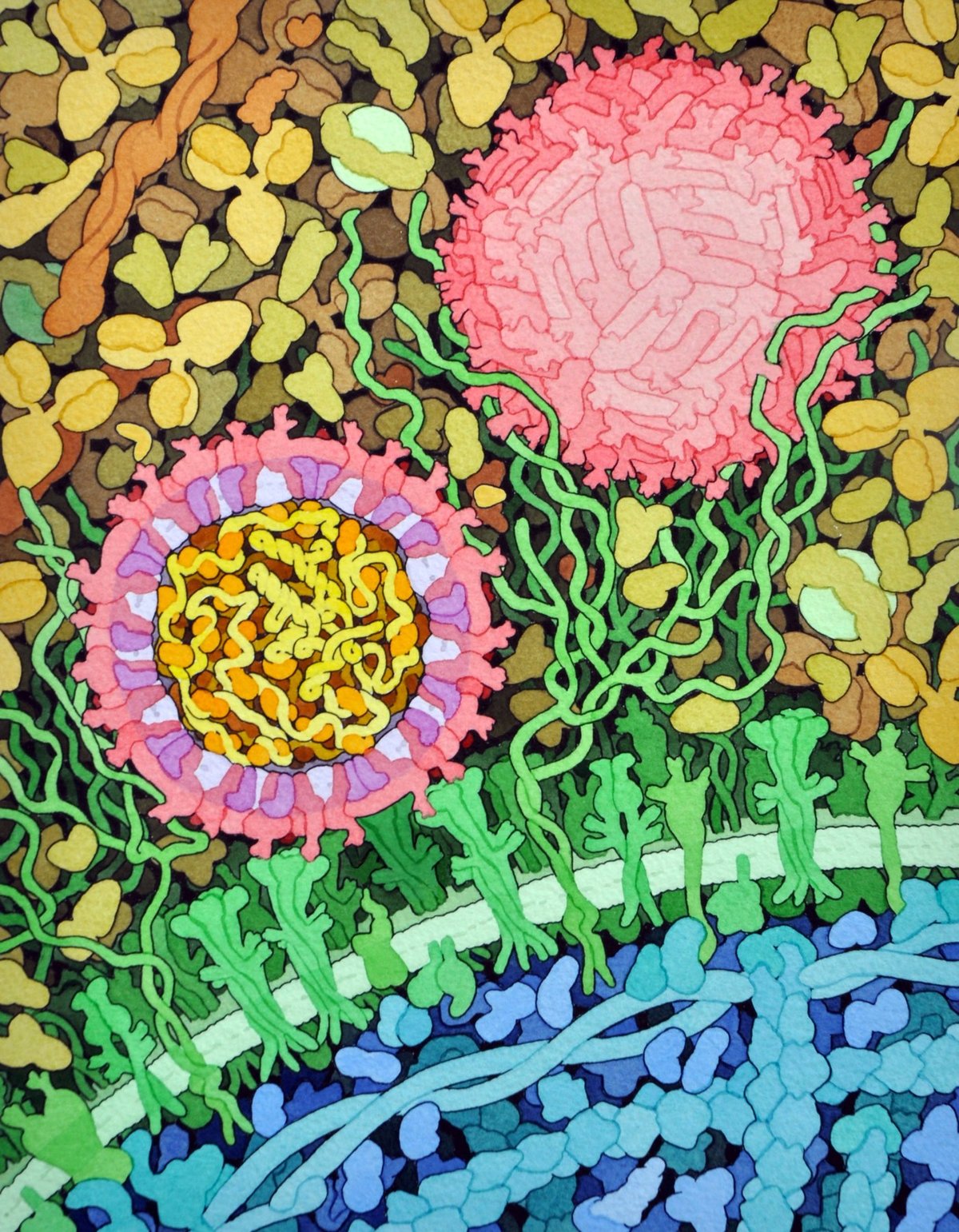
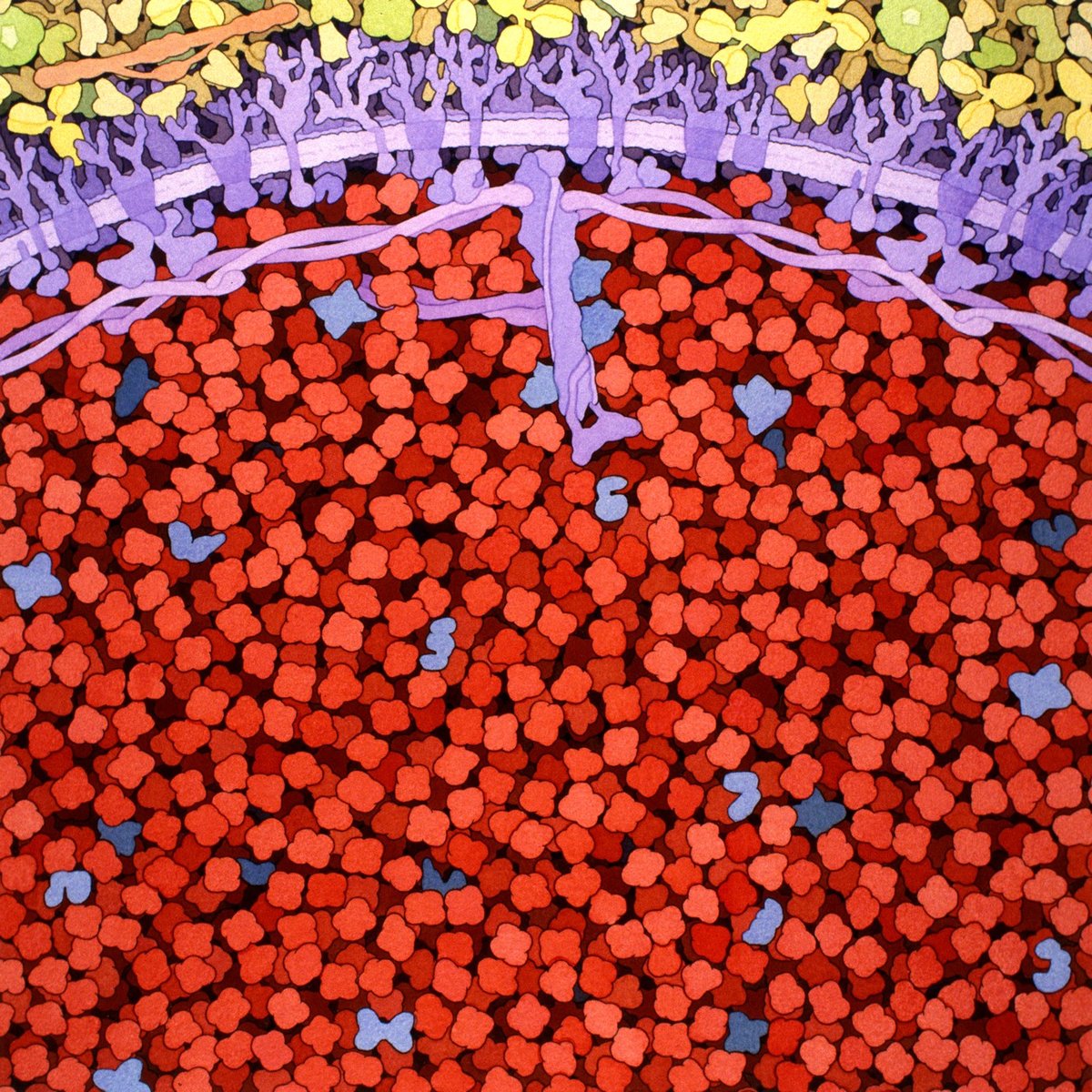
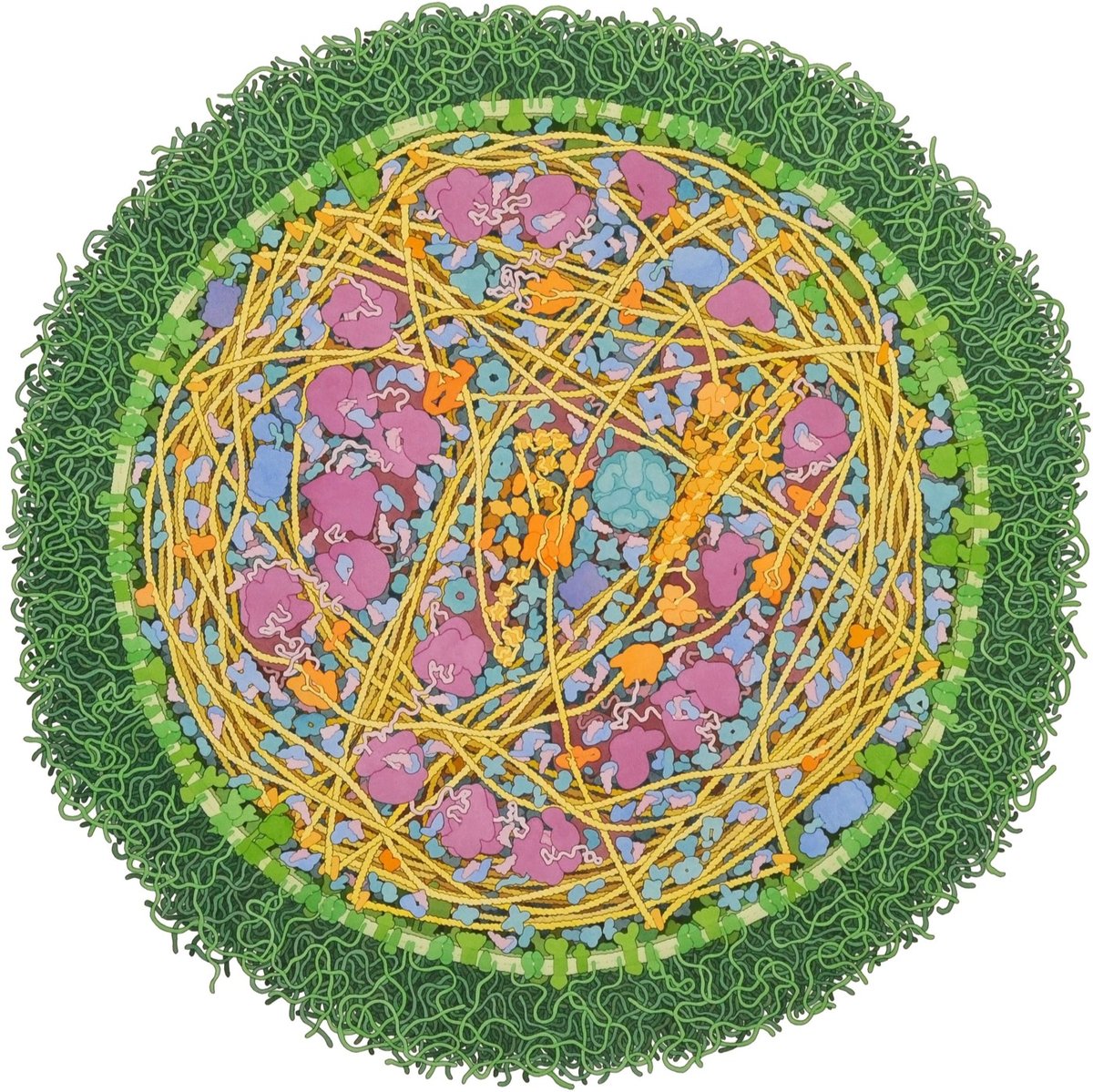
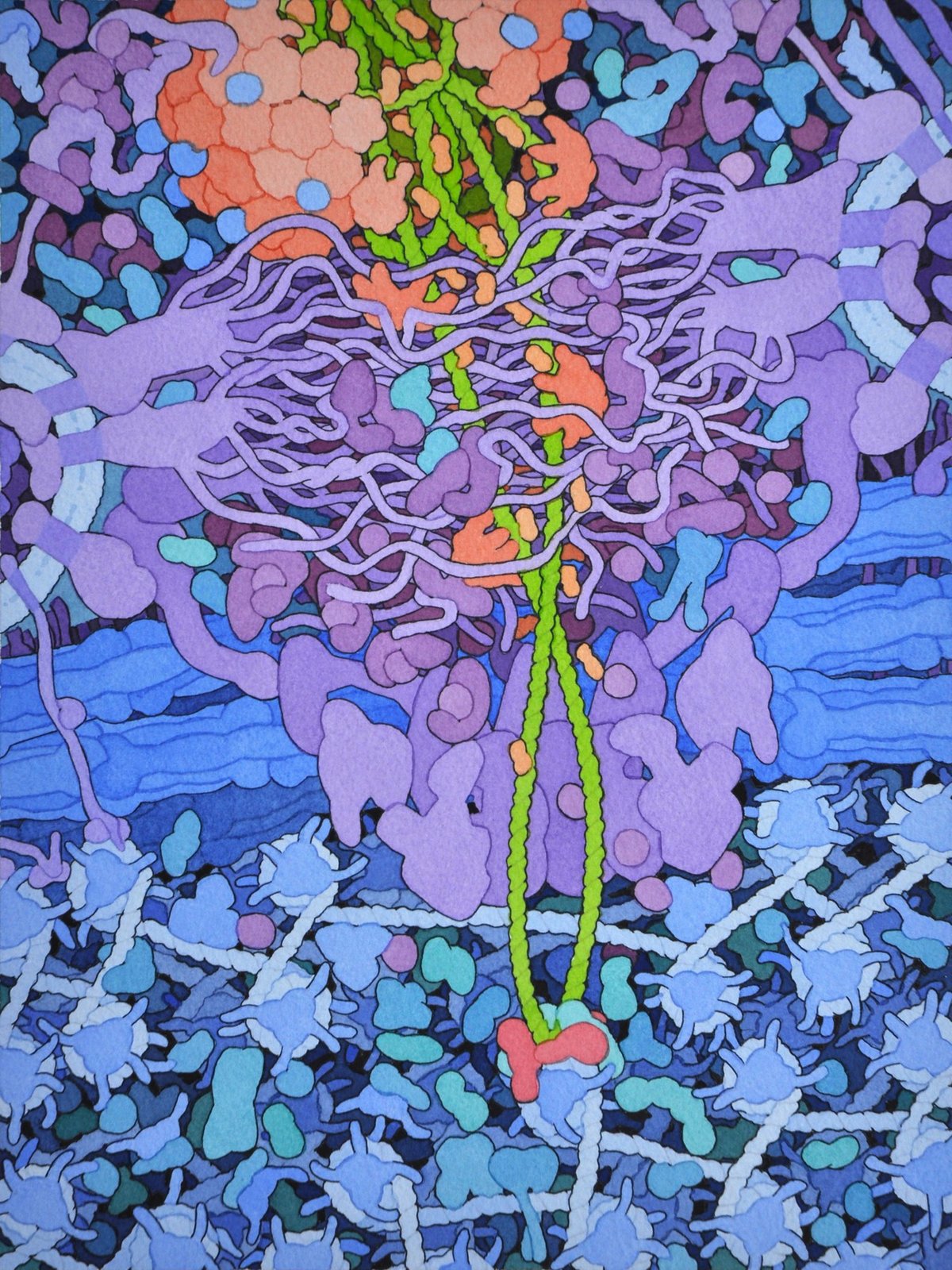
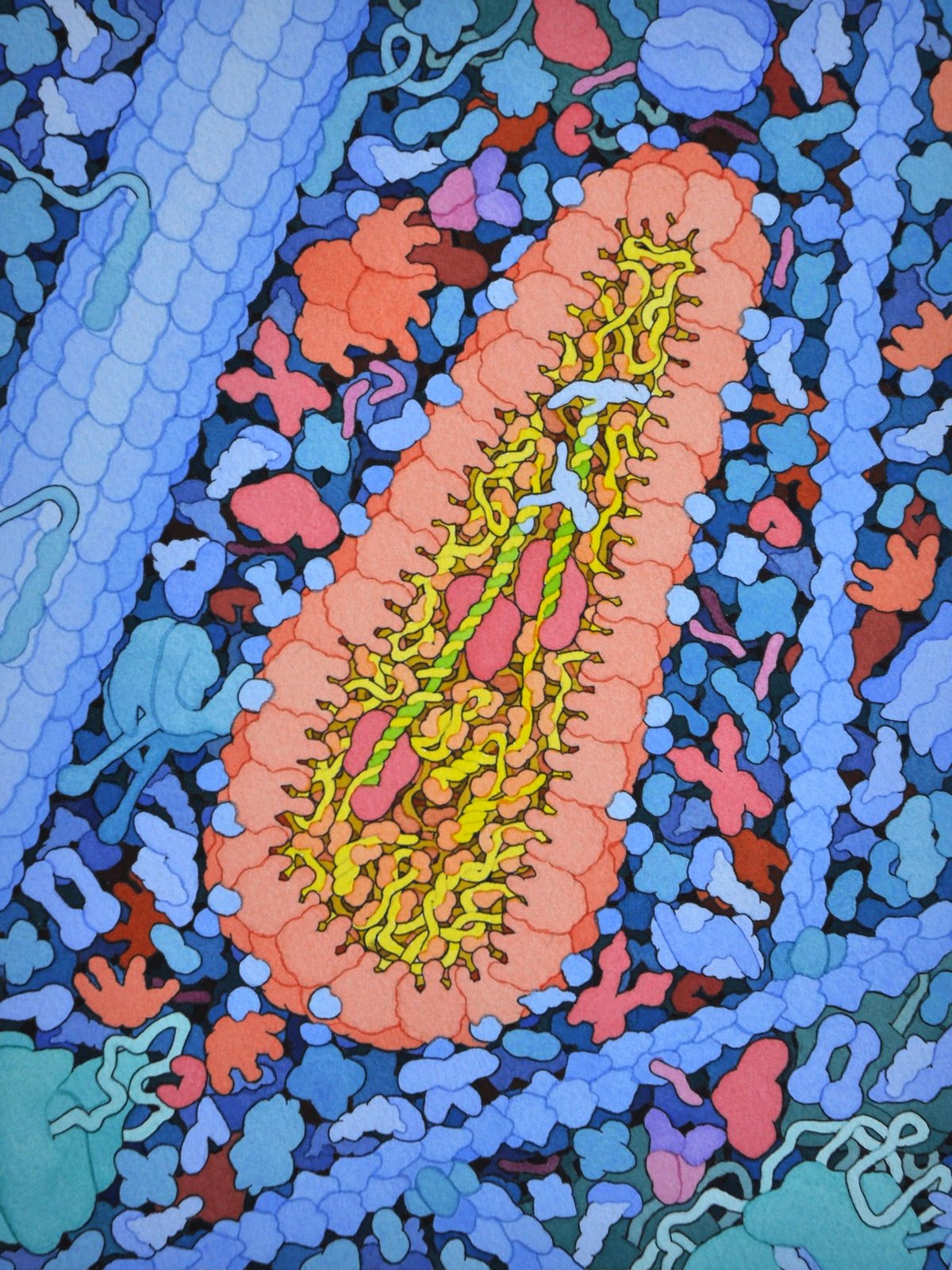
For more than 25 years, biologist David Goodsell has been making scientifically accurate paintings and illustrations of the molecular structures of things related to HIV, cancer cells, ebola, Zika, diabetes, proteins, enzymes, and hundreds of other scientific and medical processes.
Since the early 1990s, I have been working with a type of illustration that shows portions of living cells magnified so that you can see individual molecules. I try to make these illustrations as accurate as possible, using information from atomic structure analysis, electron microscopy, and biochemical analysis to get the proper number of molecules, in the proper place, and with the proper size and shape.
Much of his work is available to use for free (with attribution) and is scattered across the web: the Molecule of the Month, Molecular Landscapes, Illustrations for Public Use. He has also published several books of his paintings, the most popular of which is The Machinery of Life. Science magazine recently profiled Goodsell and his work.
In addition to studying pictures of cells from high-powered microscopes, Goodsell relies on molecular structures from electron microscopy (EM), x-ray crystallography, and nuclear magnetic resonance spectroscopy to make his paintings, which show the often crowded and complex world of cells and the microbes that infect them. He even uses the known weights of molecules if that’s all he has so that he can at least draw, say, a correctly sized circle. “I’m a scientist first,” he says. “I’m not making editorial images that are meant to sell magazines. I want to somehow inform the scientists and armchair scientists what the state of knowledge is now and hopefully give them an intuitive sense of how these things really look — or may look,” he says.
May look?
“These pictures have tons and tons and tons of artistic license,” he says. “They’re just one snapshot of something that’s intrinsically superdynamic. Every time I do a painting, the next day it’s out of date because there’s so much more data coming out.”
Here’s a quick video profile as well:
All images are by David S. Goodsell, the Scripps Research Institute. (via alexandra kammen)
The Nautilus expedition exploring the Davidson Seamount near Monterey Bay turned up something interesting last week: a relatively recent whale fall. A whale fall is when the body of a dead whale settles on the deep-sea floor, providing sustenance for the marine life in that area for decades.
While evidence of whale falls have been observed to remain on the seafloor for several years, this appears to be a relatively recent fall with baleen, blubber, and some internal organs remaining. The site also exhibits an interesting mid-stage of ecological succession, as both large scavengers like eel pouts are still stripping the skeleton of blubber, and bone-eating Osedax worms are starting to consume lipids (fats) from the bones. Other organisms seen onsite include crabs, grenadier, polychaetes, and deep-sea octopus.
The scientists were *so* excited to find this, a thriving mini ecosystem & food web in the process of formation at a depth of over 10,600 feet. They got pulled away from the carcass but went back for a closer look later.
You can read more about whale falls and their impact on deep-sea ecosystems in this New Yorker story from earlier this year.
For denizens of the seafloor, a whale fall is like a Las Vegas buffet — an improbable bounty in the middle of the desert. Rosebud had delivered about a thousand years’ worth of food in one fell swoop. The first animals to pounce had been scavengers, such as sleeper sharks and slimy, snake-like hagfish. In the course of about six months, they had eaten most of the skin and muscle. Inevitably, the scavengers had scattered pieces of flesh around the whale carcass, and native microbes had multiplied quickly around those scraps. Their feeding frenzy, in turn, had depleted oxygen in the seafloor’s top layers, creating niches for microbes that could make methane or breathe sulfate.
As Rosebud came into view, we saw colorful microbial carpets light up the screens-plush white, yellow, and orange mats, each a community of microbes precisely tuned to their chemical milieu. The whale’s towering rib cage had become a cathedral for worms, snails, and crabs, which grazed beneath its buttresses. A few hungry hagfish slithered through the skull’s eye sockets. When the cameras zoomed in, we saw that the bones were covered in red splotches. Rouse leapt from his chair and rushed to the monitors for a closer look: he suspected that the red tufts were colonies of remarkable bone-eating worms called Osedax, which had only just recently been described in a rigorous scientific study.
Let’s just all pretend that this trailer did not give me goosebumps and make me pump my fist a little, because at this point Star Wars is a sliced-n-diced and repackaged global financial instrument and very much not something a 46-year-old man who knows better should get excited about. (Jk jk, pump Mark Hamill’s gravely voice and John Williams’ soaring crescendos directly into my veins. And if James Earl Jones’ voice does not make an appearance in this movie, I will eat a Stormtrooper helmet.)
From filmmaker David Freid, Nobody Dies in Longyearbyen is a short film about Longyearbyen, Norway, the one of the northernmost towns in the world. The town of about 2100 residents is situated on the Svalbard archipelago and is the home of the Global Seed Vault. Freid went to investigate the rumor that no one is allowed to die in Longyearbyen and discovered that if climate change results in the permafrost melting in places like this, diseases from long ago may be released back into the world.
But for more than 70 years, not a single person has been buried in Longyearbyen. That’s due to the region’s year-round sub-zero temperatures: Bodies don’t decompose, but are preserved, as if mummified, in the permafrost. Should anyone die there, the government of Svalbard requires that the body is flown or shipped to mainland Norway to be interred.
See also A Trip to the Northernmost Town on Earth.
In this clip from a longer conversation in the Off Camera interview series, Zach Galifianakis talks about his brief two-week stint on Saturday Night Live and how he felt when a sketch he wrote totally bombed at the cast table read.
Here are all 10 clips of the interview. See also Robert Downey Jr. recounting his year-long SNL career.
BrickBrosProductions makes stop motion animated films featuring Lego bricks. Their most popular video is a compilation of the three short films in their “Lego In Real Life” series, where objects built from Lego interact with the real world — Lego butter, Lego apples, Lego pencils, and Lego wood.
Here’s a behind-the-scenes of the woodworking movie as well as a general tutorial about how to make Lego stop motion videos.
Newer posts
Older posts





Socials & More