kottke.org posts about video
A group of Stanford engineers has built an electric self-driving DeLorean that they’ve taught how to drift through a fairly complicated kilometer-long course “with the agility and precision of a human driver”. I imagine this will be available as a free update to Telsas soon after some of this project’s team members get hired over there.
According to this article, the car completed the course on the first try, after “seeing” a GPS map of it.
MARTY is a 1981 DeLorean that Goh and his colleagues at Stanford’s Dynamic Design Lab converted into an all-electric, autonomous drift car. Four years ago, MARTY drifted — the style of driving where the car moves forward even though it’s pointed sideways — through its first doughnuts with inhuman precision. Since then, Goh and team have been busy welding and coding to prepare MARTY to apply those basic drifting skills to an intense driving course, and unbelievably everything had worked perfectly. MARTY screeched its way through turns and quick zigs and zags in just a few minutes, kicking up smoke and bits of rubber, without nicking a single cone along the course.
This behind-the-scenes explains how the car was built and how it navigates the course:
Even more details on project lead Jonathan Goh’s website. And of course they shot the whole thing overhead with a drone:


Move over, every other craft project — this Homer Simpson disappears into the bushes embroidery piece by Rayna of Hermit Girl Creations is the best embroidery in the history of the world. The scene is taken from a 1994 episode of The Simpsons called Homer Loves Flanders and has become a bit of a meme in recent years; here’s the clip:
Check out her Instagram or Etsy shop — she does a lot of other Simpsons-based embroidery as well as Charlie Brown, The Office, Dr. Seuss, Frog & Toad, Stranger Things, and Futurama. Looks like she takes commissions via Instagram DM.
I am fascinated with the sound of movies, from the soundtracks to the foley effects and even temp music. Making Waves is a documentary about this integral aspect of cinema. Here’s a trailer:
Directed by veteran Hollywood sound editor Midge Costin, the film reveals the hidden power of sound in cinema, introduces us to the unsung heroes who create it, and features insights from legendary directors with whom they collaborate.
Featuring the insights and stories of iconic directors such as George Lucas, Steven Spielberg, David Lynch, Barbra Streisand, Ang Lee, Sofia Coppola and Ryan Coogler, working with sound design pioneers — Walter Murch, Ben Burtt and Gary Rydstrom — and the many women and men who followed in their footsteps.
(thx, dunstan)
This Saturday Night Live mock TV commercial for a Macy’s holiday sale cuts right to the truth about buying clothes for kids that aren’t right for them or their parents.
Some of their deals include “40% off cozy corduroys that’ll pinch his little nuts”, “kids jackets that are so big & thick they won’t fit in their carseat anymore”, and “everyday savings on mittens they’ll lose, shirts with the wrong Frozen princess, sweaters that make them hot”.
This video catalogs every borrowed sample from Paul’s Boutique by the Beastie Boys, from the soundtrack to Car Wash to the Sugarhill Gang to the Eagles to the Ramones to the Beatles. They play the original first and then what they did with it on the album.
Somehow this video only has 31,000 views?! You can also listen to this remix of Paul’s Boutique on Soundcloud, which combines the source tracks with Beastie Boys vocals and some audio commentary.
Tim Carmody made a Spotify playlist of all the sampled songs or you can download zip files of the original songs sampled in Paul’s Boutique and five of their other albums.
They just don’t make ‘em like this anymore, mostly because clearing all of the samples would be prohibitively expensive if not impossible.
Hip-hop sampling began as a live technique, with DJs working turntables at parties and clubs. Whether it was strictly legal or not, nobody was going to try to sue anyone about it. As the genre’s popularity grew, people naturally started recording performances and releasing them as albums. Early sampling tended to come fast and furious. In the ’80s, short clips of existing recordings were the order of the day, often — as in the case of the Beastie Boys — lots of them, layered and shuffled in a clearly creative way. As hip-hop pushed further into the mainstream, however, the stakes got bigger and so did the samples.
1990 saw the release of both M.C. Hammer’s “U Can’t Touch This” and Vanilla Ice’s “Ice, Ice, Baby.” Not only did both songs sample, they each relied heavily on one particular sample — the baselines from Rick James’ “Superfreak” and Queen and David Bowie’s “Under Pressure” — for their main hook. Both hits resulted in legal controversy.
Radiohead have uploaded all of their albums to YouTube where they are available for all of your streaming needs.
The move comes after Billboard announced that album charts will reflect YouTube views.
Over at Open Culture, Josh Jones notes that the band has always been willing to experiment with technology and distribution, as with the pay-what-you-want release of In Rainbows:
As Yorke had predicted, Napster encouraged “enthusiasm for music in a way that the music industry has long forgotten to do.” The industry began to collapse. File sharing may have been utopian for listeners, but it was potentially ruinous for artists. 2007’s In Rainbows showed a way forward.
Released on a pay-what-you-want model, with a “digital tip jar,” the release was met with bemusement and contempt. (The Manic Street Preacher’s Nicky Wire wrote that it “demeans music.”) Two years later, the jury was still out on the “Radiohead experiment.”
(via open culture)
Colin Levy recently finished a sci-fi short that he’s been working on for several years called Skywatch. And spoiler alert: Jude Law is in it for a few seconds. As Levy admits, he had a barebones budget and didn’t have big Hollywood connections, so how did that happen? How do you convince an Oscar nominated actor to be in your no-name low-budget film project? Like so:
That’s pretty cool. Check out the finished product:
What’s interesting is that the explainer video has 250,000 more views than the short film.
Actress and singer/songwriter Kim Hill became a member of the Black Eyed Peas in the mid-90s, appearing with the group on Soul Train and singing on their first two albums. After feeling pressure from management to sexualize her appearance and from the other members of the band to broaden their appeal, Hill quit the group and was eventually replaced by Fergie. In this video by Ben Proudfoot, she talks about that decision:
Yeah, they got rid of the black girl that they never made a part of the band and they got the white girl, they made her a part and they blew up and it’s like, no! That’s not how it happened.
I really really liked this video. Hill has such a great expressive face and a generous soul and Proudfoot makes the most of it by getting in close and just letting her talk.
Hey, Merry Ehrlichmas! David Ehrlich’s video countdown of his top 25 films of the year is one of my most anticipated end-of-the-year thingers. Viewing it always makes me want to watch movies for three straight days. As a companion, Ehrlich listed the movies here, along with the most memorable moment from each.
Watching “The Irishman,” especially for the first time, you get the sense that it’s teeming with hidden moments that will cling to you like barnacles for the rest of your life. Some of them are more apparent than others: Pacino chanting “Solidarity!” Pesci saying “It’s what it is.” Ray Romano asking De Niro if he’s really guilty at heart. The film’s most indelible treasures are lurking a bit deeper under the surface. On my second viewing, nothing hit me harder than the rhyme between two distant confrontations: As a child, Peggy suspects that her father is hiding some demons, but Frank directs his daughter back to her breakfast. Years later, Peggy wordlessly confronts her dad with daggers in her eyes, and Frank is so far beyond salvation that his only recourse is to keep eating his cereal like nothing ever happened.
Some random thoughts on the list and the year in movies: Surprised to see Ad Astra so high — I didn’t hear great things so I skipped it. I thought I saw a lot of movies this year, but this list once again proves me wrong. I can’t wait to see Uncut Gems. No Booksmart? I really loved Booksmart. I did not like Once Upon a Time in Hollywood and Knives Out as much as everyone else did. I mean, they were fine, but… Great to see Hustlers on the list — when Jennifer Lopez gets good roles, she knocks the cover off of the ball. Give Jennifer Lopez more good roles!
See also these two 2019 movie trailer mashups:
(thx, brandt & david)
Christopher Nolan loves to play around with time. In most of his films — Interstellar, Memento, Dunkirk, Inception — time flows slow, fast, and in unexpected directions. His latest project, Tenet, appears from the above trailer to be no different, with events occurring in reverse and characters observing events that haven’t happened yet. You can read more about the movie here, but here in the real world, we’re going to have to somehow wait through the normal passage of time until July 17th, 2020 to see it. (thx, aaron)
Elem Kilmov’s 1985 Soviet anti-war film Come and See is getting a 2K restoration and theatrical re-release in 2020. In a 4/4 star review of Come and See, Roger Ebert called it “one of the most devastating films ever about anything”:
It’s said that you can’t make an effective anti-war film because war by its nature is exciting, and the end of the film belongs to the survivors. No one would ever make the mistake of saying that about Elem Klimov’s “Come and See.” This 1985 film from Russia is one of the most devastating films ever about anything, and in it, the survivors must envy the dead.
Director Steven Soderbergh called it “one of the best things I’ve ever seen”.
This is a 45-second clip from Pinocchio, an animated film made by Disney in 1940.
The scene itself isn’t that exciting…until you actually start to wonder, wait, how was this made? The way the camera effortlessly swoops past buildings and through archways like one of Pixar’s infinitely pliable virtual cameras, the depth of field changing as we pan and zoom toward Pinocchio’s door — how did they do that 80 years ago, animating by hand? The film’s animators achieved this effect using a relatively recent invention, the multiplane camera.
The basic idea is that instead of animating characters against a single static background, you can animate several layers of independently moving scenes painted on glass. In a 1957 film, Walt Disney himself explained how the camera worked:
And here’s how Disney used the technique in dozens of scenes from Snow White to Bambi to 101 Dalmatians:
Because we’re seeing the output of an actual camera zooming and panning, many of these scenes feel more grounded in reality than even some of today’s best digital output. Even 80 years later, the effect is impressive, a real testament to the collaborative talent of Disney’s animators & technicians.
Product designer Jonna Breitenhuber has come up with an interesting way to get rid of plastic shampoo and body wash containers: by packaging the liquids in bottles made of slow-dissolving soap.
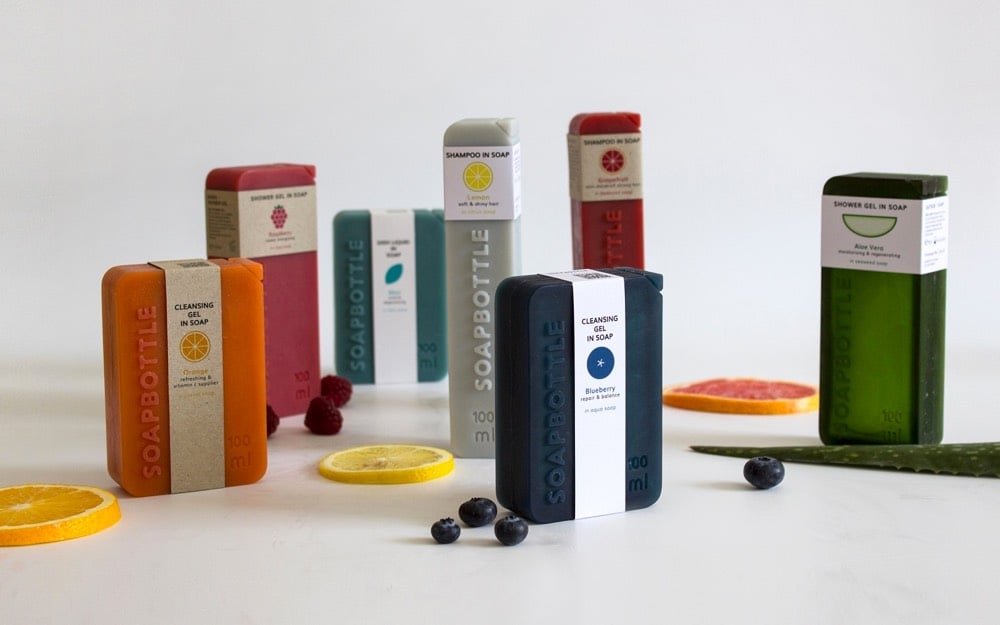

Soapbottle is a packaging made from soap. As the content within is being used, the soap packaging very gradually dissolves. When finished, remnants can be used again, as hand soap or processed into detergents. Soap is made of natural ingredients and is biodegradable: waste can be completely avoided.
You can see Soapbottle in action here:
I love that you open the bottle by cutting the corner off with a knife. See also Biodegradable Food Containers Inspired by Egg Shells & Orange Peels. (via moss & fog)
Update: The Soapbottle project has gone live on Kickstarter as an actual product.
Joe Sabia is a VP for Conde Nast Entertainment and he and his team have been the creative force behind some of the most interesting video series of recent years, including Vogue’s 73 Questions (Sabia is the questioner), the Billie Eilish time capsule interviews, Wired’s Autocomplete Interviews, and Gourmet Makes.
Recently Sabia shared a list of 136 internet videos which he says “left some sort of impression on me since the dawn of the internet video explosion (which I’ll define as 2006)”. So the collection is personal, but it’s also an expert’s record of creative people & orgs playing around with the internet video form, breaking new ground, or contributing significantly to culture.
I’ve spent my entire career inside internet video. If I didn’t mess around with it in college, I’d be a law school drop out. Back then, so much of YouTube began as a bunch of weird hobbyists making things we were curious about. Meeting people who saw the same popular videos you did felt like meeting someone who genuinely shared a bit of your identity. It was special. It was authentic. It was unusual. Everywhere you looked was some sort of bizarre concept that may have existed in weird avant garde museum galleries decades before, or from DVD curations like Wholphin — and most certainly never in shareable form on your computer.
I’ve posted a lot of these videos over the years, which is not surprising — while I’m not a video creator, Sabia and I are often on the lookout for stuff that is new or creative in some way. Fair warning: this list could occupy your attention for hours. HOURS. Here are a few videos I pulled out:
If this were my list, I would have included Primitive Technology. Even though it’s such a simple premise, I’d never seen anything like it before: a long-ish silent how-to video that felt tight and never boring.
That’s the trailer for Fantastic Fungi, a feature-length documentary about the worldwide network of mushrooms & mycelium that thrives beneath our feet. Here’s a description of what the film covers, from its companion book:
Fantastic Fungi is at the forefront of a mycological revolution that is quickly going mainstream. In this book, learn about the incredible communication network of mycelium under our feet, which has the proven ability to restore the planet’s ecosystems, repair our health, and resurrect our symbiotic relationship with nature. Fantastic Fungi aspires to educate and inspire the reader in three critical areas: First, the text showcases research that reveals mushrooms as a viable alternative to Western pharmacology. Second, it explores studies pointing to mycelium as a solution to our gravest environmental challenges. And, finally, it details fungi’s marvelous proven ability to shift consciousness.
In a review for RogerEbert.com, Matt Fagerholm called the film “one of the year’s most mind-blowing, soul-cleansing and yes, immensely entertaining triumphs”. (via colossal)
Newer posts
Older posts






Socials & More