kottke.org posts about video
When you look really closely at record grooves, like at 1000x magnification, you can see the waveforms of the music itself. Sooo cool.
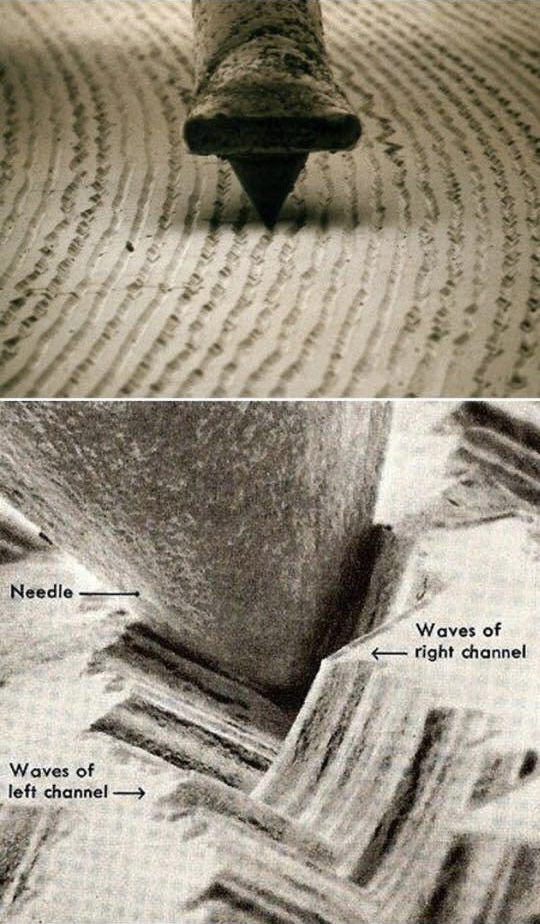
This video shows how the stylus moves through the grooves.
As Lisa Simpson would say, “I can see the music!”
Update: Here’s a great visual explanation of how you get stereo sound out of a record. (via @pcnofelt & @marcrobichaud)
Update: This is a much better video showing the needle riding through a record’s grooves.
Confirmed: metal shavings flung off of drill bits in slow motion are beautiful.
(via digg)
Klaus Kemp is one of the last great practitioners of arranging diatoms, tiny single celled algae. The art is only visible under microscopic magnification.
More information about Kemp and his images is available on his web site. (via waxy)
city.ballet is a video series about the workings of the New York City Ballet. The twelve episodes of season two cover everything from apprentice dancers to injuries to the sacrifices the dancers make to pursue their onstage dreams.
Imagine a city unto itself — a place where 16 year olds are professionals, 18 year olds are revered and many 30 year olds are retirees. Imagine a world so insular that nearly every one of these virtuosos has trained together in an academy since childhood, their lives forever intertwined by work, play, competition, friendship and love. Imagine a world in which the bottom line standard is to be, simply, the best on the planet, and where each night, an empty stage, in front of thousands, beckons with a challenge. This enclave has a name — New York City Ballet — and you are invited into this world, one that has never opened up to the outside before.
Season two just came out and is available at AOL. (via cup of jo)
What is more fun than watching the Danish National Chamber Orchestra play a piece after having eaten some of the world’s hottest chili peppers? Probably a few things, but this is pretty entertaining nonetheless.
Chili consumption happens at 1:36. Classic highbrow + lowbrow stuff here. The brass and woodwind instrument players in particular should get some kind of award…I can’t imagine blowing on a trumpet in that condition. See also Hot Pepper Game Reviews.
Neill Blomkamp (District 9, Elysium) is coming out with a new film in the spring, Chappie. Chappie is a robot who learns how to feel and think for himself. According to Entertainment Weekly, two of the movie’s leads are Ninja and Yo-Landi Vi$$er of Die Antwoord, who play a pair of criminals who robotnap Chappie.
Discussions of AI are particularly hot right now (e.g. see Musk and Bostrom) and filmmakers are using the opportunity to explore AI in film, as in Her, Ex Machina, and now Chappie.
Blomkamp, with his South African roots, puts a discriminatory spin on AI in Chappie, which is consistent with his previous work. If robots can think and feel for themselves, what sorts of rights and freedoms are they due in our society? Because right now, they don’t have any…computers and robots do humanity’s bidding without any compensation or thought to their well-being. Because that’s an absurd concept, right? Who cares how my Macbook Air feels about me using it to write this post? But imagine a future robot that can feel and think as well as (or, likely, much much faster than) a human…what might it think about that? What might it think about being called “it”? What might it decide to do about that? Perhaps superintelligent emotional robots won’t have human feelings or motivations, but in some ways that’s even scarier.
The whole thing can be scary to think about because so much is unknown. SETI and the hunt for habitable exoplanets are admirable scientific endeavors, but humans have already discovered alien life here on Earth: mechanical computers. Boole, Lovelace, Babbage, von Neumann, and many others contributed to the invention of computing and those machines are now evolving quickly, and hardware and software both are evolving so much faster than our human bodies (hardware) and culture (software) are evolving. Soon enough, perhaps not for 20-30 years still but soon, there will be machines among us that will be, essentially, incredibly advanced alien beings. What will they think of humans? And what will they do about it? Fun to think about now perhaps, but this issue will be increasingly important in the future.
Thirty years after starting Def Jam in his NYU dorm room, Rick Rubin returns to the room in question and talks about how Def Jam began.
(via ★interesting)
If you believe in gravity, then you know that if you remove air resistance, a bowling ball and a feather will fall at the same rate. But seeing it actually happen, in the world’s largest vacuum chamber (122 feet high, 100 feet in diameter), is still a bit shocking.
In the late 1500s, Galileo was the first to show that the acceleration due to the Earth’s gravity was independent of mass with his experiment at the Leaning Tower of Pisa, but that pesky air resistance caused some problems. At the end of the Apollo 15 mission, astronaut David Scott dropped a hammer and a feather in the vacuum on the surface of the Moon:
Science!
You know what’s pretty? Big waves and surfing in slow motion. Take a break and relax at 1000 fps with this mesmerizing video.
The Hans Zimmer soundtrack only adds to the effect. (via ★interesting)
A new short episode of Every Frame a Painting, in which Tony Zhou talks about how to show character choice in movies without using dialogue. His main example is Snowpiercer. Spoilers ahoy.
Three dancers from The Australian Ballet share their prep routines for their pointe shoes.
Take-aways: Ballerinas’ feet are really not attractive, they soup up their shoes in all sorts of unusual ways, but the end result is beautiful. (thx, fiona)
We the Economy is a series of 20 short videos that attempt to explain important economic concepts. For instance, acclaimed director Ramin Bahrani did a video about regulatory capture starring Werner Herzog, Patton Oswalt, and the Sherman Antitrust Act of 1890.
Anchorman director Adam McKay directed an animated My Little Pony-esque video about wealth distribution and income inequality featuring the voice talents of Amy Poehler, Maya Rudolph, and Sarah Silverman.
Paul Allen and Morgan Spurlock are behind the effort, with Bob Balaban, Steve James, Catherine Hardwicke, and Mary Harron directing some of the other videos. (via mr)
A woman recently took to the streets of NYC and walked around for 10 hours. She walked behind someone wearing a hidden camera that captured all of the catcalls and harassment directed toward her during that time…108 incidents in all. This is what it’s like being a woman in public:
At The Awl, John Herrman notes the parallels between a woman on the streets of NYC and a woman spending time on the internet.
But the video works in two ways: It’s also a neat portrayal of what it is like to be a woman talking about gender on the mainstream internet. This became apparent within minutes of publication, at which point the video’s comment section was flooded with furious responses.
A typical post in the YouTube comments thread:
are you fucking kidding me “verbal harassment”? most of all the guys called that woman “beautiful” or said to “have a good day”….it would be harassment if the guys called that woman a “hoe” or “bitch”…you are a fucktard.
On Tumblr, Alex Alvarez neatly dispenses with that sort of “logic”:
To anchor this more concretely, consider the behavior of the men in the video. Take a look at how they seek the woman out to wish her a good morning, despite her not having made eye contact or shown any interest in talking to them. Take a look at how they’re not wishing a good morning to any other person, particularly male people, also walking around. The woman is walking directly behind the man filming her (the camera is hidden in his backpack), and not one of the men shown in the video are seen to be greeting him and wishing him a good day. Just her.
Why is this?
It’s because they don’t care, really whether she has a good day or not. What they care about is letting her know that they have noticed her — her hair, her face, her body, her outfit. They want her to notice that they’ve noticed, and they want her to notice them, however fleetingly.
In this music video for Roy Kafri, a bunch of iconic album covers come alive and start singing.
Among them, The Smiths, Madonna, David Bowie, and Michael Jackson. (via colossal)
Earlier today, with zero fanfare from an energy drink company, 57-year-old Alan Eustace broke Felix Baumgartner’s 2-year-old record for the highest free-fall parachute jump.
Mr. Eustace’s maximum altitude was initially reported as 135,908 feet. Based on information from two data loggers, the final number being submitted to the World Air Sports Federation is 135,890 feet.
The previous altitude record was set by Austrian daredevil Felix Baumgartner, who jumped from 128,100 feet on Oct. 14, 2012.
Mr. Eustace was carried aloft without the aid of the sophisticated capsule used by Mr. Baumgartner or millions of dollars in sponsorship money. Instead, Mr. Eustace planned his jump in secrecy, working for almost three years with a small group of technologists skilled in spacesuit design, life-support systems, and parachute and balloon technology.
He carried modest GoPro cameras aloft, connected to his ground-control center by an off-the-shelf radio.
Flash? Meet substance.
Mat Kirkby’s short film, The Phone Call, won the Best Narrative Short prize at the Tribeca Film Festival and is rumored to be in the running for an Oscar nomination. It features a young woman who works in helpline call office (Oscar nominee Sally Hawkins) taking a call from a distraught man (Oscar winner Jim Broadbent). (via slate)
Update: The video has been taken down from Vimeo, so I’ve removed the embed. I think it was something about film festival eligibility?
Update: The Phone Call did end up being nominated for an Oscar; here’s Kirkby and friends reacting to the nomination.
You don’t know what you would do unless you’re in that situation.
That’s Philip Zimbardo’s1 introduction to this fascinating and deeply disturbing video, depicting a real-world instance of Stanley Milgram’s experiment on obedience to authority figures2. In the video, you see a McDonald’s manager take a phone call from a man pretending to be a police officer. The caller orders the manager to strip search an employee. And then much much worse.
The video is NSFW and if you’re sensitive to descriptions and depictions of sexual abuse, you may want to skip it. And lest you think this was an isolated incident featuring exceptionally weak-minded people, the same caller was alleged to have made several other calls resulting in similar behavior. (via mr)
From Grantland’s 30 for 30 Shorts series, a short film on former major league catcher Mackey Sasser and how he lost the ability to throw the ball back to the pitcher.
[I took the video out because someone at ESPN/Grantland is idiot enough to think that, by default, videos embedded on 3rd-party sites should autoplay. Really? REALLY!? Go here to watch instead.]
I remember Sasser (I had his rookie card) but had kinda stopped paying attention to baseball by the time his throwing problem started; I had no idea it was so bad. The video of him trying to throw is painful to watch. According to the therapists we see working with Sasser in the video, unresolved mental trauma (say, from childhood) builds up and leaves the person unable to resolve something as seemingly trivial as a small problem throwing a ball back to the pitcher. I’ve read and written a lot about this sort of thing over the years.
When’s the last time I let you down? Ok, maybe don’t answer that. But, when I tell you that a short film about the hand gestures used by a quarry boss guiding massive excavators harvesting marble is well worth watching, you’re gonna go ahead and watch it, right? Because this is a beautiful little film.
I was so taken by the chief, watching him work. How he can move gigantic marble blocks using enormous excavators, but his own movements are light, precise and determined.
Notice the tips of two fingers are missing. That’s how you get to be the boss. More hand gestures: hand signals used by traders on the floor of the NY Mercantile Exchange, nightclub hand signals, hand signals at Eleven Madison Park, and church usher hand signals. (via digg)
If you want to watch a bunch of realistic-looking fake people run into a slowly spinning metal bar (and you really should want to watch it), this is the video for you:
It’s better bigger or with sound. (via waxy)
Tony Zhou’s excellent series on filmmaking, Every Frame a Painting, has become a much-watch for me. Here’s the latest one, a short look at a single scene from Silence of the Lambs in which Zhou asks: Who Wins the Scene?
A Euro 2016 qualifying match between Albania and Serbia was abandoned today after a drone flying a banner with a map of Kosovo and the Albanian flag on it hovered over the pitch.
Tensions increased further when the flag was snared by Serbia’s Stefan Mitrovic, who then pulled on the strings connecting it to the drone. He was immediately confronted by Albanian players, and a shoving match ensued.
The match was abandoned after a lengthy delay. At the recommendation of UEFA, no Albanian fans were allowed into the stadium for the match in Belgrade due to tensions between the two nations. Kosovo, where the population includes both ethnic Serbs and Albanians, declared its independence from Serbia in 2008, a declaration that the Serbians dispute. Nick Ames wrote a soccer-centric take on the tensions between the two nations.
It comes down, really, to Kosovo — and that is a phrase that can be applied as shorthand for Serbian-Albanian relations as a whole. As Tim Judah writes in his seminal history, The Serbs: “So poisoned is the whole subject of Kosovo that when Albanian or Serbian academics come to discuss its history, especially its modern history, all pretence of impartiality is lost.”
Kosovo, situated to the south of Serbia and the north-east of Albania, declared independence in 2008 having previously been part of Serbia. The Serbs still regard it as their own, but it is recognised by 56 percent of UN member states and its ethnic makeup is, depending on which side you refer to, overwhelmingly Albanian. (It’s worth noting that figures vary wildly.)
The emotional significance goes as far back as 1389, when the Serbs were defeated by the Ottoman army in the Battle of Kosovo, which took place near its modern-day capital, Pristina. It has been much-mythologised in Serbian history. Far more recently, memories of the 1998-99 Kosovo War — an appallingly brutal fight for the territory from which it has not really recovered — still run deep.
FYI: the YouTube embed above was recorded off of a TV…if you’re in the US, the ESPN story has better video.
From CineFix, their top ten slow motion sequences of all time.
Includes scenes from The Matrix, Hard Boiled, Reservoir Dogs, and The Shining. But no Wes Anderson!?! *burns down internet* (via @DavidGrann)
I’ve posted quite a few skateboarding videos here over the years and they all have their share of amazing tricks, but the shit Bob Burnquist pulls on his massive backyard MegaRamp in this video is crazy/incredible. My mouth dropped open at least four times while watching. I rewatched the trick at 2:50 about 10 times and still can’t believe it’s not from a video game. (via @bryce)
A short and sweet pixel art tribute to legendary animator and director Hayao Miyazaki.
See also 8-bit Ghibli.
In 1959, Lt Colonel William Rankin ejected from his F-8 Crusader at 47,000 feet. He was not wearing a pressure suit, which was a bummer because it was -58 °F outside the cockpit. Frostbite and symptoms of decompression1
immediately ensued. But his troubles were just beginning.
As the parachute opened, he felt the familiar tug upwards. Except instead of a slow descent, he experienced a rapid ascent. The powerful updraft filled his parachute like a sail and rocketed him vertically thousands of feet at a velocity of nearly 100 mph. During his ascent, he could see hail stones forming around him. The lightning was described by him as “blue blades several feet thick” and incredibly close. The thunder was so loud, he could feel it resonating in his chest cavity and remembered this more so than how loud it was. At one point, the lightning lit up his parachute leading him to believe he had died. The rain would pelt him from all directions, and at times was so intense, he had to hold his breath for fear of drowning. But this was only half the agony — the other half being the downdrafts.
Once the updraft exhausted itself, the associated downdraft would ensue. It was during this phase of his journey that he truly thought he would die. His parachute would collapse around him, much like a wet blanket, and plunge him into a rapid free fall towards earth. The odds of his parachute re-inflating correctly were slim, but not only did it do so once, it did numerous times through a multitude of updraft and downdraft cycles.
Under normal conditions, Rankin’s trip to the ground would have taken less than 10 minutes, but that thunderstorm kept him hostage for 40 minutes. (via @BadAstronomer)
Update: In 1966, pilot Bill Weaver and his navigator Jim Zwayer were testing an SR-71 Blackbird when something went wrong and the plane disintegrated around its occupants. Weaver was incredibly lucky to make it out alive.
My next recollection was a hazy thought that I was having a bad dream. Maybe I’ll wake up and get out of this mess, I mused. Gradually regaining consciousness, I realized this was no dream; it had really happened. That also was disturbing, because I could not have survived what had just happened. Therefore, I must be dead. Since I didn’t feel bad — just a detached sense of euphoria — I decided being dead wasn’t so bad after all. As full awareness took hold, I realized I was not dead, but had somehow separated from the airplane. I had no idea how this could have happened; I hadn’t initiated an ejection. The sound of rushing air and what sounded like straps flapping in the wind confirmed I was falling, but I couldn’t see anything. My pressure suit’s face plate had frozen over and I was staring at a layer of ice.
(via @axlotl)
From Errol Morris and the NY Times, Three Short Films about Peace. Morris interviewed Nobel Prize winners and nominees Liberian activist Leymah Gbowee, the former Polish president Lech Walesa and rock star Bob Geldof.
I interviewed five of the world’s greatest peacemakers, and chose to feature the three who told the most compelling stories on camera. But it was a privilege to meet and to interview every one of them. David Trimble, whose participation in the Good Friday Agreement helped bring an end to Northern Ireland’s Troubles, and Oscar Arias Sanchez, who brokered the Esquipulas peace agreement that ended decades of internecine strife in Central America, were no less inspiring than the three included here.
It’s the easiest thing to say: that each of these stories is inspiring. They are. I was inspired by them. Can one person make a difference? In most cases, no. But every now and again something seemingly miraculous happens. And one person changes the world. Or as Bob Geldof puts it, tilts the world on its axis.
European suits of armor always look so impractical when you see them in museums, but how did they perform in combat? Well enough for the wearer to do jumping jacks and move quickly on the battlefield.
(via the kid should see this)
Watch and listen as Anna-Maria Hefele demonstrates polyphonic overtone singing, a technique where it sounds as though she’s singing two different notes at the same time.
This blew my mind a little, particularly starting around the 3:00 mark, where she actually starts to be more fluid in her singing. (via @anotherny)
Update: See also Tuvan throat singing, Inuk throat singer Tanya Tagaq (who posted a photo online of her infant daughter next to a dead seal, a “sealfie”), and many other cultures who practice overtone singing. (thx, @bmcnely, @ChrisWalks1 & james)
Gorgeous videos of chemical reactions (precipitation, bubbling, crystallization, etc.). I think the metal displacement reaction video is my favorite:
(via hn)
Newer posts
Older posts





Socials & More