


How film works
A short but info-packed explanation about how film works…you know, the actual stuff that snakes its way through movie cameras. (via one perfect shot)

This site is made possible by member support. 💞
Big thanks to Arcustech for hosting the site and offering amazing tech support.
When you buy through links on kottke.org, I may earn an affiliate commission. Thanks for supporting the site!
kottke.org. home of fine hypertext products since 1998.
Beloved by 86.47% of the web.
A short but info-packed explanation about how film works…you know, the actual stuff that snakes its way through movie cameras. (via one perfect shot)
I am not alone in saying that The Darjeeling Limited is perhaps my least favorite Wes Anderson movie (even though Ebert liked it). But it’s Evan Puschak’s favorite and he does an admirable job in raising my appreciation for the film.
The dude from Primitive Technology is back and this time he’s constructed a grass hut from scratch.
This hut is easy to build and houses a large volume. The shape is wind resistant and strong for it’s materials. Gaps can be seen in the thatch but not if viewing from directly underneath meaning that it should shed rain well. A fire should be possible in the hut as long as it’s small and kept in a pit in the center.The reason the hut took so long is due to the scarcity of grass on the hill. It could be built much quicker in a field.
The Stanley Kubrick Exhibition is currently showing at the Contemporary Jewish Museum in San Francisco and Adam Savage went to take a look and show us around. Super bummed I haven’t seen this in person yet. After SF, it heads off to Mexico City.
Channel 4 is broadcasting the 2016 Paralympic Games in the UK and the commercial they made for it is great. I spied Richard Whitehead in there…his performance winning the 200 meters in the 2012 Paralympic Games is incredible:
The Auralnauts are back with their expertly made revisions of Star Wars movies (see also Star Wars Episode II: The Friend Zone) and this time their subject is Kylo Ren from The Force Awakens.
What? What, dude?! Jim, what is up with your friend?
The Po Dameron interrogation scene: I haven’t laughed that hard in a loooong time.
If you need a small window of peaceful beauty today, here you are.
This is a scene from Miloš Forman’s 1971 film, Taking Off, in which a support group of “square” parents meet to try and understand their children who have run away from home. What a great scene. Unfortunately, the entire movie seems quite difficult to find these days. It’s not streaming anywhere and this Blu-ray is $45. (via @dunstan)
Saving Private Ryan has been praised for its graphic and intense depiction of World War II, particularly the Normandy landing scene. History Buffs recently analyzed the film for its historical accuracy. How well does the film reflect the events of the actual D-Day landing and aftermath?
The video takes a bit to get going but is really good when it does. For instance, did you know that the Allies used inflatable tanks and Jeeps to make Germany believe Allied forces had strongholds in places they did not? Look at them inflating the tanks and bouncing Jeeps around:
What compels people to do things? Especially things that don’t make sense to other people? Bruce Zaccagnino has, by himself over the past few years, built Northlandz, a massive model train installation 75 minutes away from NYC. The facility is 52,000 square feet, where more than 100 trains travel over 8 miles of track.
But can it last? While Bruce has even grander plans for Northlandz, his dream has grown beyond what anyone initially imagined. Yet the audiences he hoped Northlandz would attract just aren’t coming. He’s transformed from a creator into a caretaker, wrestling with upkeep instead of making art. Northlandz is not just another roadside attraction. It’s a man’s life, work, and home.
The true scale of the thing becomes evident at 3:40, when you see Zaccagnino walking through a valley with the walls towering over him. As someone who has built a massive, sprawling thing by himself without knowing why or how it was going to be successful, I hope Zaccagnino finds a way to keep Northlandz going.
HBO did a beginner’s guide to Game of Thrones and got Samuel L. Jackson to narrate it.
Over in Westeros, Lord Eddard Stark, aka Ned, is asked by his friend the King, Robert Baratheon, to be the Hand of the King, aka his right hand man. Ned doesn’t wanna go, but das his boy! So he uproots his family and heads to King’s Landing. Nice family, right? Don’t get attached. I’m just saying.
Does anyone swear as delightfully well as Samuel L. Jackson?
Rodney Mullen, one of modern skateboarding’s founding fathers is still skating hard at age 49. (So’s Tony Hawk, landing 900s at 48 years old.) In this short film, he’s captured in 360° video performing some tricks, new and old, in what he refers to as a “stanceless” style. Mullen’s still got it, but he had to resort to some extreme measures to make sure his body came along for the ride.
What makes a soul regular, and what makes a soul goofy? To understand why this question began to grip Mullen, you have to go back to 2003. That’s when his body began to lock up. Decades of skating had yielded decades of scar tissue; his right femur had started to grind against his right hip. “Like anything that grinds, the body will fuse it, will calcify it,” explains Mullen. “I could feel how fast it was cinching me down. I couldn’t roll out of stuff anymore. And if you can’t fall, you can’t skate.” Doctors were wary of breaking up the fusion. One doctor in particular, says Mullen, “said with his eyes what he wouldn’t say with his mouth: There’s no way out for you with this.”
Mullen was determined to find a way out. With wrenches, knife handles, and other instruments, he began to jam open the scar tissue that was locking him down. In time he graduated to pulling the tissue apart, using large objects as leverage. “You know it’s a little rope in there that’s binding you,” he explains. “So you pull, you pull, you pull, and right when you think you can’t take it anymore, that’s when you give it all you have.” Late at night, Mullen would look for things against which he could hoist, heave, and winch himself, tearing the tissue into submission. “Fire hydrants are great,” he says. “Shopping cart racks: Those are really useful.” When scar tissue breaks free, it feels like dried gum snapping in half, or uncooked spaghetti cracking apart. Mullen was twice approached by police who, hearing his screams, thought he might be getting mugged. “You have to be so desperate where you actually don’t care what happens to you at some point.”
I mean!!! (via @freney & @UnlikelyWords)
Some recent research suggests that if you’re feeling anxious, saying “I am excited” can switch your heightened emotional state from negative (anxiety) to positive (excitement).
It’s also counterintuitive: When most people feel anxious, they likely tell themselves to just relax. “When asked, ‘how do you feel about your upcoming speech?’, most people will say, ‘I’m so nervous, I’m trying to calm down,’” said Alison Wood Brooks, a professor at Harvard Business School who has studied the phenomenon. She cites the ubiquitous “Keep Calm and Carry On” posters as partial evidence.
But that might be precisely the wrong advice, she said. Instead, the slogan should be more like, “Get Amped and Don’t Screw Up.”
That’s because anxiety and excitement are both aroused emotions. In both, the heart beats faster, cortisol surges, and the body prepares for action. In other words, they’re “arousal congruent.” The only difference is that excitement is a positive emotion’ focused on all the ways something could go well.
Calmness is also positive, meanwhile, but it’s also low on arousal. For most people, it takes less effort for the brain to jump from charged-up, negative feelings to charged-up, positive ones, Brooks said, than it would to get from charged-up and negative to positive and chill. In other words, its easier to convince yourself to be excited than calm when you’re anxious.
Totally trying this the next time I’m anxious.
This is cool. StyLit is a patent-pending program for tranferring the style of an artist’s drawing to a 3D rendering in realtime. (via subtraction)
The Internet Archive has just uploaded a bunch of commercials that were shown during Saturday morning cartoons during the 70s, 80s, and 90s.1 Holy nostalgia bomb, OMG that Frosted Mini Wheats commercial! I somehow remember most of the 80s ones…can I delete those memories somehow to make more room for new thoughts about AI, self-driving cars, and climate change?
For you youngsters out there, it used to be that cartoon shows on TV were shown on Saturday mornings…and only on Saturday mornings (mostly). Evenings were for dramas and sitcoms, afternoons were for soaps and game shows, and Sundays were for news shows and religion. It was an Event…and the only time during the week when parents could sleep in knowing for sure where the kids would be and what they were doing. Oh and also, there were only four channels and the TV screen was about as large as a sheet of paper…in B&W. And the phone was on the wall and had a rotary dial! And at the store, they looked your credit card number up in a book to make sure the card was valid! And you had to hand-crank your car to start it! And when the flint started to go on your axe, you just chipped yourself a new one….↩
Back in 2014, Ukrainian Danyl Boldyrev scampered up a 15-meter course in just 5.60 seconds. That’s almost 6 mph, straight up a wall.
Alex Gibney, the documentary filmmaker who directed the awesome Going Clear (on Scientology) as well as films about Enron and Wikileaks, has a new film out called Zero Days. The film is generally about cyberwarfare and specifically about the Stuxnet virus, which has a particularly cyberpunk sci-fi first paragraph on Wikipedia:
Stuxnet is a malicious computer worm believed to be a jointly built American-Israeli cyber weapon. Although neither state has confirmed this openly, anonymous US officials speaking to The Washington Post claimed the worm was developed during the Obama administration to sabotage Iran’s nuclear program with what would seem like a long series of unfortunate accidents.
The movie was funded on Kickstarter and is out in select theaters…but is also available to rent on Amazon right now. Gonna watch this tonight.
Update: Ok, weird. Zero Days was not funded on Kickstarter. The KS film was originally called Zero Day and changed its name to Every Move You Make when the focus of the film changed. Gibney came on as a “Consulting Producer” to Every Move last year so that’s where my confusion came in. (thx, ken)
Casimir Nozkowski grew up in a building at 70 Hester Street on the Lower East Side of Manhattan. Before his parents occupied it in the late 1960s, the building had been a synagogue, a Prohibition-era distillery, and a raincoat factory. Before they moved out in 2012, Nozkowski “filmed the hell out of it” and made a short documentary about his childhood home.
My documentary is about my childhood home and how much of the past you could still see in it when we left. It’s about the development of a neighborhood a lot of lives have passed through and whether you can protect that legacy while still making room for new lives and new memories. In making my movie, I tried to follow some advice my mom gave me: “Don’t make a movie about moving out. Make it about how great it was to live here.” I like that sentiment but I couldn’t help wondering what was going to happen next to the old building I grew up in.
I posted a short video earlier today featuring Jane Elliott. She’s a noted anti-racism activist famous for her blue eyes/brown eyes exercise, featured in the video above.
White people’s number one freedom in the United States of America is the freedom to be totally ignorant about those who are other than white. And our number two freedom is the freedom to deny that we’re ignorant.
In the exercise, Elliott divides the class into two groups based on their eye color: those with blue eyes and those with brown eyes. The brown eyed group is instructed to treat the blue eyed group as inferior because of their eye color — they are to be called “bluey” or “boy” or “honey” but not by their names.
At the beginning of the session (which starts at about 1:30 (but don’t skip the intro!)), Elliott calls herself “the resident bitch for the day” and does she mean it…she does not let up because, as she says in the video, society doesn’t let up on people of color either. (via @dunstan)
Update: The original video was taken down and I’ve replaced it with a different video of Elliott teaching a workshop.
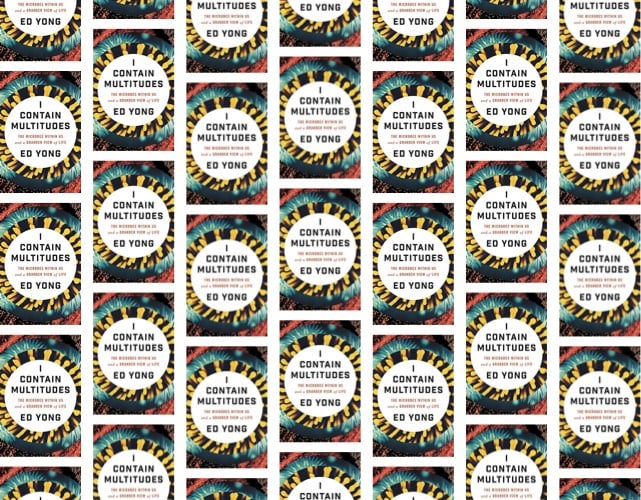
Crackerjack science writer Ed Yong is coming out with his very first book in a month’s time. It’s called I Contain Multitudes (good title!) and is about “astonishing partnerships between animals and microbes”.
Every animal, whether human, squid, or wasp, is home to millions of bacteria and other microbes. Ed Yong, whose humor is as evident as his erudition, prompts us to look at ourselves and our animal companions in a new light-less as individuals and more as the interconnected, interdependent multitudes we assuredly are.
The microbes in our bodies are part of our immune systems and protect us from disease. In the deep oceans, mysterious creatures without mouths or guts depend on microbes for all their energy. Bacteria provide squid with invisibility cloaks, help beetles to bring down forests, and allow worms to cause diseases that afflict millions of people.
I will read anything described as “like a David Attenborough series shot through a really good microscope”.
Update: Bill Gates liked I Contain Multitudes so much he sat down for a chat with Yong to discuss the particulars.
We are also utterly inseparable from them. Yong illustrates that we are at least as much microbe as human. We literally have more microbial cells living inside our bodies than human cells. And even the cells we label “human” are part microbe. With the exception of red blood cells and sperm, all our cells are powered by mitochondria, which are likely the descendants of ancient bacteria that became integrated into the type of cells that subsequently gave rise to all complex life.
Jane Elliott asks an audience a very simple question about being black in America. (via @carltonspeight who says “No BS, I wish every white person on Twitter could see this. Maybe it’ll help”)
From the films he made as a teenager on up to the recently released BFG, this is a look at the evolution of the films of Steven Spielberg.
I was 20 when Jurassic Park came out and while I really liked it, I didn’t think much about who directed it at the time. It certainly didn’t remind me much of Raiders of the Lost Ark or ET. I watched it again last night (it’s on Netflix) and it is soooooo obviously Spielberg.
In a relatively new video essay about movies, Lessons from the Screenplay, Michael Tucker looks at Dan Aykroyd and Harold Ramis’s original script for Ghostbusters and how the framework it provided, enhanced by the improv skills of the actors, produced a movie better than the script might have indicated at first glance. And oh man, I love the turn-of-the-century Ghostbusters idea. (via one perfect shot)
Even though I was one of the (relative) few to watch the first episode when it originally aired,1 I had forgotten how weird the pilot for Seinfeld was. The theme music is completely different, Michael Richards’ character is called “Kessler” (because the network had legal concerns related to Larry David’s real-life neighbor, Kenny Kramer, on whom the character was based), and Elaine2 neither appears or is mentioned. Oh, and the first season was only five episodes long (NBC was very skeptical about the show) and both Steve Buscemi and David Alan Grier auditioned for the role of George.
Update: Well, that got taken down from Vimeo fairly quickly. You can still watch the pilot on Hulu.
I watched an incredible amount of TV as a kid. I would read TV Guide from cover to cover each week and have seen every episode of a number of embarrassing shows.↩
Fun fact: Julia Louis-Dreyfus wasn’t even aware of the existence of the Elaine-less pilot episode until 2004 (6 years after the show ended) and plans never to watch it. Whoever told her must have earned a solid GET! OUT! shove in the chest.↩
From Jamie xx’s In Colour. Directed by Romain Gavras. Best at fullscreen with headphones.
In 1852, Frederick Douglass gave a speech in Rochester, NY which historian James West Davidson calls “the most remarkable Independence Day oration in American history”.
In Rochester, Douglass stalked his largely white audience with exquisite care, taking them by stealth. He began by providing what many listeners might not have expected from a notorious abolitionist: a fulsome paean to the Fourth and the founding generation. The day brought forth “demonstrations of joyous enthusiasm,” he told them, for the signers of the Declaration were “brave men. They were great men too-great enough to give fame to a great age.” Jefferson’s very words echoed in Douglass’s salute: “Your fathers staked their lives, their fortunes, and their sacred honor, on the cause of their country … “
Your fathers. That pronoun signaled the slightest shift in the breeze. But Douglass continued cordially. “Friends and citizens, I need not enter further into the causes which led to this anniversary. Many of you understand them better than I do.” Then another step back: “That is a branch of knowledge in which you feel, perhaps, a much deeper interest than your speaker.”
The text of the speech itself is well worth reading…that “slightest shift in the breeze” slowly builds to a mighty hurricane.
Fellow-citizens, pardon me, allow me to ask, why am I called upon to speak here to-day? What have I, or those I represent, to do with your national independence? Are the great principles of political freedom and of natural justice, embodied in that Declaration of Independence, extended to us? and am I, therefore, called upon to bring our humble offering to the national altar, and to confess the benefits and express devout gratitude for the blessings resulting from your independence to us?
Several years ago, James Earl Jones read a portion of Douglass’ speech:
Update: Baratunde Thurston recently presented Douglass’ speech live at the Brooklyn Public Library. (thx, rick)
I couldn’t figure this out when I watched it on my phone this morning, but if you watch it in fullscreen HD, you can see how the shapes are cut to look different from various angles. Still trippy though.
Update: Make Anything reverse-engineered the illusion…here’s how it works:
(via @dunstan)
Evan Puschak examines the rise of the independence movement in Britain, from their entrance into the European Community in 1973 to Thatcher’s rumblings about EU governance to UKIP’s rise, culminating in Brexit last week. I thought this was a pretty succinct summary of right-wing political tactics:
And that’s the point about far-right political organizations: they use the fulcrum of populism and fear to lift many times their weight in people.
Update: More on the history of the movement to withdraw Britain from the EU from Gary Younge in The Guardian.
Legendary director Terrence Malick is making a documentary about the birth and death of the universe. It looks like a Koyaanisqatsi sort of thing rather than a here’s a suburban tableau that’s a metaphor for Big Bang and everything that comes after it sort of thing.
Apparently: 1. Malick has been working on this for more than 30 years. 2. Brad Pitt is narrating a 40-minute version that will air exclusively in IMAX. 3. There will also be a feature-length version of the movie narrated by Cate Blanchett. 4. This will either be amazing or sort of, you know, eh.
Update: A second trailer:
Ok, I’m officially excited for this. Cate Blanchett’s breathy Galadriel voice over gorgeous imagery? I’m there. (via one perfect shot)
This storyboarded scene from Zootopia shows an early and much darker direction for the plot: the predators need to wear collars that shock them if they get too excited. This reminds me that Woody was a “sarcastic jerk” in the early drafts of Toy Story. Oh, and Lightning McQueen was an asshole in Cars whose redemption the audience didn’t completely buy, which Pixar didn’t end up fixing.
Update: There’s more about how Zootopia’s story evolved in Fusion’s 45-minute feature about the production of the film. (via @luketonge)
Socials & More