



100 iconic film scenes
From Cinefix, the 100 most iconic shots in film.
Skews heavily toward pop culture favorites, but still worth a look. Here’s a video with annotations of each scene. (via digg)

This site is made possible by member support. 💞
Big thanks to Arcustech for hosting the site and offering amazing tech support.
When you buy through links on kottke.org, I may earn an affiliate commission. Thanks for supporting the site!
kottke.org. home of fine hypertext products since 1998.
Beloved by 86.47% of the web.
From Cinefix, the 100 most iconic shots in film.
Skews heavily toward pop culture favorites, but still worth a look. Here’s a video with annotations of each scene. (via digg)
A compilation of some of the vehicles used in Wes Anderson’s movies, shot from the first-person POV.
(via devour)

Laura Ingalls Wilder wrote her autobiography, Pioneer Girl, in the early 1930s. The book was deemed unsuitable for publication, but Wilder reworked her story into the successful Little House on the Prairie series for children.
Now the South Dakota Historical Society is publishing an annotated version of Pioneer Girl, which includes stories from Wilder’s childhood that didn’t make it into the kids’ books. And for good reason.
It contains stories omitted from her novels, tales that Wilder herself felt “would not be appropriate” for children, such as her family’s sojourn in the town of Burr Oak, where she once saw a man became so drunk that, when he lit a cigar, the whisky fumes on his breath ignited and killed him instantly. In another recollection, a shopkeeper drags his wife around by her hair, pours kerosene on the floor of his house, and sets their bedroom on fire.
Wilder’s memoir also paints a different picture of her father, Charles Ingalls, known in the novels as Pa. Although the real man’s character is essentially the same as the version in the novels - affectionate, musical and restless to move on through America’s frontier - he is, said the book’s publisher, the South Dakota Historical Society Press, clearly “romanticised and idealised”. In Wilder’s autobiography, he is described sneaking his family out of town in the middle of the night after failing to negotiate the rent with the landlord, justifying the flit by calling the man a “rich old skinflint”.
Earlier this year, there was an open casting call for the role of Laura in a new movie version of Little House on the Prairie. Maybe the drunken self-immolation will make it into this one!
Update: Pioneer Girl has become an unlikely bestseller. The small press that published the book is doing a fifth printing and bookstores online and off can’t keep it in stock.
That a hardcover book of this heft and complexity — in addition to the side notes, there are scores of maps, illustrations and photographs — has been such a hit has surprised everyone, including the publisher. The South Dakota Historical Society Press is a seven-person operation based in Pierre. In the five months since the book’s release, it has been trying frantically to print more copies to keep up with demand (the first printing of 15,000 copies sold out in just a couple of weeks). “When people have to wait, they want it more,” says Nancy Tystad Koupal, director of the press.
That’s the somewhat unusual name of a feature-length documentary about world-class stone skippers. Here’s the trailer:
I love skipping stones. When I see flat water and flat rocks, I can’t not do it. They have to change that name though. They were likely going for “Jiro Dreams of Sushi” but really missed the mark. Oh, and they’re raising funds on Kickstarter to finish the film.
The zen art of stone skipping meets the competitive nature of mankind in this feature-length documentary. Set in the world of professional stone skipping, this film will examine the competitive nature of mankind. World Records will be tested, rivalries will fester, and a sport will rise from the ashes of obscurity.
Update: The full-length movie is now available for rent or purchase on Vimeo.
A short appreciation of the Steadicam and its inventor, Garrett Brown. (Brown also invented the football SkyCam.) Features footage from Rocky, Return of the Jedi, and The Shining.
From Wikipedia:
The Steadicam was first used in the Best Picture-nominated Woody Guthrie biopic Bound for Glory (1976), debuting with a shot that compounded the Steadicam’s innovation: cinematographer Haskell Wexler had Brown start the shot on a fully elevated platform crane which jibbed down, and when it reached the ground, Brown stepped off and walked the camera through the set. This technically audacious and previously impossible shot created considerable interest in how it had been accomplished, and impressed the Academy enough for Wexler to win the Oscar for Best Cinematography that year. It was then used in extensive running and chase scenes on the streets of New York City in Marathon Man (1976), which was actually released two months before Bound for Glory. It landed a notable third credit in Avildsen’s Best Picture-winning Rocky (1976), where it was an integral part of the film’s Philadelphia street jogging/training sequences and the run up the Art Museum’s flight of stairs, as well as the fight scenes (where it can even be plainly seen in operation at the ringside during some wide shots of the final fight). Garrett Brown was the Steadicam operator on all of these.
The Shining (1980) pushed Brown’s innovations even further, when director Stanley Kubrick requested that the camera shoot from barely above the floor. This prompted the innovation of a “low mode” bracket to mount the top of a camera to the bottom of an inverted post, which substantially increased the creative angles of the system, which previously could not go much lower than the operator’s waist height. This low-mode concept remains the most important extension to the system since its inception.
(via @robinsloan)
Update: Here’s Brown talking about the Steadicam and his career. And here’s Stanley Kubrick’s introduction to the Steadicam, via a letter from a colleague. (via @poritsky & @LettersOfNote)
Automata is a film directed by Gabe Ibáñez in which robots become sentient and…do something. Not sure what…I hope it’s not revolt and try to take over the world because zzzz… But this movie looks good so here’s hoping.
Jacq Vaucan, an insurance agent of ROC robotics corporation, routinely investigates the case of manipulating a robot. What he discovers will have profound consequences for the future of humanity.
Automata will be available in theaters and VOD on Oct 10. (via devour)
When Alex Belth was 25 years old, he worked with Joel and Ethan Coen on The Big Lebowski, first as a personal assistant and then as an assistant editor. He recently published a short Kindle book about the experience.
The Dudes Abide is the first behind-the-scenes account of the making of a Coen Brothers movie, and offers an intimate, first-hand narrative of the making of The Big Lebowski — including never-before-revealed details about the making of the film, and insight into the inner workings of the Coen Brothers’ genius.
An excerpt of the book was published on Deadspin.
Joel told Goodman about re-recording dialogue for the profanity-free television version of Fargo. They rewrote the line, “I’m fucking hungry now” to “I’m full of hungry now.”
“Why didn’t we write it like that originally?” said Joel. “It’s funnier.”
Goodman said, “Who else is coming on this show?” (In Los Angeles, movie people call a movie a “show.”)
There was Steve Buscemi as Donny, Julianne Moore as Maude, Jon Polito as Da Fino.
Joel said, “Our friend Luis, who was an assistant film editor on Hudsucker, will be playing the enraged Mexican.”
“Yeah, you’ll like Luis,” Ethan said in a creaky voice. “He makes a big statement.”
“Turturro is coming in to play the pederast,” Joel said. “He said he’d do his best F. Murray Abraham.”
(thx, brad)
From Tony Zhou, A Brief Look at Texting and the Internet in Film.
Michele Tepper wrote about Sherlock’s display of texts in 2011.
The rise of instant messaging, and even more, the SMS, has added another layer of difficulty; I’m convinced that the reason so many TV characters have iPhones is not just that Hollywood thinks they’re cool, but also because the big crisp screen is so darn easy to read. Still, the cut to that little black metal rectangle is a narrative momentum killer. What’s a director trying to make a ripping good adventure yarn to do?
The solution is deceptively simple: instead of cutting to the character’s screen, Sherlock takes over the viewer’s screen.
And just today, a trailer for Jason Reitman’s Men, Women & Children, which movie seems to consist entirely of texting and social media interaction:
(via @tcarmody)
A remastered copy of the original 1977 Han-shoots-first version of Star Wars is out there and you can watch it but it’s probably illegal. But Disney is never going to show it to you, so maybe it’s ok to find it on Bittorrent?
The Despecialized Edition is the years-long work of a diverse group of people who have taken elements from many different sources and created the ultimate version of the first Star Wars film. It has also been upgraded to display properly on high definition screens, with high-quality sounds and a near perfect image.
The latest Blu-Ray release of the film serves as the skeleton for this edition, but elements of the 2006 bonus DVD that included the unaltered version of the film was also used to remove special effects and edits that were added by Lucas.
Here’s a short feature on the video sources used:
And here’s how to get the full film.
Update: Here’s an extensive side-by-side look at how dozens of shots were modified to make The Despecialized Edition.
The mixtape that Star-Lord carries around in Guardians of the Galaxy is of course available as an actual album (Amazon mp3, iTunes). The album isn’t on Spotify, but there is a playlist of all the songs.
As Slate notes, the movie merch album isn’t totally true to the movie as it includes two songs from Awesome Mix Vol. 2, but I will never complain of Marvin Gaye’s or the Jackson 5’s inclusion in anything.
Here’s the trailer for the third and final movie in Peter Jackson’s The Hobbit trilogy:
The Hobbit was initially supposed to be just two films but Jackson decided to split the second film into two. From Wikipedia:
According to Jackson, the third film would contain the Battle of the Five Armies and make extensive use of the appendices that Tolkien wrote to expand the story of Middle-Earth (published in the back of The Return of the King).
The second movie was better than the first so I’m looking forward to this one. But then again, I’m totally in the tank for Jackson’s take on Middle Earth (I did the Weta Digital tour when I was in New Zealand) so I would see it even if the first two movies sucked.
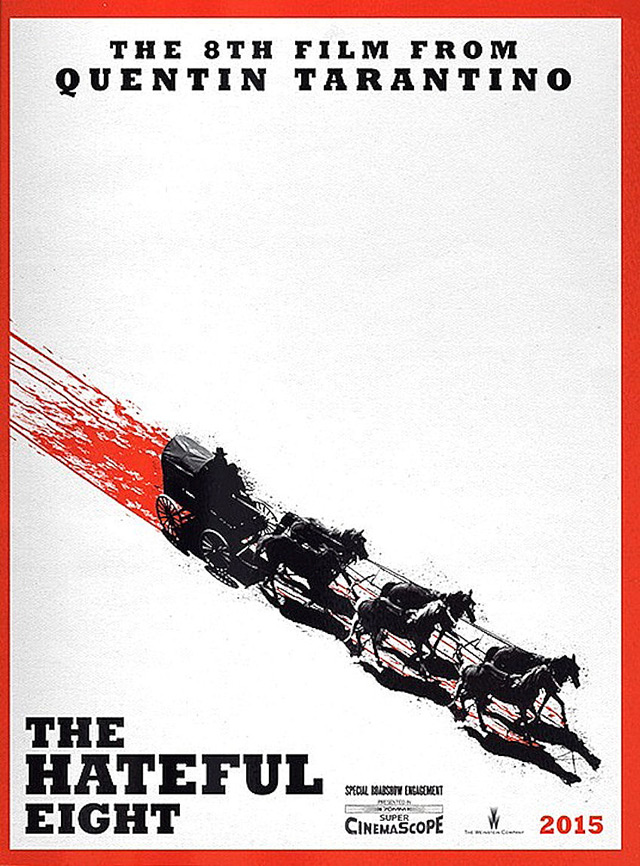
So, a few months ago Quentin Tarantino scrapped plans to make what was supposed to be his next film, The Hateful Eight, after the script leaked. Which struck me as weird and petty, but Hollywood in general seems weird and petty to me. Turns out that Tarantino’s gonna do the movie after all.
During the Comic-Con panel, one of the audience members point blank asked Tarantino if he’ll be making the script as his next feature, following recent word that it could be heating back up again. Tarantino hemmed and hawed for a bit — before finally committing: “Yeah — We’re going to be doing The Hateful Eight.” So there you have it: The Hateful Eight will be the next Quentin Tarantino feature.
The photo at the top is the first official poster for the film.
Actor Robin Williams was found dead in his home today of an apparent suicide. He was 63. I have been thinking a lot about this scene from Dead Poets Society lately:
From James Marsh, the director of the excellent Man on Wire, a biopic of physicist Stephen Hawking and his first wife, Jane. Here’s the first trailer:
The film is based on a book by Jane Hawking, Travelling to Infinity: My Life with Stephen.
In this compelling memoir, his first wife, Jane Hawking, relates the inside story of their extraordinary marriage. As Stephen’s academic renown soared, his body was collapsing under the assaults of motor neurone disease. Jane’s candid account of trying to balance his 24-hour care with the needs of their growing family reveals the inner-strength of the author, while the self-evident character and achievements of her husband make for an incredible tale presented with unflinching honesty.
As promising as this looks, the Kanye in me needs to remind you that Errol Morris’ A Brief History of Time is the best film about Stephen Hawking of all time. OF ALL TIME.
Sight and Sound polled 340 critics and filmmakers in search of the world’s best documentary films. Here are their top 50. From the list, the top five:
A Man with a Movie Camera
Shoah
Sans soleil
Night and Fog
The Thin Blue Line
Unless you went to film school or are a big film nerd, you probably haven’t seen (or even heard of) the top choice, A Man with a Movie Camera. Roger Ebert reviewed the film several years ago as part of his Great Movies Collection.
Born in 1896 and coming of age during the Russian Revolution, Vertov considered himself a radical artist in a decade where modernism and surrealism were gaining stature in all the arts. He began by editing official newsreels, which he assembled into montages that must have appeared rather surprising to some audiences, and then started making his own films. He would invent an entirely new style. Perhaps he did. “It stands as a stinging indictment of almost every film made between its release in 1929 and the appearance of Godard’s ‘Breathless’ 30 years later,” the critic Neil Young wrote, “and Vertov’s dazzling picture seems, today, arguably the fresher of the two.” Godard is said to have introduced the “jump cut,” but Vertov’s film is entirely jump cuts.
If you’re curious, the film is available on YouTube in its entirety:
(via open culture)
Christopher Nolan + Matthew McConaughey + space + doomed Earth. Oh man, this is looking like it might actually be great. Or completely suck.
Please don’t suck, please don’t suck, please don’t suck, please don’t suck, please don’t suck, please don’t suck, please don’t s (via @aaroncoleman0)

Physicist Andy Howell recently gave a talk about the science of Star Wars and wrote up a summary of it for Ain’t It Cool News. Topics covered include binary star systems, droids, the Death Star, and lightsabers:
Of course, we still don’t know how to make a lightsaber. One big problem is confining plasma (if that is even what it is), into some tube. But a bigger problem is the amount of energy required. We can actually calculate this from clues in the movies!
In Episode I, Qui-Gon jabs his lightsaber into a door, and melts part of it. That’s just basic physics! To melt something, you have to raise its temperature to the melting point, and you can calculate how much energy that takes using the specific heat capacity of a material.
(thx, greg)
Alarming reports out of Japan are saying that super-animation studio Studio Ghibli is closing!
Just moments ago, Toshio Suzuki, Studio Ghibli producer, announced on the TV show of the MBS Jounetsu Tairiku chain effectively as announced as sources close to the studio, Studio Ghibli will close and production studio anime, leaving himself only as a company that will manage its trademarks. As stated in the program’s producer, “the production department of anime will be dismantled,” which coincides with the data that we gave in our previous post on this decision had been taken from spring after the poor reception at the box office of Kaguya-hime no Monogatari.
Luckily those reports appear to be overblown and poorly translated. As Kotaku explains, Suzuki’s comments were much more speculative in nature:
Suzuki’s wording makes it sound like the studio is considering reorganization and regrouping. It could mean that Studio Ghibli decides it won’t make anime films anymore. Though it could mean they do keep making anime films. It could mean a lot of things!
Realize that, at the time of writing, no major Japanese newspaper is running this story. Nor did any morning TV shows. Had Studio Ghibli — a national treasure — definitively ceased production of films, it would be headline news around the country, as it would be important in both the entertainment and business worlds.
(via @tcarmody)
From This Must Be the Place, a lovely short profile of Old Town Music Hall in El Segundo, California. Old Town shows silent films with live musical accompaniment. Includes a brief tour of the inner workings of the theater’s wind-powered pipe organ from 1925.
The Imitation Game is a historical drama about Alan Turing, focusing on his efforts in breaking the Enigma code during WWII. Benedict Cumberbatch plays Alan Turing. Here’s a trailer:
The first season of a new series based on 12 Monkeys (and La Jetée) is set to debut on Syfy in January; here’s the trailer:
(via the verge)
This is a lie, but I got dozens of emails today asking, “Jason, what movie should I watch tonight?” Whoa, slow down everyone, I’ve got just the thing: Snowpiercer. It’s a Korean film from 2013 that’s just now trickling into the consciousness of the rest of the world (c.f. this Grantland piece). The film takes place entirely on a train carrying the last remaining humans speeding forever around a frozen Earth (caused by an overenthusiastic response to climate change) and director Bong Joon-ho takes full advantage of this confined and linear setting. Plus, Tilda Swinton as a Terry Gilliam-ified Maggie Thatcher is worth the price of admission alone.
Snowpiercer is out in ~350 theaters in the US, so if you’re not in a major metropolitan area, it might be a little hard to catch. But the movie is also available digitally at Amazon and iTunes.
In the same vein as the Zinn/Chomsky Lord of the Rings commentary is A People’s History of Tattooine, a Twitter conversation that Jacob Harris kicks off thusly:
What if Mos Eisley wasn’t really that wretched and it was just Obi Wan being racist again?
Some other highlights:
“more civilized time?” Check your privilege, Obi Wan
the Tusken People. Raiders presumes some malevolent intent
all I’m saying is that I don’t blame the Tusken People for steering clear of the racist, violent and armed old man
like anybody forgets what Luke and his friends did to native womp rat populations at Beggars Canyon Park
There are 46 reviews (and counting) of The Grand Budapest Hotel on TripAdvisor, which is ranked “#1 of 1 hotels in The Republic of Zubrowka”.
As an elderly women I was thoroughly delighted by the attention of the staff! Particularly the concierge, what a thoughtful generous man! Wish I could take him home to service me there! I also loved the food and the chocolate treats from mendls. Tip top!
See also Schrute Farms on TripAdvisor and TripAdvisor reviews for the Overlook Hotel. Oh and The Grand Budapest Hotel movie is now available for digital rental. (via @khoi)
This is an old piece from McSweeney’s, but it’s absolute gold and I can’t believe I’ve been missing it all these years. In it, Noam Chomsky and Howard Zinn record a DVD commentary for the first Lord of the Rings movie. So, so good.
Zinn: You’ve spoken to me before about Mordor’s lack of access to the mineral wealth that the Dwarves control.
Chomsky: If we’re going to get into the socio-economic reasons why certain structures develop in certain cultures… it’s mainly geographical. We have Orcs in Mordor — trapped, with no mineral resources — hemmed in by the Ash Mountains, where the “free peoples” of Middle Earth can put a city, like Osgiliath, and effectively keep the border closed.
Zinn: Don’t forget the Black Gate. The Black Gate, which, as Tolkien points out, was built by Gondor. And now we jump to the Orcs chopping down the trees in Isengard.
Chomsky: A terrible thing the Orcs do here, isn’t it? They destroy nature. But again, what have we seen, time and time again?
Zinn: The Orcs have no resources. They’re desperate.
Chomsky: Desperate people driven to do desperate things.
Zinn: Desperate to compete with the economic powerhouses of Rohan and Gondor.
Chomsky: Who really knows their motive? Maybe this is a means to an end. And while that might not be the best philosophy in the world, it makes the race of Man in no way superior. They’re going to great lengths to hold onto their power. Two cultures locked in conflict over power, with one culture clearly suffering a great deal. I think sharing power and resources would have been the wisest approach, but Rohan and Gondor have shown no interest in doing so. Sometimes, revolution must be —
Zinn: Mistakes are often —
Chomsky: Blood must be shed. I forget what Thomas Jefferson —
Here’s part two. And the same writers, Jeff Alexander and Tom Bissell, also did one for The Return of the King.
From CineFix, a collection of ten of the most iconic and memorable editing moments in cinematic history.
(via @brillhart)
Narrated by Malcolm McDowell and featuring interviews from many collaborators and colleagues, Lost Kubrick is a short documentary on the films that Stanley Kubrick never finished.
Through interviews and abundant archival materials, this documentary examines these “lost” films in depth to discover what drew Kubrick to these projects, the work he did to prepare them for production, and why they ultimately were abandoned. Some of the unfinished project discussed here are “Napoleon”, “The Aryan Papers” and also “A.I” (which we know finally made by Steven Spielberg).
In 1976, 20th Century Fox released a teaser trailer for a little film called Star Wars…aka “the story of a boy, a girl, and a universe”.
No James Earl Jones voiceover for Vader, no John Williams score (which wasn’t finished until just two months before the film premiered), but those visuals must have impressed.
Here’s the first teaser trailer for Empire Strikes Back, which features no film footage at all, just concept art drawn by Ralph McQuarrie:
And for the sake of completeness, the teaser trailer for Return of the Jedi, which appeared in theaters before Lucas changed the name from Revenge of the Jedi:
The staff and contributors of Dissolve recently listed the 50 greatest summer blockbusters ever. Here’s #50-31, #30-11, and the top 10.
Blockbusters have become such an integral part of the way we talk about films that it’s hard to believe they haven’t always been with us. But while there have always been big movies-lavish productions designed to draw crowds and command repeat business-the blockbuster as we know it has a definite start date: June 20, 1975. That’s when Jaws first hit screens in the middle of what was once, in the words of The Financial Times, a “low season” when the “only steady summer dollars came, in the U.S., from drive-in theaters.” It’s summer, after all; why go to the movies when you could be outside? Jaws changed that. Star Wars cemented that change. And now, the summer-movie season is dominated by the biggest films Hollywood has to offer.
Jaws is the no-surprise #1 but Who Framed Roger Rabbit at #8? Hmm, dunno about that. And leaving Star Wars just off the top 10 is a bold move. My personal top ten would also have included Ghostbusters — I remember vividly waiting in line in the sweltering heat outside the El Lago theater to see Ghostbusters and just being completely and utterly blown away by it — and Terminator 2. Oh and Batman. I think I saw that movie half-a-dozen times in the theater and it was just everywhere that summer…the logo, that song by Prince, everything. (via @khoi)
Life Itself, the documentary about Roger Ebert, is now out in theaters. But you can also watch it via various Video On Demand services, including Amazon and iTunes. Here’s the trailer to whet yer whistle:
Socials & More