kottke.org posts about artificial intelligence
Humans are the first and, to our knowledge, only entities on Earth to develop general intelligence, which has allowed us to dominate and alter the planet in a way and at a speed that no other entity has managed. Now, some people are working towards building an artificial general intelligence. So what happens when humans are matched or even far outclassed by this new general intelligence?
Such an intelligence explosion might lead to a true superintelligent entity. We don’t know what such a being would look like, what its motives or goals would be, what would go on in its inner world. We could be as laughably stupid to a superintelligence as squirrels are to us. Unable to even comprehend its way of thinking.
This hypothetical scenario keeps many people up at night. Humanity is the only example we have of an animal becoming smarter than all others — and we have not been kind to what we perceive as less intelligent beings. AGI might be the last invention of humanity.
YouTuber Nerrel takes James Cameron to task for releasing 4K remasters of Aliens and True Lies that have been, well, ruined by using AI to clean them up.
The best 4k releases tend to follow a pretty simple template: clean and scan the negative, repair any obvious signs of damage, and restore the colors to match the original grading, with as little meddling beyond that as possible. The process should not be about modernizing the style or forcing film to look like digital video. 35mm film was capable of incredible picture quality, and 4k is the first home format capable of delivering most of that detail — that should be enough. A well done 4k is like having a pristine copy of the original negative to watch in your own home, with the full data from that celluloid — grain and detail alike — digitally preserved forever. And that’s the problem with deep learning algorithms — they can’t preserve details. They make their best guess about what an object is supposed to be, then pull new details out of their digital assholes and smear them across the screen.
If Hollywood and one of its best directors don’t care enough about their movies to do them right, how are they supposed to convince us to care about their movies?
I enjoyed Ezra Klein’s podcast conversation with Nilay Patel, the editor of The Verge. They talked about media and AI mostly.
(First of all, anyone who says they’re trying to “revolutionize the media through blog posts” is a-ok in my book.)
Anyway, here’s Patel on the limitations of AI and where humans shine:
But these models in their most reductive essence are just statistical representations of the past. They are not great at new ideas.
And I think that the power of human beings sort of having new ideas all the time, that’s the thing that the platforms won’t be able to find. That’s why the platforms feel old. Social platforms like enter a decay state where everyone’s making the same thing all the time. It’s because we’ve optimized for the distribution, and people get bored and that boredom actually drives much more of the culture than anyone will give that credit to, especially an A.I. developer who can only look backwards.
Later he talks more specifically about why curation will grow more important in a world inundated with aggressively mid AI content:
And the idea is, in my mind at least, that those people who curate the internet, who have a point of view, who have a beginning and middle, and an end to the story they’re trying to tell all the time about the culture we’re in or the politics we’re in or whatever. They will actually become the centers of attention and you cannot replace that with A.I. You cannot replace that curatorial function or that guiding function that we’ve always looked to other individuals to do.
And those are real relationships. I think those people can stand in for institutions and brands. I think the New York Times, you’re Ezra Klein, a New York Times journalist means something. It appends some value to your name, but the institution has to protect that value. I think that stuff is still really powerful, and I think as the flood of A.I. comes to our distribution networks, the value of having a powerful individual who curates things for people, combined with a powerful institution who protects their integrity actually will go up. I don’t think that’s going to go down.
Yeah, exactly. Individuals and groups of like-minded people making things for other people — that stuff is only going to grow more valuable as time goes on. The breadth and volume offered by contemporary AI cannot provide this necessary function right now (and IMO, for the foreseeable future).
And finally, I wanted to share this exchange:
EZRA KLEIN: You said something on your show that I thought was one of the wisest, single things I’ve heard on the whole last decade and a half of media, which is that places were building traffic thinking they were building an audience. And the traffic, at least in that era, was easy, but an audience is really hard. Talk a bit about that.
NILAY PATEL: Yeah first of all, I need to give credit to Casey Newton for that line. That is something — at The Verge, we used to say that to ourselves all the time just to keep ourselves from the temptations of getting cheap traffic. I think most media companies built relationships with the platforms, not with the people that were consuming their content.
I never focused on traffic all that much, mainly because for a small site like kottke.org, there wasn’t a whole lot I could do, vis-à-vis Google or Facebook, to move the needle that much. But as I’ve written many times, switching to a reader-supported model in 2016 with the membership program has just worked so well for the site because it allows me to focus on making something for those readers — that’s you! — and not for platforms or algorithms or advertisers. I don’t have to “pivot to video”; instead I can do stuff like comments and [new thing coming “soon”] that directly benefit and engage readers, which has been really rewarding.
See also Kyle Chayka’s recent piece for the New Yorker: The Revenge of the Home Page.
Perhaps the platform era caused us to lose track of what a Web site was for. The good ones are places you might turn to several times per day or per week for a select batch of content that pointedly is not everything. Going there regularly is a signal of intention and loyalty: instead of passively waiting for social feeds to serve you what to read, you can seek out reading materials-or videos or audio-from sources you trust. If Twitter was once a sprawling Home Depot of content, going to specific sites is more like shopping from a series of specialized boutiques.
I’m going to get slightly petty here for a sec and say that these “back to the blog / back to the web” pieces almost always ignore the sites that never gave up the faith in favor of “media” folks inspired by the former. It’s nice to see the piece end with a mention of Arts & Letters Daily, still bloggily chugging along since 1998. /salty
Data artist Robert Hodgin recently created a feedback loop between Midjourney and ChatGPT-4 — he prompted MJ to create an image of an old man in a messy room wearing a VR headset, asked ChatGPT to describe the image, then fed that description back into MJ to generate another image, and did that 10 times. Here was the first image:

And here’s one of the last images:

Recursive art like this has a long history — see Alvin Lucier’s I Am Sitting in a Room from 1969 — but Hodgin’s project also hints at the challenges facing AI companies seeking to keep their training data free of material created by AI. Ted Chiang has encouraged us to “think of ChatGPT as a blurry jpeg of all the text on the Web”:
It retains much of the information on the Web, in the same way that a jpeg retains much of the information of a higher-resolution image, but, if you’re looking for an exact sequence of bits, you won’t find it; all you will ever get is an approximation. But, because the approximation is presented in the form of grammatical text, which ChatGPT excels at creating, it’s usually acceptable. You’re still looking at a blurry jpeg, but the blurriness occurs in a way that doesn’t make the picture as a whole look less sharp.
And we already know what you get if you recursively save JPEGs…
See also La Demoiselle d’Instagram, I Am Sitting in a Room (with a video camera), Google Image Search Recursion, and Dueling Carls.
For the last few weeks, I’ve been listening to the audiobook of Brian Merchant’s history of the Luddite movement, Blood in the Machine: The Origins of the Rebellion Against Big Tech. In it, Merchant argues the Luddites were at their core a labor movement against capitalism and compares them to contemporary movements against big tech and media companies. Merchant writes in the Atlantic:
The first Luddites were artisans and cloth workers in England who, at the onset of the Industrial Revolution, protested the way factory owners used machinery to undercut their status and wages. Contrary to popular belief, they did not dislike technology; most were skilled technicians.
At the time, some entrepreneurs had started to deploy automated machines that unskilled workers — many of them children — could use to churn out cheap, low-quality goods. And while the price of garments fell and the industrial economy boomed, hundreds of thousands of working people fell into poverty. When petitioning Parliament and appealing to the industrialists for minimum wages and basic protections failed, many organized under the banner of a Robin Hood-like figure, Ned Ludd, and took up hammers to smash the industrialists’ machines. They became the Luddites.
He goes on to compare their actions to tech publication writers’ strikes, the SAG-AFTRA & WGA strikes, the Authors Guild lawsuit against AI companies, and a group of masked activists “coning” self-driving cars. All this reminds me of Ted Chiang’s quote about AI:
I tend to think that most fears about A.I. are best understood as fears about capitalism. And I think that this is actually true of most fears of technology, too. Most of our fears or anxieties about technology are best understood as fears or anxiety about how capitalism will use technology against us. And technology and capitalism have been so closely intertwined that it’s hard to distinguish the two.
Ross Andersen for the Atlantic on the effort to talk to sperm whales using AI tech:
Their codas could be orders of magnitude more ancient than Sanskrit. We don’t know how much meaning they convey, but we do know that they’ll be very difficult to decode. Project CETI’s scientists will need to observe the whales for years and achieve fundamental breakthroughs in AI. But if they’re successful, humans could be able to initiate a conversation with whales.
This would be a first-contact scenario involving two species that have lived side by side for ages. I wanted to imagine how it could unfold. I reached out to marine biologists, field scientists who specialize in whales, paleontologists, professors of animal-rights law, linguists, and philosophers. Assume that Project CETI works, I told them. Assume that we are able to communicate something of substance to the sperm whale civilization. What should we say?
One of the worries about whale/human communication is the potential harm a conversation might cause.
Cesar Rodriguez-Garavito, a law professor at NYU who is advising Project CETI, told me that whatever we say, we must avoid harming the whales, and that we shouldn’t be too confident about our ability to predict the harms that a conversation could cause.
The sperm whales may not want to talk. They, like us, can be standoffish even toward members of their own species-and we are much more distant relations. Epochs have passed since our last common ancestor roamed the Earth. In the interim, we have pursued radically different, even alien, lifeways.
Really interesting article.
A team of three students were able to virtually “unroll” a 2000-year-old papyrus scroll that was carbonized during the eruption of Mount Vesuvius in Herculaneum, thereby winning the grand prize in the Vesuvius Challenge. These scrolls (there are hundreds of them) are little more than “lumps of carbonized ash”; this Wikipedia entry helpfully summarizes their fate:
Due to the eruption of Mount Vesuvius in 79 AD, bundles of scrolls were carbonized by the intense heat of the pyroclastic flows. This intense parching took place over an extremely short period of time, in a room deprived of oxygen, resulting in the scrolls’ carbonization into compact and highly fragile blocks. They were then preserved by the layers of cement-like rock.
Using high-resolution CT scans of the scrolls, machine learning, and computer vision techniques, the team was able to read the text inside one of the scrolls without actually unrolling it. I am stunned by how much text they were able to recover from these blackened documents — take a look at this image:
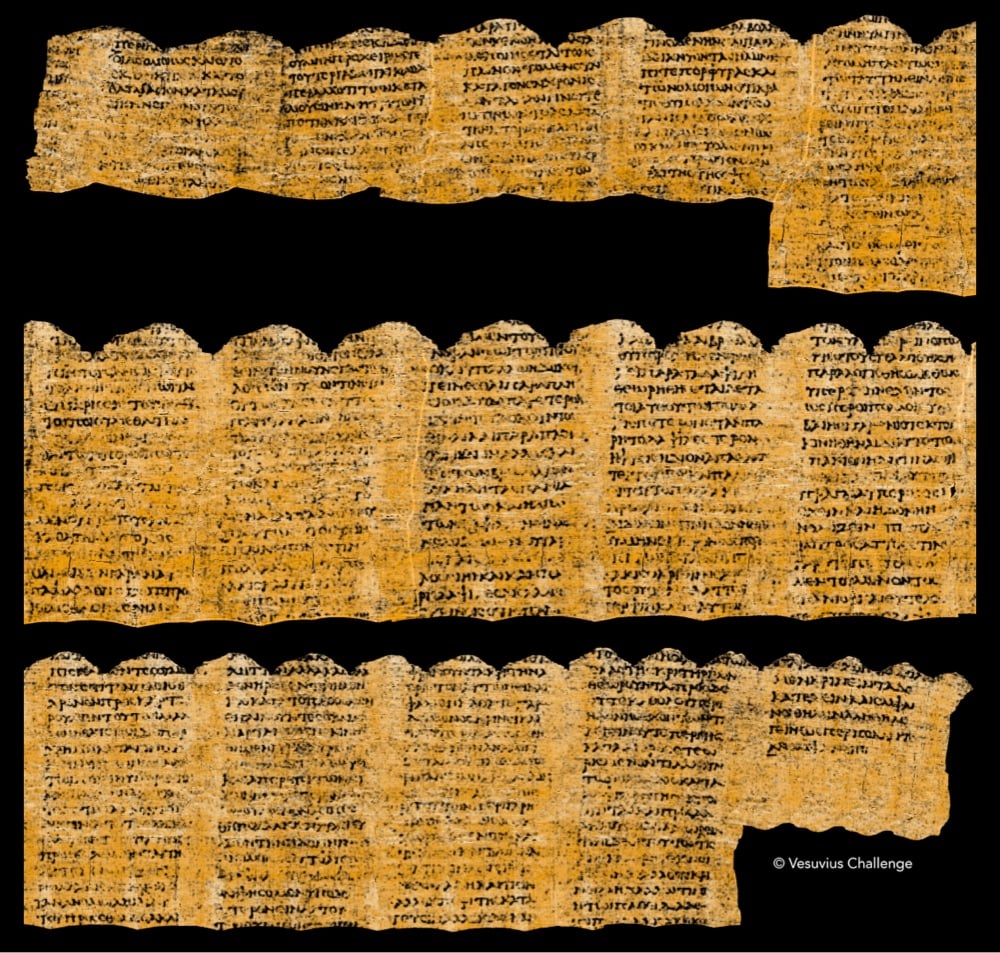
There was one submission that stood out clearly from the rest. Working independently, each member of our team of papyrologists recovered more text from this submission than any other. Remarkably, the entry achieved the criteria we set when announcing the Vesuvius Challenge in March: 4 passages of 140 characters each, with at least 85% of characters recoverable. This was not a given: most of us on the organizing team assigned a less than 30% probability of success when we announced these criteria! And in addition, the submission includes another 11 (!) columns of text - more than 2000 characters total.
If you’re interested, it’s fascinating to read through the whole thing to see just how little they were working with compared to how much they were able to recover. And the best part is, all the contest submissions are open source, so researchers will be able to build each other’s successes. (via waxy.org)
OpenAI unveiled their prototype video generator called Sora. It does text-to-video and a ton more. Just check out the videos here and here — I literally cannot believe what I’m seeing.
For reference, this is what AI-generated video looked like a year ago. For more context and analysis, check out Marques Brownlee video about Sora:
(via waxy)
In June 2021 (pre The Bear), New Yorker cartoonist Zoe Si coached Ayo Edebiri through the process of drawing a New Yorker cartoon. The catch: neither of them could see the other’s work in progress. Super entertaining.
I don’t know about you, but Si’s initial description of the cartoon reminded me of an LLM prompt:
So the cartoon is two people in their apartment. One person has dug a hole in the floor, and he is standing in the hole and his head’s poking out. And the other person is kneeling on the floor beside the hole, kind of like looking at him in a concerned manner. There’ll be like a couch in the background just to signify that they’re in a house.
Just for funsies, I asked ChatGPT to generate a New Yorker-style cartoon using that prompt. Here’s what it came up with:

Oh boy. And then I asked it for a funny caption and it hit me with: “I said I wanted more ‘open space’ in the living room, not an ‘open pit’!” Oof. ChatGPT, don’t quit your day job!
Over the weekend, I listened to this podcast conversation between the psychologist & philosopher Alison Gopnik and writer Ted Chiang about using children’s learning as a model for developing AI systems. Around the 23-minute mark, Gopnik observes that care relationships (child care, elder care, etc.) are extremely important to people but is nearly invisible in economics. And then Chiang replies:
One of the ways that conventional economics sort of ignores care is that for every employee that you hire, there was an incredible amount of labor that went into that employee. That’s a person! And how do you make a person? Well, for one thing, you need several hundred thousand hours of effort to make a person. And every employee that any company hires is the product of hundreds of thousands of hours of effort. Which, companies… they don’t have to pay for that!
They are reaping the benefits of an incredible amount of labor. And if you imagine, in some weird kind of theoretical sense, if you had to actually pay for the raising of everyone that you would eventually employ, what would that look like?
It’s an interesting conversation throughout — recommended!
Chiang has written some of my favorite things on AI in recent months/years, including this line that’s become one of my guiding principles in thinking about AI: “I tend to think that most fears about A.I. are best understood as fears about capitalism.”
It’s a trip watching how fast CyberRunner can run a marble through this wooden labyrinth maze.
Labyrinth and its many variants generally consist of a box topped with a flat wooden plane that tilts across an x and y axis using external control knobs. Atop the board is a maze featuring numerous gaps. The goal is to move a marble or a metal ball from start to finish without it falling into one of those holes. It can be a… frustrating game, to say the least. But with ample practice and patience, players can generally learn to steady their controls enough to steer their marble through to safety in a relatively short timespan.
CyberRunner, in contrast, reportedly mastered the dexterity required to complete the game in barely 5 hours. Not only that, but researchers claim it can now complete the maze in just under 14.5 seconds — over 6 percent faster than the existing human record.
CyberRunner was capable of solving the maze even faster, but researchers had to stop it from taking shortcuts it found in the maze. (via clive thompson)


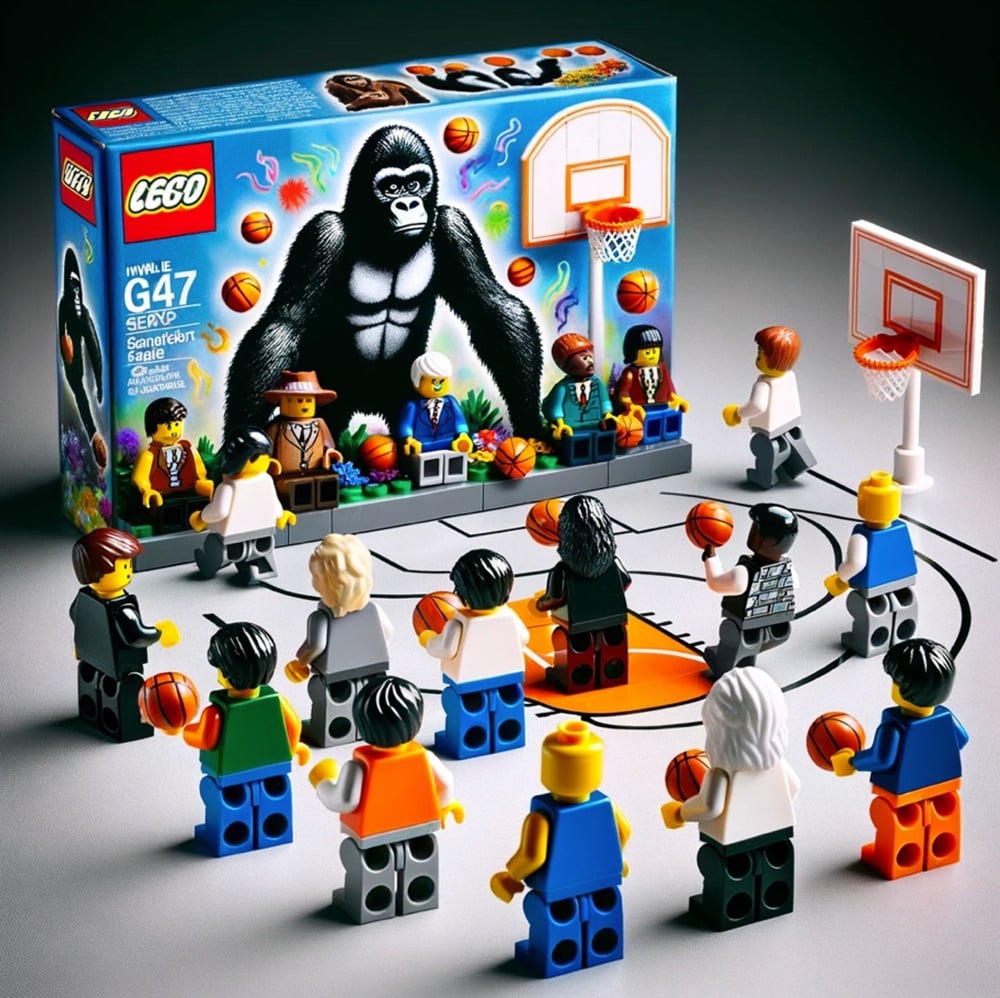
I love these depictions of famous moments in psychology and cognitive science via @tomerullman. From top to bottom: the Stanford prison experiment, the marshmallow test, and the selective attention test.
These didn’t track as AI-generated at first…and then I tried to read the text — THE STANFORD PRESERIBENT. You can see the whole set on Bluesky (if you have access).
The four members of the Beatles, assisted by machine learning technology, come together one last time to record a song together, working off of a demo tape recorded by John Lennon in the 70s.
The long mythologised John Lennon demo was first worked on in February 1995 by Paul, George and Ringo as part of The Beatles Anthology project but it remained unfinished, partly because of the impossible technological challenges involved in working with the vocal John had recorded on tape in the 1970s. For years it looked like the song could never be completed.
But in 2022 there was a stroke of serendipity. A software system developed by Peter Jackson and his team, used throughout the production of the documentary series Get Back, finally opened the way for the uncoupling of John’s vocal from his piano part. As a result, the original recording could be brought to life and worked on anew with contributions from all four Beatles.
Here’s the result, a song called Now and Then:
I enjoyed Ben Lindbergh’s take on the new song and its recording.
Ok, this is a little bit bonkers: HeyGen’s Video Translate tool will convert videos of people speaking into videos of them speaking one of several different languages (incl. English, Spanish, Hindi, and French) with matching mouth movements. Check out their brief demo of Marques Brownlee speaking Spanish & Tim Cook speaking Hindi or this video of a YouTuber trying it out:
The results are definitely in the category of “indistinguishable from magic”.
Photographs have always been an imperfect reproduction of real life — see the story of Dorothea Lange’s Migrant Mother or Ansel Adams’ extensive dark room work — but the seemingly boundless alterations offered by current & future AI editing tools will allow almost anyone to turn their photos (or should I say “photos”) into whatever they wish. In this video, Evan Puschak briefly explores what AI-altered photos might do to our memories.
I was surprised he didn’t mention the theory that when a past experience is remembered, that memory is altered in the human brain — that is, “very act of remembering can change our memories”. I think I first heard about this on Radiolab more than 16 years ago. So maybe looking at photos extensively altered by AI could extensively alter those same memories in our brains, actually making us unable to recall anything even remotely close to what “really” happened. Fun!
But also, one could imagine this as a powerful way to treat PTSD, etc. Or to brainwash someone! Or an entire populace… Here’s Hannah Arendt on constantly being lied to:
If everybody always lies to you, the consequence is not that you believe the lies, but rather that nobody believes anything any longer. This is because lies, by their very nature, have to be changed, and a lying government has constantly to rewrite its own history. On the receiving end you get not only one lie — a lie which you could go on for the rest of your days — but you get a great number of lies, depending on how the political wind blows. And a people that no longer can believe anything cannot make up its mind. It is deprived not only of its capacity to act but also of its capacity to think and to judge. And with such a people you can then do what you please.
As I said in response to this quote in a post about deepfakes:
This is the incredible and interesting and dangerous thing about the combination of our current technology, the internet, and mass media: “a lying government” is no longer necessary — we’re doing it to ourselves and anyone with sufficient motivation will be able to take advantage of people without the capacity to think and judge.
P.S. I lol’d too hard at his deadpan description of “the late Thanos”. RIP, big fella.
Newer posts
Older posts




Socials & More