



Castello Cavalcanti
Wes Anderson did a short film for Prada. The film contains race cars, Jason Schwartzman, Italy, and tweeness.
(via digg)

This site is made possible by member support. 💞
Big thanks to Arcustech for hosting the site and offering amazing tech support.
When you buy through links on kottke.org, I may earn an affiliate commission. Thanks for supporting the site!
kottke.org. home of fine hypertext products since 1998.
Beloved by 86.47% of the web.
Wes Anderson did a short film for Prada. The film contains race cars, Jason Schwartzman, Italy, and tweeness.
(via digg)
This video visualization of 15 different sorting algorithms is mesmerizing. (Don’t forget the sound.)
An explanation of the process. You can play with several different kinds of sorts here.
Felix Salmon shares perhaps the most reliable technique for turning money into happiness: buying and drinking expensive wine.
But here’s the trick: if you can’t buy happiness by spending more money on higher quality, then you can buy happiness by spending money taking advantage of all the reasons why people still engage in blind tastings, despite the fact that they are a very bad way to judge a wine’s quality. If you know what the wine you’re tasting is, if you know where it comes from, if you know who made it, if you’ve met the winemaker, and in general, if you know how expensive it is — then that knowledge deeply affects — nearly always to the upside — the way in which you taste and appreciate the wine in question.
Mark Wagner constructs intricate works of collage out of pieces of US $1 bills.
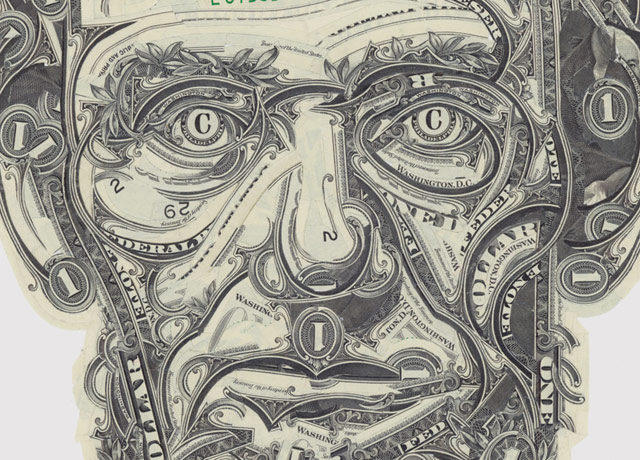
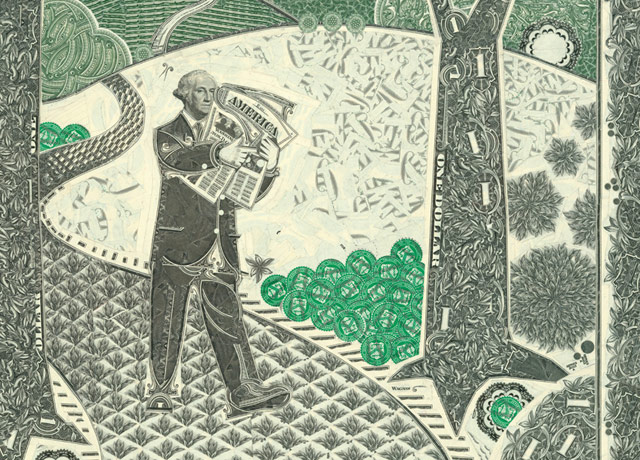
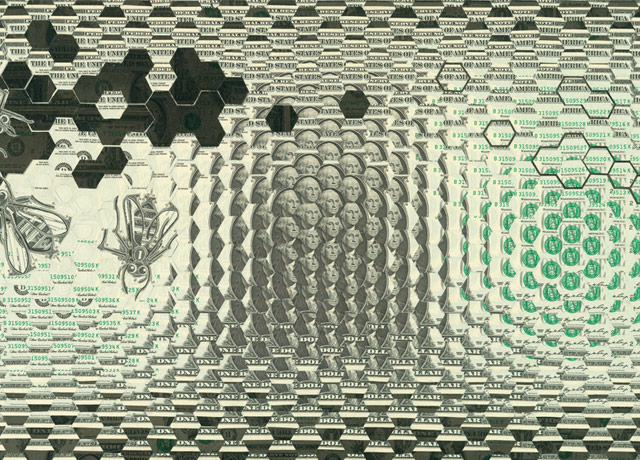
I love that last one. No Photoshop…he cuts and assembles the pieces by hand:
Hans Bethe was a giant in the field of nuclear physics. He rubbed shoulders with Einstein, Bohr, and Pauli, was head of the Theoretical Division of the US atomic bomb project, and was awarded a Nobel Prize. In 1999, at the age of 93, Bethe gave a series of three lectures to the residents of his retirement community near Cornell University, where he had taught since 1935. Video of the lectures is available on the Cornell website.
In the first lecture, Bethe covers the development of the “old quantum theory”, covering the work of Max Planck and Niels Bohr. In the second and third lectures, he relates how modern quantum mechanics was developed, with a healthy amount of personal recollection along the way:
Professor Bethe offers personal anecdotes about many of the famous names commonly associated with quantum physics, including Bohr, Heisenberg, Born, Pauli, de Broglie, Schrödinger, and Dirac.
Without a doubt, this is the most high-power presentation ever made at a retirement home. (via @stevenstrogatz)
One of my favorite books on technology, Tom Standage’s The Victorian Internet, was adapted into a TV documentary. It is now available on YouTube:
The Victorian Internet tells the colorful story of the telegraph’s creation and remarkable impact, and of the visionaries, oddballs, and eccentrics who pioneered it, from the eighteenth-century French scientist Jean-Antoine Nollet to Samuel F. B. Morse and Thomas Edison. The electric telegraph nullified distance and shrank the world quicker and further than ever before or since, and its story mirrors and predicts that of the Internet in numerous ways.
Writing in the Times, Frank Bruni notes the increasing tendency in the US to provide various levels of service for money.
Much has been made of commercial flights these days, with all those divisions between first class and coach. For various supplements or with various deals, you can get a few more inches of legroom or, shy of that, a prime aisle seat. You can get to board earlier or later, and thus hoard or miss out on the overhead bins. Will it be long before there’s a ranked queue for the bathroom? I’m not even sure I’m kidding.
It’s not that pecking orders or badges of affluence are anything new. Our homes, cars, clubs and clothes have long been advertisements of our economic clout, used and perceived that way.
But lately, the places and ways in which Americans are economically segregated and stratified have multiplied, with microclimates of exclusivity popping up everywhere. The plane mirrors the sports arena, the theater, the gym. Is it any wonder that class tensions simmer? In a country of rising income inequality and an economy that’s moved from manufacturing to services, one thing we definitely make in abundance is distinctions.
Reminds me of Tom Junod’s piece in Esquire about waiting in line as an expression of American democracy.
Apparently, an Englishman named Leonard Sim took his family to Disneyland a few years ago, and his vacation was ruined by waiting in line. He invented something called the Flash Pass, and then sold it to an English company called Lo-Q — as in “Low Queue” — which contracted it to Whitewater. So now, when you go to Whitewater and many other American amusement parks, you pay for parking ($15, at Whitewater), and then for admission ($37.50, for any human being over 48 inches tall), and finally for a locker ($16), and then, once you’re inside, you can pay an extra $30 for a “standard” Flash Pass or $40 for the “gold.” And then you can cut the lines.
It sounds like an innovative answer to the problem that everybody faces at an amusement park, and one perfectly in keeping with the approaches currently in place at airports and even on some crowded American highways — perfectly in keeping with the two-tiering of America. You can pay for one level of access, or you can pay for another. If you have the means, you can even pay for freedom. There’s only one problem: Cutting the line is cheating, and everyone knows it. Children know it most acutely, know it in their bones, and so when they’ve been waiting on a line for a half-hour and a family sporting yellow plastic Flash Passes on their wrists walks up and steps in front of them, they can’t help asking why that family has been permitted the privilege of perpetrating what looks like an obvious injustice. And then you have to explain not just that they paid for it but that you haven’t paid enough — that the $100 or so that you’ve ponied up was just enough to teach your children that they are second- or third-class citizens.
In 1898, an editor named Clement K. Shorter made a list of the 100 best novels (with an additional limit of one/author).
1. Don Quixote - 1604 - Miguel de Cervantes
2. The Holy War - 1682 - John Bunyan
3. Gil Blas - 1715 - Alain René le Sage
4. Robinson Crusoe - 1719 - Daniel Defoe
5. Gulliver’s Travels - 1726 - Jonathan Swift
6. Roderick Random - 1748 - Tobias Smollett
7. Clarissa - 1749 - Samuel Richardson
8. Tom Jones - 1749 - Henry Fielding
9. Candide - 1756 - Françoise de Voltaire
10. Rasselas - 1759 - Samuel Johnson
So much on there I’ve never even heard of. Compare this list with that of the best novels of the 20th century…how many of those novels and authors will readers be scratching their heads over in 2113? See also a contemporary list of the best books from before 1900. (via mr)
Google and NASA recently bought a D-Wave quantum computer. But according to a piece by Sophie Bushwick published on the Physics Buzz Blog, there isn’t scientific consensus on whether the computer is actually using quantum effects to calculate.
In theory, quantum computers can perform calculations far faster than their classical counterparts to solve incredibly complex problems. They do this by storing information in quantum bits, or qubits.
At any given moment, each of a classical computer’s bits can only be in an “on” or an “off” state. They exist inside conventional electronic circuits, which follow the 19th-century rules of classical physics. A qubit, on the other hand, can be created with an electron, or inside a superconducting loop. Obeying the counterintuitive logic of quantum mechanics, a qubit can act as if it’s “on” and “off” simultaneously. It can also become tightly linked to the state of its fellow qubits, a situation called entanglement. These are two of the unusual properties that enable quantum computers to test multiple solutions at the same time.
But in practice, a physical quantum computer is incredibly difficult to run. Entanglement is delicate, and very easily disrupted by outside influences. Add more qubits to increase the device’s calculating power, and it becomes more difficult to maintain entanglement.
(via fine structure)
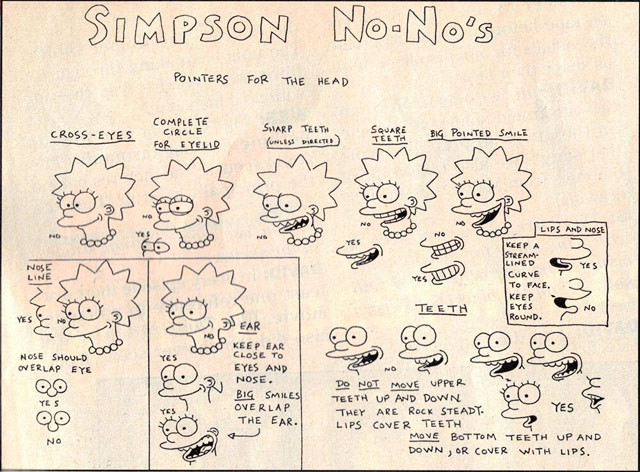
Chris Pattle has constructed Simpsons characters completely out of CSS.

We’ve come a long way from #cccccc. And it looks like Pattle avoided the Simpson No-Nos.
Esquire has Tom Junod writing profiles of the most famous men in Hollywood: Leonard DiCaprio, Matt Damon, and Brad Pitt. This month, Junod tackles George Clooney, who despite not having a big box office hit until Gravity, is right up there with Pitt, Cruise, and Hanks in pure wattage of stardom.
He has other houses. He has one, famously, on Lake Como, in Italy, and he has built another in Cabo. In this, he is not so much of a throwback-after all, Leonardo DiCaprio has a house in Cabo. Indeed, Clooney and DiCaprio once ran into each other in Cabo and struck up a conversation based on their common interest in basketball. They each have ongoing games, and their ongoing games have attained a celebrity of their own. Clooney suggested they might play someday. DiCaprio said sure, but felt compelled to add, “You know, we’re pretty serious.”
They played at a neighborhood court. “You know, I can play,” Clooney says in his living room. “I’m not great, by any means, but I played high school basketball, and I know I can play. I also know that you don’t talk shit unless you can play. And the thing about playing Leo is you have all these guys talking shit. We get there, and there’s this guy, Danny A I think his name is. Danny A is this club kid from New York. And he comes up to me and says, ‘We played once at Chelsea Piers. I kicked your ass.’ I said, ‘I’ve only played at Chelsea Piers once in my life and ran the table. So if we played, you didn’t kick anybody’s ass.’ And so then we’re watching them warm up, and they’re doing this weave around the court, and one of the guys I play with says, ‘You know we’re going to kill these guys, right?’ Because they can’t play at all. We’re all like fifty years old, and we beat them three straight: 11-0, 11-0, 11-0. And the discrepancy between their game and how they talked about their game made me think of how important it is to have someone in your life to tell you what’s what. I’m not sure if Leo has someone like that.”
I posted a video earlier today of a Super Cub airplane landing on the side of a mountain. Super Cubs are ideal for that undertaking because of their low stall speed and short take-off and landing distances. But I had no idea you could land and take off in one in the space of 20 feet.
Never seen a plane do that before…well, aside from tiny model planes. What an incredible power-to-weight ratio that plane must have. You can seriously land these things anywhere, almost like a helicopter. Wanna go fly fishing? Just set it down on the banks of a stream:
Or on a gravel bar in a river:
These planes are referred to as STOL (short takeoff and landing) aircraft; here’s some detail on how they work. (via @alper)
Update: Is this the shortest takeoff in history?
Six feet. Six. (via @mikebee)
When you read the title of this video, “Super Cub landing on windy mt. top”, you’re thinking, ok, there’s a runway on the side of this mountain and it’s gonna be a little dicey but not a big deal. But then the video starts and there’s just a steep snowy mountain and no runway and it’s uphill and you’re like, WHAT JUST HAPPENED?
I looked up info on the plane and if you’re going to land on the side of a mountain, the Super Cub is the plane for you. It can take off in as little as 200 feet, land in 300-400 feet, and has a stall speed of only 43 mph. The guy lands uphill and takes off downhill in this video and looks like he needed less than 100 feet in each case. (via ★mouser)
Just warning you, this piece by Ariel Levy will wreck you, put you back together, and wreck you again. Damn powerful beautiful writing.
My doctor told me that it was fine to fly up until the third trimester, so when I was five months pregnant I decided to take one last big trip. It would be at least a year, maybe two, before I’d be able to leave home for weeks on end and feel the elation of a new place revealing itself. (It’s like having a new lover-even the parts you aren’t crazy about have the crackling fascination of the unfamiliar.) Just before Thanksgiving, I went to Mongolia.
People were alarmed when I told them where I was going, but I was pleased with myself. I liked the idea of being the kind of woman who’d go to the Gobi Desert pregnant, just as, at twenty-two, I’d liked the idea of being the kind of girl who’d go to India by herself. And I liked the idea of telling my kid, “When you were inside me, we went to see the edge of the earth.” I wasn’t truly scared of anything but the Mongolian winter. The tourist season winds down in October, and by late November, when I got on the plane, the nights drop to twenty degrees below zero. But I was prepared: I’d bought snow pants big enough to fit around my convex gut and long underwear two sizes larger than I usually wear.
(via @DavidGrann)
In 1999, Sugata Mitra left a computer in a New Delhi slum and watched what the neighborhood kids would do with it. With no prior computer experience, they quickly figured out how to work it. In subsequent experiments, Mitra used computers and very little adult oversight (what we refer to as “education”) to teach children all sorts of different things.
Over the years, Mitra got more ambitious. For a study published in 2010, he loaded a computer with molecular biology materials and set it up in Kalikuppam, a village in southern India. He selected a small group of 10- to 14-year-olds and told them there was some interesting stuff on the computer, and might they take a look? Then he applied his new pedagogical method: He said no more and left.
Over the next 75 days, the children worked out how to use the computer and began to learn. When Mitra returned, he administered a written test on molecular biology. The kids answered about one in four questions correctly. After another 75 days, with the encouragement of a friendly local, they were getting every other question right. “If you put a computer in front of children and remove all other adult restrictions, they will self-organize around it,” Mitra says, “like bees around a flower.”
It’s tempting to conclude that the computer is the magical ingredient here: just add computers and children can learn anything. But if the story of Sergio Juárez Correa’s fifth-grade class is any indication, the secret is the kids organizing themselves to learn.
For Juárez Correa it was simultaneously thrilling and a bit scary. In Finland, teachers underwent years of training to learn how to orchestrate this new style of learning; he was winging it. He began experimenting with different ways of posing open-ended questions on subjects ranging from the volume of cubes to multiplying fractions. “The volume of a square-based prism is the area of the base times the height. The volume of a square-based pyramid is that formula divided by three,” he said one morning. “Why do you think that is?”
He walked around the room, saying little. It was fascinating to watch the kids approach the answer. They were working in teams and had models of various shapes to look at and play with. The team led by Usiel Lemus Aquino, a short boy with an ever-present hopeful expression, hit on the idea of drawing the different shapes-prisms and pyramids. By layering the drawings on top of each other, they began to divine the answer. Juárez Correa let the kids talk freely. It was a noisy, slightly chaotic environment-exactly the opposite of the sort of factory-friendly discipline that teachers were expected to impose. But within 20 minutes, they had come up with the answer.
“Three pyramids fit in one prism,” Usiel observed, speaking for the group. “So the volume of a pyramid must be the volume of a prism divided by three.”
Archer Lars Andersen can shoot 10 arrows in less than 5 seconds, without sacrificing power or accuracy. Andersen learned his technique by studying ancient archery practices…the key is holding the extra arrows in the hand and instinctive shooting.
Update: Anderson is back with a new video and new skills, like incoming shooting arrows with arrows of his own.
(via @psillin & @gavinpurcell)
I don’t wear cologne (or colon) or really care for the smell of perfume, but I love reading about perfume and scent. Roja Dove is an independent perfumer who creates bespoke scents for well-heeled clientele.
His custom-made leather Dunhill case holds small eyedropper bottles with the 238 tinctures, resinoids, absolutes and essential oils that comprise the “building blocks of every single fragrance that you can think of.” It also folds neatly into a piece of hand luggage should a client require him to pay a flying visit.
“Most of my formulas are quite short, normally between 20 and 50 ingredients,” he says. “It’s like painting; if you use too many colors, all you get is a dirty gray.”
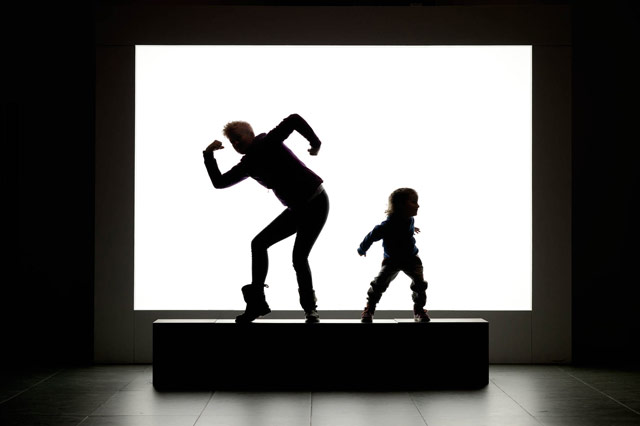
An exhibition from Philip Worthington at MoMA last year turned people’s shadows into monsters. Joe Holmes turned his lens away from the shadows and instead captured the silhouettes of museums goers in their attempts to make shadows.

Hall of Famer Tony Dorsett is among a growing group of former NFL players who have been diagnosed with diseases caused by years of head trauma and other injuries.
The former Cowboys running back, now 59, said that when he took his Oct. 21 flight from Dallas to Los Angeles for testing, he repeatedly struggled to remember why he was aboard the plane and where he was going. Such episodes, he said, are commonplace when he travels.
Dorsett said he also gets lost when he drives his two youngest daughters, ages 15 and 10, to their soccer and volleyball games.
“I’ve got to take them to places that I’ve been going to for many, many, many years, and then I don’t know how to get there,” he said.
The 1976 Heisman Trophy winner and eighth all-time leading NFL rusher said he has trouble controlling his emotions and is prone to outbursts at his wife and daughters.
“It’s painful, man, for my daughters to say they’re scared of me.” After a long pause, he tearfully reiterated, “It’s painful.”
And I missed this last year, but former Bears QB Jim McMahon is suffering from early-stage dementia.
In an interview with Fox affiliate WFLD-TV, aired Wednesday, the 53-year-old McMahon says he knows where he’s going when in an airport. But when he meets people, “I’m asking two minutes later, ‘Who was that?’
“When my friends call and leave me a message … I’ll read it and delete it before I respond and then I forget who called and left me a message.”
McMahon says he is not worried about his mind withering away. He says he still reads a lot and is doing other things to keep his mind active. However, he said he doesn’t know whether he is getting worse.
These stories are just going to keep coming. Perhaps a true tipping point will come when one of the league’s past megastars is dianosed with CTE…if Brett Favre or Dan Marino or John Elway or Troy Aikman or Ray Lewis or any of the other former players that appear regularly on NFL game broadcasts announces he has CTE or dementia, maybe then the league will take real action? Or not? (via df)
Update: Former NFL player Kevin Turner died at 46 in March and his doctors say he had “advanced CTE” from repeated head trauma.
“This is not ALS; this is CTE,” McKee said. “The severity of Mr. Turner’s CTE was extraordinary and unprecedented for an athlete who died in his 40s.”
Turner died in March at age 46. He had spoken of his certainty that his declining physical state leading to his death was due to his football career. Doctors said they believed he had such advanced CTE because he endured decades of head traumas while playing football.
Hanukkah and Thanksgiving overlap this year…and then almost never again orig. from Jan 17, 2013
* Q: Wha? A: These previously published entries have been updated with new information in the last 24 hours. You can find past updates here.
Elizabeth Kolbert on yet another report which says that the future effects of anthropogenic climate change will be irreversible and catastrophic.
Promoting “preparedness” is doubtless a good idea. As the executive order notes, climate impacts — which include, but are not limited to, heat waves, heavier downpours, and an increase in the number and intensity of wildfires — are “already affecting communities, natural resources, ecosystems, economies, and public health across the Nation.” However, one of the dangers of this enterprise is that it tends to presuppose, in a Boy Scout-ish sort of way, that “preparedness” is possible.
As we merrily roll along, radically altering the planet, we are, as the leaked I.P.C.C. report makes clear, increasingly in danger of committing ourselves to outcomes that will simply overwhelm societies’ ability to adapt. Certainly they will overwhelm the abilities of frogs and trees and birds to adapt. Thus, any genuine “preparedness” strategy must include averting those eventualities for which preparation is impossible. This is not something that the President can do by executive order, but it’s something he ought to be pursuing with every other tool.
In linking to the piece, Philip Gourevitch notes:
This is simply the most important & urgent issue in our time & will be for as long as there is a foreseeable future
I wonder… what it’s gonna take for the world’s governments to lurch into action on this? Or will they ever? Years of iron-clad scientific consensus isn’t doing it. Sandy didn’t do it. Heat waves, wildfires, and floods seem to have little effect. The melting Arctic, ha! The risk to food and water supplies? Not really. For fun, here’s a Guardian piece from six years ago on 2007’s IPCC report, the same report Kolbert is referring to above.
Sea levels will rise over the century by around half a metre; snow will disappear from all but the highest mountains; deserts will spread; oceans become acidic, leading to the destruction of coral reefs and atolls; and deadly heatwaves will become more prevalent.
The impact will be catastrophic, forcing hundreds of millions of people to flee their devastated homelands, particularly in tropical, low-lying areas, while creating waves of immigrants whose movements will strain the economies of even the most affluent countries.
‘The really chilling thing about the IPCC report is that it is the work of several thousand climate experts who have widely differing views about how greenhouse gases will have their effect. Some think they will have a major impact, others a lesser role. Each paragraph of this report was therefore argued over and scrutinised intensely. Only points that were considered indisputable survived this process. This is a very conservative document — that’s what makes it so scary,’ said one senior UK climate expert.
It’s the same shit! It’s absurd.
Amazon introduced their Amazon Source program today, which enables indie booksellers to sell Kindles and receive a cut of future Kindle book sales made on those devices.
Retailers that are part of the program can use Amazon Source (http://source.amazon.com) to purchase Kindle devices and accessories for resale. Retailers can choose between two programs:
1) Bookseller Program: Earn 10% of the price of every Kindle book purchased by their customers from their Kindle devices for two years from device purchase. This is in addition to the discount the bookseller receives when purchasing the devices and accessories from Amazon.
2) General Retail Program: Receive a larger discount when purchasing the devices from Amazon, but do not receive revenue from their customers’ Kindle book purchases.
Amazon Source aside, I’ve often wondered if an independent bookstore could sell their usual selection of paper books but also sell Kindle books to those who wanted them. The bookstore would basically buy the books as gifts for the customer through Amazon and take the affiliate fee (which is 8.5% with sufficient monthly sales volume) as profit. (The fee on magazine subscriptions is 25%!) I love frequenting indie bookshops — the browsing experience of a good bookstore is still far superior to that on Amazon or a Kindle — but I don’t buy paper books anymore. So I usually leave bookstores with a list of 2-3 books I later buy on Amazon…it would be nice if the bookstore gets a cut of that action. If it worked well enough, the physical books in the store would be more like advertisements for the digital copies than salable items and you could change how you stock the store…less overall inventory or a more varied inventory with far less overhead.
Knowing next to nothing about the economics of bookstores, I don’t know how well that would actually work, but it would certainly be an interesting experiment. (via @tcarmody)
Earlier this year, Hogwarts School of Witchcraft and Wizardry was subjected to a review by the Board of Education and was found wanting in several areas.
Pupils at Hogwarts have access to a reasonably wide range of esoteric qualifications, suited to its key demographic. As an independent school, it does not have to follow the National Curriculum closely; however, it is disappointing to note that basic requirements such as English, Mathematics and Religious Education are all lacking or entirely missing from the school’s syllabus. This has had adverse effects on all students, many of whom have never even been taught basic KS1 or 2 literacy. A few students have attended state or independent primary schools, and these students typically perform very well in contrast to their peers.
The majority of students appear to be under-performing, with most pupils struggling in all their lessons, most of which appear to be set at too challenging a level. One particular class, which seemed to be based on A-Level chemistry, proved too difficult for even the most proficient students. Only one pupil managed to complete the lesson objectives, mainly thanks to his use of an annotated text book.
(via slate)
A video from Microsoft Research showcases a system that uses the Kinect motion sensing input device to translate between American Sign Language and other sign and spoken languages.
You can read more about the system at Microsoft Research.
From the Indiana Daily Student, the last days in the life of a Waffle House in Bloomington, Indiana.
Most of the students had stopped visiting years ago. The smoking ban forced out the puffers. Many of the regulars grew so old that they died or went to nursing homes.
Once Bud decided to close, it all slipped away even faster. Some of his staff had taken other jobs. The gumballs emptied out of the shiny red machine. No one bothered to mark the white board with the daily special.
They would close at precisely 3 p.m. Bud checked his watch, ignoring the broken wall clock, its hands frozen for more years than he could remember, stuck in time.
It suited the place.
Care of Google Maps, here’s the Waffle House before it got torn down. (via unlikely words)

If all the glaciers and snow and ice in the world melted, the sea level would rise 216 feet and, as this National Geographic map of the world shows, things would look a little different.
There are more than five million cubic miles of ice on Earth, and some scientists say it would take more than 5,000 years to melt it all. If we continue adding carbon to the atmosphere, we’ll very likely create an ice-free planet, with an average temperature of perhaps 80 degrees Fahrenheit instead of the current 58.
See also Flood Maps.
There’s little doubt that meditation and mindfulness are extremely valuable. But these days, the labels are being attached to an increasing number of products and activities. And it’s no coincidence that many ancient practices are now getting a ton of buzz as our devices make it less and less likely that we’ll take the time to chill out, even for a few minutes a day. One of the ironies of the era is that you can now download apps that promise to help you meditate and be more mindful. It’s a familiar trend. Technology strips away something important. Then technology is created to fill the void. From the NYT: Mindfulness — getting its share of attention.
And here’s a Wired piece Noah Schactman wrote last summer: Meditation and mindfulness are the new rage in Silicon Valley. And it’s not just about inner peace — it’s about getting ahead. Om, Om, Ugh.
This is fun: a selection of pop songs separated into their component tracks (vocals, bass, drums, etc.). You can turn parts on and off as the songs play. Featured artists include The Beatles, Spice Girls, Radiohead, and Amy Winehouse.
The text/interface is in French…just click the dark grey link labelled “> Chanson” for the song listing. (via @ajsheets)
For the sufficiently skilled front-end loader driver, doing a front wheelie with a 20-ton machine is a piece of cake.
Got this from Modern Farmer’s selection of “Jaw-Dropping Russian Tractor Videos”; the other one I liked from the list is this guy who souped up his tractor with a car engine and then does donuts in his field.
Joe Posnanski thinks about how baseball would change if MLB moved to a 16-game schedule like the the NFL. I love stuff like this.
4. Baseball would become dramatically more violent.
I’m not 100% certain of this, of course. But I am probably 75% certain. Right now, we don’t tend to think of baseball as a contact sport. There IS contact — plays at the plate, double-play meetings at second base, the occasional hit-by pitch and ensuing bench-clear — but it’s mostly tangential to the game. Football, meanwhile, is violent at its core. Or anyway, that’s what we think now.
Except — baseball was extremely violent in its early days. And I think that if the game was played just once a week, if you faced each team only once or twice a season, if every game was critical, there would be a lot more violence in baseball. Collisions at the plate would be intensified. Nobody would concede the double play without really taking out the fielder. Pitchers would be much more likely to send message pitches. And I think you would probably find violence where there is none right now.
(via mr)
New Zealand journalist Duncan Greive caught onto Lorde early and has written the self-styled “definitive inside account of Ella Yelich-O’Conner’s rise to the top”.
For advertising, Maclachlan calls in Alistair Cain, Universal New Zealand’s head of marketing, and plays an early cut of the television commercial on his computer. Ella wants to keep the date rendered in Roman numerals. It looks crazy (XXVII.IX.MMXIII). She won’t be moved. After an hour, they’re done.
Afterwards, Cain says that in 20 years in the industry he’s never come across an artist so engaged with the minutiae of their presentation. He points up at a giant poster of Lana Del Rey. “With her, we could do whatever we liked,” he says.
Ella is frequently compared to Del Rey, though it infuriates her. Both are white women making pop music soaked in the rhythm and attitude of hip-hop. But Del Rey has a much more conventional narrative — she had an image makeover prior to her breakout Born To Die album, and co-writes her songs with some of the biggest producers and writers in the industry.
Ella’s songs, meanwhile, are very much her vision, and hers alone.
For the New Yorker, B.J. Novak writes about the guy who invented the calendar.
February 1st-Another small fuckup: I put an extra “r” in all the copies of the calendar I handed out, even though I already told everyone the next month coming was called Febuary. But Alice came up with the best solution! She said, “Just tell everyone it’s spelled ‘February’ but pronounced ‘Feb-u-ary.’ That way, they’ll feel stupid!” Alice is the best.
February 14th-Alice stuff weird. Tonight we were having a nice dinner at the same place we always go, but she was unusually quiet. Finally, I asked if anything was wrong, and she said, “Do you know what day it is today?” I said, “Yes, of course I do, I invented the calendar. It’s February 14th. Why?” She smiled a really tight smile, said, “Yes. Yes, it is,” and then walked out. What’s that about?
February 15th-So cold.
February 28th-I hate this month. I can’t take one more day of it. This month will just have to be shorter than the rest, and if people don’t like it they can go fuck themselves.
A mouse finds a cracker about his own size and thinks, “this is great, I’ll be able to eat for a week!” But he can’t quite get the cracker up and over the short ledge that leads back to his hole. But he doesn’t give up that easily:
(via ★interesting)
It’s not up on their web site or YouTube yet, but I’m pretty sure this is a prototype of a new dancing robot built by Boston Dynamics, makers of the Big Dog, Cheetah, and Petman robots.
Looks similar to Atlas or Petman, but way more advanced…how did they pack all of the circuitry and power supplies into such a small yet realistic-looking housing? (via devour)
Some Hollywood people are making a Lego movie called The Lego Movie. Batman’s in it and the plot is from The Matrix. I can’t decide if it looks horrible or amazing.
An ordinary guy named Emmet (Chris Pratt) is mistaken as being the Master Builder, the one who can save the Lego universe. With the aid of an old mystic named Vitruvius (Morgan Freeman), a tough young lady named Wyldstyle (Elizabeth Banks), and Batman (Will Arnett), Emmet will fight to defeat the evil tyrant Lord Business (Will Ferrell) who is bent on destroying the Lego universe by gluing it together.
The Wikipedia page notes The Lego Movie Video Game will be released in conjunction with the movie. Which, if you’re following along, is a video game based on a movie based on stacking toys & figures containing characters based on other movies that are based on comic books. I can’t wait for The Lego Movie Videogame Comic Book Movie that comes out in 2019.
Roland Deschane took a few paintings by cheeseball artist Thomas Kinkade and incorporated Star Wars characters into them.

(via @Coudal)
From Seth Stevenson, an appreciation of leaving social occasions without saying goodbye.
These sorts of goodbyes inevitably devolve into awkward small talk that lasts too long and then peters out. We vow vaguely to meet again, then linger for a moment, thinking of something else we might say before the whole exchange fizzles and we shuffle apart. Repeat this several times, at a social outing delightfully filled with your acquaintances, and it starts to sap a not inconsiderable portion of that delight.

Socials & More