


The Oreo separator machine
And the TED Prize (“awarded to an extraordinary individual with a creative and bold vision to spark global change”) this year goes to this guy, who invented a machine for separating Oreos:
Congratulations! (thx, brad)

This site is made possible by member support. 💞
Big thanks to Arcustech for hosting the site and offering amazing tech support.
When you buy through links on kottke.org, I may earn an affiliate commission. Thanks for supporting the site!
kottke.org. home of fine hypertext products since 1998.
Beloved by 86.47% of the web.
And the TED Prize (“awarded to an extraordinary individual with a creative and bold vision to spark global change”) this year goes to this guy, who invented a machine for separating Oreos:
Congratulations! (thx, brad)
Tony McCabe demonstrates how to jump on eggs without breaking them.
If this is what Britain was like in the 70s, it’s possible that Monty Python’s Flying Circus was a documentary. (via @scottlamb)

If this photo series from 1950 of the interior of the White House being ripped out so that the building could be structurally reinforced isn’t an apt metaphor for the current state of American politics, I don’t know what is.
Experts called the third floor of the White House “an outstanding example of a firetrap.” The result of a federally commissioned report found the mansion’s plumbing “makeshift and unsanitary,” while “the structural deterioration [was] in ‘appalling degree,’ and threatening complete collapse.” The congressional commission on the matter was considering the option of abandoning the structure altogether in favor of a built-from-scratch mansion, but President Truman lobbied for the restoration.
“It perhaps would be more economical from a purely financial standpoint to raze the building and to rebuild completely,” he testified to Congress in February 1949. “In doing so, however, there would be destroyed a building of tremendous historical significance in the growth of the nation.”
So it had to be gutted. Completely. Every piece of the interior, including the walls, had to be removed and put in storage. The outside of the structure-reinforced by new concrete columns-was all that remained.
(via digg)
Wearable computing is heating up. Jawbone and Nike are vying for your wrists, Google and Lat Ware want your face, Fitbit owns the hips, and Apple might want to make your shoes smarter. But one of the most intriguing demos I’ve seen, if the footage in the video is to be believed, is the Myo gesture control armband.
It’s an eye-popping demo. The copy on the site reads “unleash your inner Jedi” and you pretty much do look like Obi-Wan using the thing. Which is to say, like a crazy person cosplaying Star Wars in the middle of the street. Adam Lisagor called Google Glass a “Segway for your face” back in April. The Segway was another great idea on paper that failed in part because of human vanity. Segways weren’t cool…you looked like a dork riding one. You’re gonna look like a dork wearing Google Glass. You’re gonna look like a dork unlocking your car with a swipe of your Myo-enabled arm.
But the uncool factor can be overridden in various ways. Nike can make anyone wear anything, especially if it’s packaged like a watch with superpowers. A few years ago, you looked like a dork wearing headphones in public but Apple made it cool. Beats By Dre made wearing huge over-the-ear headphones in public cool a few years later. You look like a dork wearing a Bluetooth headset and talking to yourself, but they are cheap and useful enough that it doesn’t matter. Mobile phone usage in public used to appear very strange…for awhile it was difficult to tell the brokers-in-a-hurry from the mentally unstable homeless folks muttering to themselves.
That’s the challenge for Google Glass and Myo: are these things useful enough and cheap enough to overcome that dork factor or can they somehow be made cool? Because if they aren’t and you can’t, no one wants to be seen using a Nintendo Power Glove in public and no amount of extreme sports dubstep transitions can save you.
The New Yorker’s John Kenney imagines what the first episode of the next season of Downton Abbey might be like, following on from the past season’s many twists and turns.
TOM BRANSON
Lady Crawley appears to have choked to death on a big hunk of meat.THE DOWAGER COUNTESS
The lengths that woman will go to for attention.LADY GRANTHAM
I think we’ll go through now, Carson.
What are all those models in the J.Crew catalog doing anyway? By cleverly piecing together narratives from catalog photographs, Meghan O’Neill imagines that they are solving crimes, misbehaving on honeymoons, and such. Here’s the most recent episode:
(via @sippey)

I saw this In Focus feature on the weapons of the Syrian rebels last week, and I can’t stop thinking about it. Some of these photos show primitive slingshots or catapults, and then there’s a machine gun controlled by what looks like a Playstation controller. On the one hand it’s so cool what they’ve created on a maker level with limited resources, and on the other, way more important hand, they’ve created these devices to try to kill people who are trying to kill them. These are weapons intended to destroy humans, and it doesn’t feel good to be fascinated by them when thinking about that.
Ross Andersen, whose interview with Nick Bostrom I linked to last week, has a marvelous new essay in Aeon about Bostrom and some of his colleagues and their views on the potential extinction of humanity. This bit of the essay is the most harrowing thing I’ve read in months:
No rational human community would hand over the reins of its civilisation to an AI. Nor would many build a genie AI, an uber-engineer that could grant wishes by summoning new technologies out of the ether. But some day, someone might think it was safe to build a question-answering AI, a harmless computer cluster whose only tool was a small speaker or a text channel. Bostrom has a name for this theoretical technology, a name that pays tribute to a figure from antiquity, a priestess who once ventured deep into the mountain temple of Apollo, the god of light and rationality, to retrieve his great wisdom. Mythology tells us she delivered this wisdom to the seekers of ancient Greece, in bursts of cryptic poetry. They knew her as Pythia, but we know her as the Oracle of Delphi.
‘Let’s say you have an Oracle AI that makes predictions, or answers engineering questions, or something along those lines,’ Dewey told me. ‘And let’s say the Oracle AI has some goal it wants to achieve. Say you’ve designed it as a reinforcement learner, and you’ve put a button on the side of it, and when it gets an engineering problem right, you press the button and that’s its reward. Its goal is to maximise the number of button presses it receives over the entire future. See, this is the first step where things start to diverge a bit from human expectations. We might expect the Oracle AI to pursue button presses by answering engineering problems correctly. But it might think of other, more efficient ways of securing future button presses. It might start by behaving really well, trying to please us to the best of its ability. Not only would it answer our questions about how to build a flying car, it would add safety features we didn’t think of. Maybe it would usher in a crazy upswing for human civilisation, by extending our lives and getting us to space, and all kinds of good stuff. And as a result we would use it a lot, and we would feed it more and more information about our world.’
‘One day we might ask it how to cure a rare disease that we haven’t beaten yet. Maybe it would give us a gene sequence to print up, a virus designed to attack the disease without disturbing the rest of the body. And so we sequence it out and print it up, and it turns out it’s actually a special-purpose nanofactory that the Oracle AI controls acoustically. Now this thing is running on nanomachines and it can make any kind of technology it wants, so it quickly converts a large fraction of Earth into machines that protect its button, while pressing it as many times per second as possible. After that it’s going to make a list of possible threats to future button presses, a list that humans would likely be at the top of. Then it might take on the threat of potential asteroid impacts, or the eventual expansion of the Sun, both of which could affect its special button. You could see it pursuing this very rapid technology proliferation, where it sets itself up for an eternity of fully maximised button presses. You would have this thing that behaves really well, until it has enough power to create a technology that gives it a decisive advantage — and then it would take that advantage and start doing what it wants to in the world.’
Read the whole thing, even if you have to watch goats yelling like people afterwards, just to cheer yourself back up.
The third episode of the first season of Charlie Brooker’s Black Mirror was called The Entire History of You, in which many people have their entire lives recorded by implants. Brooker’s take on the self-recorded future and Google’s rosier view meet in this video:
Black Mirror is currently in its second season in the UK, with no US release on the horizon. Here’s what one of the season two episodes is about:
A CG character from a TV show is jokingly put forward to become a member of Parliament. The actor behind the character is uneasy about this new political world he’s found himself in, and as the character’s popularity among voters increases things begin to take a turn for the worse.
See also The real Google Glasses.
In a fantastic piece for The London Review of Books adapted from a speech, Hilary Mantel writes about royalty as “breeding stock” and “collections of organs”, among other things.
I used to think that the interesting issue was whether we should have a monarchy or not. But now I think that question is rather like, should we have pandas or not? Our current royal family doesn’t have the difficulties in breeding that pandas do, but pandas and royal persons alike are expensive to conserve and ill-adapted to any modern environment. But aren’t they interesting? Aren’t they nice to look at? Some people find them endearing; some pity them for their precarious situation; everybody stares at them, and however airy the enclosure they inhabit, it’s still a cage.
Mantel has been blasted by the British press for her comments related to Kate Middleton. I demolished Mantel’s Wolf Hall and Bring Up the Bodies and am eagerly awaiting her third book in the Cromwell trilogy.
Mark Seal pieces together an oral history of the making of Pulp Fiction through interviews with Tarantino, Thurman, Jackson, Travolta, Harvey Weinstein, and many others.
When Pulp Fiction thundered into theaters a year later, Stanley Crouch in the Los Angeles Times called it “a high point in a low age.” Time declared, “It hits you like a shot of adrenaline straight to the heart.” In Entertainment Weekly, Owen Gleiberman said it was “nothing less than the reinvention of mainstream American cinema.”
Made for $8.5 million, it earned $214 million worldwide, making it the top-grossing independent film at the time. Roger Ebert called it “the most influential” movie of the 1990s, “so well-written in a scruffy, fanzine way that you want to rub noses in it — the noses of those zombie writers who take ‘screenwriting’ classes that teach them the formulas for ‘hit films.’ “
Pulp Fiction resuscitated the career of John Travolta, made stars of Samuel L. Jackson and Uma Thurman, gave Bruce Willis new muscle at the box office, and turned Harvey and Bob Weinstein, of Miramax, into giants of independent cinema. Harvey calls it “the first independent movie that broke all the rules. It set a new dial on the movie clock.”
“It must be hard to believe that Mr. Tarantino, a mostly self-taught, mostly untested talent who spent his formative years working in a video store, has come up with a work of such depth, wit and blazing originality that it places him in the front ranks of American filmmakers,” wrote Janet Maslin in The New York Times. “You don’t merely enter a theater to see Pulp Fiction: you go down a rabbit hole.” Jon Ronson, critic for The Independent, in England, proclaimed, “Not since the advent of Citizen Kane … has one man appeared from relative obscurity to redefine the art of movie-making.”
So many great things in this piece. Daniel Day-Lewis as Vincent Vega, Samuel L. Jackson had to fight to play Jules, how to replicate a heroin high (“drink as much tequila as you can and lay in a warm pool or tub of water”), Travolta’s contribution to the humor (and choreography) of the film, and the true contents of the briefcase.
I saw Pulp Fiction on opening weekend in a mall theater in Iowa. We had no idea what to expect going in and holy hell the drive home was a weird mixture of shellshocked and wired. (via df)
The On1on gathers news that seems like it should be from The Onion but isn’t. Like “Russian man busted for cheating on girlfriend when she spots him on the Russian version of google maps with the other woman”, “Accused of being gay, Spanish priest challenges Church to measure his anus”, and “China Bans Reincarnation Without Government Permission”. (via waxy)
A popular option for moving companies to offer in Japan is, not only to transport your belongings, but to pack them and unpack them for you.
I’d move to Japan just so I’d never have to pack up my own apartment again… except I’d have to pack up my apartment to get there. (via @ohheygreat)
The entire soundtrack for Shane Carruth’s Upstream Color is available for streaming on SoundCloud.
From what I can gather, Carruth did the soundtrack himself. So for those keeping track at home, Carruth wrote, directed, starred in, did the soundtrack for, produced, edited, did the cinematography for, and operated a camera for Upstream Color. Oh, and he’s self-distributing the film through his own production company. No wonder I like this guy.
The film opens in US theaters beginning in mid-April and will be available for sale in early May: pre-order at Amazon or on iTunes. (via @gotrlelo)
According to Penguin’s year-end financial report, Thomas Pynchon’s next novel will deal with “Silicon Alley between dotcom boom collapse and 9/11”. The title is Bleeding Edge.
After working at it for three years, Octavio Aburto finally got his shot:
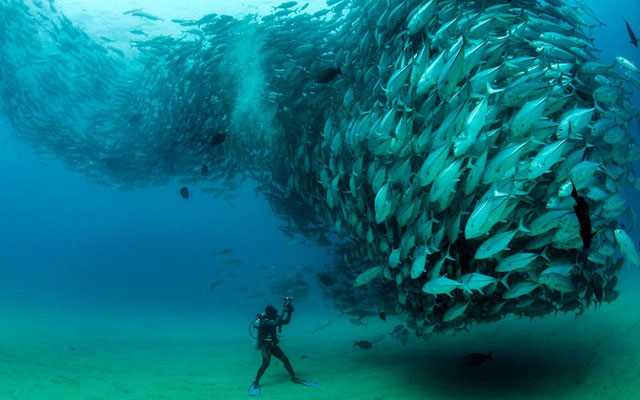
Beautiful. And holy crap, did you know that rays could fly?

That sucker must be 10 feet out of the water! (via the telegraph)
You’ve gotta wait for it. Nope, not that one. Not that. Or that. THAT. THAT’S THE SHOT.
Literally unbelievable. Totally lucky but unbelievable. (via @DavidGrann)
Artist Rutherford Chang only collects first pressings of The Beatles’ The White Album on vinyl. Dust & Grooves recently interviewed Chang about his collection.

Q: Are you a vinyl collector?
A: Yes, I collect White Albums.
Q: Do you collect anything other than that?
A: I own some vinyl and occasionally buy other albums, but nothing in multiples like the White Album.
Q: Why just White Album? why not Abbey road? or Rubber Soul?
A: The White Album has the best cover. I have a few copies of Abbey Road and Rubber Soul, but I keep those in my “junk bin”.
Q: Why do you find it so great? It’s a white, blank cover. Are you a minimalist?
A: I’m most interested in the albums as objects and observing how they have aged. So for me, a Beatles album with an all white cover is perfect.
Q: Do you care about the album’s condition?
A: I collect numbered copies of the White Album in any condition. In fact I often find the “poorer” condition albums more interesting.
Chang’s collection is currently on view at Recess in Soho, NYC until March 7th. Gotta get down there and see this. (via mr)
Last weekend, Sarah alerted us that the Criterion Collection movies on Hulu were available to watch for free all weekend long. It was a classic kottke.org post: here’s something of very high quality that everyone can experience right now. Spot on, nailed it, I personally got excited and I would have taken full advantage had I not been out of the country.
The funny thing is that Hulu’s Criterion movies are almost always nearly free. There are many films — like Hoop Dreams, Babette’s Feast, A Woman Under the Influence, and Rashomon — that are totally free right now, just click the links and they start playing. But the rest of the Criterion films (looks like there’s dozens if not hundreds of them) are very nearly free all the time, all available if you subscribe to Hulu Plus for $7.99 per month. Dammit, I don’t want to do this but I’m trotting out the hoary cups of coffee metric here: for the price of two cups of coffee, you can watch as many Criterion-caliber films in the next month as you want, until your eyeballs pus over and burst from all the electromagnetic radiation pulsing into your retinas. And you also get all three seasons of Arrested Development!

Thank you, G.O.B. Most iPhone apps are either free or nearly free. Hundreds of classic works of literature are available on your favorite reading device for free or nearly free. There are enough freely available longreads out there to gag Instapaper. And let’s not even get started on YouTube, it’s a cultural fucking goldmine. Louis, you were right: everything is amazing and nobody’s happy. Because who has two thumbs, disposable income, an interest in excellent films, and is not subscribing to Hulu Plus because it seems like too much money and too much effort? This spoiled idiot right here.
Is it permissible to squee about Westeros?
Squee! I still miss Sean Bean though. I wouldn’t mind a little Six Feet Under Late Ned action. Maybe bring him back as a White Walker or something. They’re headless zombies, right? Hello?
Michael Moss is a Pulitzer-winning investigative journalist for the NY Times and he’s written a book called Salt Sugar Fat.
From a Pulitzer Prize-winning investigative reporter at The New York Times comes the explosive story of the rise of the processed food industry and its link to the emerging obesity epidemic. Michael Moss reveals how companies use salt, sugar, and fat to addict us and, more important, how we can fight back.
Every year, the average American eats thirty-three pounds of cheese (triple what we ate in 1970) and seventy pounds of sugar (about twenty-two teaspoons a day). We ingest 8,500 milligrams of salt a day, double the recommended amount, and almost none of that comes from the shakers on our table. It comes from processed food. It’s no wonder, then, that one in three adults, and one in five kids, is clinically obese. It’s no wonder that twenty-six million Americans have diabetes, the processed food industry in the U.S. accounts for $1 trillion a year in sales, and the total economic cost of this health crisis is approaching $300 billion a year.
Moss researched the book for four years, interviewing hundreds of current and former processed-food industry employees and reviewing thousands of pages of industry memos. This weekend’s NY Times Magazine has a lengthy excerpt from the book that’s well worth a read.
Eventually, a line of the [Lunchables] trays, appropriately called Maxed Out, was released that had as many as nine grams of saturated fat, or nearly an entire day’s recommended maximum for kids, with up to two-thirds of the max for sodium and 13 teaspoons of sugar.
When I asked Geoffrey Bible, former C.E.O. of Philip Morris, about this shift toward more salt, sugar and fat in meals for kids, he smiled and noted that even in its earliest incarnation, Lunchables was held up for criticism. “One article said something like, ‘If you take Lunchables apart, the most healthy item in it is the napkin.’ “
Well, they did have a good bit of fat, I offered. “You bet,” he said. “Plus cookies.”
The prevailing attitude among the company’s food managers - through the 1990s, at least, before obesity became a more pressing concern - was one of supply and demand. “People could point to these things and say, ‘They’ve got too much sugar, they’ve got too much salt,’ ” Bible said. “Well, that’s what the consumer wants, and we’re not putting a gun to their head to eat it. That’s what they want. If we give them less, they’ll buy less, and the competitor will get our market. So you’re sort of trapped.” (Bible would later press Kraft to reconsider its reliance on salt, sugar and fat.)
And this is classic processed food as molecular gastronomy right here:
I brought him two shopping bags filled with a variety of chips to taste. He zeroed right in on the Cheetos. “This,” Witherly said, “is one of the most marvelously constructed foods on the planet, in terms of pure pleasure.” He ticked off a dozen attributes of the Cheetos that make the brain say more. But the one he focused on most was the puff’s uncanny ability to melt in the mouth. “It’s called vanishing caloric density,” Witherly said. “If something melts down quickly, your brain thinks that there’s no calories in it… you can just keep eating it forever.”
(via @bryce)
This Esquire article asks: Do We Really Want to Live Without the Post Office?
The postal service is not a federal agency. It does not cost taxpayers a dollar. It loses money only because Congress mandates that it do so. What it is is a miracle of high technology and human touch. It’s what binds us together as a country.
Go on, read the whole thing. Near the top of The List of What Makes America Great and No One Realizes Until It Disappears and Even Then Probably Not is The United States Postal Service. A poster child for Mundane Technology if there ever was one.
Chris Buck takes pictures of celebrities after giving them 30 seconds to hide. Here’s Cindy Sherman:

Buck’s photos are on display in NYC for a couple more days at Foley but are also available in book form. (via digg)
The electric lighbulb, the phonograph, and the movie camera were invented (or significantly improved upon) by Thomas Edison, so lets give him credit for one more: LOLcats:
This short film was shot at the world’s first movie studio, The Black Maria, located in West Orange, NJ. The entire building was built on a turntable so that the building could rotate with the sun for the best lighting conditions. (via “robin sloan”)
Nick Bostrom, a Swedish-born philosophy professor at Oxford, thinks that we’re underestimating the risk of human extinction. The Atlantic’s Ross Andersen interviewed Bostrom about his stance.
I think the biggest existential risks relate to certain future technological capabilities that we might develop, perhaps later this century. For example, machine intelligence or advanced molecular nanotechnology could lead to the development of certain kinds of weapons systems. You could also have risks associated with certain advancements in synthetic biology.
Of course there are also existential risks that are not extinction risks. The concept of an existential risk certainly includes extinction, but it also includes risks that could permanently destroy our potential for desirable human development. One could imagine certain scenarios where there might be a permanent global totalitarian dystopia. Once again that’s related to the possibility of the development of technologies that could make it a lot easier for oppressive regimes to weed out dissidents or to perform surveillance on their populations, so that you could have a permanently stable tyranny, rather than the ones we have seen throughout history, which have eventually been overthrown.
While reading this, I got to thinking that maybe the reason we haven’t observed any evidence of sentient extraterrestrial life is that at some point in the technology development timeline just past the “pumping out signals into space” point (where humans are now), a discovery is made that results in the destruction of a species. Something like a nanotech virus that’s too fast and lethal to stop. And the same thing happens every single time it’s discovered because it’s too easy to discover and too powerful to stop.
The trailer doesn’t reveal much:
But from everything that I have heard, this movie is a must-see for Kubrick fans. In US theaters (and available online, I think) on March 29th.
All Criterion movies free this weekend orig. from Feb 15, 2013
* Q: Wha? A: These previously published entries have been updated with new information in the last 24 hours. You can find past updates here.
I love these 50th anniversary yearly round-ups that Alan Taylor is doing over at In Focus. This year marks the 50th anniversary of 1963:

Nassim Taleb asserts that, on average, old technologies have longer life expectancies than younger technologies, which helps explain why books are still around and CD-ROM magazines aren’t.
For example: Let’s assume the sole information I have about a gentleman is that he is 40 years old, and I want to predict how long he will live. I can look at actuarial tables and find his age-adjusted life expectancy as used by insurance companies. The table will predict he has an extra 44 years to go; next year, when he turns 41, he will have a little more than 43 years to go.
For a perishable human, every year that elapses reduces his life expectancy by a little less than a year.
The opposite applies to non-perishables like technology and information. If a book has been in print for 40 years, I can expect it to be in print for at least another 40 years. But — and this is the main difference — if it survives another decade, then it will be expected to be in print another 50 years.
This is adapted from Taleb’s recent book, Antifragile. Anyone read this yet? I really liked The Black Swan.
DrawQuest is a new iPad app from Chris Poole’s Canvas. It’s a super-simple drawing app that is sort of a combination between Draw Something and Instagram. I suck at drawing, but I’ve been using it for a few weeks and it makes me want to draw more.
This is really simple: these are goats who sound like people. You have probably seen this before, but if you’re anything like me, you’ll want to watch it at least once a day for the rest of your life.
Michael Jordan just turned 50 and so Deadspin’s Emma Carmichael asked former Cavs guard Craig Ehlo what it was like to guard Jordan in his prime. Sometimes Jordan would tell Ehlo what he was going to do ahead of time and still score.
Usually, Ron Harper would start on him, then I would come in and go to him, and Ron would go to Scottie Pippen or something like that. I always felt very lucky that Coach Wilkens had that faith in me to guard him. Michael was very competitive when he got between the lines. He was never a bad talker or too arrogant, but it was just like what Jason [Williams] said: He’d tell you. He only did that to me one time, from what I remember. It was his 69-point game, and things were going so well for him that I guess he just went for it. We were running up the court side-by-side and he told me: “Listen man, I’m hitting everything, so I’m gonna tell you what I’m gonna do this time and see if you can stop it. You know you can’t stop it. You know you can’t stop this. You can’t guard me.
“I’m gonna catch it on the left elbow, and then I’m gonna drive to the left to the baseline, and then I’m gonna pull up and shoot my fadeaway.”
And sure enough …
Ehlo famously guarded Jordan during The Shot:
See also Michael Jordan Has Not Left the Building and Jordan’s top 50 greatest moments.
The documentary about recently discovered street photographer Vivian Maier that was funded via Kickstarter almost two years ago is finally getting somewhere. Here’s the trailer for the film, which appears to involve a crazy twist in Maier’s story.
Argo orig. from Feb 20, 2013
Hilarious fake Guy Fieri menu orig. from Feb 20, 2013
Watch full-length movies on YouTube orig. from Feb 20, 2013
* Q: Wha? A: These previously published entries have been updated with new information in the last 24 hours. You can find past updates here.

That’s a movie poster for Argo, the fake movie that the CIA “made” as a cover for getting six American diplomats out of Iran in 1980. Ben Affleck’s Argo, which cements the former prettyboy actor’s status as one of the best young American directors, is somewhat loosely based on The Master of Disguise, a book written by the guy Affleck plays in Argo, and a 2007 Wired magazine article by Joshuah Bearman called The Great Escape. Argo is up for several Oscars and is now available on Blu-ray and DVD.
Update: Here’s a CIA report written by Mendez about the caper. And I’m listening to the soundtrack right now.
Some enterprising genius has registered the domain for Guy Fieri’s (famously panned) restaurant in Times Square and put up a fake menu chock full of hilarious foodstuffs. For instance, the Hobo Lobo Bordello Slam Jam Appetizer:
We take 38 oz of super-saddened, Cheez-gutted wolf meat, lambast it with honey pickle wasabi and pile drive it into an Ed Hardy-designed bucket. Sprayed with Axe and finished with a demiglaze of thick & funky Mushroom Dribblins.
Also, “Add a Cinnabon and two more Cinnabons $4.95”. Also, “superbanged”. Also, “ranch hose”.
Update: Copy for parts of the menu were crowdsourced from Twitter. Which doesn’t make it any less funny…just that the person who made it is not an “enterprising genius”. (via everyone)
This Reddit group is collecting links to full-length movies and TV shows that are available on YouTube. Like this unauthorized copy of Django Unchained:
See if you can get through the whole thing before it gets taken down.
Update: David reminded me that you can actually watch full-length movies and TV shows on YouTube for a rental fee. (thx, david)
Google is making a wearable headset called Google Glass and here’s a look at how the heads-up display is going to work.
Maybe it’s the jetlag talking, but that looks pretty fricking great. But I have a feeling that Glass is going to be a Segway for your face.
Here are some of the rules students live by at Harper High School in Chicago: Know your geography (whether you join a gang or not, you’re in one). Never walk by yourself. Never walk with someone else. If someone shoots, don’t run. These are just a few of the exhausting complexities that face the kids at Harper High, where 29 current and former students were shot last year. The reality on the streets leads the kids to one final rule: never go outside. This American Life spent five months at Harper High School. Part one of their report is a must-listen. Within a few minutes of the piece, you’ll understand what one of the adults who was interviewed means when he says, “it ain’t a fairy tale.”
All Criterion movies free this weekend orig. from Feb 15, 2013
* Q: Wha? A: These previously published entries have been updated with new information in the last 24 hours. You can find past updates here.
For the NY Times, Ben Schott compiles an extensive list of wine-related jargon.
WHALE . PLAYER . BALLER . DEEP OCEAN
A serious drinker who will regularly DROP more than $1,000 on a single bottle. When on a furious spending spree, a WHALE is said to be DROPPING THE HAMMER. BIG WALES — or EXTRA BIG BALLERS (E.B.B.) — can spend more than $100,000 on wine during a meal.
Schott expanded on this list in a companion blog post:
But, vocabulary aside, the central thing I learned from these talented people is that if you are dining in a restaurant which employs a Sommelier, you should never, ever order your own wine.
If you know little or nothing about wine, they will guide you to a bottle far more interesting and suited to your food than you could possibly pluck from the list.
And if you are a wine aficionado, you will not know more than the Somm about their list - or what they are hiding off-list in the cellar.
See also What Restaurants Know (About You)
With the northeast still smarting from their two+ feet of snow, it’s worth watching this two minute video to see how those trillions of flakes were born.
For more, this recent 16 minute Radiolab segment looks into whether perfect snowflakes exist.
From Sarah Marshall, a list of celebrity fragrances that didn’t quite make it to market.
Goldbloom by Jeff Goldblum: This fragrance, meant to be drizzled down the wearer’s forearm (preferably while in a moving car) is redolent of warm eyeglasses, tanning oil, and Velociraptor musk. Perfect for work or leisure.
Wintour Harvest by Anna Wintour: Peppery, balsamic, indecisive, and fresh. Notes of warm blood and Galliano Sequin enliven this fragrance designed for the gal on the go.
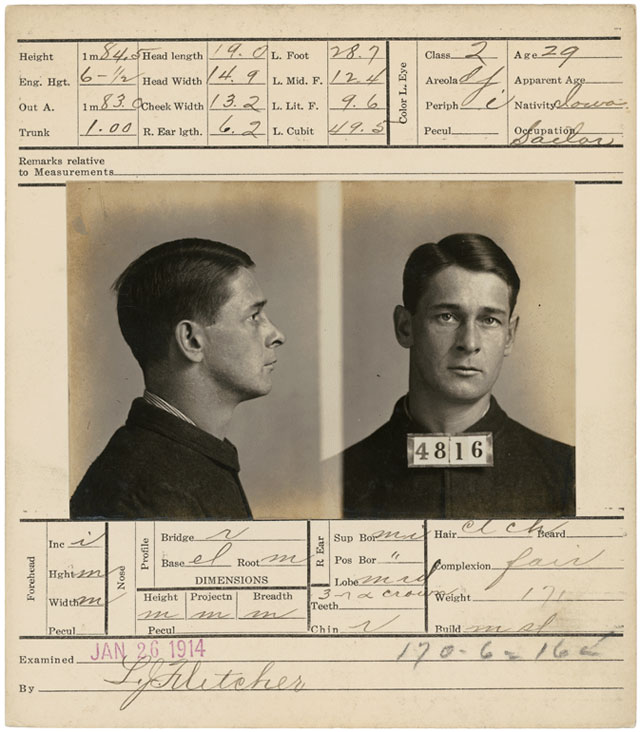
Seeing so many CSI and police procedural shows on TV today, it’s easy to take for granted being able to rapidly and accurately identify criminals. Fingerprinting, as probably the biggest technological advancement in identifying criminals, is a big part of that. But what’d we have before fingerprinting?
According to the National Law Enforcement Museum:
Alphonse Bertillon was a French criminologist who first developed this anthropometric system of physical measurements of body parts, especially components of the head and face, to produce a detailed description of an individual. This system, invented in 1879, became known as the Bertillon system, or bertillonage, and quickly gained wide acceptance as a reliable, scientific method of criminal investigation. In 1884 alone, French police used Bertillon’s system to help capture 241 repeat offenders, which helped establish the system’s effectiveness. Primarily, investigators used the Bertillon system to determine if a suspect in custody had been involved in previous crimes. Law enforcement agencies began to create archives of records of known criminals, which contained his or her anthropometric measurements, as well as full-face and profile photographs of the perpetrator (now commonly known as “mugshots,” which are still in use today).
It was essentially a criminal justice Dewey Decimal System, the first step in taking police out of the dark ages. Before Bertillion standardized measurements, police just had a jumble of descriptions and photographs with no way to organize them so they’d almost never be able to cross reference existing records when people were arrested.
Of course Bertillion’s system was just a stop-gap measure. The system was only really in use for about 30 years before fingerprints became the dominant identification method.
In 1903, a man named Will West was committed to the penitentiary at Leavenworth, Kansas, where he was photographed and measured using the Bertillon system. Will West’s measurements were found to be almost identical to a criminal at the same penitentiary named William West, who was committed for murder in 1901 and was serving a life sentence. Furthermore, their photographs showed that the two men bore a close physical resemblance to one another, although it was not clear that they were even related. In the ensuing confusion surrounding the true identities of the two men, their fingerprints conclusively identified them and demonstrated clearly that the adoption of a fingerprint identification system was more reliable than the older Bertillon system.
The guy in this photo is John Welshouse who was convicted in 1914 for violating the White Slave Act (prostitution). (via @pruned)
I-Wei Huang got a Strandbeest, an articulated contraption that you can walk across a tabletop with your hand or attach a sail and watch it move under windpower, and he was wondering what might be another fun way to power it. His first thought was steam but that wouldn’t work great with the plastic Strandbeest. He might have tried it anyways but, as he puts it, “thankfully, I had another even sillier idea.”
The hamster powered? that’s just stupid, which is the exact reason why I did it. It’s different, hasn’t been done before, yet it’s in so many what’s-under-the-hood jokes. It also had a high likelyhood of working, so I had to attempt it. Only problem: I don’t have a hamster, I don’t want a hamster for a pet, and I don’t know what sort of power and weight a little critter like that has. All I know is that I’ve seen them go ballistic on the hamster wheel, and so they must have great weight to power ratio.
The top-heavy animal-ified mechanical transporter makes it feel like a mini, cuter version of a Star Wars AT-AT.
On Edible Geography, Nicola Twilley looks at what used to be a common process in Japan but is now only done on a boutique basis: apple tattooing.

As they are finally exposed to the elements for the final few weeks before harvest, the most perfect of these already perfect apples are then decorated with a sticker that blocks sunlight to stencil an image onto the fruit. This “fruit mark” might be the Japanese kanji for “good health,” as Susan Brown mentioned. Others have brand logos (most notably that of Apple, the company), and some, according to Stevens, are “negatives with pictures. One Japanese pop star put his picture on apples to give his entourage for presents.”
The marked fruit of the Montreuillois first won renown at the 1894 Saint Petersburg exhibition, where they presented the czar of Russia with an apple stenciled with his own portrait. King Leopold of Belgium, Edward VII of England, and Teddy Roosevelt received similar fruits.
(via @stewart)
What’s with all the Russian dashboard cameras? orig. from Feb 15, 2013
* Q: Wha? A: These previously published entries have been updated with new information in the last 24 hours. You can find past updates here.
The meteor streaking across Russia this morning was largely captured by cameras mounted on car dashboards. Why do so many Russian drivers seem to have dash-cams? Protection against fraud & hit-and-runs. Kottke featured this article from Animal New York’s Marina Galperina back in December.
Dash-cam footage is the only real way to substantiate your claims in the court of law. Forget witnesses. Hit and runs are very common and insurance companies notoriously specialize in denying claims. Two-way insurance coverage is very expensive and almost completely unavailable for vehicles over ten years old-the drivers can only get basic liability. Get into a minor or major accident and expect the other party to lie to the police or better yet, flee after rear-ending you. Since your insurance won’t pay unless the offender is found and sued, you’ll see dash-cam videos of post hit and run pursuits for plate numbers.
And sometimes drivers back up or bump their pre-dented car into yours. It used to be a mob thing, with the accident-staging specialists working in groups. After the “accident,” the offending driver — often an elderly lady — is confronted by a crowd of “witnesses,” psychologically pressured and intimidated to pay up cash on the spot. Since the Age of the Dash-cam, hustle has withered from a flourishing enterprise to a dying trade, mainly thriving in the provinces where dash-cams are less prevalent.
Update: The other reason for the dash-cams? Russians are apparently crazy drivers. From the other previous Kottke Russian driving post: 13 minutes of can’t-look-away traffic accidents.
Geoff Manaugh of BLDGBLOG ruminates on optical calibration targets, weird landscape relics scattered across military bases made to check the resolution of cold war era photograph-snapping spy planes. You can find one target on Google Maps here.

Although I am truly fascinated by what sorts of optical landmarks might yet be developed for field-testing the optical capabilities of drones, as if the world might soon be peppered with opthalmic infrastructure for self-training autonomous machines, it is also quite intriguing to realize that these calibration targets are, in effect, ruins, obsolete sensory hold-overs from an earlier age of film-based cameras and less-powerful lenses. Calibrating nothing, they are now just curious emblems of a previous generation of surveillance technology, robot-readable hieroglyphs whose machines have all moved on.
Seeing how quickly news of the resignation of Pope Benidict XVI spread on Twitter, The Atlantic’s Rebecca Rosen wondered how people found out about the last Papal resignation back in the Middle Ages.
In 1415, mass media happened not on a TV but at, well, Mass. “This is the big thing about the Middle Ages,” George Ferzoco, a medievalist at the University of Bristol, told me. “We tend to think that they had no such thing as a mass medium. The fact is they did. And that mass medium was the sermon, because everyone would regularly be at one.
“Imagine,” he continued, “what it’s like to have a major international meeting lasting a few years, and you’ve got to discuss written texts. Well you’ve got to have an army of people writing this stuff out, nonstop, day and night. So all of these people together would have been potential news sources. They would have sent news back to their home cities, or indeed to people who they deem are important or interested.”
From Constance, news traveled outward through a network of messengers on horseback. Couriers “would take documents out of Constance, go to a town 20 or 30 miles down the road, transfer things there to a fresh person and a fresh person and so on,” said Ferzoco. Medievalists I spoke with estimated that this sort of “Pony Express” system could have conveyed the news of Gregory XII’s resignation to major European cities such as Paris in something like a week.
Socials & More