Entries for August 2012
In a move that harkens back to composers of old, Beck’s next album, ‘Song Reader’ will be released in December as sheet music of 20 unreleased and unrecorded songs.
The sheet music will come with full colour art works for each song as well as a hardcover carrying case. Two of the 20 songs are instrumentals. The ‘album’ features the tracks ‘Do We? We Do’ and ‘Don’t Act Like Your Heart Isn’t Hard’. The idea behind the release is for fans to play the songs and ‘bring them to life’ themselves.
Sometimes you’re out fishing for tuna and messing around with a torpedo with a GoPro camera on the end of it and a pod of dolphins comes along and you get swimming-with-dolphin shots that you haven’t even seen even from Planet Earth.
Takes a bit to get going…the good stuff starts around 1:40. (via @Colossal)
The uneven parallel bars event has changed a lot over the years. For one thing, the bars used to be a lot closer together. And obviously the routines have gotten a lot harder.
Some of those moves in the 60s and 70s were sweet though. More grace and less raw power. (thx, doug)
The rise of the high-speed trading bots and “quote spam” orig. from Aug 08, 2012
Jim Thorpe, greatest Olympian* ever? orig. from Aug 09, 2012
Do fonts affect people’s opinions? orig. from Aug 09, 2012
* Q: Wha? A: These previously published entries have been updated with new information in the last 24 hours. You can find past updates here.
The first 30 seconds of this video are exactly what you want from a motorcycle race video. No, no, there’s no motorcycle crash scenes that involve a stone wall, sheep, and a helicopter, but it’s a good look back at this year’s race. These guys go fast.
(via stellar)
Where have I seen this before, a massive long-lasting Arctic storm that looks a lot like a hurricane? Oh right, The Day After Tomorrow.
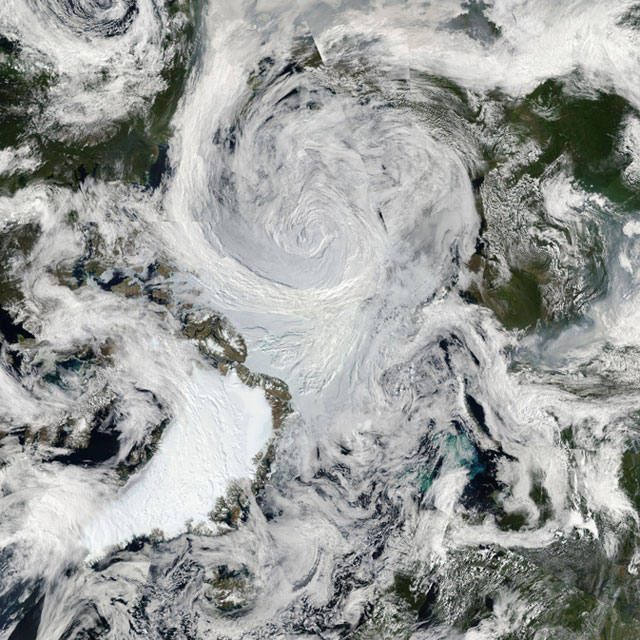
The storm had an unusually low central pressure area. Paul A. Newman, chief scientist for Atmospheric Sciences at NASA’s Goddard Space Flight Center in Greenbelt, Md., estimates that there have only been about eight storms of similar strength during the month of August in the last 34 years of satellite records. “It’s an uncommon event, especially because it’s occurring in the summer. Polar lows are more usual in the winter,” Newman said.
Arctic storms such as this one can have a large impact on the sea ice, causing it to melt rapidly through many mechanisms, such as tearing off large swaths of ice and pushing them to warmer sites, churning the ice and making it slushier, or lifting warmer waters from the depths of the Arctic Ocean.
I love The Day After Tomorrow. I know it’s a cheeseball disaster movie (which is pretty much why I love it) but it’s also looking more than a little prescient. Well, as prescient as a cheeseball disaster movie can be anyway. In the Washington Post the other day, prominent climatologist James Hansen wrote that human-driven climate change is responsible for an increase in extreme weather.
My projections about increasing global temperature have been proved true. But I failed to fully explore how quickly that average rise would drive an increase in extreme weather.
In a new analysis of the past six decades of global temperatures, which will be published Monday, my colleagues and I have revealed a stunning increase in the frequency of extremely hot summers, with deeply troubling ramifications for not only our future but also for our present.
This is not a climate model or a prediction but actual observations of weather events and temperatures that have happened. Our analysis shows that it is no longer enough to say that global warming will increase the likelihood of extreme weather and to repeat the caveat that no individual weather event can be directly linked to climate change. To the contrary, our analysis shows that, for the extreme hot weather of the recent past, there is virtually no explanation other than climate change.
In many ways, the phrase “global warming” is grossly misleading. “Oh,” we think, “it’s gonna be a couple degrees warmer in NYC in 20 years than it is now.” But the Earth’s climate is a chaotic non-linear system, which means that a sudden shift of a degree or two — and when you’re talking about something as big as the Earth, a degree over several decades is sudden — pushes things out of balance here and there in unpredictable ways. So it’s not just that it’s getting hotter, it’s that you’ve got droughts in places where you didn’t have them before, severe floods in other places, unusually hot summers, and even places that are cooler than normal, all of which disrupts the animal and plant life that won’t be able to acclimate to the new reality fast enough.
But pretty Arctic cyclone though, right?
TextMate creator Allan Odgaard has posted the code for TextMate 2 on GitHub.
I’ve always wanted to allow end-users to tinker with their environment, my ability to do this is what got me excited about programming in the first place, and it is why I created the bundles concept, but there are limits to how much a bundle can do, and with the still growing user base, I think the best move forward is to open source the program.
TextMate 2 is out in alpha and as a TextMate 1 user that would like to upgrade to a stable 2.0 version, I am skeptical that this is a good move in that direction.
The main imaging cameras on the Mars Curiosity rover have only 2-megapixel sensors with 8 GB of flash memory — compare that to a maxed-out iPhone 4S with an 8-megapixel sensor and 64 GB of flash memory (not to mention 30-fps 1080p video). Planning timeframes and communications bandwidth contributed to the chosen camera size.
‘There’s a popular belief that projects like this are going to be very advanced but there are things that mitigate against that. These designs were proposed in 2004, and you don’t get to propose one specification and then go off and develop something else. 2MP with 8GB of flash [memory] didn’t sound too bad in 2004. But it doesn’t compare well to what you get in an iPhone today.’
The cameras were also supposed to be outfitted with zoom lenses but that part of the project was scrapped.
In this slow-motion video, you can see how cats rotate themselves in the air while conserving angular momentum.
This is an interesting companion to yesterday’s owl rotation video. (via @stevenstrogatz)
You may remember a short piece by Errol Morris in the Times a few weeks ago that was more of a quiz than a essay. Well, the quiz turned out to be a smokescreen for how people’s opinions change when the text is set in different typefaces.
Each Times participant read the passage in one of six randomly assigned fonts - Baskerville, Computer Modern, Georgia, Helvetica, Comic Sans and Trebuchet. The questions, ostensibly about optimism or pessimism, provided data about the influence of fonts on our beliefs.
The test consisted of comparing the responses and determining whether font choice influenced our perception of the truth of the passage.
The results pointed to a small but noticeable effect in the authority of each font.
DAVID DUNNING: Baskerville seems to be the king of fonts. What I did is I pushed and pulled at the data and threw nasty criteria at it. But it is clear in the data that Baskerville is different from the other fonts in terms of the response it is soliciting. Now, it may seem small but it is impressive.
ERROL MORRIS: I am completely surprised by this. If you asked me in advance, I would have guessed Georgia or Computer Modern, something that has the imprimatur of, I don’t know, truth - truthiness.
DAVID DUNNING: The word that comes to my mind is gravitas. There are some fonts that are informal - Comic Sans, obviously - and other fonts that are a little bit more tuxedo. It seems to me that Georgia is slightly tuxedo. Computer Modern is a little bit more tuxedo and Baskerville has just a tad more starchiness. I would have expected that if you are going to have a winner in Baskerville, you are also going to have a winner in Computer Modern. But we did not. And there can be a number of explanations for that. Maybe there is a slight difference in how they are rendered in PCs or laptops that causes the starch in Computer Modern to be a little softer than the starch in Baskerville.
ERROL MORRIS: Starchiness?
DAVID DUNNING: Fonts have different personalities. It seems to me that one thing you can say about Baskerville is that it feels more formal or looks more formal. So that may give it a push in terms of its level of authority. This is, of course, speculation. I don’t really know. What one would do with, when you get surprising results is you now have to think about, O.K., what do we do to take that back-ended speculation and support it with data?
Update: Pentagram’s Michael Bierut weighs in on Morris’ article.
Whether or not a typeface can do any or all of those things, I do agree the landscape has changed. Once upon a time, regular people didn’t even know the names of typefaces. Then, with the invention of the personal computer, people started learning. They had their opinions and they had their favorites. But until now, type was a still matter of taste. Going forward, if someone wants to tell the truth, he or she will know exactly what typeface to use. Of course, the truth is the truth no matter what typeface it’s in. How long before people realize that Baskerville is even more useful if you want to lie?
Smithsonian Magazine has a good argument on why Jim Thorpe should be considered amongst the greatest Olympians even though his records and medals are not officially acknowledged by the IOC.
A week later the three-day decathlon competition began in a pouring rain. Thorpe opened the event by splashing down the track in the 100-meter dash in 11.2 seconds-a time not equaled at the Olympics until 1948.
On the second day, Thorpe’s shoes were missing. Warner hastily put together a mismatched pair in time for the high jump, which Thorpe won. Later that afternoon came one of his favorite events, the 110-meter hurdles. Thorpe blistered the track in 15.6 seconds, again quicker than Bob Mathias would run it in ‘48.
On the final day of competition, Thorpe placed third and fourth in the events in which he was most inexperienced, the pole vault and javelin. Then came the very last event, the 1,500-meter run. The metric mile was a leg-burning monster that came after nine other events over two days. And he was still in mismatched shoes.
Thorpe left cinders in the faces of his competitors. He ran it in 4 minutes 40.1 seconds. Faster than anyone in 1948. Faster than anyone in 1952. Faster than anyone in 1960 — when he would have beaten Rafer Johnson by nine seconds. No Olympic decathlete, in fact, could beat Thorpe’s time until 1972. As Neely Tucker of the Washington Post pointed out, even today’s reigning gold medalist in the decathlon, Bryan Clay, would beat Thorpe by only a second.
Update: I misstated what the Smithsonian article actually said about Thorpe’s official status according to the IOC. Here’s what the article says:
It’s commonly believed that Thorpe at last received Olympic justice in October of 1982 when the IOC bowed to years of public pressure and delivered two replica medals to his family, announcing, “The name of James Thorpe will be added to the list of athletes who were crowned Olympic champions at the 1912 Games.” What’s less commonly known is that the IOC appended this small, mean sentence: “However, the official report for these Games will not be modified.”
In other words, the IOC refused even to acknowledge Thorpe’s results in the 15 events he competed in. To this day the Olympic record does not mention them. The IOC also refused to demote Wieslander and the other runners-up from their elevated medal status. Wieslander’s results stand as the official winning tally. Thorpe was merely a co-champion, with no numerical evidence of his overwhelming superiority. This is no small thing. It made Thorpe an asterisk, not a champion. It was lip service, not restitution.
Thorpe’s family got his medals and is listed on the Olypmic web site. But as the article says, it does nothing to recognize just how dominant Thorpe was in the decathalon and pentathalon. In the decathalon, Thorpe led from the second event on and beat his nearest competitor Hugo Wieslander by almost 700 points. (For his part, Wieslander refused to accept the gold medal retroactively awarded to him because of Thorpe’s disqualification.) His victory in the pentathlon was even more lopsided…in an event where fewer points are better, the second-place competitor earned three times as many points as Thorpe. (thx, gary)
Starbucks to accept Square payments orig. from Aug 08, 2012
* Q: Wha? A: These previously published entries have been updated with new information in the last 24 hours. You can find past updates here.
If you move an owl’s body around in any direction, its head will remain remarkably still.
See also the eerie stillness of chicken heads. (via stellar)
Technology Review has an animated GIF originally posted by Nanex Research that shows the activity generated by trading bots on US exchanges. It’s pretty quiet for a couple years and then starts going nuts.
Algorithmic trading lets financial firms to spot and exploit market patterns at lightning speeds. This can bring a tidy profit, but it also puts computers in charge of making decisions that can cost a company millions, and that may have an unpredictable effect on the rest of the market.
If I’m reading the original source correctly, it seems like the vast majority of the activity is not trades but quotes — Nanex calls it “quote spam”. Basically the bots are asking for prices on stocks/options/etc. over and over again, looking for price advantages that they can then exploit via trades. The quote spam is swamping the communications systems:
Quote spam has exploded with no signs of stopping, while trade frequency has stalled and is actually lower than it was years ago. Each day is plotted in a separate color over the course of a trading day (9:30 to 16:00 Eastern): older data uses colors towards the violet end of the spectrum, recent data towards the red end of the spectrum. The gaps you see between color groups on the quote chart (left-side) is when system capacity was upgraded to handle the increase in traffic, and quote spam jumped to fill the new capacity that very same day.
(via @cory_arcangel)
Update: Quote spam is not about asking for prices, it’s about sending out millions of buy/sell offers hoping for a small percentage to reply…just like email spam. (thx, @falfa)
Burner is a new iPhone app that will give you a disposable, short term cell phone number to give to randos at the bar, weirdos on Craigslist, and Marlos on the corner.
Disposable cell numbers certainly seem like they might be used for nefarious activities, but founder & CEO Greg Cohn said these numbers can be used for any number of purposes in the era when a cell number is so closely tied a person’s identity.
(thanks, Alex)
Neat project from Michal Kohút: glasses that turn the lights off whenever the person wearing them blinks.
The lights in the room are temporarily turned off whenever the person wearing the glasses blinks. It all happens so fast that the person wearing the glasses does not even notice the change.
(via @essl)
I hope this will make saying “put it on Jason” a lot less awkward.
When Starbucks builds the Square Directory into their apps and in-store Digital Network, it gives Square new visibility, driving more customers to opt-in to Square. And with nearly 7,000 Starbucks stores soon accepting Square, these new payers will be able to find your business (including coffeehouses) and pay with their name, building community and creating value.
Update: Dan Frommer has more on how Square’s partnership with Starbucks will work.
Starbucks isn’t doing anything radical with its cashier / point of sale design / philosophy yet. There won’t be any pre-ordering drinks a block away, or paying anywhere in the cafe like you can at an Apple Store. Schultz says Starbucks has tried some of that and it’s “highly complicated.”
Some boats in a race orig. from Aug 06, 2012
* Q: Wha? A: These previously published entries have been updated with new information in the last 24 hours. You can find past updates here.
Tony Ortega has a long interview in the Village Voice with John Brousseau, who was a 32-year member of the Church of Scientology until he left in 2010.
In some ways, Brousseau’s tale is one of the most remarkable to come out of the secretive organization, and one that parallels so much of Scientology’s own development and controversies.
He and [Scientology leader David] Miscavige were brothers in law. They were both young cameramen working for Scientology founder L. Ron Hubbard during his movie-making phase. Brousseau was Hubbard’s personal chauffeur and helped maintain the cloak of secrecy when Hubbard vanished for good. He watched Miscavige transform Scientology and turn its base into a prison camp. He worked for Tom Cruise, which included serving in the household with Cruise and Katie Holmes. And having worked closely with both Cruise and Miscavige, he has choice things to say about the nature of their relationship.
Here’s part two of the interview.
David Simon remembers his friend DeAndre McCullough, who died last week. You might remember him as Lamar (Brother Mouzone’s assistant) from The Wire and was also profiled by Simon and Edward Burns in The Corner.
At fifteen, he was selling drugs on the corners of Fayette Street, but that doesn’t begin to explain who he was. For the boys of Franklin Square — too many of them at any rate — slinging was little more than an adolescent adventure, an inevitable right of passage. And whatever sinister vision you might conjure of a street corner drug trafficker, try to remember that a fifteen-year-old slinger is, well, fifteen years old.
He was funny. He could step back from himself and mock his own stances — “hard work,” he would say when I would catch him on a drug corner, “hard work being a black man in America.” And then he would catch my eye and laugh knowingly at his presumption. His imitations of white-authority voices — social workers, police officers, juvenile masters, teachers, reporters — were never less than pinpoint, playful savagery. The price of being a white man on Fayette Street and getting to know DeAndre McCullough was to have your from-the-other-America pontifications pulled and scalpeled apart by a manchild with an uncanny ear for hypocrisy and cant.
(via @mrgan)
The Cheesecake Factory has a hundred and sixty restaurants that each feature more than three hundred menu items that are served up to cool eighty million customers a year. Whether you’re a fan of the Cheesecake Factory or not, there’s no denying that — like many major chains that enjoy the benefits of scale — their product is consistent, the prices remain under control, and their efficiency is impressive. The New Yorker’s always excellent Atul Gawande wonders: What can hospitals learn about quality from the Cheesecake Factory?
Francis Higgins took it upon himself to provide amazing color commentary to the Olympic sailing race. This is the honey badger of Olympic commentary.
(via ★Interesting)
Update: The IOC has removed this video because they hate awesome stuff.
Update: There are copies of the video located here and here. But for how long? (thx, darren & john)
In 1979, 11 peopled died in a stampede before a stop on The Who’s Quadrephenia tour in Cincinnati when not enough doors were opened to let in the crowd. Providence mayor Buddy Cianci canceled a concert two weeks later at the Providence Civic Center, and The Who hasn’t ever been back to Providence. Last week, the GM of the PCC, now called the Dunkin’ Donuts Center announced he’d accept unrefunded tickets for The Who’s February, 2013 concert.
Tuesday, as the Providence Journal reports, “the patience and tenacity of 10 Who fans was rewarded … at the Dunkin’ Donuts Center, where they traded in 14 tickets to the band’s canceled 1979 Providence performance in exchange for tickets to their February 2013 show at the Dunk.” The ProJo has video. Fan Ed McConnell says he knew exactly where his two ‘79 tickets were: one was in a cigar box in a closet and the other one “was stuck on a cork bulletin board in my parent’s house in my brother’s old bedroom.”
About 10 fans exchanged their tickets, including one fan who had waited in line for 3 days to get tickets in 1978. (via Josh)
PS: Songs by The Who considered of puntastic entry in this post include the following: Going Mobile, I Can See for Miles, I Can’t Explain, I’ve Been Away, Long Live Rock, My Generation, The Kids Are Alright, and Who Are You?
It was shot by Thomas Edison in 1909 about a year before Twain’s death.
(via the atlantic)
If you’re anything like me, you take things like 34 People You Probably Didn’t Know Were On Seinfeld as a challenge. It’s been awhile, but I’ve seen every episode of that show (most of them at least twice) so I thought this would be easy but I totally had forgotten or didn’t realize that Jon Favreau, Catherine Keener, Amanda Peet, Denise Richards, and James Spader were on the show. Guess I’m not the Seinfeld fan I thought I was.
Every decade since 1952, Sight & Sound has polled film professionals to determine the greatest films of all time. Citizen Kane is always the winner, except for the first year. This year, however, S&S expanded the number of contributors dramatically and included online critics as well resulting in Citizen Kane’s unseating. They’ve released the list of top 50 films now, and will release a top 100 in about a month.
About a year ago, the Sight & Sound team met to consider how we could best approach the poll this time. Given the dominance of electronic media, what became immediately apparent was that we would have to abandon the somewhat elitist exclusivity with which contributors to the poll had been chosen in the past and reach out to a much wider international group of commentators than before. We were also keen to include among them many critics who had established their careers online rather than purely in print.
To that end we approached more than 1,000 critics, programmers, academics, distributors, writers and other cinephiles, and received (in time for the deadline) precisely 846 top-ten lists that between them mention a total of 2,045 different films.
I (Aaron) have seen 4 of the movies in the top 50 because I am, apparently, a Luddite philistine. Topping the list this year is Vertigo.
After half a century of monopolising the top spot, Citizen Kane was beginning to look smugly inviolable. Call it Schadenfreude, but let’s rejoice that this now conventional and ritualised symbol of ‘the greatest’ has finally been taken down a peg. The accession of Vertigo is hardly in the nature of a coup d’etat. Tying for 11th place in 1972, Hitchcock’s masterpiece steadily inched up the poll over the next three decades, and by 2002 was clearly the heir apparent. Still, even ardent Wellesians should feel gratified at the modest revolution - if only for the proof that film canons (and the versions of history they legitimate) are not completely fossilised.
There’s also a directors’ list of top 10 films. (via @chrissandoval)
Nate Jones was disappointed about how women’s Olympic beach volleyball has been photographed at the Olympics so he decided to show us what other sports look like through the lens of women’s Olympic beach volleyball photographer’s lens. The results are hilarious.

(via ★mathowie)
On Twitter right now, Neil deGrasse Tyson is imagining how various Olympic events would work on Mars.
Women’s Beach Volleyball on Mars: No protective ozone layer there. Solar UV would irradiate all exposed legs, buns, & tummies
Gymnastics: On Mars, with only 38% of Earth’s gravity, the Vault & other spring-assisted leaps would resemble circus cannons.
(via @jaycer17)
The WSJ is producing some homemade highlight videos of important Olympic events, sort of like what one of the Tenenbaum children might conjure up.
(via @davidfg)
Listen to this guy absolutely lose his shit while taking video of these two vintage trains. I’ve never heard someone so excited about anything before.
Fun fact: US train enthusiasts are sometime called “foamers”. (via @LTBelcher, who also came up with the genius “double trainbow” phrase)
This is an oldie but a goodie. Ron Avitzur was working for Apple as a contractor in 1993 when the project he was working on (a graphing calculator) was cancelled and his contract subseuently ended. However, Avitzur really wanted to finish what he started he kept on going into Apple to work on this calculator.
There was one last pressing question: How could we get this thing included with the system software when the new machines shipped? The thought that we might fail to do this terrified me far more than the possibility of criminal prosecution for trespass. All the sweat that Greg and I had put in, all the clandestine aid from the friends, acquaintances, and strangers on whom I had shamelessly imposed, all the donations of time, expertise, hardware, soft drinks, and junk food would be wasted.
Once again, my sanity was saved by the kindness of a stranger. At 2:00 one morning, a visitor appeared in my office: the engineer responsible for making the PowerPC system disk master. He explained things this way: “Apple is a hardware company. There are factories far away building Apple computers. One of the final steps of their assembly line is to copy all of the system software from the ‘Golden Master’ hard disk onto each computer’s hard disk. I create the Golden Master and FedEx it to the manufacturing plant. In a very real and pragmatic sense, I decide what software does and does not ship.” He told me that if I gave him our software the day before the production run began, it could appear on the Golden Master disk. Then, before anyone realized it was there, thirty thousand units with our software on the disks would be boxed in a warehouse. (In retrospect, he may have been joking. But we didn’t know that, so it allowed us to move forward with confidence.)
Once we had a plausible way to ship, Apple became the ideal work environment. Every engineer we knew was willing to help us. We got resources that would never have been available to us had we been on the payroll. For example, at that time only about two hundred PowerPC chips existed in the world. Most of those at Apple were being used by the hardware design engineers. Only a few dozen coveted PowerPC machines were even available in System Software for people working on the operating system. We had two. Engineers would come to our offices at midnight and practically slip machines under the door. One said, “Officially, this machine doesn’t exist, you didn’t get it from me, and I don’t know you. Make sure it doesn’t leave the building.”
Avitzur told this story at Google in 2006. (via mental floss)
There’s something about this video of men throwing rocks with their opposite hand. Maybe it’s the French music?
(via ★dunstan)
Imagining Earth with Saturn’s rings orig. from Dec 09, 2009
* Q: Wha? A: These previously published entries have been updated with new information in the last 24 hours. You can find past updates here.
A report from the Credit Suisse Research Institute shows that companies that have women on their boards of directors out perform companies with all male boards in a number of different metrics. The report looked at 2300 companies with a market cap of over $10 billion, and found that stocks of companies with women on the board outpaced companies without by 26%. These companies also had net income growth of 14% vs 10%.
“Companies with women on boards really outperformed when the downturn came through in 2008,” Mary Curtis, director of thematic equity research at Credit Suisse in Johannesburg and an author of the report, said in a telephone interview. “Stocks of companies with women on boards tend to be a little more risk averse and have on average a little less debt, which seems to be one of the key reasons why they’ve outperformed so strongly in this particular period.”
(via @alexmleo)
Spoilers have been talked about a bunch lately with NBC broadcasting most of the Olympic events on tape delay in the US. Whether or not this is a problem (it’s not, get over it), it turns out most people enjoy books and movies more if they’ve been spoiled. Do you hate when the trailer for a film gives away all the best parts? Further in the article, a film trailer maker mentions that trailers that give away more details test better.
The paper, published in the September issue of Psychological Science, presents the results of a series of experiments conducted by Jonathan D. Leavitt and Nicholas J. S. Christenfeld. The authors asked a large group of undergraduates to read classic short stories in three categories: literary works (such as Raymond Carver’s “The Calm”), mysteries (Agatha Christie’s “A Chess Problem”), and ironic-twist tales (Ambrose Bierce’s “An Occurrence at Owl Creek Bridge”). Each student read one story in its original form, one with separate introductory material that laid out everything that was about to happen, and one with that same material simply incorporated as part of the text. Even surprise endings were given away.
Curiously, the test subjects favored the spoiled stories, sometimes significantly so. Even more paradoxically, it was the genres that seem to depend on surprise the most — mysteries and ironic-twist stories — that readers liked best when they already knew the ending.
“It seemed like a simple thing to demonstrate that if you completely ruin a story before people get into it, they’re not going to like it,” says Leavitt. “And we just couldn’t demonstrate that.”
vintage post from Aug 2012
· gift link
What if Mars orbited the Earth at the same distance as the Moon…what would that look like? How about Neptune? Or Jupiter? Like this:
See also what the Earth would look like with Saturn’s rings. (via @stevenstrogatz)
The Children’s Development Khazana is a bank staffed and patronized exclusively by children. It started in New Delhi in 2001 and has since opened up more than 200 branches in half-a-dozen countries.
The branches are run almost entirely by and for the children, with account holders electing two volunteer managers from the group every six months.
“Children who make money by begging or selling drugs are not allowed to open an account. This bank is only for children who believe in hard work,” said Karan, a 14-year-old “manager”.
During the day, Karan earns a pittance washing up at wedding banquets or other events. In the evening, he sits at his desk to collect money from his friends, update their pass books and close the bank.
“Some account holders want to withdraw their money. I ask them why and give it to them if other children approve. Everyone earns five per cent interest on their savings.”
Sandra Fluke writes that the portion of Affordable Care Act that guarantees women access to preventative health services went into effect today.
Women across the country have reason to celebrate tonight. Why? Because on Wednesday, the law that provides American women with access to preventive health services, including birth control, at no cost-no co-pay, no increase in premium, no deductible-goes into effect.
Under the law, women are guaranteed “a free annual well-woman visit” (including screenings for domestic violence and HIV), DNA screenings for HPV every three years, free screenings for gestational diabetes for pregnant women, and no-cost contraception. Sometimes it almost feels like we’re not living in the Stone Age here in the US. Almost:
But they do need to find out when their next insurance plan year begins, and make sure their plan qualifies. That’s because — with the exception of women who access their insurance through certain religiously-affiliated non-profits and schools, who unfortunately must wait another year for contraception coverage — this policy takes effect August 1. But each woman’s insurance plan will implement these benefits with the next new plan year after today. So if a woman’s insurance plan year begins on September 15, she’s eligible for these services beginning September 15.
Newer posts




Socials & More