



Steam is keeping some interesting statistics related
Steam is keeping some interesting statistics related to how people play Half-Life 2. I love the heat maps of where people die on certain levels.

This site is made possible by member support. 💞
Big thanks to Arcustech for hosting the site and offering amazing tech support.
When you buy through links on kottke.org, I may earn an affiliate commission. Thanks for supporting the site!
kottke.org. home of fine hypertext products since 1998.
Beloved by 86.47% of the web.
Steam is keeping some interesting statistics related to how people play Half-Life 2. I love the heat maps of where people die on certain levels.
Your Daily Awesome, one of my favorite new blogs of the past few months, has ceased publication. Alas. But I can identify with the reason behind the shuttering:
I am a writer first and an artist second (or vice versa, it’s hard to keep track): Blogging is not my main gig, and for the past several months, I’ve been unable to devote myself to my real work so that I can noodle around on the internet every night, hunting for something appropriately awesome to blog. Those (substantial) daily chunks of time need to be applied to other projects that are more significant to me, creatively and professionally.
The just-released Michelin restaurant guide for Tokyo awards more stars to that city’s restaurants than New York and Paris put together. And 8 get a 3-star rating, only 2 fewer than in Paris.
Tokyo has more restaurants - at least 160,000 that could be classified as proper “restaurants” - than almost any other urban centre. Paris, by comparison, has little more than 20,000 and New York about 23,000.
There’s a lot of handwringing about Tokyo restaurants getting so many stars, but to look at it another way, Paris has 8 times fewer restaurants and has more 3 stars than Tokyo. Not bad.
(via marginal revolution)
The Zagat History of My Last Relationship by Noah Baumbach.
At this Wall Street old boys’ club, don’t be surprised if you run into one of her “ex-boyfriends” who works in “finance.” Be prepared for his “power play,” when he sends over a pitcher of “the freshest-tasting sangria this side of Barcelona,” prompting her to visit his table for “ten minutes” and to come back “laughing” and suddenly critical of your “cravat.” The room is “snug,” to say the least, and it’s not the best place to say, full voice, “What the fuck were you thinking dating him?” But don’t overlook the “best paella in town” and a din “so loud” you won’t notice that neither of you is saying anything.
The top 60 Japanese buzzwords and buzzphrases of 2007.
The term “monster parents” refers to Japan’s growing ranks of annoying parents who make extravagant and unreasonable demands of their children’s schools.
(via bb)
Chart of the possible shapes and forms of leaves. For instance, you could have a leaf of lanceolate shape with a crenate margin and reticulate veins.
Update: kottke.org reader Flip passes along this article about the wavy edges of flowers, leaves and even garbage bags, summarizing it thusly:
Basically, as the leaf grows it is constrained to a 2-d surface, but the cells of some leaves reproduce fast enough to require more surface area than a pi-r-squared plane surface can provide. Its only recourse is to buckle out-of-plane, giving the wrinkles. Since the exuberant growth continues as the leaf grows outward, the buckling process repeats and you get the multi-scale (ripples on ripples on ripples) shape that you see in kale and daffodils.
(thx, flip)
Video of Errol Morris talking with Philip Gourevitch about Abu Ghraib and Standard Operating Procedure at the 2007 New Yorker Festival. This was painful to watch at times — Morris speaks very deliberately — but worth leaving the audio on in the background. They showed a clip of the movie at the festival but it got cut from the video…rights issues, I imagine.
Photograph of a human Statue of Liberty taken circa-WWI in Des Moines, Iowa.
Hasbro is releasing a special “Regular Monopoly” edition of the popular game, following the success of hits like Star Wars Monopoly and Simpsons Monopoly.
[The game] replaces the iconic, high-valued properties of Mariowalk and Luigi Place with its own fancifully named “Boardwalk” and “Park Place.”
Japanese researchers have developed “melody roads” that play tunes when you drive on them. You could use this technique for traffic calming…i.e. the road plays music only when you’re driving the speed limit and hope that there’s no second-order melody that plays at two times the speed limit to entice highway hackers to speed for forbidden tunes.
William Gibson doesn’t have to write about the future anymore because he believes the present is so much more unlikely.
If one had gone to talk to a publisher in 1977 with a scenario for a science-fiction novel that was in effect the scenario for the year 2007, nobody would buy anything like it. It’s too complex, with too many huge sci-fi tropes: global warming; the lethal, sexually transmitted immune-system disease; the United States, attacked by crazy terrorists, invading the wrong country. Any one of these would have been more than adequate for a science-fiction novel. But if you suggested doing them all and presenting that as an imaginary future, they’d not only show you the door, they’d probably call security.
The best thing about the HP Scitex TJ8300/TJ8500 series printer is not that it makes 5.4 ft. by 12.1 ft. prints or can output 4,304 sq. ft. per hour or costs who knows how many 10000s of dollars. No, the striking feature of this printer is that they made it look just like a normal desktop-sized HP inkjet printer, despite the fact that the damn thing is as big as a hippopotamus.
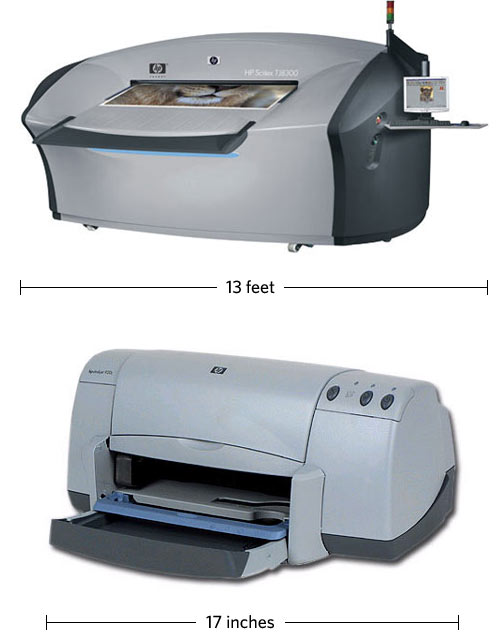
Ceci n’est pas une big fucking printer! Interesting extra tidbit: after the TJ8300s retire from active printing, they’re put out to stud to sire the next generation of HP desktop inkjets.
From an article on human memory that includes profiles of a woman who remembers everything she’s done in her life since age 11 and a man who remembers almost nothing after 1960:
The metaphors we most often use to describe memory — the photograph, the tape recorder, the mirror, the hard drive — all suggest mechanical accuracy, as if the mind were some sort of meticulous transcriber of our experiences. And for a long time it was a commonly held view that our brains function as perfect recorders-that a lifetime of memories are socked away somewhere in the cerebral attic, and if they can’t be found it isn’t because they’ve disappeared, but only because we’ve lost access to them.
That’s not the case, of course. A better metaphor for human memory might be that of an almost-saturated sponge trying to sop up spilled water on a counter. The sponge gets some of the water up but also loses some of its already-captured liquid and you just sort of smear the watery mess all over until the counter is completely wet but appears less waterlogged than it was. At least, that’s how *my* memory works.
Half of the NYU students polled for an NYU journalism class survey said that they’d give up their right to vote forever for $1 million.
Silhouettes of patrons at the American Museum of Natural History by NYC photographer Joe Holmes. Joe also has a nice photo of the Manhattan Bridge up today on his photoblog.
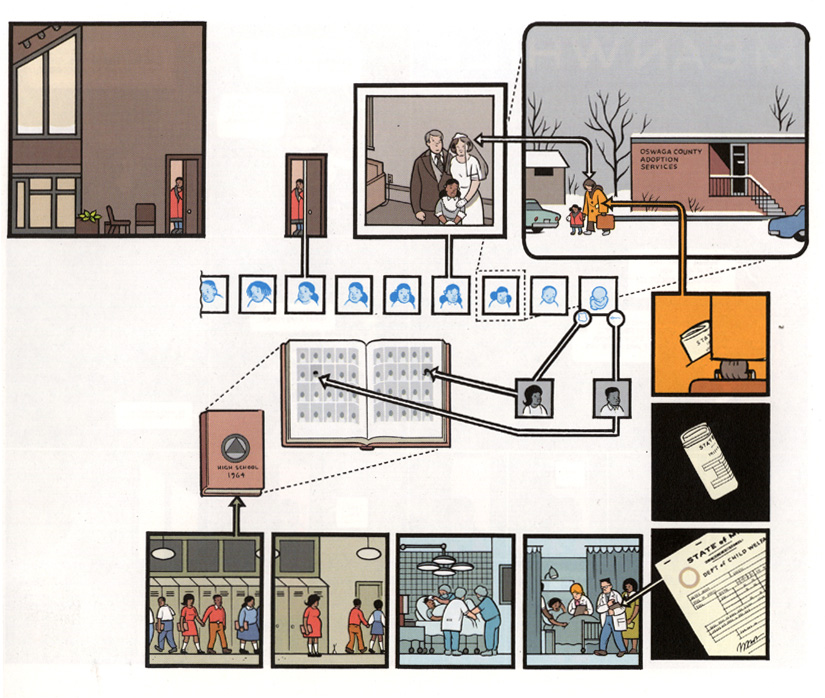
Related to Jason Salavon’s work from last week is Brian Piana’s work, the layouts and colors of web sites with all of the text and graphics stripped out. For instance, Barack Obama’s Twitter page. The flowchart stuff is lovely…reminds me a bit of this page from Jimmy Corrigan. (thx, jonathan)
Jon Hicks has a nice slideshow of typography from the Harry Potter and the Order of the Phoenix. (via waxy) Design Observer did a piece on the typography of Order of the Phoenix becoming its own character.
It is The Daily Prophet which emerges in this film as a secondary character, performing interstitial cameos made all the more exhilarating because the camera sweeps in and out, ricocheting off the page, magnifying and dramatizing a typographic vocabulary that combines a slightly mottled, letterpress-like display face with great portions of illegible calligraphy.
I want a proper e-book reader as much as anyone, but Amazon’s Kindle sounds underwhelming (and unfortunately looks, as a friend put it, like “the Pontiac Aztec of e-readers”). Amazon CEO Jeff Bezos says:
This isn’t a device, it’s a service.
That’s CEO-speak for “yay, we can charge you for buying this gadget again and again”. That emphasis makes it seem like the Kindle is less of a “read any text you want on the go” device and more of an interface for purchasing Amazon’s e-books, e-magazines, and blogs (yes, they’re charging for blogs somehow…). E-ink is a genuine innovation but until someone without some skin in the media game takes a good crack at it, e-book readers are destined to be buying machines and not reading machines.
Update: Here’s a list of all the blogs that Amazon is selling for reading on the Kindle. Subscriptions are $0.99-$1.99. No kottke.org (thanks, Amazon!!). Are the bloggers getting their cut of the subscription fees? Can I put kottke.org on there for free…or at least at cost? I suspect bloggers are getting a cut, with the rest taken by Amazon for profit and the conversion of the blogs’ text into whatever goofy format the Kindle uses. Would have been a lot cooler to put an RSS reader on there and just let people read whatever blogs they wanted.
Update: Joel Johnson has some more information about the Kindle after playing with one for a bit. The device service (sorry!) has an experimental web browser, on which you can browse whichever blogs and sites you wish (on Amazon’s dime).
Update: Engadget says, among other things, that “blogs that are aggregated by the Kindle get a revenue share with Amazon, since it costs money to get those publications.” (thx, daniel)
From the past weekend’s box office: the Coen brothers’ No Country For Old Men took in $3.1 million on 148 screens while Tom Cruise’s bombtacular Lions for Lambs took in $2.9 million on 2216 screens. Ouch.
Video of Twitter on CSI. They even stayed within the 140 character limit. (via waxy)
Has Abe Lincoln been discovered in the background of a pair of photographs taken right before the Gettysburg Address?
The new photos are enlarged details from much wider crowd shots; they were discovered by a Civil War hobbyist earlier this year in the vast trove of Library of Congress photographs digitized since 2000, and provided to USA Today. They show a figure believed to be Lincoln, white-gloved and in his trademark stovepipe hat, in a military procession.
The funny thing is, if you look at a similar photograph of Lincoln taken shortly after his speech, there are at least three men seated around him who are wearing stovepipe hats. The photographic evidence alone is not compelling. “Paging Errol Morris. Would Errol Morris please come to the information desk. Thank you.”
If you believe that software made for a mass market audience that costs $129 (or even $259), does just about anything you want the instant you specify, and runs on mass-produced hardware that fits comfortably in a small backpack will always perform flawlessly, you’re deluded. If you believe any advertising or marketing to the contrary, you’re twice deluded, once by yourself and once by someone else. You want 100% reliability for cheap? Buy a calculator. But don’t expect anything more than arithmetic.
Paper laptop interfaces designed by 7-9 year-olds.
The children started making these laptops last year and dubbed themselves “the laptop club.” This was truly an innovation of kid culture without adult coaching. The children were in second and third grade last year, and are continuing to create and play with new designs this year. […] All of the kids played with their laptops so much that many of the laptops have been worn out or lost.
The desires and preoccupations of the kids come through quite clearly in these drawings. Reminds me of the letters to Santa we wrote in grade school.
This wasn’t meant to be Tyler Cowen day on kottke.org, but you need to check out this concise barnburner of an article written by Cowen for the Washington Post on the cost of the war in Iraq. Taking the form of a letter to President Bush, the article explores the opportunity costs of the war and then offers the real reason why the war has been disastrous:
In fact, Mr. President, your initial pro-war arguments offer the best path toward understanding why the conflict has been such a disaster for U.S. interests and global security.
Following your lead, Iraq hawks argued that, in a post-9/11 world, we needed to take out rogue regimes lest they give nuclear or biological weapons to al-Qaeda-linked terrorist groups. But each time the United States tries to do so and fails to restore order, it incurs a high — albeit unseen — opportunity cost in the future. Falling short makes it harder to take out, threaten or pressure a dangerous regime next time around.
Foreign governments, of course, drew the obvious lesson from our debacle — and from our choice of target. The United States invaded hapless Iraq, not nuclear-armed North Korea. To the real rogues, the fall of Baghdad was proof positive that it’s more important than ever to acquire nuclear weapons — and if the last superpower is bogged down in Iraq while its foes slink toward getting the bomb, so much the better. Iran, among others, has taken this lesson to heart. The ironic legacy of the war to end all proliferation will be more proliferation.
As a refreshing mint, check out the length of the y-axis on this graph comparing the cost of the war and the amount spent by the US govt on energy R&D. (thx, ivan)
Update: Noam Chomsky, in an August 2002 interview:
The planned invasion will strike another blow at the structure of international law and treaties that has been laboriously constructed over the years, in an effort to reduce the use of violence in the world, which has had such horrifying consequences. Apart from other consequences, an invasion is likely to encourage other countries to develop WMD, including a successor Iraqi government, and to lower the barriers against resort to force by others to achieve their objectives, including Russia, India, and China.
(thx, matt)
Tyler Cowen of Marginal Revolution loves his iPhone and “can no longer imagine not having one” but has yet to make a phone call with it.
In a stairway leading down to the subway platform of the N/Q Canal St. stop, a pair of doors face each other on a landing. About every three days for more than a year, I’ve seen graffiti painted on both doors. Each time, the day after the graffiti appears, so does a fresh coat of cream-colored paint. By my count, those doors are covered in at least 100 coats of paint and must be more than an inch thicker than they were last year.
Update: Probably looks something like this if you cut it open. (thx, emmet) Or this.
A history of matching tile games (like Tetris, Dr. Mario, Bejeweled). Don’t miss the family tree of matching tile games about a fourth of the way down the page (larger version here). I’m no matching tile game scholar, but where the hell is Snood?
Update: Aha, it’s because Snood is a rip-off of Puzzle Bobble. (thx, greg & kevin)
The Book Design Review blog offers up its picks for the best book covers of the year.
How to run Greasemonkey scripts in Safari. Doesn’t work with some scripts, but something is better than nothing. (via justin)
An Apple Lisa commercial featuring Kevin Costner. While you digest the awesomeness of that, it’s interesting to note how consistent Apple has been under Steve Jobs in their message and approach…the emphasis on non-traditional business uses of computers in the Lisa ad and the whole iLife philosophy go together quite well. (via the house next door)
Erik Spiekermann on FE-Mittelschrift, the typeface used for German license plates.
The official typeface for our license plates is now called FE-Mittelschrift, with FE meaning it is Fälschungs-Erschwert, i.e. difficult to forge. Apparently car thieves, terrorists and notorious law-breakers had been exploiting DIN’s geometric construction principle and turning E into F or 3 into 8 etc by simply using a bit of black tape or white paint.
Here are all the alphanumeric characters:

Note the tamper-resistant differences between the 6 (no notch) and 9 (notched), the E & F, the I & 1, the O & zero, the P & R, and so on.
The American Society of Magazine Editors picks their magazine favorite covers of 2007.
New York magazine has compiled a great collection of vintage NYC videos featuring the likes of Grandmaster Flash, the construction of the Empire State Building, Andy Warhol, and Union Square, circa 1896.
Whiskey enthusiast, reacting to 2400 bottles of antique Jack Daniel’s possibly being poured down the drain because of unlicensed sales: “Punish the person, not the whiskey.”
Jason Salavon’s Field Guide to Style & Color, a reproduction of the 2007 Ikea catalog with everything but the structure and color excluded. You may remember Mr. Salavon from his composite photographs and videos of blowjobs, late night talk show hosts, and Playboy centerfolds.
David Gallagher dings Beowulf for using digital actors, resulting in an uncanny valley problem for the movie.
It’s impossible to watch “Beowulf” without sensing that the “actors” are being pushed around by invisible forces, not living and breathing on their own.
I noticed the same thing when I saw the trailer in the theater a few weeks ago. I’m stunned that the filmmakers thought it was OK that the whole thing seems soulless and constantly reminds people that, hey, this is fake, you’re watching a movie! It’s a real testament to Pixar that they’re able to stop short of the uncanny valley (they’re still obviously cartoons) and still imbue their characters with life and emotion (see Anton Ego’s revelation in Ratatouille).
Update: I forgot that Zemeckis and company did the creepy Polar Express as well.
Examples of photographic tampering from the 1860s to the present. This would be more instructive with the unaltered originals displayed in situ.
Thunder! Nah, nah, nah, nah, nah, nah, nah, nah! Con Edison is cutting their last direct current line in NYC, ending 125 years of continuous service that started when Thomas Edison set up shop in 1882 and signaling the final triumph of alternating current in the AC/DC wars. (Lesson: Nikola Tesla always wins in the end.)
The last snip of Con Ed’s direct current system will take place at 10 East 40th Street, near the Mid-Manhattan Library. That building, like the thousands of other direct current users that have been transitioned over the last several years, now has a converter installed on the premises that can take alternating electricity from the Con Ed power grid and adapt it on premises. Until now, Con Edison had been converting alternating to direct current for the customers who needed it — old buildings on the Upper East Side and Upper West Side that used direct current for their elevators for example.
The annual report for Podravka, a Croatian food company, has to be heated in the oven before you can read it.
Called Well Done, the report features blank pages printed with thermo-reactive ink that, after being wrapped in foil and cooked for 25 minutes, reveal text and images.
Well done, indeed. (thx, judson)
The last bit of high-speed track has been placed, cutting the Eurostar train’s journey from Paris to London to 2 hours and 15 minutes. Peak speed is 183 mph with an average speed of 130 mph. For reference, the NYC-to-Boston Acela averages 66 mph (top speed of 150 mph) and the Shanghai Maglev averages 142 mph (top speed: 268 mph).
I can’t see how on earth Julie Jackson’s Subversive Cross Stitch didn’t make it into the Museum of Arts & Design show on Extreme Embroidery. Maybe it’s too straightforward but still…
On his NYTimes blog, Dick Cavett remembers having Norman Mailer on his show along with Gore Vidal and Janet Flanner. It was a notorious episode; a perhaps more than slightly drunk Mailer lashed out first at Vidal and then everyone else in the room but couldn’t keep up with the jeers and witticisms flying at him from all angles.
Mailer: I said that the need of the magazine reader for a remark he could repeat at dinner was best satisfied by writers with names like Gore Vidal.
Flanner: All those writers called Gore Vidal.
Vidal: I know. There are thousands of them, yeah.
Mailer: There are two or three.
Cavett: Who are some of the others?
Mailer [with a dark look]: I don’t know.
Cavett: Who wants to host the rest of this show?
Mailer, years later, told me that it was at this point that “in the face of the Cavett wit and Flanner’s deft interruption” — adored by the audience — and in consideration of his alcohol content, he realized that he was not being skillful at mounting a sustained argument.
In an interview a number of years ago with Cavett, Charlie Rose showed a clip of the incident:
The video should cue up at the clip in question, but if not, skip to 29:00 in. Highly entertaining reading and viewing.
In discussing a popular conspiracy theory film (Zeitgeist), David Galbraith coins a new acronym: FEBL for Fucking Entertaining Big Lie.
FEBL media usually means nothing and is patently false but incredibly seductive. It is the perfect scaffold to hang propaganda and acts like a bit-borne, pernicious narcotic. Although films like Zeitgeist are mildly entertaining, due to their unbelievable popularity (more than 5 Million people have watched it on YouTube), they must be taken seriously. I suspect they might actually be dangerous, and therefore, as someone who does not believe in censorship it is important to make fun of Zeitgeist as the tired piece of po-faced, visually illiterate, polemically challenged, pornographic bullshit that it is.
(thx, bbj)
The movie poster for The Savages was done nicely by Chris Ware.
A primary school in the UK has moved from the bottom 25% of schools to near the top 5% using a curriculum based on Harry Potter.
During the most recent visit from Ofsted, the inspector witnessed a maths lesson where the children were motivated to learn about subtraction by pretending that it is a magic formula created by Harry Potter. Pupils were not allowed to answer questions without first saying a spell — “numerus subtracticus”, which they devised themselves.
(thx, david)
An update on the MUJI in Soho, three days before it opens. I’d loveto go to the opening, but it’s gonna be a zoo and a half down there on Friday. (thx david)
Tobias Wong has made a slick all-black iPhone called the ccPhone. It comes preloaded with videos, photos, music, and the company address book of Citizen:Citizen, the company selling it. Available as a limited edition of 50, each phone is $2000. Another of Wong’s projects that I really like is the Tiffany diamond solitaire engagement ring with the diamond turned upside down so the point sticks out (possibly for slashing attackers). A nice play on the marital security that an engagement ring offers the wearer. (via core77)


Socials & More