



NewsFire is now a Universal Binary. I
NewsFire is now a Universal Binary. I believe it’s the first newsreader to make the switch.

This site is made possible by member support. 💞
Big thanks to Arcustech for hosting the site and offering amazing tech support.
When you buy through links on kottke.org, I may earn an affiliate commission. Thanks for supporting the site!
kottke.org. home of fine hypertext products since 1998.
Beloved by 86.47% of the web.
NewsFire is now a Universal Binary. I believe it’s the first newsreader to make the switch.
For one year, Maria Dahvana Headley “[responded] positively to all flirting and saying yes to literally anyone who asked her out. The ensuing 150 dates included a homeless man, several non-English speakers, 10 taxi drivers, two lesbians and a mime.” And she got a husband out of the deal.
Interview with Annie Proulx about writing Brokeback Mountain. Just read the short story yesterday afternoon and it was wonderful. (via pb)
Mesmerizing movie of Paris Hilton’s unchanging facial expression. I can’t stop watching this. I especially like that her hair looks like it’s chasing itself around the top of her head.
Update: The Lindsey Lohan one is pretty good as well. (thx, patrick)
Photos of pool hustlers in NYC. (via coolfer by way of the actual janelle)
Steven Levitt does some further fact-checking of James Frey’s A Million Little Pieces.
A recently unveiled Chinese map — a reproduction of a 1418 map — may show that the Chinese discovered the Americas more than 70 years before Columbus. There is, however, some question about the map’s authenticity.
Fascinating article about how people are selected for reality TV shows and the effects of the shows on the contestants. “The producers are looking for that authenticity because they believe it’s impossible to fake who you are on camera during the course of a shoot, and they want to know exactly what they’re getting before they let you on their show.”
kottke.org favorites Andrew Zolli and Marissa Meyer (from a little company called Google) are going to be speaking at Core77’s panel on Design 2.0 in NYC at the end of February. Looks pretty interesting.
Rubik’s Cube world record broken International Rubik’s Cube Competition: 11.13 seconds. But the competition was best of three and the record-holder was beaten by 15 yo from Pasedena with an average lower time.
Thousands of young Japanese (men mostly) shut themselves in their rooms and don’t come out, sometimes for years on end. Hikikomori, as ths phenomenon is referred to, has many potential causes, including that “Japanese parents tell their children to fly while holding firmly to their ankles”. Reminds me of some of the themes from The Wind-Up Bird Chronicle by Haruki Murakami.
This blog cites a Target store advertising on Google Maps (by painting their logo on the roof), but it’s more likely that the bullseye is there for the benefit of airline passengers landing at nearby O’Hare (as this slightly wider view shows). (via bb)
Knickers, the lingerie weblog, has compiled a lingerie shopping guide for Valentine’s Day with breakdowns by size and style (from virgin to vixen). Possibly NSFW.
Cory has calculated the center of gravity of Starbucks in Manhattan…that is, the geographic point where all of them are pulling equally on you. It’s right around 40th St and 5th Ave.
Michael Bierut on the “slow design” of the New Yorker. “In contrast, one senses that each of the changes in The New Yorker was arrived at almost grudgingly. Designers are used to lecturing timid clients that change requires bravery. But after a certain point — 80 years? — not changing begins to seem like the bravest thing of all.”
A pair of photoessays from Time magazine: Martin Luther King in His Own Words and The Last Days of Martin Luther King.
Biography of Martin Luther King from Time magazine’s list of the world’s 100 most influential people.
Some remarks by Robert Kennedy on the assassination of Martin Luther King. (Audio version.)
Martin Luther King’s acceptance speech for the 1964 Nobel Peace Prize. (His Nobel lecture is also available.)
In 1998, six newspapers profiled the streets named after Martin Luther King in their respective cities. Along Martin Luther King is a collection of essays and photographs documenting life along the nearly 500 streets named for MLK. In 2003, Rob Walker took some photos along MLK Blvd in New Orleans).
3quarksdaily has the full-text of Martin Luther King’s “I Have a Dream” speech given on August 28, 1963 at the Lincoln Memorial in Wash. DC. Audio of the speech available here. (Also, King’s I’ve Been to the Mountaintop and declaration against the Vietnam War.)
The evolution of Allen Iverson from misunderstood troublemaker to one of the NBA’s “most transcendental stars”. Says Iverson, “just trying to approach it in a John Stockton-type of way, to where you don’t play so much with your physical ability all the time. You have to think the game out a lot more. That’s where I’m a lot better”
“no sampling, please”, a photoset depicting binge-sampling of nearly everything in sight, contrary to posted signage.
Consumer Reports on when buying organic makes sense and when it doesn’t. You should buy organic apples, poultry, and baby food, but not seafood or cosmetics.
Hilarious real-world version of Million Dollar Homepage: Fill My Room. For each donation of a dollar, a block gets added to this person’s room until it fills up. (via cyn-c)
On the copyright of recipes. Recipes are covered by US copyright law but not very well and very few suits get brought against those who republish them without permission. For the most part, it sounds like food folks recognize the essential remix culture of cooking. (via
More than you’d ever want to know about Tecmo Super Bowl. Still one of my all-time favorite video games…I play it on my Gameboy and still have a Sega Genesis in the closet.
The NY Times spends some time at home with Paula Scher. The gallery displaying her work is right around the corner from Eyebeam….I think I’ll head over there today.
I was wondering much the same thing as Michael re: iTunes phoning home with your listening history. Isn’t that what we want? Our software watching and making recommendations for us…isn’t that helpful? Providing better, more targetted advertising (if we have to have advertising, it should be useful)? There are privacy concerns and companies should be clearer about what’s going on, but I don’t mind if the software I use is a little smarter.
There’s been lots of talk on the web lately about Digg being the new Slashdot. Two months ago, a Digg reader noted that according to Alexa, Digg’s traffic was catching up to that of Slashdot, even though Slashdot has been around for several years and Digg is just over a year old. The brash newcomer vs. the reigning champ, an intriguing matchup.
Last weekend, a piece on kottke.org (50 Fun Things to Do With Your iPod) was featured on Digg and Slashdot[1] and the experience left behind some data that presents a interesting comparison to the Alexa data.
On 1/7 at around 11:00pm ET (a Saturday night), the 50 Things/iPod link appeared on Digg’s front page. It’s unclear exactly what time the link fell off the front page, but from the traffic pattern on my server, it looks like it lasted until around 2am Sunday night (about 3 hours). As of 10pm ET on 1/11, the story had been “dugg” 1387 times[2], garnered 65 comments, and had sent ~20,000 people to kottke.org.
On 1/8 at around 5pm ET (a Sunday afternoon), the 50 Things/iPod link appeared on Slashdot’s front page and was up there for around 24 hours. As of 10pm ET on 1/11, the story has elicited 254 comments and sent ~84,100 people to kottke.org.
Here’s a graph of my server’s traffic (technically, it’s a graph of the bandwidth out in megabits/second) during the Digg and Slashdot events. I’ve overlaid the Digg trend on the Slashdot one so you can directly compare them:
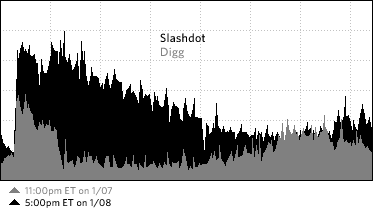
That’s roughly 18 hours of data…and the scales of the two trends are the same. Here’s a graph that shows the two events together on the same trend, along with a “baseline” traffic graph of what the bandwidth approximately would have been had neither site linked to kottke.org:
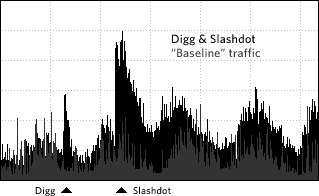
That’s about 4.5 days of data. Each “bump” on the baseline curve is a day[3].
The two events are separated by just enough time that it’s possible to consider them more or less separately and make some interesting observations. Along with some caveats, here’s what the data might be telling us:
In terms of comparing this with the Alexa data, it’s not a direct comparison because they’re measuring visitors to Digg and Slashdot, and I’m measuring (roughly) visitors from each of those sites. From the kottke.org data, you can infer how many people visit each site by how many people visited from each site initially…the bandwidth burst from Slashdot was roughly about 1.8 times as large as Digg’s. That’s actually almost exactly what Alexa shows (~1.8x).
But over a period of about 4 days, Slashdot has sent more than 4 times the number of visitors to kottke.org than Digg — despite a 18-hour headstart for Digg — and the aftershock for Slashdot is much larger and prolonged. It’s been four days since the Slashdotting and kottke.org is still getting 15,000 more visitors a day than usual. This indicates that although Digg may rapidly be catching up to Slashdot traffic-wise, it has a way to go in terms of influence[4].
Slashdot is far from dying…the site still wields an enormous amount of influence. That’s because it’s been around so long, it’s been big, visible, and influential for so long, and their purpose is provide their audience with 20-25 relevant links/stories each day. The “word-of-mouth” network that Slashdot has built over the years is broad and deep. When a link is posted to Slashdot, not only do their readers see it, it’s posted to other blogs (and from there to other blogs, etc.), forwarded around, etc. And those are well-established pathways.
In contrast, Digg’s network is not quite so broad and certainly less deep…they just haven’t been around as long. Plus Digg has so much flow (links/day) that what influence they do have is spread out over many more links, imparting less to each individual link. (There are quite a few analogies you can use somewhat successfully here…the mafia don who outsmarts a would-be usurper because of his connections and wisdom or the aging rock group that may currently be less popular than the flavor of the month but has collectively had a bigger influence on pop music. But I’ll leave making those analogies as an exercise to the reader.)
What all this suggests is that if you’re really interested in how influence works on the web, just looking at traffic or links doesn’t tell you the whole story and can sometimes be quite misleading. Things like longevity, what the social & linking networks look like, and how sites are designed are also important. The Alexa data suggests that Digg has half the traffic of Slashdot, but that results in 4x the number of visitors from Slashdot and a much larger influence afterwards. The data aside, the Digg link was fun and all but ultimately insignificant. The Slashdot link brought significantly more readers to the site, spurred many other sites to link to it, and appears to have left me with a sizable chunk of new readers. As an online publisher, having those new long-term readers is a wonderful thing.
Anyway, lots of interesting stuff here just from this little bit of data…more questions than conclusions probably. And I didn’t even get into the question of quality that Gene brings up here[5] or the possible effect of RSS[6]. It would be neat to be a researcher at someplace like Google or Yahoo! and be able to look more deeply into traffic flows, link propagation, different network topologies, etc. etc. etc.
[1] The way I discovered the Digging and Slashdotting was that I started getting all sorts of really stupid email, calling me names and swearing. One Slashdot reader called me a “fag” and asked me to stop talking about “gay ipod shit”. The wisdom of the crowds tragedy of the commons indeed.
[2] On Digg, a “digg” is a like a thumbs-up. You dig?
[3] That’s the normal traffic pattern for kottke.org and probably most similar sites…a nearly bell-shaped curve of traffic that is low in the early morning, builds from 8am to the highest point around noon, and declines in the afternoon until it’s low again at night (although not as low as in the morning).
[4] The clever reader will note here that Slashdot got the link from Digg, so who’s influencing who here? All this aftershock business…the Slashdotting is part of the Digg aftershock. To stick with the earthquake analogy though, no one cares about the 5.4 quake if it’s followed up by a 7.2 later in the day.
[5] Ok, twist my arm. Both Digg and Slashbot use the wisdom of crowds to offer content to their readers. Slashdot’s human editors post 25 stories a day suggested by individual readers while Digg might feature dozens of stories on the front page per day, collectively voted there by their readers. In terms of editorial and quality, I am unconvinced that a voting system like Digg’s can produce a quality editorial product…it’s too much of an informational firehose. Bloggers and Slashdot story submitters might like drinking from that hose, but there’s just too much flow (and not enough editing) to make it an everyday, long-term source of information. (You might say that, duh, Digg doesn’t want to be a publication like Slashdot and you’d probably be right, in which case, why are people comparing the two sites in the first place? But still, in terms of influence, editing matters and if Digg wants to keep expanding its influence, it’s gotta deal with that.)
[6] Digg might be more “bursty” than Slashdot because a higher percentage of its audience reads the site via RSS (because they’re younger, grew up with newsreaders in their cribs, etc.). Brighter initial burn but less influence over time.
The USPTO (United States Patent and Trademark Office) has released a list of the top 10 companies receiving the most US patents for 2005. In announcing the list, Under Secretary of Commerce for Intellectual Property Jon Dudas had this to say (emphasis mine):
America’s technological and economic strength is the result of its tremendous ingenuity. The USPTO has taken and will continue to take aggressive steps that will enhance quality and improve productivity to ensure that U.S. intellectual property protection remains the best in the world, protecting American innovation and sustaining economic growth.
The only problem is, 6 out of the 10 companies on the list are non-US companies: Canon, Matsushita, Samsung, Hitachi, Toshiba, and Fujitsu. Just whose innovation is the USPTO protecting here? Mr. Dudas? (thx, cathy)
James Frey was on Larry King last night but didn’t seem to address specific concerns about his book (transcript). Oprah called in to support him. I love the paragraph of disclaimer in the article: “The [Smoking Gun] Web site is owned by Court TV, which is half owned by Time-Warner, CNN’s parent company. The movie rights have been purchased by Warner Brothers, also part of Time Warner.” Meanwhile, the vigorous discussion continues in the thread…361 comments and counting.
Related to the stories about binding books with human skin from earlier in the week, apparently architect Le Corbusier bound one of his favorite books (Don Quixote) with the hide from one of his favorite dogs (Pinceau). The result looks like that textbook in Harry Potter that you needed to stroke the spine to get it to open without biting you.
Best new trend (if one is a trend…): personal annual reports. See also personal branding, personal outsourcing, personal board of advisors.
Fine gallery of well-designed book covers with an opportunity for you, the visitor, to comment on them. (via coudal)
Random House, the publisher of James Frey’s A Million Little Pieces, is offering refunds to folks who bought the book. Wow, this situation is getting out of hand in a hurry for Mr. Frey. And speaking of out of control, the kottke.org thread about Frey is going fast, furious, hot, and heated. Not sure where all the participants came from, but they sure are energetic.
Following Hanna’s example, here’s my 2005 in cities:
New York, NY*
London, UK
Austin, TX
Paris, France
Boston, MA*
Blarney, Ireland
Ballylickey, Ireland
Waterville, Ireland
Dingle, Ireland
Ennis, Ireland
Etna, NH*
Los Angeles, CA
Orange, MA
Nantucket, MA*
Woodstock, VT
Rochester, VT
Las Vegas, NV
Hong Kong*
Bangkok, Thailand
Saigon, Vietnam
Waitsfield, VT*
One or more nights spent in each place. Those cities marked with an * were visited multiple times on non-consecutive days. Somehow, I did a lot more and a lot less traveling last year than I had anticipated. And just for fun, let’s make this a meme! Blog your list of cities and get your friends to do the same. It’ll be fun.
A list of a favorite movie moments from 2005. I need to get out to way more movies this year.
Edward Jay Epstein examines where it all went wrong for Blockbuster Video. Blockbuster had an opportunity to have rental pricing for DVDs like they did with video, but they turned the deal down and the studios priced DVDs for retail instead and have been minting money with that scheme ever since.
Slate’s The Year in Culture for 2005. “As infuriating and crippling as the [NYC transit] strike was for so many, I selfishly appreciated having a city that was uninviting and briefly in turmoil.”
A world map of cultural prejudices, compiled by asking Google what different cultures “are known for”. (via waxy, who is known for good links)
On the day that Apple announced their first Intel-based computers, their stock price closed at $80.86. Spooky. (via df)
Socials & More