



A couple of guys calculated the average
A couple of guys calculated the average color of the universe to be turquiose. Then it turned out they had made an error and the actual color of the universe is beige.

This site is made possible by member support. 💞
Big thanks to Arcustech for hosting the site and offering amazing tech support.
When you buy through links on kottke.org, I may earn an affiliate commission. Thanks for supporting the site!
kottke.org. home of fine hypertext products since 1998.
Beloved by 86.47% of the web.
A couple of guys calculated the average color of the universe to be turquiose. Then it turned out they had made an error and the actual color of the universe is beige.
As part of my ongoing series of thoughts about conference badge and program design (Poptech 2004, Web 2.0 2004, PopTech 2003), here’s a quick review of the AIGA conference badges and programs. The badges are pretty good. Both first and last names are printed in large type for easy glancing and the schedule fits in the badge holder.
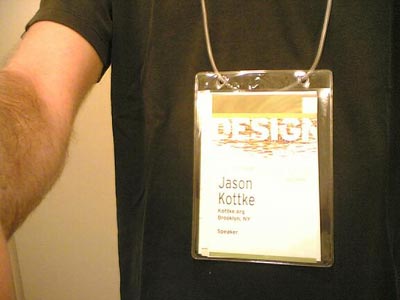
The badge lanyards are not the usual string/cloth, but a simple length of thin hollow plastic tube that’s looped together with a small piece of plastic that fits inside the tube like so:

If the lanyard is too long (as they often are at these things) and your badge is hanging down to your belt buckle, just grab a scissors, cut a bit off one end of the tube, and stick it back together. The program is a small thick book which I’ve left in my hotel room the entire time, preferring to rely on the Web site for event descriptions and the smaller schedule that fits in the badge holder for times, room numbers, etc. The schedule is actually not a booklet, but a series of folding pieces, one for each day of the conference, so when Friday is over, you can take the Friday schedule out of your badge holder and leave it behind, which is kind of handy.
Music video for Breathe Me by Sia, that song at the end of the last episode of Six Feet Under.
Nicholas Negroponte spoke this morning about the MIT Media Lab’s $100 laptop initiative. “One does not think of community pencils—kids have their own. They are tools to think with, sufficiently inexpensive to be used for work and play, drawing, writing, and mathematics. A computer can be the same, but far more powerful.” More info at BBC News and Technology Review.
I must be living in a cave because I hadn’t really heard of the Daily Show’s America the Book (more here) before today’s presentation by Paula Scher and Ben Karlin.
Designboom interview with designer/citizen Milton Glaser. Glaser is responsible for one of my favorite sayings: just enough is more.
Clip of Dj Spooky’s “Rebirth of a Nation”, a remix of D.W. Griffith’s “Birth of a Nation” adapted from a Ku Klux Klan propaganda piece.
Going all city is graffiti slang for putting your graffiti on trains in all five boroughs of NYC.
“I/O Brush is a new drawing tool to explore colors, textures, and movements found in everyday materials by ‘picking up’ and drawing with them. I/O Brush looks like a regular physical paintbrush but has a small video camera with lights and touch sensors embedded inside.”
Some miscellaneous bits I haven’t had a chance to post yet about the conference:
More tomorrow, already the last full day of the conference.
OPENSTUDIO was announced at the conference today by John Maeda. Keith sez about the project: “described as an experiment in creativity, collaboration, and capitalism, Open Studio is designed to simplify tools for the creative process and provide a pseudo-currency model for tool use and sharing.” Gotta go check this one out in the Media Lab space here.
Something to look forward to: podcasts from the AIGA Design Conference. I’ve been told they’ll be up in a week or two and that they will include many of the presentations as well as a lot of interviews with speakers. I’ll point to them when they’re available.
The Designing for User eXperience conference “[gathers] together researchers and practitioners of all the design disciplines and related fields to share their stories and experiences on how the needs and goals of both users and businesses are met through design”. Looks like the blog has yet to get going.
Are you at the AIGA conference? Are you taking notes? Are those notes on a computer or posted to a blog? There are several sessions going on at a time now and I’m trying to get to as many as I can without, you know, going insane. If you’ve got notes (especially from sessions I didn’t get to) and you don’t mind sharing them, send them along and I’ll put them up on the site. If you’re blogging, send your links or post them in the comments below. Thanks!
ps. Did anyone go to the yoga at 6:30am this morning? What percentage of the participants were hung over? Was everyone in black?
The Design Encyclopedia is a wiki that aims to be filled with definitions and descriptions of design terms, people, concepts, companies, etc. This could become a great resource. (thx armin)
UnBeige blogged the blog panel that I participated on with Michael Bierut, Jen Bekman, Armin Vit, and Steven Heller. More here and here.
Cool video by the British group Hexstatic for a song called Distorted Minds. It’s almost audiovisual hypertext.
Paul D. Miller (aka Dj Spooky) has a new book out about remix culture called Rhythm Science. More on the book at MIT Press and it’s available at Amazon.
Helvetica vs. Arial. Two of the world’s most popular typefaces battle it out for supremacy.
Ellen Lupton is up on stage now talking about dumb quotes, weird scaling, and pseudo italics.
Design for Democracy is utilizing the skillset of designers to improve the election process in America, including ballot redesigns and polling place signage.
In preparing for the conference, I read up on the last conference (held in Vancouver in 2003) on the Speak Up design blog: 1, 2, 3, 4.
As part of the conference within a conference for students, Michael Bierut listed 20 courses he did not take in design school (I think I got all of them):
Semiotics
Contemporary Performance Art
Traffic Engineering
The Changing Global Financial Marketplace
Urban planning
Sex Education
Early Childhood Development
Economics of Commerical Aviation
Biography as History
Introduction to Horticulture
Sports Marketing in Modern Media
Modern Architecture
The 1960s: Culture and Conflict
20th Century American Theater
Philanthropy and Social Progress
Fashion Merchandising
Studies in Popular Culture
Building Systems Engineering
Geopolitics, Military Conflict, and the Cultural Divide
Political Science: Electoral Politics and the Crisis of Democracy
His point was that design is just one part of the job. In order to do great work, you need to know what your client does. How do you design for new moms if you don’t know anything about raising children? Not very well, that’s how. When I was a designer, my approach was to treat the client’s knowledge of their business as my biggest asset…the more I could get them to tell me about what their product or service did and the people it served (and then talk to those people, etc.), the better it was for the finished product. Clients who didn’t have time to talk, weren’t genuinely engaged in their company’s business, or who I couldn’t get to open up usually didn’t get my best work.
Bierut’s other main point is, wow, look at all this cool stuff you get to learn about as a designer. If you’re a curious person, you could do worse than to choose design as a profession.
A list of twenty-eight design aphorisms to consider before attending the AIGA conference.
I’m sitting in a huge room filled with ~2,000 people at the opening remarks of the AIGA Design Conference and there’s no single other person on Bonjour (formerly Rendezvous) in iChat:
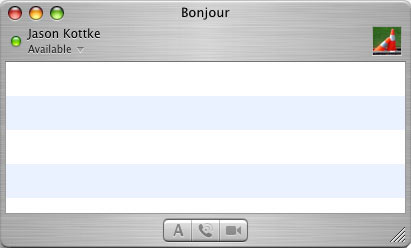
I may be the only person in the entire room with his laptop open. Instead, everyone is listening to the speakers. Like Jeff, I’m torn: is this lack of a back channel a good thing or does the presence of an online component of a conference make the experience more rewarding?
Nikolaus Hafermaas made an interesting observation about visual design. If you’ve a visual designer, you’re working with a rapidly depleting finite resource: people’s personal attention.
Rafael Esquer just showed some of his most recent work here at the Student Conference. I like his Made in NY logo that he did for NYC. Here’s a short interview with Esquer.
Timeline of the AIGA Design Conference. Nicely done little Flash movie.
Publish looks at Microsoft’s newly announced interactive design application, Sparkle, comparing it with Flash. More on Sparkle.
Todd Radom designs sports logos, including ones for the Super Bowl, Fenway Park’s 90th anniversary, and the new Cleveland Browns. Read about his design for the Washington Nationals logo in Fast Company.
Dressed to the Nines is an interactive look at the design of baseball uniforms. “Whether we are looking at someone in a uniform or we are trying it on ourselves, it is the feeling of the fabric, the design on the cap and jersey, the colors, cut, and history of the outfit, that all lend meaning to our relationship with the game.”
A look at Jefferson Burdick’s baseball card collection which he donated the Met Museum in NYC. One downside to the collection: most of the cards are pasted into albums and so are in poor condition.
One of the pre-conference events was a talk at Fenway Park followed by a tour of the ballpark. Janet Marie Smith, VP of planning and development for the Sox, kicked things off with how the team (especially the new management) works really hard to preserve the essential character of Fenway while at the same time trying to upgrade the park (and keep it from getting torn down). She talked about the advertisements added to the Green Monster, which was actually not a purely commercial move but a throwback to a time when the Monster was actually covered with ads.
Lots of talk and awareness of experience design…the Red Sox folks in particular kept referring to the “experience” of the park. One of the speakers (can’t recall who, might have been Jim Dow) talked about how other ballparks are becoming places where only people who can afford $100 tickets can go to the games and what that does to the team’s fan base. With Fenway, they’re trying to maintain a variety of ticket prices to keep the diversity level high…greater diversity makes for a better crowd and a better fan base and is quite appropriate for Boston (and New England in general), which has always been an area with vibrant blue collar and blue blood classes.
Janet also referred to the “accidental” design of the park. Like many other urban ballparks built in the late 19th/early 20th centuries, the placement of the streets constrained the design of Fenway and made it rather an odd shape….these days larger plots are selected where those types of restraints are removed. And over time, the game has changed, the needs of the fans have changed, and the fire codes have changed and the park has changed with the times. In the dead ball era, the walls of the stadium weren’t for hitting home runs over; their sole function was to keep people on the street for catching the game for free, so the Fenway outfield ran over 500 feet in right field — practically all the way to the street — where there’s now 30 rows of seats. Jim Holt observed that American butts have gotten bigger so bigger seats are called for. Fire codes helped that change along as well…wooden seats, bleachers, and overcrowding are no longer a large part of the Fenway experience (save for the wooden seats under the canopy).
The design talk continued on the tour of the park. Our guide detailed how ballparks are built around specific ballplayers. Yankee Stadium was the house that Ruth built but it was also seemingly (but not literally) built for him with a short trip for his home run balls to the right field wall. Boston added a bullpen to make the right field shorter for Ted Williams. Barry Bonds does very well at PacBell/SBC/WhateverItsCalledTheseDays Park. And more than that, the design of Fenway also dictated for a long time the type of team that they could field, which had some bearing on how they did generally. Players who played well in Fenway (i.e. could hit fly balls off of the Monster in left) often didn’t do so well in other parks and the team’s away record suffered accordingly.

Perfect for those long Security Council meetings when your Secretary of State won’t let you go potty.
Odd story of one astronomer possibly “stealing” another astronomer’s discovery of a large trans-Neptunian object. The original discoverer alleges that the usurper looked at a couple of Web sites that detailed the discovery and where the discover’s telescopes were pointed…the astronomy equivalent of stealing signs.
Heading out to CMJ this week in NYC? Coolfer has some thoughts on which groups might make a big splash among the glut of live music that CMJ brings to the already-oversupplied city.
Five things I’d ask every Supreme Court nominee if I sat on the Senate Judiciary Committee: “If you knew to an absolute moral certainty that you could capture and consume a live infant without being caught, how many do you suppose you could eat in a weekend?”
Animal Reviews is (duh) a site that reviews animals, including giving them a rating. The dolphin gets 0.8/10 while the duck-billed platypus gets a 6.3.
You’ve got to love an article called The Ten Stupidest Utopias. In regard to the Internet, he says “utopia is never more than what we are; the people in them will always be just like us”.
Paragraph looks like a neat idea. It’s a writer’s workspace located near Union Square here in NYC. It’s like a gym, except for writers. You pay a membership fee and then you can show up and use the facilities (desks, kitchen, your own locker for your stuff, wifi, etc.). More on Paragraph at designer Khoi Vinh’s site.
In case you ever need it, a long, long piece about how to vanish in America without a trace.
Papalotzin is a project to follow the migration of the monarch butterfly from Canada to Mexico in an ultralight airplane (they call it their big butterfly). They’ve made it as far as NYC so far and are blogging and taking pictures as they go. (via gurgly)
Sigur Ros played New York’s Beacon Theatre last night, and it was one of the oddest rock and roll shows I’ve been to. Not that I’ve been to a lot of shows, but still. It was like going to the symphony…everyone sat quietly in their seats, clapped politely at the conclusion of songs, and since the music was so quiet at times, people were shushed for talking too loudly (after awhile, most of the audience got clued in that you couldn’t just yak during the whole thing like at normal concerts). And then there was the 30 seconds of complete silence when the band paused in the middle of a song — not a peep from the audience — and then kept right on playing. Great show though…the visuals for the last two songs (final song + encore) were especially impressive. Makes me remember how much I like Sigur Ros. Even though I’ve heard their older albums a thousand times, I don’t get sick of them. I’m looking forward to listening to the new album on the train ride to Boston today.
Here’s some Flickr photos of the show…probably a mixture of stuff from last night’s show and the previous night’s.
Google finally launches a blog search service. The default search is by relevance, which I’m not sure is correct, and it’s pretty bare bones so far, but I’m sure that many other people will be saying so long, Technorati. Also available in Blogger flavor. (via waxy)
Dear The Onion, please stop paginating your stories. I know you’re trying to increase your ad real estate, but it’s annoying to have to click to read more, especially on shorter stories. From now on, when I link to stuff like this excellent Errol Morris interview, it’s going to be to the handy one-page print version with zero ads. NY Times, Salon, WaPo, Wired News, that goes double for you.
TiVo’s new OS adds content “protection”, which means if the copyright holder of Seinfeld wants your TiVo to delete the show after a week whether you’ve watched it or not, that’s what it’s going to do. I love my TiVo and I’m currently suffering from outrage fatigue, but if the company wants to side with the entertainment industry over its customers and cripple useful features, then it’s the last one I’m ever going to own. (via the wax)
The writer of this blog hates the New Yorker, especially the David Denby part of it. From reading the site a bit, it seems to me that they actually like the NYer, but wish it were better, a feeling which I’ve had for several things in my life.
The human brain may have undergone “substantial evolution” in the past 60,000 years.
March of the Penguins has become a favorite for conservative moviegoers, who cite it as making a good case for monogomy, intelligent design, and a pro-life stance on abortion. I wonder if liberals watch the film and come out advocating universal health care…all those dead penguin babies could have been saved with proper medical care.
Socials & More