Within the past 100 million years, an icy moon got too close to Saturn and the planet’s gravity ripped it apart, forming the iconic rings. This clip from BBC’s The Planets details how that happened, accompanied by some amazing photography from NASA’s Cassini mission.
They are younger than the dinosaurs, they form a disk wider than Jupiter that averages just 9 meters (30 feet) thick, and thanks to Cassini, we now know that there are tall peaks rising as high as 2.5 kilometers (1.6 miles) from the planet’s B ring.
I’ve shared this story on the site before, but seeing the rings of Saturn through my telescope in my backyard as a teenager made a massive impression on me as to the scale of the solar system and humankind’s ability to understand it through science and technology. I still can’t believe you can see those rings with a cheap telescope or binoculars. Incredible.
Space is mostly just what it says on the tin: empty space. The solar system is no exception; it’s a massive volume occupied by little more than the Sun’s mass — the mass of all the planets, moons, comets, asteroids, space dust, and stray electrons are just a bit more than a rounding error. But oh what mass it is when you get up close to it.
The NASA space probe Cassini, on its seven-year journey to Saturn, cozied up to Jupiter in December 2000 and captured a succession of images of Io and Europa passing over the Great Red Spot during the moons’ orbit of the gas giant planet. Kevin Gill turned those images into the incredible video embedded above. That we have such crisp, smooth video of two small moons orbiting a planet some 444 million miles away from Earth is something of a miracle — it looks totally rendered. Also in the video is footage of Titan orbiting Saturn — that horizontal line bisecting the frame is Saturn’s rings, edge-on.
On one of its final passes of Saturn, the Cassini probe captured this image of a wave structure in Saturn’s rings known as the Janus 2:1 spiral density wave. The waves are generated by the motion of Janus, one of Saturn’s smaller moons.
This wave is remarkable because Janus, the moon that generates it, is in a strange orbital configuration. Janus and Epimetheus (see “Cruising Past Janus”) share practically the same orbit and trade places every four years. Every time one of those orbit swaps takes place, the ring at this location responds, spawning a new crest in the wave. The distance between any pair of crests corresponds to four years’ worth of the wave propagating downstream from the resonance, which means the wave seen here encodes many decades’ worth of the orbital history of Janus and Epimetheus. According to this interpretation, the part of the wave at the very upper-left of this image corresponds to the positions of Janus and Epimetheus around the time of the Voyager flybys in 1980 and 1981, which is the time at which Janus and Epimetheus were first proven to be two distinct objects (they were first observed in 1966).
The photograph is also an optical illusion of sorts. The rings appear to be getting farther away in the upper lefthand corner but the plane of the photograph is actually parallel to the plane of the rings…it’s just that the wavelength of the density wave gets shorter from right to left.
Update: Here are those density waves converted into sound waves. The first set sounds like an accelerating F1 car.
The Cassini spacecraft took a photo of two moons of Saturn, Tethys and Enceladus, beautifully aligned with each other. The cosmic ballet goes on. (via slate)
The Cassini probe, launched from Earth in 1997 (six months before I started publishing kottke.org), has been taking photos of Saturn and its moons for 11 years now. The Wall Street Journal has a great feature that shows exactly what the probe has been looking at all that time. (Note: the video above features flashing images, so beware if that sort of thing is harmful to you.)
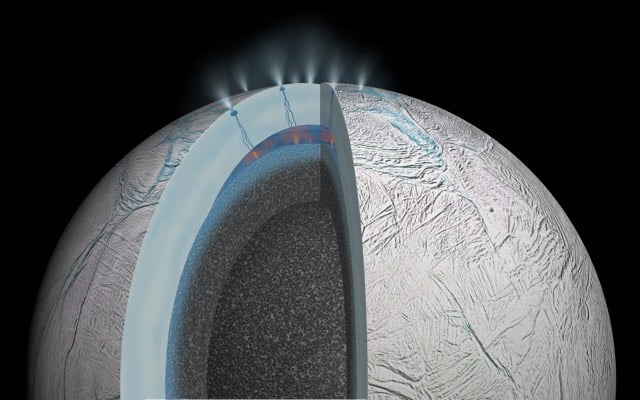
Discovering life was not on the agenda when Cassini was designed and launched two decades ago. Its instruments can’t capture microbes or detect life, but in a couple of dozen passes through the plumes of Enceladus, it has detected various molecules associated with life: water vapor, carbon dioxide, methane, molecular nitrogen, propane, acetylene, formaldehyde and traces of ammonia.
Wednesday’s dive will be the deepest Cassini will make through the plumes, only 30 miles above the icy surface. Scientists are especially interested in measuring the amount of hydrogen gas in the plume, which would tell them how much energy and heat are being generated by chemical reactions in hydrothermal vents at the bottom of the moon’s ocean.
That’s pretty crazy…it sounds like science fiction. NASA is doing a wonderful job producing great science with the lean budgets they are given.
Two teams of NASA scientists have discovered evidence that hydrothermal vents on the Saturnian moon of Enceladus show signs of “active hot-water chemistry”. Why is that exciting? Because similar chemistry occurs deep in the Earth’s oceans *and* can support life. Phil Plait explains.
We see these vents in the ocean bottom on Earth, too. The water there is very hot, heated by tectonic processes inside Earth’s crust. It brings up minerals and nutrients, and life thrives there. A lot of the processes are the same as what’s imagined is happening on Enceladus; minerals are dissolved in hot water that spews up into the cold ocean, precipitating out. A lot of it is sulfur based, but amazingly life exists there anyway. The environment is highly toxic to humans-huge pressure, boiling water near the vents, freezing a bit farther away, and loaded with icky chemicals-but as a scientist once said, “Life finds a way.”
Between the evidence of past flowing water on Mars, Titan’s hydrocarbon lakes, Europa’s underground ocean, and Enceladus, it seems increasingly probable we’ll find life somewhere else in the solar system. That’s a pretty exciting prospect! (via @ericholthaus)
Update: It was also announced today that the Hubble has detected signs of a salty underground ocean on Jupiter’s moon Ganymede.
New observations of the moon using Hubble support this. Ganymede has a weak magnetic field, and, like on Earth, this generates an aurora-the glow created when high-speed subatomic particles slam into the extremely thin atmosphere. This glow is brightest in ultraviolet, and so astronomers used the Space Telescope Imaging Spectrograph (my old camera!) on Hubble to observe Ganymede. STIS is quite sensitive to UV and detected the aurora.
Now this part is a bit tricky: Jupiter has a powerful magnetic field as well, which interacts with Ganymede’s. As they do, the aurora changes position over time, moving up and down in latitude. However, the observations show that the aurorae do not change nearly as much as expected if Ganymede were solid. The best way to explain this is if the moon has a salty ocean under its surface. The ocean would have its own magnetic field and would resist the influence of Jupiter’s magnetic field, which in turn keeps the aurora steadier.
Turns out there’s water all over the place in the solar system. How about that?
Clive Thompson recently saw the moons of Jupiter with his own eyes and has a moment.
I saw one huge, bright dot, with three other tiny pinpoints of light nearby, all lined up in a row (just like the image at the top of this story). Holy moses, I realized; that’s no star. That’s Jupiter! And those are the moons of Jupiter!
I’m a science journalist and a space buff, and I grew up oohing and aahing over the pictures of Jupiter sent back by various NASA space probes. But I’d never owned a telescope, and never done much stargazing other than looking up in the night unaided. In my 45 years I’d never directly observed Jupiter and its moons myself.
So I freaked out. In a good way! It was a curiously intense existential moment.
For my birthday when I was seven or eight, my dad bought me a telescope. (It was a Jason telescope; didn’t everyone have a telescope named after them?) We lived in the country in the middle of nowhere where it was nice and dark, so over the next few years, we looked at all sorts of celestial objects through that telescope. Craters on the Moon, the moons of Jupiter, Mars, and even sunspots on the Sun with the aid of some filters. But the thing that really got me, that provided me with my own version of Thompson’s “curiously intense existential moment”, was seeing the rings of Saturn through a telescope.
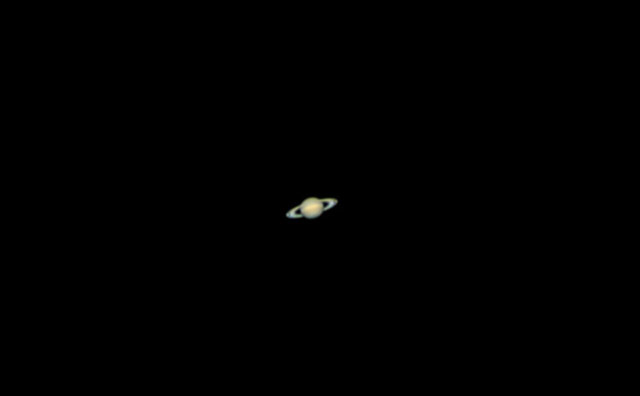
We had heard from PBS’s Jack Horkheimer, the Star Hustler, that Saturn and its rings would be visible and he showed pictures of what it would look like, something like this:
But seeing that with your own eyes through a telescope was a different thing entirely. Those tiny blurry rings, visible from millions of miles away. What a thrill! It’s one of my favorite memories.
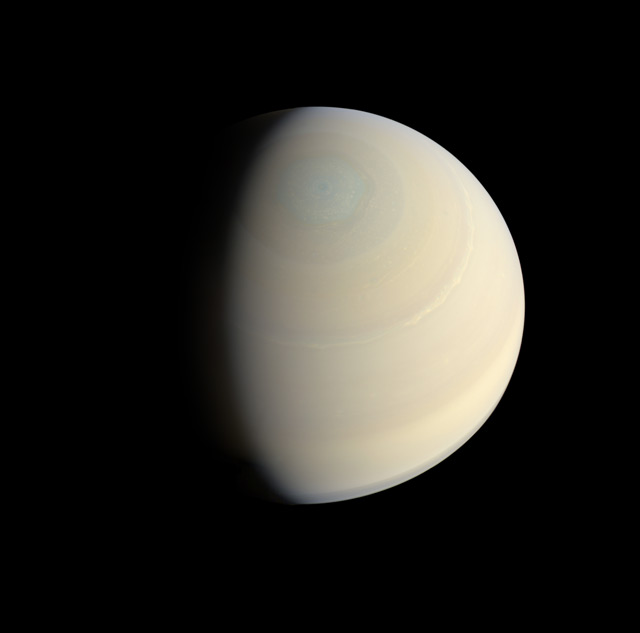
Over at The Planetary Society, Emily Lakdawalla highlighted an image taken by the Cassini spacecraft of Saturn separate from its rings.
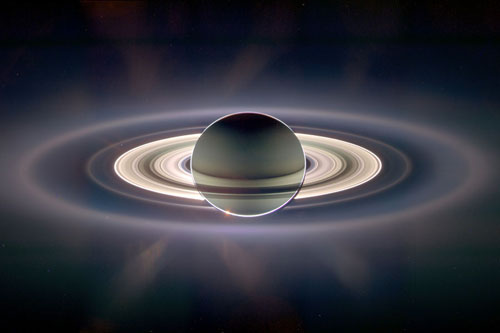
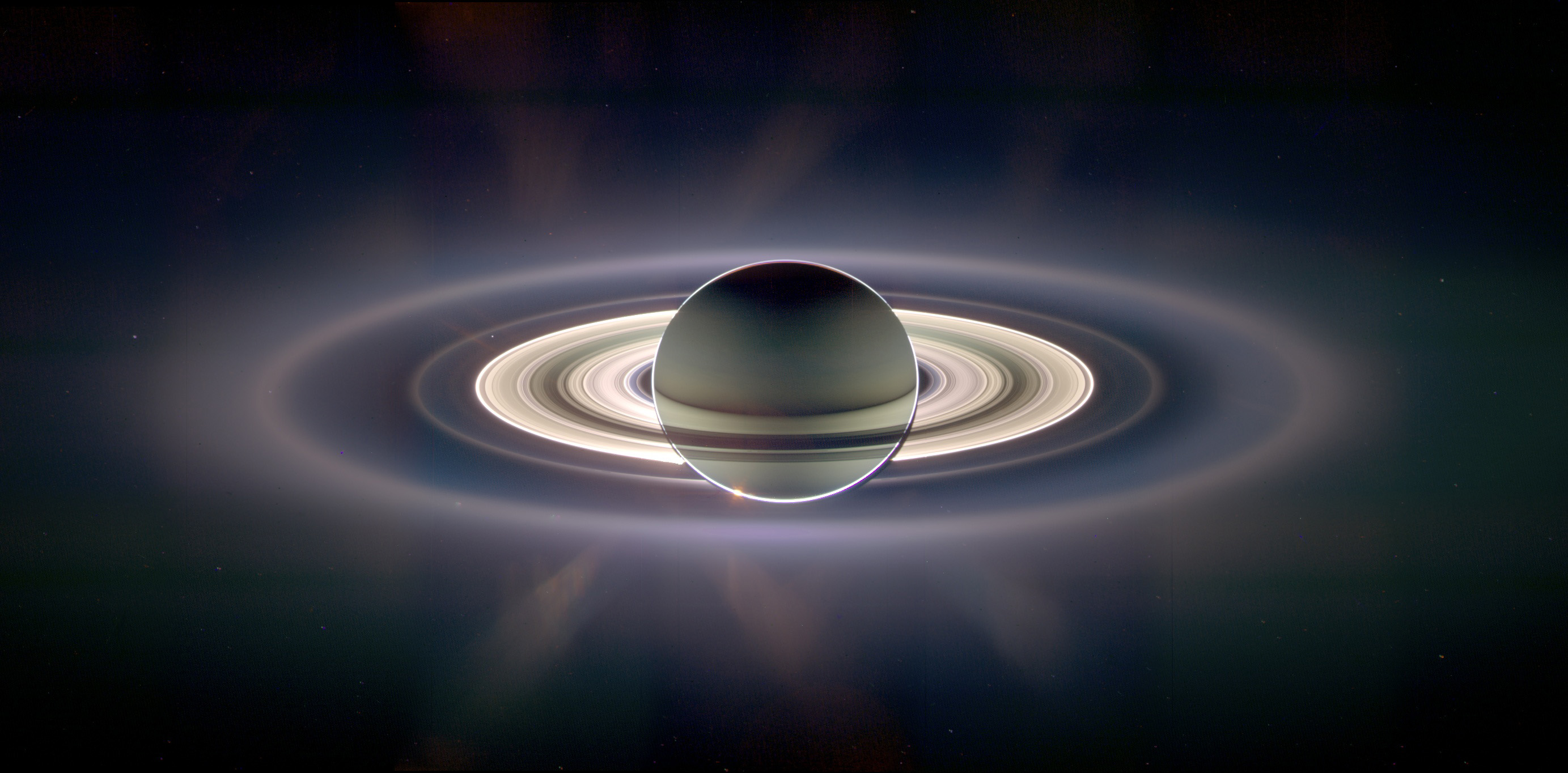
This enormous mosaic showing the flattened globe of Saturn floating amongst the complete disk of its rings must surely be counted among the great images of the Cassini mission. From Earth, we never see Saturn separate from its rings. Here, we can see the whole thing, a gas giant like Jupiter, separated at last from the rings that encircle it.
Taking this idea one step further, I removed the rings completely, along with the “ringlight” lighting up the night hemisphere, creating a more-or-less pure look of what Saturn would look like without its rings.
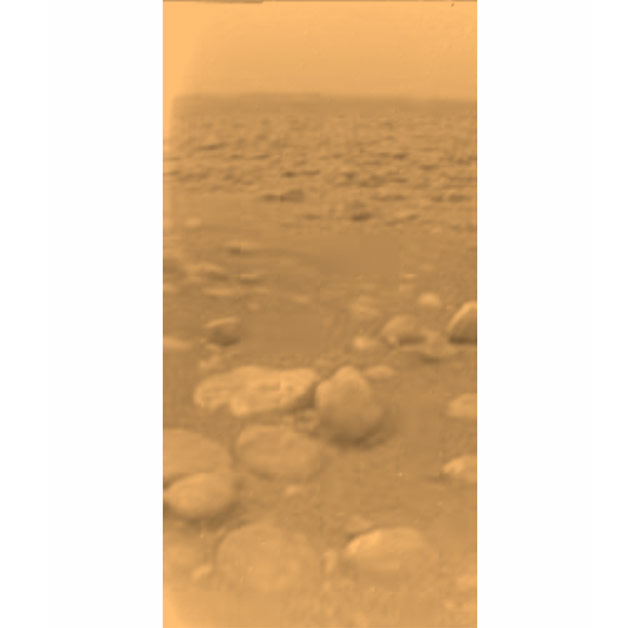
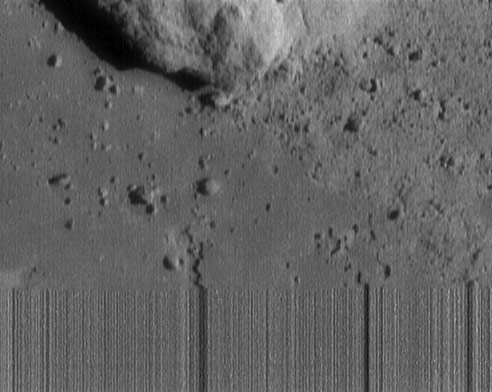
So far, humans have taken photos from the surfaces of Earth, the Moon, Venus, and Mars. But I had no idea that a photo from the surface of Titan existed:
The photo of the Saturnian moon was taken in 2005 by the Huygens probe, which was designed to land safely on the moon’s surface. From Wikipedia:
After landing, Huygens photographed a dark plain covered in small rocks and pebbles, which are composed of water ice. The two rocks just below the middle of the image on the right are smaller than they may appear: the left-hand one is 15 centimeters across, and the one in the center is 4 centimeters across, at a distance of about 85 centimeters from Huygens. There is evidence of erosion at the base of the rocks, indicating possible fluvial activity. The surface is darker than originally expected, consisting of a mixture of water and hydrocarbon ice. The assumption is that the “soil” visible in the images is precipitation from the hydrocarbon haze above.
And a special close-but-no-cigar award goes to the NEAR Shoemaker probe, which snapped this photo from about 400 feet above the surface of the near-Earth asteroid Eros:
The probe landed on the surface of Eros in February 2001 and transmitted usable data for about two weeks afterwards, none of which was photographic in nature.
Well, now, this is gorgeous. Stamen Design overlaid watercolor textures on OpenStreetMap map tiles to show you what it would look like if your favorite watercolorist designed Google Maps.
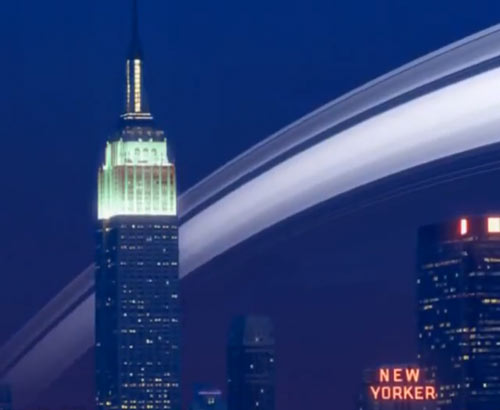
And since we all could stand to look at more pretty things, watch this video of what different landscapes would look like if Earth had Saturn’s rings. (via @ianmurren)
This video of what Earth would look like with Saturnine rings is pretty ho-hum, yeah, there’s a shot from orbit of the Earth with Saturn’s rings around it, and then BAM! here’s what it would look like at night in NYC:
With the combination of GPS and orientation data that’s baked in to so many digital photographs, it should be possible to create a filter — I hear the kids call them apps now — that automatically inserts properly positioned Saturn rings into any sky you want.





Stay Connected