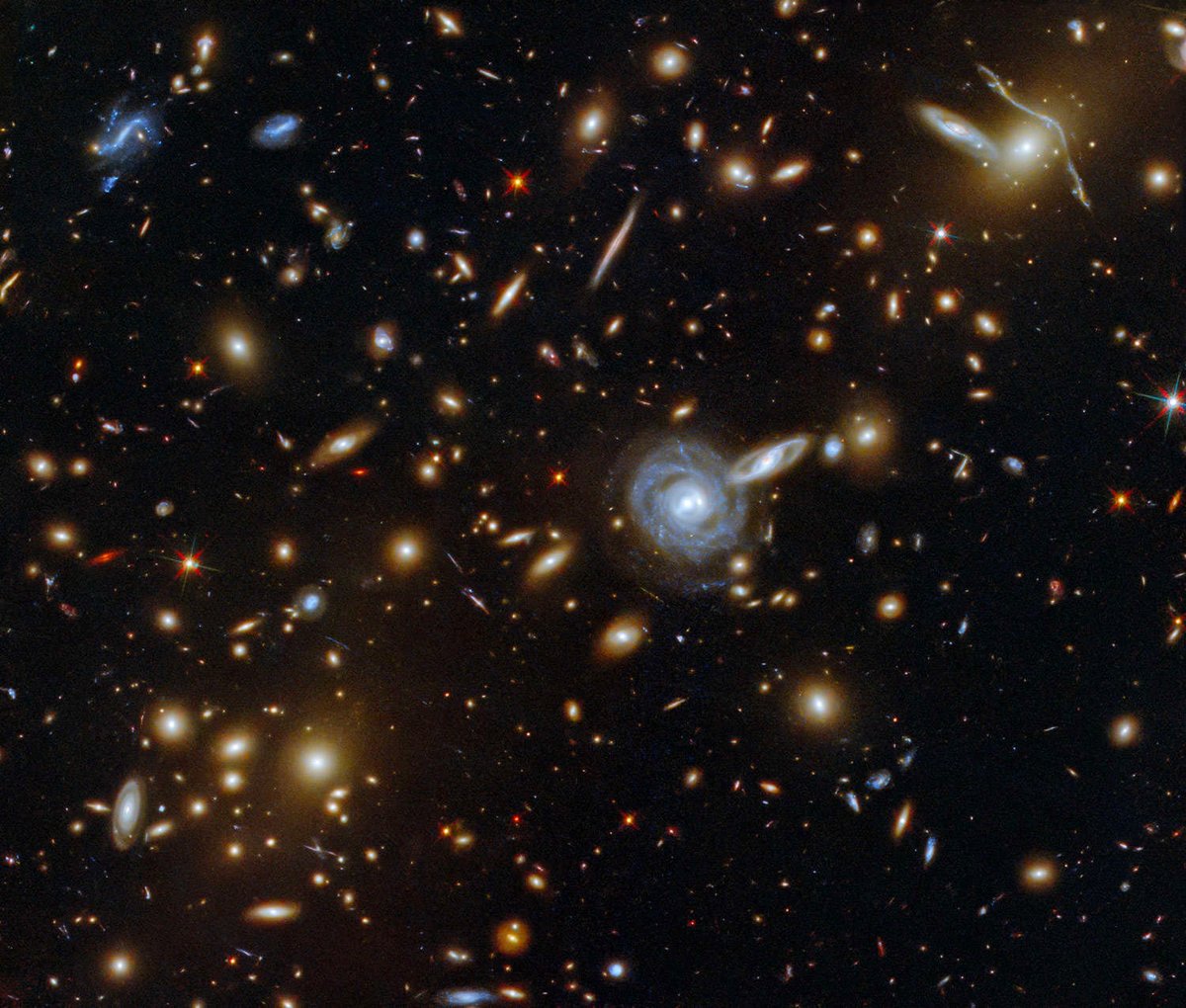
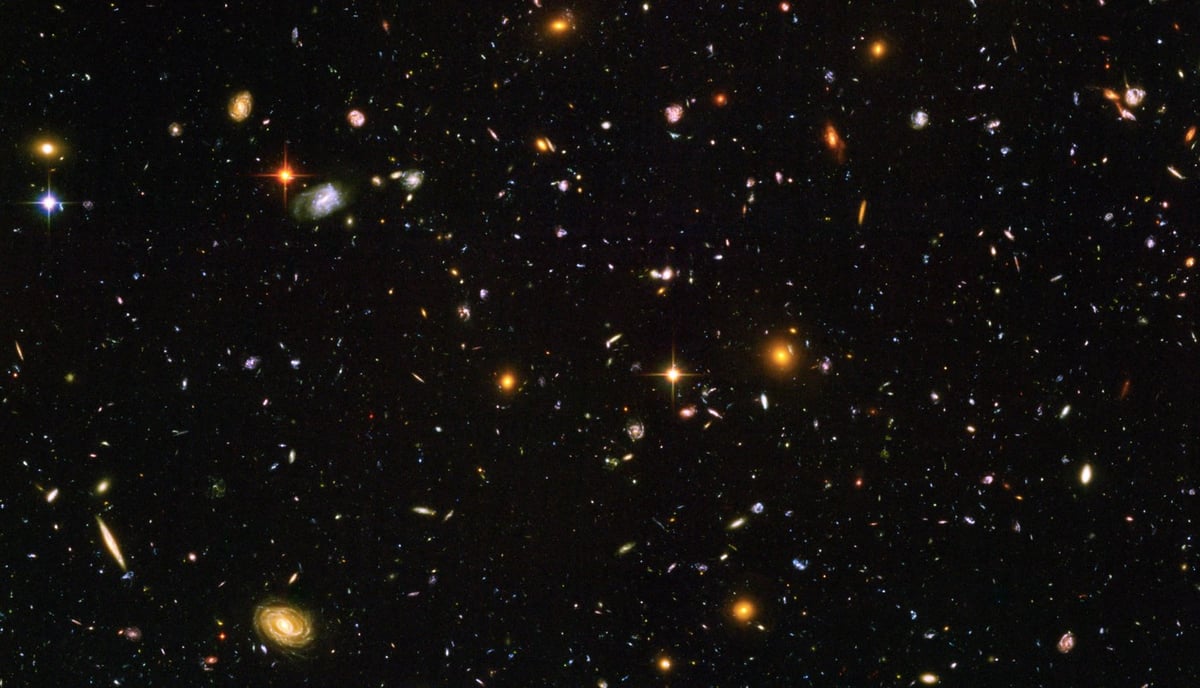
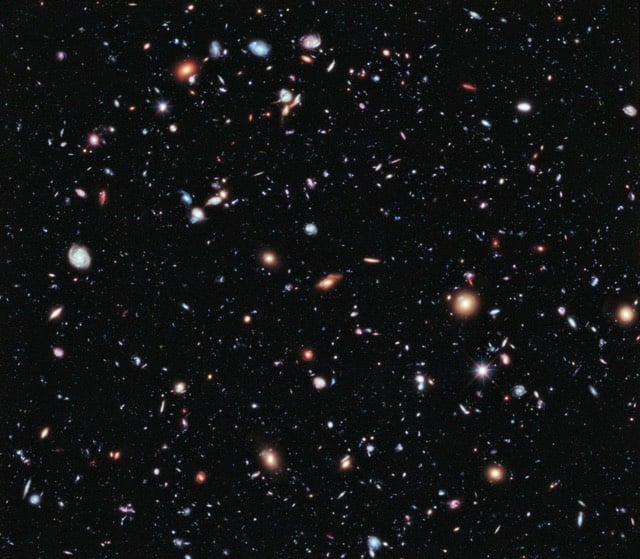
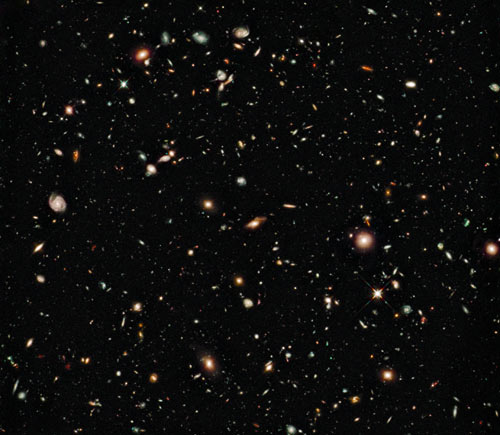
This is a photo of a tiny tiny snippet of the universe, taken by the Hubble Space Telescope. Every object you see in the photo is a staggeringly massive galaxy that contains hundreds of billions of stars along with all sort of other things.
Our own galaxy, the Milky Way, is well over one hundred thousand light years across. We only see a pitiful portion of it. Although it contains several hundred billion stars in its expanse, we can only see a fraction of a fraction of them.
And even that doesn’t fully capture the essence of a galaxy, which also has planets, gas, dust, dark matter, and more. Galaxies are colossal objects, their true nature only becoming apparent to us a century ago.
I know I’ve posted photos like this before, but every time I see something like this, my mind boggles anew at the sheer scale and magnitude of it all and I just have to share it.
P.S. And Earth contains the only sentient life in the entire universe? Lol.
Last month, I told you about Comet ATLAS, which at that time looked capable of putting on a real show in the night sky.
Except, since its discovery, the comet has been brightening at an almost unprecedented speed. As of March 17, ATLAS was already magnitude +8.5, over 600 times brighter than forecast. As a result, great expectations are buzzing for this icy lump of cosmic detritus, with hopes it could become a stupendously bright object by the end of May.
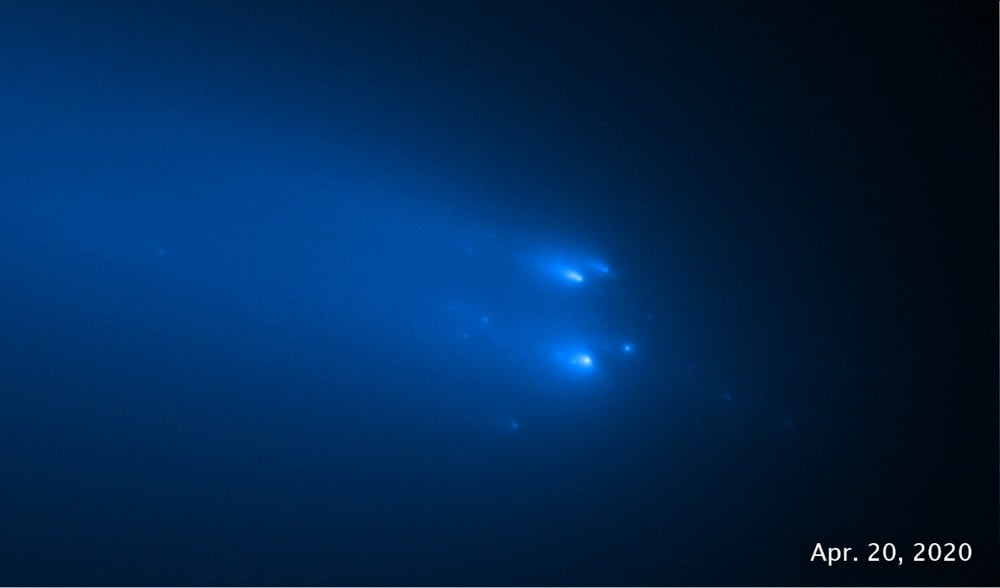
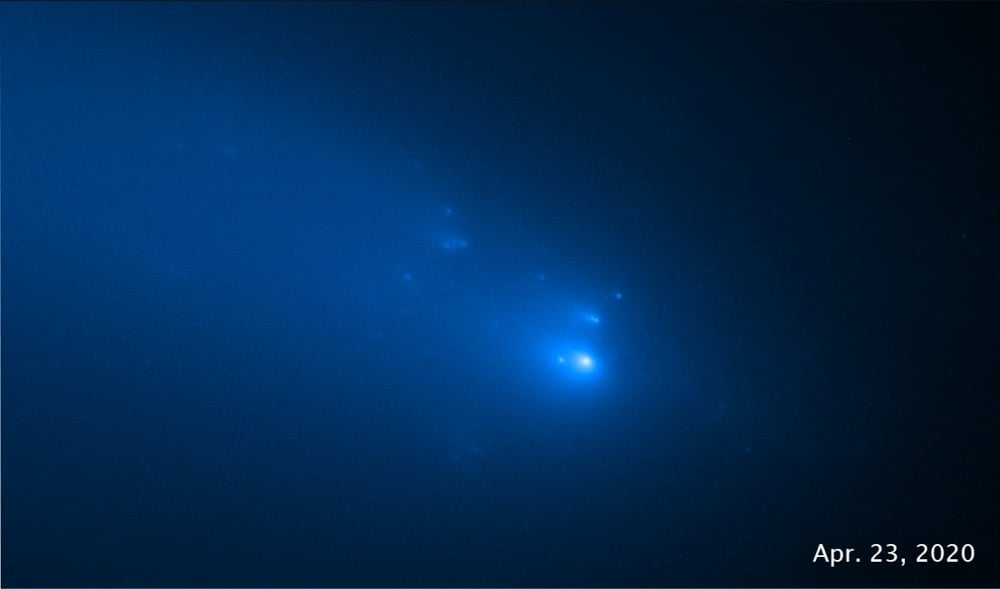
It turns out the increase in brightness was fleeting — and possibly due to the comet breaking apart. In the past week, the Hubble Space Telescope has gotten two good looks at the disintegrating comet, identifying that the main mass has broken into about 30 fragments.
“This is really exciting — both because such events are super cool to watch and because they do not happen very often. Most comets that fragment are too dim to see. Events at such scale only happen once or twice a decade,” said the leader of a second Hubble observing team, Quanzhi Ye, of the University of Maryland, College Park.
The results are evidence that comet fragmentation is actually fairly common, say researchers. It might even be the dominant mechanism by which the solid, icy nuclei of comets die. Because this happens quickly and unpredictably, astronomers remain largely uncertain about the cause of fragmentation. Hubble’s crisp images may yield new clues to the breakup. Hubble distinguishes pieces as small as the size of a house. Before the breakup, the entire nucleus may have been no more than the length of two football fields.
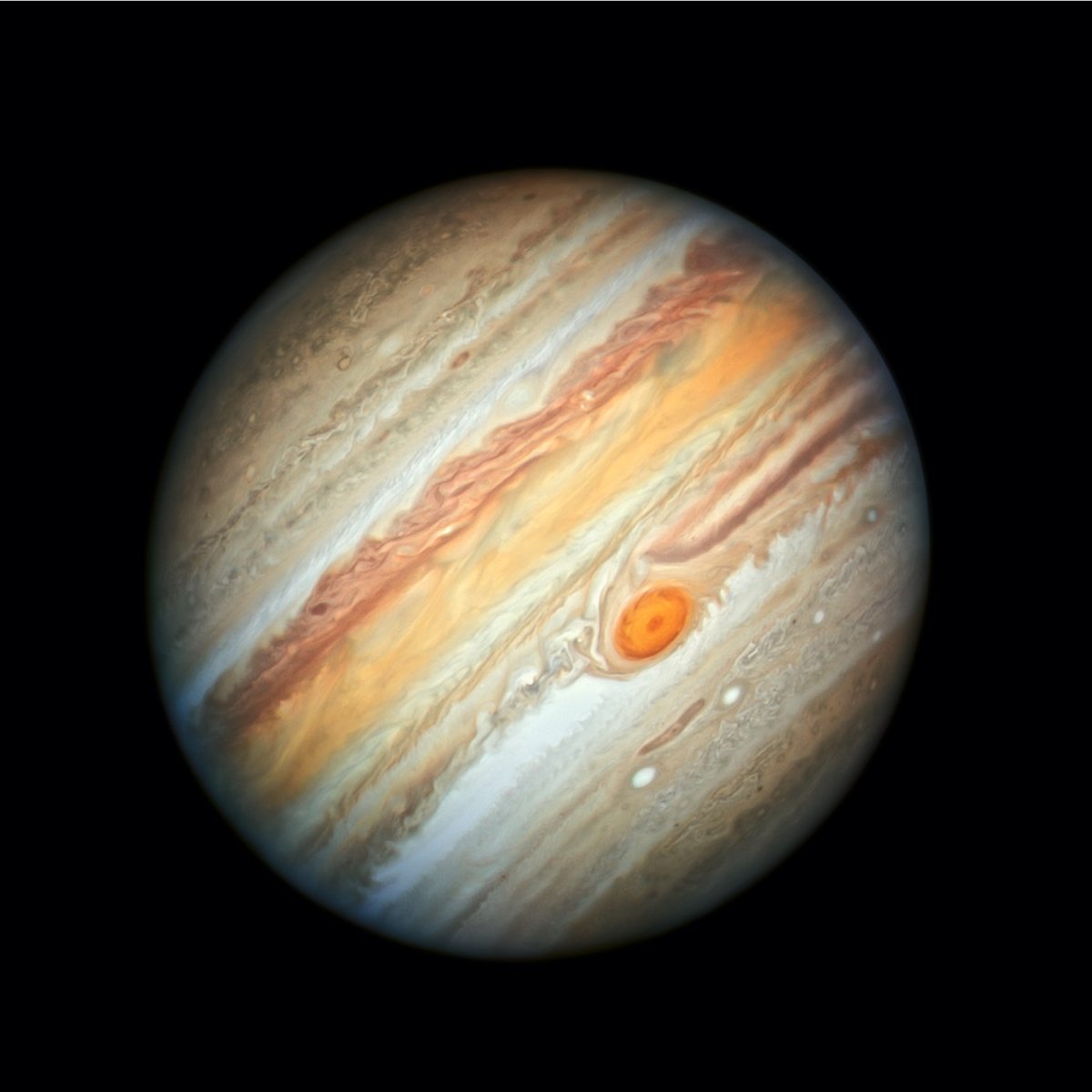
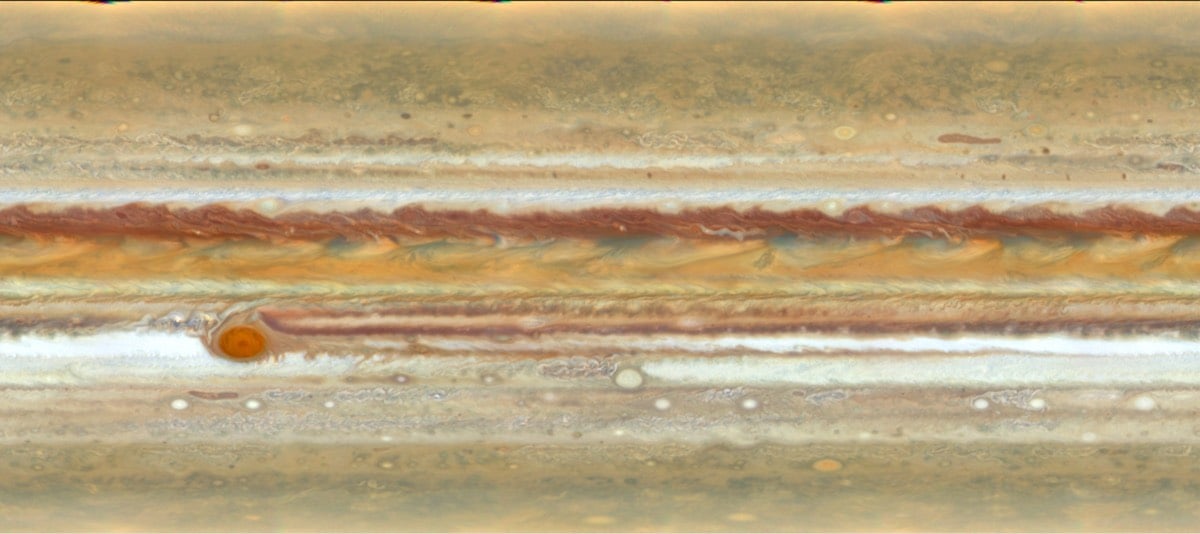
A photo of Jupiter taken by the Hubble Space Telescope in late June was recently released by NASA. Among other things, it shows just how much smaller, redder, and rounder the Great Red Spot has gotten.
The Great Red Spot is a towering structure shaped like a wedding cake, whose upper haze layer extends more than 3 miles (5 kilometers) higher than clouds in other areas. The gigantic structure, with a diameter slightly larger than Earth’s, is a high-pressure wind system called an anticyclone that has been slowly downsizing since the 1800s. The reason for this change in size is still unknown.
Because the storm has been contracting, the researchers expected to find the already-powerful internal winds becoming even stronger, like an ice skater who spins faster as she pulls in her arms.
Instead of spinning faster, the storm appears to be forced to stretch up. It’s almost like clay being shaped on a potter’s wheel. As the wheel spins, an artist can transform a short, round lump into a tall, thin vase by pushing inward with his hands. The smaller he makes the base, the taller the vessel will grow.
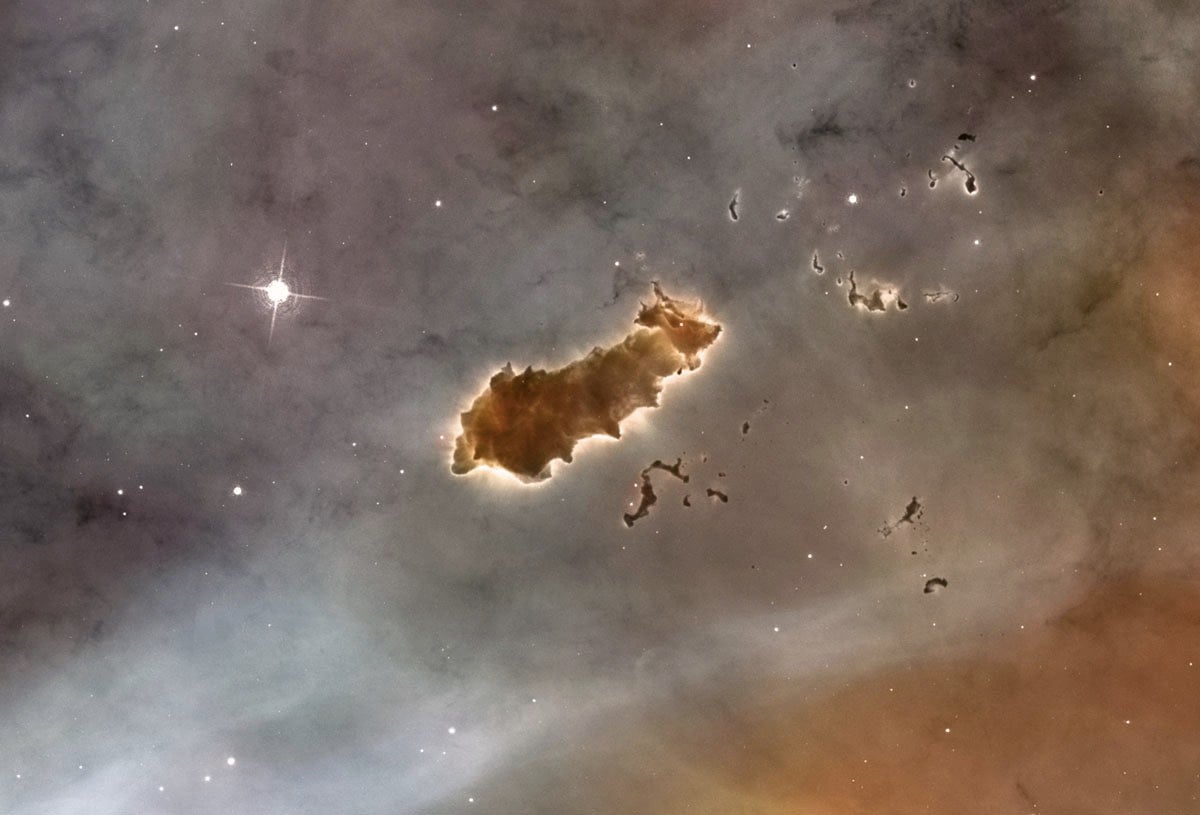
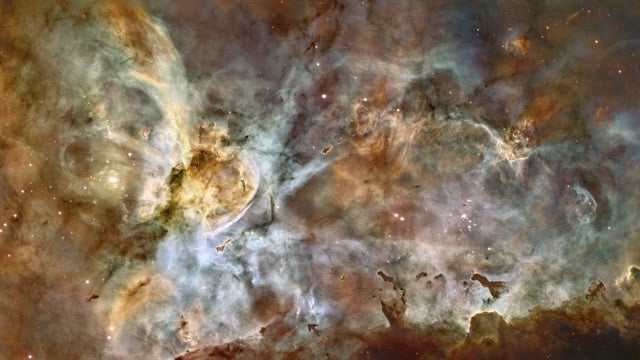
A Caterpillar in the Carina Nebula. Scattered across the enormous Carina nebula are numerous dense clumps of cosmic gas and dust called Bok globules, including this one, which resembles a huge glowing caterpillar. First described by by astronomer Bart Bok, the globules are relatively small, dark, and cold regions made up of molecular hydrogen, carbon oxides, helium, and dust. The glowing edge of the caterpillar indicates that it is being photoionized by the hottest stars in the surrounding cluster. It has been hypothesized that stars may form inside these dusty cocoons.
More than 20 years ago, the Hubble Space Telescope took a photo of a patch of seemingly dark sky and, lo, it was filled with hundreds and hundreds of galaxies.
About ten years after that, they looked even deeper into the night sky and observed thousands of galaxies, each containing hundreds of billions of stars. The video above is an appreciation of these Deep Field images and what they taught us about the Universe.
In 1995, scientists pointed the Hubble Telescope at an area of the sky near the Big Dipper. The location was apparently empty, and the whole endeavour was risky — what, if anything, was going to show up? But what came back was nothing short of spectacular: an image of over 1,500 galaxies glimmering in a tiny sliver of the universe. Alex Hofeldt helps us understand the scale of this image.
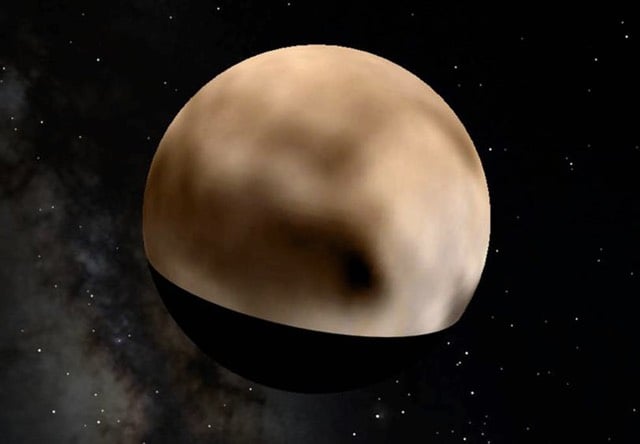
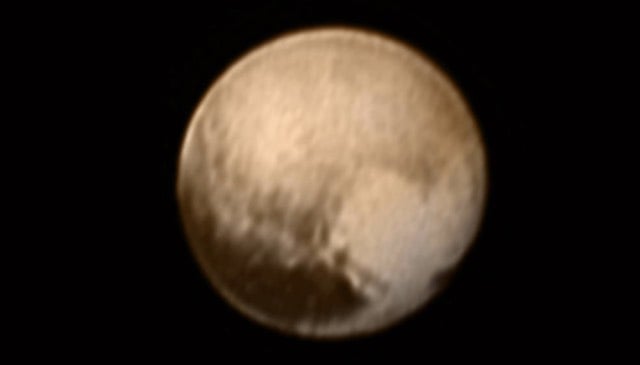
New Horizons will reach its closest approach to Pluto in just under 6 days, on July 14. The probe will pass within 7,800 miles of the surface…I can’t wait to find out what that day’s photos look like.
Update: You don’t even need to wait until tomorrow for that better image…here’s one that NASA released just a short while ago. Tune in tomorrow for an even better view.
New Horizons’ imaging capability of Pluto surpassed Hubble’s on May 15, 2015. So every picture since then has been better than what we’ve had previously.↩
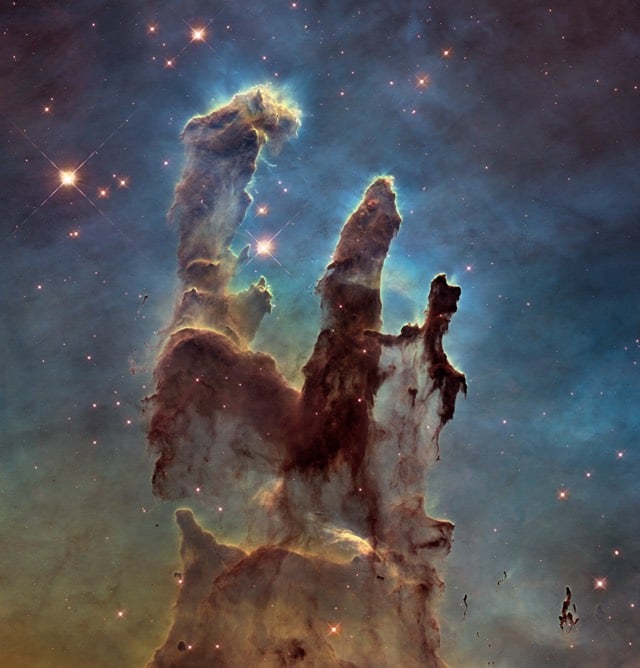
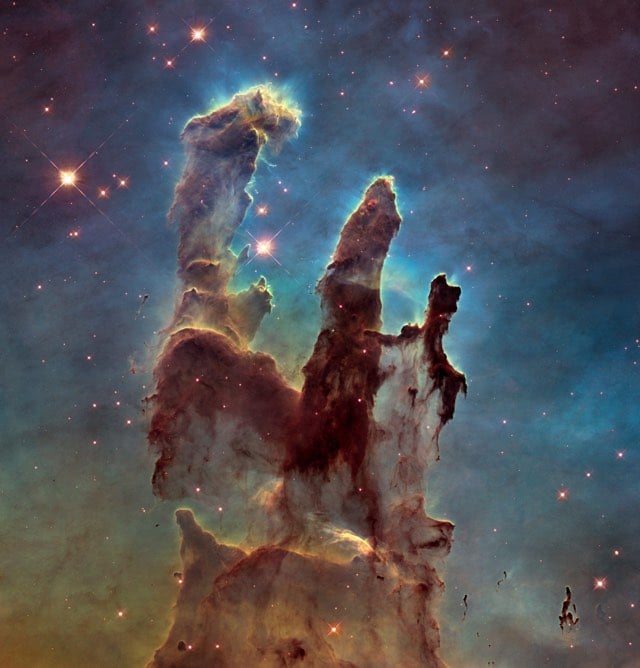
The Hubble Space Telescope was launched 25 years ago, and to start the celebration, NASA has released a pair of images that actually did make this space nerd’s jaw drop. The first is an update of a classic: a much sharper photo of the so-called Pillars of Creation:
Although NASA’s Hubble Space Telescope has taken many breathtaking images of the universe, one snapshot stands out from the rest: the iconic view of the so-called “Pillars of Creation.” The jaw-dropping photo, taken in 1995, revealed never-before-seen details of three giant columns of cold gas bathed in the scorching ultraviolet light from a cluster of young, massive stars in a small region of the Eagle Nebula, or M16.
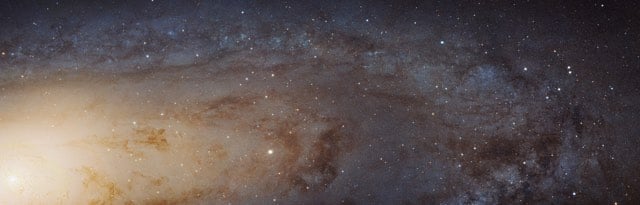
The second image isn’t so immediately amazing but is my favorite of the two. It’s a photo of half of the Andromeda galaxy, the big galaxy closest to our own in distance but also in rough size and shape. Here’s a very very scaled-down version of it:
The largest NASA Hubble Space Telescope image ever assembled, this sweeping view of a portion of the Andromeda galaxy (M31) is the sharpest large composite image ever taken of our galactic neighbor. Though the galaxy is over 2 million light-years away, the Hubble telescope is powerful enough to resolve individual stars in a 61,000-light-year-long section of the galaxy’s pancake-shaped disk. It’s like photographing a beach and resolving individual grains of sand. And, there are lots of stars in this sweeping view — over 100 million, with some of them in thousands of star clusters seen embedded in the disk.
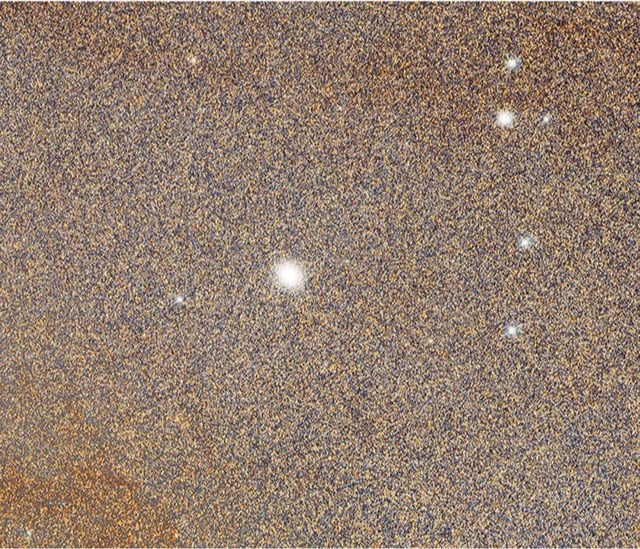
The original image is 1500 megapixels (1.5 gigapixels!), which is so big that you’d need 600 HD televisions to display the whole thing. But if you take the biggest reasonable size available for download (100 megapixels) and zoom in on it, you get this:
That looks like JPEG compression noise, right? Nope, each one of those dots is a star…some of the 100 million individual stars that can be seen in the full image.
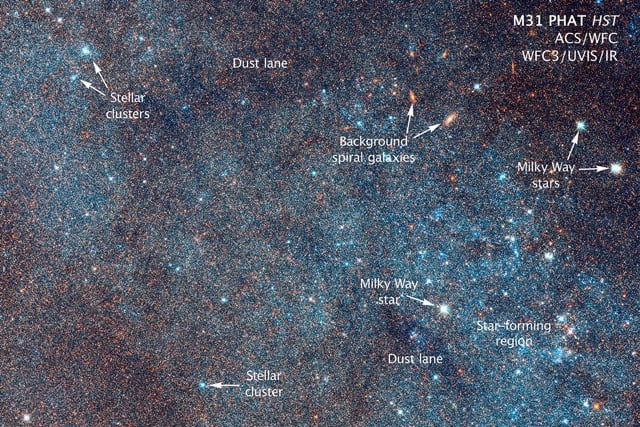
That’s right, Keanu. Whoa. For an even closer look, check out this annotated close-up released by NASA:
The colors in Hubble images, which are assigned for various reasons, aren’t always what we’d see if we were able to visit the imaged objects in a spacecraft. We often use color as a tool, whether it is to enhance an object’s detail or to visualize what ordinarily could never be seen by the human eye.
In 2004, the Hubble Space Telescope took an image called the Hubble Ultra Deep Field; basically astronomers pointed the Hubble toward an “empty” part of space and took a long-exposure shot in the visible spectrum. What they found were thousands of far away galaxies from early in the development of the universe. Now the Hubble has peered even deeper into the universe in near-infrared and captured this image:
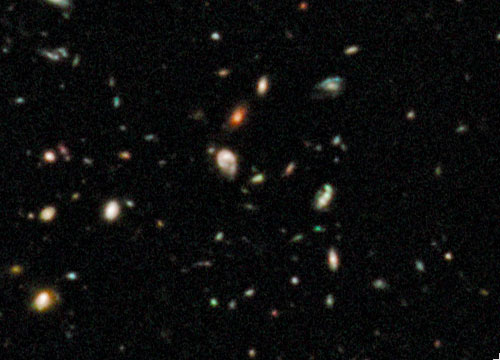
Each one of those little specks is an entire galaxy, some only 600 million years old. Here’s a zoomed-in section:
Live on NASA TV right now: the launch of the Space Shuttle Atlantis, tasked to repair the Hubble telescope. Looks like if the weather holds, lift-off is around 2:01pm. (via @noahkalina)
The “Pillars of Creation” may be the most iconic Hubble photograph ever taken. “Located in the Eagle Nebula, the pillars are clouds of molecular hydrogen, light years in length, where new stars are being born,” says Aguilar. “However, recent discoveries indicate these pillars were destroyed by a massive nearby super nova some 6,000 years ago. This is a ghost image of a past cosmic disaster that we won’t see here on Earth for another thousand years or so-and a perfect example of the fact that everything we see in the universe is history.”
An Einstein Ring happens when two galaxies are perfectly aligned. The closer galaxy acts as a lens, magnifying and distorting the view of a more distant galaxy. But today astronomers announced that they’ve discovered a double Einstein Ring: three galaxies are perfectly aligned, creating a double ring around the lensing galaxy.
Two powerful new instruments will be installed on the mission. The Wide Field Camera 3 (WFC3) will allow Hubble to see fainter and more distant galaxies than anything it has seen before, shedding light on the early universe. This could allow Hubble to see galaxies so far away that we see them as they were just 400 million years after the big bang.
Hubble’s optics provide greater detail over a wider angle, while the Lucky camera as used at Palomar gives ultra-high resolution only for a tiny slice of the sky at one time.
Woo, NASA finally decides to fix the Hubble, repairs that will keep it working until at least 2013. “Scientists expect an upgraded Hubble to continue to make groundbreaking discoveries.”






Stay Connected