kottke.org posts about video
A new episode of Estelle Caswell’s Earworm series is always cause for celebration. In this one, Caswell examines the title track off John Coltrane’s “Giant Steps” album and what makes it so challenging to play & rewarding to listen to.
John Coltrane, one of jazz history’s most revered saxophonists, released “Giant Steps” in 1959. It’s known across the jazz world as one of the most challenging compositions to improvise over for two reasons - it’s fast and it’s in three keys. Braxton Cook and Adam Neely give me a crash course in music theory to help me understand this notoriously difficult song, and I’m bringing you along for the ride. Even if you don’t understand a lick of music theory, you’ll likely walk away with an appreciation for this musical puzzle.
This is me actually walking away with that new appreciation.
It looks like Netflix has sifted through their data and determined subscribers cannot get enough of the Planet Earth and Blue Planet nature series, so they’re making their own. With David Attenborough. The teaser trailer for Our Planet borrows heavily from Planet Earth (fonts & music are similar) but is light on the details, aside from the launch date: April 5, 2019.
Update: The full trailer is out, which I’ve embedded above. Here’s the previous teaser trailer:
The Our Planet series will consist of 8 episodes filmed across 50 countries. April 5 is soooon!
Tetris was invented in 1984 by Alexey Pajitnov. It was a hit from the start but became a sensation after it was bundled with Nintendo’s Game Boy. It’s perhaps the most popular video game of all time and was played casually (and not so casually) by hundreds of millions of people around the world. You’d think with all those people playing, the limits of the game were fully probed and the highest scores reached, right? Not quite…
As John Green explains in this video, a few people are actually getting much better at the NES version of Tetris than anyone was back in the 90s. One of the reasons for this is that a smaller dedicated group working together can be more effective than a massive group of people working alone on a problem. Today’s top players can not only compare scores (as people did in the pages of Nintendo Power), but they get together for competitions, share techniques, and post videos of their gameplay to Twitch and YouTube for others to mine for tricks.
The two approaches boil down to ants solving problems vs. deliberate practice. The hundreds of millions of players were able to map out seemingly all corners of the game, but only up to a point. It took a smaller group engaging in a collective deliberate practice to push beyond the mass effort.
Green’s discussion also reminded me of something Malcolm Gladwell said in his conversation with Tyler Cowen:
The most interesting thing happening, to me, in distance running right now is the rise of Japan as a distance-running power. And what’s interesting about Japan is that Japan does not have any one runner, particularly in marathons, does not have any one marathoner who is in the top 10 in the world, or even the top 20 in the world, but they have an enormous number of people who are in the top 100. So, your notion of whether Japan is a distance-running power depends on how you choose to define distance-running power.
We have one definition that we use, where we say we recognize a country as being very good at distance running if they have lots and lots of people in the top 10, but that strikes me as being incredibly arbitrary and it goes to my point about we’re not encouraging mediocrity. Why? All that says is… OK, Kenya’s got 9 of the top 10 of the fastest marathoners right now — why is that better than having 300 of the top 1,000? It’s purely arbitrary that we choose to define greatest as just the country that most densely occupies the 99th percentile. Why can’t we define it as the country that most densely occupies the 75th through 100th percentiles?
Tetris today is like Kenya in distance running…all the best-ever players are active right now. With Tetris in the 90s, you had a much broader group of people who were really good at the game but none of whom would crack the all-time top 20 (or perhaps even top 100).
Maybe you don’t give a flying flip about excellence in Tetris or distance running, but how about education? Should we direct the resources of our educational system to ensure that most people get a pretty good education or that fewer get an excellent education? Having a few super-educated people might result in more significant discoveries in science and achievements in literature or music (that everyone can then take advantage of) but having a broader base of educated citizens would result in better decisions being made in untold numbers of everyday situations. Which of those two situations is better? Which is more just? I’d suggest the answer maybe isn’t that obvious…
In this video, Jonna Mendez, the former Chief of Disguise of the CIA, explains how disgu — Wait, wait, wait…Chief of Disguise!! That is an actual job title!?! WHAT! Ok, back to the post… — explains how disguises are used in the CIA.
With women, you have a broader range of what you can do. You also have one extra step: you can turn a woman into a man. I would mention that it’s almost impossible to turn a man into a woman. What we do is always additive — we can make you taller, we can make you heavier, we can make you older — we can’t go the other direction. You want to be the person that gets on the elevator and then gets off and nobody even remembers that you were really there. That is a design goal at the disguise labs at CIA.
Interesting throughout. As a fan of the disguises on The Americans and as someone who got to wear some bitchin’ makeup for a short extra appearance on Halt and Catch Fire, I really enjoyed this video, but now I’m wondering what my “dead giveaway” mannerisms are. Friends, any thoughts?
Vanity Fair interviewed singer/songwriter Billie Eilish last October just as her career was taking off. A year later, they repeated the interview with her, now 16 years old, using the same questions to see what had changed — 2017: 257K followers on Insta, playing to crowds of 500 people. 2018: 6.3 million Insta followers, crowds of 40,000+. The result is really affecting, particularly on questions like “Do you feel pressure?” where the difference in answers is greatest.
Eilish’s situation is extreme, but some version of this is playing out with all of America’s youth right now, dealing with how to be in the world when interacting with thousands or even hundreds of thousands or millions of other people, far beyond Dunbar’s number, is increasingly commonplace. Now if you’ll excuse me, I have something in my eye and who’s playing that Cat’s in the Cradle song anyway?!
This is easily the most awe-inspiring and jaw-dropping thing I’ve seen in months. In its low Earth orbit ~250 miles above our planet, the International Space Station takes about 90 minutes to complete one orbit of the Earth. Fewer than 600 people have ever orbited our planet, but with this realtime video by Seán Doran, you can experience what it looks like from the vantage point of the IIS for the full 90 minutes.
The video is in 4K so find the largest monitor/TV you can, turn up the sound, watch for awhile (even if it’s only for a few minutes), and see if you don’t experience a little bit of the Overview Effect, what NASA astronaut Kathryn Sullivan described as a life-altering experience:
I first saw the earth — the whole earth — from the shuttle Challenger in 1984. The view takes your breath away and fills you with childlike wonder. An incredibly beautiful tapestry of blue and white, tan, black and green seems to glide beneath you at an elegant, stately pace. But you’re actually going so fast that the entire map of the world spins before your eyes with each 90-minute orbit. After just one or two laps, you feel, maybe for the first time, like a citizen of a planet.
We could use more global citizenry these days.
In January 1972, the Southern California Community Choir, a group of Atlantic Records musicians, and Aretha Franklin gathered at the New Temple Missionary Baptist Church in Los Angeles to record music for a live album. That album, Amazing Grace, went on to be Franklin’s best selling album and is still the top-selling gospel album of all time.
Director Sydney Pollack, who would later win a Best Director Oscar for Out of Africa, filmed the two-day recording for a documentary but wound up not being able to complete the film because the picture and sound couldn’t be synced — they hadn’t used a clapperboard before takes. So the footage, which includes the Rolling Stones’ Mick Jagger and Charlie Watts jamming out in the back of the church, was shelved. Before he died in 2008, Pollack entrusted the footage to Alan Elliott, who was able to sync the sound and make a 87-minute film out of it.
The film was going to be released a few times over the past decade, but Franklin successfully sued to keep it from the public, saying that her likeness was being used without her permission Even though she professed to liking the film, Franklin was strident about her finances. After Franklin’s death, Elliott screened it for her family and they approved its release. According to Variety, the film will screen at the DOC NYC film festival on November 12th and then later in NYC and LA to qualify for the Oscars.
The trailer for the film is embedded above. Elliott seems to have snuck it online without anyone noticing — as of now, it’s got fewer than 800 views on YouTube.
Darius Miles was drafted 3rd overall by the LA Clippers in the 2000 NBA Draft. After 8 seasons, a major injury, and $62 million, Miles was out of the league and bankrupt. In this entertaining and affecting article for The Players’ Tribune, Miles explains how he got to the NBA and what went wrong.
It’s crazy to think about, but six years after we were at the peak with the Young Clippers, I was basically out of the league. I was 27 years old, and I had doctors telling me that my knee was too messed up to play basketball ever again.
My whole life, I used basketball as an escape. When you grow up how I grew up, I think you’re probably bound to have some kind of PTSD. I ain’t a doctor, but when you grow up running from gunshots all the time, I think there’s something inside you that never leaves. I used to feel this pressure on me — I’m talking like a physical pressure, you know? But I used to be able to go out onto a basketball court and just unleash it. You could let it all out. You could dunk the shit outta that motherfucker in front of 100 people or 20,000 people and feel good for a minute.
Basketball got taken away from me at 27, and I was lost. I was just kind of going through the motions. Then a couple years later, my momma got taken away from me, and I pretty much went insane.
Miles’ friend and former teammate Quentin Richardson edited the piece and wrote one of his own for the Tribune as well.
Today is Election Day in the US and even President Obama is saying these elections “might be the most important of our lifetimes”. Everyone is a liiiittle on edge. Instead of exhorting you to go vote, I dug through the kottke.org archives for some videos to watch if you need a calm moment or hour or entire afternoon and deep into the evening’s election returns.
From the BBC Earth team, long videos of relaxing sounds and scenes from their groundbreaking documentaries like Planet Earth II and Blue Planet II (more here):
A 10-hour version of the world’s most relaxing song:
This is one of my personal favorites, a Norwegian icebreaker idling in the frozen Arctic — “natural white noise sounds generated by the wind and snow falling, combined with deep low frequencies with delta waves from the powerful icebreaker idling engines”:
A 30-day time lapse of a container ship traveling from the Red Sea to Hong Kong:
Claude Debussy’s Clair de Lune is always relaxing and is the perfect accompaniment to snow surfing, an acrobatic art performance, and a tour of the Moon:
A realtime orbit of the Earth in 92 minutes, as seen from the International Space Station:
Somehow, watching someone unslice a tomato is super relaxing:
Recording of a live view of a Norwegian train making its way through the wintery countryside:
Julian Baumgartner restoring a damaged painting:
90-minute video of the sea filmed from the bow of a container ship (no sound but you could combine w/ the most relaxing song):
An 18-minute tour of the International Space Station:
One of Michael Shainblum’s many nature time lapse videos:
A 24-hour generative soundtrack to a trip around Iceland by Sigur Rós (thx, lisa):
This isn’t relaxing but it is funny — a meditation guided by a Dalek:
That’s all I’ve got. Do you have any particular favorites I haven’t posted? Let me know!
I’ve been keeping track of every media thing I “consume”, so here are quick reviews of some things I’ve read, seen, heard, and experienced in the last month or so. Ok, two months in this case…it’s been awhile. There are a lot of movies on this installment of the list, but I’ve actually gotten some reading done as well. I’m still making my way through Making a Murderer’s second season, just started Small Fry, and am looking forward to seeing the Fantastic Beasts sequel with my kids in a couple of weeks. I’m trying to convince them to dress up when we go to the theater but no dice so far.
Origin Story by David Christian. This is a book based on Christian’s Big History concept, a story that weaves everything from quarks to water to dinosaurs to humans fighting entropy through greater energy & resource usage into one long history of the universe. (B+)
Slow Burn Season 2. Leon Neyfakh and his team are operating at a high level…this is one of the best podcasts out there. I had two major and conflicting thoughts while listening to this season: 1. Bill Clinton is not a good human being, should not have been President, and should not be embraced by contemporary progressives, and 2. The investigation of Clinton by the “independent” counsel was motivated entirely by partisan politics, was mostly bullshit, and shouldn’t have led to anything close to Clinton’s impeachment. (A+)
Three Identical Strangers. Fascinating entry in the nature vs nurture debate. This movie had at least two more gears than I expected. (A-)
Prohibition. Really interesting three-part documentary from Ken Burns & Lynn Novick about Prohibition in America. For instance, I didn’t know that the early temperance movement was led by women who were basically fed up with their husbands coming home and beating & raping them. Between this and some other stuff I’ve been thinking about, I’m convinced that while prohibition isn’t the answer, the US would be a better place to live if alcohol consumption were much lower. (A-)
Seeing White. What even to say about this? Fantastic and fascinating podcast series about the notion of “whiteness”, where racism comes from, and a lot of related topics. For instance, the synopsis for the second episode is “For much of human history, people viewed themselves as members of tribes or nations but had no notion of “race.” Today, science deems race biologically meaningless. Who invented race as we know it, and why?” Two episodes particularly stick out: the one about Native Americans and the one on white affirmative action, which was extraordinarily eye-opening. Top recommendation, a must-listen. (A+)
Smokey and the Bandit. This always seemed to be on TV when I was a kid. I gotta say, it’s still entertaining. But whoa, the casual overt racism that made it into movies in 1977. Oof. (B)
First Reformed. Ethan Hawke is terrific in this spare film. (B+)
Deadpool 2. I feel like I should feel bad for liking this so much. Probably did laugh until I cried. (A-)
A Beautiful Mind. I saw this when it came out and it seemed more straightforward than Oscar-winning this time around. Best Picture? I don’t see it. (B)
Mad Max: Fury Road. Fourth or fifth viewing? God, this movie is just so simple and devastatingly effective. It just *works*. (A)
Now My Heart Is Full by Laura June. Roxane Gay wrote of this book: “Sometimes, a book swells into something far lovelier than you assume it will be.” Exactly right. (B+)
Montreal bagels. Better than NYC bagels. And it’s not close. (A-)
The Good Neighbor: The Life and Work of Fred Rogers by Maxwell King. A bit uneven in spots, but there’s some really great stuff in here. Rogers really was an incredible person. (A-)
Fantastic Beasts and Where to Find Them. Getting ready for the sequel. (B+)
Maniac. I’ve watched the first four episodes of this. Good aesthetics and quirky but I’m wondering if I really need to finish the rest of it. (B)
Searching. Worth watching for the unique way the story is told. Solid & engaging plot too. (B+)
Jurassic World: Fallen Kingdom. I’ve already forgotten what happens in this movie. (C)
Last Seen. No one knows who stole $500 million worth of art from the Isabella Stewart Gardener Museum in 1990 nor has the art ever been recovered. This podcast details the major theories and suspects. (B)
Civilizations. This wannabe art history nerd loved this series. (A-)
Reply All: The Crime Machine. Fascinating story about how the NYPD got hooked on crime statistics, which helped them to clean up the city but then went wrong. (A-)
Schwartz’s Deli. The smoked meat sandwich somehow lives up to the hype. Don’t skip the pickle! (A-)
First Man. I noticed many of the things that Richard Brody did in his review but don’t consider the film a “right-wing fetish object”, Armstrong’s red baseball cap aside. It seemed to me that the arrested emotional development of Armstrong & his fellow astronauts was not played for heroic effect but actually seemed rather sad. If this was the great America we need to get back to, count me out. (B+)
Kingsman: The Golden Circle. Not as fun as the original. (B-)
Tomb Raider. This should have been better. (B-)
Bohemian Rhapsody. Pro tip: always go to fandom movies on opening night, even if you’re not particularly interested in the movie. I saw this with a packed theater of Queen fans. People were dressed up and they sang along to the songs. During We Will Rock You, the theater was actually shaking. Really fun. Like this guy, I also have a new appreciation on Queen’s music. Oh and if you’re bent about the liberties taken with the story, this take on the film by a Queen superfan is worth reading. (A-)
The TED Interview podcast w/ Elizabeth Gilbert. The second section, on the grief she left after her partner died earlier this year, in particularly worth a listen. (B+)
X-Men. Viewed during an 11-hour plane ride. Solid but shows its age with the action stuff, which was slow and inconsequential. I also watched the two sequels. (B)
Moneyball. I somehow hadn’t seen this before and really liked it. I think I need to read the book again. (A-)
Ocean’s Thirteen. Surprisingly fresh for the 13th movie in the series. Don’t @ me. (B+)
Volver. I need more Almodovar (and Penelope Cruz) in my life. (B+)
Farsighted by Steven Johnson. The advice on how you can make better long-term decisions is actually quite short, but Johnson’s explanation is typically well-informed and buoyed by keen storytelling. Favorite line: “The novel is an empathy machine.” (B+)
Conversations with Tyler w/ Paul Krugman. Tyler Cowen might have the best interview questions around. My favorite aspect of this episode is how many times Krugman, a Nobel Prize winner, says some version of “I don’t know” in reply to a question. (B+)
Conversations with Tyler w/ Malcolm Gladwell. Another thought-provoking episode. Gladwell answered every question. (B+)
Conversations with Tyler w/ Michael Pollan. Psychedelics seem increasingly promising. Time to read Pollan’s book on the subject perhaps. (B+)
Making a Murderer. The second season isn’t as compelling as the first (at least through the first 2/3s) but the show is still an intriguing examination of our legal system, class & wealth, the power of the human imagination, and all things Wisconsin. (A-)
I also covered a bunch of stuff I experienced in Berlin in this post so I won’t repeat myself. I plan on writing a similar post for Istanbul this week.
Past installments of my media diet are available here.
Koyaanisqatsi is a 1982 experimental film by Godfrey Reggio with a soundtrack from Philip Glass. The movie has no dialogue or narrative and mainly features slow motion and time lapse footage of nature, technology, and cities.
Rico Monkeon has built a tool called Gifaanisqatsi that constructs the trailer for Koyaanisqatsi using a random assortment of slow motion and time lapse animated GIFs from Giphy. The trailer you get is different each time. You can compare it to the actual trailer.
I wondered how easy it would be to make an internet version using random Giphy ‘gifs’ which have been tagged as slow motion or time-lapse, playing them along with the Philip Glass soundtrack.
I *love* this and have watched at least 5 or 6 different trailers now…the slow motion cats and dogs are best. I recorded one of the trailers it generated for me:
I miiiiight just want to watch a feature-length version of this accompanied by the full soundtrack.
In collaboration with creative agency Sagmeister & Walsh, Kurzgesagt explores what beauty is and how it makes people happier. This Atlantic piece is a good companion piece that summarizes some of the research done about beauty’s connection to happiness.
The usual markers of happiness are colloquially known as the “Big Seven”: wealth (especially compared to those around you), family relationships, career, friends, health, freedom, and personal values, as outlined by London School of Economics professor Richard Layard in Happiness: Lessons from a New Science. According to the Goldberg study, however, what makes people happiest isn’t even in the Big Seven. Instead, happiness is most easily attained by living in an aesthetically beautiful city. The things people were constantly surrounded by — lovely architecture, history, green spaces, cobblestone streets — had the greatest effect on their happiness. The cumulative positive effects of daily beauty worked subtly but strongly.
See also Richard Feynman on Beauty.
After he retired from making feature length films in 2013, legendary animator Hayao Miyazaki started work on a short film using CGI animation techniques, which he had never worked with before. For two years, a film crew followed him and his progress, resulting in a feature-length documentary, Never-Ending Man: Hayao Miyazaki. You can watch the trailer above.
I’m a weak used-up old man. It’d be a ridiculous mistake to think I’ll ever regain my youth. But what do I do with the time I have left?
The documentary was shown on Japanese TV in 2016 but will make its American debut in December, showing on December 13 and 18.
Possible spoiler alert for the documentary: Miyazaki unretired last year and is turning that short film into a full-length feature.

Samer Dabra uses a drawing machine called the AxiDraw and a custom program to generate Impressionistic line drawings of people. The machine builds the portraits using four single lines drawn in the four CMYK colors, one on top of another, with minimal tweaking from Dabra. Rion Nakaya of The Kid Should See This edited together a video of the machine creating drawings.
There is something more than a little Vincent van Gogh & Georges Seurat about these. You can see the results on Instagram.
In this video, Carlos Maza talks about how the Republican Party has become more extremist than the Democrats, which has caused our government to cease working in the way that it should. It’s worth watching in full.
Over the past few decades, both Democrats and Republicans in Congress have moved away from the center. But the Republican Party has moved towards the extreme much more quickly — a trend that political scientists’ call “asymmetrical polarization.”
That asymmetry poses a major obstacle in American politics. As Republicans have become more ideological, they’ve also become less willing to work with Democrats: filibustering Democratic legislation, refusing to consider Democratic appointees, and even shutting down the government in order to force Democrats to give in to their demands.
Democrats have responded in turn, becoming more obstructionist as Republican demands become more extreme.
Maza references the work of Norman Ornstein and Thomas Mann, who have written several books on Congress, most relevantly 2012’s It’s Even Worse Than It Looks. The pair have been saying for some time that the present dysfunction in American politics is the fault of the Republican Party, as in a 2012 Washington Post piece titled Let’s just say it: The Republicans are the problem. and a 2017 piece in the NY Times.
What is astounding, and still largely unappreciated, is the unexpected and rapid nature of the decline in American national politics, and how one-sided its cause. If in 2006 one could cast aspersions on both parties, over the past decade it has become clear that it is the Republican Party — as an institution, as a movement, as a collection of politicians — that has done unique, extensive and possibly irreparable damage to the American political system.
In the video, Maza and Ornstein rightfully criticize the “knee-jerk neutrality” on the part of the news media, the inclination to blame “both sides” for failing to work together on specific issues and for the general dysfunction, and in the process refusing to acknowledge that Republican extremist views and tactics are to blame much of the time. They’re not talking about propaganda outlets like Fox News or Breitbart here, by the way — they’re referring to the NY Times, MSNBC, CNN, NPR, and the like. They argue that this impulse results in Americans not getting a clear picture of how our government is failing. Adam Davidson recently made much the same point on Twitter.
Both-sidism operates at every level. From the highest and most noble aspirations and core identity of journalists to the most cowardly, trying to solve a quick problem on deadline level. It is shoved into the brains of newbies and a source of enormous pride for veterans.
Both-sidism determines who gets hired, who gets promoted or fired, how editorial and business decisions are made.
It is so fundamental that there is no mechanism, no language to truly critique it from within. And little ability to adjust when it makes no sense.
You can see “both sides” at work in stories about climate change (making it seem like the science isn’t settled), vaccines (ditto), and even mass murders (“Billy was a quiet boy who loved his momma until he killed 12 children with an assault rifle”). These kinds of stories do their readers the injustice of not telling them the truth. Journalists need to stop doing this and as readers, we need to push them on it.
But what about the voters? Leading up to next week’s midterm elections, much of the focus of progressive anger has been on Donald Trump. But he seems to me to be a symptom and not the disease. The Republican Party is the disease. Take Trump away and, while that might mean fewer accidental nuclear wars, the biggest problems still remain. As long as Republicans persist in operating as a bloc with obstructionist tactics and producing legislation without meaningful debate against the desires of the people, there are no good Republicans. Vote them out, all of them.
If you need a moment of relaxation today, check out this live feed of a Norwegian train making its journey through the wintery countryside. A fine example of slow TV.
New Orleans’ Hot 8 Brass Band somehow reimagines Joy Division’s Love Will Tear Us Apart Again as an upbeat jazzy tune.
The band also did a cover of Marvin Gaye’s Sexual Healing a few years ago.
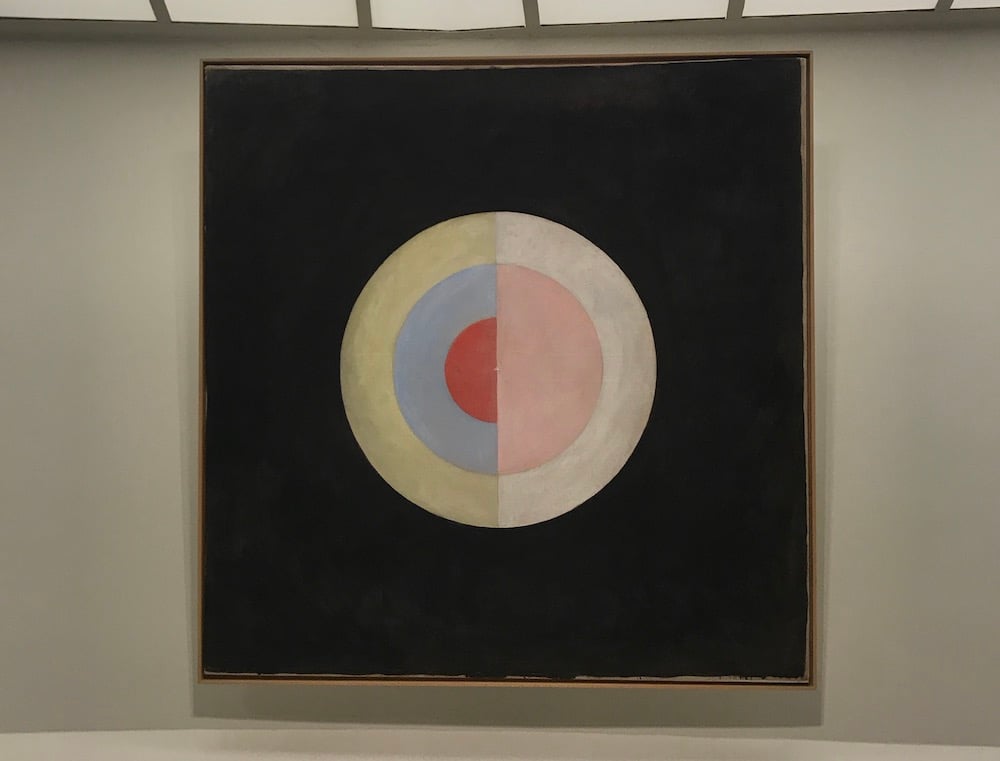
The Hilma af Klint retrospective at the Guggenheim is by far the trippiest thing I’ve seen within the confines of an esteemed art institution. The show is expansive and stunning and truly transcends time (images in her paintings look like things discovered decades later, from a double helix to the 80s electronic memory game Simon). As if to prove she’s a futurist, she envisioned that her major body of work would be displayed in a spiral temple.
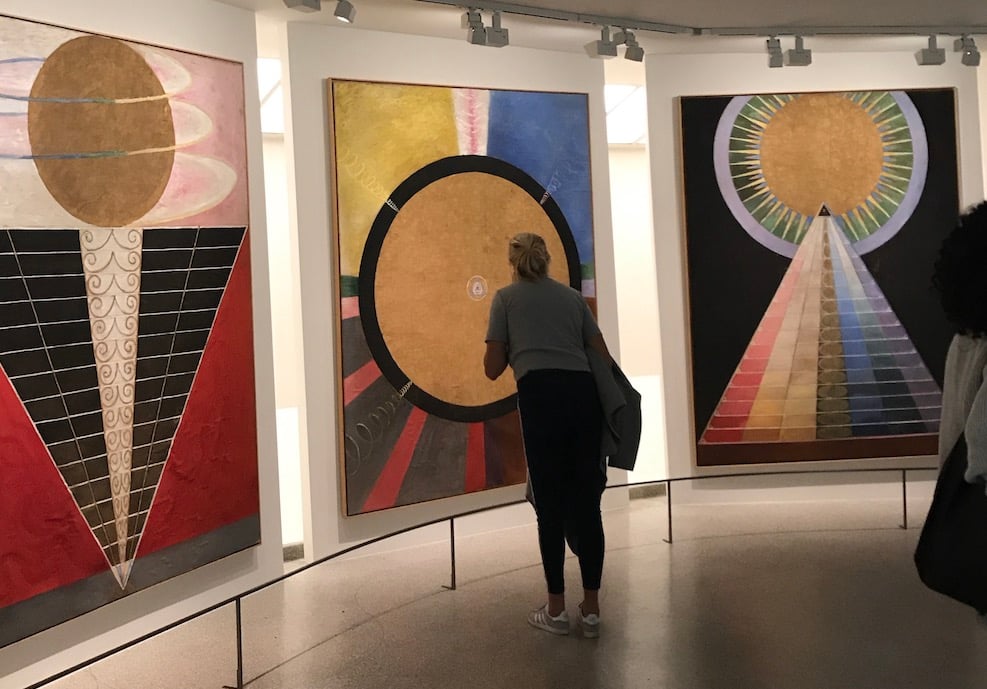
Words cannot fully describe the power or style of her pieces, which are botanical, psychedelic, scientific, occult, and truly mystical. Her abstract paintings, which she started producing five years before Kandinsky or any other of the more famous men of her time created something of the sort, were channeled through her spiritualism. She was influenced by Rosicrucianism, Theosophy, and later in life, anthroposophy.
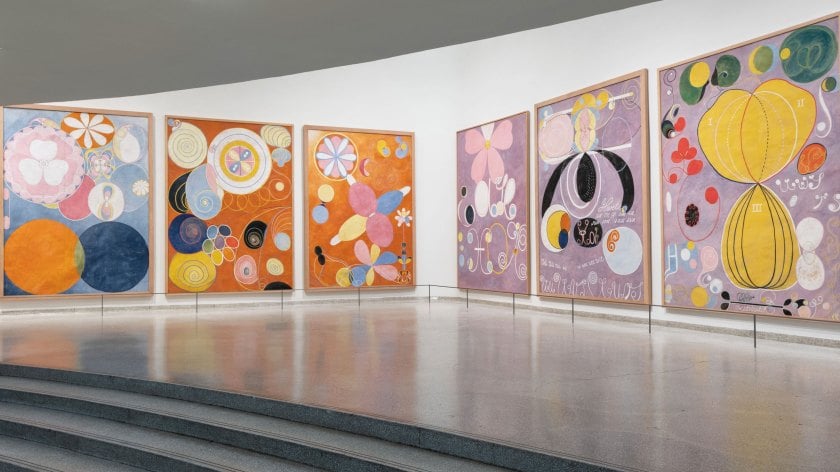
It’s all a bit mind-bending. af Klint knew that the world was not ready for her work, so she specified it not be shown until 20 years after her death. This was likely because, at a visit to her Stockholm studio in 1908, Rudolf Steiner was “unable to decipher the paintings and claims that no one during the coming 50 years will be able to.” She died in 1944, the same year as Kandinsky and Mondrian, and it was over four decades until there was a show that included her paintings.
From The New Yorker:
The art is fearfully esoteric. But something about it resonates with a restlessly searching mood in present culture, hostile to old ideas. Af Klint has a lot of people’s rapt attention. From what I hear, young artists of many stripes are mad for her.
Yes, people are ready for it. Never before have I witnessed so many museum-goers studying paintings so up close (see my top photo, above) and really being with the art. And I’d argue our current #MeToo era is fertile ground for retelling origin stories with more representation of women and those who were otherwise overlooked.
The endlessly inspiring Hilma af Klint: Paintings for the Future is up at the Guggenheim in New York until April 23, 2019.
n.b. You may recall that Acne Studios did a capsule collection using Hilma af Klint prints in 2014. (thx Eviana)
Update: Here’s a good video introduction to af Klint’s work:
I don’t know how many people under the age of 35 know about the Chicago Tylenol murders, but for a few weeks in 1982, it was a national news sensation. Seven people in the Chicago area died after ingesting Tylenol capsules laced with potassium cyanide. Retro Report took a look back at this episode, with a focus on how Johnson & Johnson and other drug companies modified their packaging to prevent in-store tampering.
The company considered renaming Tylenol, a word that incorporates some of the letters from 4- (aceTYLamino) phENOL, a chemical name for acetaminophen, the drug’s active ingredient. But a name change was rejected.
Instead, a mere six weeks after the crisis flared, the company offered a different solution, a new bottle with the sorts of safety elements now familiar (if at times exasperating) to every shopper: cotton wad, foil seal, childproof cap, plastic strip. Capsules began to be replaced with caplets the following year.
Johnson & Johnson was viewed as an exemplar of corporate responsibility, and enjoyed what some people described as the greatest comeback since Lazarus. Nowadays, all sorts of products come in containers deemed tamper-proof, or at least tamper-evident, meaning that consumers can readily tell if a seal has been broken or something else is amiss.
Incredibly, the case is still unsolved…no one knows who did it or why. Thinking about the amount of in-store surveillance that we have, it seems unlikely that such a crime would go unsolved for long today.
One answer to the question of “How do I help a grieving friend?” is to acknowledge their circumstances…to “join them in their pain” instead of trying to take it away from them. As Megan Devine says in this video:
Cheering people up, telling them to be strong and persevere, helping them move on…it doesn’t actually work. It’s kind of a puzzle. It seems counterintuitive, but the way to help someone feel better is to let them be in pain.
One of the odd things about getting older (and hopefully wiser) is that you stop chuckling at cliches and start to acknowledge their deep truths. A recent example of this for me is “the only way out is through”. As Devine notes, in this video and her book It’s OK That You’re Not OK, there’s no shortcut for dealing with pain…you have to go through it to move past it.
In a new TED podcast, writer Elizabeth Gilbert talked about the grief she felt when her partner and longtime best friend Rayya Elias was diagnosed with and died from cancer.
Grief… happens upon you, it’s bigger than you. There is a humility that you have to step into, where you surrender to being moved through the landscape of grief by grief itself. And it has its own timeframe, it has its own itinerary with you, it has its own power over you, and it will come when it comes. And when it comes, it’s a bow-down. It’s a carve-out. And it comes when it wants to, and it carves you out — it comes in the middle of the night, comes in the middle of the day, comes in the middle of a meeting, comes in the middle of a meal. It arrives — it’s this tremendously forceful arrival and it cannot be resisted without you suffering more… The posture that you take is you hit your knees in absolute humility and you let it rock you until it is done with you. And it will be done with you, eventually. And when it is done, it will leave. But to stiffen, to resist, and to fight it is to hurt yourself.
The only way out is through.
Update: When Gary Andrews’ wife Joy died, he documented his pain and his family’s grief through a daily doodle posted to Twitter. (thx, matt)
In his four seasons as manager for FC Barcelona, Pep Guardiola led the club to 14 trophies, including winning the Champions League twice and La Liga 3 times. Sure, he had players like Messi, Eto’o, Xavi, Iniesta, Puyol, Alves, Henry, and Ibrahimović, but as the trailer says, he also knew exactly what to do with them. Take the Ball, Pass the Ball is an upcoming documentary about the Guardiola years at Barca. I’m excited for this…Pep’s first year was right around when I started watching the team in earnest.
Tech titan Paul Allen died yesterday at the age of 65 of complications from non-Hodgkin’s lymphoma. His Microsoft co-founder Bill Gates remembered his friend in a short piece called “What I loved about Paul Allen”.
Paul foresaw that computers would change the world. Even in high school, before any of us knew what a personal computer was, he was predicting that computer chips would get super-powerful and would eventually give rise to a whole new industry. That insight of his was the cornerstone of everything we did together.
In fact, Microsoft would never have happened without Paul. In December 1974, he and I were both living in the Boston area — he was working, and I was going to college. One day he came and got me, insisting that I rush over to a nearby newsstand with him. When we arrived, he showed me the cover of the January issue of Popular Electronics. It featured a new computer called the Altair 8800, which ran on a powerful new chip. Paul looked at me and said: “This is happening without us!” That moment marked the end of my college career and the beginning of our new company, Microsoft. It happened because of Paul.
Gates also noted Allen’s love of music. In an interview earlier this year, legendary producer Quincy Jones said Allen “sings and plays just like Hendrix”.
Yeah, man. I went on a trip on his yacht, and he had David Crosby, Joe Walsh, Sean Lennon — all those crazy motherfuckers. Then on the last two days, Stevie Wonder came on with his band and made Paul come up and play with him — he’s good, man.
Here’s a short clip of Allen melting some faces:
Hot off the heels of their video showing a humanoid robot casually doing parkour, Boston Dynamics has made a clip of their robot dog doing a hip hop dance routine to Uptown Funk.
While the robot in the parkour video looked distinctly un-human at times, I have to say that this dog robot is a much better and more fluid dancer than I expected — it’s got better moves than most of the people I’ve seen dancing at Midwestern weddings. The robot does what looks like the running man and then twerks while mugging for the camera. I don’t know what level of cultural appropriation this is and Boston Dynamics is probably just doing this to distract from the whole Terminator narrative, but was anyone else the tiniest bit jealous of and turned on by (and then deeply ashamed of those feelings) the robot’s moves?
In 1950, Swiss photographer Hans Namuth took some photos of Jackson Pollock painting some of his drip paintings, which were used to illustrate a 1951 article in ArtNews. Along with photos published alongside a piece in Life in 1949, they made Pollock and his unusual technique famous.
Namuth returned with a film camera and captured the artist painting in full color motion in a short film called Jackson Pollock 51.
In the film, you can see the physicality and performative aspect of Pollock’s work, the near repetition, the footwork, the precise imprecision of his arm movements, the cigarette dangling from his mouth. Pollock narrates part of the film:
I don’t work from drawings or color sketches. My painting is direct. I usually paint on the floor. I enjoy working on a large canvas. I feel more at home, more at ease, in the big area. Having the canvas on the floor, I feel nearer, more a part of the painting. This way, I can walk around it, work from all four sides, and be in the painting, similar to the Indian sand painters of the West.
At one point, Pollock paints on glass and Namuth shoots from underneath, so you can see how it looks from the point of view of the canvas. A 1998 NY Times piece by Sarah Boxer has an account of how the photos and film were captured, including a series of incidents that brought the Namuth/Pollock collaboration (and, some say, Pollock’s life six years later) to an end:
When Pollock and Namuth came in from outside, blue from the cold, the first thing Pollock did was pour himself a tumbler of bourbon. It was the beginning of the end. Pollock had been sober (some say) for two years. Soon Namuth and Pollock got into an argument — a volley of “I’m not a phony, you’re a phony.” Then Pollock tore a strap of cowbells off the wall and started swinging it around.
With the dinner guests seated and food on the table, Pollock and Namuth continued to argue. Finally Pollock grabbed the end of the table, shouting “Should I do it now?” to Namuth. “Now?” Then he turned over the whole table, plates, glasses, meat, gravy and all. (There is a scholarly disagreement about whether it was turkey or roast beef.) The dogs lapped at the glassy gravy. Krasner said, “Coffee will be served in the living room.”
After that night, Pollock never stopped drinking. He didn’t bring in the glass painting (“No. 29, 1950”) until it was covered with rain and leaves. He returned to a more figurative style of painting. Six years later, bloated, depressed and drunk, he drove his car into a tree, killing himself and a friend.
(via open culture)
I’ve watched this a dozen times now and it looks fake and I can’t figure out quite why. Is it the uncanny valley at work? This thing moves mostly like a human would…but not entirely. Look at the robot when it hops over the log. It appears too effortless…not enough recoil on the landing or something. And going up the steps, it looks like it’s levitating, like how CG characters sometimes move, unaffected by actual contact with surfaces. See also the robot’s casual gymnastics.
Vox has updated their video on how US politicians talked about climate change over the past 12 years. Until recently, climate change was more or less a bipartisan issue. Democrats and Republicans alike publicly acknowledged that climate change was happening, that humans were at least partially responsible, and that we needed to do something about it. Perhaps Republicans were a little less sincere in their desire for action and all politicians were not as urgent in their response as the situation required, but at a minimum, they all believed what scientists were saying.
Then, as this video shows, after the election of Barack Obama in 2008 and the Republican victories in the 2010 midterms, things shifted. Republicans increasingly came out saying, well, the science isn’t settled on this, we don’t know what is causing climate change, so we’re not going to do anything about it. They did this in part because their big political donors wanted them to.
Those divisions did not happen by themselves. Republican lawmakers were moved along by a campaign carefully crafted by fossil fuel industry players, most notably Charles D. and David H. Koch, the Kansas-based billionaires who run a chain of refineries (which can process 600,000 barrels of crude oil per day) as well as a subsidiary that owns or operates 4,000 miles of pipelines that move crude oil.
Government rules intended to slow climate change are “making people’s lives worse rather than better,” Charles Koch explained in a rare interview last year with Fortune, arguing that despite the costs, these efforts would make “very little difference in the future on what the temperature or the weather will be.”
I posted about the first installment of this video last year and watching it again hit me about as hard as it did the first time around. The amount of cynicism and lack of integrity & sense of duty here is staggering. What tiny tiny minds. [Insert a lot of swearing about Republicans here that I will get email about so I’ll just save us all some time and skip it. But seriously, fuck these assholes.]
Astronomers behind the Event Horizon Telescope are building a virtual telescope with a diameter of the Earth to photograph the supermassive black hole at the center of our galaxy. The idea is that different observatories from all over the surface of the Earth all look at the black hole at the same time and the resulting data is stitched together by a supercomputer into a coherent picture. Seth Fletcher wrote a great piece about the effort for the NY Times Magazine (it’s an excerpt from his new book, Einstein’s Shadow: A Black Hole, a Band of Astronomers, and the Quest to See the Unseeable):
Astronomical images have a way of putting terrestrial concerns in perspective. Headlines may portend the collapse of Western civilization, but the black hole doesn’t care. It has been there for most of cosmic history; it will witness the death of the universe. In a time of lies, a picture of our own private black hole would be something true. The effort to get that picture speaks well of our species: a bunch of people around the world defying international discord and general ascendant stupidity in unified pursuit of a gloriously esoteric goal. And in these dark days, it’s only fitting that the object of this pursuit is the darkest thing imaginable.
Avery Broderick, a theoretical astrophysicist who works with the Event Horizon Telescope, said in 2014 that the first picture of a black hole could be just as important as “Pale Blue Dot,” the 1990 photo of Earth that the space probe Voyager took from the rings of Saturn, in which our planet is an insignificant speck in a vast vacuum. A new picture, Avery thought, of one of nature’s purest embodiments of chaos and existential unease would have a different message: It would say, There are monsters out there.
A video by the EHT team says that imaging the black hole is like trying to count the dimples on a golf ball located in LA while standing in NYC.
EHT team member Katie Bouman also did a TEDx talk on the project.
P.S. There’s a cloud near the center of the galaxy that tastes like raspberries and smells like rum.
The surviving members of Nirvana (minus Kurt Cobain, of course) held a six-song reunion at the Cal Jam festival with a couple of special guests, including Joan Jett taking over vocal duties on Smells Like Teen Spirit, and All Apologies, and Breed. The video above captures the whole thing from the crowd…here’s another view of just Smells Like Teen Spirit:
Sunday night, SpaceX launched a Falcon 9 rocket into orbit from Vandenberg Air Force Base in California. The nighttime launch created what looked like a nebula in the sky, prompting LA mayor Eric Garcetti to tweet that his city was not being visited by a flying saucer. This 4K time lapse of the launch is only 13 seconds long and is worth watching about 40 times in a row.
A few years ago, the artist Banksy built a shredder into the frame of one of his paintings “in case it was ever put up for auction”. On Friday, that painting came up for auction at Sotheby’s and after selling for ~$1.4 million, the shredder in the frame activated and cut the painting into little strips. The video of the sale and subsequent shredding is amazing:
Fantastic. I imagine Banksy meant this as a commentary on the ridiculous prices people pay for art, but as this is the art world, the shredding will likely increase the value of the piece as well as the artist’s other pieces. As @Limericking said:
A painting by Banksy was smart;
At auction, it shredded apart.
Now tattered, in pieces,
Its value increases,
For such is the market for art.
Update: The winning bidder for the shredded Banksy says she’s going to keep it.
Update: Here’s a longer video of the stunt from Banksy…”The Director’s Cut”.
The shredder malfunctioned at the auction…it was supposed to eat the entire print. On Instagram, Banksy says:
Some people think it didn’t really shred. It did. Some people think the auction house were in on it, they weren’t.
Newer posts
Older posts





Socials & More