Punch-Out is coming to the Wii (@ Amazon)…the teaser commercial features Isiah Whitlock, Jr., who played Clay Davis on The Wire, as Little Mac’s trainer. It’s worth watching to hear Whitlock’s comparison of comebacks and yo-yos. (thx, rob)
Free running is like parkour except that the former is more expressive than the latter. Whereas parkour is the efficient movement through space, free running adds acrobatic flair for aesthetic purposes. One of the more talented practictioners of free running is Levi Meeuwenberg; here’s a demo reel he made of his stunts.
However, by bending and rolling, the time of impact can be increased to as much as 0.3 or 0.4 seconds. By decreasing his velocity over this extended period of time, the force is substantially reduced. Applying the above calculation with an acceleration time of 0.4 seconds we now get Fground = 2000 N (460 pounds). It’s still a significant force but as you can see in the video quite manageable for someone with the proper skill, strength and technique.
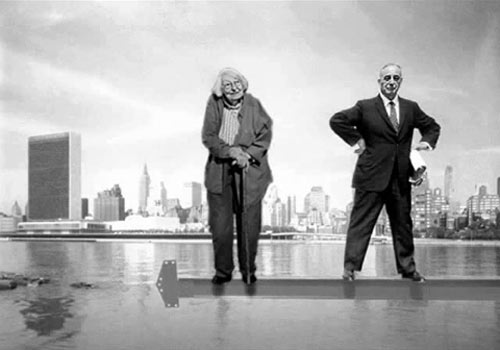
The CBC has a clip of Jane Jacobs talking about Toronto and Montreal from 1969. In it, she makes the distinction between the two urban organizational forces at work in Toronto, a sort of “civil schizophrenia”: the vernacular spirit (“full of fun”) and the official spirit (“stamp out fun”). I also found a video on YouTube about Robert Moses and his difficulties with Ms. Jacobs which concludes with a cheeky update of Arnold Newman’s iconic photo of Moses.
Sport Science recently tested to see whether professional golfer Padraig Harrington could drive the ball further than normal by employing a Happy Gilmore swing.
The good stuff doesn’t get going until around 3:00. The running swing technique increased Harrington’s distance by an average of 30 yards but his accuracy suffered. The split-screen view of his stationary and running swings is amazing…it’s the same swing.
As resolution rises & prices fall on video cameras and hard drive space, memory, and video editing capabilities increase on PCs, I suspect that in 5-10 years, photography will largely involve pointing video cameras at things and finding the best images in the editing phase. Professional photographers already take hundreds or thousands of shots during the course of a shoot like this, so it’s not such a huge shift for them. The photographer’s exact set of duties has always been malleable; the recent shift from film processing in the darkroom to the digital darkroom is only the most recent example.
Esquire’s moving cover reminds me of two other things.
1. Flickr encourages their members to think of short videos as long photos. When he guest edited kottke.org last year, Deron Bauman wrote about short video as a contemporary version of the photograph. Matt Jones argued that looping short video is the real long photography. So maybe the photograph of 10 years from now might not even be a still image.
2. In order to get the jaw-dropping slow-motion footage of great white sharks jumping out of the ocean, the filmmakers for Planet Earth used a high-speed camera with continuous buffering…that is, the camera only kept a few seconds of video at a time and dumped the rest. When the shark jumped, the cameraman would push a button to save the buffer.
There’s just too much good stuff on the internet today. So rather than flood the site with a bunch of posts, I’m going to clear out my tabs and round them up here.
Dear Prudence: “I cheated on my wife while sleepwalking. What do I do now?” I’ve heard quite a few weird/bad things about Ambien in the past few months. Also, paging Emily Gould from The Awl, please A this Q.
I return to the court to hear Justice Ginsburg speak to law students. And in answer to the question “How does it feel to be the only woman on the court?” she answers simply, “Lonely.”
You know, newspapers are gonna say, “We already let the horse out of the barn door. How can you charge for content? Information wants to be free.” All that bullshit. As I remember, there wasn’t an American in America 30 thirty years ago who paid for their television. Television was free 30 years ago. Now everybody’s paying 16 bucks a month, 17 bucks a month, 70 dollars a month.
Matt Zoller Seitz has completed his five-part look at Wes Anderson’s influences.
Part 1: Bill Melendez, Orson Welles, and Francois Truffaut Part 2: Martin Scorsese, Richard Lester, and Mike Nichols Part 3: Hal Ashby Part 4: J.D. Salinger Part 5: The Royal Tenenbaums, annotated
Seek out the video links in the right sidebar; they’re better than just reading the text. From the Salinger segment:
Detractors say Anderson’s dense production design (courtesy of regular collaborator David Wasco) overwhelms his stories and characters. This complaint presumes that in real life our grooming and style choices aren’t a kind of uniform — visual shorthand for who we are or who we want others to think we are. This is a key strength of both Anderson and Salinger’s work. Both artists have a knack for what might be called “material synecdoche” — showcasing objects, locations, or articles of clothing that define whole personalities, relationships, or conflicts.
The fifth part, where Seitz annotates the beginning segment of The Royal Tenenbaums with text, images, and video, is particularly fun to watch.
Trying to suggest that a lack of explanation is evidence that supernatural powers are at work is actually a contradiction. In effect what it’s saying is, “I can’t explain something, therefore I can explain it.”
I had no interest in adding a complete 3D physics library because my needs at this time are fairly simple. I am not worried about environment… I just want the snakes to crawl over each other. I decided to try magnetic repulsion despite thinking it probably wouldn’t work well enough. The thinking is this: Take each segment of a snake (200 segments each), and check its distance to every single other segment of every other snake on screen. Stupid, right? Yeah, pretty much. But with some optimization and only checking the segment distances if the snakes in question are close enough for overlap to be possible, I got it to run at 60 fps with 10 snakes.
Actually, when you get right down to it — the atoms in snakes’ bodies, that is — magnetic repulsion isn’t that far off from how matter achieves its electromagnetic opacity. Hodgin also made a video in which the snakes react to music. I wonder if this one’s gonna end up in iTunes. (via waxy)
A wonderful little animation by Tomas Nilsson of my favorite fairytale, the one with wolves and woodsmen. This one’s all zippy infographics and diagrams.
Archibald Query was the inventor of the pasty, sticky, somewhat offensive “creme spread” known as Marshmallow Fluff. The sugar shortage during World War I cost Query his confection. He sold the recipe to H. Allen Durkee and Fred Mower, two candymakers who quickly figured out that combining it with peanut butter creates the “Fluffernutter,” which in turn creates sandwich-obsessed mobs of thieving children. The Fluffernutter may soon be the state sandwich of Massachusetts, even though it was almost legally banned from school lunches back in 2006.
Marshmallow was originally used as a throat-coating precursor to the lozenge, but these days it’s molded into everything, from cereal squares to baby chickens and moon pies.
This Croque Madame is a fancy, sweet version of a fried ham-and-cheese, made with Nutella and Fluff on cinammon-raisin bread. Yum.
Eno is an antacid produced by GlaxoSmithKline. It’s globally distributed, mainly across South America, India, and the Middle East, and it’s available as sachets and tablets in both Lemon and an ambiguous “Regular” flavor.
Ogilvy & Mather produced a stunning print advertisement for the company, featuring a gun made of food. Quite an improvement over Eno’s commercial from the 80s, although if the packets made me seem as effervescent as the actor, perhaps I’d take some on my down days.




Socials & More