kottke.org posts about video
Irene Taylor Brodsky directed this short film in which about a dozen deaf people talk simply about their hearing loss and the technology (like cochlear implants) that is transforming how they interact with others. This was wonderful…I learned a lot from listening to these stories.
I was also struck by how difficult it actually is to lump “people who X” into a single category, despite the human desire to tidy people and things into groups. Even among the relatively few people featured in this short film, there were many different approaches and attitudes about deafness. Watching it, you think, jeez, what do all these people really have in common? Probably less than you might have assumed initially. (via @JossFong)
In this short video, Evan Puschak talks about how music is made for Super Nintendo games. That system was first released in 1990 and the audio chips could only hold 64 KB of information, only enough room for beeps, boops, and very short samples. But composers like David Wise, whose soundtrack for the Donkey Kong Country series of games is on many lists of the best video game music, were able to make the SNES sing despite its limited capabilities.
NASA recently published this visualization of sunrises and sunsets on the Moon set to the strains of Claude Debussy’s most famous work, Clair de Lune.
The visuals were composed like a nature documentary, with clean cuts and a mostly stationary virtual camera. The viewer follows the Sun throughout a lunar day, seeing sunrises and then sunsets over prominent features on the Moon. The sprawling ray system surrounding Copernicus crater, for example, is revealed beneath receding shadows at sunrise and later slips back into darkness as night encroaches.
A lovely way to spend five minutes. (thx, gina)
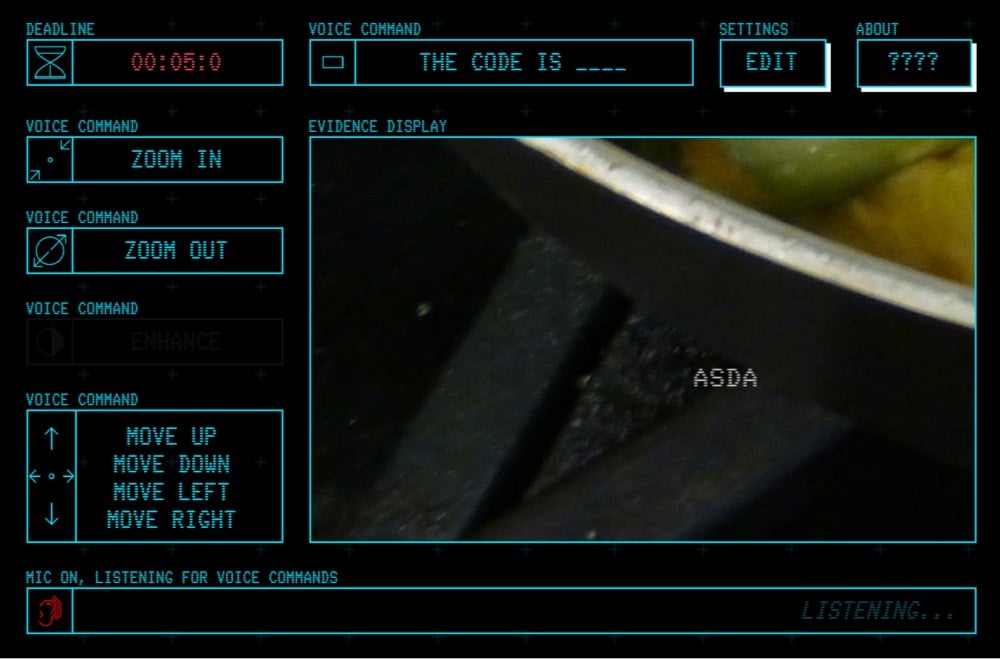
Nicole He has built a voice-controlled game called Enhance in which you speak commands to zoom & enhance images to look for secret codes, just like a detective on a CSI TV show. I bet if you try this in your open plan office, your coworkers will look at you like you’re nuts for a sec but will soon gather around, shouting their own commands at the computer. After all, everyone wants to enhance:

For the New Yorker, photographer David Williams visited the 2018 World Livestock Auctioneer Championship in Bloomington, Wisconsin. Amanda Petrusich wrote about the competition and his photos here.
This year’s champion, Jared Miller, of Leon, Iowa, took home a customized 2018 Chevrolet Silverado truck to drive for his yearlong reign; he also won six thousand dollars, a world-champion belt buckle, a world-champion ring, a money clip, and a bespoke leather briefcase. In interviews, Miller, like many successful auctioneers, appears personable and polite. When he begins his chant, his mouth only opens so much — when you’re talking as fast as he is, the tongue does most of the work — but what comes out sounds something like a undulating yodel, or a less guttural take on the Inuit tradition of throat singing. Once you tune in to its particular rhythms — and it can take a few minutes to acclimate to the crests and swells — the prices become discernible: “One dollar bid, now two, now two, would you give me two?”
You can listen to Miller’s winning chant on Facebook.
I hadn’t realized Werner Herzog made a 45-minute documentary about auctioneers at the same competition in 1976 called How Much Wood Would a Woodchuck Chuck. You can watch the whole thing on YouTube, although the audio isn’t synced that well:
According to the article, Herzog called auctioneering “the last poetry possible, the poetry of capitalism”. This poetry can be difficult to follow, so this auctioneer explained what he and his fellow chanters are saying up on the stand.
Rap music also has a claim on being “the poetry of capitalism” and Graham Heavenrich had the genius idea of layering auctioneer chants over beats; you can listen in on Instagram or with this compilation:
Ok and just for kicks, when I was searching for the auctioneer beats thing on YouTube, I ran across this young woman rapping the entirety of Rap God by Eminem (the part starting at 4:26 = fire). Sign her up for the 2019 World Livestock Auctioneer Championship!
The New Yorker asked three professional poker players to give blow-by-blow accounts of their most memorable hands. Aside from the rules, I know almost nothing about poker and have played Texas Hold’em for about one total hour in my life — guess how I did! — so I actually learned a lot from this video. And the third player’s explanation of his hand and his thought process was fascinating.
See also Scrabble pros recount their best and worst plays.
English is a marvelously and maddeningly inconsistent language. The words “rough”, “though”, “thought”, and “through” all contain “ough” but pronounced in a different way.
In this video, Aaron Alon gradually normalizes the vowel sounds in his speech down to one sound per letter. The end result sounds a little like Werner Herzog doing an impression of someone from Wales doing an impression of an Italian who doesn’t speak English that well. Which makes sense because that’s pretty much how the language came together in the first place!
As a fundraiser for the Leukemia & Lymphoma Society, Micah Sherman and Mark Stetson produced a web series called The Bob Ross Challenge in which 13 comedians attempt to paint along with Bob Ross as he does his thing with the trees and little fluffy clouds. Here’s the first episode, featuring Aparna Nancherla:
I feel like she does a lot better than I would have! The episodes are each less than 2 minutes long…you can burn through the whole season in about 20 minutes. Or if you want to try the challenge yourself, you can watch every episode of The Joy of Painting on YouTube. (via open culture)
From Jenny Yang’s Bad Appetite series, a group of Vietnamese critique questionable recipes for phở from American recipe sites that, for instance, try to substitute daikon radish for the noodles?
Politely, to not hurt your feelings, I’ll eat it.
The title is wrong. The whole thing, the recipe is fine. You want to eat, whatever, you cook it. Not with that name. Wrong name. Rename it. This one’s “Japanese soup”.
Don’t skip the last third of this. After politely dissing the recipes, Yang’s subjects talk about the importance of food in Vietnamese culture and share stories of how they came to the United States.
See also Koreans Learn to Make Kimchi from Brad at Bon Appetit.
Are wormholes science or just science fiction? As this video by Kurzgesagt shows, they’re actually a little bit of both. Einstein and string theory both posit that these “short cuts” through spacetime could exist, but finding or building a stable wormhole, a la Star Trek, is another matter altogether.
In the description of the video, they link to a pair of papers published by Michael Morris and Kip Thorne in the late 80s: Wormholes, Time Machines, and the Weak Energy Condition and Wormholes in spacetime and their use for interstellar travel: A tool for teaching general relativity. For a high school physics class, I gave a presentation on wormholes & time travel and I’m pretty sure I used at least one of those papers as a reference. The presentation also included a clip of Bill & Ted’s Excellent Adventure. The teacher gave me a B+ — he felt the presentation was excellent (*guitar riff*) but that I had, in spite of the movie clip, “lost most of the other students” and should have chosen a more suitable topic.
Add finding Waldo to the long list of things that machines can do better than humans. Creative agency Redpepper built a program that uses Google’s drag-and-drop machine learning service to find the eponymous character in the Where’s Waldo? series of books. After the AI finds a promising Waldo candidate, a robotic arm points to it on the page.
While only a prototype, the fastest There’s Waldo has pointed out a match has been 4.45 seconds which is better than most 5 year olds.
I know Skynet references are a little passé these days, but the plot of Terminator 2 is basically an intelligent machine playing Where’s Waldo I Want to Kill Him. We’re getting there!
Update: Prior art: Hey Waldo, HereIsWally, There’s Waldo!
From CBC’s This Is That, a satirical presentation that is
I’m now going to come back to the center of the stage and give you some unremarkable context about how I became a thought leader. If it’s ok with you, I’d like to pace while telling you this story.
I chuckled throughout this, but deep down I’d love to have the stage presence to give a talk like this. Whenever I’ve done talks in the past, my brain always convinces me that I’m about to be eaten by a lion — “flee flee flee!” — and I end up doing my best impression of the squeaky-voiced teen from The Simpsons.
Update: In 2014, Will Stephen did a talk at TedxNewYork that’s very similar to the one above, perhaps even a bit better.
White men speaking confidently gets you 85% of the way to a compelling talk, irrespective of content. (via @h4emtfr)
For the past six years, physicist Greg Spriggs and a team at Lawrence Livermore National Laboratory have been tracking down films of nuclear tests conducted by the United States in order to digitize and declassify them.
“You can smell vinegar when you open the cans, which is one of the byproducts of the decomposition process of these films,” Spriggs said. “We know that these films are on the brink of decomposing to the point where they’ll become useless. The data that we’re collecting now must be preserved in a digital form because no matter how well you treat the films, no matter how well you preserve or store them, they will decompose. They’re made out of organic material, and organic material decomposes. So this is it. We got to this project just in time to save the data.”
You can find over 400 of the films they’ve restored so far on LLNL’s YouTube account.
I’m not saying that your day will be 100% better if you watch this short video of 30 normally super-aggro hummingbirds splashing around together in a birdbath, but I’m not not saying that either. At any rate, this video is quite charming. (via colossal)
Tom Cruise is not scared of heights. And he can fly helicopters? (Not only can he fly them, he does it well enough to perform stunts.) In this rough 30-minute reel of behind-the-scenes footage from the filming of Mission Impossible: Fallout, you get to see how many of the movie’s best stunts are done. Note: you’ll need to skip around a bit…there’s a lot of less exciting bits in there too. But don’t miss the car/bike stuff at the beginning, Cruise flying/hanging from the chopper, and, holy shit, the skydive choreography at the end, where the actors and camera folks dance intricately in a military cargo plane with the back hatch open before just jumping out of it, Cruise acting all the way.
You can tell when watching the film that you’re seeing practical effects. Visual effects are getting really really good, but movies like this with real people driving real vehicles…they just feel different. Visual effects sometimes break the fourth wall (and not in a good way); if it looks fake, your brain says “that’s fake”, and then you’re just a little less invested in what’s going on in the story.
Newer posts
Older posts




Socials & More