kottke.org posts about video
By some accounts, 99% of the wasabi consumed in the world is not actually wasabi — it’s horseradish + green food coloring. Real wasabi is difficult to grow:
Authentic wasabi, known as Wasabia japonica, is the most expensive crop to grow in the world. The temperamental semiaquatic herb, native to the mountain streams of central Japan, is notoriously difficult to cultivate. Once planted, it takes several years to harvest; even then, it doesn’t germinate unless conditions are perfect. Grated wasabi root loses its flavor within 15 minutes.
Profiled in the short film above, 75-year old Shigeo Iida is the 8th generation owner of a wasabi farm in Japan, where he’s been painstakingly growing the herb in a beautiful valley for decades. He loves his work, but like other aging Japanese responsible for long-lived family businesses, there’s uncertainty about the future. (via craig mod)
Quentin Tarantino brings back two of his biggest stars, Brad Pitt and Leonardo DiCaprio, in his new film Once Upon a Time in Hollywood. The teaser trailer is low on details, but we do know that Pitt plays stunt double to DiCaprio’s aging film star, the plot involves the murder of Sharon Tate by members of the Manson Family, and it opens on July 26. The film is also the last movie that Luke Perry made before he died.
Update: The full-length trailer is out:
Kate McCartney and Kate McLennan, a pair of comedians whose hilarious cooking show I’ve previously featured, are back with Get Krack!n, a series that parodies a typical TV morning show. In this clip, they debut a new segment that perfectly skewers how TV media provides a platform for radical kooks to promote hateful agendas for the mutual benefit of both kook & show. (Note: this clip contains swearing and simulated religious bigotry & misogyny.)
They’re not necessarily views that we endorse or share personally, Kate McCartney, but they’re definitely opinions that we are 100% complicit in broadcasting, and that in time we will go to hell for.
This is an Australian show, but a similar panel and topic could easily have appeared on any number of Fox News programs.
This week, Last Week Tonight covered the topic of public shaming and the episode included an interview by host John Oliver of Monica Lewinsky, who shared her experience of going through perhaps the most intense and enduring instance of public shaming ever.
The whole video is worth watching, but if you want to skip to the Lewinsky interview, it starts around the 15:00 mark. Lewinsky doesn’t do a lot of interviews, and it’s interesting that Oliver has built enough trust to get one, especially as the host of a comedy show.
Religion and philosophy have their own answers as to where our consciousness comes from, but in this video, Kurzgesagt explores how scientists believe consciousness first evolved, from organisms moving more quickly when consuming food to animals being able to animals who can remember where they hid food to reading the minds of competitors and allies.
The main source for the video is Rupert Glasgow’s Minimal Selfhood and the Origins of Consciousness (available as a free download). The complete list of their sources is here.
This guided meditation by Alan Watts really helped me this morning. (There’s a version without music as well.)
From The Practice of Meditation:
Simply sit down, close your eyes, and listen to all sounds that may be going on — without trying to name or identify them. Listen as you would listen to music. If you find that verbal thinking will not drop away, don’t attempt to stop it by force of will-power. Just keep your tongue relaxed, floating easily in the lower jaw, and listen to your thoughts as if they were birds chattering outside — mere noise in the skull — and they will eventually subside of themselves, as a turbulent and muddy pool will become calm and clear if left alone.
Also, become aware of breathing and allow your lungs to work in whatever rhythm seems congenial to them. And for a while just sit listening and feeling breath. But, if possible, don’t call it that. Simply experience the non-verbal happening. You may object that this is not “spiritual” meditation but mere attention to the “physical” world, but it should be understood that the spiritual and the physical are only ideas, philosophical conceptions, and that the reality of which you are now aware is not an idea. Furthermore, there is no “you” aware of it. That was also just an idea. Can you hear yourself listening?
And then begin to let your breath “fall” out, slowly and easily. Don’t force or strain your lungs, but let the breath come out in the same way that you let yourself slump into a comfortable bed. Simply let it go, go, and go. As soon as there is the least strain, just let it come back in as a reflex; don’t pull it in. Forget the clock. Forget to count. Just keep it up for so long as you feel the luxury of it.
(via open culture)
This trailer made by cinematographer and director Morgan Cooper imagines a contemporary reboot of The Fresh Prince of Bel-Air that’s a little darker and grittier than the original. I dunno about you, but that’s one of the best fan-made trailers I’ve ever seen. I say give Cooper the show and let him run with it.
This is a photo taken in Germany in 1914 by August Sander:
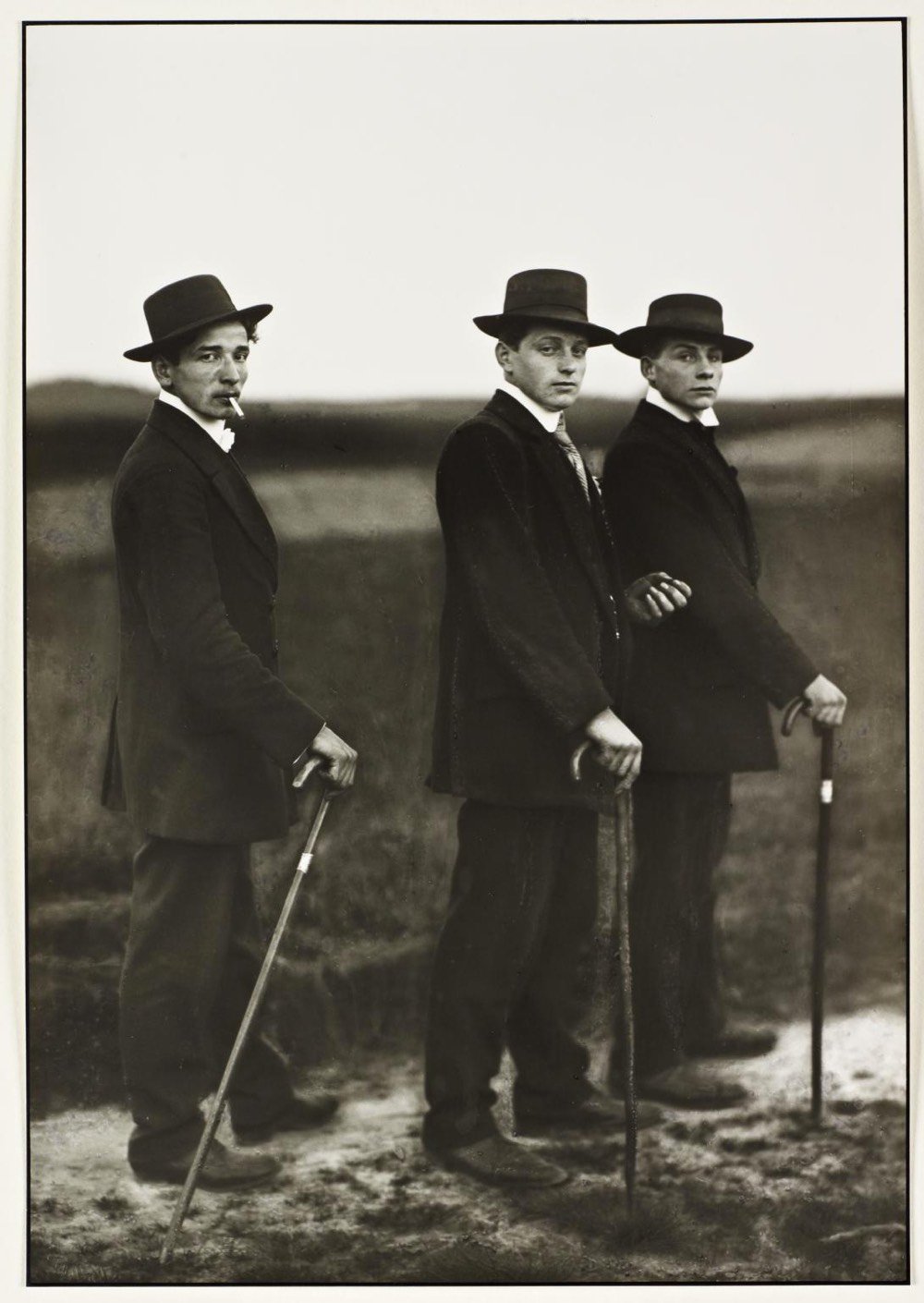
It’s called Young Farmers and it depicts three young men on their way to a dance in rural Germany. But as John Green explains in this video, there is so much more going on with this photo.
From The Tate, which has a print of Young Farmers in its collection:
The Marxist art critic John Berger famously analysed the photograph in his influential essay ‘The Suit and the Photograph’ (1980) writing: ‘The date is 1914. The three young men belong, at the very most, to the second generation who ever wore such suits in the European countryside. Twenty or 30 years earlier, such clothes did not exist at a price which peasants could afford.’ (Berger 1980, p.30.) Berger suggests that these mass market suits, emulating the higher quality attire of the bourgeois urban class, draws attention to, rather than disguises, their ‘social caste’, and not in a particularly flattering sense. In his essay, Berger considers that the three young men are of a social group not beyond the reach of aspirational advertising campaigns and travelling salesmen, and in a state of awkward transition, succumbing to a new ‘cultural hegemony’. The posturing of these three rural ‘lads’, perhaps on their way to a dance, confounds and subverts expectations of the peasant ‘type’, especially in that they smoke cigarettes. Peasants were traditionally depicted smoking a pipe handcrafted from wood, and which like the wooden canes that appear frequently in Sander’s volume of photographs devoted to peasants and farmers, including this one, connoted an organic connection to the native soil as well as a certain time-honoured wisdom. By contrast, the mass-manufactured cigarette was often seen at the time as an urban symbol of social dissolution.
However, Green also cautions that there’s only so much you can infer about people from a photograph (given, for example, that the three men weren’t actually farmers).
This video is from a new-to-me channel called The Art Assignment, which is about art and art history. Subscribed!
Jonathan Demme’s The Silence of the Lambs is one of the finest psychological thrillers ever made. In the episode of the always-illuminating Lessons from the Screenplay, the team analyzes a scene from the film with Hannibal Lecter and Clarice Starling that demonstrates how effective scenes follow the same three act structure as entire movies/books/stories do.
The Lessons team also did a podcast episode about the differences between the screenplay for the film and the book that inspired it.
Ron and Diana Watson have been eating dinner at the same restaurant in Wichita 6 nights a week for 15 years. It’s their only meal of the day and they skip the bread because Ron was gaining too much weight from the complimentary dinner rolls.
The ritual is all part of the order Ron Watson likes in his life. A Vietnam veteran, he dines only in restaurants that offer military discounts, and Texas Roadhouse gives vets 10 percent off. He still has some PTSD, he said, and he feels comfortable at table 412, which is a booth at the bar that gives him a good view of the door and everyone coming and going.
The couple also are regular enough customers that they know how to make the most of their money at Texas Roadhouse. Every Sunday through Wednesday, they arrive between 3 and 3:15 p.m. to take advantage of the restaurant’s early bird special, which is available from 3 to 5 p.m. Mondays through Thursdays and offers a full meal for $9.49.
I’m fascinated by people for whom routine is so important. I definitely have those tendencies; I watch favorite shows and movies repeatedly, wear pretty much the same outfit daily, return to familiar vacation destinations, and order the same dishes at the same restaurants again and again. So much of what I do for kottke.org focuses on finding the new — ideas, people, art, discoveries, culture — that it’s comforting to have parts of my life that aren’t relentlessly novel. But I also make ample time for new experiences that bring happiness & fulfillment into my life…and the rest I put on cruise control. (via tmn)
Update: From The Atlantic, The People Who Eat the Same Meal Every Day.
Many of the people I talked with emphasized the stress-reducing benefits of eating the same thing each day. Amanda Respers, a 32-year-old software developer in Newport News, Virginia, once ate a variation on the same home-brought salad (a lettuce, a protein, and a dressing) at work for about a year. She liked the simplicity of the formula, but the streak ended when she and her now-husband, who has more of an appetite for variety, moved in together six years ago. Would she still be eating the salad every day if she hadn’t met him? “Oh heck yeah,” she told me. “It would’ve saved so much time.”
Happy Pi Day! In celebration of this gloriously nerdy event, mathematician Steven Strogatz wrote about how pi was humanity’s first glimpse of the power of calculus and an early effort to come to grips with the idea of infinity.
As a ratio, pi has been around since Babylonian times, but it was the Greek geometer Archimedes, some 2,300 years ago, who first showed how to rigorously estimate the value of pi. Among mathematicians of his time, the concept of infinity was taboo; Aristotle had tried to banish it for being too paradoxical and logically treacherous. In Archimedes’s hands, however, infinity became a mathematical workhorse.
He used it to discover the area of a circle, the volume of a sphere and many other properties of curved shapes that had stumped the finest mathematicians before him. In each case, he approximated a curved shape by using a large number of tiny straight lines or flat polygons. The resulting approximations were gemlike, faceted objects that yielded fantastic insights into the original shapes, especially when he imagined using infinitely many, infinitesimally small facets in the process.
Here’s a video that runs through Archimedes’ method for calculating pi:
Strogatz’s piece is an excerpt from his forthcoming book, Infinite Powers: How Calculus Reveals the Secrets of the Universe.
Comedian Miel Bredouw packed every single type of interaction you’re ever going to have with another human being on a hiking trail into a video less than 40 seconds long. As a semi-frequent Vermont hiker (including this recent winter hike), I can vouch for every single one of these. They’re all here: the friendly dog greeting, the sing-song “hello”, the running “excuse me”, and the classic “hey how ya doin?” My go-to is usually the panting “hey”.
Float is a feature-length documentary film directed by Phil Kibbe about “the ultra-competitive sport of elite, stunningly-designed indoor model airplanes”. The main action of the film takes place at the F1D World Championships in Romania, where competitors from all over the world build delicately beautiful rubber-band-powered airplanes and compete to keep them afloat the longest.
After devoting years of time into construction and practice for no material reward, glory becomes their primary incentive. Like any competition, cheating and controversy are an integral part of the sport. FLOAT follows the tumultuous journey of Brett Sanborn and Yuan Kang Lee, two American competitors as they prepare for and compete at the World Championships.
“Designing, building, and flying the planes is truly an experience that requires patience and zen-like focus,” says Ben Saks, producer and subject in the film.
Float began as a Kickstarter project back in 2012…congrats to the team for their patience in getting it finished.
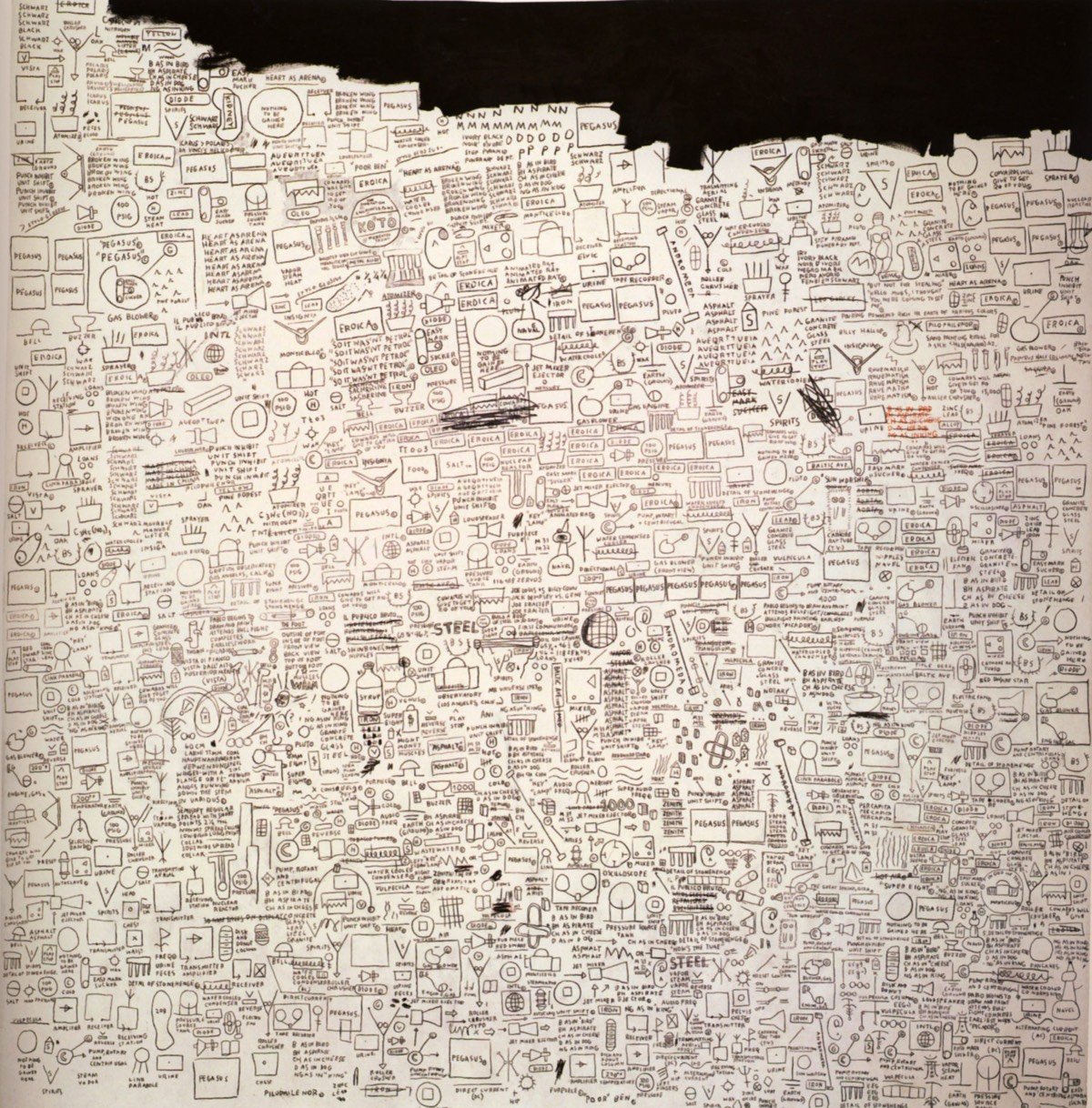
The drawing above is Pegasus by Jean-Michel Basquiat. His first art dealer, Annina Nosei, once called it “the most beautiful drawing ever”. I am not going to disagree with her. I’ve only seen Basquiat’s work sporadically, mostly single paintings included in larger exhibitions with Warhols and Harings, but when I saw Pegasus in this short video about the artist’s life & work, it grabbed me, an instant favorite.
The drawing is held in a private collection, but I hope I get to see it in person someday. For more on Basquiat, check out the 2009 documentary Jean-Michel Basquiat: The Radiant Child.
At SXSW, Congresswoman Alexandria Ocasio-Cortez was asked by an audience member about the economic challenge of a significant percentage of our labor force being replaced by automation. She responded, in part, by suggesting we decouple the idea of employment with being able to remain alive:
We should not be haunted by the specter of being automated out of work. We should not feel nervous about the toll booth collector not having to collect tolls anymore. We should be excited by that. But the reason we’re not excited by it is because we live in a society where if you don’t have a job, you are left to die. And that is, at its core, our problem.
Then she went on to say:
We should be excited about automation, because what it could potentially mean is more time educating ourselves, more time creating art, more time investing in and investigating the sciences, more time focused on invention, more time going to space, more time enjoying the world that we live in. Because not all creativity needs to be bonded by wage.
Her full answer, including a bit about “automated inequality”, is worth worth watching in full, starting at ~55:15:
In a 1970 article in New York magazine, the architect and futurist Buckminster Fuller wrote about the collision of technology and “this nonsense of earning a living”:
We must do away with the absolutely specious notion that everybody has to earn a living. It is a fact today that one in ten thousand of us can make a technological breakthrough capable of supporting all the rest. The youth of today are absolutely right in recognizing this nonsense of earning a living. We keep inventing jobs because of this false idea that everybody has to be employed at some kind of drudgery because, according to Malthusian-Darwinian theory, he must justify his right to exist. So we have inspectors of inspectors and people making instruments for inspectors to inspect inspectors. The true business of people should be to go back to school and think about whatever it was they were thinking about before somebody came along and told them they had to earn a living.
(thx to @claytoncubitt for the AOC-Fuller connection)
Newer posts
Older posts



Socials & More