kottke.org posts about video
Starting when she was 21, Helen Fagin was imprisoned by the Nazis in the Radomsko and Warsaw ghettos in Poland. Her parents were sent to Treblinka and murdered there, but Fagin and her sister eventually managed to escape and, after a long journey around Europe, made it to the United States. Fagin has offered lengthy testimony about her experience of the Holocaust (for the USC Shoah Foundation and US Holocaust Memorial Museum), but in this short video, she reads a letter she wrote about how reading and stories gave a spark of hope to those under the Nazi boot in Warsaw.
Could you imagine a world without access to reading, to learning, to books?
At twenty-one, I was forced into Poland’s WWII ghetto, where being caught reading anything forbidden by the Nazis meant, at best, hard labor; at worst, death.
There, I conducted a clandestine school offering Jewish children a chance at the essential education denied them by their captors. But I soon came to feel that teaching these sensitive young souls Latin and mathematics was cheating them of something far more essential — what they needed wasn’t dry information but hope, the kind that comes from being transported into a dream-world of possibility.
One day, as if guessing my thoughts, one girl beseeched me: “Could you please tell us a book, please?”
I had spent the previous night reading Gone with the Wind — one of a few smuggled books circulated among trustworthy people via an underground channel, on their word of honor to read only at night, in secret. No one was allowed to keep a book longer than one night — that way, if reported, the book would have already changed hands by the time the searchers came.
The full text of the letter is here and is also collected in the book The Velocity of Being. (via open culture)
In a letter to his brother Theo, Vincent van Gogh called his 1888 oil painting The Night Café “one of the ugliest pictures I have done”.
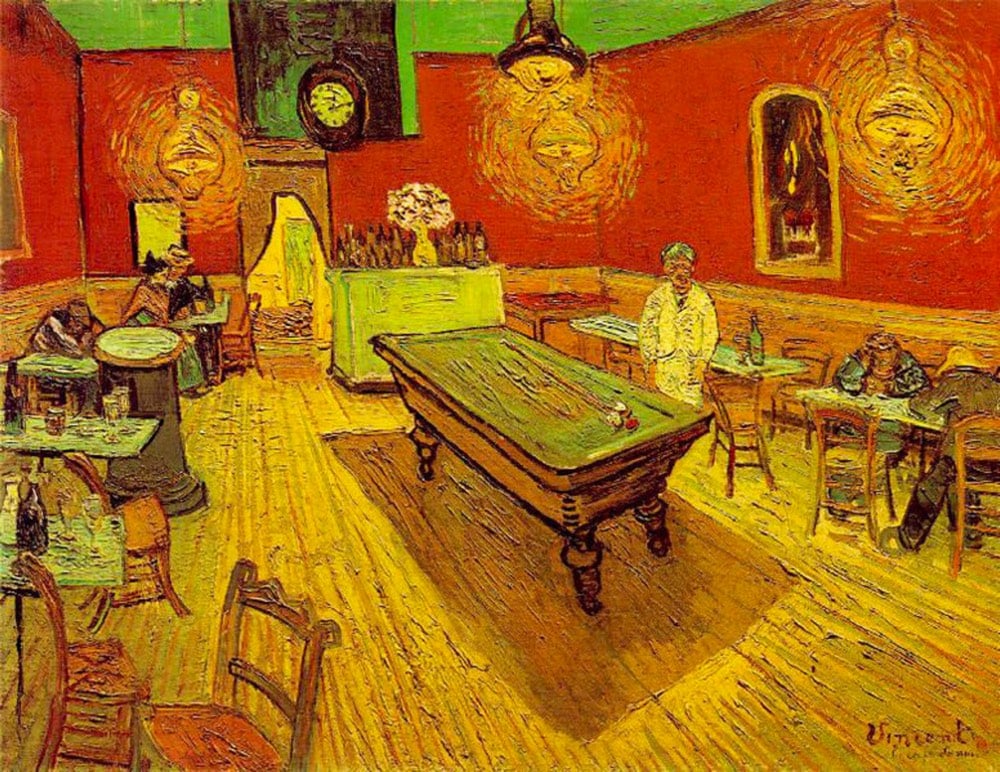
In this video, Evan Puschak looks at what van Gogh meant by that and how he used discordant colors together to suggest a mood.
van Gogh wrote of his intentions for the painting to his brother:
I have tried to express the terrible passions of humanity by means of red and green. The room is blood red and dark yellow with a green billiard table in the middle; there are four lemon-yellow lamps with a glow of orange and green. Everywhere there is a clash and contrast of the most alien reds and greens, in the figures of little sleeping hooligans, in the empty dreary room, in violet and blue. The blood-red and the yellow-green of the billiard table, for instance, contrast with the soft tender Louis XV green of the counter, on which there is a rose nosegay. The white clothes of the landlord, watchful in a corner of that furnace, turn lemon-yellow, or pale luminous green.
Hagfish are an eel-like sea creatures with the ability to excrete a teaspoon of slime that almost instantly expands to 10,000 times the volume. The slime, a combination of mucous and protein threads, is magical, too! Surprise, it’s not sticky, and it’s actually incredibly soft. Think about the softest thing you can think of. WRONG, this is softer. Hagfish slime is so soft, scientists had to create new ways to measure it when traditional instruments couldn’t hack it.
The proteins threads that give the slime cohesion are incredible in their own right. Each is one-100th the width of a human hair, but can stretch for four to six inches. And within the slime glands, each thread is coiled like a ball of yarn within its own tiny cell — a feat akin to stuffing a kilometer of Christmas lights into a shoebox without a single knot or tangle. No one knows how the hagfish achieves this miracle of packaging, but Fudge just got a grant to test one idea. He thinks that the thread cells use their nuclei — the DNA-containing structures at their core — like a spindle, turning them to wind the growing protein threads into a single continuous loop.
But that’s not all! Hagfish don’t have a jawbone, they’ve got kind of a sandpaper on their face, which is not the scientific way to describe it at all. They eat by burrowing into carcasses and rub their face around to get their fill. The skin of a hagfish is more efficient at processing nutrients than their intestines, so needless to say the burrowing really works for them. While hagfish use their slime to defend against attacks — the excreted slime clogs the gills of attackers — they also use their ridiculously squishy bodies as a defense. If a shark bites them, the important bits squish out of the way like one of those water wiggly toys. (Do you know how hard it is is to google the name of a toy you’ve played with your entire life without ever having known the name of? “Squishy squiggly water snake” is what worked for me.) Lastly, hagfish tie themselves in knots to rid themselves of slime AND to help them eat when they’re inside the dead bodies of recently passed sea friends. Now you know.
As a hagfish cleanser, sea otters hold hands while they’re sleeping so they don’t drift apart.
(Allow me an aside. The last time I wrote about the wacky world of sea creatures on Kottke.org, it was a post about the first known case of the sperm of cooked squid implanting in someone’s mouth. (At the time, of course, everyone knew the sperm of raw squid could implant, but this first case of cooked squid doing the same was big news).)
In this video released by JAXA, the Japanese space agency, you can see an on-board view of the Hayabusa2 probe touching down on an asteroid called Ryugu.
The blast you see is the probe firing a bullet made of tantalum at the surface in order to collect a sample. Here’s a photo of the landing site. From Wikipedia:
When the sampler horn attached to Hayabusa2’s underside touched the surface, a projectile (5-gram tantalum bullet) was fired at 300 m/s into the surface. The resulting ejecta particles were collected by a catcher at the top of the horn, which the ejecta reaches under their own momentum under microgravity conditions.
This is the first of three samples that are scheduled to be collected by Hayabusa2. The third sampling will try to collect material located under the surface of the asteroid. To achieve this, a separate gun will detach from the probe and fire a copper bullet at the surface, blasting a hole in the surface and exposing “pristine material”. Meanwhile, the probe itself will deploy a separate camera to watch the bullet’s impact, scoot out of the way to avoid debris, and then come back in a couple of weeks to collect a sample from the resulting crater, which will then be returned to Earth along with the other two samples. Ingenious! I love it when a plan comes together!
While studying some of the oldest art in the world found in caves and engraved on animal bones or shells, paleoanthropologist Genevieve von Petzinger has found evidence of a proto-writing system that perhaps developed in Africa and then spread throughout the world.

The research also reveals that modern humans were using two-thirds of these signs when they first settled in Europe, which creates another intriguing possibility. “This does not look like the start-up phase of a brand-new invention,” von Petzinger writes in her recently published book, The First Signs: Unlocking the mysteries of the world’s oldest symbols (Simon and Schuster). In other words, when modern humans first started moving into Europe from Africa, they must have brought a mental dictionary of symbols with them.
That fits well with the discovery of a 70,000-year-old block of ochre etched with cross-hatching in Blombos cave in South Africa. And when von Petzinger looked through archaeology papers for mentions or illustrations of symbols in cave art outside Europe, she found that many of her 32 signs were used around the world. There is even tantalising evidence that an earlier human, Homo erectus, deliberately etched a zigzag on a shell on Java some 500,000 years ago. “The ability of humans to produce a system of signs is clearly not something that starts 40,000 years ago. This capacity goes back at least 100,000 years,” says Francesco d’Errico from the University of Bordeaux, France.
Nonetheless, something quite special seems to have happened in ice age Europe. In various caves, von Petzinger frequently found certain symbols used together. For instance, starting 40,000 years ago, hand stencils are often found alongside dots. Later, between 28,000 and 22,000 years ago, they are joined by thumb stencils and finger fluting — parallel lines created by dragging fingers through soft cave deposits.
Von Petzinger lays out the results of her work in a 2016 book called The First Signs: Unlocking the Mysteries of the World’s Oldest Symbols and in a TED Talk from 2015:
It’s not writing (because the symbols don’t appear to be capable of representing the full range of spoken language) and it’s not an alphabet, but it’s definitely an intriguing something. (via open culture)
Ava DuVerney has written and directed a four-part TV series called When They See Us that “chronicles the notorious case of five teenagers of color, labeled the Central Park Five, who were convicted of a rape they did not commit”. Here’s a teaser trailer:
The series starts airing on Netflix on May 31.
And if you haven’t seen it, the documentary The Central Park Five (directed by Ken Burns, Sarah Burns, and David McMahon) is excellent.
Whatever your opinion of the Freddie Mercury biopic Bohemian Rhapsody,1 you gotta admit the music was pretty great. After all, Mercury and Queen were pretty great. But some of the credit also goes to Marc Martel, who sounds remarkably like Mercury and did some of the vocals for the film.
Rami Malek embodies Mercury onscreen, but as he told The New York Times last year, “No one wants to hear me sing.” During the performance sequences in “Bohemian Rhapsody,” the movie sometimes employs Mercury’s actual vocals from the Queen archives, but that wasn’t always practical — some scenes demanded a stunt vocal-cord performer.
The film’s creators have conceded that the sung vocals in the movie are largely by Mercury and Martel, although they haven’t broken down the specifics of who contributed what; doing so might distract from Malek’s performance.
Here’s Martel singing We Are The Champions:
He even looks a little bit like Mercury, don’t you think? Perhaps more impressively, here’s Martel doing Bohemian Rhapsody:
Vocal coach Carl Franz was impressed.
Martel is currently touring with a Queen cover band and released an album of Queen covers last year.
Bonus: Polyphonic explains why Mercury was such an incredible singer:
(via open culture)
Mathieu Stern had an idea. He thought that if you could sculpt a piece of ultra-clear ice into the correct shape, it would function as a camera lens. To find that quality of ice, he traveled to Iceland to scavenge a chunk of an iceberg washed ashore on a black sandy beach. After some trial and error, he succeeded in making his iceberg lens and using it to shoot some photos and video. The lens lasted for about a minute before melting.
Here are some of the photos he took:
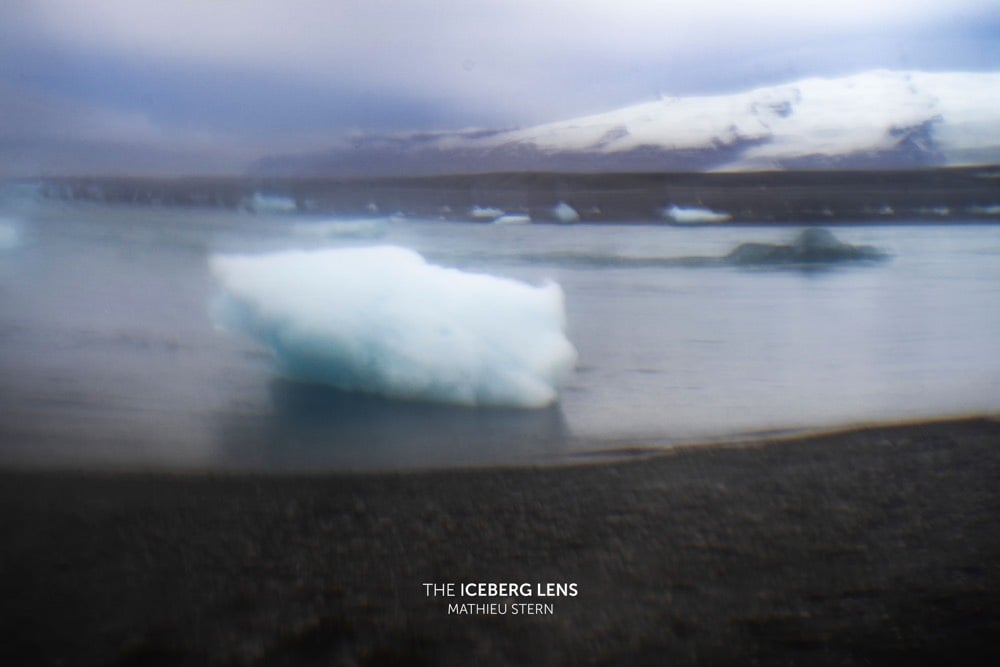
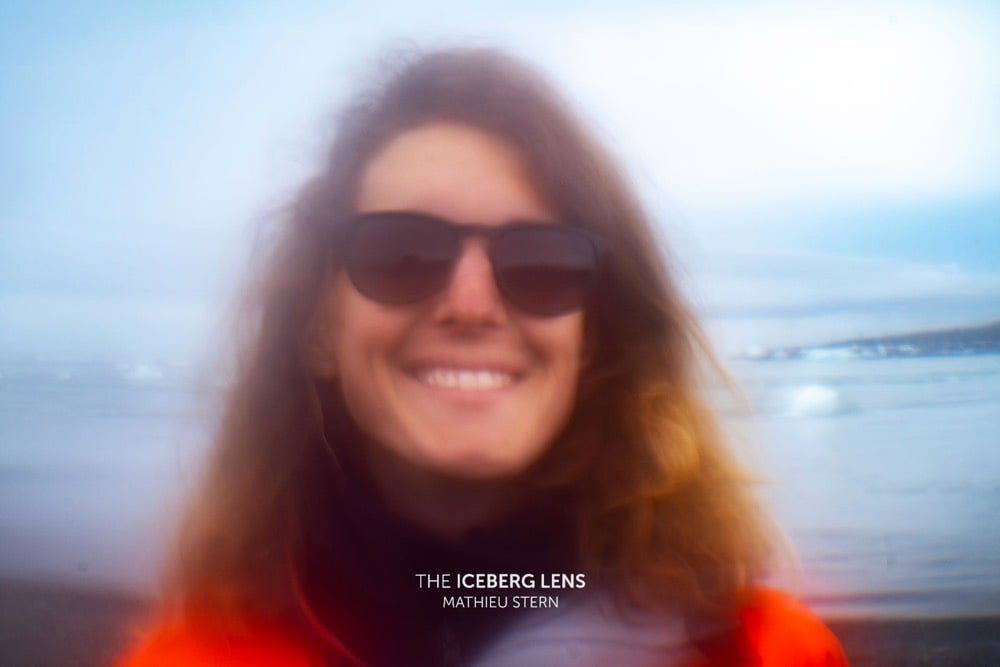
It’s a little impractical to go all the way to Iceland for iceberg ice when you can make your own clear ice at home, but Stern had this to say:
Now if people asks me “Are you happy with the result? it’s a bunch of blurry photos!?”, my response would be: “this project is a scientific, artistic and poetic project, I never imagined the result would look like the photos that comes from an ultra modern lens, but I was amazed by the strange beauty of the images I made with the first ever 10 000 year old lens.”
This is not a project for everyday photography, it was an adventure and a bet that when you have a crazy hypothesis, you should do everything to experiment it in the field.
I also wondered whether iceberg ice was actually more clear or pure than ice you could make at home. I didn’t find anything definitive but I did read this piece by Michelle Iwen about drinking single-malt scotch cooled by iceberg ice.
Our expedition leader, an Irish biologist studying southern birds, fished small chunks of clear-bubbled ice directly from the water as he worked to dislodge a sharp edged growler from beneath the propeller. He encouraged us to taste the ice, licking off the overlying salt water to find the pure, flavorless cold underneath.
“If you hold it in your bare hand long enough to speed the melting, you’ll hear it fizzle,” he told us. The fizzy pop of bergy seltzer is a familiar, yet unexpected sound. It sounds like a freshly opened can of soda, as the bubbles newly freed from the ice travel up toward the surface of the water. Yet the mundane sound of bergy seltzer belies the sinister power of melt against the bottom of the iceberg. Each bubble released scores the surface of the ice, compromising its structural integrity. We held the ice shards in our hands to make it fizz, let our skin burn against the freeze, as our expedition guide hoisted the free-floating remnants of a tiny growler into the zodiac to be chipped apart and consumed in cocktails that evening.
(via @peteashton)
The US government created HIV. The CIA killed Kennedy. The KGB deliberately spread disinformation designed to hurt the US and its allies for decades. In this excellent three-part video series from the NY Times, they show how this KBG program worked and how, under Vladimir Putin, it continues to affect world politics.
The first installment is an introduction to how the KGB wielded disinformation as well as a profile of one of their most successful operations: convincing the world that the US government created the AIDS epidemic. It took almost 4 years, but an article planted by the KGB in an Indian newspaper was eventually reported by Dan Rather on the CBS evening news, embraced by anti-AIDS activists, and believed by many foreign governments.
In the words of a KGB agent that defected to the US, the goal of Soviet disinformation was “to change the perception of reality of every American to such an extent that despite the abundance of information, no one is able to come to sensible conclusions in the interests of defending themselves, their families, their community, and their country.” It was a denial of service attack on the truth.
Fast forward through the end of the Cold War and to the rise of former KGB agent Vladimir Putin. Now Russia is creating fake news stories like Pizzagate which now form the basis of US domestic and foreign policy because our President watches Fox News every morning. In the second segment, the Seven Commandments of Fake News are introduced:
The commandments are:
1. Find the cracks in the fabric of society, the social, demographic, economic, and ethnic divisions.
2. Create a big lie, something that would be very damaging if you could get people to believe it.
3. Wrap the lie in a kernel of truth.
4. Conceal your hand, make it seem like the story came from somewhere else.
5. Find yourself a useful idiot.
6. Deny everything, even if the truth is obvious.
7. Play the long game.
In the third video, they look at what can be done to combat Russia and other players in this war of disinformation, and how ineffective the response has been on the part of the US government (including the Obama administration) and social media companies:
There are certainly no shortage of useful idiots for Putin to exploit. Fox News and Trump top the list along with the alt-right media charlatans, but YouTube’s algorithms, Facebook’s business model, and the everyday American citizens like you and me are also to blame. Add into the mix that Trump is also waging his own disinformation campaign against the American public, and there’s a lot to ponder and despair.
See also Putin’s Playbook for Discrediting America and Destabilizing the West.
In 2012, actor and budding film editor Topher Grace took all three Star Wars prequels and condensed them into an 85-minute movie called Star Wars: Episode III.5: The Editor Strikes Back.
Earlier today, Grace and trailer editor Jeff Yorkes uploaded a trailer they created for all 10 movies in the Star Wars franchise: the originals, the prequels, the two new ones, and the Star Wars Stories (Solo and Rogue One). As a trailer, it leaves a lot out, but the pair still make a few connections explicit that the casual fan may have overlooked in the midst of all the light saber & fighter duels.
As you can see on the US wind map, it’s been blustery in New England for the past couple of days. Yesterday the observatory atop Mount Washington in New Hampshire recorded a wind gust of 171 mph, the fastest gust ever recorded there in the month of February. This is what yesterday’s “Hays Chart” looked like:
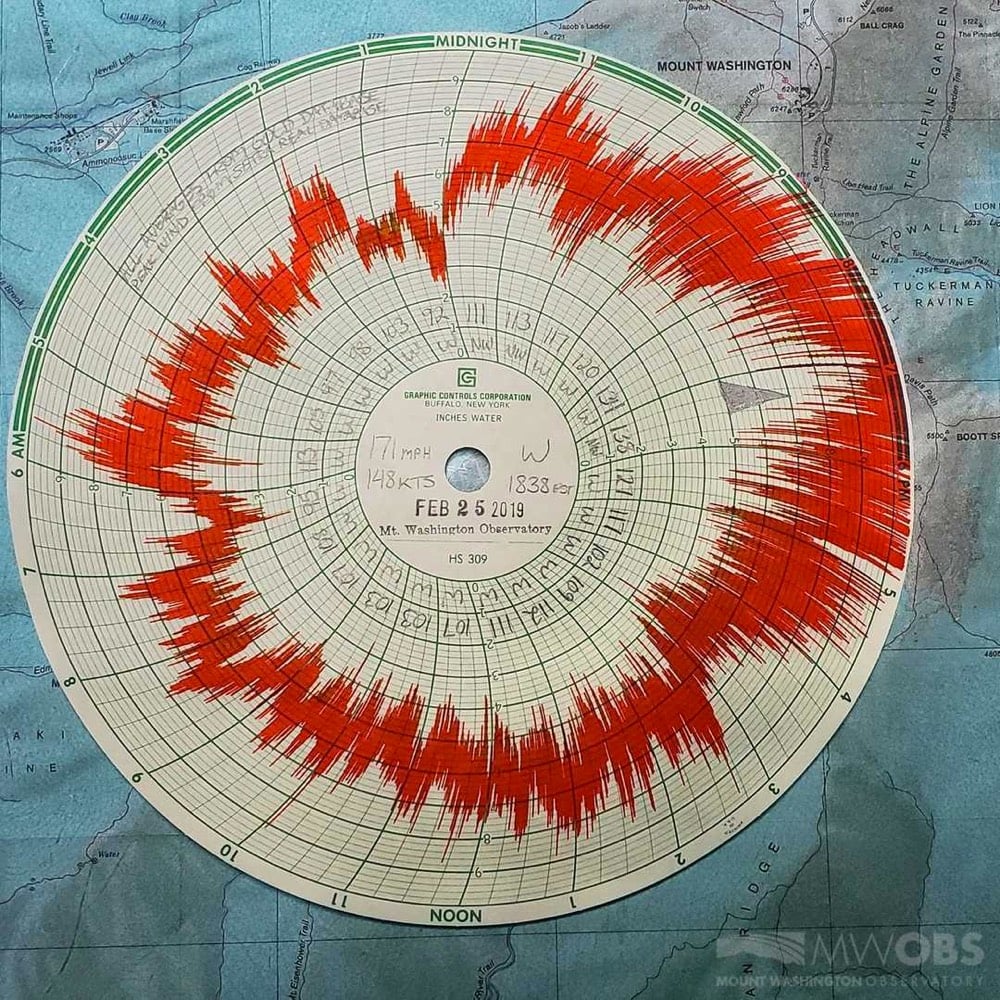
While it’s more that 50 mph slower than the 1934 record of 231 mph (!!), a look at the historical record shows that it’s one of the strongest winds ever recorded there and the strongest one since 1985.
While the observatory building itself is rated for winds up to 300 mph, humans venturing out at that speed might blow away. Here’s what a person battling 70-100 mph winds looks like:
On Instagram, someone at the observatory said of last night’s winds:
We could absolutely hear the winds yesterday! Sounded like a constant rumble similar to an earthquake. At the height of the storm our coffee mugs were shaking across the table and our bullet proof windows were constantly flexing back and forth.
(thx, meg)
Behind the Curve, now available on Netflix, is a 2018 documentary about the global community of people who believe that the Earth is flat. In this scene at the end of the film (um, spoilers?), a Flat-Earther named Jeran Campanella devises a simple experiment that he claims will prove that the Earth is flat…but very quickly proves the opposite:
Campanella’s reaction: “Interesting. Interesting. That’s interesting.” This is one of two straightforward experiments shown in the film that are devised by Flat-Earthers to prove the planet’s flatness that end up affirming that the Earth is indeed round (or, more accurately, an oblate spheroid).
One of the more jaw-dropping segments of the documentary comes when Bob Knodel, one of the hosts on a popular Flat Earth YouTube channel, walks viewers through an experiment involving a laser gyroscope. As the Earth rotates, the gyroscope appears to lean off-axis, staying in its original position as the Earth’s curvature changes in relation. “What we found is, is when we turned on that gyroscope we found that we were picking up a drift. A 15 degree per hour drift,” Knodel says, acknowledging that the gyroscope’s behavior confirmed to exactly what you’d expect from a gyroscope on a rotating globe.
“Now, obviously we were taken aback by that. ‘Wow, that’s kind of a problem,’” Knodel says. “We obviously were not willing to accept that, and so we started looking for ways to disprove it was actually registering the motion of the Earth.”
Knodel & Campanella are the co-hosts of a YouTube channel called Globebusters (I’m not going to link to it…YouTube’s conspiracy-minded algorithms don’t need any help) where they claim to debunk the Earth’s curvature and heliocentrism as well as discussing how NASA fakes space activities. Their failed experiments don’t seem to have diminished their Flat Earth zeal. One of their recent videos, nearly 4 hours long, is an attempt to “[debunk] the bogus claim that Globebusters proved a 15 degree per hour rotation of the Earth” and another, also almost 4 hours long, is a rebuttal to the “misrepresentation” of their views and experiments in Behind the Curve.
A grawlix is a string of typographic characters that represent obscene language, often found in comics. In this video Phil Edwards traces the history of the grawlix back to the early 20th century, right around when the comic form was invented.
Known as the “grawlix” — a term invented by Beetle Bailey cartoonist Mort Walker — this string of symbols is almost as old as comics, extending back to the early 1900s. Comics like The Katzenjammer Kids and Lady Bountiful were truly inventing the art form and, in the process, had to figure out a way to show obscenities to kids. Enter #*@!$ like this. The grawlix performs a censorship function while, at the same time, revealing that something naughty is going on.
After a nearly three-year wait, the second season of the excellent Fleabag is coming soon (March 4 in the UK, May 17 in the US on Amazon). Here’s a snack-sized trailer:
If you aren’t on the Fleabag train yet (and you definitely should be), you can catch up with the first season on Amazon Prime (it’s only six 25-minute episodes). Oh, and you can catch series creator and star Phoebe Waller-Bridge in Fleabag the play in NYC starting next week.
Popping bubble wrap, sharpening a new pencil, catching a falling glass in the knick of time, waking up before your alarm. Some things are just really, really satisfying. If you’re of a certain age, you’ve probably spent more time than you’d care to admit staring at a TV for an extremely gratifying event to occur: when the bouncing DVD logo hits perfectly in the corner of the screen. Watch this bar crowd go absolutely bonkers celebrating this thrilling occurence:
I watched this at least 5 times and am still chuckling about it 20 minutes later. I don’t even care that it’s fake…that was beautiful. (via @StephMBuck)
Update: I love this…if you have 100 bouncing DVD logos, you can hit the corners a lot more often.
Newer posts
Older posts


Socials & More