kottke.org posts about science
Climatologist James Hansen, who is the director of NASA’s Goddard Institute for Space Studies and the creator of one of the first climate models that predicted global warming, is convinced that the problem of climate change caused by humans is much more dire than is generally thought (subscribers only link; abstract).
Hansen has now concluded, partly on the basis of his latest modeling efforts and partly on the basis of observations made by other scientists, that the threat of global warming is far greater than even he had suspected. Carbon dioxide isn’t just approaching dangerous levels; it is already there. Unless immediate action is taken-including the shutdown of all the world’s coal plants within the next two decades-the planet will be committed to climate change on a scale society won’t be able to cope with. “This particular problem has become an emergency,” Hansen said.
Hansen is so adamant about this belief that he has begun participating in protests around the globe, an unusual level of activism for such a respected and high-ranking government official. The last sentence of the piece reads:
He said he was thinking of attending another demonstration soon, in West Virginia coal country.
Elizabeth Kolbert, the author of the piece above, reports that Hansen not only attended that demonstration but got arrested.
Newish episode of Radiolab about randomness: Stochasticity.
How big a role does randomness play in our lives? Do we live in a world of magic and meaning or … is it all just chance and happenstance? To tackle this question, we look at the role chance and randomness play in sports, lottery tickets, and even the cells in our own body. Along the way, we talk to a woman suddenly consumed by a frenzied gambling addiction, two friends whose meeting seems purely providential, and some very noisy bacteria.
Scientists have created a sonic black hole using Bose-Einstein condensates near absolute zero.
Since atoms move between the [Bose-Einstein condensate] clouds faster than sound, any sound wave trying to escape will fall farther and farther behind, never able to escape the sonic event horizon. “It’s like trying to swim slowly against a fast current,” said Steinhauer. “The sound waves fall behind because the current is moving faster than the waves.”
Bose for speakers, Bose-Einstein for anti-speakers. Now, if we could just position one of these holes near the Fox News anchor desk, we’d be all set.
Geeking Out sounds interesting, but I can’t go. Perhaps you’d like to?
This month, we’ll be discussing the interaction between science and religion with speakers including: astrophysicist and Is God a Mathematician? author Mario Livio; psychologist Paul Bloom, the author of Descartes’ Baby; and The GOD Part of the Brain author Matthew Alper, one of the founders of the field of neurotheology. The work of local artists will be on display as well.
Geeking Out will be held Thursday, June 18th, at 7:30 pm (doors open at 7:00 pm) at the JLA Studios art gallery on 63 Pearl St in the DUMBO neighborhood of Brooklyn. Admission is FREE. Drinks will be available. Please spread the word and bring your friends.
Chips made from bismuth telluride could signal a new era in electronics.
Recently-predicted and much-sought, the material allows electrons on its surface to travel with no loss of energy at room temperatures and can be fabricated using existing semiconductor technologies. Such material could provide a leap in microchip speeds, and even become the bedrock of an entirely new kind of computing industry based on spintronics, the next evolution of electronics.
No loss of energy…it’s like magic!
The NY Times on the progress being made in explaining how life arose on Earth.
With these four recent advances — Dr. Szostak’s protocells, self-replicating RNA, the natural synthesis of nucleotides, and an explanation for handedness — those who study the origin of life have much to be pleased about, despite the distance yet to go. “At some point some of these threads will start joining together,” Dr. Sutherland said. “I think all of us are far more optimistic now than we were five or 10 years ago.”
Oliver Morton fills us in on the current happenings in the search for planets outside of our solar system. A friend of his clued him in on a technique that could be used to not only discover planets but to determine if those planets show signs of supporting Earth-like life.
When they are passing in front of their stars, their atmospheres are backlit in a way that can make spectroscopic analysis of the different chemicals in their atmospheres comparatively easy: the wavelengths of light absorbed by the various chemicals will show up, in a tiny way, in the spectrum of the starlight. And this is what makes it possible to imagine looking at them for signs of life.
What scientists would look for are planets with unstable atmospheres, which James Lovelock said was an indication of life.
After the extragalactic planet post this morning, Sam Arbesman sent me a link to systemic, a blog dedicated to the search for extrasolar planets written by Greg Laughlin, one of the scientists involved in the effort. Here are two relevant posts. In Forward, Laughlin says we’re very close to finding a nearby Earth-like planet:
Detailed Monte-Carlo simulations indicate that there’s a 98% probability that TESS will locate a potentially habitable transiting terrestrial planet orbiting a red dwarf lying closer than 50 parsecs. When this planet is found, JWST (which will launch near the end of TESS’s two year mission) can take its spectrum and obtain resolved measurements of molecular absorption in the atmosphere.
In Too cheap to meter, Laughlin presents a formula for the land value of such a discovery that depends on how far away the planet is, the age of the star it orbits, and the star’s visual magnitude.
Applying the formula to an exact Earth-analog orbiting Alpha Cen B, the value is boosted to 6.4 billion dollars, which seems to be the right order of magnitude. And applying the formula to Earth (using the Sun’s apparent visual magnitude) one arrives at a figure close to 5 quadrillion dollars, which is roughly the economic value of Earth (~100x the Earth’s current yearly GDP)…
Scientists may have found the first planet located in another galaxy. The evidence is a little sparse but the search technique they’re using is solid.
The idea is to use gravitational microlensing, in which a distant source star is briefly magnified by the gravity of an object passing in front of it. This technique has already found several planets in our galaxy, out to distances of thousands of light years. Extending the method from thousands to millions of light years won’t be easy, says Philippe Jetzer of the University of Zurich in Switzerland, but it should be possible.
The Geek Atlas is a travel guide for those interested in science, math, and technology.
The history of science is all around us, if you know where to look. With this unique traveler’s guide, you’ll learn about 128 destinations around the world where discoveries in science, mathematics, or technology occurred or is happening now. Travel to Munich to see the world’s largest science museum, watch Foucault’s pendulum swinging in Paris, ponder a descendant of Newton’s apple tree at Trinity College, Cambridge, and more.
Sounds interesting. It’s selling surprisingly well at Amazon right now.
This list of 50 Scientifically Proven Ways to Be Persuasive is pretty awesome. Two of my favorites:
2. Introduce herd effect in highly personalized form. The hotel sign in the bathroom informed the guests that many prior guests chose to be environmentally friendly by recycling their towels. However, when the message mentioned that majority of the guests who stayed in this specific room chose to be more environmentally conscious and reused their towels, towel recycling jumped 33%, even though the message was largely the same.
40. Incentive programs need a good start. A car-wash place gave one group of customers a free car wash after 8 washes, and everybody got their first stamp after their visit. Group B got a free car wash after 10 car washes, with 3 stamps on the card. Both groups needed to make 7 more trips to get a free wash. 19% of the Group A returned, while 34% of the Group B did.
These are all taken from a book of the same name. (via lone gunman)
What does it feel like to almost freeze to death? Probably something like this.
At 85 degrees, those freezing to death, in a strange, anguished paroxysm, often rip off their clothes. This phenomenon, known as paradoxical undressing, is common enough that urban hypothermia victims are sometimes initially diagnosed as victims of sexual assault. Though researchers are uncertain of the cause, the most logical explanation is that shortly before loss of consciousness, the constricted blood vessels near the body’s surface suddenly dilate and produce a sensation of extreme heat against the skin.
But even if you are caught out in the cold long enough to paradoxically undress, not all hope is lost.
The lowest recorded core temperature in a surviving adult is 60.8 degrees. For a child it’s lower: In 1994, a two-year-old girl in Saskatchewan wandered out of her house into a minus-40 night. She was found near her doorstep the next morning, limbs frozen solid, her core temperature 57 degrees. She lived.
Update: The frozen two-year-old was Karlee Kosolofski. In 2001, after the article above was written, a one-year-old clad only in a diaper was found frozen in a backyard.
She was clinically dead, and her heart stopped beating for about two hours. But doctors slowly warmed her body and started her heart again. The girl, nicknamed Miracle, made a complete recovery.
(thx, jason)
Using a Chilean telescope, astronomer Debra Fischer is leading a team searching for Earth-like planets around Alpha Centuri, our sun’s nearest stellar neighbor.
RV shifts are how the vast majority of extrasolar worlds have been discovered, but only because these planets, called “hot Jupiters,” are extremely massive and in hellishly close orbits around their stars. Their stellar wobbles are measurable in meters per second; seeing the much smaller centimeters-per-second wobble of an Earth twin is orders of magnitude more difficult. For the Alpha Centauri system, the feat is akin to detecting a bacterium orbiting a meter from a sand grain-from a distance of 10 kilometers. But by devoting hundreds of nights of telescope time to collecting hundreds of thousands of individual observations of just these two stars, Fischer believes she can eventually distill the faint RV signal of any Earth-like planets. It’s simply a matter of statistics and brute force. The planets wouldn’t reveal themselves as images in a telescope, but as steadily strengthening probabilistic peaks.
Is the recently revealed 47 million-year-old primate fossil a missing link or an overhyped publicity stunt?
But despite a television teaser campaign with the slogan “This changes everything” and comparisons to the moon landing and the Kennedy assassination, the significance of this discovery may not be known for years. An article to be published on Tuesday in PLoS ONE, a scientific journal, will report more prosaically that the scientists involved said the fossil could be a “stem group” that was a precursor to higher primates, with the caveat, “but we are not advocating this.”
From the scientific paper’s conclusion/significance section:
Darwinius masillae represents the most complete fossil primate ever found, including both skeleton, soft body outline and contents of the digestive tract. Study of all these features allows a fairly complete reconstruction of life history, locomotion, and diet. Any future study of Eocene-Oligocene primates should benefit from information preserved in the Darwinius holotype. Of particular importance to phylogenetic studies, the absence of a toilet claw and a toothcomb demonstrates that Darwinius masillae is not simply a fossil lemur, but part of a larger group of primates, Adapoidea, representative of the early haplorhine diversification.
This should provide a sufficient amount of “whoa” for the day: mathematically speaking, how are elephants and big cities the same? A: both cities and elephants have developed a similar level of efficiency in the distribution of resources and transportation.
Geoffrey West of the Santa Fe Institute and his colleagues Jim Brown and Brian Enquist have argued that a 3/4-power law is exactly what you’d expect if natural selection has evolved a transport system for conveying energy and nutrients as efficiently and rapidly as possible to all points of a three-dimensional body, using a fractal network built from a series of branching tubes — precisely the architecture seen in the circulatory system and the airways of the lung, and not too different from the roads and cables and pipes that keep a city alive.
(thx, john)
This week in the New Yorker, Elizabeth Kolbert tells us that up until modern times, there have been five big mass extinctions of life on Earth. Most biologists now agree that we are in the midst of the sixth big mass extinction, one caused by humans.
Currently, a third of all amphibian speicies, nearly a third of all reef-building corals, a quarter of all mammals, and an eighth of all birds are classified as “threatened with extinction.” These estimates do not include the species that humans have already wiped out or the species for which there are insignificant data. Nor do the figures take into account the projected effects of global warming or or ocean acidification. Nor, of course, can they anticipate the kinds of sudden, terrible collapses that are becoming almost routine.
See also a related audio clip by Kolbert, the Holocene extinction event, and colony collapse disorder.
What Makes Us Happy? asks Joshua Wolf Shenk in the June 2009 issue of The Atlantic. The article is a dual biography of two intertwined entities, a long-running study of 268 Harvard men and the study’s long-time principal investigator, George Vaillant. The study was started as a way to determine how people lived successful lives. Valliant’s main interpretation from decades of study is that how people respond or adapt to trouble correlates with their healthy aging.
At the bottom of the pile are the unhealthiest, or “psychotic,” adaptations — like paranoia, hallucination, or megalomania — which, while they can serve to make reality tolerable for the person employing them, seem crazy to anyone else. One level up are the “immature” adaptations, which include acting out, passive aggression, hypochondria, projection, and fantasy. These aren’t as isolating as psychotic adaptations, but they impede intimacy. “Neurotic” defenses are common in “normal” people. These include intellectualization (mutating the primal stuff of life into objects of formal thought); dissociation (intense, often brief, removal from one’s feelings); and repression, which, Vaillant says, can involve “seemingly inexplicable naivete, memory lapse, or failure to acknowledge input from a selected sense organ.” The healthiest, or “mature,” adaptations include altruism, humor, anticipation (looking ahead and planning for future discomfort), suppression (a conscious decision to postpone attention to an impulse or conflict, to be addressed in good time), and sublimation (finding outlets for feelings, like putting aggression into sport, or lust into courtship).
Shenk then goes on to evaluate Vaillant on his own terms, with some interesting results.
Chemist John Sutherland has discovered a process by which ordinary chemicals could spontaneously form RNA molecules, the suspected building blocks of the first life on Earth.
Scientists have long suspected that the first forms of life carried their biological information not in DNA but in RNA, its close chemical cousin. Though DNA is better known because of its storage of genetic information, RNA performs many of the trickiest operations in living cells. RNA seems to have delegated the chore of data storage to the chemically more stable DNA eons ago. If the first forms of life were based on RNA, then the issue is to explain how the first RNA molecules were formed.
Robert Wright has a new book out soon called The Evolution of God. Andrew Sullivan has a review.
From primitive animists to the legends of the first gods, battling like irrational cloud-inhabiting humans over the cosmos, Wright tells the story of how war and trade, technology and human interaction slowly exposed humans to the gods of others. How this awareness led to the Jewish innovation of a hidden and universal God, how the cosmopolitan early Christians, in order to market their doctrines more successfully, universalised and sanitised this Jewish God in turn, and how Islam equally included a civilising universalism despite its doctrinal rigidity and founding violence.
Last month’s issue of The Atlantic contained an excerpt.
For all the advances and wonders of our global era, Christians, Jews, and Muslims seem ever more locked in mortal combat. But history suggests a happier outcome for the Peoples of the Book. As technological evolution has brought communities, nations, and faiths into closer contact, it is the prophets of tolerance and love that have prospered, along with the religions they represent. Is globalization, in fact, God’s will?
I loved two of Wright’s previous books, The Moral Animal and especially Nonzero. (via marginal revolution)
[Note: spoilers.] Bones did it for me. As soon as he sat down next to Kirk on the shuttle, I was hooked. Loved Star Trek, wanted to go again as soon we got out.
J.J. Abrams did something kinda crazy with the film though. He took the entire Star Trek canon and tossed it out the window. Because of the whole time travel thing, the events that occurred in The Original Series, The Next Generation, Voyager, DS9, and the previous 10 movies will not happen. Which means that in terms of sequels to this film, the slate is pretty much clean for Abrams or whomever he passes it off to.
Well. Almost. Events in this alternate timeline unfold differently but the same. Even though the USS Kelvin was destroyed with Kirk’s father aboard, Kirk and the rest of the gang somehow all still end up on the Enterprise. But the destruction of an entire planet and 6 billion people should have a somewhat larger effect going forward.
Also worth noting is how the time travel in Trek compares with that on Lost, a show Abrams co-created and currently executive produces. On Lost (so far), the universe is deterministic: no matter who travels when, not much changes. Time travel can affect little details here and there, but the big events unfold the same way each time and every character remembers events unfolding in the same way, no matter when they are on the timeline. Star Trek’s universe is not that way; characters before time travel events remember events unfolding differently. According to the older Spock, the Romulan ship going back in time changed things. Kirk knew his dad, Vulcan wasn’t sucked into a black hole, etc.
On the excellent Bad Astronomy blog, Phil Plait doesn’t cover the time travel aspect of the film but reviews the rest of the science in the film.
And yeah, we do hear ships whoosh as they go to warp and all that, but that’s what we expect to hear, having evolved in an atmosphere which whooshes when things fly past us. I’d prefer that we hear nothing, but I accept that as a filmmaker’s prerogative to make the audience comfortable.
But I’ll add that for years I have complained about sounds in space, saying that done correctly, making things silent can add drama. That sentiment was proven here; the sudden silence as we leave the ship and fly into space with the doomed crewmember is really eerie and unsettling.
In the NY Times, David Hajdu tackles time travel of a different kind, arguing that the original Star Trek was not about science or the future; it was a nostalgic lens through which to view pop culture.
“Star Trek” was an early manifestation of our contemporary absorption with the pop culture of the past. The show’s creator, Gene Roddenberry, was a gifted hack writer for TV Westerns like “Have Gun, Will Travel” and cop shows like “Highway Patrol,” and “Star Trek,” though set in a nominally stylized future, was essentially a Western cop show. In fact, Roddenberry pitched the series to NBC as “Wagon Train” to the stars; and, as Captain Kirk noted in his log, the ship would venture out on “patrol,” cruising the galaxy like a city beat.
On the Zeitgedächtnis, or time-sense, of honeybees.
Flowers of a given species all produce nectar at about the same time each day, as this increases the chances of cross-pollination. The trick works because pollinators, which in most cases means the honeybee, concentrate foraging on a particular species into a narrow time-window. In effect the honeybee has a daily diary that can include as many as nine appointments — say, 10:00 a.m., lilac; 11:30 a.m., peonies; and so on. The bees’ time-keeping is accurate to about 20 minutes.
Bone is a springy and salty wonder that is proving much more functional within the human body than originally thought.
The skeleton is a multipurpose organ, offering a ready source of calcium for an array of biochemical tasks, and housing the marrow where blood cells are born. Yet above all the skeleton allows us to locomote, which means it gets banged up and kicked around. Paradoxically, it copes with the abuse and resists breaking apart in a major way by microcracking constantly. “Bone microcracks, that’s what it does,” Dr. Ritchie said. “That’s how stresses are relieved.” […] But like all forms of health care, bone repair doesn’t come cheap, and maintaining skeletal integrity consumes maybe 40 percent of our average caloric budget.
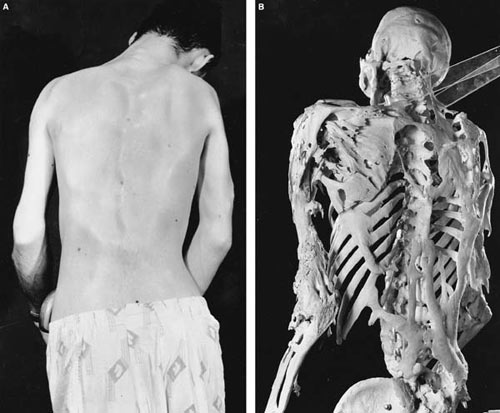
The article leads off with the story of Harry Eastlack, whose body repaired itself with bone-building cells no matter what the injury, essentially giving him a not-so-Wolverine-like second skeleton. Here’s a photo I found of Eastlack’s skeleton, which is housed at the Mutter Museum of the College of Physicians.
Have Spanish scientists found a cure for colony collapse disorder, which affects millions of honeybees around the world? The sole cause, according to the scientists, is a fungal parasite called nosema ceranae. This finding doesn’t jibe with the recent Scientific American article written by two American CCD investigators. They say that nosema is one factor out of many.
In the gut contents we found spores of nosema, single-celled fungal parasites that can cause bee dysentery. The spore counts in these and in subsequent samples, however, were not high enough to explain the losses. Molecular analysis of Hackenberg’s bees, performed by the other of us (Cox-Foster), also revealed surprising levels of viral infections of various known types. But no single pathogen found in the insects could explain the scale of the disappearance.
(via waxy)
Update: Some beekeepers have solved bee death problems in their hives by using comb with smaller cell sizes.
In case you weren’t aware, and I wasn’t for a long time, the foundation in common usage by beekeepers results in much larger bees than what you would find in a natural hive. I’ve measured sections of natural worker brood comb that are 4.6mm in diameter. This 4.6mm comb was drawn by a hive of commercial Carniolans and this 4.7mm comb was drawn on the first try by a package of commercial Carniolans. What most beekeepers use for worker brood is foundation that is 5.4mm in diameter. If you translate that into three dimensions, instead of one, that produces a bee that is about half again as large as is natural. By letting the bees build natural sized cells, I have virtually eliminated my Varroa and Tracheal mite problems.
The cell size in commercially available combs has been increased over the years to increase the honey yield. (thx, brian)
The cow genome has been published and the results show changes due to millions of years of natural selection but also to the thousands of years of selective breeding by humans.
Both types of cattle show evidence of natural selection in genes that appear to be involved in making the animals — large, horned and potentially dangerous — docile. In some breeds, specific variants of behavior-related genes are “fixed,” or seen in essentially every animal. Curiously, some of those genes are in regions that in the human genome seem to be involved in autism, brain development and mental retardation.
So…by “docile”, you really mean “mentally retarded”. (via long now)
Science magazines seem to write this list about once a year but they are always fun to read: thirteen things that science cannot explain. This version of the list includes the Kuiper cliff, tetraneutrons, cold fusion, and our old friend the Pioneer anomaly.
Nine words that came to us from science fiction and not science.
Deep space. One of the other defining features of outer space is its essential emptiness. In science fiction, this phrase most commonly refers to a region of empty space between stars or that is remote from the home world. E. E. “Doc” Smith seems to have coined this phrase in 1934. The more common use in the sciences refers to the region of space outside of the Earth’s atmosphere.
Ten steps to perform in the event that you have accidentally swallowed the Higgs boson.
7. Do you feel protons decaying? Grand Unification may be occurring near your vital organs. However, this may be caused by far less elegant X bosons — the poor man’s Higgs, as it were. We shall not deal with these “country cousins” here. Still, you must not use electroweak force in this situation. You must at least attempt to curb the force of your nuclei to delay Grand Unification. You would be wise to begin a preventive training regimen for your nuclei right away — Fermion My Wayward Son (Bloomsbury, 1996) contains the internationally accepted techniques.
This video explains how to counteract the “you’re not being open-minded” argument that atheists and scientists sometimes get when confronted by those who believe in the supernatural.
Trying to suggest that a lack of explanation is evidence that supernatural powers are at work is actually a contradiction. In effect what it’s saying is, “I can’t explain something, therefore I can explain it.”
(via buzzfeed)
Although it’s widely accepted that the scream heard when a lobster is dropped into a pot of boiling water is a bunch of hot air, it turns out that some crustaceans do feel pain, and have the capacity to remember it.
Some crabs that evacuated attacked the shell in the manner seen in a shell fight. Most crabs, however, did not evacuate at the stimulus level we used, but when these were subsequently offered a new shell, shocked crabs were more likely to approach and enter the new shell. Furthermore, they approached that shell more quickly, investigated it for a shorter time and used fewer cheliped probes within the aperture prior to moving in. Thus the experience of the shock altered future behaviour in a manner consistent with a marked shift in motivation to get a new shell to replace the one occupied. The results are consistent with the idea of pain in these animals.
And for a more eloquent take on the struggles of our shelled undersea edibles, there’s always David Foster Wallace’s riveting essay, “Consider the Lobster.”
via discover
Newer posts
Older posts



Socials & More