kottke.org posts about science
Karrie Karahalios created a program that interprets conversations and generates real-time visual feedback. A social mirror of sorts.
The “clock” shows the progress of the talk. Three times a second, a color bar pops up showing who was speaking. The louder the speech, the longer the bar. Interruptions are shown as overlapping color bars. Every minute, a new circle of bars is rendered in a visual record akin to the rings of tree trunk.
Referred to as a “conversation clock,” it’s already been tested with kids with low-functioning autism, teaching them to vocalize. One speech specialist thinks it can help kids with Asperger’s, who tend to dominate conversations, learn not to “monologue” so much.
Marriage counselors are also using it to teach your husband how to shut up for five minutes.
Sea urchins have teeth so powerful they can munch through limestone. These teeth are composed of calcite, a form of calcium carbonate, which happens to be the same material in the limestone they’re snacking on. So how do they chomp through the rock without grinding down their tusks? By aligning the calcite crystals that make up their teeth.
The structure and composition of the tip, particularly the orientation of the calcite crystals, is exquisitely controlled.
Maybe as dentists investigate how to spur humans to generate teeth like sharks, they can devise a way to make them as strong as those of a sea urchin. A scary prospect when you think about playing hockey.
Australia celebrated Toad Day Out this past weekend, resulting in the deaths of thousands of toxic cane toads.
Cane toads were introduced to north Queensland canefields from South America in 1935 to eat pest beetles. The slimy interlopers couldn’t jump high enough to reach the beetles at the top of the cane stalks and, instead, rapidly spread in search of food. Millions of them now threaten many local species and spread diseases such as salmonella across northern Australia.
Ick. The hallucinogenic amphibians were profiled in the documentary Cane Toads: An Unnatural History. Ribbit in peace.
Crinoids, or sea lilies, are marine animals that resemble plants. Unlike its garden namesake, the sea lily doesn’t stay still, but creeps along to avoid becoming prey for sea urchins and other predators.
It seems they’ve also developed the ability to “shed” their stalk-like appendages.
“It’s the lizard’s tail strategy,” said Baumiller, who is also a curator in the UM Museum of Paleontology. “The sea lily just leaves the stalk end behind. The sea urchin is preoccupied going after that, and the sea lily crawls away.” And the speed at which they move—-three to four centimeters per second—-suggests that “in a race with a sea urchin, the sea lily would probably win.”
When on the move, they resemble graceful spiders in a hurry.
Crinoids are also the state fossil of Missouri, and inspired the design of Pokemon characters Lileep and Cradily.
An excerpt from one of Galileo Galilei’s letters to Don Virginio Cesarini:
Long experience has taught me this about the status of mankind with regard to matters requiring thought: the less people know and understand about them, the more positively they attempt to argue concerning them, while on the other hand to know and understand a multitude of things renders men cautious in passing judgment upon anything new.
Want more Galileo? The Istituto e Museo di Storia della Scienza in Florence is loaning out their exhibit, Galileo, the Medici and the Age of Astronomy to The Franklin in Philadelphia. It features one of the last two telescopes belonging to the astronomer, as well as his notes, paintings, and other instruments, including the cylindrical sundial and Michelangelo’s compass.
The coelacanth, a 400 million year old prehistoric fish once thought to be extinct, has undergone a CT scan. Forty eggs were found inside of the large, frozen bodies of the two coelacanth tested, originally caught off the coast of Tanzania and then shipped to Japan for study.
The coelacanth young are thought to hatch inside of the mother and grow to 30cm before their live birth, when they swim outside of her body, looking identical to their parents, only tiny and cute. The discovery of the eggs could contribute to evidence that the ancient ocean dweller is the missing link between fish and amphibians:
Many scientists believe that the unique characteristics of the coelacanth represent an early step in the evolution of fish to terrestrial four-legged animals like amphibians. The most striking feature of this “living fossil” is its paired lobe fins that extend away from its body like legs and move in an alternating pattern, like a trotting horse.
As far as fish go, it’s just a shade prettier than the sea wolf.
Love at first sight apparently applies to men only:
Researchers believe that this difference between men and women can best be explained by the fact that the former use eye contact to seek fertile and fit mates. Meanwhile, the latter shy from making eye contact or drawing unwanted attention onto themselves for fear of unwanted pregnancies and single parenthood, it has been said.
The same study found that it takes approximately 8.2 seconds of eye contact for a man to decide if a woman is attractive. It’s hard not to stare at the eyes of photographer Rankin’s hypnotizing Eyescapes for a whole lot longer, but that’s a different type of beauty.
Attention milk product enthusiasts: The 2009-2014 World Outlook for 60-Milligram Containers of Fromage Frais has been released, and it won the dubious distinction of the Bookseller/Diagram Prize for Oddest Book Title of the Year.
The benefits of winning the award appear to be few. According to Philip Stone, The Bookseller’s charts editor:
“What does the future hold for these items?” Mr. Stone asked, speaking of fromage-frais cartons. “Well, given that fromage frais normally comes in 60-gram containers, one would assume that the world outlook for 0.06-gram containers of fromage frais is pretty bleak. But I’m not willing to pay £795 to find out.”
For those of you who are more into designer accessories than dairy almanacs, the Calf & Half pitcher lets you pour with udder abandon.
And if you’re looking for more clandestine cream, bring your own containers. Raw milk, once our only option, then treated as a potential health hazard, now finds itself on the black market.
From a post that includes all 120 crayon names, codes, and trivia:
The name Crayola was coined by Alice Binney, wife of company founder Edwin, and a former school teacher. She combined the words craie, which is French for chalk, and ola, for oleaginous, because crayons are made from petroleum based paraffin.
I don’t remember ever having scribbled with sticks of Manatee or Jazzberry Jam, but I do distinctly recall meticulously practicing my hearts and starts with the dulled point of Carnation Pink.
via Colour Lovers
Biogen is an art installation by Hanna von Goeler that’s inspired by the genetic engineering of tomatoes. Consisting of oil paintings, sculptures, a mobile made of tomato skin, and a model of a “tomato six pack,” von Goeler’s work is striking, and notably unappetizing.
Food Fray offers an equally fascinating, though less creative case against GM fruits and veggies. Both the art and the argument raise questions about the dangers of chewing with an open mind.
Santorio Santorio was an Italian physician in the 1700s who performed experiments so precise, they named him twice. He’s best known for Medicina Statica, a collection of research which, among other things, details his experiments with “insensible perspiration.” Santorio would weigh what he consumed both before and after it was digested. The results concluded that a fair amount of what he put into his body was lost through his skin.
Fascinating stuff from the University of Virginia’s vault of historical collections:
“Santorio made more than theoretical contributions to science and medicine. He is credited with inventing a wind gauge, a water current meter, the “pulsilogium” to measure the pulse rate, an instrument to remove bladder stones, and a trocar to drain fluid from cavities. Both he and his friend Galileo mentioned the thermoscope, a precursor to the thermometer. There is debate over the actual inventor, but it is known that Santorio was the first to add a numerical scale to the instrument.”
And putting him soundly in the “mad scientist” category is the fact that he invented a precursor to the waterbed. It’s unclear whether or not it was filled with insensible perspiration, but it was probably hard to hump on.
via Claude Moore Health Sciences Library
Metafilter feeds our needs for time-lapse photography and nutrition by linking to a full plate of time-lapse vegetation growth. Beans may be good for the heart, but pepper plants know how to shake it.
Cold fusion is back in the news.
After two to three weeks, the team found a small number of “triple tracks” in the plastic — three 8-micrometre-wide pits radiating from a point (see diagram, top right). The team says such a pattern occurs when a high-energy neutron strikes a carbon atom inside the plastic and shatters it into three charged alpha particles that rip through the plastic leaving tracks.
It’ll be interesting to see if this can be replicated and the source of the neutrons verified.
In an article for Scientific American, two scientists who are working on the causes of colony collapse disorder (CCD) say that they and other researchers have made some progress in determining what’s killing all of those bees.
The growing consensus among researchers is that multiple factors such as poor nutrition and exposure to pesticides can interact to weaken colonies and make them susceptible to a virus-mediated collapse. In the case of our experiments in greenhouses, the stress of being confined to a relatively small space could have been enough to make colonies succumb to IAPV and die with CCD-like symptoms.
It’s like AIDS for bees…the lowered immunity doesn’t kill directly but makes the bees more susceptible to other illness. One the techniques researchers used in investigating CDD is metagenomics. Instead of singling out an organism for analysis, they essentially mixed together a bunch of genetic material found in the bees (including any bacteria, virii, parasites, etc.) and sliced it up into small pieces that were individually deciphered. They went through those pieces one by one and assigned them to known organisms until they ran across something unusual.
The CSI-style investigation greatly expanded our general knowledge of honeybees. First, it showed that all samples (CCD and healthy) had eight different bacteria that had been described in two previous studies from other parts of the world. These findings strongly suggest that those bacteria may be symbionts, perhaps serving an essential role in bee biology such as aiding in digestion. We also found two nosema species, two other fungi and several bee viruses. But one bee virus stood out, as it had never been identified in the U.S.: the Israeli acute paralysis virus, or IAPV.
The entire Cosmos series is available for free on Hulu, in 480p no less (US only). From the Wikipedia:
[Cosmos] covered a wide range of scientific subjects including the origin of life and a perspective of our place in the universe. The series was first broadcast by the Public Broadcasting Service in 1980, and was the most widely watched series in the history of American public television until 1990’s The Civil War. It is still the most widely watched PBS series in the world. It won an Emmy and a Peabody Award and has since been broadcast in more than 60 countries and seen by over 600 million people, according to the Science Channel.
(thx, sam)
The results of a survey commissioned by the California Academy of Sciences reveals that Americans don’t know a whole lot about science.
- Only 53% of adults know how long it takes for the Earth to revolve around the Sun.
- Only 59% of adults know that the earliest humans and dinosaurs did not live at the same time.
- Only 47% of adults can roughly approximate the percent of the Earth’s surface that is covered with water.*
- Only 21% of adults answered all three questions correctly.
I bet this got cumulatively 10 seconds of coverage on the major “news” networks, if that. Compare with the endless airtime given to this AIG business and then pull your hair out until you resemble Bruce Willis. (via clusterflock)
Every year, a professor from Liberty University takes his Advanced Creation Studies biology class to the Smithsonian Museum of Natural History to check out the opposition.
“There’s nothing balanced here. It’s completely, 100 percent evolution-based,” said DeWitt, a professor of biology. “We come every year, because I don’t hold anything back from the students.”
Creationists, who take their view of natural history straight from the book of Genesis, believe that scientific data can be interpreted to support their idea that God made the first human, Adam, in an essentially modern form 6,000 to 10,000 years ago.
A 2006 poll by the Pew Forum on Religion & Public Life found that 42 percent of Americans believe humans have always existed in their present form. At universities such as Liberty, founded by the late Jerry Falwell, those views inform the entire science curriculum.
(via clusterflock)
Two independent groups of scientists have recently confirmed that the universe does exist when we are not observing it.
The reality in question — admittedly rather a small part of the universe — was the polarisation of pairs of photons, the particles of which light is made. The state of one of these photons was inextricably linked with that of the other through a process known as quantum entanglement. The polarised photons were able to take the place of the particle and the antiparticle in Dr Hardy’s thought experiment because they obey the same quantum-mechanical rules. Dr Yokota (and also Drs Lundeen and Steinberg) managed to observe them without looking, as it were, by not gathering enough information from any one interaction to draw a conclusion, and then pooling these partial results so that the total became meaningful.
That’s a relief, although the head of one of the group called their results “preposterous”, so perhaps we’re still not really here.
Note: the drinking bird is not a perpetual motion machine. But it is a heat engine. Here’s how it works:
The water evaporates from the felt on the head (Maxwell-Boltzmann distribution). Evaporation lowers the temperature of the glass head (heat of vaporization). The temperature’s drop causes some of the dichloromethane vapor in the head to condense. The lower temperature and condensation together cause the pressure to drop in the head (ideal gas law). The pressure differential between the head and base causes the liquid to be pushed up from the base. As liquid flows into the head, the bird becomes top heavy and tips over during its oscillations. When the bird tips over, the bottom end of the neck tube rises above the surface of the liquid. A bubble of vapor rises up the tube through this gap, displacing liquid as it goes. Liquid flows back to the bottom bulb, and vapor pressure equalizes between the top and bottom bulbs. The weight of the liquid in the bottom bulb restores the bird to its vertical position. The liquid in the bottom bulb is heated by ambient air, which is at a temperature slightly higher than the temperature of the bird’s head.
Also, it’s drinking the water!
This review of Superorganism, a new book by Bert Hölldobler and Edward O. Wilson, is chock full of fascinating facts about ant societies and how they organize themselves.
The progress of ants from this relatively primitive state to the complexity of the most finely tuned superorganisms leaves no doubt that the progress of human evolution has largely followed a path taken by the ants tens of millions of years earlier. Beginning as simple hunter-gatherers, some ants have learned to herd and milk bugs, just as we milk cattle and sheep. There are ants that take slaves, ants that lay their eggs in the nests of foreign ants (much like cuckoos do among birds), leaving the upbringing of their young to others, and there are even ants that have discovered agriculture. These agricultural ants represent the highest level of ant civilization, yet it is not plants that they cultivate, but mushrooms.
You may remember reading the New Yorker article on Garrett Lisi, a surfer, physicist, and snowboarder who came out of nowhere in 2007 to present a plausible Theory of Everything, “a unifying idea that aims to incorporate all the universe’s forces in a single mathematical framework”. I do but I missed this visualization of Lisi’s theory posted by New Scientist in late 2007. You may want to break out the bong for this one. (thx, matt)
A dialogue with Sarah, aged 3: in which it is shown that if your dad is a chemistry professor, asking “why” can be dangerous.
SARAH: Why?
DAD: Why do the molecules have a hydrophilic head and a hydrophobic tail?
SARAH: Yes.
DAD: Because the C-O bonds in the head are highly polar, and the C-H bonds in the tail are effectively non-polar.
My grandpappy used to say to me, “Them dolphins is smart. The chefs of the sea they are!”** Scientists have observed bottlenose dolphins preparing cuttlefish for consumption.
Considering they can’t wield a knife or cleaver, dolphins make impressive butchers. Researchers in Australia recently observed a bottlenose performing a precise series of manoeuvres to kill, gut and bone a cuttlefish. The six-step procedure gets rid of the invertebrate’s unappetising ink and hard-to-swallow cuttlebone.
** This is not true.
Scientists are still trying to figure out what’s causing CCD, or Colony Collapse Disorder, a plague that’s killing off millions of bee across the United States. Among the possible culprits are a virus, increased vulnerability to disease due to breeding, overwork (hives of bees are trucked around the country for months to pollinate crops), increased exposure to all kinds of insecticides, and perhaps even all of the above.
Whatever the cause, Aaron Hirsh says, the way to keep our crops pollinated could be simple: restore habitats for wild bees near crops that need to be pollinated.
As the swift expansion of feral honeybees across the Americas shows, they are not especially picky about their habitat; most anything outside of parking lot or vast monoculture will do. And for native bees, habitat could be restored to suit the needs of whichever species are exceptionally good pollinators of local crops. Bumblebees, for instance, are the best pollinators of Maine blueberries, whereas blue orchard bees work well for California almonds.
Hirsh’s idea is reminiscent of Michael Pollan’s proposals for decreasing the present monoculture in American agriculture outlined in his recent books.
Update: See also Beekeeping Backwards. (thx, david)
David Attenborough, the voice of several thousand hours of nature films, gets hate mail from viewers who believe he should be crediting God for nature’s beauty.
Telling the magazine that he was asked why he did not give “credit” to God, Attenborough added: “They always mean beautiful things like hummingbirds. I always reply by saying that I think of a little child in east Africa with a worm burrowing through his eyeball. The worm cannot live in any other way, except by burrowing through eyeballs. I find that hard to reconcile with the notion of a divine and benevolent creator.”
(via cyn-c)
Remarkable photo of a gynandromorphic cardinal with bilateral asymmetry, meaning that the left side of the bird is male and the right side is female…a red/brown split right down the middle.
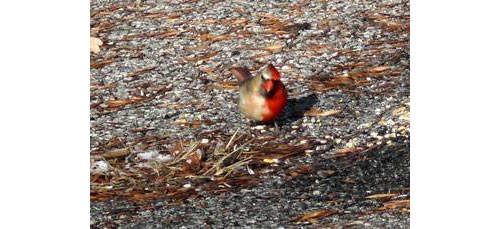
Not Photoshopped, although the phenomenon is more common with butterflies. (thx, jason)
Update: Here’s a two-tone lobster caught in Maine in 2006. (thx, nicole & jim)
In response to John Brockman’s Edge Annual Question for 2009:
What will change everything? What game-changing scientific ideas and developments do you expect to live to see?
Stuart Kauffman says that we’ll come to believe that much of the universe cannot be explained by or reduced to the fundamental laws of physics.
Let me point to the Adjacent Possible of the biosphere. Once there were lung fish, swim bladders were in the Adjacent Possible of the biosphere. Before there were multicelled organisms, the swim bladder was not in the Adjacent Possible of the biosphere. Something wonderful is happening right in front of us: When the swim bladder arose it was of selective advantage in its context. It changed what was Actual in the biosphere, which in turn created a new Adjacent Possible of the biosphere. The biosphere self consistently co-constructs itself into its every changing, unstatable Adjacent Possible.
If the becoming of the swim bladder is partially lawless, it certainly is not entailed by the fundamental laws of physics, so cannot be deduced from physics. Then its existence in the non-ergodic universe requires an explanation that cannot be had by that missing entailment. The universe is open.
(via david galbraith)
An examination of gravity in the Super Mario Bros series.
We determined that, generally speaking, the gravity in each Mario game, as game hardware has increased, is getting closer to the true value of gravity on earth of 9.8 m/s^2. However, gravity, even on the newest consoles, is still extreme.
In Super Mario 2, Mario experiences a g-force of 11 each time he falls from a ledge, a force that would cause mere humans to black out. In Madden 2006, the game’s fastest cornerbacks can run the 40 in 2.6 seconds. (via waxy)
Newer posts
Older posts



Socials & More