


The metal that remembers
Video of Nitinol wire, a shape memory alloy which returns to a pre-determined shape when heated.

This site is made possible by member support. 💞
Big thanks to Arcustech for hosting the site and offering amazing tech support.
When you buy through links on kottke.org, I may earn an affiliate commission. Thanks for supporting the site!
kottke.org. home of fine hypertext products since 1998.
Beloved by 86.47% of the web.
Video of Nitinol wire, a shape memory alloy which returns to a pre-determined shape when heated.
Discover has a list of the top 100 science stories of 2008 (scroll a bit for the whole list). Post-oil, LHC, ice on Mars, cheap genomes, quantum spookiness, etc.
Is there a mini Stonehenge under the waters of Lake Michigan?
In a surprisingly under-reported story from 2007, Mark Holley, a professor of underwater archaeology at Northwestern Michigan University College, discovered a series of stones - some of them arranged in a circle and one of which seemed to show carvings of a mastodon — 40-feet beneath the surface waters of Lake Michigan. If verified, the carvings could be as much as 10,000 years old — coincident with the post-Ice Age presence of both humans and mastodons in the upper midwest.
Aired a few weeks before the 2008 election, The President’s Guide to Science is a 50-minute video featuring several prominent scientists — Richard Dawkins, Michio Kaku, etc. — offering their advice for the incoming US President, basically what they would teach the President about science. (via smashing telly)
Seed Magazine has collected some of the wonderful science-themed photography which appears in the pages of the magazine into an online portfolio.

Bacteria photo by Eshel Ben-Jacob.
Steven Johnson really likes a book called Eating the Sun: How Plants Power the Planet by Oliver Morton; he calls it his favorite book (so far) of 2008. From a Publishers Weekly review:
The cycle of photosynthesis is the cycle of life, says science journalist Morton (Mapping Mars). Green leaves trap sunlight and use it to absorb carbon dioxide from the air and emit life-giving oxygen in its place. Indeed, plants likely created Earth’s life-friendly oxygen- and nitrogen-rich biosphere. In the first part, Morton, chief news and features editor of the leading science journal, Nature, traces scientists’ quest to understand how photosynthesis works at the molecular level. In part two, Morton addresses evidence of how plants may have kick-started the complex life cycle on Earth. The book’s final part considers photosynthesis in relation to global warming, for, he says, the Earth’s plant-based balance of carbon dioxide and oxygen is broken: in burning vast amounts of fossil fuels, we are emitting more carbon dioxide than the plants can absorb. But Morton also explores the possibility that our understanding of photosynthesis might be harnessed to regain that balance.
News to me: Jonah Lehrer, author of Proust Was a Neuroscientist, has a new book coming out in February called How We Decide.
From the acclaimed author of Proust Was a Neuroscientist, a fascinating look at the new science of decision-making-and how it can help us make better choices. Since Plato, philosophers have described the decisionmaking process as either rational or emotional: we carefully deliberate or we “blink” and go with our gut. But as scientists break open the mind’s black box with the latest tools of neuroscience, they’re discovering that this is not how the mind works.Our best decisions are a finely tuned blend of both feeling and reason — and the precise mix depends on the situation.When buying a house, for example, it’s best to let our unconscious mull over the many variables. But when we’re picking a stock, intuition often leads us astray.The trick is to determine when to lean on which part of the brain, and to do this, we need to think harder (and smarter) about how we think.
Scientists are saying that we can make ourselves a whoolly mammoth for as little as $10 million. All it takes is a mammoth genome, a lot of painstaking work, and much computing power.
If the genome of an extinct species can be reconstructed, biologists can work out the exact DNA differences with the genome of its nearest living relative. There are talks on how to modify the DNA in an elephant’s egg so that after each round of changes it would progressively resemble the DNA in a mammoth egg. The final-stage egg could then be brought to term in an elephant mother, and mammoths might once again roam the Siberian steppes.
The article also notes that if this works for the mammoth, it might also be possible to do the same for a Neanderthal. What an age we live in.
Five quick physics lessons for President-Elect Obama from the author of Physics for Future Presidents (@ Amazon). One of the lessons: nuclear power is the way to go.
It’s true that after 300 years, nuclear waste is still about 100 times more radioactive than the original uranium that was removed from the earth. But even this isn’t as scary as it sounds. If the waste is stored underground in such a way that there’s only a 10 percent chance that 10 percent of it will leak — which should be more than doable — the risk will be no worse than if we had never mined the uranium in the first place.
Muller asserts that safe nuclear power is a solved technical problem and that the use of it is a political issue.
It’s worth sitting through the annoying “in a world…” narration to see the structure of an immense colony of ants. The scientists poured 10 tons of concrete down into an abandoned ant colony, waited for it to harden, and then spent weeks excavating the results.
During the construction of the giant structure, it’s estimated that the ants hauled 40 tons of dirt out of the holes, the equivalent of building the Great Wall of China. (via cyn-c)
Update: The ant colony was not abandoned. Nice work, scientists!
Richard Feynman on the “perpetual absurdity” of school textbooks.
The same thing happened: something would look good at first and then turn out to be horrifying. For example, there was a book that started out with four pictures: first there was a windup toy; then there was an automobile; then there was a boy riding a bicycle; then there was something else. And underneath each picture it said, “What makes it go?”
I thought, “I know what it is: They’re going to talk about mechanics, how the springs work inside the toy; about chemistry, how the engine of the automobile works; and biology, about how the muscles work.”
It was the kind of thing my father would have talked about: “What makes it go? Everything goes because the sun is shining.” And then we would have fun discussing it:
“No, the toy goes because the spring is wound up,” I would say. “How did the spring get wound up?” he would ask.
“I wound it up.”
“And how did you get moving?”
“From eating.”
“And food grows only because the sun is shining. So it’s because the sun is shining that all these things are moving.” That would get the concept across that motion is simply the transformation of the sun’s power.
(via rw)
In lean times, men look for women who can work and in times of plenty, they want women who can reproduce.
The Environmental Security Hypothesis says that in tough times men will prefer women who are good at production, generally older, taller, heavier, less curvaceous women with less body fat. In good times, they will prefer women who are good at reproduction, generally younger, shorter, lighter, more curvaceous women.
A pair of social psychologists looked for signs of this in the pages of Playboy magazine.
Consistent with Environmental Security Hypothesis predictions, when social and economic conditions were difficult, older, heavier, taller Playboy Playmates of the Year with larger waists, smaller eyes, larger waist-to-hip ratios, smaller bust-to-waist ratios, and smaller body mass index values were selected. These results suggest that environmental security may influence perceptions and preferences for women with certain body and facial features.
Due to a hand tremor, musician Eddie Adcock was having trouble playing the banjo. During the surgery to fix the problem, the doctors had Adcock play his banjo to isolate the problem in his brain and then they made the repair. Video here. (via delicious ghost)
A list of 15 uses of tiny black holes, including hazardous waste disposal, cheap transport, and hanging posters without tacks.
A new study suggests that HIV jumped from apes to humans around the turn of the 20th century, which coincides with the development of colonial cities in sub-Saharan Africa.
HIV was and remains a “relatively poorly transmitted” virus, he said, so the key to the success of the virus was possibly the development of cities such as Leopoldville in the early 1900s.
The large numbers of people living in close proximity would have allowed more opportunity for new infections.
“I think the picture that has emerged here, is that changes the human population experienced may have opened to the door to the spread of HIV,” he said.
DARPA is soliciting research proposals for people wishing to solve one of twenty-three mathematical challenges, many of which deal with attempting to find a mathematical basis underlying biology.
What are the Fundamental Laws of Biology?: This question will remain front and center for the next 100 years. DARPA places this challenge last as finding these laws will undoubtedly require the mathematics developed in answering several of the questions listed above.
(via rw)
Spreading nasty rumors can make people feel literally dirty and being socially excluded from a group can make you feel cold.
John Bargh, a psychologist at Yale who was not involved in the research, said the finding made “perfect sense.” In an e-mail message, he noted that a brain region called the insula tracks both body temperature and general psychological states, and it may be here where social perceptions and sensations of warmth or coldness are fused.
Deborah Solomon recently interviewed Charles Murray for the NY Times. Murray is the author of the recent book, Real Education, which argues that 80% of all college students should not be pursuing a bachelor’s degree.
Even though the interview is pretty short, Solomon shows how Murray’s scientific views don’t jibe with his political views, namely that you don’t need smart, able people running the country.
What do you make of the fact that John McCain was ranked 894 in a class of 899 when he graduated from the U.S. Naval Academy? I like to think that the reason he ranked so low is that he was out drinking beer, as opposed to just unable to learn stuff.
What do you think of Sarah Palin? I’m in love. Truly and deeply in love.
She attended five colleges in six years. So what?
Why is the McCain clan so eager to advertise its anti-intellectualism? The last thing we need are more pointy-headed intellectuals running the government. Probably the smartest president we’ve had in terms of I.Q. in the last 50 years was Jimmy Carter, and I think he is the worst president of the last 50 years.
The cognitive dissonance inside Murray’s head must be deafening.
New studies show that prehistoric agriculture may have taken much longer to develop than previously thought.
Until recently researchers say the story of the origin of agriculture was one of a relatively sudden appearance of plant cultivation in the Near East around 10,000 years ago spreading quickly into Europe and dovetailing conveniently with ideas about how quickly language and population genes spread from the Near East to Europe. Initially, genetics appeared to support this idea but now cracks are beginning to appear in the evidence underpinning that model.
Some physicists have worked out what Usain Bolt’s time in the 100 meters in Beijing would have been if he hadn’t started celebrating before the finish line: 9.55 seconds. The original paper is here. I tried doing this the day after the race but even the HD footage wasn’t good enough to see the tick marks on the track and I didn’t want to mess around with all the angles. (via justin blanton)
Update: The folks at The Science of Sport lay out a much more sensible case relying on split times that Bolt would have run somewhere between 9.61 and 9.69. (thx, jim)
It looks like black holes can grow to be as massive as 50 billion suns. How massive is that? It’s approximately 99 duodecillion kilograms….which is a 99 followed by 39 zeros. (Put another way, if you had 99 duodecillion dollars, you could buy as many PlayStation 3s as you wanted. Blows your mind, right?)
You know helium makes your voice go all squeaky? Adam from Mythbusters demonstrates that sulfur hexafluoride makes it do the opposite. Must get sulfur hexafluoride.
Meg bought Ollie this ball a couple of weeks ago. It’s got all the planets of the solar system on it, plus the Sun. But no Pluto. That’s right, it’s barely been two years since Pluto was demoted to dwarf planet status and the toy manufacturers have already made the adjustment.
It saddens me that Ollie has to grow up in a world where Pluto isn’t considered a planet, although I take comfort that his textbooks probably won’t be updated by the time he’s in school. In the meantime, I’ve Sharpied Pluto onto his ball.
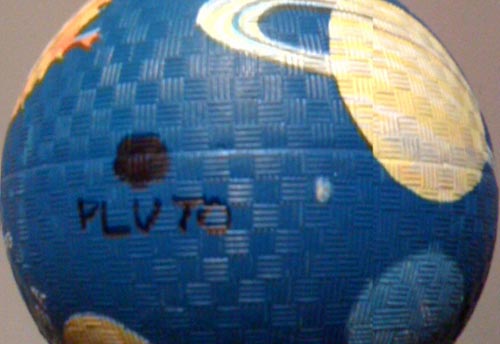
One ball at a time people, that’s how we win.
A list of ten things that you didn’t know about the earth. My favorite one, by far:
But what if you did dig a hole through the Earth and jump in? What would happen?
Well, you’d die (see below). But if you had some magic material coating the walls of your 13,000 km deep well, you’d have quite a trip. You’d accelerate all the way down to the center, taking about 20 minutes to get there. Then, when you passed the center, you’d start falling up for another 20 minutes, slowing the whole way. You’d just reach the surface, then you’d fall again. Assuming you evacuated the air and compensated for Coriolis forces, you’d repeat the trip over and over again, much to your enjoyment and/or terror. Actually, this would go on forever, with you bouncing up and down. I hope you remember to pack a lunch.
Note that as you fell, you accelerate all the way down, but the acceleration itself would decrease as you fell: there is less mass between you and the center of the Earth as you head down, so the acceleration due to gravity decreases as you approach the center. However, the speed with which you pass the center is considerable: about 7.7 km/sec (5 miles/second).
Fast forward to the year 2483 and we’ll probably all be using such holes to quickly travel through the earth. Spain to New Zealand in 42 minutes! New York to the middle of the Indian Ocean? 42 minutes! I also recall reading somewhere that the tunnels don’t need to run through the middle of the earth. You don’t get the free fall effect, but with the proper contraption (mag-lev tunnel train?) you’ll be pulled through the tunnel at a great speed. Does this ring anyone’s bell?
Update: A bell has rung. The tunnels described above are called chord tunnels and the travel time through the earth in a frictionless chord tunnel is always 42 minutes, even if the tunnel is only a few hundred miles long or so (say from New York to Detroit). (thx, mike)
Update: In this short Nova clip, Neil deGrasse Tyson “demonstrates” a trip through the center of the earth. (thx, michael)
Steven Johnson’s new book is called The Invention of Air.
It has an organizing theme of how innovative ideas emerge and spread in a society, while integrating many different threads along the way: 18th-century London coffeehouse culture; the Adams-Jefferson letters; the origins of ecosystem science; the giant dragonflies of the Carboniferous Era; the impact of energy deposits on British political change; the discovery of the gulf stream; the Alien and Sedition acts; Jefferson’s bible; the Lunar Society; mob violence; Thomas Kuhn’s Structure of Scientific Revolutions; Ben Franklin’s kite experiment.
It’s also not, somehow, 6500 pages. I thought for sure that this was going to be some sort of long zoom book, not a book with a long zoom approach.
Jonah Lerher on daydreaming and the human brain’s default network. Creativity, especially with regard to children, might be stifled by too little daydreaming and too much television.
After monitoring the daily schedule of the children for several months, Belton came to the conclusion that their lack of imagination was, at least in part, caused by the absence of “empty time,” or periods without any activity or sensory stimulation. She noticed that as soon as these children got even a little bit bored, they simply turned on the television: the moving images kept their minds occupied. “It was a very automatic reaction,” she says. “Television was what they did when they didn’t know what else to do.”
The problem with this habit, Belton says, is that it kept the kids from daydreaming. Because the children were rarely bored — at least, when a television was nearby — they never learned how to use their own imagination as a form of entertainment. “The capacity to daydream enables a person to fill empty time with an enjoyable activity that can be carried on anywhere,” Belton says. “But that’s a skill that requires real practice. Too many kids never get the practice.”
But television isn’t the default network that Lehrer is referring to:
Every time we slip effortlessly into a daydream, a distinct pattern of brain areas is activated, which is known as the default network. Studies show that this network is most engaged when people are performing tasks that require little conscious attention, such as routine driving on the highway or reading a tedious text. Although such mental trances are often seen as a sign of lethargy — we are staring haplessly into space — the cortex is actually very active during this default state, as numerous brain regions interact. Instead of responding to the outside world, the brain starts to contemplate its internal landscape. This is when new and creative connections are made between seemingly unrelated ideas.
Basketball players are more skilled than even keen observers of the game (sportswriters and coaches) when predicting whether a shot will go in the basket or not.
Not surprisingly, the players were significantly better at predicting whether or not the shot would go in. While they got it right more than two-thirds of the time, the non-playing experts (i.e., the coaches and writers) only got it right 44 percent of the time.
It’s thought that the brains of the players act as though they are actually taking the shot.
In other words, when professional basketball players watch another player take a shot, mirror neurons in their pre-motor areas might light up as if they were taking the same shot. This automatic empathy allows them to predict where the ball will end up before the ball is even in the air.
Before European conquerers arrived, large areas of the Amazon River basin had been cleared away to make room for a network of towns and villages.
The findings raise big questions, says Susanna Hecht of the University of California in Los Angeles.
For starters, it forces a rethink of the long-held assumption that these parts of the Amazon were virtually empty before colonisation. What’s more, it shows that the large populations that did inhabit the region transformed the landscape.
“What we find is that what we think of as the primitive Amazon forest is not so primitive after all,” Heckenberger told New Scientist. “European colonialism wasted huge numbers of native peoples and cleared them off the land, so that the forest returned.”
I’m gonna plug 1491 again…the story above isn’t news to anyone who’s read this book, which argues that there was plenty going on in the New World before Columbus, et. al. arrived.
Anatomical drawings that are part medical and part American Apparel advertisement. (via clusterflock)
Ice cream is an igneous rock made up of ice, air, and sugar.
Much like igneous rocks, the same liquid mix can turn out very differently depending on what happens while it is freezing. The goal of most ice cream and sorbet is to have a smooth and creamy texture, which would be ruined by the presence of large ice crystals. To achieve this, you want to cool your ice cream so quickly that the crystals don’t have time to grow, and keep the mixture stirred up while it freezes. There’s a lot of energy involved in the transition from liquid to solid water, and a home ice cream maker can’t do the heat transfer quickly enough to keep the ice crystals small, so you have to sit there and turn the crank until your arm is sore while the mixture slowly freezes (or invest in a fancier machine that will do the stirring for you).
See also what happens when ice cream sits for too long in the freezer and the book, The Science of Ice Cream.
Socials & More