
The Seed Salon
The Seed Salon features videos and text transcripts of conversations with scientists and other persons of scientific interest. Includes the likes of Paola Antonelli, Noam Chomsky, Errol Morris, and Lisa Randall.

This site is made possible by member support. 💞
Big thanks to Arcustech for hosting the site and offering amazing tech support.
When you buy through links on kottke.org, I may earn an affiliate commission. Thanks for supporting the site!
kottke.org. home of fine hypertext products since 1998.
Beloved by 86.47% of the web.
The Seed Salon features videos and text transcripts of conversations with scientists and other persons of scientific interest. Includes the likes of Paola Antonelli, Noam Chomsky, Errol Morris, and Lisa Randall.
Every now and then, you may find yourself wondering: how many atoms of Jesus do you eat everyday?
In the Catholic doctrine of transubstantiation, the eucharist actually becomes the blood and body of Jesus Christ. […] Transubstantiation means that eventually the earth’s entire biomass will be made out of Jesus.
Eventually = 4.91 billion years.
In a Swiss experiment, two entangled photons 18 km away from each other were able to communicate with each other almost instantaneously.
On the basis of their measurements, the team concluded that if the photons had communicated, they must have done so at least 100,000 times faster than the speed of light — something nearly all physicists thought would be impossible. In other words, these photons cannot know about each other through any sort of normal exchange of information.
Update: Hrm, the link above scampered behind Nature’s paywall. Here’s a post on the Scientific American blog instead.
The Genius of Charles Darwin is a three-part series about Darwin presented by his rottweiler, Richard Dawkins. A short video taste of the show is here and the entire first part is on Google Video. (via smashing telly)
Flat-earthers are people who believe, here in the 21st century, that the Earth is flat. (Believers in a round earth are called globularists.)
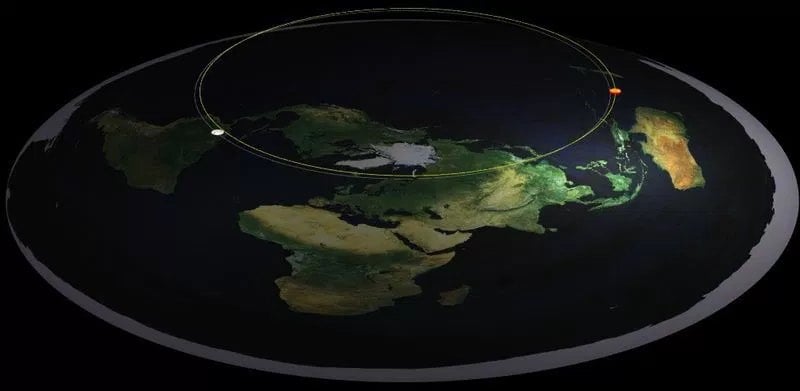
And what about the fact that no one has ever fallen off the edge of our supposedly disc-shaped world? Mr McIntyre laughs. “This is perhaps one of the most commonly asked questions,” he says. “A cursory examination of a flat earth map fairly well explains the reason — the North Pole is central, and Antarctica comprises the entire circumference of the Earth. Circumnavigation is a case of travelling in a very broad circle across the surface of the Earth.”
If, like me, you have questions about how the Earth could possibly be flat, some of them are answered in the Flat Earth FAQ.
Q: “What about the stars, sun and moon and other planets? Are they flat too? What are they made of?”
A: The sun and moon, each 32 miles in diameter, circle Earth at a height of 3000 miles at its equator, located midway between the North Pole and the ice wall. Each functions similar to a “spotlight,” with the sun radiating “hot light,” the moon “cold light.” As they are spotlights, they only give light out over a certain are which explains why some parts of the Earth are dark when others are light. Their apparent rising and setting are caused by optical illusions. In the “accelerating upwards” model, the stars, sun and moon are also accelerating upwards. The stars are about as far as San Francisco is from Boston. (3100 miles)
BTW, the “ice wall” is what separates the edge of the earth’s disc with outer space or whatever ether or monsters are beyond the earth. We know the wall as Antarctica. I call shenanigans on all this…it’s gotta be a hoax. Nobody’s this ignorant, right? Please?
I’ve been waiting patiently for this one. Big Picture has 27 photos of the Large Hadron Collider and they’re stunning. The scale of this thing, it’s overwhelming.
X-ray analysis has revealed a van Gogh painting underneath another van Gogh painting. (via clusterflock)
Human activities can trigger natural disasters such as earthquakes and flooding.
“Dams are the most dangerous man-made structure likely to cause quake,” says David Booth of the British Geological Survey. By artificially holding a large volume of water in one place, dams increase pressure on fractures beneath the surface of the earth. What’s more, water has a lubricating effect, making it easier for the fractures — or faults — to slip.
Jonah Lerher, author of Proust Was a Neuroscientist, has a piece in the New Yorker this week (not online1) about how the process of insight works in the brain. The main takeaway is that insight comes easiest when our brains are relaxed and not focused on too much detail so that it is able to look for more general associations between seemingly disparate ideas.
Kounios tells a story about an expert Zen meditator who took part in one of the C.R.A. insight experiments. At first, the meditator couldn’t solve any of the insight problems. “This Zen guy went through thirty or so of the verbal puzzles and just drew a blank,” Kounios said. “He was used to being very focussed, but you can’t solve these problems if you’re too focussed.” Then, just as he was about to give up, he started solving one puzzle after another, until, by the end of the experiment, he was getting them all right. It was an unprecedented streak. “Normally, people don’t get better as the task goes along,” Kounios said. “If anything, they get a little bored.” Kounios believes that the dramatic improvement of the Zen meditator came from his paradoxical ability to focus on not being focussed, so that he could pay attention to those remote associations in the right hemisphere. “He had the cognitive control to let go,” Kounios said. “He became an insight machine.”
[1] There’s a samizdat PDF of the article here. ↩
If physical theories were women.
Quantum mechanics is the girl you meet at the poetry reading. Everyone thinks she’s really interesting and people you don’t know are obsessed about her. You go out. It turns out that she’s pretty complicated and has some issues. Later, after you’ve broken up, you wonder if her aura of mystery is actually just confusion.
Would like to see the list for men as well. (via snarkmarket)
Seed Magazine has posted Noah Kalina’s photos of science labs at night. The Salk Institute is represented of course.
The money brought in due to Beatlemania funded the research that led to the CAT scanning machine. (via gawker lite)
Another Wikipedia gem: a list of unsolved problems from a number of different fields, including linguistics, physics, and computer science. (via lone gunman)
The Periodic Table of Videos is a collection of videos about all the elements. All your favorites are there…Neon, Rubidium, Lead, Plutonium.
Physicists of the 20th Century on Banknotes (5 MB PDF), including Marie & Pierre Curie on a short-lived 500 franc note, Niels Bohr on a Danish 500 kroner note, and Nikola Tesla on several notes from Yugoslavia and Serbia. The author of the article is Steve Feller, physics professor at Coe College and my college advisor. Feller has a keen interest in numismatics and recently published a book about the money used in WWII camps.
Humans are consuming natural resources so quickly that we’re running out of elements.
The element gallium is in very short supply and the world may well run out of it in just a few years. Indium is threatened too, says Armin Reller, a materials chemist at Germany’s University of Augsburg. He estimates that our planet’s stock of indium will last no more than another decade. All the hafnium will be gone by 2017 also, and another twenty years will see the extinction of zinc. Even copper is an endangered item, since worldwide demand for it is likely to exceed available supplies by the end of the present century.
Many of the elements listed above are used in the construction of computer equipment and flat-panel TVs.
Scientists were recently “astonished” to find water in Mercury’s atmosphere. Plus, the particles in the atmosphere were blasted off the surface by the solar wind so the atmospheric water could indicate that it can be found on the surface as well. First Mars and now this. Has The Onion done a “Scientists find evidence of water on Earth” story yet?
I try not to miss any of Atul Gawande’s New Yorker articles, but his piece on itching from this week’s issue is possibly the most interesting thing I’ve read in the magazine in a long time. He begins by focusing on a specific patient for whom compulsive itching has become a very serious problem. (Warning, this quote is pretty disturbing…but don’t let it deter you from reading the article.)
…the itching was so torturous, and the area so numb, that her scratching began to go through the skin. At a later office visit, her doctor found a silver-dollar-size patch of scalp where skin had been replaced by scab. M. tried bandaging her head, wearing caps to bed. But her fingernails would always find a way to her flesh, especially while she slept.
One morning, after she was awakened by her bedside alarm, she sat up and, she recalled, “this fluid came down my face, this greenish liquid.” She pressed a square of gauze to her head and went to see her doctor again. M. showed the doctor the fluid on the dressing. The doctor looked closely at the wound. She shined a light on it and in M.’s eyes. Then she walked out of the room and called an ambulance. Only in the Emergency Department at Massachusetts General Hospital, after the doctors started swarming, and one told her she needed surgery now, did M. learn what had happened. She had scratched through her skull during the night — and all the way into her brain.
From there, Gawande pulls out to tell us about itching/scratching (the two are inseparable), then about a recent theory of how our brains perceive the world (“visual perception is more than ninety per cent memory and less than ten per cent sensory nerve signals”), and finally about a fascinating therapy initially developed for those who experience phantom limb pain called mirror treatment.
Among them is an experiment that Ramachandran performed with volunteers who had phantom pain in an amputated arm. They put their surviving arm through a hole in the side of a box with a mirror inside, so that, peering through the open top, they would see their arm and its mirror image, as if they had two arms. Ramachandran then asked them to move both their intact arm and, in their mind, their phantom arm-to pretend that they were conducting an orchestra, say. The patients had the sense that they had two arms again. Even though they knew it was an illusion, it provided immediate relief. People who for years had been unable to unclench their phantom fist suddenly felt their hand open; phantom arms in painfully contorted positions could relax. With daily use of the mirror box over weeks, patients sensed their phantom limbs actually shrink into their stumps and, in several instances, completely vanish. Researchers at Walter Reed Army Medical Center recently published the results of a randomized trial of mirror therapy for soldiers with phantom-limb pain, showing dramatic success.
Crazy! Gawande documents and speculates about other applications of this treatment, including using virtual reality representations instead of mirrors and utilizing multiple mirrors for treatment of M.’s itchy scalp. Anyway, read the whole thing…highly recommended.
About 2 hours ago, the Mars Phoenix rover twittered that it had found evidence of ice on Mars.
Are you ready to celebrate? Well, get ready: We have ICE!!!!! Yes, ICE, *WATER ICE* on Mars! w00t!!! Best day ever!!
The Mars rover said “w00t”. Here’s the w00t-less press release and the associated images that show the ice sublimating from the surface over the last four days.
When two plastics (polymers TTF and TCNQ) are placed atop one another, a thin strip forms that conducts electricity “as well as a metal”.
The TTF-TCNQ interface conducts electricity much better than standard semiconductors. “The electron concentration there is an order of magnitude higher,” Mannhart says. “That has the power to create new effects, from magnetism to superconductivity.”
All blacks are not created equal…a team at Rensselaer and Rice University have created the world’s darkest material. Plain old black paint reflects between 5 and 10 percent of incident light; the new material reflects only 0.045%. (via animamundi)
The idea of evolution did not begin with Darwin…he just (just!) explained how it happened and backed it up with evidence.
“The only novelty in my work is the attempt to explain how species become modified,” Darwin later wrote. He did not mean to belittle his achievement. The how, backed up by an abundance of evidence, was crucial: nature throws up endless biological variations, and they either flourish or fade away in the face of disease, hunger, predation and other factors. Darwin’s term for it was “natural selection”; Wallace called it the “struggle for existence.” But we often act today as if Darwin invented the idea of evolution itself, including the theory that human beings developed from an ape ancestor. And Wallace we forget altogether.
In fact, scientists had been talking about our primate origins at least since 1699, after the London physician Edward Tyson dissected a chimpanzee and documented a disturbing likeness to human anatomy. And the idea of evolution had been around for generations.
Rampant speculation from Jonah Lehrer on why people care so much when they watch overpaid athletes play sports. It is, perhaps, all about mirror neurons:
“The main functional characteristic of mirror neurons is that they become active both when the monkey makes a particular action (for example, when grasping an object or holding it) and when it observes another individual making a similar action.” In other words, these peculiar cells mirror, on our inside, the outside world; they enable us to internalize the actions of another. They collapse the distinction between seeing and doing.
This suggests that when I watch Kobe glide to the basket for a dunk, a few deluded cells in my premotor cortex are convinced that I, myself, am touching the rim. And when he hits a three pointer, my mirror neurons light up as I’ve just made the crucial shot. They are what bind me to the game, breaking down that 4th wall separating fan from player. I’m not upset because my team lost: I’m upset because it literally feels like I lost, as if I had been on the court.
This phrase is attributed to French monk Dom Pierre Pérignon upon his discovery of Champagne:
Venez vite, je goûte les étoiles!
It’s typically translated into English as:
Come quickly, I am drinking the stars!
Although Pérignon made important advances in sparkling wine production, a reproducible process for making sparkling wine (of which Champagne is one variety) was actually first described by an Englishman, Christopher Merret, some thirty years before. In a paper presented to the Royal Society, Merret noted that the addition of sugar to wine would result in a second fermentation, which made the wine sparkle.
Merret came to sparkling wine through his interest in glass. The process of secondary fermentation had been known since before medieval times but was not reproducible because the glass bottles would explode under the pressure. Using stronger English glass and sturdy corks, Merret was able to dependably reproduce the sparkling effect and publish the technique for anyone to do the same. A bit less glamorous than “drinking the stars” perhaps, but a deft illustration of the scientific method nonetheless.
BTW, Moët and Chandon, producers of the Dom Pérignon brand of Champagne, still perpetuate the myth that Dom Pérignon invented the method for making sparkling wine. From the DP web site:
Make “the best wine in the world.” It took a visionary spirit and exceptional daring to set such an exalted ambition at the end of the 17th century. But vision and daring were second nature to Pierre Pérignon. Before him, there was only what was known as the wines of Reims, of La Montagne and of La Rivière, according to their origins in the Champagne region. With amazing intuition, Dom Pérignon was the first to see the fabulous promise of luxury. He took very ordinary wines and gave them body, spirit and grace. Through his efforts Champagne wine entered a new world.
Whatever helps you sell the Champers, I guess.
Man, I love this video. It’s some guy explaining how the banana — “the atheist’s nightmare” — so perfectly fits in the human hand and peels so easily that it must have been made by God**. Kirk Cameron listens intently. I can’t wait for the follow-up video where he explains why watermelons don’t have handles and what God was thinking when he built the coconut.
** Not that this guy cares or whatever, but the modern banana is a cultivated fruit…i.e. pressured by humans to, oh what’s the word…evolve into its present form. And other varieties of bananas are smaller or larger and differently shaped. Some wild bananas have large hard seeds. I could go on….
At the very moment that humans discovered the scale of the universe and found that their most unconstrained fancies were in fact dwarfed by the true dimensions of even the Milky Way Galaxy, they took steps that ensured that their descendants would be unable to see the stars at all. For a million years humans had grown up with a personal daily knowledge of the vault of heaven. In the last few thousand years they began building and emigrating to the cities. In the last few decades, a major fraction of the human population had abandoned a rustic way of life. As technology developed and the cities were polluted, the nights became starless. New generations grew to maturity wholly ignorant of the sky that had transfixed their ancestors and had stimulated the modern age of science and technology. Without even noticing, just as astronomy entered a golden age most people cut themselves off from the sky, a cosmic isolationism that only ended with the dawn of space exploration.
That’s Carl Sagan in Contact from 1985. The effects of light pollution were documented in the New Yorker last August.
Here’s an update on the effort to solve the Pioneer anomaly, the unexplained deviation in motion of deep space probes from what Newton and Einstein’s theories predict.
As it sped through space, a specialist in radio-wave physics named John Anderson at NASA’s Jet Propulsion Laboratory noticed an odd thing. The spacecraft was drifting off course. The discrepancy was less than a few hundred-millionths of an inch per second for every second of spaceflight, accumulating year after year across billions of miles. Then Pioneer 11, an identical probe escaping the solar system in the opposite direction, also started to veer off course at the same rate.
Ordinarily, such small deviations might be overlooked, but not by Dr. Anderson. He monitored the trajectories six years before calling attention to the matter. “I’m a little like an accountant,” Dr. Anderson said. “We have Newton’s theory and Einstein’s theory, and when you apply them to something like this — and it doesn’t add up — it bothers me.”
The researchers, using data recovered from recently discovered Pioneer records and funded by sources outside of NASA, have figured out part of the problem but the rest remains a mystery.
Do we really need science to tell us that the DNA of an egg-laying, no nippled, duck-billed mammal is unusual?
One of the interesting findings of Elizabeth Spelke’s Harvard baby brain research lab is that while babies prefer looking at pictures of people of their own race over other races, they are much more biased about language.
‘They like toys more that are associated with someone who has spoken their language. They prefer to eat foods offered to them by a native speaker compared to a speaker of a foreign language. And older children say that they want to be friends with someone who speaks in their native accent.’ Accents and vernacular, far more than race, seem to influence the people we like. ‘Children would rather be friends with someone who is from a different race and speaks with a native accent versus somebody who is their own race but speaks with a foreign accent.’
Socials & More