kottke.org posts about science
From Penn Jillette’s book, God, No!: Signs You May Already Be an Atheist and Other Magical Tales:
There is no god and that’s the simple truth. If every trace of any single religion died out and nothing were passed on, it would never be created exactly that way again. There might be some other nonsense in its place, but not that exact nonsense. If all of science were wiped out, it would still be true and someone would find a way to figure it all out again.
(via mlkshk)
College-age women end sentences in the lowest vocal register, a creaky vibration called vocal fry, possibly to broadcast themselves as part of a social group.
Vocal fry…great term! Here’s a demo of how the effect is used in singing.
Update: About a minute into this clip from Louie, there’s a great example of vocal fry used by “college-age women [to] end sentences”:
(via @dalton)
At the beginning of this video, Ramesh Raskar, associate professor at the MIT Media Lab, announces calmly:
We have built a virtual slow-motion camera where we can see photons, or light particles, moving through space.
Yeah, no biggie.
Russian scientists are seeing dramatically increased levels of methane coming from melting permafrost in the East Siberian Ice Shelf. If enough methane is released, that could really put a foot on the gas pedal with this whole global warming thing.
“Earlier we found torch-like structures like this but they were only tens of metres in diameter. This is the first time that we’ve found continuous, powerful and impressive seeping structures, more than 1,000 metres in diameter. It’s amazing,” Dr Semiletov said. “I was most impressed by the sheer scale and high density of the plumes. Over a relatively small area we found more than 100, but over a wider area there should be thousands of them.”
Scientists estimate that there are hundreds of millions of tonnes of methane gas locked away beneath the Arctic permafrost, which extends from the mainland into the seabed of the relatively shallow sea of the East Siberian Arctic Shelf. One of the greatest fears is that with the disappearance of the Arctic sea-ice in summer, and rapidly rising temperatures across the entire region, which are already melting the Siberian permafrost, the trapped methane could be suddenly released into the atmosphere leading to rapid and severe climate change.
Elephants were the “perfect food package” for pre-human hominids (they were slow with a good fat-to-protein ratio) and their extinction in the Middle East (and Africa) caused those hominids to evolve to be more like modern humans.
When elephants began to die out, Homo erectus “needed to hunt many smaller, more evasive animals. Energy requirements increased, but with plant and protein intake limited, the source had to come from fat. He had to become calculated about hunting,” Ben-Dor says, noting that this change is evident in the physical appearance of modern humans, lighter than Homo erectus and with larger brains.
(via @daveg)
Rumor has it that the LHC at CERN has found the Higgs boson. The news runs contrary to some earlier speculation.
The teams are sworn to secrecy, but various physics blogs, and the canteens at Cern, are alive with talk of a possible sighting of the Higgs, and with a mass inline with what many physicists would expect.
Since the Higgs’ nickname is the God particle, does this count as the Second Coming? (@gavinpurcell)
From Sean Carroll at Cosmic Variance, a list of facts and very strong opinions about the nature of time.
4. You live in the past. About 80 milliseconds in the past, to be precise. Use one hand to touch your nose, and the other to touch one of your feet, at exactly the same time. You will experience them as simultaneous acts. But that’s mysterious - clearly it takes more time for the signal to travel up your nerves from your feet to your brain than from your nose. The reconciliation is simple: our conscious experience takes time to assemble, and your brain waits for all the relevant input before it experiences the “now.” Experiments have shown that the lag between things happening and us experiencing them is about 80 milliseconds.
5. Your memory isn’t as good as you think. When you remember an event in the past, your brain uses a very similar technique to imagining the future. The process is less like “replaying a video” than “putting on a play from a script.” If the script is wrong for whatever reason, you can have a false memory that is just as vivid as a true one. Eyewitness testimony, it turns out, is one of the least reliable forms of evidence allowed into courtrooms.
A recently discovered species of crab grows gardens of bacteria on its claws on which to feed.
The bristles that cover the crab’s claws and body are coated in gardens of symbiotic bacteria, which derive energy from the inorganic gases of the seeps. The crab eats the bacteria, using comb-like mouthparts to harvest them from its bristles. […] Thurber thinks that K. puravida waves its claws to actively farm its bacterial gardens: movements stir up the water around the bacteria, ensuring that fresh supplies of oxygen and sulphide wash over them and helping them to grow. “This ‘dance’ is extraordinary and comical,” says Van Dover. “We’ve never seen this strategy before.”
(via @noahwg)
80-minute video of a conversation between Neil deGrasse Tyson and of an out-of-character Stephen Colbert “about science, society, and the universe”. Someone needs to get this on YouTube or something…the video streaming is slooooow.
Update: Ah, here’s a mirror on YouTube. (thx, aaron)
When dense briny water (left behind by newly formed sea ice) sinks, it freezes the water around it, forming an icicle that stretches to the sea floor. Then it freezes water and wildlife on the sea floor. David Attenborough narrates:
Here’s an interesting hypothesis: that all current life on Earth originated from a planet-wide super-organism named LUCA.
The latest results suggest LUCA was the result of early life’s fight to survive, attempts at which turned the ocean into a global genetic swap shop for hundreds of millions of years. Cells struggling to survive on their own exchanged useful parts with each other without competition — effectively creating a global mega-organism.
It was around 2.9 billion years ago that LUCA split into the three domains of life: the single-celled bacteria and archaea, and the more complex eukaryotes that gave rise to animals and plants (see timeline). It’s hard to know what happened before the split. Hardly any fossil evidence remains from this time, and any genes that date that far back are likely to have mutated beyond recognition.
(via @daveg)
What the what? This video gives a little more explanation into the effect at work here (superconductivity + quantum trapping of the magnetic field in quantum flux tubes) and an awesome demonstration of a crude rail system. You can almost hear your tiny mind explode when the “train” goes upside-down.
Wingardium Leviosa! (via stellar)
In a 2008 paper called The Seductive Allure of Neuroscience Explanations, a group from Yale University demonstrated that including neuroscientific information in explanations of psychological phenomena makes the explanations more appealing, even if the neuroscientific info is irrelevant.
Explanations of psychological phenomena seem to generate more public interest when they contain neuroscientific information. Even irrelevant neuroscience information in an explanation of a psychological phenomenon may interfere with people’s abilities to critically consider the underlying logic of this explanation.
I don’t know if I buy this. Perhaps if the authors had explained their results relative to how the human brain functions…
Richard Feynman talking about the beauty of science and of the natural world over a bunch of video footage taken from NASA, Microcosmos, and BBC nature docs like Planet Earth? This is fantastically right up my alley.
Part two is Honours and part three is Curiosity. If I ever go on hallucinogenic walkabout in the desert, I’d want Richard Feynman to be my spirit animal. (via ★interesting)
This is incredible…researchers at Berkeley have developed a system that reads people’s minds while they watch a video and then roughly reconstructs what they were watching from thousands of hours of YouTube videos. This short demo shows how it works:
Nishimoto and two other research team members served as subjects for the experiment, because the procedure requires volunteers to remain still inside the MRI scanner for hours at a time.
They watched two separate sets of Hollywood movie trailers, while fMRI was used to measure blood flow through the visual cortex, the part of the brain that processes visual information. On the computer, the brain was divided into small, three-dimensional cubes known as volumetric pixels, or “voxels.”
“We built a model for each voxel that describes how shape and motion information in the movie is mapped into brain activity,” Nishimoto said.
The brain activity recorded while subjects viewed the first set of clips was fed into a computer program that learned, second by second, to associate visual patterns in the movie with the corresponding brain activity.
Brain activity evoked by the second set of clips was used to test the movie reconstruction algorithm. This was done by feeding 18 million seconds of random YouTube videos into the computer program so that it could predict the brain activity that each film clip would most likely evoke in each subject.
Finally, the 100 clips that the computer program decided were most similar to the clip that the subject had probably seen were merged to produce a blurry yet continuous reconstruction of the original movie.
The kicker: “the breakthrough paves the way for reproducing the movies inside our heads that no one else sees, such as dreams and memories”. First time travelling neutrinos and now this…what a time to be alive. (via ★essl)
Physicists at CERN believe they have observed neutrinos moving at speeds faster than the speed of light, a feat previously assumed to be impossible.
Thousands of experiments have been undertaken to measure it ever more precisely, and no result has ever spotted a particle breaking the limit.
But Dr Ereditato and his colleagues have been carrying out an experiment for the last three years that seems to suggest neutrinos have done just that.
Neutrinos come in a number of types, and have recently been seen to switch spontaneously from one type to another.
The team prepares a beam of just one type, muon neutrinos, sending them from Cern to an underground laboratory at Gran Sasso in Italy to see how many show up as a different type, tau neutrinos.
In the course of doing the experiments, the researchers noticed that the particles showed up 60 billionths of a second sooner than light would over the same distance.
This is a tiny fractional change, but one that occurs consistently.
The team measured the travel times of neutrino bunches some 15,000 times, and have reached a level of statistical significance that in scientific circles would count as a formal discovery.
If true, saying this is a significant discovery is a doubly significant understatement.
Most of the possible masses for the Higgs boson (aka the God particle) have been eliminated with at a 95% confidence level by physicists at CERN. They’re checking the other masses and will likely have an answer one way or the other in December.
“We are now entering a very exciting phase in the hunt for the Higgs boson,” Sharma said. “If the Higgs boson exists between 114-145 GeV, we should start seeing statistically significant excesses over estimated backgrounds, and if it does not then we hope to rule it out over the entire mass range. One way or the other we are poised for a major discovery, likely by the end of this year.”
(via @daveg)
Dinosaur feathers have been found preserved in amber, Jurassic Park-style.
Dinosaur and bird feathers preserved in amber from a Late Cretaceous site in Canada reveal new insights into the structure, function, and color of animals that date back to about 78 million years ago.
Researchers led by University of Alberta paleontologist Ryan McKellar say these specimens represent distinct stages of feather evolution, from early-stage, single filament protofeathers to much more complex structures associated with modern diving birds. After analyzing the preserved pigment cells, the authors add that these feathered creatures may have also had a range of transparent, mottled, and diffused colors, similar to birds today. They can’t determine which feathers belonged to birds or dinosaurs yet, but they did observe filament structures that are similar to those seen in other non-avian dinosaur fossils. Their findings appear in the current issue of the journal Science.
Click through for a slideshow of photos.
This crazy-experimental therapy uses a modified HIV virus to attack cancer cells in humans. Only three people have tried this therapy for chronic lymphocytic leukemia; two are in complete remission and one showed improvement.
Doctors removed a billion of his T-cells — a type of white blood cell that fights viruses and tumors — and gave them new genes that would program the cells to attack his cancer. Then the altered cells were dripped back into Mr. Ludwig’s veins.
At first, nothing happened. But after 10 days, hell broke loose in his hospital room. He began shaking with chills. His temperature shot up. His blood pressure shot down. He became so ill that doctors moved him into intensive care and warned that he might die. His family gathered at the hospital, fearing the worst.
A few weeks later, the fevers were gone. And so was the leukemia.
There was no trace of it anywhere — no leukemic cells in his blood or bone marrow, no more bulging lymph nodes on his CT scan. His doctors calculated that the treatment had killed off two pounds of cancer cells.
A year later, Mr. Ludwig is still in complete remission. Before, there were days when he could barely get out of bed; now, he plays golf and does yard work.
(via @marcprecipice)
You know how your hands and feet get all wrinkly when they’re immersed in water for a long time? There’s speculation the wrinkles might be an adaptation that allows for better gripping in wet conditions.
Now a paper in the journal Brain, Behavior and Evolution offers more evidence that wet wrinkles serve a purpose. Much like the tread on a tire, they improve traction.
In the study, an evolutionary neurobiologist and his co-authors examined 28 fingers wrinkled by water. They found that they all had the same pattern of unconnected channels diverging away from one another as they got more distant from the fingertips.
The wrinkles allow water to drain away as fingertips are pressed to wet surfaces, creating more contact and a better grip.
(via stellar)
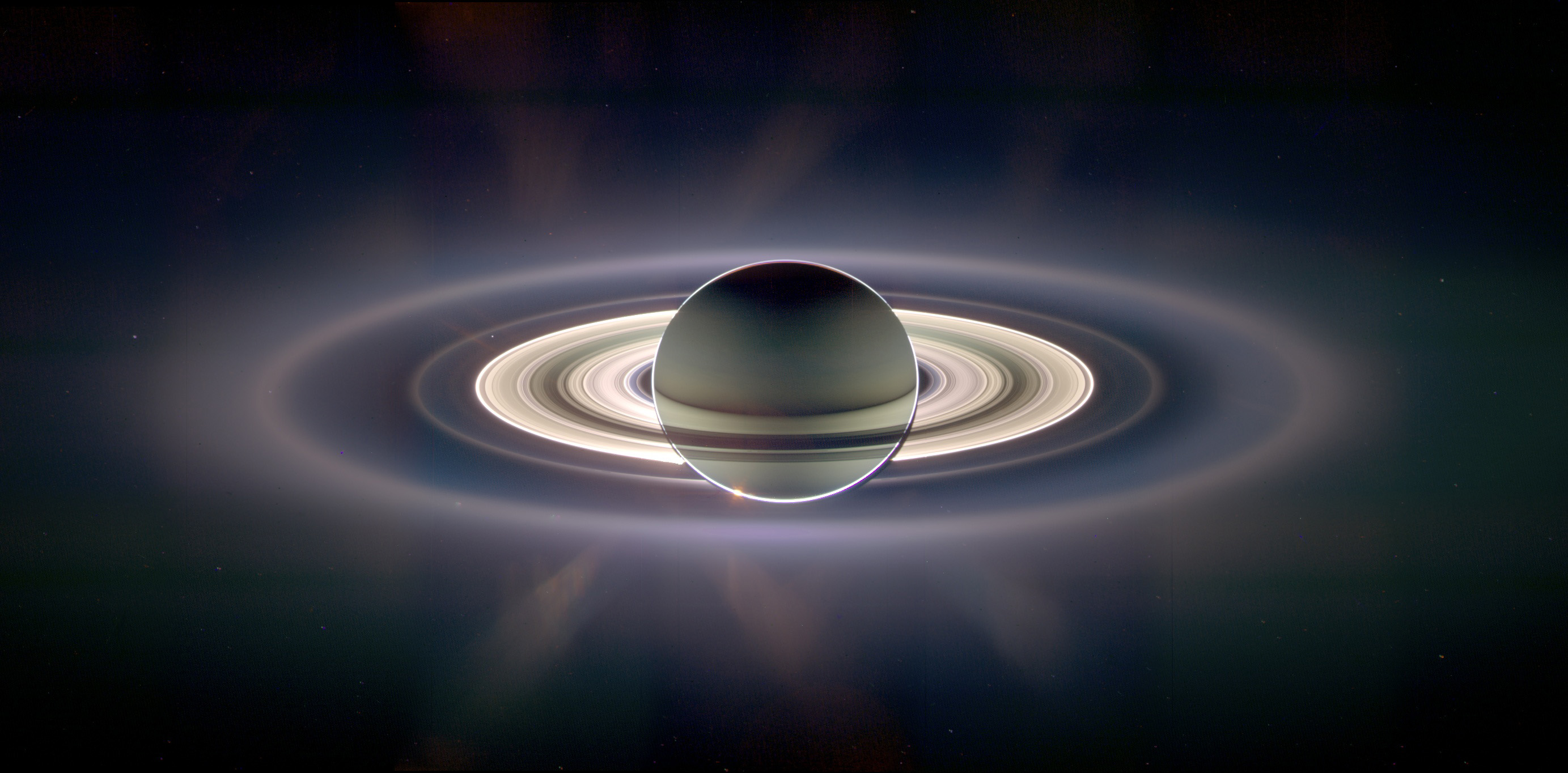
The Cassini spacecraft caught this remarkable photo of Saturn eclipsing the Sun in 2006.
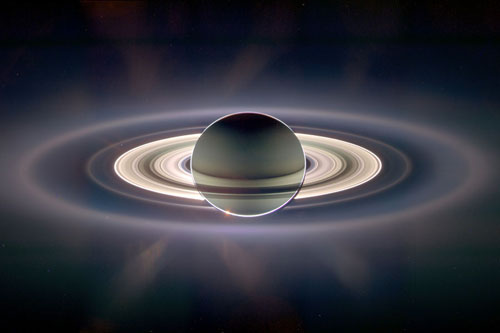
Click through for the big image and the massive image. If you look close can see the Earth in the image, for reals!
The giants of physics (and Morgan Freeman, who can be a giant of anything he wants) explain quantum mechanics using relatively simple terms and autotune.
(via devour)
From late last week, news that NASA’s Mars Reconnaissance Orbiter has found possible evidence that there’s flowing water on Mars.
Dark, finger-like features appear and extend down some Martian slopes during late spring through summer, fade in winter, and return during the next spring. Repeated observations have tracked the seasonal changes in these recurring features on several steep slopes in the middle latitudes of Mars’ southern hemisphere.
“The best explanation for these observations so far is the flow of briny water,” said Alfred McEwen of the University of Arizona, Tucson. McEwen is the principal investigator for the orbiter’s High Resolution Imaging Science Experiment (HiRISE) and lead author of a report about the recurring flows published in Thursday’s edition of the journal Science.
This is a bit of a head-scratcher…the guy behind the Family Guy (Seth MacFarlane) is teaming up with Carl Sagan’s widow and Neil DeGrasse Tyson to do a sequel to the landmark science series, Cosmos. The series will air in primetime on Fox.
The producers of the show say the new series will tell “the story of how human beings began to comprehend the laws of nature and find our place in space and time.” They go on to boast: “It will take viewers to other worlds and travel across the universe for a vision of the cosmos on the grandest scale. The most profound scientific concepts will be presented with stunning clarity, uniting skepticism and wonder, and weaving rigorous science with the emotional and spiritual into a transcendent experience.”
I’ll be tuning in but will be pleasantly surprised if it does well in the ratings or is any good.
Evolutionary biologists are increasingly studying organisms (like mice, fish, and bacteria) in urban areas like New York City to find out how they evolve to urban conditions.
Dr. Munshi-South and his colleagues have been analyzing the DNA of the mice. He’s been surprised to find that the populations of mice in each park are genetically distinct from the mice in others. “The amount of differences you see among populations of mice in the same borough is similar to what you’d see across the whole southeastern United States,” he said.
Using a modified iPhone and a fluorescing nanoparticle tattoo, researchers at Northeastern University have found a way to monitor chemicals in the blood without drawing blood.
The team begins by injecting a solution containing carefully chosen nanoparticles into the skin. This leaves no visible mark, but the nanoparticles will fluoresce when exposed to a target molecule, such as sodium or glucose. A modified iPhone then tracks changes in the level of fluorescence, which indicates the amount of sodium or glucose present. Clark presented this work at the BioMethods Boston conference at Harvard Medical School last week.
The tattoos were originally designed as a way around the finger-prick bloodletting that is the standard technique for measuring glucose levels in those with diabetes. But Clark says they could be used to track many things besides glucose and sodium, offering a simpler, less painful, and more accurate way for many people to track many important biomarkers.
Recent analysis of some Viking bones suggests that women were a significant part of the Viking settlement of England around 900 A.D.
So, the study looked at 14 Viking burials from the era, definable by the Norse grave goods found with them and isotopes found in their bones that reveal their birthplace. The bones were sorted for telltale osteological signs of which gender they belonged to, rather than assuming that burial with a sword or knife denoted a male burial.
Overall, McLeod reports that six of the 14 burials were of women, seven were men, and one was indeterminable. Warlike grave goods may have misled earlier researchers about the gender of Viking invaders, the study suggests. At a mass burial site called Repton Woods, “(d)espite the remains of three swords being recovered from the site, all three burials that could be sexed osteologically were thought to be female, including one with a sword and shield,” says the study.
I’m slowly working my way through Charles Mann’s 1493 and there are interesting tidbits on almost every page. One of my favorite bits of the book so far is a possible explanation of the Little Ice Age that I hadn’t heard before put forth by William Ruddiman.
As human communities grow, Ruddiman pointed out, they open more land for farms and cut down more trees for fuel and shelter. In Europe and Asia, forests were cut down with the ax. In the Americas before [Columbus], the primary tool was fire. For weeks on end, smoke from Indian bonfires shrouded Florida, California, and the Great Plains.
Burning like this happened all over the pre-Columbian Americas, from present-day New England to Mexico to the Amazon basin to Argentina. Then the Europeans came:
Enter now the Columbian Exchange. Eurasian bacteria, viruses, and parasites sweep through the Americas, killing huge numbers of people — and unraveling the millenia-old network of human intervention. Flames subside to embers across the Western Hemisphere as Indian torches are stilled. In the forests, fire-hating trees like oak and hickory muscle aside fire-loving species like loblolly, longleaf, and slash pine, which are so dependent on regular burning that their cones will only open and release seed when exposed to flame. Animals that Indians had hunted, keeping their numbers down, suddenly flourish in great numbers. And so on.
The regular fires and forest regrowth resulted in less carbon dioxide in the atmosphere and the atmosphere traps less heat. It’s like global warming in reverse.
There is evidence that modern humans mating with Neanderthals helped humans spread out of Africa to distant parts of the globe.
While only 6 per cent of the non-African modern human genome comes from other hominins, the share of HLAs acquired during interbreeding is much higher. Half of European HLA-A alleles come from other hominins, says Parham, and that figure rises to 72 per cent for people in China, and over 90 per cent for those in Papua New Guinea.
This suggests they were increasingly selected for as H. sapiens moved east. That could be because humans migrating north would have faced fewer diseases than those heading towards the tropics of south-east Asia, says Chris Stringer of the Natural History Museum in London.
Newer posts
Older posts


Socials & More