kottke.org posts about science
The Jenny McCarthy Body Count site tracks the number of vaccine-preventable illnesses and deaths in the US since June 2007.

In June 2007 Jenny McCarthy began promoting anti-vaccination rhetoric. Because of her celebrity status she has appeared on several television shows and has published multiple books advising parents not to vaccinate their children. This has led to an increase in the number of vaccine preventable illnesses as well as an increase in the number of vaccine preventable deaths.
I hadn’t realized just how much of a nutter McCarthy is…her embrace of pseudoscience runs deep.
Indigo children is a term used to describe children who are believed to possess special, unusual and sometimes supernatural traits or abilities. The term is pseudoscientific. The idea is based on New Age concepts developed in the 1970s by Nancy Ann Tappe and further developed by Jan Tober and Lee Carroll. The concept of indigo children gained popular interest with the publication of a series of books in the late 1990s and the release of several films in the following decade. A variety of books, conferences and related materials have been created surrounding belief in the idea of indigo children and their nature and abilities. The interpretations of these beliefs range from their being the next stage in human evolution, in some cases possessing paranormal abilities such as telepathy, to the belief that they are more empathic and creative than their peers.
I missed this last July when the news came out, but since I’ve been following the Pioneer Anomaly for the past eight years, I wanted to mention it here for closure purposes. First, what the hell is the Pioneer Anomaly?
The Pioneer anomaly or Pioneer effect is the observed deviation from predicted accelerations of the Pioneer 10 and Pioneer 11 spacecraft after they passed about 20 astronomical units (3×10^9 km; 2×10^9 mi) on their trajectories out of the Solar System. Both Pioneer spacecraft are escaping the Solar System, but are slowing under the influence of the Sun’s gravity. Upon very close examination of navigational data, the spacecraft were found to be slowing slightly more than expected. The effect is an extremely small but unexplained acceleration towards the Sun, of 8.74±1.33x10^-10 m/s^2.
A team at JPL has tracked the problem to uneven heat emissions from the probes’ fuel source.
For their new analysis, Turyshev et. al. compiled a lot more data than had ever been analyzed before, spanning a much longer period of the Pioneers’ flight times. They studied 23 years of data from Pioneer 10 instead of just 11, and 11 years of data from Pioneer 11 instead of 3. As explained in their new paper, the more complete data sets reveal that the spacecraft’s anomalous acceleration did indeed seem to decrease with time. In short, the undying force had been dying after all, just like the decaying plutonium.
A more recent paper by the same researchers offers even more support for their theory. Case closed, I say.
Aisha Mustafa, a 19-year-old Egyptian physics student, has invented a promising new quantum propulsion system for spacecraft.
Mustafa invented a way of tapping this quantum effect via what’s known as the dynamic Casimir effect. This uses a “moving mirror” cavity, where two very reflective very flat plates are held close together, and then moved slightly to interact with the quantum particle sea. It’s horribly technical, but the end result is that Mustafa’s use of shaped silicon plates similar to those used in solar power cells results in a net force being delivered. A force, of course, means a push or a pull and in space this equates to a drive or engine.
Soon after the US dropped two nuclear bomb on Japan in 1945, a group of physicists at the University of Pennsylvania decided to investigate for themselves how nuclear fission and the bomb might work using non-classified materials. In doing so, they ventured into classified territory and raised questions about the nature of science and secrecy.
To what degree would nuclear research become shackled by the requirements of national security? Would the open circulation of new scientific knowledge cease if that knowledge was relevant to nuclear fission? Those questions were hardly idle speculation: From the fall of 1945 through the summer of 1946, the US Congress was crafting new, unprecedented legislation that would legally define the bounds of open scientific research and even free speech. The idea of restricting open scientific communication “may seem drastic and far-reaching,” President Harry S. Truman argued in an October 1945 statement exhorting Congress to rapid action. But, he said, the atomic bomb “involves forces of nature too dangerous to fit into any of our usual concepts.”
The former Manhattan Project scientists who founded what would eventually become the Federation of American Scientists were adamantly opposed to keeping nuclear technology a closed field. From early on they argued that there was, as they put it, “no secret to be kept.” Attempting to control the spread of nuclear weapons by controlling scientific information would be fruitless: Soviet scientists were just as capable as US scientists when it came to discovering the truths of the physical world. The best that secrecy could hope to do would be to slightly impede the work of another nuclear power. Whatever time was bought by such impediment, they argued, would come at a steep price in US scientific productivity, because science required open lines of communication to flourish.
At the University of Pennsylvania were nine scientists sympathetic to that message. All had been involved with wartime work, but in the area of radar, not the bomb. Because they had not been part of the Manhattan Project in any way, they were under no legal obligation to maintain secrecy; they were simply informed private citizens. In the fall of 1945, they tried to figure out the technical details behind the bomb.
Dr. Sergio Cittolin has worked at CERN for the past 30 years as a research physicist. He has also made several drawings of the Large Hadron Collider in the style of Leonardo da Vinci.
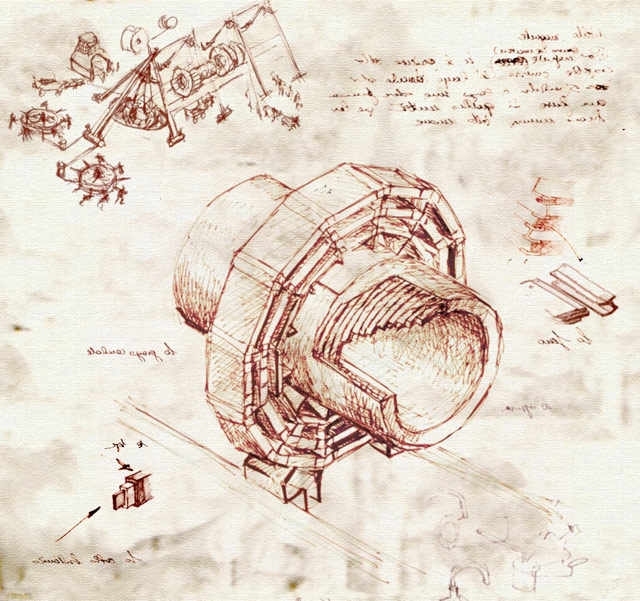
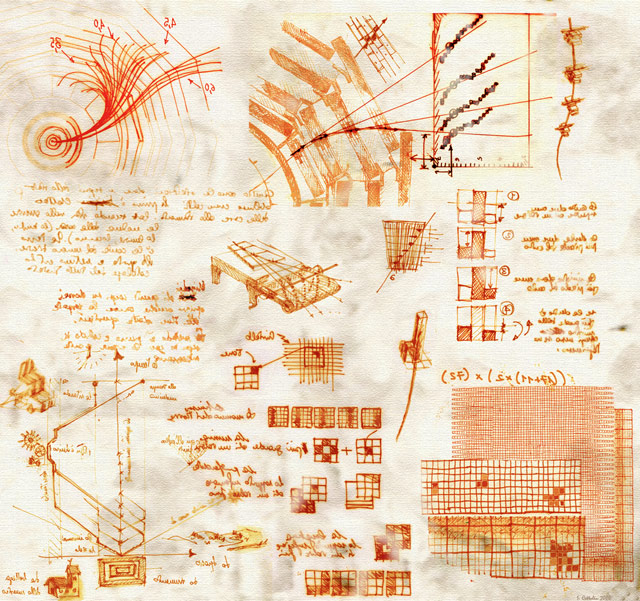
Symmetry magazine profiled Cittolin a few years ago.
As a naturalist, da Vinci probed, prodded, and tested his way to a deeper understanding of how organisms work and why, often dissecting his object of study with this aim. “I thought, why not present the idea of data analysis to the world within the naturalist world of Leonardo?” Cittolin says. In the drawing below, the CMS detector is the organism to be opened; the particles passing through it and the tracks they leave behind are organs exposed for further investigation.
Cittolin brings a sense of humor to his work. For example, after betting CMS colleague Ariella Cattai that he could produce a quality drawing for the cover of the CMS tracker technical proposal by a given deadline, he included in the drawing a secret message in mirror-image writing-which was also a favorite of da Vinci’s. The message jokingly demanded a particular reward for his hard work. The completed picture was delivered on time and within a few hours Cattai cleverly spotted and deciphered the message. She promptly presented him with the requested bottle of wine.
(via ★johnpavlus)
Up until 2007, Kodak operated a small nuclear reactor that contained 3.5 pounds of weapons-grade highly enriched uranium.
The Democrat and Chronicle learned of the facility when an employee happened to mention it to a reporter a few months ago.
The recent silence was by design. Detailed information about nuclear power plants and other entities with radioactive material has been restricted since the 2001 terrorist attacks.
Nuclear non-proliferation experts express surprise that an industrial manufacturer like Eastman Kodak had had weapons-grade uranium, especially in a post-9/11 world.
“I’ve never heard of it at Kodak,” said Miles Pomper, senior research associate at the Center for Nonproliferation Studies in Washington. “It’s such an odd situation because private companies just don’t have this material.”
(via @kdawson)
In studying yogurt’s effects on obesity in mice, a team of MIT scientists discovered several unanticipated results. Basically, yogurt turned these mice into Kanye. Science is weird.

First, the scientists noticed that the yogurt-eating mice were incredibly shiny. Using both traditional histology techniques and cosmetic rating scales, the researchers showed that these animals had 10 times the active follicle density of other mice, resulting in luxuriantly silky fur.
Then the researchers spotted something particular about the males: they projected their testes outward, which endowed them with a certain “mouse swagger,” Erdman says. On measuring the males, they found that the testicles of the yogurt consumers were about 5 percent heavier than those of mice fed typical diets alone and around 15 percent heavier than those of junk-eating males.
More important, that masculinity pays off. In mating experiments, yogurt-eating males inseminated their partners faster and produced more offspring than control mice. Conversely, females that ate the yogurt diets gave birth to larger litters and weaned those pups with greater success. Reflecting on their unpublished results, Erdman and Alm think that the probiotic microbes in the yogurt help to make the animals leaner and healthier, which indirectly improves sexual machismo.
‘Mouse swagger’
Update: Illustration by Chris Piascik.
George Dvorsky details five possible scientific explanations for Westeros’ seasons of unpredictable length. A “wobbly planetary tilt” is one possible reason:
In the episode “The Kingsroad,” we learn that Westeros has at least one moon. It’s very possible, therefore, that they have a very small or distant moon, that is causing a variable tilt in their planet’s rotational axis.
It’s interesting to note that, according to legend, Westeros used to have two moons, but “one wandered too close to the sun and it cracked from the heat” pouring out a thousand thousand dragons. Well, dragons aside, it’s conceivable that some kind of cataclysmic celestial event could have wiped out their second moon, which would have thrown their planet’s rotational axis out of whack.
In a review of the Color Uncovered iPad app, Carl Zimmer highlights something I hadn’t heard before: Claude Monet could see in ultraviolet.
Late in his life, Claude Monet developed cataracts. As his lenses degraded, they blocked parts of the visible spectrum, and the colors he perceived grew muddy. Monet’s cataracts left him struggling to paint; he complained to friends that he felt as if he saw everything in a fog. After years of failed treatments, he agreed at age 82 to have the lens of his left eye completely removed. Light could now stream through the opening unimpeded. Monet could now see familiar colors again. And he could also see colors he had never seen before. Monet began to see — and to paint — in ultraviolet.
The condition is called aphakia.
They appear to be, although not in a way that we think of as intelligence sometimes. Fascinating article.
Octopuses have the largest brains of any invertebrate. Athena’s is the size of a walnut — as big as the brain of the famous African gray parrot, Alex, who learned to use more than one hundred spoken words meaningfully. That’s proportionally bigger than the brains of most of the largest dinosaurs.
Another measure of intelligence: you can count neurons. The common octopus has about 130 million of them in its brain. A human has 100 billion. But this is where things get weird. Three-fifths of an octopus’s neurons are not in the brain; they’re in its arms.
“It is as if each arm has a mind of its own,” says Peter Godfrey-Smith, a diver, professor of philosophy at the Graduate Center of the City University of New York, and an admirer of octopuses. For example, researchers who cut off an octopus’s arm (which the octopus can regrow) discovered that not only does the arm crawl away on its own, but if the arm meets a food item, it seizes it — and tries to pass it to where the mouth would be if the arm were still connected to its body.
“Meeting an octopus,” writes Godfrey-Smith, “is like meeting an intelligent alien.” Their intelligence sometimes even involves changing colors and shapes. One video online shows a mimic octopus alternately morphing into a flatfish, several sea snakes, and a lionfish by changing color, altering the texture of its skin, and shifting the position of its body. Another video shows an octopus materializing from a clump of algae. Its skin exactly matches the algae from which it seems to bloom-until it swims away.
George Dvorsky argues that if we wanted to, humanity could get a Dyson sphere up and running in a few decades.
The Dyson sphere, also referred to as a Dyson shell, is the brainchild of the physicist and astronomer Freeman Dyson. In 1959 he put out a two page paper titled, “Search for Artificial Stellar Sources of Infrared Radiation” in which he described a way for an advanced civilization to utilize all of the energy radiated by their sun. This hypothetical megastructure, as envisaged by Dyson, would be the size of a planetary orbit and consist of a shell of solar collectors (or habitats) around the star. With this model, all (or at least a significant amount) of the energy would hit a receiving surface where it can be used. He speculated that such structures would be the logical consequence of the long-term survival and escalating energy needs of a technological civilization.
Needless to say, the amount of energy that could be extracted in this way is mind-boggling. According to Anders Sandberg, an expert on exploratory engineering, a Dyson sphere in our solar system with a radius of one AU would have a surface area of at least 2.72x10¹⁷ km2, which is around 600 million times the surface area of the Earth. The sun has an energy output of around 4x1026 W, of which most would be available to do useful work.
The downside: we’d have to part with Mercury to do it.
And yes, you read that right: we’re going to have to mine materials from Mercury. Actually, we’ll likely have to take the whole planet apart. The Dyson sphere will require a horrendous amount of material-so much so, in fact, that, should we want to completely envelope the sun, we are going to have to disassemble not just Mercury, but Venus, some of the outer planets, and any nearby asteroids as well.
At Forbes, Alex Knapp explains why Dvorsky’s scheme and timeline might not work.
I emailed Astronomer Phil Plait about this project, who told me in no uncertain terms that the project doesn’t make sense.
“Dismantling Mercury, just to start, will take 2 x 10^30 Joules, or an amount of energy 100 billion times the US annual energy consumption,” he said. “[Dvorsky] kinda glosses over that point. And how long until his solar collectors gather that much energy back, and we’re in the black?”
Now available in its entirety on YouTube, a 95-minute documentary on physicist Richard Feynman called No Ordinary Genius.
The excellent film on Andrew Wiles’ search for the solution to Fermat’s Last Theorem is available as well (watch the first two minutes and you’ll be hooked).
A pair of recent info visualizations look as though they were painted by Vincent van Gogh. Wind Map shows the realtime flow of wind over the United States.

Perpetual Ocean is a NASA animation of ocean currents around the world.
Would be cool to see both of these rendered through Stamen’s watercolor filter.
With their ability to move seamlessly through walls, rocks, lead shielding, and entire planets, neutrinos would seem like a great choice for a new method of wireless communication. Scientists at Fermilab have demonstrated sending messages via neutrino but the downside is that the slippery particles can also move seamlessly through detectors.
In the Fermilab experiment, the physicists fired a proton beam into a carbon target to produce a shower of particles called pions and kaons that quickly decay into neutrinos. For every pulse of 22.5 trillion protons, the physicists registered an average of 0.81 neutrino with the 170-ton MINERvA detector.
That translates into a data rate of 0.1 bits/second, or just slightly faster than America Online’s dialup service circa 1992. (Hey, hey, if you liked that one, perhaps you’ll also enjoy my impression of Dana Carvey doing George H.W. Bush.)
The VISTA telescope in Chile recently took a photo of the sky that contains over 200,000 galaxies. For reference, the Hubble Ultra-Deep Field image shows only about 10,000 galaxies (but sees further back in time, I think).
I’ve spent years studying all this, and it still sometimes gets to me: just how flipping BIG the Universe is! And this picture is still just a tiny piece of it: it’s 1.2 x 1.5 degrees in size, which means it’s only 0.004% of the sky! And it’s not even complete: more observations of this region are planned, allowing astronomers to see even deeper yet.
Here’s a full view of the image that looks sorta unimpressive:

You can download the original 17,000 x 11,000 pixel image here (250 Mb, yo) for the full effect. As a preview, this is several levels of zoom in…just a tiny part of the full image.

Birds can detect the magnetic field of the Earth, which gives them an incredible sense of direction. Curiously, this sense of direction doesn’t work in darkness. This led scientists to discover that some birds can actually see the directions overlaid on their normal vision, like a heads-up display.
According to the new model, when a photon of light from the Sun is absorbed by a special molecule in the bird’s eye, it can cause an electron to be kicked from its normal state into an alternative location a few nanometres away. Until the electron eventually relaxes back, it creates an ‘electric dipole field’ which can augment the bird’s vision - for example altering colours or brightness.
Crucially, the alignment of the molecule compared to the Earth’s magnetic field controls the time it takes for the electron to relax back, and so controls the strength of the effect on the bird’s vision.
There are many such molecules spread throughout the eye, with different orientations. So from the patterns on top of its vision, and the change of these patterns as it moves its head, the bird learns about the direction of Earth’s magnetic field.
(via @daveg)
The NY Times is reporting that a data bump “smells like the Higgs boson”. The odor is emanating not from CERN in Europe but from Fermilab near Chicago, where their Tevatron still flings some pretty fast particles.
“Based on the current Tevatron data and results compiled through December 2011 by other experiments, this is the strongest hint of the existence of a Higgs boson,” said the report, which will be presented on Wednesday by Wade Fisher of Michigan State University to a physics conference in La Thuile, Italy.
None of these results, either singly or collectively, are strong enough for scientists to claim victory. But the recent run of reports has encouraged them to think that the elusive particle, which is the key to mass and diversity in the universe, is within sight, perhaps as soon as this summer.
Update: The Tevatron is no longer flinging, having been shut down in 2011 due to budget cuts. Which makes the Higgs discovery a little bittersweet, to say the least. (thx, miles)
Remember those time traveling neutrinos that they found in Italy? It is likely that a faulty connection between the GPS and the computer collecting data is to blame for the time travel illusion.
According to sources familiar with the experiment, the 60 nanoseconds discrepancy appears to come from a bad connection between a fiber optic cable that connects to the GPS receiver used to correct the timing of the neutrinos’ flight and an electronic card in a computer. After tightening the connection and then measuring the time it takes data to travel the length of the fiber, researchers found that the data arrive 60 nanoseconds earlier than assumed.
Neutrinos? More like Nintendo…they forgot to blow in the cartridge. (via @tcarmody)
There is increasing evidence that a parasite called Toxoplasma gondii, which many humans have gotten from cat feces, can rewire our brains and modify human behavior in unexpected ways.
The parasite, which is excreted by cats in their feces, is called Toxoplasma gondii (T. gondii or Toxo for short) and is the microbe that causes toxoplasmosis-the reason pregnant women are told to avoid cats’ litter boxes. Since the 1920s, doctors have recognized that a woman who becomes infected during pregnancy can transmit the disease to the fetus, in some cases resulting in severe brain damage or death. T. gondii is also a major threat to people with weakened immunity: in the early days of the AIDS epidemic, before good antiretroviral drugs were developed, it was to blame for the dementia that afflicted many patients at the disease’s end stage. Healthy children and adults, however, usually experience nothing worse than brief flu-like symptoms before quickly fighting off the protozoan, which thereafter lies dormant inside brain cells-or at least that’s the standard medical wisdom.
But if Flegr is right, the “latent” parasite may be quietly tweaking the connections between our neurons, changing our response to frightening situations, our trust in others, how outgoing we are, and even our preference for certain scents. And that’s not all. He also believes that the organism contributes to car crashes, suicides, and mental disorders such as schizophrenia. When you add up all the different ways it can harm us, says Flegr, “Toxoplasma might even kill as many people as malaria, or at least a million people a year.”
The Scale of the Universe 2 is an interactive Powers of Ten that takes you from the Planck length all the way up to the size of the observable Universe. That’s more than 60 orders of magnitude! Also interesting that the smallest things (Planck length, strings, branes) are millions of times smaller compared to human scale than the observable Universe is larger. Plenty of room at the bottom indeed.
In this transcript of a talk given to the attendees of the Joint Summits on Translational Science, Carl Zimmer highlights an important aspect of understanding the human body and how to treat its many maladies: the ecosystem of microbes.
The microbes in your body at this moment outnumber your cells by ten to one. And they come in a huge diversity of species — somewhere in the thousands, although no one has a precise count yet. By some estimates there are twenty million microbial genes in your body: about a thousand times more than the 20,000 protein-coding genes in the human genome. So the Human Genome Project was, at best, a nice start. If we really want to understand all the genes in the human body, we have a long way to go.
Now you could say “Who cares? They’re just wee animalcules.” Those wee animacules are worth caring about for many reasons. One of the most practical of those reasons is that they have a huge impact on our “own” health. Our collection of microbes-the microbiome-is like an extra organ of the human body. And while an organ like the heart has only one function, the microbiome has many.
When food comes into the gut, for example, microbes break some of them down using enzymes we lack. Sometimes the microbes and our own cells have an intimate volley, in which bacteria break down a molecule part way, our cells break it down some more, the bacteria break it down even more, and then finally we get something to eat.
Another thing that the microbiome does is manage the immune system. Certain species of resident bacteria, like Bacteroides fragilis, produce proteins that tamp down inflammation. When scientists rear mice that don’t have any germs at all, they have a very difficult time developing a normal immune system. The microbiome has to tutor the immune system in how to do its job properly. It also acts like an immune system of its own, fighting off invading microbes, and helping to heal wounds.
While the microbiome may be an important organ, it’s a peculiar one. It’s not one solid hunk of flesh. It’s an ecosystem, made up of thousands of interacting species.
Scott Carpenter was one of the original seven Mercury astronauts and the second American to orbit the Earth. Just before he went into space, his father wrote this wonderful letter.
And I venture to predict that after all the huzzas have been uttered and the public acclaim is but a memory, you will derive the greatest satisfaction from the serene knowledge that you have discovered new truths. You can say to yourself: this I saw, this I experienced, this I know to be the truth. This experience is a precious thing; it is known to all researchers, in whatever field of endeavour, who have ventured into the unknown and have discovered new truths.
I don’t know if the nudie playing cards are absolutely essential, but this trick is pretty neat.
(via @itscolossal)
The standard measure for the kilogram needs to change because, offically speaking, the universe is gaining mass. The trick is finding a technique that ties the kilogram to a fundamental constant (like the second is tied to energy transition times in cesium atoms).
Familiarly known as Le Grand K and held in a vault just outside of Paris under three bell jars, [the international prototype kilogram] dates back to the 1880s, when it was forged by the British metallurgist George Matthey from an alloy of nine-tenths platinum and one-tenth iridium. As a metric unit, the kilogram is “equal to the mass of the international prototype,” according to the official definition. In other words, as metrologists like to point out, it has the remarkable property of never gaining or losing mass. By definition, any physical change to it alters the mass of everything in the cosmos.
Aside from a yearly ceremonial peek inside its vault, which can be unlocked only with three keys held by three different officials, the prototype goes unmolested for decades. Yet every 40 years or so, protocol requires that it be washed with alcohol, dried with a chamois cloth, given a steam bath, allowed to air dry, and then weighed against the freshly scrubbed national standards, all transported to France. It is also compared to six temoins (witnesses), nominally identical cylinders that are stored in the vault alongside the prototype. The instruments used to make these comparisons are phenomenally precise, capable of measuring differences of 0.0000001 percent, or one part in 1 billion. But comparisons since the 1940s have revealed a troublesome drift. Relative to the t’emoins and to the national standards, Le Grand K has been losing weight — or, by the definition of mass under the metric system, the rest of the universe has been getting fatter. The most recent comparison, in 1988, found a discrepancy as large as five-hundredths of a milligram, a bit less than the weight of a dust speck, between Le Grand K and its official underlings.
The sound and picture are poor, but the entirety of Errol Morris’ A Brief History of Time is available on YouTube.
Featuring music from Philip Glass, the film is a documentary about Stephen Hawking and his ideas about the universe. Morris recently stated on Twitter:
Yes. I plan to re-release [A Brief History of Time]. (It was never properly color corrected and is one of my best films.)
The film is difficult, if not impossible, to find on DVD and isn’t available on Netflix, Amazon Instant Video, or iTunes. And as far as I can tell, the soundtrack was never released either.
During pregnancy, the mother and fetus exchange cells and some of those cells can live on forever in the two bodies after the child is born.
During pregnancy, cells sneak across the placenta in both directions. The fetus’s cells enter his mother, and the mother’s cells enter the fetus. A baby’s cells are detectable in his mother’s bloodstream as early as four weeks after conception, and a mother’s cells are detectable in her fetus by week 13. In the first trimester, one out of every fifty thousand cells in her body are from her baby-to-be (this is how some noninvasive prenatal tests check for genetic disorders). In the second and third trimesters, the count is up to one out of every thousand maternal cells. At the end of the pregnancy, up to 6 percent of the DNA in a pregnant woman’s blood plasma comes from the fetus. After birth, the mother’s fetal cell count plummets, but some stick around for the long haul. Those lingerers create their own lineages. Imagine colonies in the motherland.
Moms usually tolerate the invasion. This is why skin, organ, and bone marrow transplants between mother and child have a much higher success rate than between father and child.
Whoa.
The quantum levitation videos I showed you a couple months ago are pretty cool, but scientists scienticiens at the Japan Institute of Science and Technology have upped the game by using QL CGI to build a real-world Wipeout track.
Say it with me: science!! Also, do Rainbow Road next! (via ★interesting)
Update: Say it with me: advertising! Or some other such nonsense. Several people have alerted me that this video is a fake…you can see vapor trails passing through walls, etc. Boo. Boo-urns. (thx, all)
From New Scientist, a list of eight different ways to lose weight that actually work. Because science!
If your idea of a holiday workout is lifting glasses of beer late into the night, then it’s not just the extra calories you need to worry about. Randy Nelson and his team at Ohio State University in Columbus found that mice exposed to light at night weighed 10 per cent more at the end of the eight-week study than mice that had experienced a standard light/dark cycle, even though they ate the same total number of calories and did the same amount of exercise.
(via @daveg)
A thick black fungus growing near a whiskey distillery warehouse in Ontario prompted mycologist James Scott to track the fungus all the way back to its discovery in France in 1881.
When he arrived at the warehouse, the first thing he noticed (after “the beautiful, sweet, mellow smell of aging Canadian whiskey,” he says) was the black stuff. It was everywhere — on the walls of buildings, on chain-link fences, on metal street signs, as if a battalion of Dickensian chimney sweeps had careened through town. “In the back of the property, there was an old stainless steel fermenter tank,” Scott says. “It was lying on its side, and it had this fungus growing all over it. Stainless steel!” The whole point of stainless steel is that things don’t grow on it.
If you drop a bunch of neodymium magnets down through a thick-walled copper pipe, an effect called eddy current braking will slow the magnets’ fall even though there’s no direct magnetic attraction between the copper and the magnets.
Science! (via make)
Newer posts
Older posts





Socials & More