kottke.org posts about science
Researchers in Germany have found evidence of room temperature superconductivity in graphite powder that has been soaking in water and then dried. Not surprisingly, the results come with a few caveats:
First, this is not a conventional bulk material. The claim from Germany is that the superconductivity occurs at the interface between grains of graphite after they have dried out.
So that’s a surface effect which involves only a tiny fraction of the total mass of carbon in the powder—just 0.0001 per cent of the mass, according to Esquinazi and co.
What’s more the effect is clearly fragile. Esquinazi and co say the superconductivity disappears if the treated powder is pressed into pellets.
So whatever allows the superconductivity to occur at the grain interfaces is destroyed when the grains are pressed together.
I’m pretty sure this is the technology used by the aliens who designed The Machine in Contact.
Writing for Slate, Daniel Engber takes a closer look at the magic cooling glove and finds some (but not a lot of) evidence that the thing actually works as advertised.
The study, which aggregates results from a decade’s worth of experiments, found that “palm cooling” helped people do 144 percent more pull-ups than they did before, on average. A closer look reveals that the effect might not be so beefy as it looks, however. That figure comes from testing just a handful of people in the lab-even after 10 years of research-and it has some honking error bars (+/-83 percent). To put it in perspective: Before the palm-cooled training, their scores ranged from 70 to 153 pull-ups in each session; after training, they ranged from 70 to 616.
Nanocrystalline cellulose is made from wood pulp, is light, strong, and even conducts electricity.
So why all the fuss? Well, not only is NCC transparent but it is made from a tightly packed array of needle-like crystals which have a strength-to-weight ratio that is eight times better than stainless steel. Even better, it’s incredibly cheap.
“It is the natural, renewable version of a carbon nanotube at a fraction of the price,” says Jeff Youngblood of Purdue University’s NanoForestry Institute in West Lafayette, Indiana.
In partnership with sciencedebate.org, Scientific American asked both major party candidates to answer questions about the important scientific questions of the day. Here are the results.
I am not a scientist myself, but my best assessment of the data is that the world is getting warmer, that human activity contributes to that warming, and that policymakers should therefore consider the risk of negative consequences. However, there remains a lack of scientific consensus on the issue — on the extent of the warming, the extent of the human contribution, and the severity of the risk — and I believe we must support continued debate and investigation within the scientific community.
Leveraging the high number of specialized heat-transfer veins in the palm of the human hand, researchers at Stanford have developed a thermal exchange glove that is able to cool a person’s core temperature in a matter of minutes. Turns out this is helpful for athletes.
The glove’s effects on athletic performance didn’t become apparent until the researchers began using the glove to cool a member of the lab — the confessed “gym rat” and frequent coauthor Vinh Cao — between sets of pull-ups. The glove seemed to nearly erase his muscle fatigue; after multiple rounds, cooling allowed him to do just as many pull-ups as he did the first time around. So the researchers started cooling him after every other set of pull-ups.
“Then in the next six weeks he went from doing 180 pull-ups total to over 620,” said Heller. “That was a rate of physical performance improvement that was just unprecedented.”
The researchers applied the cooling method to other types of exercise — bench press, running, cycling. In every case, rates of gain in recovery were dramatic, without any evidence of the body being damaged by overwork - hence the “better than steroids” claim.
The cooling resets a temperature-sensitive enzyme that muscles need to generate energy, “essentially resetting the muscle’s state of fatigue”. I expect this will be either everywhere in pro sports in a couple of years or banned. (via @jsnell)
The crazy (and possibly high) folks at Backyard Brains hooked an iPod up to a squid in such a way that when the music played, it was converted into electrical impulses that triggered color changes on the squid’s skin, thereby creating the world’s first cephalo-iPod. Here’s a video of the squid’s skin pulsing along to Insane in the Membrane by Cypress Hill:
During experiments on the giant axons of the Longfin Inshore Squid (loligo pealei) at the Marine Biological Laboratory in Woods Hole, MA; we were fascinated by the fast color-changing nature of the squid’s skin. Squids (like many other cephalopods) can quickly control pigmented cells called chromatophores to reflect light. The Longfin Inshore has 3 different chromatophore colors: Brown, Red, and Yellow. Each chromatophore has tiny muscles along the circumference of the cell that can contract to reveal the pigment underneath.
(via colossal)
Opening on September 15 at Edward Tufte’s gallery in Chelsea is All Possible Photons, an exhibit of sculptures by Tufte of Richard Feynman’s subatomic particle diagrams.
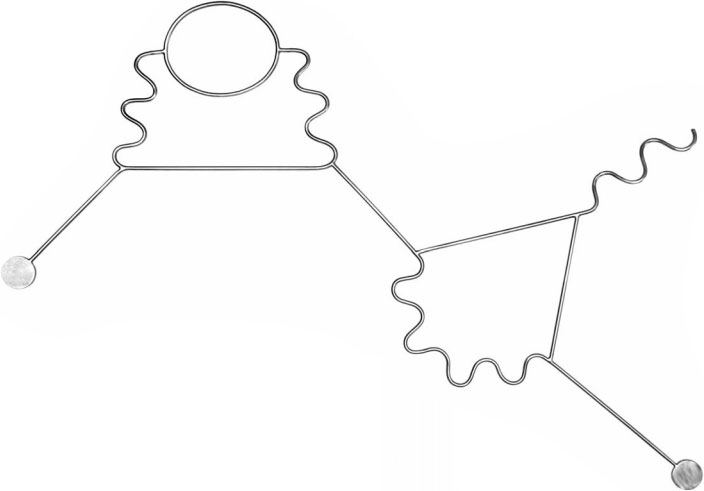
Made from stainless steel and air, the artworks grow out of Richard Feynman’s famous diagrams describing Nature’s subatomic behavior. Feynman diagrams depict the space-time patterns of particles and waves of quantum electrodynamics. These mathematically derived and empirically verified visualizations represent the space-time paths taken by all subatomic particles in the universe.
The resulting conceptual and cognitive art is both beautiful and true. Along with their art, the stainless steel elements of All Possible Photons actually represent something: the precise activities of Nature at her highest resolution.
Using just the camera on your iPhone, the Cardiio app can accurately measure your heart rate. Here’s how it works:
Every time your heart beats, more blood is pumped into your face. This slight increase in blood volume causes more light to be absorbed, and hence less light is reflected from your face. Using sophisticated software, your iPhone’s front camera can track these tiny changes in reflected light that are not visible to the human eye and calculate your heart beat!
This video shows this process in action (with a short explanatory intro of the mathematical technique):
That is flat-out amazing. (via @delfuego)
Where have I seen this before, a massive long-lasting Arctic storm that looks a lot like a hurricane? Oh right, The Day After Tomorrow.
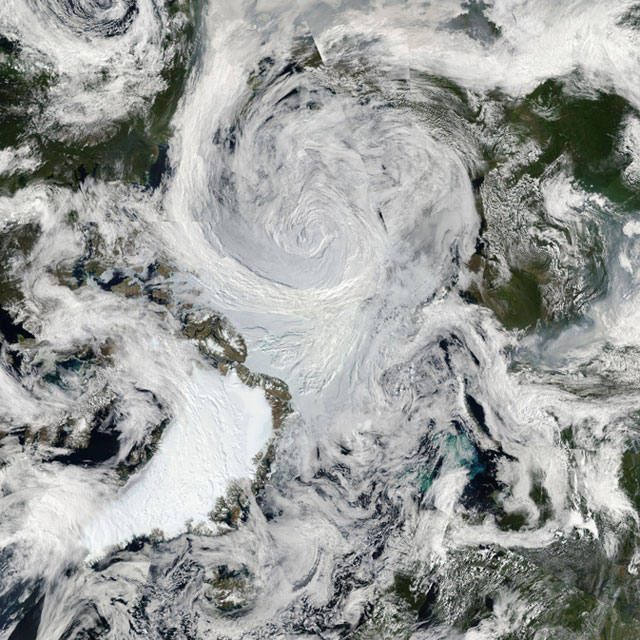
The storm had an unusually low central pressure area. Paul A. Newman, chief scientist for Atmospheric Sciences at NASA’s Goddard Space Flight Center in Greenbelt, Md., estimates that there have only been about eight storms of similar strength during the month of August in the last 34 years of satellite records. “It’s an uncommon event, especially because it’s occurring in the summer. Polar lows are more usual in the winter,” Newman said.
Arctic storms such as this one can have a large impact on the sea ice, causing it to melt rapidly through many mechanisms, such as tearing off large swaths of ice and pushing them to warmer sites, churning the ice and making it slushier, or lifting warmer waters from the depths of the Arctic Ocean.
I love The Day After Tomorrow. I know it’s a cheeseball disaster movie (which is pretty much why I love it) but it’s also looking more than a little prescient. Well, as prescient as a cheeseball disaster movie can be anyway. In the Washington Post the other day, prominent climatologist James Hansen wrote that human-driven climate change is responsible for an increase in extreme weather.
My projections about increasing global temperature have been proved true. But I failed to fully explore how quickly that average rise would drive an increase in extreme weather.
In a new analysis of the past six decades of global temperatures, which will be published Monday, my colleagues and I have revealed a stunning increase in the frequency of extremely hot summers, with deeply troubling ramifications for not only our future but also for our present.
This is not a climate model or a prediction but actual observations of weather events and temperatures that have happened. Our analysis shows that it is no longer enough to say that global warming will increase the likelihood of extreme weather and to repeat the caveat that no individual weather event can be directly linked to climate change. To the contrary, our analysis shows that, for the extreme hot weather of the recent past, there is virtually no explanation other than climate change.
In many ways, the phrase “global warming” is grossly misleading. “Oh,” we think, “it’s gonna be a couple degrees warmer in NYC in 20 years than it is now.” But the Earth’s climate is a chaotic non-linear system, which means that a sudden shift of a degree or two — and when you’re talking about something as big as the Earth, a degree over several decades is sudden — pushes things out of balance here and there in unpredictable ways. So it’s not just that it’s getting hotter, it’s that you’ve got droughts in places where you didn’t have them before, severe floods in other places, unusually hot summers, and even places that are cooler than normal, all of which disrupts the animal and plant life that won’t be able to acclimate to the new reality fast enough.
But pretty Arctic cyclone though, right?
The main imaging cameras on the Mars Curiosity rover have only 2-megapixel sensors with 8 GB of flash memory — compare that to a maxed-out iPhone 4S with an 8-megapixel sensor and 64 GB of flash memory (not to mention 30-fps 1080p video). Planning timeframes and communications bandwidth contributed to the chosen camera size.
‘There’s a popular belief that projects like this are going to be very advanced but there are things that mitigate against that. These designs were proposed in 2004, and you don’t get to propose one specification and then go off and develop something else. 2MP with 8GB of flash [memory] didn’t sound too bad in 2004. But it doesn’t compare well to what you get in an iPhone today.’
The cameras were also supposed to be outfitted with zoom lenses but that part of the project was scrapped.
In this slow-motion video, you can see how cats rotate themselves in the air while conserving angular momentum.
This is an interesting companion to yesterday’s owl rotation video. (via @stevenstrogatz)
On Twitter right now, Neil deGrasse Tyson is imagining how various Olympic events would work on Mars.
Women’s Beach Volleyball on Mars: No protective ozone layer there. Solar UV would irradiate all exposed legs, buns, & tummies
Gymnastics: On Mars, with only 38% of Earth’s gravity, the Vault & other spring-assisted leaps would resemble circus cannons.
(via @jaycer17)
The rest of you can have your Olympics, but the early August event I’m most looking forward to is the arrival on Mars of the Curiosity rover. But NASA has had some problems in the past delivering payloads to Mars, so this is going to be somewhat of a nail-biter. If you haven’t seen it, Curiosity’s Seven Minutes of Terror is well worth watching to see the logistical challenge of getting the rover down to the surface.
Curiosity will hopefully land on the surface on Aug 6 at about 1:30 am ET.
Three people are HIV-free due to bone marrow transplants and that’s providing scientists with hope for a possible AIDS cure.
AIDS patients are susceptible to cancers, but they usually stop taking HIV drugs before receiving cancer treatment. “That allows the virus to come back and it infects their donor cells,” Kuritzkes said.
About 34 million people are infected with HIV, the virus that causes AIDS, globally; 25 million have died from it. While there’s no vaccine, cocktails of powerful antiviral drugs called antiretroviral therapy (ART) can keep the virus suppressed and keep patients healthy. No matter how long patients take ART, however, they are never cured. The virus lurks in the body and comes back if the drugs are stopped. Scientists want to flush out these so-called reservoirs and find a way to kill the virus for good.
Brown, and now these two other men, offer some real hope.
Dr. Timothy Henrich and colleagues at Brigham and Women’s Hospital launched a search about a year ago for HIV patients with leukemia or lymphoma who had received bone marrow stem cell transplants. Bone marrow is the body’s source of immune system cells that HIV infects and it’s a likely place to look for HIV’s reservoirs.
“If you took an HIV patient getting treated for various cancers, you can check the effect on the viral reservoirs of various cancer treatments,” Kuritzkes, who works with Henrich, said. They found the two patients by asking colleagues at Dana-Farber Cancer Institute in Boston which, like Brigham and Women’s, is associated with Harvard Medical School.
Both men had endured multiple rounds of treatment for lymphoma, both had stem cell treatments and both had stayed on their HIV drugs throughout. “They went through the transplants on therapy,” Kuritzkes said.
It turns out that was key.
“We found that immediately before the transplant and after the transplant, HIV DNA was in the cells. As the patients’ cells were replaced by the donor cells, the HIV DNA disappeared,” Kuritzkes said. The donor cells, it appears, killed off and replaced the infected cells. And the HIV drugs protected the donor cells while they did it.
The two men have been HIV-free for two years and three-and-a-half years, respectively. Another man who benefited from a bone marrow transplant from a donor whose immune cells resist HIV infection has been free of HIV for five years. (via @gavinpurcell)
Ignoring the prequels (of course), how much power does Yoda put out when he’s using the Force? It’s perhaps less than you’d realize.
Yoda’s greatest display of raw power in the original trilogy came when he lifted Luke’s X-Wing from the swamp. As far as physically moving objects around goes, this was easily the biggest expenditure of energy through the Force we saw from anyone in the trilogy.
The energy it takes to lift an object to height h is equal to the object’s mass times the force of gravity times the height it’s lifted. The X-Wing scene lets us use this to put a lower limit on Yoda’s peak power output.
First we need to know how heavy the ship was. The X-Wing’s mass has never been canonically established, but its length has-16 meters. An F-22 is 19 meters long and weighs 19,700 lbs, so scaling down from this gives an estimate for the X-Wing of about 12,000 lbs (5 metric tons).
The Apollo 11 Lunar Module landed on the surface of the Moon 43 years ago today. For the 40th anniversary of the landing in 2009, I put together a page where you can watch the original CBS News coverage of Walter Cronkite reporting on the Moon landing and the first Moon walk, synced to the present-day time. I’ve updated the page to work again this year: just open this page in your browser and the coverage will start playing at the proper time. Here’s the schedule:
Moon landing broacast start: 4:10:30 pm EDT on July 20
Moon landing shown: 4:17:40 pm EDT
Moon landing broadcast end: 4:20:15 pm EDT
{break}
Moon walk broadcast start: 10:51:27 pm EDT
First step on Moon: 10:56:15 pm EDT
Nixon speaks to the Eagle crew: approx 11:51:30 pm EDT
Moon walk broadcast end: 12:00:30 pm EDT on July 21
Here’s a post I wrote when I launched the project.
If you’ve never seen this coverage, I urge you to watch at least the landing segment (~10 min.) and the first 10-20 minutes of the Moon walk. I hope that with the old time TV display and poor YouTube quality, you get a small sense of how someone 40 years ago might have experienced it. I’ve watched the whole thing a couple of times while putting this together and I’m struck by two things: 1) how it’s almost more amazing that hundreds of millions of people watched the first Moon walk *live* on TV than it is that they got to the Moon in the first place, and 2) that pretty much the sole purpose of the Apollo 11 Moon walk was to photograph it and broadcast it live back to Earth.
Thanks to Dave Schumaker for the reminder.
A team in Boston is working on a method for injecting oxygen straight into a person’s bloodstream, which is faster than the more traditional method (you know, breathing).
Researchers led by Harvard Medical School’s John N. Kheir engineered tiny, gas-filled microparticles, which were about three micrometers in size and invisible to the naked eye. They used a device called a sonicator, which uses high-intensity sound waves, to produce a foamy liquid solution with microparticles that consist of a single layer of lipids that trap a tiny pocket of oxygen gas. They then injected the resulting mixture directly into the bloodstream of rabbits that were severely oxygen-deprived.
Within seconds, infusions of the microparticles restored the blood oxygen saturation of these mammals to near-normal levels. When the rabbits’ windpipes were completely blocked, the solution kept them alive for 15 minutes without a single breath and reduced the likelihood of cardiac arrest and organ injury.
More here and here.
XKCD is answering “hypothetical questions with physics” once a week and the first installment is just flat-out delightful: What would happen if you tried to hit a baseball pitched at 90% the speed of light?
The ideas of aerodynamics don’t apply here. Normally, air would flow around anything moving through it. But the air molecules in front of this ball don’t have time to be jostled out of the way. The ball smacks into them hard that the atoms in the air molecules actually fuse with the atoms in the ball’s surface. Each collision releases a burst of gamma rays and scattered particles.
These gamma rays and debris expand outward in a bubble centered on the pitcher’s mound. They start to tear apart the molecules in the air, ripping the electrons from the nuclei and turning the air in the stadium into an expanding bubble of incandescent plasma. The wall of this bubble approaches the batter at about the speed of light-only slightly ahead of the ball itself.
All science writing should (and probably could!) be this entertaining. (via @delfuego)
From a collection of his papers recently acquired by The Library of Congress, a 1954 reading list from physicist Carl Sagan. Huxley, Plato, Shakespeare, and the Bible are all on there among many others. If I understand mathematics properly, and I think I do, using the associative property, if you read all these books, you will become as smart and cool as Carl Sagan was. Or is it the transitive property?
Frazil ice is a Slushee-like mixture of ice and supercooled water that behaves a lot like lava or flowing cement. Here’s a short video about frazil ice in Yosemite…it starts off a bit slow but gets good around 1:30.
Motherboard journeyed out onto the streets of Williamsburg to see if the hipster on the street knew what the Higgs boson was. And he/she did not.
If you’re in that same boat, take a few minutes to learn about what the Higgs is. (via @alexismadrigal)
Or, to put it in the cautious words of science, researchers have observed a “particle consistent with long-sought Higgs boson”.
“We observe in our data clear signs of a new particle, at the level of 5 sigma, in the mass region around 126 GeV. The outstanding performance of the LHC and ATLAS and the huge efforts of many people have brought us to this exciting stage,” said ATLAS experiment spokesperson Fabiola Gianotti, “but a little more time is needed to prepare these results for publication.”
“The results are preliminary but the 5 sigma signal at around 125 GeV we’re seeing is dramatic. This is indeed a new particle. We know it must be a boson and it’s the heaviest boson ever found,” said CMS experiment spokesperson Joe Incandela. “The implications are very significant and it is precisely for this reason that we must be extremely diligent in all of our studies and cross-checks.”
How sure are they that they’ve found the Higgs? Brian Cox notes on Twitter:
5 sigma is the usual particle physics threshold for discovery. It roughly means that you’re 99.9999% sure
Sam Arbesman has turned his mesofacts concept into an upcoming book called The Half-Life of Facts.
Facts change all the time. The age at which women should get a mammogram has increased. Smoking has gone from doctor recommended to deadly while the healthiness of carbs and fat seems to be in constant flux. We used to think the Earth was the center of the universe, that Pluto was a planet, and that the brontosaurus was a real dinosaur. What we know about the world is constantly changing.
Samuel Arbesman is an expert in scientometrics, literally the science of science-how we know what we know. It turns out that knowledge in most fields evolves in systematic and predictable ways, and understanding that evolution can be enormously powerful. For instance, knowing how different branches of medicine overturn their bodies of knowledge can improve the way we train (and retrain) physicians.
The Half-Life of Facts features fascinating examples from fields as diverse as technology and literature. It will help us find new ways to measure the world while accepting the limits of how much we can know with certainty.
Back in 1999, as he prepared to make a movie called The Minority Report, Steven Spielberg gathered top science and technology types to an “idea summit” where they would share thoughts on what things might look like in 50 years. To mark the ten year anniversary of the movie’s release, Wired asked a dozen of the summit attendees to reflect on the experience. According to one participant: “There was no shortage of megalomania, although there was good reason for it.”
In this series of slow motion clips, you can see that if you hold a Slinky by one end and drop it, the bottom end doesn’t actually move until the top end catches up with it.
I’ve watched this like six times and it drops my jaw every time…the bottom of the Slinky JUST. DOES. NOT. MOVE. Here’s the scientific explanation:
The explanation that “it takes time for the bottom of the slinky to feel the change” might work ok, but it isn’t the best.
Then why doesn’t the bottom of the slinky fall as the top is let go? I think the best thing is to think of the slinky as a system. When it is let get, the center of mass certainly accelerates downward (like any falling object). However, at the same time, the slinky (spring) is compressing to its relaxed length. This means that top and bottom are accelerating towards the center of mass of the slinky at the same time the center of mass is accelerating downward.
(via @stevenstrogatz)
Update: See also The Physics of a Falling Slinky. (via @jeffhellman)
When they were launched in 1977, the two Voyager spacecraft each carried with them a 12-inch gold-plated copper record containing multimedia pertaining to life on Earth, the idea being that if an extraterrestrial ran across one of these records millions of years from now, they could play it an learn something about our planet. This site has a listing of some of the music, images, and sounds contained on the records. Here are two of the images included…the first is a rudimentary mathematics primer and the second is a family portrait:


I wonder when we’ll see these records again. I mean, it seems more plausible that Elon Musk’s grandson will mount an expedition to retrieve a Voyager probe in 2077 than some alien running across the thing.
From The Royal Observatory, Greenwich, a short video explanation of how scientists measure the size of the Universe.
This is science for the layperson done right…PBS or the Discovery Channel would have inflated this into a 30-minute show. (via ★interesting)
Venus passed in front of the Sun yesterday for the last time until 2117. The transit took almost seven hours but this NASA video shows it in under a minute.
The Tacoma Narrows Bridge was open for about four months in 1940 before a steady wind set it twisting and ultimately tore the bridge apart.
Damn Interesting has a detailed account of the bridge’s short history and demise.
After opening, the new bridge shortly came to be known as “Galloping Gertie,” so named by white-knuckled motorists who braved the writhing bridge on windy days. Even in a light breeze, Gertie’s undulations were known to produce waves up to ten feet tall. Sometimes these occurrences were brief, and other times they lasted for hours at a time. Numerous travelers shunned the route altogether to avoid becoming seasick, whereas many thrill-seeking souls paid the 75-cent toll to traverse Gertie during her more spirited episodes.
The 99% Invisible podcast devoted a show to the collapse of the bridge.
(via sarah pavis)
According to a recent study, the cause of Pine Mouth (where eating pine nuts can make food taste horrible for days afterwards) is still unknown. The full text of the study is behind a paywall but The Awl has a short summary of the findings.
Now, a new publication by the Journal of Agricultural & Food Chemistry finds esteemed scientists literally throwing up their hands. They learned a lot about pine nuts and their composition! But nothing useful.
cc: Megnut.
Newer posts
Older posts





Socials & More