



The evolution of the human face
Here’s a video that shows how scientists believe the human face has changed over the past 7 million years:

This site is made possible by member support. 💞
Big thanks to Arcustech for hosting the site and offering amazing tech support.
When you buy through links on kottke.org, I may earn an affiliate commission. Thanks for supporting the site!
kottke.org. home of fine hypertext products since 1998.
Beloved by 86.47% of the web.
Here’s a video that shows how scientists believe the human face has changed over the past 7 million years:
A baby in Mississippi may have been cured of HIV by an early treatment of standard HIV drugs.
After starting on treatment, the baby’s immune system responded and tests showed diminishing levels of the virus until it was undetectable 29 days after birth. Ten months later, when the baby returned to the hospital (her mother stopped bringing her, without explanation) the researchers tested her again for HIV and found no sign of the virus. It appeared she had been functionally cured.
Michael Moss is a Pulitzer-winning investigative journalist for the NY Times and he’s written a book called Salt Sugar Fat.
From a Pulitzer Prize-winning investigative reporter at The New York Times comes the explosive story of the rise of the processed food industry and its link to the emerging obesity epidemic. Michael Moss reveals how companies use salt, sugar, and fat to addict us and, more important, how we can fight back.
Every year, the average American eats thirty-three pounds of cheese (triple what we ate in 1970) and seventy pounds of sugar (about twenty-two teaspoons a day). We ingest 8,500 milligrams of salt a day, double the recommended amount, and almost none of that comes from the shakers on our table. It comes from processed food. It’s no wonder, then, that one in three adults, and one in five kids, is clinically obese. It’s no wonder that twenty-six million Americans have diabetes, the processed food industry in the U.S. accounts for $1 trillion a year in sales, and the total economic cost of this health crisis is approaching $300 billion a year.
Moss researched the book for four years, interviewing hundreds of current and former processed-food industry employees and reviewing thousands of pages of industry memos. This weekend’s NY Times Magazine has a lengthy excerpt from the book that’s well worth a read.
Eventually, a line of the [Lunchables] trays, appropriately called Maxed Out, was released that had as many as nine grams of saturated fat, or nearly an entire day’s recommended maximum for kids, with up to two-thirds of the max for sodium and 13 teaspoons of sugar.
When I asked Geoffrey Bible, former C.E.O. of Philip Morris, about this shift toward more salt, sugar and fat in meals for kids, he smiled and noted that even in its earliest incarnation, Lunchables was held up for criticism. “One article said something like, ‘If you take Lunchables apart, the most healthy item in it is the napkin.’ “
Well, they did have a good bit of fat, I offered. “You bet,” he said. “Plus cookies.”
The prevailing attitude among the company’s food managers - through the 1990s, at least, before obesity became a more pressing concern - was one of supply and demand. “People could point to these things and say, ‘They’ve got too much sugar, they’ve got too much salt,’ ” Bible said. “Well, that’s what the consumer wants, and we’re not putting a gun to their head to eat it. That’s what they want. If we give them less, they’ll buy less, and the competitor will get our market. So you’re sort of trapped.” (Bible would later press Kraft to reconsider its reliance on salt, sugar and fat.)
And this is classic processed food as molecular gastronomy right here:
I brought him two shopping bags filled with a variety of chips to taste. He zeroed right in on the Cheetos. “This,” Witherly said, “is one of the most marvelously constructed foods on the planet, in terms of pure pleasure.” He ticked off a dozen attributes of the Cheetos that make the brain say more. But the one he focused on most was the puff’s uncanny ability to melt in the mouth. “It’s called vanishing caloric density,” Witherly said. “If something melts down quickly, your brain thinks that there’s no calories in it… you can just keep eating it forever.”
(via @bryce)
There’s an assumption that because of the relationship between metabolic rates, volume, and surface area, animals get an average of one billion heartbeats out of their bodies before they expire. Turns out there’s some truth to it.
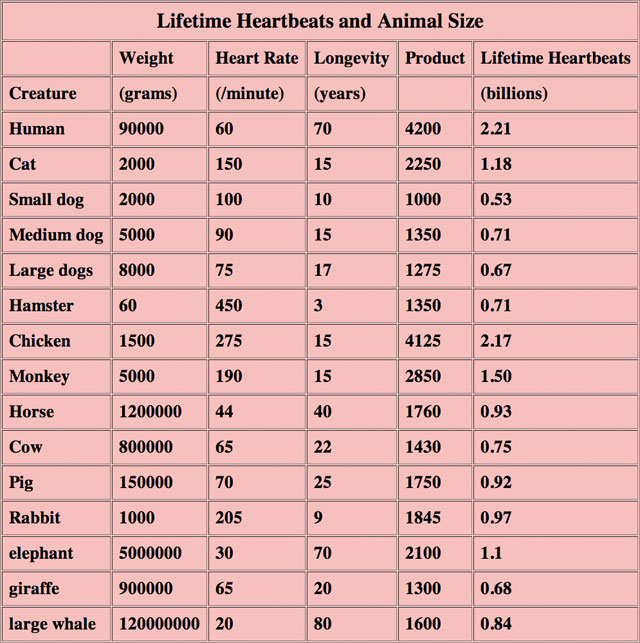
As animals get bigger, from tiny shrew to huge blue whale, pulse rates slow down and life spans stretch out longer, conspiring so that the number of heartbeats during an average stay on Earth tends to be roughly the same, around a billion.
Mysteriously, these and a large variety of other phenomena change with body size according to a precise mathematical principle called “quarter-power scaling”.
It might seem that because a cat is a hundred times more massive than a mouse, its metabolic rate, the intensity with which it burns energy, would be a hundred times greater. After all, the cat has a hundred times more cells to feed.
But if this were so, the animal would quickly be consumed by a fit of spontaneous feline combustion, or at least a very bad fever. The reason: the surface area a creature uses to dissipate the heat of the metabolic fires does not grow as fast as its body mass.
To see this, consider a mouse as an approximation of a small sphere. As the sphere grows larger, to cat size, the surface area increases along two dimensions but the volume increases along three dimensions. The size of the biological radiator cannot possibly keep up with the size of the metabolic engine.
Humans and chickens are both outliers in this respect…they both live more than twice as long as their heart rates would indicate. Small dogs live about half as long.
Another fine installment of XKCD’s What If? series: What would happen if you tried to fly a normal Earth airplane above different Solar System bodies?
Unfortunately, [the X-Plane simulator] is not capable of simulating the hellish environment near the surface of Venus. But physics calculations give us an idea of what flight there would be like. The upshot is: Your plane would fly pretty well, except it would be on fire the whole time, and then it would stop flying, and then stop being a plane.
(via stellar)
The Space Shuttle Challenger disintegrated shortly after liftoff 27 years ago today. Physicist Richard Feynman had a hand in determining the reason for the disaster.
I’m an explorer, ok? I get curious about everything and I want to investigate all kinds of stuff.
Here’s Feynman’s appendix to The Presidential Commission on the Space Shuttle Challenger Accident in which he dissents with the majority opinion of the commission. His conclusion:
If a reasonable launch schedule is to be maintained, engineering often cannot be done fast enough to keep up with the expectations of originally conservative certification criteria designed to guarantee a very safe vehicle. In these situations, subtly, and often with apparently logical arguments, the criteria are altered so that flights may still be certified in time. They therefore fly in a relatively unsafe condition, with a chance of failure of the order of a percent (it is difficult to be more accurate).
Official management, on the other hand, claims to believe the probability of failure is a thousand times less. One reason for this may be an attempt to assure the government of NASA perfection and success in order to ensure the supply of funds. The other may be that they sincerely believed it to be true, demonstrating an almost incredible lack of communication between themselves and their working engineers.
In any event this has had very unfortunate consequences, the most serious of which is to encourage ordinary citizens to fly in such a dangerous machine, as if it had attained the safety of an ordinary airliner. The astronauts, like test pilots, should know their risks, and we honor them for their courage. Who can doubt that McAuliffe was equally a person of great courage, who was closer to an awareness of the true risk than NASA management would have us believe?
Let us make recommendations to ensure that NASA officials deal in a world of reality in understanding technological weaknesses and imperfections well enough to be actively trying to eliminate them. They must live in reality in comparing the costs and utility of the Shuttle to other methods of entering space. And they must be realistic in making contracts, in estimating costs, and the difficulty of the projects. Only realistic flight schedules should be proposed, schedules that have a reasonable chance of being met. If in this way the government would not support them, then so be it. NASA owes it to the citizens from whom it asks support to be frank, honest, and informative, so that these citizens can make the wisest decisions for the use of their limited resources.
For a successful technology, reality must take precedence over public relations, for nature cannot be fooled.
Clear thought, clear writing. Feynman was perhaps the most efficient mechanism ever conceived for consuming complexity and pumping out simplicity. (via @ptak)
As previously reported, global warming doesn’t just mean the Earth is getting warmer…the weather is getting weirder.
Britons may remember 2012 as the year the weather spun off its rails in a chaotic concoction of drought, deluge and flooding, but the unpredictability of it all turns out to have been all too predictable: Around the world, extreme has become the new commonplace.
Especially lately. China is enduring its coldest winter in nearly 30 years. Brazil is in the grip of a dreadful heat spell. Eastern Russia is so freezing — minus 50 degrees Fahrenheit, and counting — that the traffic lights recently stopped working in the city of Yakutsk.
Bush fires are raging across Australia, fueled by a record-shattering heat wave. Pakistan was inundated by unexpected flooding in September. A vicious storm bringing rain, snow and floods just struck the Middle East. And in the United States, scientists confirmed this week what people could have figured out simply by going outside: last year was the hottest since records began.
BTW, this story was published the day before the NY Times announced that they are dismantling their environment news desk and dispersing the nine-person staff throughout the newsroom.
It wasn’t a decision we made lightly,” said Dean Baquet, the paper’s managing editor for news operations. “To both me and Jill [Abramson, executive editor], coverage of the environment is what separates the New York Times from other papers. We devote a lot of resources to it, now more than ever. We have not lost any desire for environmental coverage. This is purely a structural matter.”
This seems like a step in the wrong direction. Which prominent national publication will be brave and start pushing climate change coverage alongside that of politics, business, and sports? At the very least, the Times should have a weekly Climate Change section, the New Yorker should have a yearly Climate issue, Buzzfeed should have a Climate & Weather vertical, etc. (via @tcarmody)
When President Obama did an interview on Reddit in August, one of the questions he got was:
Would you rather fight 100 duck-sized horses or one horse-sized duck?
Obama declined to answer the question, but Conor Friedersdorf decided to ask a waterfowl expert what he thought and the answer involves an interesting mix of science:
With such a huge body, the problem of surface area to body volume comes into play. The terror-ducktyl would have a problem losing heat. Hence, a possible tactic would be to get it running around chasing me and it might overheat, stroke out, and die. Birds have higher body temperatures than mammals in any case (often very close to the 40 degrees Celsius upper lethal limit) so it might not take too much to push the duck over the metabolic cliff. Merits consideration.
and politics:
After engaging his graduate students in conversation, he came to realize that it would be politically disastrous for Obama to fight the duck-sized horses. Think about it. In America, the duck lobby is composed of duck hunters. The horse lobby is made up of horse lovers who succeeded in stopping Californians from buying horse meat. The young women voters essential to the Democratic coalition are far more sympathetic to veritable ponies than a giant, rape-obsessed mallard. Shooting the duck would be perfectly legal under existing law, or would at worst result in a citation for hunting without a license.
See also The Biology of B-Movie Monsters by Michael LaBarbera, a classic and one of my favorite internet things ever.
When the Incredible Shrinking Man stops shrinking, he is about an inch tall, down by a factor of about 70 in linear dimensions. Thus, the surface area of his body, through which he loses heat, has decreased by a factor of 70 x 70 or about 5,000 times, but the mass of his body, which generates the heat, has decreased by 70 x 70 x 70 or 350,000 times. He’s clearly going to have a hard time maintaining his body temperature (even though his clothes are now conveniently shrinking with him) unless his metabolic rate increases drastically.
Luckily, his lung area has only decreased by 5,000-fold, so he can get the relatively larger supply of oxygen he needs, but he’s going to have to supply his body with much more fuel; like a shrew, he’ll probably have to eat his own weight daily just to stay alive. He’ll also have to give up sleeping and eat 24 hours a day or risk starving before he wakes up in the morning (unless he can learn the trick used by hummingbirds of lowering their body temperatures while they sleep).
Studies have long shown evidence of placebos doing something to help ill patients. Harvard Medical School’s Ted Kaptchuk is studying this effect to determine how and why it works.
Two weeks into Ted Kaptchuk’s first randomized clinical drug trial, nearly a third of his 270 subjects complained of awful side effects. All the patients had joined the study hoping to alleviate severe arm pain: carpal tunnel, tendinitis, chronic pain in the elbow, shoulder, wrist. In one part of the study, half the subjects received pain-reducing pills; the others were offered acupuncture treatments. And in both cases, people began to call in, saying they couldn’t get out of bed. The pills were making them sluggish, the needles caused swelling and redness; some patients’ pain ballooned to nightmarish levels. “The side effects were simply amazing,” Kaptchuk explains; curiously, they were exactly what patients had been warned their treatment might produce. But even more astounding, most of the other patients reported real relief, and those who received acupuncture felt even better than those on the anti-pain pill. These were exceptional findings: no one had ever proven that acupuncture worked better than painkillers. But Kaptchuk’s study didn’t prove it, either. The pills his team had given patients were actually made of cornstarch; the “acupuncture” needles were retractable shams that never pierced the skin. The study wasn’t aimed at comparing two treatments. It was designed to compare two fakes.
The NOAA says that 2012 was the hottest year on record. BY AN ENTIRE DEGREE.
The average temperature was 55.3 degrees, 1 degree above the previous record and 3.2 degrees more than the 20th-century average. Temperatures were above normal in every month between June 2011 and September 2012, a 16-month stretch that hasn’t occurred since the government began keeping such records in 1895.
Weather-wise, 2012 is Usain Bolt crossing the line in the 100-meter final at the Beijing Olympics, already slowing down, arms out, and still so so much faster than everyone else.

Scientists in Peru have discovered what they think may be a new species of spider which uses twigs and dead insects to build decoy spiders to trick predators.
Afterward, Torres returned to the trails near the research center. Only within a roughly 1-square-mile area near the floodplain did Torres find more spider-building spiders — about 25 of them. “They could be quite locally restricted,” he said. “But for all I know, there’s millions of them in the forest beyond.” The spiders’ webs were crafted around face-height, near the trail, and about the width of a stretched-out hand. Some of the decoys placed in the webs looked rather realistic. Others resembled something more like a cartoon octopus.
(thanks, Alex)
The timeline of the far future artice is far from the longest page on Wikipedia, but it might take you several hours to get through because it contains so many enticing detours. What’s Pangaea Ultima? Oooh, Roche limit! The Degenerate Era, Poincaré recurrence time, the Big Rip scenario, the cosmic light horizon, the list goes on and on. And the article itself is a trove of fascinating facts and eye-popping phrases. Here are a few of my favorites. (Keep in mind that the universe is only 13.75 billion years old. Unless we’re living in a computer simulation.)
50,000 years: “Niagara Falls erodes away the remaining 32 km to Lake Erie and ceases to exist.”
1 million years: “Highest estimated time until the red supergiant star Betelgeuse explodes in a supernova. The explosion is expected to be easily visible in daylight.”
1.4 million years: “The star Gliese 710 passes as close as 1.1 light years to the Sun before moving away. This may gravitationally perturb members of the Oort cloud; a halo of icy bodies orbiting at the edge of the Solar System. As a consequence, the likelihood of a cometary impact in the inner Solar System will increase.”
230 million years: “Beyond this time, the orbits of the planets become impossible to predict.”
800 million years: “Carbon dioxide levels fall to the point at which C4 photosynthesis is no longer possible. Multicellular life dies out.”
4 billion years: “Median point by which the Andromeda Galaxy will have collided with the Milky Way, which will thereafter merge to form a galaxy dubbed ‘Milkomeda’.”
7.9 billion years: “The Sun reaches the tip of the red giant branch, achieving its maximum radius of 256 times the present day value. In the process, Mercury, Venus and possibly Earth are destroyed. During these times, it is possible that Saturn’s moon Titan could achieve surface temperatures necessary to support life.”
100 billion years: “The Universe’s expansion causes all galaxies beyond the Milky Way’s Local Group to disappear beyond the cosmic light horizon, removing them from the observable universe.”
1 trillion years: “The universe’s expansion, assuming a constant dark energy density, multiplies the wavelength of the cosmic microwave background by 10^29, exceeding the scale of the cosmic light horizon and rendering its evidence of the Big Bang undetectable.”
1 quadrillion years: “Estimated time until stellar close encounters detach all planets in the Solar System from their orbits. By this point, the Sun will have cooled to five degrees above absolute zero.”
10^65 years: “Assuming that protons do not decay, estimated time for rigid objects like rocks to rearrange their atoms and molecules via quantum tunneling. On this timescale all matter is liquid.”
10^10^56 years: “Estimated time for random quantum fluctuations to generate a new Big Bang, according to Caroll and Chen.”
Read the whole thing, it’s worth the effort. (via @daveg)
Note: Illustration by Chris Piascik…prints & more are available.
The supposed debate among scientists over climate change has melted faster than the polar ice caps. National Science Board member James Lawrence Powell looked at all the related peer-reviewed scientific papers over the last several years. Twenty-four of those articles rejected the notion of climate change. Out of 14,000.
So let this be clear: There is no scientific controversy over this. Climate change denial is purely, 100 percent made-up political and corporate-sponsored crap.
It’s still easy for many of us to ignore the issue of climate change, but every now and then a headline makes us take notice. This one did it for me: The End of Pasta.
But if humans want to keep eating pasta, we will have to take much more aggressive action against global warming. Pasta is made from wheat, and a large, growing body of scientific studies and real-world observations suggest that wheat will be hit especially hard as temperatures rise and storms and drought intensify in the years ahead.
A ProPublica Investigation: Poisoning the Well: How the feds let industry pollute the nation’s underground water supply.
Federal officials have given energy and mining companies permission to pollute aquifers in more than 1,500 places across the country, releasing toxic material into underground reservoirs that help supply more than half of the nation’s drinking water.
In many cases, the Environmental Protection Agency has granted these so-called aquifer exemptions in Western states now stricken by drought and increasingly desperate for water.
In 2003, British philosopher Nick Bostrom suggested that we might live in a computer simulation. From the abstract of Bostrom’s paper:
This paper argues that at least one of the following propositions is true: (1) the human species is very likely to go extinct before reaching a “posthuman” stage; (2) any posthuman civilization is extremely unlikely to run a significant number of simulations of their evolutionary history (or variations thereof); (3) we are almost certainly living in a computer simulation. It follows that the belief that there is a significant chance that we will one day become posthumans who run ancestor-simulations is false, unless we are currently living in a simulation. A number of other consequences of this result are also discussed.
The gist appears to be that if The Matrix is possible, someone has probably already invented it and we’re in it. Which, you know, whoa.
But researchers believe they have devised a test to check if we’re living in a computer simulation.
However, Savage said, there are signatures of resource constraints in present-day simulations that are likely to exist as well in simulations in the distant future, including the imprint of an underlying lattice if one is used to model the space-time continuum.
The supercomputers performing lattice quantum chromodynamics calculations essentially divide space-time into a four-dimensional grid. That allows researchers to examine what is called the strong force, one of the four fundamental forces of nature and the one that binds subatomic particles called quarks and gluons together into neutrons and protons at the core of atoms.
“If you make the simulations big enough, something like our universe should emerge,” Savage said. Then it would be a matter of looking for a “signature” in our universe that has an analog in the current small-scale simulations.
If it turns out we’re all really living in an episode of St. Elsewhere, I’m going to be really bummed. (via @CharlesCMann)
Looking to live forever? You might want to take a close look at the immortal jellyfish. This death-defying creature ages, but researchers studying the jellyfish found that, instead of dying, it started “to age in reverse, growing younger and younger until it reached its earliest stage of development, at which point it began its life cycle anew.” (If beginning the life cycle anew means another trip through junior high, count me out.) From NYT Magazine: Can a Jellyfish Unlock the Secret of Immortality?
Fairy wrens have a cuckoo problem. Specifically, cuckoos lay their eggs in the nest of the fairy wrens and, if undetected, they would end up raising the baby cuckoos to the potential detriment of their own children. But what the fairy wren mother does is after laying her eggs, she sings a unique song to the eggs until they hatch. Having learned the song while in-egg, the hatched baby wrens sing back part of the song to get fed.
She kept 15 nests under constant audio surveillance, and discovered that fairy-wrens call to their unhatched chicks, using a two-second trill with 19 separate elements to it. They call once every four minutes while sitting on their eggs, starting on the 9th day of incubation and carrying on for a week until the eggs hatch.
When Colombelli-Negrel recorded the chicks after they hatched, she heard that their begging call included a single unique note lifted from mum’s incubation call. This note varies a lot between different fairy-wren broods. It’s their version of a surname, a signature of identity that unites a family. The females even teach these calls to their partners, by using them in their own begging calls when the males return to the nest with food.
These signature calls aren’t innate. The chicks’ calls more precisely matched those of their mother if she sang more frequently while she was incubating. And when Colombelli-Negrel swapped some eggs between different clutches, she found that the chicks made signature calls that matches those of their foster parents rather than those of their biological ones. It’s something they learn while still in their eggs.
(via bruce schneier)
Children often close or cover their eyes to hide, and researchers at the University of Cambridge wanted to find out why. Click through for more interesting snippets.
Now things get a little complicated. In both studies so far, when the children thought they were invisible by virtue of their eyes being covered, they nonetheless agreed that their head and their body were visible. They seemed to be making a distinction between their “self” that was hidden, and their body, which was still visible. Taken together with the fact that it was the concealment of the eyes that seemed to be the crucial factor for feeling hidden, the researchers wondered if their invisibility beliefs were based around the idea that there must be eye contact between two people — a meeting of gazes — for them to see each other (or at least, to see their “selves”).
(via @noahwg)
Aired as The Quest For Tannu Tuva in the UK and The Last Journey Of A Genius in the US, this hour-long program is the last extended interview that physicist Richard Feynman gave; he died a few days after the recording.
Richard Feynman was not only an iconoclastic and influential theoretical physicist and Nobel laureate but also an explorer at heart. Feynman through video recordings and comments from his friend and drumming partner Ralph Leighton tell the extraordinary story of their enchantment with Tuva, a strange and distant land in the centre of Asia.
While few Westerners knew about Tuva, Feynman discovered its existence from the unique postage stamps issued there in the early 20th century. He was intrigued by the unusual name of its capital, Kyzyl, and resolved to travel to the remote, mountainous land. However, the Soviets, who controlled access, were mistrustful, unconvinced that he was interested only in the scenery. They obstructed his plans throughout 13 years.
I could watch this guy talk all day long. Feynman is a national treasure; we should give Andrew Jackson the boot and put Feynman on the $20.
A European team of exoplanet hunters has discovered a planet about the size of Earth orbiting Alpha Centauri B, which is in a group of stars closest to the solar system, a mere 4.3 light years away. Lee Billings explains the significance.
At a distance of just over 4.3 light years, the stars of Alpha Centauri are only a cosmic stone’s throw away. To reach Alpha Centauri B b, as this new world is called, would require a journey of some 25 trillion miles. For comparison, the next-nearest known exoplanet is a gas giant orbiting the orange star Epsilon Eridani, more than twice as far away. But don’t pack your bags quite yet. With a probable surface temperature well above a thousand degrees Fahrenheit, Alpha Centauri B b is no Goldilocks world. Still, its presence is promising: Planets tend to come in packs, and some theorists had believed no planets at all could form in multi-star systems like Alpha Centauri, which are more common than singleton suns throughout our galaxy. It seems increasingly likely that small planets exist around most if not all stars, near and far alike, and that Alpha Centauri B may possess additional worlds further out in clement, habitable orbits, tantalizingly within reach.
I love these posters featuring six women who changed science and the world. Hard to pick a favorite but I’ll go with the Sally Ride one:

The Rosalind Franklin poster is a close second. The same artist also did this wonderfully minimalist poster for Louis Braille.
ps. Today is Ada Lovelace Day!
Researchers in Copenhagan and Perth used DNA found in the leg bones of the extinct moa bird to determine the half-life of DNA: 521 years.
By comparing the specimens’ ages and degrees of DNA degradation, the researchers calculated that DNA has a half-life of 521 years. That means that after 521 years, half of the bonds between nucleotides in the backbone of a sample would have broken; after another 521 years half of the remaining bonds would have gone; and so on.
The team predicts that even in a bone at an ideal preservation temperature of -5 ºC, effectively every bond would be destroyed after a maximum of 6.8 million years. The DNA would cease to be readable much earlier — perhaps after roughly 1.5 million years, when the remaining strands would be too short to give meaningful information.
That means no real-life Jurassic Park, folks.
In the last few years, scientists have discovered that before Neanderthals went extinct around 30,000 years ago, they interbred with modern humans. As a result, many humans alive today contain Neanderthal DNA in their genomes, typically between 1-4%.
Yesterday, a few of the editors at The Atlantic had their genes analyzed for Neanderthal DNA: Alexis Madrigal had 3.6%, Steve Clemons had 4.3%, and James Fallows had 5%. Personal genetic information company 23andMe added the ability to determine your Neanderthal DNA percentage a few months ago and it turns out 2.7% of my DNA is from Neanderthals, compared to 2.5% for the average 23andMe user.
If you have a 23andMe acct, you can check your percentage by logging in and going to “Ancestry Labs” in the sidebar.
While driving a couple weeks ago, I happened to catch a meteor shooting across the sky:
Saw one of the coolest things ever tonight: a meteor burning up in the lower atmosphere. Super bright, exploded at the end like a firework.
It turned out that “one of the coolest things ever” wasn’t hyperbole. You see, earlier that day over the UK, a meteor streaked across the sky for about 50 seconds:
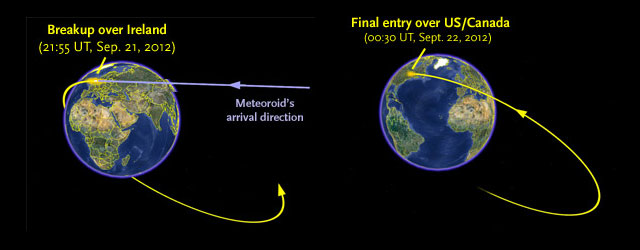
And then the one I saw happened about two-and-a-half hours later. Spurred by this unlikely coincidence, mathematician Esko Lyytinen of the colorfully named Finnish Fireball Working Group of the Ursa Astronomical Association did some calculations and determined that the two events were actually the same meteor.
He believes a large body grazed the upper atmosphere, dipping to an altitude of 33 miles (53 km) over Ireland before escaping back to space. Because it arrived moving at only about 8 miles (13 km) per second, barely above Earth’s escape velocity, it lingered for more than a minute as it crossed the sky. (This explains why some witnesses mistook it for reentering spacecraft debris.)
Lyytinen says the brief atmospheric passage took its toll. As the meteoroid broke apart, its velocity dropped to just 5.7 miles (9.2 km) per second, too slow to make an escape back to space. Instead, it became a temporary satellite of Earth, looping completely around the globe before reentering the atmosphere — this time for good. “It looks now that the fireball witnessed 155 minutes later in U.S. and Canada, may have been one fragment of the British fireball, most probably the biggest one,” Lyytinen explains.
These earth-grazers are not common but they do happen from time to time. But a visible Earth grazing meteor that enters the atmosphere twice? Unprecedented. So cool! (thx, alex)
Hey, if Randall keeps writing them, I’m gonna keep posting links to them…today’s XKCD What If is “If every person on Earth aimed a laser pointer at the Moon at the same time, would it change color?”
Unfortunately, the laser energy flow would turn the atmosphere to plasma, instantly igniting the Earth’s surface and killing us all.
Earlier this month, the Curiosity rover photographed a dry stream bed on the surface of Mars.
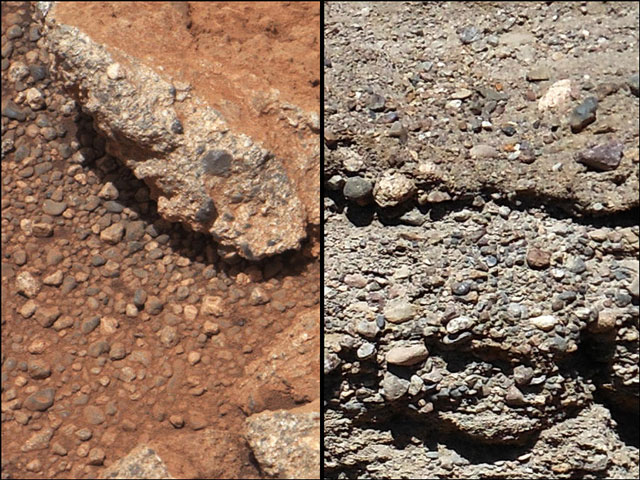
That’s the Mars river bed on the left and an Earth river bed on the right. Note the flat smooth rocks in the Mars pic. Pretty cool.
Plant grafting is something I always sort of knew existed, but never really thought it worked well enough to create fruit salad trees. A plant with multiple different kinds of herbs would be amazing.
In Australia, James and Kerry West grow and sell four types of fruit salad trees, each of which bears several different kinds of fruit. Stone fruit salad trees grow peaches, plums, nectarines, apricots and peachcots. Citrus salad trees offer a winter and summer orange, mandarins, lemons, limes, grapefruits, tangelos and pomelos. Multi-apple trees boast between two and four different kinds of apples and multi-nashi trees produce between two and four different kinds of Asian pears.
(thanks, Jessie)
Gorilla Glass is the thin strong glass used for the screens of most smartphones. It was invented in the 1960s by Corning but was shelved in the early 1970s due to a lack of demand. The iPhone brought it out of retirement in a big way.
Chemical strengthening, the method of fortifying glass developed in the ’60s, creates a compressive layer too, through something called ion exchange. Aluminosilicate compositions like Gorilla Glass contain silicon dioxide, aluminum, magnesium, and sodium. When the glass is dipped in a hot bath of molten potassium salt, it heats up and expands. Both sodium and potassium are in the same column on the periodic table of elements, which means they behave similarly. The heat from the bath increases the migration of the sodium ions out of the glass, and the similar potassium ions easily float in and take their place. But because potassium ions are larger than sodium, they get packed into the space more tightly. (Imagine taking a garage full of Fiat 500s and replacing most of them with Chevy Suburbans.) As the glass cools, they get squeezed together in this now-cramped space, and a layer of compressive stress on the surface of the glass is formed. (Corning ensures an even ion exchange by regulating factors like heat and time.) Compared with thermally strengthened glass, the “stuffing” or “crowding” effect in chemically strengthened glass results in higher surface compression (making it up to four times as strong), and it can be done to glass of any thickness or shape.
I did glass research in college so I’m a sucker for this sort of thing. (via @joeljohnson)
XKCD’s What If? science feature continues to delight. This week’s question is “What if a rainstorm dropped all of its water in a single giant drop?”
The drop is now falling at 90 meters per second (200 mph). The roaring wind whips up the surface of the water into spray. The leading edge of the droplet turns to foam as air is forced into the liquid. If it kept falling for long enough, these forces would gradually disperse the entire droplet into rain.
Before that can happen, about 20 seconds after formation, the edge of the droplet hits the ground. The water is now moving at over 200 m/s (450 mph). Right under the point of impact, the air is unable to rush out of the way fast enough, and the compression heats it so quickly that the grass would catch fire if it had time.
Fortunately for the grass, this heat lasts only a few milliseconds because it’s doused by the arrival of a lot of cold water. Unfortunately for the grass, the cold water is moving at over half the speed of sound.
It turns out that yo-yos work pretty well in space. Astronaut Don Pettit demontrates from the International Space Station.
(via explore)
Socials & More