kottke.org posts about science
The structure of the social network among characters in Homer’s Odyssey indicates the story is at least partially based on actual events.
In analysing the Odyssey, they identified 342 unique characters and over 1700 relations between them.
Having constructed the social network, Miranda and co then examined its structure. “Odyssey’s social network is small world, highly clustered, slightly hierarchical and resilient to random attacks,” they say.
What’s interesting about this conclusion is that these same characteristics all crop up in social networks in the real world. Miranda and co say this is good evidence that the Odyssey is based, at least in part, on a real social network and so must be a mixture of myth and fact.
We’re used to thinking that technology progresses. Stuff gets better. But that’s not the case with concrete…the Romans made concrete that’s superior to the stuff we have now and scientists recently found out why it’s so good.
The secret to Roman concrete lies in its unique mineral formulation and production technique. As the researchers explain in a press release outlining their findings, “The Romans made concrete by mixing lime and volcanic rock. For underwater structures, lime and volcanic ash were mixed to form mortar, and this mortar and volcanic tuff were packed into wooden forms. The seawater instantly triggered a hot chemical reaction. The lime was hydrated — incorporating water molecules into its structure — and reacted with the ash to cement the whole mixture together.”
The Portland cement formula crucially lacks the lyme and volcanic ash mixture. As a result, it doesn’t bind quite as well when compared with the Roman concrete, researchers found. It is this inferior binding property that explains why structures made of Portland cement tend to weaken and crack after a few decades of use, Jackson says.
In a unanimous decision, the US Supreme Court ruled today that human genes cannot be patented.
The case involved Myriad Genetics Inc., which holds patents related to two genes, known as BRCA1 and BRCA2, that can indicate whether a woman has a heightened risk of developing breast cancer or ovarian cancer.
Justice Clarence Thomas, writing for the court, said the genes Myriad isolated are products of nature, which aren’t eligible for patents.
The high court’s ruling was a win for a coalition of cancer patients, medical groups and geneticists who filed a lawsuit in 2009 challenging Myriad’s patents. Thanks to those patents, the Salt Lake City company has been the exclusive U.S. commercial provider of genetic tests for breast cancer and ovarian cancer.
The challengers argued the patents have allowed Myriad to dictate the type and terms of genetic screening available for the diseases, while also dissuading research by other laboratories.
Fuck yes. A defect in her BRCA1 gene is what caused Angelina Jolie to recently have a preventive double mastectomy. (via @tylercowen)
Some countries, the cool ones, put physicists and other scientists on their money. Here’s Niels Bohr on the Danish 500 kroner note:
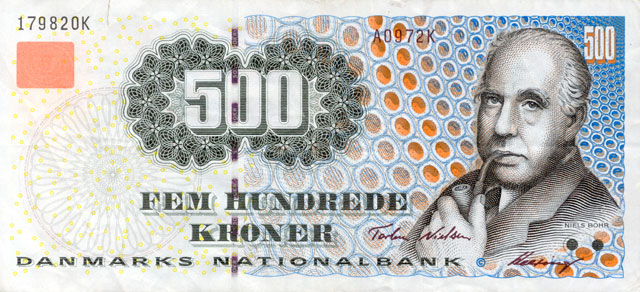
Even the US sneaks onto the cool list with Ben Franklin on the $100.
We are all mostly related to each other. But weirder still, you’re just about as related to the stranger next to you as to your great×12 grandparents.
Now, there’s another important implication of genomic ancestry studies: Most of the people you are descended from are no more genetically related to you than strangers are. Or to put it another way, your genealogical family tree, which includes all the history of your family going back thousands of years, is much larger than your genetic family tree-the people whom genome sequencing would pinpoint as related to you. 99.9 percent of your genome is the same as that of every other human being (apart from the x and y chromosomes), and that .1 percent of variation in each person gets thinned out pretty quickly across the generations, as each child gets half of each of her parents’ genomes, passes on half to each of her children, and so on. Geneticist Luke Jostins did a nice mathematical analysis and estimated that you have only about a 12 percent chance of being genetically related to an ancestor 10 generations ago; by the time you get to a 14-generation ancestor, the probability is nearly zero.
A mammoth recently found in Siberia was so well preserved that when researchers were chipping it out of the ice, liquid blood flowed out.
Semyon Grigoriev, chairman of the university’s Museum of Mammoths and head of the expedition, said: “The fragments of muscle tissues, which we’ve found out of the body, have a natural red colour of fresh meat. The reason for such preservation is that the lower part of the body was underlying (sic) in pure ice, and the upper part was found in the middle of tundra. We found a trunk separately from the body, which is the worst-preserved part.”
The temperature was ten degrees celsius below zero when the mammoth was found, so the discovery of liquid blood was a shock. “It can be assumed that the blood of mammoths had some cryo-protective properties,” Grigoriev said. “The blood is very dark, it was found in ice cavities below the belly and when we broke these cavities with a pick, the blood came running out.”
More photos and information here. Bring on the mammoth clones, John Hammond. (via @carlzimmer)
Surprisingly entertaining article about better choices for the state birds of each of the 50 US states.
4. Arkansas. Official state bird: northern mockingbird
Christ. What makes this even less funny is that there are like eight other states with mockingbird as their official bird. I’m convinced that the guy whose job it was to report to the state’s legislature on what the official bird should be forgot until the day it was due and he was in line for a breakfast sandwich at Burger King. In a panic he walked outside and selected the first bird he could find, a dirty mockingbird singing its stupid head off on top of a dumpster.
What it should be: painted bunting
More hilarious science journalism, please. Yes, in addition to the excellent What If? (via @jessamyn)
A group of researchers in Oregon have successfully cloned human embryos. No, really:
The researchers, at Oregon Health and Science University, took skin cells from a baby with a genetic disease and fused them with donated human eggs to create human embryos that were genetically identical to the 8-month-old. They then extracted stem cells from those embryos.
The embryo-creation technique is essentially the same as that used to create Dolly the sheep and the many cloned animals that have followed. In those cases, the embryos were implanted in the wombs of surrogate mothers.
These embryos won’t work for producing clones humans…they are being used to harvest stem cells.
The Oregon researchers, who published a paper on their work in the journal Cell, say their goal is what has been called therapeutic cloning: making embryonic stem cells that are genetically identical to a particular patient.
Embryonic stem cells can turn into any type of cell in the body, like heart cells, muscles or neurons. That raises the hope that one day the cells will be turned into replacement tissue or even replacement organs to treat a host of diseases.
In this morning’s NY Times, Angelina Jolie writes about her decision to have a preventive double mastectomy to hopefully ward off cancer.
My mother fought cancer for almost a decade and died at 56. She held out long enough to meet the first of her grandchildren and to hold them in her arms. But my other children will never have the chance to know her and experience how loving and gracious she was.
We often speak of “Mommy’s mommy,” and I find myself trying to explain the illness that took her away from us. They have asked if the same could happen to me. I have always told them not to worry, but the truth is I carry a “faulty” gene, BRCA1, which sharply increases my risk of developing breast cancer and ovarian cancer.
It happens that just last night I read about the BRCA-1 gene in Siddhartha Mukhergee’s excellent biography of cancer, The Emperor of All Maladies. This part is right near the end of the book:
Like cancer prevention, cancer screening will also be reinvigorated by the molecular understanding of cancer. Indeed, it has already been. The discovery of the BRCA genes for breast cancer epitomizes the integration of cancer screening and cancer genetics. In the mid-1990s, building on the prior decade’s advances, researchers isolated two related genes, BRCA-1 and BRCA-2, that vastly increase the risk of developing breast cancer. A woman with an inherited mutation in BRCA-1 has a 50 to 80 percent chance of developing breast cancer in her lifetime (the gene also increases the risk for ovarian cancer), about three to five times the normal risk. Today, testing for this gene mutation has been integrated into prevention efforts. Women found positive for a mutation in the two genes are screened more intensively using more sensitive imaging techniques such as breast MRI. Women with BRCA mutations might choose to take the drug tamoxifen to prevent breast cancer, a strategy shown effective in clinical trials. Or, perhaps most radically, women with BRCA mutations might choose a prophylactic mastectomy of both breasts and ovaries before cancer develops, another strategy that dramatically decreases the chances of developing breast cancer.
Radical is an understatement…what a tough and brave decision to make. Again from the book, I liked this woman’s take on it:
An Israeli woman with a BRCA-1 mutation who chose this strategy after developing cancer in one breast told me that at least part of her choice was symbolic. “I am rejecting cancer from my body,” she said. “My breasts had become no more to me than a site for my cancer. They were of no more use to me. They harmed my body, my survival. I went to the surgeon and asked him to remove them.”
The genetic testing company 23andme screens for three common types of mutation in the BRCA1 or BRCA2 genes:
Five to 10 percent of breast cancers occur in women with a genetic predisposition for the disease, usually due to mutations in either the BRCA1 or BRCA2 genes. These mutations greatly increase not only the risk for breast cancer in women, but also the risk for ovarian cancer in women as well as prostate and breast cancer among men. Hundreds of cancer-associated BRCA1 and BRCA2 mutations have been documented, but three specific BRCA mutations are worthy of note because they are responsible for a substantial fraction of hereditary breast cancers and ovarian cancers among women with Ashkenazi Jewish ancestry. The three mutations have also been found in individuals not known to have Ashkenazi Jewish ancestry, but such cases are rare.
23andme testing kits are only $99.
Update: Two things. First, and I hope this isn’t actually necessary because you are all intelligent people who can read things and make up your own minds, but let me just state for the official record that you should never never never never NEVER take medical advice, inferred or otherwise, from celebrities or bloggers. Come on, seriously. If you’re concerned, go see a doctor.
Two: I have no idea what the $99 23andme test covers with regard to BRCA1 and BRCA2 gene mutations beyond what the company states. The most comprehensive test for BRCA1 and BRCA2 mutations was developed by a company called Myriad Genetics and costs about $3000. Myriad has patented the genes, a decision that has been sharply criticized and is currently being decided by the Supreme Court.
But many doctors, patients and scientists aren’t happy with the situation.
Some are offended by the very notion that a private company can own a patent based on a gene that was invented not by researchers in a lab but by Mother Nature. Every single cell in every single person has copies of the BRCA1 and BRCA2 genes.
Myriad officials say they deserves the patent because they invested a great deal of money to figure out the sequence and develop “synthetic molecules” based on that sequence that can be used to test the variants in a patient.
“We think it is right for a company to be able to own its discoveries, earn back its investment, and make a reasonable profit,” the company wrote on its blog.
I do know the 23andme test covers something related to the BRCA1 and BRCA2 mutations…a friend of a friend did the 23andme test, tested positive for the BRCA1 mutation, and decided to have a preventive double mastectomy after consulting her doctor and further tests. (thx, mark, allison, and ★spavis)
The quick progress of the US space program in the 1960s and 70s and the science fiction of the 70s and 80s seemed to point towards humans living permanently in space. What happened?
Ironically, our actual experiments in space living have largely reinforced this stark perspective. Real life in space is often cramped, unpleasant and even pointless. Some years back, I visited Star City near Moscow, the training centre for cosmonauts since Gagarin, where I had a chance to clamber inside a full-scale training mock-up of the Mir space station. The experience was more like residing inside a computer terminal than one of O’Neill’s cylindrical islands, so proximate and abundant were tubes, wires, levers, buttons and unnameable gadgets.
More disorienting was the placement of controls and conveniences: because space was limited, these were distributed throughout the station without reference to Earthly gravity, thus making use of ‘ceilings’ as sleeping quarters, walls for toilet cubicles and virtually any other surface for any other activity. One could get used to such things (and you’d have to be a true cynic to tire of the view outside your window). But it’s a far, far cry from strolling the wide corridors of the Starship Enterprise.
They promised us life in space, flying cars, and jetpacks but all we got were pocket-sized rectangles containing all human knowledge. FAIL.
Since 861 AD, almost 35,000 meteorites were recorded hitting the Earth but only 1,045 were actually seen falling. This animated infographic is a good way to visualize the data. Bolides is the perfect domain name. (via @DavidGrann)
Damn! Watch this railroad tanker car instantly implode:
I couldn’t find too much information on the source of this clip, but it appears to be part of a safety training video on the perils of improperly steam cleaning tanker cars. In the clip, the tanker car is filled with steam and the safety valves are disabled. The steam cools, then condenses, the pressure inside drops, and the pressure difference is big enough to crumple that huge railcar like a napkin.
Update: See also “sun kink”, when railroad tracks buckle in intense heat:
An explanation of the effect can be found here. (thx, will)
Normally when someone says they’ve thought up a theoretically possible perpetual motion scheme, you roll your eyes and pass the dutchie to the left hand side. But when that someone is a Nobel laureate in physics, is not generally off his rocker, and has published his idea in a prestigious peer-reviewed journal, people pay attention. Frank Wilczek believes he’s invented something called time crystals.
In February 2012, the Nobel Prize-winning physicist Frank Wilczek decided to go public with a strange and, he worried, somewhat embarrassing idea. Impossible as it seemed, Wilczek had developed an apparent proof of “time crystals” — physical structures that move in a repeating pattern, like minute hands rounding clocks, without expending energy or ever winding down. Unlike clocks or any other known objects, time crystals derive their movement not from stored energy but from a break in the symmetry of time, enabling a special form of perpetual motion.
“Most research in physics is continuations of things that have gone before,” said Wilczek, a professor at the Massachusetts Institute of Technology. This, he said, was “kind of outside the box.”
An effort to prove or disprove Wilczek’s theory is underway…let’s hope it holds up to scientific scrutiny better than Time Cube. (via digg)
An article from a mother who was anti-vaccine until her daughter (and then the rest of the family) got the whooping cough. And still she feels “funny” about vaccination.
And yet I still wondered about that list of things that I would now, I suppose, have to surrender to and immunise my child against. Polio, for one — a couple of my parents’ pensioner friends still carry the limp left by their childhood polio, but none of my friends do, because it isn’t around any more. And diphtheria — what was that, even? I knew it had killed one of Queen Victoria’s daughters, but that wasn’t our reality.
The reason it wasn’t our reality was, of course, due to a continuous programme of immunisation. Duh. Diphtheria is a disease that still kills one in five infants it meets, even if they get treatment, their necks swelling up until they can no longer breathe. I have now seen a picture of a child whose neck was ravaged by diphtheria, bloated like a foie gras goose about to burst. I wish I could unsee it.
Duh, indeed. This anti-vaccination nonsense is an instance in which the public’s lack of knowledge about how science works (and not just their lack of recall of scientific facts) is truly harmful. (via @CharlesCMann)
A pair of scientists looked at the rate at which the complexity of life increases and then extrapolated back to a point of zero complexity, aka the origin of life. The answer they came up with is 9.7 ± 2.5 billion years ago. Which is much older than the Earth. This idea has some provocative implications:
Sharov and Gordon say their interpretation also explains the Fermi paradox, which raises the question that if the universe is filled with intelligent life, why can’t we see evidence of it.
However, if life takes 10 billion years to evolve to the level of complexity associated with humans, then we may be among the first, if not the first, intelligent civilisation in our galaxy. And this is the reason why when we gaze into space, we do not yet see signs of other intelligent species.
This video footage of metallic putty eating magnets is super freaky.
What happens when you wring a washcloth out in zero gravity? Something cool.
Commander Hadfield is the best. I love when he casually lets go of the wireless mic and it just floats there right in front of his face. (thx, dusty)
Great article by Burkhard Bilger about NASA’s Curiosity mission to Mars.
The search for life on Mars is now in its sixth decade. Forty spacecraft have been sent there, and not one has found a single fossil or living thing. The closer we look, the more hostile the planet seems: parched and frozen in every season, its atmosphere inert and murderously thin, its surface scoured by solar winds. By the time Earth took its first breath three billion years ago, geologists now believe, Mars had been suffocating for a billion years. The air had thinned and rivers evaporated; dust storms swept up and ice caps seized what was left of the water. The Great Desiccation Event, as it’s sometimes called, is even more of a mystery than the Great Oxygenation on Earth. We know only this: one planet lived and the other died. One turned green, the other red.
Perfect read if you’ve been curious about what Curiosity is up to on Mars but needed something a bit more narrative than the mission home page or Wikipedia page to guide you. Also features the phrase “a self-eating watermelon of despair”, so there’s that. Oh, and here’s the Seven Minutes of Terror video referred to in the story.
Starting with cubes of four simple materials (bone, tissue, 2 types of muscles) and one simple rule (faster bots have more offspring) results in a surprising amount of complexity among walking robots.
(via buzzfeed)
From Phil Plait at Bad Astronomy, a list of ten things you might not know about black holes. Some of this I knew, but this one is incredible:
If you were to rope off the solar system out past Neptune, enclose it in a giant sphere, and fill it with air, it would be a black hole!
See also this recent tweet from physicist Brian Greene:
Remove all the space within the atoms making up the human body, and every person that’s ever lived would fit inside a baseball.
(via @daveg & @rosecrans)
The other day I posted a video about how differential gears work to help cars go smoothly around curves. Trains don’t have differential gears, so how do they manage to go around curves without slipping or skidding? Richard Feynman explains:
Ha, it looks like I’ve posted this one before as well. Can never get enough Feynman. (thx, kerry)
Or at least unbeneficial. A comprehensive study out of Croatia complements other evidence that stretching your muscles before exercise results in less strength, power, and performance than if you hadn’t stretched.
The numbers, especially for competitive athletes, are sobering. According to their calculations, static stretching reduces strength in the stretched muscles by almost 5.5 percent, with the impact increasing in people who hold individual stretches for 90 seconds or more. While the effect is reduced somewhat when people’s stretches last less than 45 seconds, stretched muscles are, in general, substantially less strong.
They also are less powerful, with power being a measure of the muscle’s ability to produce force during contractions, according to Goran Markovic, a professor of kinesiology at the University of Zagreb and the study’s senior author. In Dr. Markovic and his colleagues’ re-analysis of past data, they determined that muscle power generally falls by about 2 percent after stretching.
And as a result, they found, explosive muscular performance also drops off significantly, by as much as 2.8 percent. That means that someone trying to burst from the starting blocks, blast out a ballistic first tennis serve, clean and jerk a laden barbell, block a basketball shot, or even tick off a fleet opening mile in a marathon will be ill served by stretching first. Their performance after warming up with stretching is likely to be worse than if they hadn’t warmed up at all.
I’ve posted this before, but it’s so good, here it is again: a super-simple explanation of why differential gears are necessary in cars and how they work.
(via @stevenstrogatz)
Climate scientists have been wrestling with a curious fact lately: the rise in global temperature has been flat over the past decade or more even as we pump ever-increasing rates of carbon dioxide into the atmosphere. The Economist discusses what that might mean for the climate and climate science.
Over the past 15 years air temperatures at the Earth’s surface have been flat while greenhouse-gas emissions have continued to soar. The world added roughly 100 billion tonnes of carbon to the atmosphere between 2000 and 2010. That is about a quarter of all the CO₂ put there by humanity since 1750. And yet, as James Hansen, the head of NASA’s Goddard Institute for Space Studies, observes, “the five-year mean global temperature has been flat for a decade.”
Temperatures fluctuate over short periods, but this lack of new warming is a surprise. Ed Hawkins, of the University of Reading, in Britain, points out that surface temperatures since 2005 are already at the low end of the range of projections derived from 20 climate models. If they remain flat, they will fall outside the models’ range within a few years.
The mismatch between rising greenhouse-gas emissions and not-rising temperatures is among the biggest puzzles in climate science just now. It does not mean global warming is a delusion. Flat though they are, temperatures in the first decade of the 21st century remain almost 1°C above their level in the first decade of the 20th. But the puzzle does need explaining.
Despite progress in recent years on causes and cures, colony collapse disorder has wreaked havoc on honeybee colonies across the country.
A mysterious malady that has been killing honeybees en masse for several years appears to have expanded drastically in the last year, commercial beekeepers say, wiping out 40 percent or even 50 percent of the hives needed to pollinate many of the nation’s fruits and vegetables.
Which is like, yeah, big whoop, it’s just bees, right? Except that:
The Agriculture Department says a quarter of the American diet, from apples to cherries to watermelons to onions, depends on pollination by honeybees.
Well, this is interesting. Graphene is a substance discovered relatively recently that has a number of unusual properties. In 2004, physicists at the University of Manchester and the Institute for Microelectronics Technology in Russia used ordinary scotch tape to isolate single-layer sheets of graphene. Once isolated, the sheets could be tested for the unusual properties I mentioned. The 2010 Nobel Prize in Physics was awarded for this work.
In 2012, a group of researchers at UCLA discovered they could make single-layer sheets of graphene by coating a DVD with graphite oxide and then “playing” the disc in a plain old DVD drive. And then in a happy accident, they found that graphene has unusually high supercapacitance properties, which could mean that graphene could be used, for example, as a mobile phone battery that lasts all day, charges in a few seconds, and can be thrown into a compost bin after use.
(via io9)
In the pages of Sidereus Nuncius, Galileo described the four large moons of Jupiter in a series of 64 sketches which looked a lot like ASCII art in the text:
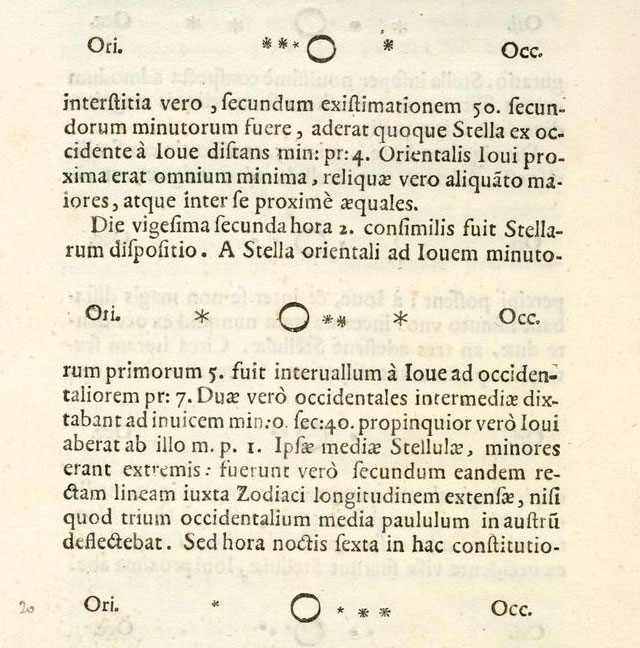
Using an online tool for computing the positions of Jupiter’s moons, Ernie Wright compared Galileo’s sketches to the moons’ actual motions.

Click through for an animated GIF of all the comparisons. Not bad for the telescopic state of the art in 1610. For a taste of how celestial objects actually appeared when viewed through Galileo’s telescope, check out this video starting around 7:30. (thx, john)
Well, here’s something potentially interesting: researchers at Cardiff University think they have found fossils in meteorite fragments from Sri Lanka.
The most startling claims, however, are based on electron microscope images of structures within the stones (see above). Wallis and co say that one image shows a complex, thick-walled, carbon-rich microfossil about 100 micrometres across that bares similarities with a group of largely extinct marine dinoflagellate algae.
They say another image shows well-preserved flagella that are 2 micrometres in diameter and 100 micrometres long. By terrestrial standards, that’s extremely long and thin, which Wallis and co interpret as evidence of formation in a low-gravity, low-pressure environment.
Gotta take this with a massive grain of salt, but it will be interesting to see how this one plays out.
Update: One of the authors of this study holds some unusual views about life on Earth.
On May 24, 2003 The Lancet published a letter from Wickramasinghe, jointly signed by Milton Wainwright and Jayant Narlikar, in which they hypothesized that the virus that causes Severe Acute Respiratory Syndrome (SARS) could be extraterrestrial in origin and not originated from chickens.
Wickramasinghe and his mentor Fred Hoyle have also used their data to argue in favor of cosmic ancestry, and against evolution.
Like I said, big grain of salt. (thx, onno)
You’ve likely seen the graph of the Earth’s average global temperature over the past 2000 years…it’s mostly a straight line until you get to the industrial revolution and then it shoots up. It looks like a hockey stick. In a study published today in Science, that graph has been extended back 11,300 years and you can really see the scope of the abrupt temperature change.
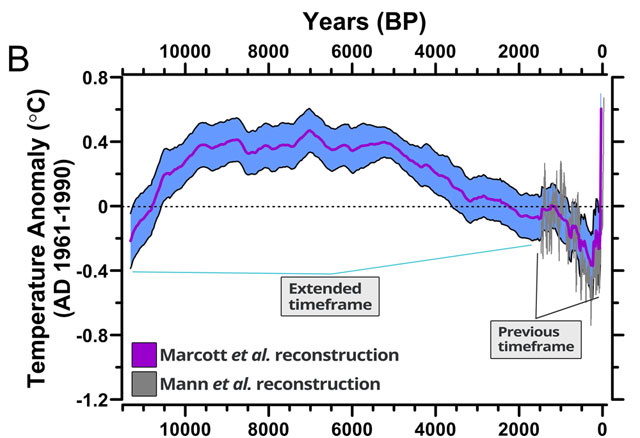
From a summary of the report at TPM:
The decade of 1900 to 1910 was one of the coolest in the past 11,300 years - cooler than 95 percent of the other years, the marine fossil data suggest. Yet 100 years later, the decade of 2000 to 2010 was one of the warmest, said study lead author Shaun Marcott of Oregon State University. Global thermometer records only go back to 1880, and those show the last decade was the hottest for this more recent time period.
“In 100 years, we’ve gone from the cold end of the spectrum to the warm end of the spectrum,” Marcott said. “We’ve never seen something this rapid. Even in the ice age the global temperature never changed this quickly.”
Using fossils from all over the world, Marcott presents the longest continuous record of Earth’s average temperature. One of his co-authors last year used the same method to look even farther back. This study fills in the crucial post-ice age time during early human civilization.
Marcott’s data indicates that it took 4,000 years for the world to warm about 1.25 degrees from the end of the ice age to about 7,000 years ago. The same fossil-based data suggest a similar level of warming occurring in just one generation: from the 1920s to the 1940s. Actual thermometer records don’t show the rise from the 1920s to the 1940s was quite that big and Marcott said for such recent time periods it is better to use actual thermometer readings than his proxies.
(via digg)
Paul Frampton is a 69-year-old theoretical particle physicist who has co-authored papers with Nobel laureates. In late 2011, the absentminded professor met a Czech bikini model online. Over email and Yahoo chat, they became romantically involved and she sent him a plane ticket to come meet her at a photo shoot in Bolivia. Then she asked him to bring a bag of hers with him on his flight.
While in Bolivia, Frampton corresponded with an old friend, John Dixon, a physicist and lawyer who lives in Ontario. When Frampton explained what he was up to, Dixon became alarmed. His warnings to Frampton were unequivocal, Dixon told me not long ago, still clearly upset: “I said: ‘Well, inside that suitcase sewn into the lining will be cocaine. You’re in big trouble.’ Paul said, ‘I’ll be careful, I’ll make sure there isn’t cocaine in there and if there is, I’ll ask them to remove it.’ I thought they were probably going to kidnap him and torture him to get his money. I didn’t know he didn’t have money. I said, ‘Well, you’re going to be killed, Paul, so whom should I contact when you disappear?’ And he said, ‘You can contact my brother and my former wife.’ ” Frampton later told me that he shrugged off Dixon’s warnings about drugs as melodramatic, adding that he rarely pays attention to the opinions of others.
On the evening of Jan. 20, nine days after he arrived in Bolivia, a man Frampton describes as Hispanic but whom he didn’t get a good look at handed him a bag out on the dark street in front of his hotel. Frampton was expecting to be given an Hermès or a Louis Vuitton, but the bag was an utterly commonplace black cloth suitcase with wheels. Once he was back in his room, he opened it. It was empty. He wrote to Milani, asking why this particular suitcase was so important. She told him it had “sentimental value.” The next morning, he filled it with his dirty laundry and headed to the airport.
Crazy story. (via @stevenstrogatz)
Newer posts
Older posts




Socials & More