kottke.org posts about movies
Skip Lievsay is one of the best sound designers in the business, having won an Oscar for his work on Gravity and worked on such films as Goodfellas, Silence of the Lambs, Do The Right Thing, and all of the Coen brothers’ movies. Jordan Kisner recently profiled Lievsay for The Guardian.
It is a central principle of sound editing that people hear what they are conditioned to hear, not what they are actually hearing. The sound of rain in movies? Frying bacon. Car engines revving in a chase scene? It’s partly engines, but what gives it that visceral, gut-level grist is lion roars mixed in. To be excellent, a sound editor needs not just a sharp, trained ear, but also a gift for imagining what a sound could do, what someone else might hear.
Everyone knows that The Karate Kid is the story of Daniel LaRusso, an undersized new-kid-in-school who, with the help of a wise mentor and unconventional training in the martial arts, is able to triumph over a gang of bullies picking on him. What this video presupposes is, maybe Daniel is the real bully?
To no one’s surprise, Johnny advances to the final round and karma catches up with Daniel when his leg is injured by the boy he wantonly attacked on the soccer field. However, just as Johnny is about to be awarded his trophy, Daniel is granted unnatural strength by the demon sorcerer Miyagi, enabling him to defeat Johnny and win the tournament in an upset.
See also more revisionist history of beloved media: Hermione Granger as the real hero of the Harry Potter books and Tim Carmody’s The Iceman List, which is about “classic movie antagonists who were actually pretty much right all along”.
Update: Another one to add to the list: Ross Geller is the hero of Friends, an intellectual and romantic man who is brought low by his so-called friends:
But the characters of the show were pitted against him from the beginning (consider episode 1, when Joey says of Ross: “This guy says hello, I wanna kill myself.”) In fact, any time Ross would say anything about his interests, his studies, his ideas, whenever he was mid-sentence, one of his “friends” was sure to groan and say how boring Ross was, how stupid it is to be smart, and that nobody cares. Cue the laughter of the live studio audience. This gag went on, pretty much every episode, for 10 seasons. Can you blame Ross for going crazy?
And like a Greek tragedy, our hero is caught in a prophecy that cannot be avoided. The show’s producers, akin to the immutable voice of the gods, declared that Ross must end up with Rachel, the one who shops. Honestly, I think he could’ve done better.
I hadn’t realized there was so much cussing swearing in Wes Anderson’s movies. Here are some damn examples:
Just realized what the world is missing: the “fuck fuck fuck” scene from the first season of The Wire, but done in the style of (“cuss cuss mothercusser”) and with the characters from Fantastic Mr. Fox.
This is a guide to the famous Lorne of the Rings trilogy of movies. All your favorite characters are here, from Samsclub Gunjeans to Starman to Flowbee the Haddock to Aerosmith, daughter of Lord Efron to Gumball, son of Groin.
This is one of those that goes from “oh how can this predictable thing actually be funny” to “oh my pants are wet because I peed in them because laughing” very quickly. (via waxy)
Two weeks ago, 99% Invisible broadcast an audio documentary from 1998 about one of the last remaining flophouses on The Bowery in NYC called The Sunshine Hotel. It is an amazing time capsule from a Manhattan that just doesn’t exist anymore.
The Sunshine Hotel opened in 1922. Rooms — or really, cubicles — were 10 cents a night. The Sunshine, like other flop houses, was always a men-only establishment. In 1998, the hotel had raised it’s rates to 10 dollars a night and it was managed by resident Nathan Smith. He sat behind a metal cage at the front desk, answering the phone and doling out toilet paper to residents for 35 cents. Smith had once worked in a bank until he was injured, and then fired. His wife left him and he ended up in the Bowery, and eventually at the Sunshine Hotel.
The interviewees sound like they’re characters in a play, not real people. It’s so good. There is also a documentary film released in 2001 about The Sunshine Hotel which is available on Amazon Instant; here’s a trailer:
John Lasseter, Chief Creative Officer of Pixar, writing in The Onion: I’ve Got You Dumb Motherfuckers Eating Right Out Of My Hand.
Yes, after the success of our first few movies we had a hunch you’d continue to enjoy the wonderfully designed animation and our smart, lyrical writing, but I didn’t think we’d create a horde of drooling morons ready to drop everything just to watch a fucking rat cook dinner. Time and time again, though, there you chumps are, lined up around the block with your stupid little kids, eager to have your stupid little hearts filled with whimsy.
See also Disney’s Lasseter: Woody will find love in ‘Toy Story 4’.
Drunk Stoned Brilliant Dead is a documentary about National Lampoon coming out this fall. Here’s the trailer:
From the 1970s thru the 1990s, there was no hipper, no more outrageous comedy in print than The National Lampoon, the groundbreaking humor magazine that pushed the limits of taste and acceptability — and then pushed them even harder. Parodying everything from politics, religion, entertainment and the whole of American lifestyle, the Lampoon eventually went on to branch into successful radio shows, record albums, live stage revues and movies, including Animal House and National Lampoon’s Vacation. The publication launched the careers of legends like John Belushi, Bill Murray, Chevy Chase, Christopher Guest and Gilda Radner, who went on to gigs at Saturday Night Live and stardom.
Director Douglas Tirola’s documentary about the Lampoon, DRUNK STONED BRILLIANT DEAD: THE STORY OF THE NATIONAL LAMPOON, cleverly chronicles its founding by two former Harvard students, its growth, demise and everything in between. Told thru fresh, candid interviews with its key staff, and illustrated with hundreds of outrageous images from the mag itself (along with never-seen interview footage from the magazine’s prime), the film gives fans of the Lampoon a unique inside look at what made the magazine tick, who were its key players, and why it was so outrageously successful: a magazine that dared to think what no one was thinking, but wished they had.
(via subtraction)
Mark Reay is a former model, actor, and fashion photographer who was homeless in NYC for six years. Homme Less is a documentary on Reay; here’s a trailer:
So began a period of my life sleeping rough. It was pretty tiring, and I didn’t have much luck with the photos, but I stuck it out. I’ve never let the lack of money stop me having a good time, and I still had (dwindling) savings from my modelling. It was a happy time. At night I would always treat myself to a rotisserie chicken, but I always wanted a chilled rosé with it. So, in the afternoon, I would sneak into a minimarket, get the cheapest one from the shelf and hide it under the frozen peas. Then, at night, I would put on a fresh shirt and go to one of the fancy bars with my wine in my bag. Again, maybe because I had a certain look, no one ever checked my bag. I’d just go in, nick a glass off the counter and drink my wine surrounded my millionaires.
You can get away with anything if you’re confident. Oh, and male, white, and good looking.
Here’s the teaser trailer for Quentin Tarantino’s The Hateful Eight. (This one was certainly not the trailer.)
Update: A second longer trailer is out:
Justin Hall has been sharing his life online for over 20 years at links.net. Justin’s Links from the Underground was one of the first sites I found and read regularly, back in the mid 90s. Now Hall has made a documentary about his time online, overshare: the links.net story.
Starting in 1994, my personal web site Justin’s Links from the Underground has documented family secrets, romantic relationships, and my experiments with sex and drugs.
overshare: the links.net story is a documentary about fumbling to foster intimacy between strangers online. Through interviews, analysis and graphic animations, I share my motivations, my joys and my sorrows from pioneering personal sharing for the 21st century. In 2004 the New York Times referred to me as “perhaps the founding father of personal weblogging.” I hope this documentary reveals that I was a privileged white male with access to technology who worked to invite as many people as possible to join him in co-creating an internet where we have a chance to honestly share of our humanity.
The movie is available in various formats, including as a digital download with extra footage from VHX for $11.99.
From Back to the Future’s DeLorean to Dr. Who’s Tardis, here’s a listing of sci-fi vehicles ranked from slowest to fastest.

In the ongoing struggle of Star Wars vs. Star Trek, Wars is the clear winner in the speed category: the Millennium Falcon is thousands of times faster than the Enterprise. Also, I didn’t know the Death Star was so fast!
Are computer generated special effects ruining movies? Freddie Wong says no; CG is so good these days that we only notice it when it’s bad and in bad movies.
My biggest concern with CG is with unrealistic camera movements, e.g. like when the camera is following Spider-Man swooping all over NYC. I can’t not notice it and it almost always takes me out of the experience, which is the opposite of what I want. (via @tonyszhou)
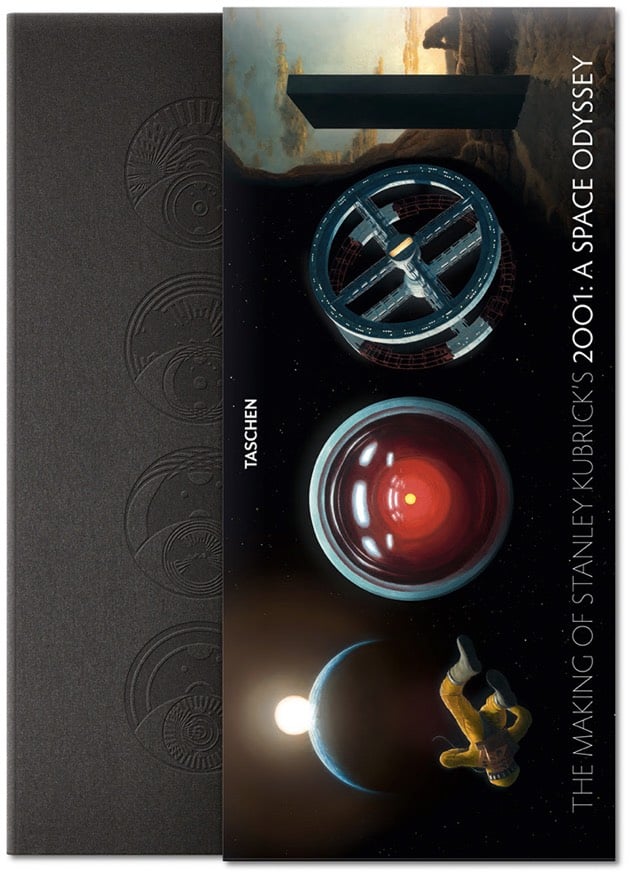
Last year, Taschen came out with a limited edition book on The Making of Stanley Kubrick’s ‘2001: A Space Odyssey’. Only a couple thousand were made and one of them is selling on Amazon for $1750. This year, they’re releasing a regular edition for a much more reasonable $47. (via @michaelbierut)
Using images found on the internet through Google’s visually similar images feature, NASA, U.S. Geological Survey, and various mapping services, Kelli Anderson recreated part of the Eames’ iconic Powers of Ten as a flipbook. Watch a video here:
Or play around with a virtual flipbook at Anderson’s site. This could not possibly be anymore in my wheelhouse. Here’s the nitty gritty on how she made it happen.
The inspiration for making discontinuous-bits-of-culture into something continuous goes back to 2011. Some of my friends camped out on a sidewalk to see Christian Marclay’s The Clock. Like a loser with a deadline, I missed out-only catching it years later at MoMA. In the day-long film, Marclay recreates each minute of the 24-hour day using clips from films featuring the current time-on a clock or watch. It runs in perfect synchronization with the audience’s day (so: while a museum crowd slumps sleepily in their chairs at 6am, starlets hit snooze on the clocks onscreen.)
There’s a documentary on Steve Jobs coming out called Steve Jobs: The Man in the Machine. The director is Alex Gibney, who directed the excellent Going Clear (about Scientology), We Steal Secrets (about Wikileaks), and Enron: The Smartest Guys in the Room. The trailer:
From Aaron Reese at Hopes&Fears, a piece on sci-fi movie sound effects. It’s chock full of interesting tidbits, like where King Kong’s chest-beating sound came from:
Initial attempts hitting a fixed kettle drum with paddled-drumsticks didn’t work, with Spivak saying the sound wasn’t “fleshy” enough. An experiment beating the floor failed as well. So Spivak decided to beat one of his assistant’s chests with drumsticks instead, saying “If wood will not take the place of flesh, then let’s use flesh.” Sure enough, this was the sound used for production.
The stabbing noise in Psycho is a knife plunging into a melon:
In a recording studio, prop man [Bob] Bone auditioned the melons for Hitchcock, who sat listening with his eyes closed. When the table was littered with shredded fruit, Hitchcock opened his eyes, and intoned simply: “Casaba.”
And my favorite, from Terminator 2:
In Robert Patrick’s T-1000 prison break scene, the robot phases through the cell bars with a slurpy metallic sound. Oscar-winning sound designer Gary Rydstrom revealed the effect was achieved by a simple solution from the sound of dog food being slowly sucked out of the can.
See also a short video tribute to the sounds of Star Wars.
Casper Christensen cut together footage from dozens of movie car chases into one big coherent chase. Well, as coherent as you can get when you’re dealing with car chases.
There’s some fun and clever editing in here…I particularly enjoyed the stitching together of Indiana Jones and Axel Foley. And I loved the brief clip of C’était un rendez-vous, which if you haven’t seen it, is a quick and thrilling watch.
In Pitchfork, Susan Shepard writes about how Magic Mike XXL uses strip club music to full advantage.
MMXXL functions more like a musical in that it uses the dance sequences deliberately to advance the plot; Mike doesn’t talk about wanting to get the band back together, he dances about it when “Pony” comes on in his workshop. Big Dick Richie finds the heart of his stripper character dancing to “I Want It That Way”. Malik challenges Mike to “Sex You”. And ultimately, they all find out something about themselves when they create new routines to new songs for the finale. It could transition seamlessly to the stage. They’re even already acting out the lyrics, which are for the most part of “this is what I want to do to you” tradition of R&B.
The film gets at the heart of strip club culture with its scenes at Domina, the exclusive club run by Mike’s former lover and working partner, Rome. All the best strip club ideas come from black clubs, specifically those in the South. Every good innovation in strip club dancing, music, and costume styles started in Atlanta or Houston or Miami clubs. The way the Florida dancers feel when they walk in and see Augustus, Andre, and Malik outdance and outperform them is exactly what it feels like to walk into Magic City from the Cheetah. Here is the future, here is how far behind it you are with your fireman routines and Kiss songs.
Having never been to a strip club in my entire life (WHAT?!! I know! I know!), I had no idea that Nine Inch Nails’ Closer was a strip club staple.
My very first stage performance was to the Revolting Cocks’ version of “Do Ya Think I’m Sexy” and Nine Inch Nails’ “Closer”, about a month after it had come out. It is one of those songs strippers fight over performing to because it’s that good and gets such a crowd response. “Closer” might as well be strip club furniture.
But it makes sense. Closer is one of the catchiest pop songs ever made. Shortly after it came out, I remember going to an on-campus party at which a friend of mine was DJing. He was playing mostly dance music — some club, some top 40ish, and some electronica — but threw on Closer for the benefit of a friend of ours who was a big industrial and NIN fan. Everyone loved it and got out onto the dance floor: the jocks, the ravers, the sorority girls, the physics club geeks. Our friend wasn’t too happy about it though. Somehow, Nine Inch Nails now belonged to everyone. Cultural appropriation is a biiii….
If you are a fan of Raiders of the Lost Ark — and who isn’t? — then this is your holy grail: a feature-length commentary on the movie by Jamie Benning that includes seemingly every tidbit related to the film, including deleted scenes, audio commentary from the cast and crew, behind the scenes video, and much more. An incredible resource in understanding the film.
Benning has also done similarly excellent commentaries for Jaws, Star Wars, Empire Strikes Back, and Return of the Jedi. (via @drwave)
Every day, a program written by Julien Deswaef selects a war-related news item from the NY Times, formats it in the style of the infamous Star Wars opening crawl (complete with John Williams’ score), and posts the results to YouTube.
Published yesterday, the crawl for Episode XXVII was taken from a NY Times article about an Obama speech about the Iranian nuclear deal.
Here’s how the project was made and if you’d like to try it yourself, grab the source code. (via prosthetic knowledge)
Ok, so narrowing down all of the beautifully shot movies in the world to a list of just 10 is absurd, but to their credit, the gang at Cinefix manage to mention more than 50 or 60 movies in their top 10 review. If you’ve only seen even a few of these, you’re doing well.
Manhattan, Citizen Kane, The Fall, 2001, Hero, The Tree of Life. Damn.

Hold onto your butts, gang… I just found out, via Pixar’s Michael B. Johnson, that the 3D file manager that Lex uses in Jurassic Park — “It’s a Unix system, I know this” — was a real thing. FSN (File System Navigator) was a demo tool for Silicon Graphics’ IRIX operating system that you could download from their web site.
P.S. In that same thread, Johnson shares that his office was the inspiration for Dennis Nedry’s work area.
For the first time since 2005, Pixar didn’t release a movie last year but are doubling up this year with Inside Out and The Good Dinosaur. Here’s the trailer for The Good Dinosaur, which looks like much more of a just-for-kids movie than Inside Out.
Man at Arms is a YouTube show in which real-life weapons from movies and TV shows are recreated. Recently they made the Bride’s Hattori Hanzo sword from Kill Bill. They started from scratch by building a furnace from before the Edo period (before 1603) to smelt the iron ore.
I know zero about swords, but it looks like these guys really did their homework in making as close to a traditional katana blade as they could. (via devour)
A compilation of some of the world special effects ever to make it to the big screen. Some of these are almost too bad to believe.
(via devour)
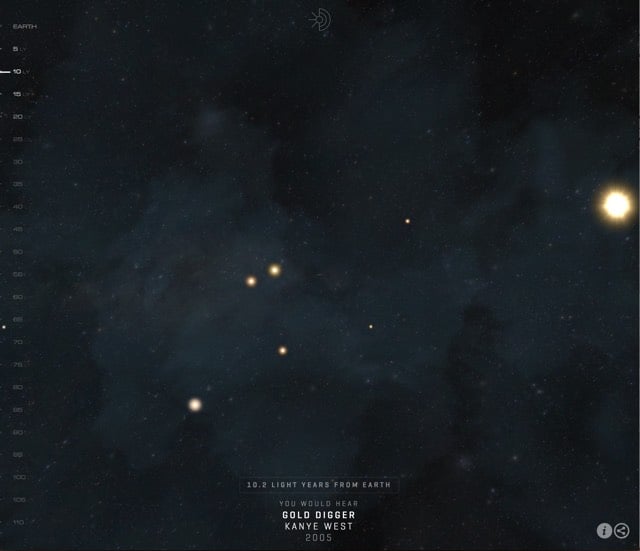
Taking inspiration from the opening sequence of Contact, lightyear.fm is a musical journey away from the Earth. As you get farther out (say, 10 light years away, just past star Ross 154 in the constellation of Sagittarius), you hear music that was broadcast on the radio at that time (Gold Digger by Kanye West).
Radio broadcasts leave Earth at the speed of light. Scroll away from Earth and hear how far the biggest hits of the past have travelled. The farther away you get, the longer the waves take to travel there — and the older the music you’ll hear.
This is the coolest.
They showed this 3 minute 30 second behind the scenes video of Star Wars: The Force Awakens at Comic-Con yesterday.
Fans at San Diego Comic-Con’s Hall H were treated to a special look behind the scenes of Star Wars:The Force Awakens by director J.J. Abrams, producer and Lucasfilm President Kathleen Kennedy and writer Lawrence Kasdan. The filmmakers were joined on stage by cast members Daisy Ridley, John Boyega, Adam Driver, Oscar Isaac, Domhnall Gleeson, Gwendoline Christie, Mark Hamill, Carrie Fisher and Harrison Ford to the surprise and delight of fans.
At the end of the Hall H presentation, the entire Hall H audience of more than 6,000 fans were all invited to continue the celebration and join cast and filmmakers at a surprise Star Wars Fan Concert. The San Diego Symphony performed the classic Star Wars music from John Williams at the Embarcadero Marina Park South.
I have zero interest in Comic-Con, but that would have been pretty cool to see.
Psychologists Dacher Keltner and Paul Ekman served as scientific consultants during the production of Pixar’s Inside Out. Keltner studies the origins of human emotion and Ekman pioneered research of microexpressions. In this NY Times piece, they discuss the science behind the movie.
Those quibbles aside, however, the movie’s portrayal of sadness successfully dramatizes two central insights from the science of emotion.
First, emotions organize — rather than disrupt — rational thinking. Traditionally, in the history of Western thought, the prevailing view has been that emotions are enemies of rationality and disruptive of cooperative social relations.
…
Second, emotions organize — rather than disrupt — our social lives. Studies have found, for example, that emotions structure (not just color) such disparate social interactions as attachment between parents and children, sibling conflicts, flirtations between young courters and negotiations between rivals.
I’ve thought about Inside Out every day since I saw it. Pixar clearly did their homework on the emotional stuff and it paid off.
The opening scenes from dozens of movies, including 2001, There Will Be Blood, Lost in Translation, Seven Samurai, and Star Wars.
(via devour)
Newer posts
Older posts






Socials & More