


Like the Silver Surfer
Surfing Google Earth using a Wii Fit Balance Board. (via quantified self)

This site is made possible by member support. 💞
Big thanks to Arcustech for hosting the site and offering amazing tech support.
When you buy through links on kottke.org, I may earn an affiliate commission. Thanks for supporting the site!
kottke.org. home of fine hypertext products since 1998.
Beloved by 86.47% of the web.
The NY Times has a timeline map showing what people from around the country said on Twitter during the Super Bowl broadcast. I like the emoticons tab but they also should have included a profanity tab.
A zoomable National Geographic map of the Moon from 1969. Richard Furno worked on the map and tells the very long story of how it came about. One of the first images on the page is from a Soviet mission called Luna-3 that took the first photographs of the far side of the Moon. (thx, lynda)
I’m still fascinated by the water landing of US Airways flight 1549 on the Hudson River late last week. Here are a few more things I’ve seen related to it over the last couple of days.
First the videos. Someone visiting the Bronx Zoo caught the plane on video, flying low in the sky just after the bird strike. A Coast Guard video monitoring station got a shot of the plane just after it splashed down…you can see the spray from the impact flying in from the left of the video just after the 2:00 mark.
Soon after the plane hits, the camera zooms in and you can see just how quickly people get out and onto the wings. And then this video shows it most clearly:
Look how low and level and steady Sully guided that thing in! Amazing!
The NY Times has a couple of good pieces in their extensive crash coverage. I loved reading what various passengers had to say about the crash, lots of little moments of heroism in there.
The life raft attached to the plane was upside down in the river, just out of reach. Mr. Wentzell turned and found another passenger, Carl Bazarian, an investment banker from Florida who, at 62, was twice his age. Mr. Wentzell grabbed the wrist of Mr. Bazarian, who grabbed a third man who held onto the plane. Mr. Wentzell then leaned out to flip the raft. “Carl was Iron Man that day,” Mr. Wentzell said. “We got the raft stabilized and we got on.” A man went into the water, and the door salesman and the banker hauled him aboard. He curled in a fetal position, freezing.
The Times also comes through with the 3-D flight graphic I asked for the other day but they upped the ante with a seating chart of the plane where you can click on certain passengers’ seats to read their thoughts. Mark Hood in seat 2A described the landing:
When we touched down, it was like a log ride at Six Flags. It was that smooth.
The whole thing is still so amazing. Looking at the underside of the plane as they lifted it from the water last night, you can see the damage to the bottom of the plane and just how close they all were to being flung all over the place or sinking quickly or a number of other different outcomes.
Slate has a slideshow of the most gerrymandered Congressional districts in the US. Gerrymandering is the practice of redistributing electoral boundaries in order to achieve a political advantage, often without regard to geography.
A map of the Milky Way done in the style of the London tube map.
I was re-reading Carl Sagan’s novel Contact recently, essentially a series of arguments about SETI wrapped into a story, and he alludes to some sort of cosmic Grand Central Station. That, coupled with my longtime interest in transit maps, got me thinking about all of this.
Compare and contrast: a map of the center of the world’s population (currently located in the northern part of south Asia) and a global accessibility map, which shows the travel time to major cities. (via lone gunman & stamen)
I made a slight addition to the kottke.org archives page the other day: a StoryMap from outside.in’s GeoToolkit.
[I removed the map temporarily because it wasn’t loading.]
To construct the map, outside.in scrapes kottke.org’s RSS feed, looks for names of specific places, and plots the related blog entries on a map. There’s not a lot of local content on kottke.org but the results are still pretty good; it works a lot better on a local site like Gothamist. [Disclosure: I am an advisor to outside.in.]
Our Dumb World is an atlas of the World presented by The Onion. It manages to inform (poorly) and entertain at the same time. For instance, here’s their description of Israel:
Home to one-third of the world’s Jews and two-thirds of the world’s anti-Semites, the nation of Israel is a place so holy that merely walking in it can gain you a place in the World to Come, nowadays often within minutes.
And about the US, “The Land Of Opportunism”:
The United States was founded in 1776 on the principles of life, liberty, and the reckless pursuit of happiness at any cost — even life and liberty.
The atlas is also available in book form.
A beautiful heart-shaped map of the NYC subway system is among the several such maps done by a pair of Korean graphic designers calling themselves Zero Per Zero.
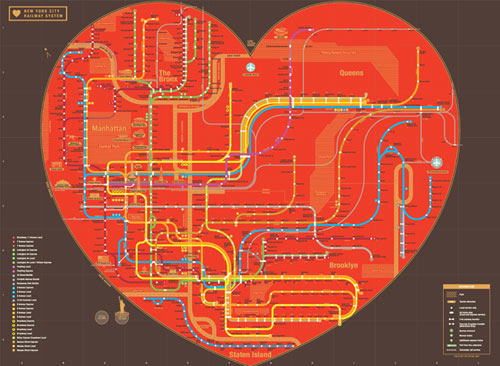
A portable map version is available for sale, but the shipping cost from Korea to the US is a bit steep.
Google is soliciting contributions to Google Maps with their Map Maker service.
With Google Map Maker, you can become a citizen cartographer and help improve the quality of maps and local information in your region. You are invited to map the world with us!
They’ve posted several videos to YouTube that show timelapsed edits to maps; here’s Islamabad, Pakistan coming into existence. (via o’reilly radar)
Update: Several people wrote in to recommend OpenStreetMap instead because Google doesn’t make the data available in a raw form whereas the OSM data is under a CC license available for derivative works like OpenCycleMap. (thx, mike and everyone)
Though not as well known as the US version, Europe has a continental divide located between the Atlantic and the Mediterranean. It doesn’t run along the Alps as much as I thought it would.
The Atlas of True Names contains maps with very literal place names.
Called the “Atlas of True Names,” the new map traces the etymological roots of European and global place names and then translates them into English. The “City of Boatmen” is also known as Paris. Should you travel to the Land of the Fire Keepers, you’d find yourself in Azerbaijan. And Italy comes from the Latin word vitulus, which means “calf.”
New York is “Wild Boar Village”, Chicago is “Stink Onion”, Great Britain is “Great Land of the Tattooed”, and Grozny is “The Awesome”. However, Language Log notes that some of the translations should be taken with a grain of salt. (thx, andreas)
According to Bender’s Game (good title!), a direct-to-DVD Futurama movie, the Planet Express HQ is located in Hell’s Kitchen right on the Hudson.
The 2008 election voting patterns in the southern United States followed the big cotton production areas in 1860 which in turn followed the shoreline of the shallow tropical seas that covered the southern part of the US 85 million years ago.
This is not a political blog. However, this is a story I couldn’t pass up: the story of how voting patterns in the 2008 election were essentially determined 85 million years ago, in the Cretaceous Period. It’s also a story about how soil science relates to political science, by way of historical chance.
Headline I’d like to see in 96 pt. type in the NY Times: Obama Elected By Rich Loamy Soils of Cretaceous Seas.
Alex Tabarrok proposes that now is a good time for the US government to form the Buffalo Commons, a huge nature preserve in the western US.
The western Great Plains are emptying of people. Some 322 of the 443 Plains counties have lost population since 1930 and a majority have lost population since 1990. Now is the time for the Federal government to sell high-priced land in the West, use some of the proceeds to deal with current problems and use some of the proceeds to buy low-priced land in the Plains creating the world’s largest nature park, The Buffalo Commons.
According to this map, the US government owns more than 50% of the land in some western states (Nevada 84.5%, Utah 57.4%, Oregon 53.1%, Arizona 48.1%, California 45.3%).
Alternate Manhattan maps, #510 in an infinite series: map of where the Marvel comic book characters hang out in the city.
Update: And of course, fans have made even better, more detailed maps. (thx, sam)
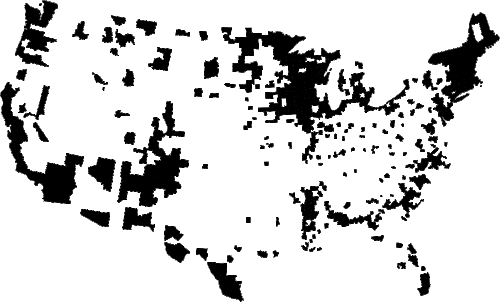
Obamaland

McCainland
I think it works much better when it’s all together, don’t you?
I added 16 new maps to the 2008 Election Maps page in what is probably the final update. Big thanks to everyone who sent in maps.
Flickr is getting slammed right now (I’m getting a lot of “hold your clicks” messages) because of the behind-the-scenes election night photos the Obama campaign put up yesterday. Maybe bookmark and come back in a few hours?
I’ve updated the post about the NY Times’ use of 96-pt type for their Obama headline. They’ve used the big type at least one additional time, on 1/1/2000.
Kristen Borchardt made an awesome video that takes a number of Nov 5th newspaper front pages and animates through them using each papers’ Obama photo as the focal point…very much like YTMND’s Paris Hilton doesn’t change facial expressions.
I’ve also updated the election headlines post with a few more collections that popped up.
Hopefully I’ll have some time this afternoon to update the 2008 Election Maps page; I’ve got lots of good submissions waiting in my inbox. Thanks to everyone who sent in links and screenshots.
Idea for the Obama administration: fireside chats. On the radio, on satellite radio, as a podcast, transcripts available online soon after airing. Done live if possible, a genuine lightly scripted chat. Maybe Obama could have special guests on to talk about different aspects of policy and government. Bush does weekly radio addresses but they’re short, boring, and scripted.
Newsweek has posted the rest of their seven-part piece on the 2008 election: part four, part five, part six, part seven. I wrote about the first three installments yesterday.
More related stuff on kottke.org: the barackobama, 2008election, and politics tags.
And I gotta tell you, if change.gov is indicative of how the Obama administration is going to use the web to engage with Americans, this is going to be an interesting four years.
Ok, that’s probably the last Obama post for a bit. Back to your irregularly unscheduled programming.
I added ten more maps to the 2008 Election Maps page, including one drawn on a dry erase board.
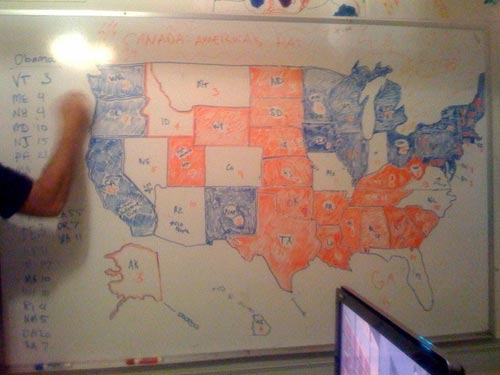
Last night as the election results were coming in online, I took screenshots of a bunch of the now-familiar red/blue electoral maps being used by the larger media sites to show election results and posted them all on this page. (There are currently 25 maps…I’m adding more in a few minutes.)
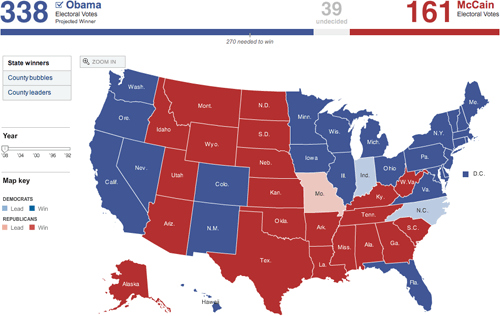
Hit me on my burner if you run across any others. A couple of quick notes:
1. No one strayed from the red and blue. The red/blue combo is overwhelmingly symbolic but there are plenty of other colors in the crayon box; I would like to have seen someone try something different.
2. In the 2000 and 2004 elections, the red/blue map was the focal point of the media coverage. People were fixated by it. This time around, it didn’t matter so much. The maps were interesting for 3-4 hours until the overwhelming nature of Obama’s victory became apparent and then, not so much. By this morning, the maps are already shrinking or disappearing from the home pages of the Times, CNN, and the like.
3. Nate Silver and the rest of the 538 guys nailed it. They got Indiana wrong and there are a couple more states that are still too close to call, but they got the rest of the map right. Their final projection had Obama getting 348.6 electoral votes and they currently have him at 349.
Flickr has enough geographically tagged photographs — 90+ million — that they are able to reverse engineer from them the shapes of continents, countries, cities, and neighborhoods.
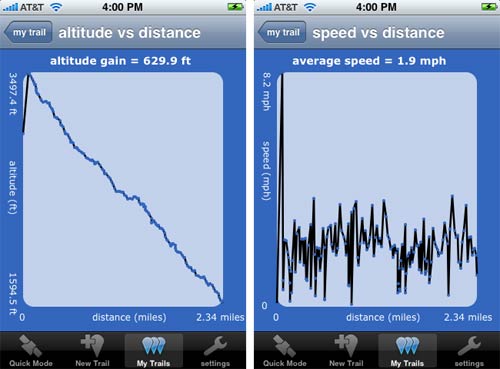
When we were up in Vermont earlier this month, we rode the single chair to the top of the mountain at Mad River Glen and then hiked down. Before we left, we installed iTrail on Meg’s phone. iTrail uses the iPhone’s GPS capability to track your progress along a trail, jogging path, etc. The reviews at the iTunes Store aren’t glowing but we found that it worked pretty well for us. Here are a couple of graphs generated by iTrail of our hike:
iTrail also allows data export to a Google Docs speadsheet. From there, you can import that data into Google Maps, like so:
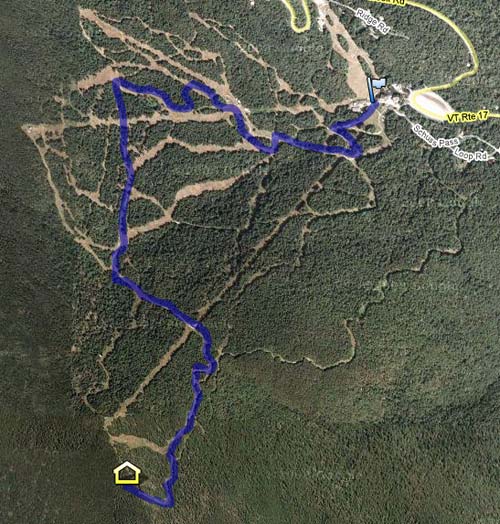
It’s not perfect (we weren’t doing 8.2 mph at the beginning of the hike) and GPS mapping apps are hardly new, but I’ve never done this before and it feels like living in the future.
SNL’s Fred Armisen shows off his interactive touchscreen skills on some political maps of the US.
Check out Michigan…I can make it bounce.
Nice commentary on TV news anchor busywork. See also Anderson Cooper’s magic pie chart. (And sorry, Hulu = US viewers only.)
Update: For non-US viewers, here’s an alternative link that includes the clip in question and a bunch of other stuff. And please don’t yell at me for using Hulu…it’s often the only alternative and it’s relatively easy to watch outside of the US. (thx, nebel)
Wow, Google Earth is now available for the iPhone. The early reviews at the iTunes Store are mixed; looks like it’s crashing a lot. (via df)
Philip Kromer took the newspaper endorsement data from the Editor and Publisher page I linked to this morning and mapped the results. The states are colored according to FiveThirtyEight’s current projections and those newspapers with larger circulations have larger circles. From Kromer’s blog post:
This seems to speak of why so many on the right feel there’s a MSM bias - 50% of the country is urban, 50% rural, but newspapers are located exclusively in urban areas. So, surprisingly, the major right-leaning papers are all located in parts of the country we consider highly leftish. The urban areas that are the largest are thus both the most liberal and the most likely to have a sizeable conservative target audience.
Nice 25-minute documentary on the London Tube map, “the pinnacle of London Transport’s modernist design”.
Socials & More