kottke.org posts about language
From Steven Pinker’s book, The Sense of Style, here are some of the most common words and phrases that trip people up.
Bemused means bewildered and does not mean amused.
Correct: The unnecessarily complex plot left me bemused. / The silly comedy amused me.
Data is a plural count noun not, standardly speaking, a mass noun. [Note: “Data is rarely used as a plural today, just as candelabra and agenda long ago ceased to be plurals,” Pinker writes. “But I still like it.”]
Correct: “This datum supports the theory, but many of the other data refute it.”
Enormity means extreme evil and does not mean enormousness. [Note: It is acceptable to use it to mean a deplorable enormousness.]
Correct: The enormity of the terrorist bombing brought bystanders to tears. / The enormousness of the homework assignment required several hours of work.
A deplorable enormousness!
From Julia Kim Smith, The Real Wi-Fi Of Baltimore, a look at the names of wifi networks in various neighborhoods of Baltimore. Some favorites:
Abraham Linksys
NSA Surveillance Van
Fuck Off
Bill Wi The Science Fi
There was even a Wu Tang LAN sighting. Note: about 4 years ago, my wireless network was called hamsterdam. Currently: surfbort.
In McSweeney’s, Vijith Assar writes about the increasingly pernicious use of the passive voice in the media and how it may have developed, one small step at a time, from:
The quick brown fox jumps over the lazy dog.
to “the ultimate in passive voice”:
Speed was involved in a jumping-related accident while a fox was brown.
Drawing upon the work of colleagues, historian Michael Todd Landis proposes new language for talking about slavery and the Civil War. In addition to favoring “labor camps” over the more romantic “plantations”, he suggests retiring the concept of the Union vs the Confederacy.
Specifically, let us drop the word “Union” when describing the United States side of the conflagration, as in “Union troops” versus “Confederate troops.” Instead of “Union,” we should say “United States.” By employing “Union” instead of “United States,” we are indirectly supporting the Confederate view of secession wherein the nation of the United States collapsed, having been built on a “sandy foundation” (according to rebel Vice President Alexander Stephens). In reality, however, the United States never ceased to exist. The Constitution continued to operate normally; elections were held; Congress, the presidency, and the courts functioned; diplomacy was conducted; taxes were collected; crimes were punished; etc. Yes, there was a massive, murderous rebellion in at least a dozen states, but that did not mean that the United States disappeared.
In seemingly disparate languages around the world, the words for “mother” and “father” are surprisingly similar…usually “mama” or “nana” for “mother” and “papa”, “baba”, “dada”, or “tata” for “father”. It’s tempting to believe these parental words were all derived from a single proto-language, but according to the work of Roman Jakobson, the words come from the first sounds all babies make.
If you’re a baby making a random sound, the easiest vowel is ah because you can make it without doing anything with your tongue or lips. Then, if you are going to vary things at all, the first impulse is to break up the stream of ahhh by closing your lips for a spell, especially since you’ve been doing that to nurse. Hence, mmmm, such that you get a string of mahs as you keep the sound going while breaking it up at intervals.
(via df)
I made a boiling frogs analogy in my post about coral bleaching this morning.
The oceans are slowly boiling and we’re the frogs who aren’t noticing.
James Fallows has been waging a small war on the use of that analogy for several years now.
You remember our old friend the boiled frog: It’s the staple of any political or business-management speech, used to show that problems that build up slowly can be explained-away or ignored, while ones that happen all of a sudden are more likely to be addressed.
Conservatives use it to talk about the expansion of the socialist state. Liberals use it to talk about climate change. Business managers use it to talk about a slide toward mediocrity. Everyone can use it to talk about something.
And that’s the problem with boiled-frogism. The minor issue is that the metaphor is flat wrong. If you put a frog in a pot of lukewarm water and gradually heat it up, the frog will stay there — until things get uncomfortably warm, at which point it will climb out. But if you drop a frog into a boil of already-boiling water, the poor creature will be so badly hurt and scalded that it will stay there and die.
I’m going to defend my usage just a little. The ocean is literally water that is getting warmer. But other than that, yeah, guilty as charged. (via @jpiz)
Get ready to update the OED. There’s a new attestation of English’s most colorful and versatile word, from the year 1310.
Dr Paul Booth of Keele University spotted the name in ‘Roger Fuckebythenavele’ in the [Cheshire] county court plea rolls beginning on December 8, 1310. The man was being named three times part of a process to be outlawed, with the final mention coming on September 28, 1311.
Dr Booth believes that “this surname is presumably a nickname. I suggest it could either mean an actual attempt at copulation by an inexperienced youth, later reported by a rejected girlfriend, or an equivalent of the word ‘dimwit’ i.e. a man who might think that that was the correct way to go about it.”
We’ve doubtlessly been using the word “fuck” in English for a lot longer; this is just an unusual set of conditions that’s led it to be preserved in the written record. Like an animal falling into a tar pit.
(Via @kirstinbutler)
John McWhorter looks at Aramaic, once the lingua franca of the near east, now reduced to about half a million speakers (who separately call it Chaldean, Syriac, Assyrian, Mandaic, etc.).
Aramaic, then, is in a splintered and tenuous state. Yet it was the English of its time—a language that united a large number of distinct peoples across a vast region, a key to accessing life beyond one’s village, and a mark of sophistication to many. The Aramaeans—according to Biblical lore named for Noah’s grandson Aram—started as a little-known nomadic group. But they were seekers, and by the 11th century B.C.E. they ruled large swaths of territory in Mesopotamia, encompassing parts of modern-day Iraq, Syria, and Turkey, including, for a spell, the city of Babylon itself. On the basis of this expansion alone, however, theirs would likely have become just one of various languages of the area that briefly enjoyed fame and then vanished in the endless game of musical chairs that was ancient Middle Eastern politics. The Aramaeans themselves were in Babylon only temporarily: In 911 B.C.E., the Assyrians, who spoke a language called Akkadian, ousted them. But the Assyrians unwittingly helped the Aramaeans’ language extinguish their own.
Namely, the Assyrians deported Aramaic-speakers far and wide, to Egypt and elsewhere. The Assyrians may have thought they were clearing their new territory, but this was like blowing on a fluffy milkweed and thinking of it as destruction rather than dissemination: The little seeds take root elsewhere.
There are many differences between English and Aramaic — English is supposedly simple and easy to learn, while Aramaic is manifestly not — but that actually had little effect on English’s emergence as a global language, or on Aramaic’s rise and decline. But one set of differences between the two languages, McWhorter argues, really is material:
At this point, I am supposed to write that English’s preeminence could end as easily as Aramaic’s. Actually, however, I doubt it: I suspect that English will hold on harder and longer than any language in history. It happened to rise to its current position at a time when three things had happened, profoundly transformative enough to stop the music, as it were: print, widespread literacy, and an omnipresent media.
Together, these things can drill a language into international consciousness in a historically unprecedented way, creating a sense of what is normal, cosmopolitan, cool even—arbitrary but possibly impregnable. If the Chinese, for example, rule the world someday, I suspect they will do it in English, just as King Darius ruled in Aramaic and Kublai Khan, despite speaking Mongolian, ruled China through Chinese translators in the 13th century C.E. Aramaic held sway at a time when a lingua franca was more fragile than it is today.
All the terminology on fancy restaurant menus can be overwhelming. From Judy Wu at Gaper’s Block, a glossary of common menu items and terms.
Gluten-Free: This dish contains a small trace of gluten, but a full dollop of bullshit.
Duck Fat: Duck fat fries, rillette, popcorn, confit, Brussels sprouts — never skip this menu item.
Amish: This chicken was raised without electricity and fear.
Jez Burrows is writing short stories composed of example sentences from the New Oxford American Dictionary. Here’s a story called Noir; the underlined words are those from which the example sentences are drawn:
The midnight hours. The rain had not stopped for days. A stranger slowly approached from the shadows. The walls threw back the echoes of his footsteps. His voice was low and shaky with emotion. A day’s growth of unshaven stubble on his chin. He took an envelope from his inside pocket. Her alabaster cheeks flushed with warmth, high cheekbones powdered with freckles. “We should talk somewhere less public.” She grabbed him by the shirt collar. “We’re going to settle this here and now.” He drew a deep, shuddering breath. Chest pains. A trickle of blood. She was smiling. “I got all dolled up for a party.”
I hadn’t realized there was so much cussing swearing in Wes Anderson’s movies. Here are some damn examples:
Just realized what the world is missing: the “fuck fuck fuck” scene from the first season of The Wire, but done in the style of (“cuss cuss mothercusser”) and with the characters from Fantastic Mr. Fox.
Polari was a secret slang language spoken by gay men in England so that they could converse together in public without fear of arrest. It fell into disuse in the 1960s, but this short film by Brian Fairbairn and Karl Eccleston features a conversation conducted entirely in Polari.
This Slate article has more on the film and Polari.
Of all the cultural forms that gay men have created and elaborated since coalescing into a social group around the late 19th century, Polari, a full-fledged gay English dialect with roots among circus folk, sailors, and prostitutes, has to be one of the most fascinating-not least since it has faded along with the need for discretion and secrecy. While some words remain in common use-zhush or zhoosh (to adjust or embellish something to make it more pleasing) and trade (highly masculine or straight-acting sex partners) come to mind — the richness that we know once defined Polari is difficult to capture in 2015.
From Mark Christian, a selection of deliciously pun-filled food truck name ideas. Some favorites:
Shwarmageddon
Calamari Damacy
Get Quiche Or Die Tryin’
What About Kebab?
Planet of the Crepes
Naan Disclosure Agreement
Entrée the Giant
(via @mathowie)

Tyler Ford was born a girl, transitioned to being a man in college, but now identifies as an agender person.
I have been out as an agender, or genderless, person for about a year now. To me, this simply means having the freedom to exist as a person without being confined by the limits of the western gender binary. I wear what I want to wear, and do what I want to do, because it is absurd to limit myself to certain activities, behaviours or expressions based on gender. People don’t know what to make of me when they see me, because they feel my features contradict one another. They see no room for the curve of my hips to coexist with my facial hair; they desperately want me to be someone they can easily categorise. My existence causes people to question everything they have been taught about gender, which in turn inspires them to question what they know about themselves, and that scares them. Strangers are often desperate to figure out what genitalia I have, in the hope that my body holds the key to some great secret and unavoidable truth about myself and my gender. It doesn’t. My words hold my truth. My body is simply the vehicle that gives me the opportunity to express myself.
Ford uses the “they”, “them”, and “their” pronouns to refer to themselves. (Is it themselves? Or would it be themself? English is a relatively young and fluid language but even it can’t keep up.)
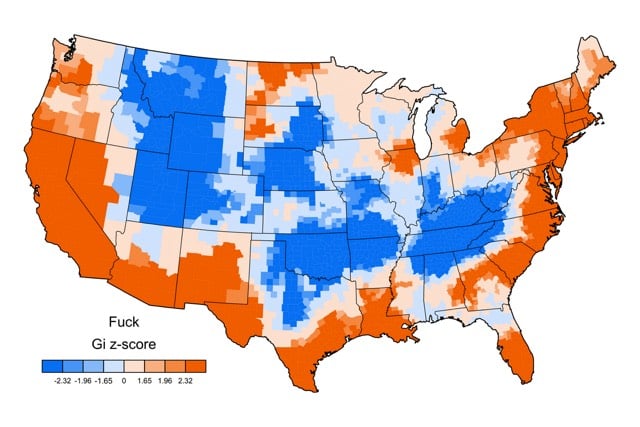
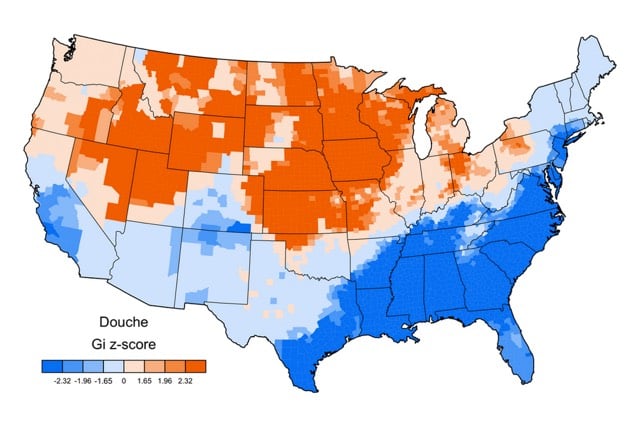
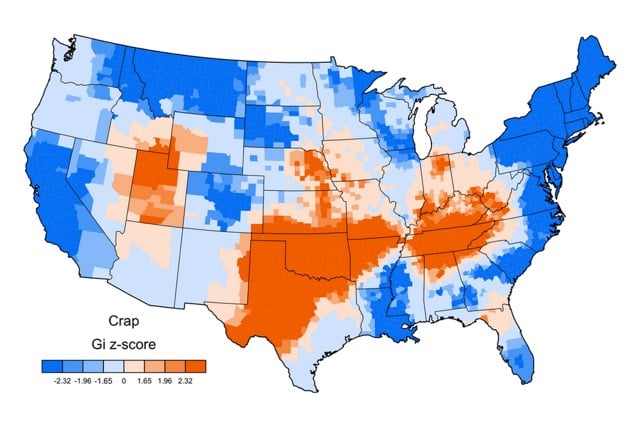
Most everyone in the United States swears, but the specific words used vary by region. For example, “fuck” is popular in California but not so much in Oklahoma, which is the “crap” epicenter of America. “Motherfucker” is unusually popular in Maine, as is “shit” in the Southeast, “douche” in Iowa, and “fuckboy” in Jersey.
Newer posts
Older posts





Socials & More