



Profile of the fortune writer for Wonton Food, Inc.
Profile of the fortune writer for Wonton Food, Inc..

This site is made possible by member support. 💞
Big thanks to Arcustech for hosting the site and offering amazing tech support.
When you buy through links on kottke.org, I may earn an affiliate commission. Thanks for supporting the site!
kottke.org. home of fine hypertext products since 1998.
Beloved by 86.47% of the web.
Profile of the fortune writer for Wonton Food, Inc..
Some great tips on grilling. “And if you think this takes a lot of time and concentration, you’re right. There’s time enough for socializing later. Do you want to grill an excellent steak or not? Okay, then. Concentrate.”
Google’s famous chef is leaving the company. It must be hard to cook free lunches when you’re so filthy, stinking rich.
50 things every foodie should do at some point in their life.
Victoria Reynolds paints meat. Meat as subject, not meat as canvas. Very strange and cool.
The Hacker’s Diet: how to lose weight and hair through stress and poor nutrition.
Photos of the 28-course tasting menu at chef Grant Achatz’s Alinea.
Frank Bruni on avant guard cuisine (also called molecular gastronomy).
The Modern, the fancy restaurant at the MoMA, gets two stars from the NY Times.
Slideshow of iPod shuffles made out of food. The winner of the contest is made out of banana, apple, and spaghetti. And there’s one made of Spam!
James Beard Award winners for 2005. Batali is best chef, Per Se is best new restaurant, Danny Meyer is “outstanding restauranteur”.
Americans are getting more excited about cheese these days.
“More big chefs are getting paid to pitch everything from shrimp to raisins — and not telling their customers”. “The Seafood institute pays [chef Ty Fredrickson’s restaurant group] $10,000 a year to have the word Alaska in front of its king-crab and halibut dishes.”
A salt taste test: “From fleur de sel to kosher, which salt is best?”.
Taste of Chinatown 2005, April 23 from 1-6pm. Fifty restaurants are offering $1.00 tasting plates in Chinatown tomorrow afternoon. Delicious!
The Fat Duck, a UK restaurant known for its “molecular gastronomy” approach, has nabbed the top spot in Restaurant magazines best of list. El Bulli is #2, French Laundry is 3rd, Per Se is 6th, and several other London spots made the top 20.
Old (but great) Jeffrey Steingarten on learning how to eat everything.
Mark Bittman cooks homemade food in challenging America’s top chefs. Daniel Boulud laughed at the complexity of Bittman’s dish, but gave an 8/10 in taste…and it only took 10 minutes to prepare.
Nominees for the 2005 James Beard Awards announced (PDF file). Nominees include Steingarten, many Minneapolis journalists, Blue Hill at Stone Barnes, Per Se, Keller, Boulud, Danny Meyer, Dan Barber. All five best new restaurtant nominees are in NY.
Two years ago, Calvin Trillin wrote an article for the New Yorker about Shopsin’s, an eccentric eatery in the West Village with about 9 billion menu items:
What does happen occasionally is that Kenny gets an idea for a dish and writes on the specials board — yes, there is a specials board — something like Indomalekian Sunrise Stew. (Kenny and his oldest son, Charlie, invented the country of Indomalekia along with its culinary traditions.) A couple of weeks later, someone finally orders Indomalekian Sunrise Stew and Kenny can’t remember what he had in mind when he thought it up. Fortunately, the customer doesn’t know, either, so Kenny just invents it again on the spot.
Shopsin’s has moved to another Village location since the article came out, but they’ve still got that big old menu. If you dare, feast your eyes on a tour de force of outsider information design, all 11 pages of the Shopsin’s General Store menu.
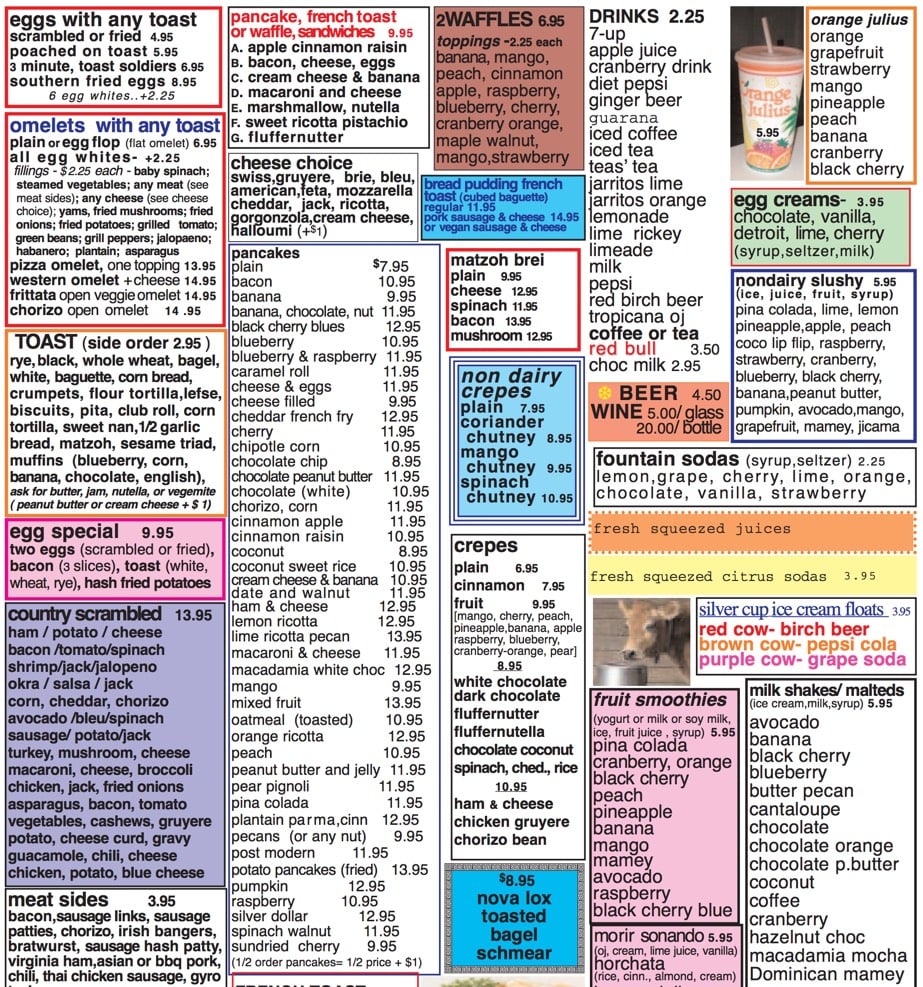
You want chicken fried eggs with a side of pancakes? Page 6. On page 1, there’s gotta be 100 soups alone, including Pistachio Red Chicken Curry. I lost count after 40 different kinds of pancakes on page 10. In amongst the kate, gregg, tamara, and sneaky pete sandwiches on page 2, you’ll find the northern sandwich: peanut butter & bacon on white toast. There appears to be nothing that’s not on the menu, although I looked pretty hard for foie gras and couldn’t find it. If they did have it, you could probably get it chicken fried with whipped cream on top.
On page 8, page 11, and the front of their Web site, you’ll find the restaurant rules:
- No cell phone use
- One meal per person minimum (everyone’s got to eat)
- No smoking
- Limit four people per group
On that last point, the menu has something additional to add (page 4):
Party of Five
you could put a chair at the end
or push the tables together
but dont bother
This banged-up little restaurant
where you would expect no rules at all
has a firm policy against seating
parties of five
And you know you are a party of five
It doesn’t matter if one of you
offers to leave or if
you say you could split into
a party of three and a party of two
or if the five of you come back tomorrow
in Richard Nixon masks and try to pretend
that you don’t know each other
It won’t work: You’re a party of five
even if you’re a beloved regular
Even if the place is empty
Even if you bring logic to bear
Even if you’re a tackle for the Chicago Bears
it won’t work
You’re a party of five
You will always be a party of five
Ahundred blocks from here
a hundred years from now
you will still be a party of five
and you will never savor the soup
or compare the coffee
or hear the wisdom of the cook
and the wit of the waitress or
get to hum the old -time tunes
among which you will find
no quintets— Robert Hershon
Love it, love it, love it, and I have to get my ass over there one of these days.
Lobstergate: David Foster Wallace and his Gourmet article about the Maine Lobster Festival. Wallace’s article is fantastic.
As competitive and crazy as he makes the CIA (Culinary Institute of America) sound, I was surprised that, even though he didn’t attend a full slate of classes or do an externship like all of his classmates, Ruhlman was not only able to keep up with everyone, but seemed to excel at times. And somehow, he was able to take notes about what he was doing and conversations he had with instructors and classmates.
Hotdish is a delicacy enjoyed by the inhabitants of the upper midwestern United States. For those of you who haven’t spent a lot of time in the flyover states, hotdish is a dish typically baked in one pan and contains a meat, a starch, and a vegetable with optional cheese or onion crisps. It’s what the rest of the US would call a casserole. Hotdish is the food of my people.
The Cadillac of hotdishes is tater tot hotdish, and here’s how you go about making it.
Step 1: Panic.
You may want to skip this step. I did, and it worked out fine.
Step 2: Learn how to peel an onion.
I did not know this going in. Valuable minutes were wasted as tears welled up in my eyes from the onion essence.
Step 3: Collect ingredients and supplies
These should include:
1.5 pounds beef, ground
1 onion, chopped
2 cans of Campbell’s cream soup (mushroom, celery, chicken, pick two)
1 soup can-worth of milk
1 can french cut green beans
1 package tater tots
1 pound cheddar cheese, grated
1 9”x13” baking pan
You can find all of these items at your local grocery store and/or in your kitchen cupboard. This task is immensely easier in rural Wisconsin than in, say, Greenwich Village; they practically sell all these items together in a blister-packed kit back home while locating the french cut green beans at D’Agostino’s was a bit touch and go.
Step 4: Assemble the hotdish
Chop the onions. Grate the cheese. In a largish pot, brown the ground beef and onions. Into the pot goes the soups, the milk, and the green beans. Stir and cook until warmish/hot. Cover the bottom of the 9x13 baking pan with the tater tots, pour the hamburger/soup mixture over them, and cover liberally with the grated cheese. Bake at 350°F for 45 minutes. Let stand for 5 minutes. Serve.
Jared Diamond has written a fantastic book that lays out in simple terms how Europeans came to dominate the rest of the world without resorting to racist notions of Europeans being intrinsically smarter or more gifted than the inhabitants of the rest of the world. Diamond’s thesis is so simple and powerful, it seems, as Erdos would say, to come from “God’s book of proofs”. An illustration of this powerful simplicity is how the orientation of the continents affected the spread of domestication of crops, animals, germs, and ideas (which in turn influenced how fast difference cultures matured):
Why was the spread of crops from the Fertile Crescent so rapid? The answer partly depends on that east-west axis of Eurasia with which I opened this chapter. Localities distributed east and west of each other at the same latitude share exactly the same day length and its seasonal variations. To a lesser degree, they also tend to share similar diseases, regimes of temperature and rainfall, and habitats or biomes (types of vegetation). That’s part of the reason why Fertile Crescent [crops and animals] spread west and east so rapidly: they were already well adapted to the climates of the regions to which they were spreading.
“Next!” said the coffee & donut man (who I’ll refer to as “Ralph”) from his tiny silver shop-on-wheels, one of many that dot Manhattan on weekday mornings. I stepped up to the window, ordered a glazed donut (75 cents), and when he handed it to me, I handed a dollar bill back through the window. Ralph motioned to the pile of change scattered on the counter and hurried on to the next customer, yelling “Next!” over my shoulder. I put the bill down and grabbed a quarter from the pile.
Maybe this situation is typical of Manhattan coffee & donut carts (although two carts near where I work don’t do this), but this was the first business establishment I’ve ever been to that lets its customers make their own change. Intrigued, I walked a few steps away and turned around to watch the interaction between this business and its customers. For five minutes, everyone either threw down exact change or made their own change without any notice from Ralph; he was just too busy pouring coffee or retrieving crullers to pay any attention to the money situation.
If you were the CEO of a big business — say, a movie studio, music company, or multinational bank — you’d have been tearing your hair out at this scene. He lets his customers make their own change?!?!! How does he know they’re making the correct change? Or putting down any change at all? Or even stealing the change? Where’s the technology that prevents the change from being stolen while he’s not looking? Surely there’s a machine that could be invented to keep track of it. Bad, bad, bad! Unclean, unclean! Does not compute…
Hold on there, Mr. CEO, don’t go all HAL 9000 on us. Ralph probably does lose a little bit of change each day to theft & bad math, but more than makes up for it in other ways. The throughput of that tiny stand is amazing. For comparison’s sake, I staked out two nearby donut & coffee stands and their time spent per customer was almost double that of Ralph’s stand. So, Ralph’s doing roughly twice the business with the same resources. Let’s see Citibank do that.
It’s also apparent that Ralph trusts his customers, and that they both appreciate and return that sense of trust (I know I do). Trust is one of the most difficult “assets” for companies to acquire, but also one of the most valuable. Many companies take shortcuts in getting their customers to trust them, paying lip service to Trust™ in press releases and marketing brochures. Which works, temporarily and superficially, but when you get down to it, you can’t market trust…it needs to be earned. People trust you when you trust them.
When an environment of trust is created, good things start happening. Ralph can serve twice as many customers. People get their coffee in half the time. Due to this time savings, people become regulars. Regulars provide Ralph’s business with stability, a good reputation, and with customers who have an interest in making correct change (to keep the line moving and keep Ralph in business). Lots of customers who make correct change increase Ralph’s profit margin. Etc. Etc.
And what did Ralph have to pay for all this? A bit of change here and there.

Socials & More