kottke.org posts about food
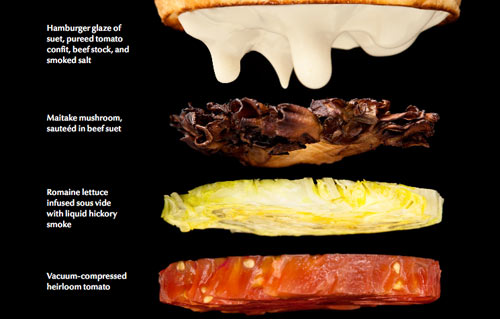
Microsoft billionaire Nathan Myhrvold’s monster 2400-page cookbook will be out in December but you can preorder it now for only $500. That’s steep but the book’s got some great blurbs from the likes of McGee, Blumenthal, Adrià, and Chang. A 20-page excerpt is available if you need convincing.
From Alan Richman in GQ, some no-nonsense guidelines for ordering wine at a restaurants.
14. I don’t care if the restaurant is pouring Chateau Latour into Minnie Mouse mugs, don’t walk into a restaurant carrying your own wine glasses. It’s more pretentious than wearing a monocle and spats.
One of the drinks that the Alinea crew is tinkering with for Aviary (a cocktail bar with food pairings) is like bubble tea crossed with gin and tonic.
(via svn)
To keep your bubbly bubbly, serve it cold and pour it like a beer into a tilted glass.
The beer-like way of serving champagne was found to impact its concentration of dissolved CO2 significantly less. Moreover, the higher the champagne temperature is, the higher its loss of dissolved CO2 during the pouring process, which finally constitutes the first analytical proof that low temperatures prolong the drink’s chill and helps it to retain its effervescence during the pouring process.
If you are filming a Girls Gone Wild video or are in the late stages of a wedding reception, pouring champagne directly into a person’s mouth is also an effective bubble-preservation technique. (via @matthiasrascher)
Jamon Iberico, the so-called “best ham in the world”, is made from a breed of pig that has been raised in Spain for 10,000 years. Fear of disease made it unavailable in the US until 2006, when one Spanish importer was finally approved. (An American company, La Quercia in Iowa, is also making waves, though purists will argue…)
In the 1500s, Spanish conquistadors exploring the new world would drop off pigs in the interest of creating a food source should they ever come back around that way again. These pigs were direct descendants of Iberian pigs, but as America settled, these pigs were passed over in favor of pigs easier to raise in captivity. Except for on Ossabaw Island, GA, where the breed remained mostly pure for 400 years. However, since pigs are about as destructive a breed as you can introduce into an ecosystem, Georgia has been working to cull the population on Ossabaw Island since 2000.
Thanks to the efforts of “hamthropologist” Peter Kaminsky, a few small farms in North Carolina are now raising Ossabaw pigs, and working to keep the breed alive. The Ossabaws suffer from insular dwarfism, making the pigs smaller, and low-grade diabetes caused by an advanced fat-storing tendency, but Kaminsky says the meat is a close approximation.
Things I learned from this article about a Thomas’ English muffin executive who wants to take a new job with Hostess Foods.
Only seven people “worldwide…know the recipe and manufacturing process that give Thomas’ English muffins their trademark ‘nooks and crannies’.”
Thomas’ English muffins’ parent company is named Bimbo USA.
Bimbo USA is a Division of a Mexican conglomerate called Grupo Bimbo.
English muffins, not found in England, are an American invention now sold by a Mexican company. Still completely delicious, though.
We are getting fatter.
The number of states with an adult obesity rate of 30 percent or more has tripled, to nine, since 2007, the Centers for Disease Control and Prevention said in a report today. Mississippi had the highest rate, 34 percent. About 75 million Americans are considered obese, the Atlanta-based CDC said.
If less people drink sugary drinks, less fewer people will be obese.
It’s not all bad news, though, as school cafeterias are mobilizing to prevent things like this:
‘You’ve got gray, mushy broccoli out? They take a bite of that, and they may never eat broccoli again. Ever. Their whole lives,’ Schwisow said, her eyes wide.
Michael Pollan on $4 peaches and $8 for a dozen eggs.
The NYT on $10 ice cream.
And for those of you who have ever wanted to get pizza from a vending machine…
Smoothie shop Jamba Juice is responding to McDonald’s jump into the smoothie market with a mock campaign selling a smooth and creamy cheeseburger smoothies. The video is a nice touch.
Somewhat related to this story, the large McDonald’s smoothies have more calories than a cheeseburger. But it’s the good kind of calories. Now all I want to know is if the smoothie cheeseburger has more calories than either the regular cheeseburger or the fruit smoothie.
The new menu at Alinea is 21 courses long and takes about 2.5 hours for a meal according to a Tweet by Alinea chef Grant Achatz. In June, Alinea announced they would only be offering one menu, down from two, though that menu was discussed as 15-16 courses.
Today in the excellent Food Lab series, Kenji Lopez-Alt reverse engineers the In-N-Out burger.
According to the In-N-Out nutrition guideline, replacing the Spread with ketchup results in a decrease of 80 calories per sandwich. I know that ketchup has about 15 calories per tablespoon, so If we estimate that an average sandwich has about 2 tablespoons of sauce on it (that’s the amount that’s inside a single packet), then we can calculate that the Spread has got about 55 calories per tablespoon (110 calories in two tablespoons of Spread minus 30 calories in 2 tablespoons of ketchup = 80 calories difference in the sandwich). With me so far?
It just so happens that relish has about the same caloric density as ketchup (15 calories per tablespoon), and that mayonnaise has a caloric density of 80 calories per tablespoon. Using all of this information and a bit of 7th grade algebra, I was able to quickly calculate that the composition of the Spread is roughly 62 percent mayo, and 38 percent ketchup/relish blend.
Here’s the recipe to make your own at home. Pairs well with make-at-home McDonald’s french fries. See also make-at-home Shake Shack burger.
This video of a robotic arm learning how to flip pancakes is surprisingly funny.
(via eater)
Here’s what it looks like when you put a variety of fruits and vegetables into an MRI machine.

Someone took all of the corn slices and stitched them together in some 3-D modeling software to remake the whole cobs. See also Big Mac MRI and hot dog MRI. (via mr)
The world’s oldest drinkable champagne has been discovered…it dates back to the time of Louis XVI and may have even been in his actual possession.
The corks kept their seal and the cold and dark of the deep Baltic preserved the champagne. Inside the bottle they found champagne, and not just champagne but drinkable champagne, complete with fizz. Ekstroem contacted champagne vintners Moet & Chandon, and they identified it with 98% certainty from the anchor marking on the cork as 18th century Veuve Clicquot.
According to records, Veuve Clicquot was first produced in 1772, but the first bottles were laid down for 10 years. “So it can’t be before 1782, and it can’t be after 1788-89, when the French Revolution disrupted production,” Ekstroem said.
ScienceBlogs has added a blog about “innovations in science, nutrition and health policy” sponsored by Pepsi to their roster. Posters to the blog will include Pepsi research staff. Some of the other bloggers on ScienceBlogs are not happy.
However, that said, I am completely mystified by ScienceBlogs’ latest development: adding the PepsiCo “nutrition” Blog. How does ScienceBlogs expect to maintain their (OUR) credibility as a science news source (we are picked up by Google news searches afterall) when they are providing paid-for content under the guise of news? Further, I cannot imagine what sorts of credible nutrition research PepsiCo is doing that they can or will actually talk about publicly, nor can I possibly imagine any “food” corporation actually caring about promoting public health. PepsiCo is a corporation, not a research institute, fer crissakes!
(via @tcarmody)
Edible Geography pays a visit to La Central de Abasto in Mexico, a contender for the world’s largest wholesale food market.
La Central de Abasto de la Ciudad de México is enormous. It sprawls across a 327 hectare site on the eastern edge of the D.F., dwarfing fellow wholesale food markets such as Hunt’s Point (24 hectares), Tsukiji (23 hectares), or even the massive Rungis, outside Paris (232 hectares).
La Central has its own postcode, its own 700-member police force, and its own border-style entry gates, but during my visit, its enormity truly hit home only when we had to take a taxi to get from flowers to fish. It was a solid fifteen minute ride from one section of the market to another!
Newer posts
Older posts





Socials & More