kottke.org posts about food
From Mallory Ortberg, a hilarious send-up of the comments you see all too frequently on recipe sites.
“I didn’t have any eggs, so I replaced them with a banana-chia-flaxseed pulse. It turned out terrible; this recipe is terrible.”
“I don’t have any of these ingredients at home. Could you rewrite this based on the food I do have in my house? I’m not going to tell you what food I have. You have to guess.”
“I don’t eat white flour, so I tried making it with raw almonds that I’d activated by chewing them with my mouth open to receive direct sunlight, and it turned out terrible. This recipe is terrible.”
“Could you please give the metric weight measurements, and sometime in the next twenty minutes; I’m making this for a dinner party and my guests are already here.”
These are barely exaggerated. I once saw a comment on a pesto recipe where the person substituted bay leaves for the basil and used other ingredients in the place of pine nuts and olive oil, then complained how bad it tasted and how terrible the recipe was. Oh, the literal humanity. (via nick)
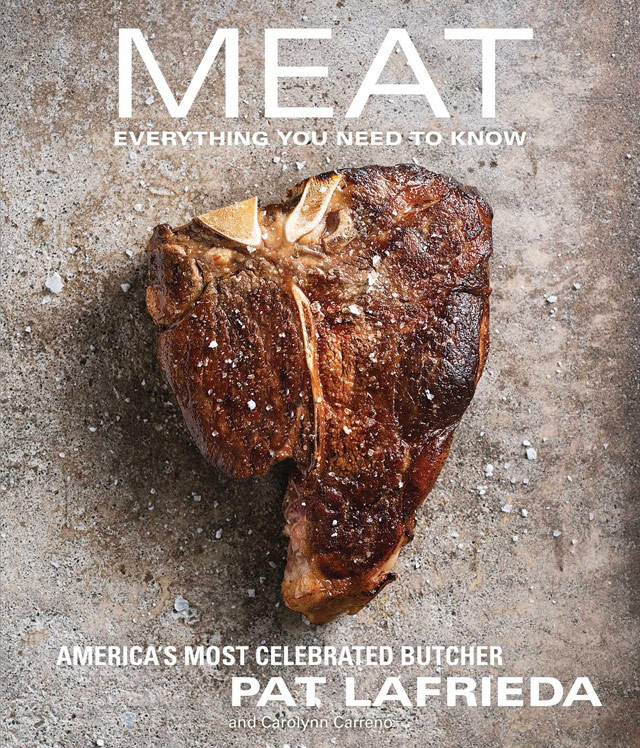
Whoa hey, super-butcher Pat LaFrieda has a cookbook out, Meat: Everything You Need to Know.
No one understands meat’s seductive hold on our palates better than America’s premier butcher, Pat LaFrieda. In Meat: Everything You Need to Know, he passionately explains the best and most flavorful cuts to purchase (some of them surprisingly inexpensive or unknown) and shares delicious recipes and meticulous techniques, all with the knowledge that comes from a fourth generation butcher. If you have ever wondered what makes the meat in America’s finest restaurants so delectable, LaFrieda — the butcher to the country’s greatest chefs — has the answers, and the philosophy behind it.
Paired up with Tartine Bread, all we need now is some emulsifying genius to hit us with Mayonnaise cookbook and we’ll be all set in sandwich-land.
David Gelb, the director of Jiro Dreams of Sushi, is going to be doing a six-part documentary series for Netflix about “culinary artists”.
Chefs featured in the docu-series are: Ben Shewry (of Attica Restaurant in Melbourne, Australia), Magnus Nilsson (Fäviken in Järpen Sweden), Francis Mallmann (El Restaurante Patagonia Sur in Buenos Aires, Argentina), Niki Nakayama (N/Naka Restaurant in Los Angeles), Dan Barber (Blue Hill in New York City and Blue Hill at Stone Barns in Pocantico Hills, N.Y.) and Massimo Bottura (Osteria Francescana in Modena, Italy).
Sounds a lot like a Jiro Dreams series. Looking forward to it. (via @MattH)
Update: The trailer for this series, Chef’s Table, is now out:
That looks fantastic. Available on Netflix on April 26th.
Here are some things you can do with instant ramen aside from eating it as directed on the package, including making a grilled cheese sandwich, gnocchi (a la David Chang), and pizza.
(via devour)
Originally from the sixth issue of the excellent Lucky Peach magazine, mad food scientist Harold McGee of the joys of aging canned food and its “extremely cooked flavor”.
This punishing heat treatment helps create the distinctive flavors of canned goods. So does the hermetically sealed container, which means that after any preliminary cooking outside the can-tuna is steamed to remove moisture, for example, and the best French sardines are lightly fried-oxygen can play only a limited role in flavor development, and that whatever happens in the can stays in the can-no aromas can escape. Hence the common presence of a sulfurous quality, which may be eggy or meaty or oniony or cabbagy or skunky, from compounds like hydrogen sulfide, various methyl sulfides, and methanethiol. Some of these notes can gradually fade during storage as the volatiles slowly react with other components of the food.
The overall flavor is nothing like freshly cooked foods. Food technologists often refer to it as “retort off-flavor.” But it’s only off in comparison to the results of ordinary cooking. It’s really just another kind of cooked flavor, an extremely cooked flavor, and it can be very good. Canned tuna, sardines, chicken spread, and Spam all have their own appeal.
(via @sippey)
Tighter FDA restrictions are keeping some classic French cheeses (Roquefort, Morbier, Tomme de Savoie) out of the US and even some American cheese makers are halting production of their cheeses because they’re afraid their products won’t meet the new standards.
In early August, these cheeses and many more landed on an FDA Import Alert because the agency found bacterial counts that exceeded its tolerance level. Cheeses on Import Alert can’t be sold in the U.S. until the producer documents corrective action and five samples test clean, a process that can take months.
Of course, French creameries haven’t changed their recipes for any of these classic cheeses. But their wheels are flunking now because the FDA has drastically cut allowances for a typically harmless bacterium by a factor of 10.
Even Parmigiano-Reggiano might be threatened by the new restrictions. Ridiculous.
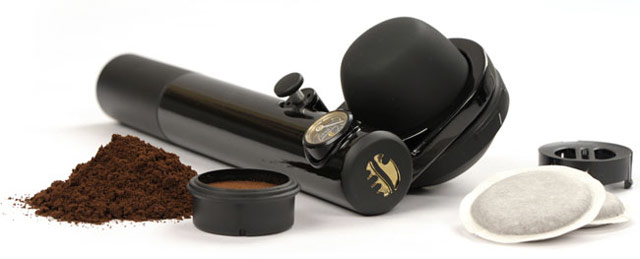
I don’t drink coffee — quelle horreur! quelle suprise! quelle whatevs! — but those around me seem excited by The Handpresso, a travel-sized espresso maker. The Wild Hybrid model even lets you use pods or your very own ground espresso (for less waste and better taste).
I went to the newish Barcade in Chelsea last night to get some dinner and play Star Wars (and Ms. Pac-Man and Tetris and Donkey Kong) and discovered their tater tots are shaped like Tetris pieces:
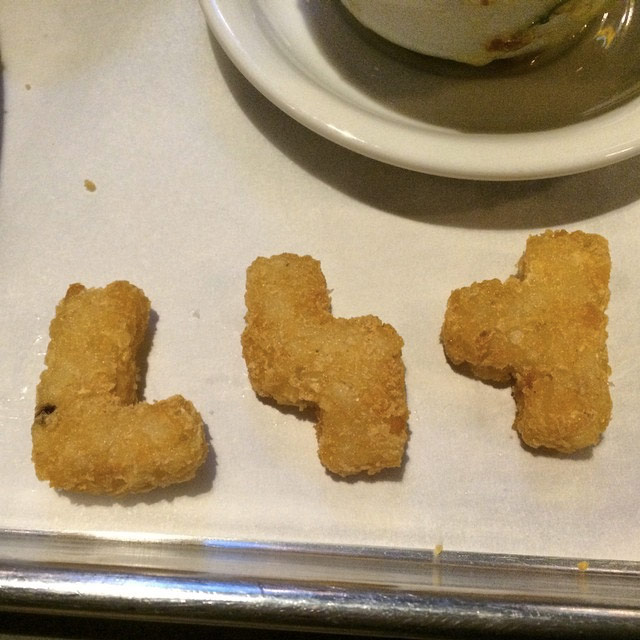
ИOM ИOM ИOM. You can get these tots from a company called US Foods; they call them Puzzle Potatoes. Their sell sheet for the product is a wonder of corporate wishful thinking masquerading as marketing.
Here’s a menu item that will encourage kids to play with their food.
Yes! This is exactly what all parents want. Huge parental issue in America right now is that kids don’t play with their food enough.
When baked, these innovative Puzzle Potatoes are a fun and healthier alternative to regular fries…
Tater tots are not a health food. That’s the whole point. Also, aren’t regular fries also healthier when baked?
Puzzle potatoes are new innovative and interactive potatoes for kids.
Imagine the meeting. “Bob, what can we do about these smartphone? Kids just aren’t spending enough time with their potatoes anymore. Instead they’re Facebooking and Flappy Birding. Wait, I know… interactive potatoes!” [Cut to Bob being paraded around the office on his coworkers’ shoulders]
Our proprietary puzzle-piece shapes…
Well, someone else’s proprietary puzzle piece shapes, but why quibble with details?
Features & Benefits… 2D or 3D
I don’t. I can’t. What does that even mean? The sell sheet for these should be super simple: a photo of the tots and this caption in all-caps 120-point type: THEY’RE TATER TOTS SHAPED LIKE TETRIS PIECES! BUY THEM, YOU FOOL! (thx, kathryn)
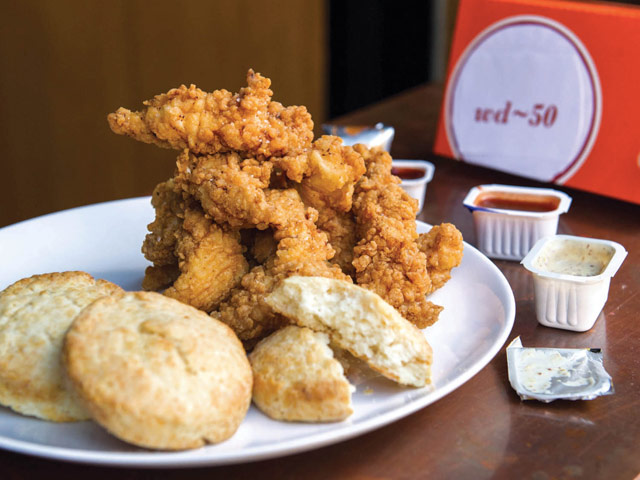
Well, well. For a cookbook called Fried & True: More than 50 Recipes for America’s Best Fried Chicken and Sides, food genius Wylie Dufresne recreated the recipes for Popeye’s chicken and biscuits.
The tenders first get an overnight soak in buttermilk and hot sauce that makes them juicy and, um, tender. To nail the perfectly seasoned crust, he eventually landed on a breading that includes a packet of onion soup and a hefty dose of McCormick’s Italian Herb Spaghetti Sauce Seasoning Mix. (If this makes you cringe, remember who we’re talking about here, and trust.) Cornstarch, potato starch and baking soda added to the self-rising flour mixture ensure the signature craggy texture and exceptional crunch. Finally, after much experimentation to find the perfect frying temperature, he settled on a relatively low 300°, which renders the crust a deep golden-brown and keeps the lean meat moist.
Better than the original, says Serious Eats’ Maggie Mariolis. Dang.
From Matter, a list of things to enjoy now before climate change takes them away or makes them more difficult to procure. Like Joshua trees:
The Joshua trees of Joshua Tree National Park need periods of cold temperatures before they can flower. Young trees are now rare in the park.
And chocolate:
Steep projected declines in yields of maize, sorghum, and other staples portend a coming food crisis for parts of sub-Saharan Africa. But here’s what will probably get everyone’s attention in the developed world: Studies suggest cacao production will begin to decline in Ghana and the Ivory Coast, the source of half of the world’s chocolate, by 2030.
And cherries:
Eighty percent of tart cherries come from a single five-county area in Michigan, all of which is threatened.
But as noted previously, we’ve got plenty of time to enjoy jellyfish:
Important cold-water fish species, including cod, pollock, and Atlantic Salmon, face a growing threat of population collapse as the oceans heat up. Studies suggest a radical fix: Eat lots of jellyfish, which will thrive in our new climate.
Also, The Kennedy Space Center, Havana, Coney Island, the Easter Island statues, and The Leaning Tower of Pisa will all be underwater sooner than you think.
Advice from Tom Mylan, The Meat Hook’s head butcher, about how to create your own custom burger blend for top notch burgers at home.
Don’t believe the “bedazzled blend” burger hype. Using fancy cuts of beef is not important and kind of a bullshit move, according to Mylan. What is important is making sure the meat is high-quality and comes from mature animals, and that your blend has the right fat content.
Use cheaper cuts of beef from harder-working muscles, like chuck or round. Why? These cuts have more myoglobin, Mylan says, and myoglobin is what gives beef its “beefy” flavor and red color. Each cut will contribute its own flavor and textural nuances, and you can play around with different cuts to bolster the flavors you prefer.
And holy cow! (Ahem.) He suggests using a hamburger patty maker, which I didn’t even know existed. $13! I’m totally getting one and trying this.
Hmm, this is interesting. Recent studies suggest that food allergies may be caused by the absense of certain intestinal bacteria…in part due to increased use of antibiotics in very young children.
Food allergies have increased about 50% in children since 1997. There are various theories explaining why. One is that the 21st century lifestyle, which includes a diet very different from our ancestors’, lots of antibiotic use, and even a rise in cesarean section deliveries, has profoundly changed the makeup of microbes in the gut of many people in developed countries. For example, the average child in the United States has taken three courses of antibiotics by the time he or she is 2 years old, says Martin Blaser, an infectious disease specialist and microbiologist at New York University in New York City. (See here for more on the reach of microbiome research these days.)
Cathryn Nagler, an immunologist at the University of Chicago in Illinois, has spent years probing links between the immune system, intestinal bacteria, and the onset of allergies. Back in 2004, she and her colleagues reported that wiping out gut bacteria in mice led to food allergies. Since then, Nagler has continued trying to understand which bacteria offer allergy protection and how they accomplish that.
I wasn’t expecting too much of this video about how to eat sushi, but it’s actually pretty good. It features Naomichi Yasuda of the highly regard Sushi Yasuda in Manhattan making sushi for a newbie and telling him how it should be eaten.
This Old House + Jiro Dreams of Sushi = this video.
Update: Another perspective on how sushi should be eaten comes from Tom Downey, who shares the 10 commandments of the owner of Tokyo’s Yajima Sushi.
There were open spots at the counter. But the chef, Susumu Yajima, instructed me to take a seat nearby and wait. Eventually I was summoned to a place directly in front of him, and the attack began: Piece after piece in rapid succession, as Yajima barked orders at me.
“Eat now!” he said, milliseconds after passing me a glistening slice of buri (amberjack) atop shari (the finger of rice that forms the base of nigiri sushi). “Use your hand!” he upbraided me, as I reached for my chopsticks. He even instructed me to half-chew one piece before washing it down with sake.
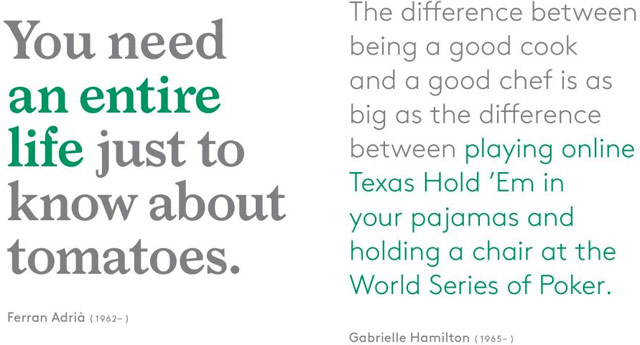
From PA Press, the latest book in their Words of Wisdom series, The Chef Says. The book features quotes about food and cooking from the likes of Escoffier, April Bloomfield, Julia Child, and Grant Achatz.
According to testing by the folks at America’s Test Kitchen, you should not be thawing out your frozen steaks before you cook them. Mind. Blown. Into. Tiny. Pieces. Sweep. Me. Up. Pls.
Conventional wisdom holds that frozen steaks should be thawed before cooking, but we wondered if steaks could be cooked straight from the freezer. Cook’s Illustrated Senior Editor Dan Souza explains our cooking experiments.
They also apparently more-or-less deep fry their steak? Is that a thing that we should be doing? (via digg)
Today I learned that iconic designer Milton Glaser co-wrote a column for New York magazine (which he co-founded) about where to find cheap-but-good food in NYC. It was called The Underground Gourmet. Here’s a typical column from the October 27, 1975 issue, reviewing a ramen joint in Midtown called Sapporo that is miraculously still around:
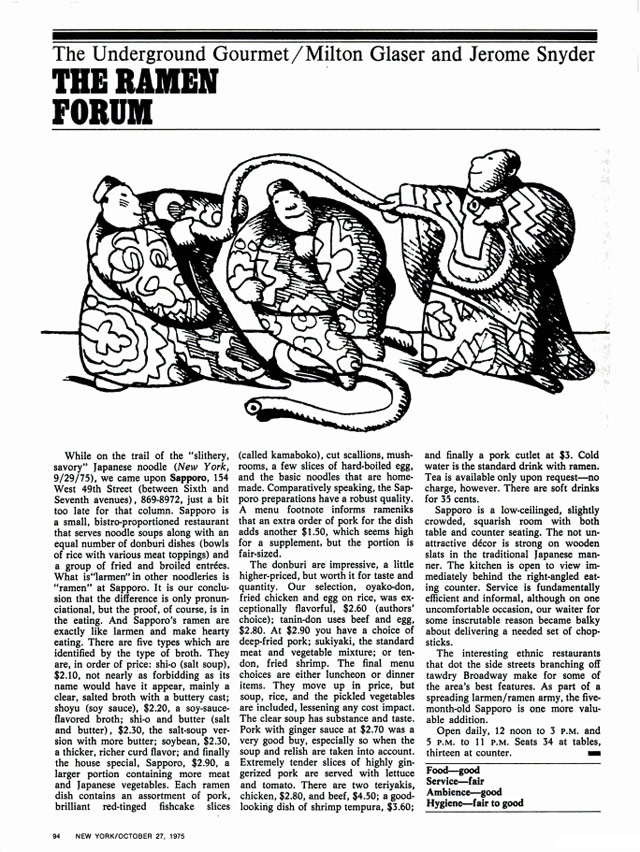
Glaser and his co-authior Jerome Snyder eventually packaged the column into a series of books, some of which you can find on Amazon…I bought a copy this morning.
I found out about Glaser’s food enthusiasm from this interview in Eye magazine about The Underground Gourmet and his long collaboration with restaurateur Joe Baum of the Rainbow Room and Windows on the World.
We just walked the streets … When friends of ours knew we were doing it we got recommendations.
There were parts of the city where we knew we could find good places … particularly in the ethnic parts. We knew if we went to Chinatown we would find something if we looked long enough, or Korea Town, or sections of Little Italy.
More then than now, the city was more locally ethnic before the millionaires came in and bought up every inch of space. So you could find local ethnic places all over the city. And people were dying to discover that. And it was terrific to be able to find a place where you could have lunch for four dollars.
In 2010, Josh Perilo wrote an appreciation of The Underground Gourmet in which he noted only six of the restaurants reviewed in the 1967 edition had survived:
Being obsessed with the food and history of New York (particularly Manhattan), this was like finding a culinary time capsule. I immediately dove in. What I found was shocking, both in the similarities between then and now, and in the differences.
The most obvious change was the immense amount of restaurants that no longer existed. These were not landmarked establishments, by and large. Most of them were hole-in-the wall luncheonettes, inexpensive Chinese restaurants and greasy spoons. But the sheer number of losses was stunning. Of the 101 restaurants profiled, only six survive today: Katz’s Delicatessen, Manganaro’s, Yonah Schimmel’s Knishes Bakery, The Puglia and La Taza de Oro. About half of the establishments were housed in buildings that no longer exist, especially in the Midtown area. The proliferation of “lunch counters” also illustrated the evolution of this city’s eating habits. For every kosher “dairy lunch” joint that went down, it seems as though a Jamba Juice or Pink Berry has taken its place.
Man, it’s hard not get sucked into reading about all these old places…looking forward to getting my copy of the book in a week or two.
Update: Glaser’s co-author Jerome Snyder was also a designer…and no slouch either.
Alexis Madrigal wonders: when did the idea of the dinner reservation come about?
Reserving a table is not so much an “industrial age bolt-on” as it’s a slippage from the older custom of reserving a ROOM in a restaurant. As my book explains, 18th-cy “caterers” [traiteurs] either served clients in their homes or in rooms at the traiteur’s, the first self-styled restaurateurs borrowed from cafes in having lots of small tables in one big room. Throughout the nineteenth century, many big city restaurants continued to have both a (very) large public eating room with numerous, small (private) tables AND a number of smaller rooms that could be reserved for more private meals. (Much as some restaurants have special “banquet facilities” or “special occasion” rooms today.)
See also: the first NY Times restaurant review circa 1859.
Mark Bittman on the true cost of producing a hamburger, after accounting for externalities like carbon generation and obesity.
Cheeseburgers are the coal of the food world, with externalities in spades; in fact it’s unlikely that producers of cheeseburgers bear the full cost of any aspect of making them.
This made me think of something I wrote for Worldchanging several years ago about a True Cost rating:
Wealth doesn’t just magically materialize into your bank account. It comes from the ground, human effort, the flesh of animals, the sun, and the atom. The global economy is driven by nature, and yet it’s not usually found on the accountant’s balance sheet. Perhaps it should be. I’d like to know the true cost of the stuff I buy. Embodied energy and carbon footprint calculations are a good start, but it would be nice if the product itself came with a True Cost number or rating, like the nutritional information on a cereal box or the Energy Star rating on a refrigerator.
When True Cost is factored in, conflict diamonds become a morally expensive choice to make when they’re fueling turmoil in the world. Likewise clothing made in sweatshops. Organic tomatoes flown in from Chile may be less expensive at the register, but how much carbon dioxide was released into the atmosphere flying/driving them to your table? What’s the energy cost of living in the suburbs compared to living downtown? Do the people who made the clock hanging on my wall get paid a fair wage and receive healthcare? Just how bad for the environment is the laptop on which I’m typing?
(via subtraction)
In 2011, Magnum photographer Martin Parr visited the Teddy Grays candy factory near Birmingham, England that makes old-fashioned candy with Wonka-esque names — Mint Humbugs, Nutty Brittles, Spearminties. The result is this ultra-charming 20 minute film profile of the company and its candy-making process.
Charmingness evidence, exhibit A: When asked if the company would ever modernize, company director Teddy Gray responds, “Imagine coming to work in the morning and looking at all them faxes, oh no.” Even his modernization references need modernizing.
Charmingness evidence, exhibit B: The lingerie calendar behind Gray as he talks on the phone, and the beefcake calendar behind his daughter in the very next scene.
Charmingness evidence, exhibit C through exhibit ZZZ: Every other scene in the film.
I know 20 minutes for a web video sounds daunting, but it’s worth the while. At the very least, skip to 14:00 and watch how they make “lettered rock”, hard candy sticks with words written on the inside of the candy. As shown in the video, the individual letters start out 3-4 inches high, are arranged into words when rolled up into a massive tube of candy a foot in diameter, and end up a fraction of an inch tall when pulled out into small sticks, like so:
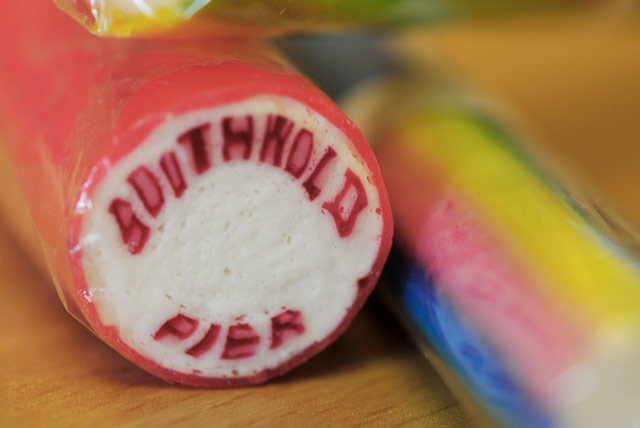
And you thought laying out type for the web was difficult. (thx, nick)
Bread and butter is often an afterthought at restaurants…the bread can be meh and bland butter served too cold to spread. Chef Dan Richer takes the bread and butter offered at his New Jersey restaurant as seriously as any of the other items on his menu.
Cultured butter is delicious…Per Se serves it as well. (via digg)
Sun Noodle makes the ramen noodles for a host of the top ramen shops in NYC, LA, and elsewhere (Ivan, Momofuku, etc.)…here’s a look at how the noodles are made in their New Jersey factory:
See also how to make hand-pulled noodles and Sun Noodle’s fresh ramen kits are available for retail (via devour)
Everyone has a superpower. This guy’s superpower is that he can flip mini-pancakes faster than I thought humanly possible.
I love watching stuff like this…here’s a guy chopping lemons in half 20 times quicker than Superman himself would.
ps. This is still the world’s best pancake recipe.
A short film about how Neal’s Yard Dairy, a top seller of cheese in London, works with producers to make cheese.
I had a tour of the caves below Murray’s in the West Village where they do the same sort of thing as at Neal’s Yard. Pretty cool to see the process in action and to taste the same cheeses at different ages.
Paul Greenberg has an excerpt in the NY Times of his new book, American Catch: The Fight for Our Local Seafood.
As go scallops, so goes the nation. According to the National Marine Fisheries Service, even though the United States controls more ocean than any other country, 86 percent of the seafood we consume is imported.
But it’s much fishier than that: While a majority of the seafood Americans eat is foreign, a third of what Americans catch is sold to foreigners.
The seafood industry, it turns out, is a great example of the swaps, delete-and-replace maneuvers and other mechanisms that define so much of the outsourced American economy; you can find similar, seemingly inefficient phenomena in everything from textiles to technology. The difference with seafood, though, is that we’re talking about the destruction and outsourcing of the very ecological infrastructure that underpins the health of our coasts.
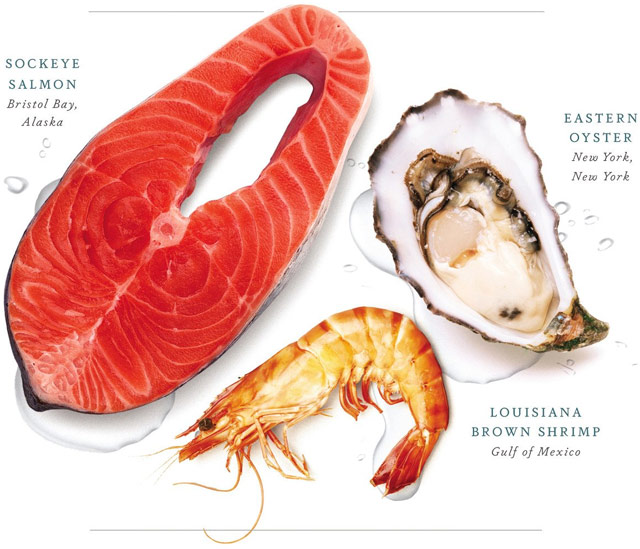
The article and book focus on three formerly American seafoods that we now mostly import from elsewhere: salmon, oysters, and shrimp.
In 2005, the United States imported five billion pounds of seafood, nearly double what we imported twenty years earlier. Bizarrely, during that same period, our seafood exports quadrupled. American Catch examines New York oysters, Gulf shrimp, and Alaskan salmon to reveal how it came to be that 91 percent of the seafood Americans eat is foreign.
In the 1920s, the average New Yorker ate six hundred local oysters a year. Today, the only edible oysters lie outside city limits. Following the trail of environmental desecration, Greenberg comes to view the New York City oyster as a reminder of what is lost when local waters are not valued as a food source.
Farther south, a different catastrophe threatens another seafood-rich environment. When Greenberg visits the Gulf of Mexico, he arrives expecting to learn of the Deepwater Horizon oil spill’s lingering effects on shrimpers, but instead finds that the more immediate threat to business comes from overseas. Asian-farmed shrimp-cheap, abundant, and a perfect vehicle for the frying and sauces Americans love-have flooded the American market.
Finally, Greenberg visits Bristol Bay, Alaska, home to the biggest wild sockeye salmon run left in the world. A pristine, productive fishery, Bristol Bay is now at great risk: The proposed Pebble Mine project could undermine the very spawning grounds that make this great run possible. In his search to discover why this precious renewable resource isn’t better protected, Greenberg encounters a shocking truth: the great majority of Alaskan salmon is sent out of the country, much of it to Asia. Sockeye salmon is one of the most nutritionally dense animal proteins on the planet, yet Americans are shipping it abroad.
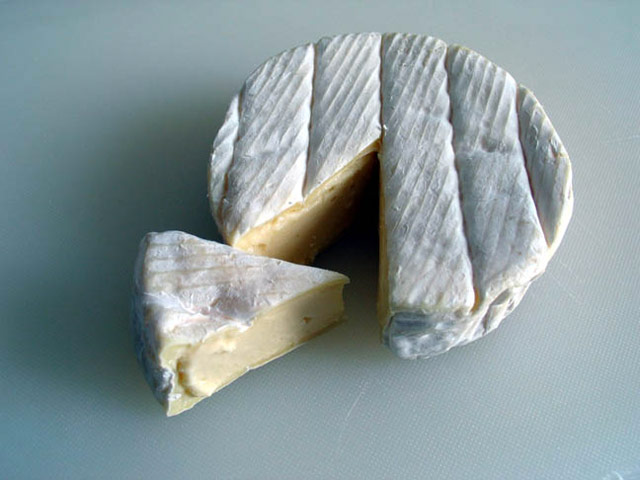
In France, pie charts are called “le camembert” after the cheese. Or sometimes “un diagramme en fromage” (cheese diagram). In Brazil, they are pizza charts. (via numberphile & reddit)

For three years, Nick Kokonas’s trio of eating/drinking establishments in Chicago (Next, Alinea, and Aviary) has been using a ticketed reservation system. In this epic piece, Kokonas details why they started using tickets and what the effect has been (emphasis mine):
Our ticket implementation strategy at Alinea was to create a “higher-touch” system than we had previously used at Next. Every customer buying a ticket at Alinea must include a cell phone number where we can reach them. About a week before they dine with us we call every customer to thank them for buying a ticket to Alinea, ask if they have any dietary restrictions or special needs, and generally get a feel for their expectations and whether it is a special occasion. We can, in fact, spend more time (not less) with every single one of our customers because we are only speaking with the customers we know are coming to dine with us. Previously, we answered thousands of calls from people we had to say ‘no’ to. Now we can take far more time to say ‘yes’.
The results on Alinea’s business are staggering. Bottom line EBITDA profits are up 38% from previous average years. No shows of full tables are almost non-existent and while partial no-shows still occur they are only a handful of people per week at most. That allows us to run at a far greater capacity with less food waste and more revenue.
Will be interesting to see if more restaurants adopt this model…I bet a bunch of restaurateurs’ eyes lit up at the 38% increase in profit. But not every restaurant is Alinea and not every restaurateur is a clever former derivatives trader.
The New Yorker and First We Feast each has an account of a talk given by NYU professor George Solt, who presented some of his research on the history of ramen.
World War II all but destroyed ramen’s first wave of popularity. Thanks to food shortages and famine, the government placed tight regulations on food supplies, and earning a profit via restaurants or pushcarts was strictly prohibited until 1949. Some wheat flour made it onto the black market, though, and many of the country’s unemployed turned to hawking ramen. Which means, Solt points out, that selling future all-nighter fuel could and did land people in jail.
Holt is the author of The Untold History of Ramen: How Political Crisis in Japan Spawned a Global Food Craze.
If distillers can’t keep up with the current and growing worldwide demand for bourbon, we may have to turn to rum instead.
You can buy some old-ass rum, which, after being distilled from molasses or sugar cane, has sat around in barrels for long periods of time, for relatively small sums of money: El Dorado 15 is, as you might expect, made with a blend of rums that have sat in a barrel for at least fifteen years. Is it slightly sweet and rounded with a “full nose packed with dark coffee, candied orange, almonds, dark chocolate, pepper and rich vanilla.” It is only thirty-six dollars. Barbancourt 15 is kind of soft and woody and fruity and other things you might say about a bourbon, but instead of corn it’s like molasses. It’s about forty bucks. Ron Zacapa 23, which is a blend of rums between six and twenty three years old, is probably the first rum that made a lot of people go, “Oh, rum isn’t just that stuff that goes in a daiquiri or a mojito or that made me vomit pieces of my intestines into a urinal while I was wearing a silver crown.” Here are some tasting notes for it: “Nose full or apricots, citrus fruits, vanilla, cocoa and bourbon.”
Beyonce is mad at Solange for not sticking to the plan. What plan? I don’t want to say too much, but it involves Chipotle.
“You just stood there. I was defending you.”
“Do I need defending?”
“That’s not the point. He is a monster.”
“He is my husband.”
Beyoncé looked away, out the window at the people and the buildings, as they sped across 59th St. “I know who I married. That was my decision and I’ll live with it.”
“Of course you take his side.”
“Excuse me?” Beyoncé turned to face her sister. “Beyoncé is on Beyoncé’s side. Always. Trust that.”
(via @ftrain)
“Doodie” is a portmanteau of “dude” and “foodie” and a good word to describe the phenomenon of (mostly) male foodies I’ve observed with increasing regularity in the past few years. Jessica Pressler coined the term in Help! There’s a Doodie in My Kitchen.
You see; these are the things you deal with when you live with a food dude. Or, as I have come to call them, doodies. I know, it’s an unfortunate term, but like its antecedent, the dreaded foodie, it is also extremely useful for summing up the characteristics of a certain breed of food enthusiast, the kind whose culinary preferences are intrinsically, classically male.
You know the type. Has Heat or Fergus Henderson’s Complete Nose to Tail on his bookshelf. Can sustain a remarkably long conversation about knives. Is super into his grill. Likes pour-over coffee. Is, at this moment, really excited about ramps. I could go on, but I won’t, because I am sure you know one. New York City in 2014 is rife with doodies: You can find them stalking around Smorgasburg, attending knife-skills classes at the Meat Hook, writing lengthy, tumescent odes to the Bo Ssam Miracle in the paper of record.
(via @fanelli)
Update: Michael Hoffman of Food52 has another name for doodies: assholes.
The food dude is nothing new. He’s just a jerk who learned to cook. He’s taken what could be a force for good — feeding loved ones well — and made it into yet another thing that he can claim to be better at than his wife or girlfriend. (Apparently, food dudes are all heterosexual, too.)
Here’s what the food dude doesn’t do: He doesn’t spend his Sunday afternoon planning practical dinners for the week; he doesn’t make sure there’s milk in the fridge; he doesn’t make something the baby is going to eat. He might as well be building train sets in the basement. Even for people like us who love doing it, getting dinner on the table is, among many other things, a chore. And guess who’s doing the chores at Food Dude’s place? Women.
Newer posts
Older posts





Socials & More