kottke.org posts about food
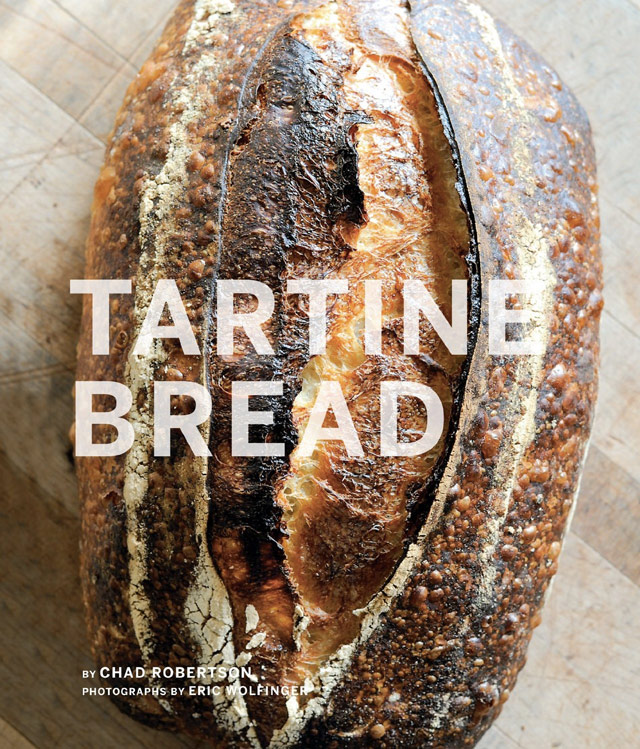
In his cookbook, Tartine Bread, Chad Robertson lays out, over 38 pages, the recipe for what might be the best bread in the world. The first time through, the recipe takes two weeks to make.
To Chad, bread is the foundation of a meal, the center of daily life, and each loaf tells the story of the baker who shaped it. He developed his unique bread over two decades of apprenticeship with the finest artisan bakers in France and the United States, as well as experimentation in his own ovens.
A streamlined version of the recipe is available from the NY Times. (via smithsonian)
Jim Koch is the co-founder and chairman of The Boston Beer Company, brewer of the Sam Adams beers. Part of his job is to drink professionally and he does so without getting completely sloshed. What’s his secret? Eating a packet of dry yeast before tying one on.
You see, what [expert brewer] Owades knew was that active dry yeast has an enzyme in it called alcohol dehydrogenases (ADH). Roughly put, ADH is able to break alcohol molecules down into their constituent parts of carbon, hydrogen, and oxygen. Which is the same thing that happens when your body metabolizes alcohol in its liver. Owades realized if you also have that enzyme in your stomach when the alcohol first hits it, the ADH will begin breaking it down before it gets into your bloodstream and, thus, your brain.
“And it will mitigate - not eliminate - but mitigate the effects of alcohol!” Koch told me.
Could have used this tip last night. Does this mean no hangovers as well?
Update: I got two kinds of feedback about this post:
1) What’s the fun in drinking alcohol if you’re not getting drunk? (Good point.)
2) Yeast doesn’t really work. What does seem to work is Pepcid AC and Zantac. From Shenglong on Hacker News:
Again, I’m not a chemist or a doctor, but from my preliminary internet research and anecdotal testing (though I have quite a few different data points), Famotadine (OTC) [Pepcid], and higher levels of APO-Ranitidine (can be prescription) [Zantac] seems to slow the rate of ethanol -> acetaldehyde, balancing out the drunkness effect more, and giving you more time to process the acetaldehyde -> acetic acid. I typically go from maxing out at 2 drinks / 3 hour period, to about 11 drinks / 3 hour period on Ranitidine, given favorable conditions. I’ve had lower levels of success with Famotadine.
And it goes without saying, I don’t recommend trying any of this at home. At the local bar on the other hand Nope, not there either. (thx, @natebirdman)
American favorites (blue jeans, whiskey, burgers) have been embraced by the Japanese, who have been turning out improved versions of the originals.
In Japan, the ability to perfectly imitate-and even improve upon-the cocktails, cuisine and couture of foreign cultures isn’t limited to American products; there are spectacular French chefs and masterful Neapolitan pizzaioli who are actually Japanese. There’s something about the perspective of the Japanese that allows them to home in on the essential elements of foreign cultures and then perfectly recreate them at home. “What we see in Japan, in a wide range of pursuits, is a focus on mastery,” says Sarah Kovner, who teaches Japanese history at the University of Florida. “It’s true in traditional arts, it’s true of young people who dress up in Harajuku, it’s true of restaurateurs all over Japan.”
It’s easy to dismiss Japanese re-creations of foreign cultures as faddish and derivative-just other versions of the way that, for example, the new American hipster ideal of Brooklyn is clumsily copied everywhere from Paris to Bangkok. But the best examples of Japanese Americana don’t just replicate our culture. They strike out, on their own, into levels of appreciation and refinement rarely found in America. They give us an opportunity to consider our culture as refracted through a foreign and clarifying prism.
Another example, not mentioned in the piece, is coffee. From the WSJ a couple of years ago:
“My boss won’t let me make espressos,” says the barista. “I need a year more, maybe two, before he’s ready to let customers drink my shots undiluted by milk. And I’ll need another whole year of practice after that if I want to be able to froth milk for cappuccinos.”
Only after 18 years as a barista in New York did his boss, the cafe’s owner, feel qualified to return home to show off his coffee-making skills. Now, at Bear Pond’s main branch, he stops making espressos at an early hour each day, claiming that the spike on the power grid after that time precludes drawing the voltage required for optimal pressure.
New from Michael Ruhlman: a cookbook about the mighty egg, “A Culinary Exploration of the World’s Most Versatile Ingredient”.
For culinary visionary Michael Ruhlman, the question is not whether the chicken or the egg came first, it’s how anything could be accomplished in the kitchen without the magic of the common egg. He starts with perfect poached and scrambled eggs and builds up to brioche and Italian meringue. Along the way readers learn to make their own mayonnaise, pasta, custards, quiches, cakes, and other preparations that rely fundamentally on the hidden powers of the egg.
Ruhlman shares a bit about the book with NPR:
But often, Ruhlman argues, we don’t treat our eggs very well. Take scrambled eggs. “It’s one of the most overcooked dishes in America,” he says. “We kill our eggs with heat.”
Instead, we need, in most instances, to give the egg gentle heat. “When you cook them very slowly over very gentle heat, the curds form. And as you sit, the rest of the egg sort of warms but doesn’t fully cook and becomes a sauce for the curds. So it should be a creamy and delicious and delicate preparation.”
Recent studies show that our physical level of hunger, in fact, does not correlate strongly with how much hunger we say that we feel or how much food we go on to consume.
As Maria Konnikova reports, a lot of things can make you hungry — a song, a book, a smell, even a study.
Being genuinely hungry, on the other hand — in the sense of physiologically needing food — matters little.
In other news, Tater Tots.
In recent years, Chipotle has worked to promote their managers from within the company. And the tactic seems to be working.
The common element among the best-performing stores was a manager who had risen up from crew. So Moran started to outline a program that would retain and train the best managers, and reward them to the point where they would be thrilled to stay on.
After Flores expressed his frustration, Moran showed him his early notes for the restaurateur program, which is unique among fast food restaurants in that it ties pay and promotion to how well you mentor people, rather than store sales.
“It was a great meeting but I didn’t know what was going to happen. At most companies you meet the top execs and then you never hear from them again,” Flores says.
A few weeks after the October meeting, while vacationing in Houston, Flores got a call on his cell from Ells and Moran letting him know that he had been promoted to restaurateur and was getting a $3,000 bonus. Rather than waiting until he returned to Milwaukee to get him the check, it was delivered to him in Houston the following day. At the time his salary was around $38,000, and the bonus was meaningful.
“That’s when I knew the company was special,” Flores said.
Interesting bits of business wisdom throughout this piece.
Kenji Lopez-Alt and the folks at the Harlem Shake restaurant have invented a burger that’s all delicious brown crust.
See, by placing a ball of meat on a hot, un-oiled griddle and smashing it down firmly into a flat, thin disk, you greatly increase the contact points between the meat and the griddle, which in turn increases the Maillard reaction. That’s the series of chemical reactions that creates the rich brown crust that makes our steaks and burgers taste so freaking good. Maximum crust = maximum flavor = maximum craving.
I’ve already discussed the basic ins and outs of smashed burgers in the past, but after writing that article, I found myself wondering, what if I were to take this to the extreme? Is there a way I can pack even more flavor into a burger?
Spoiler alert: the answer is a big fat (or should I say short smashed?) yes.
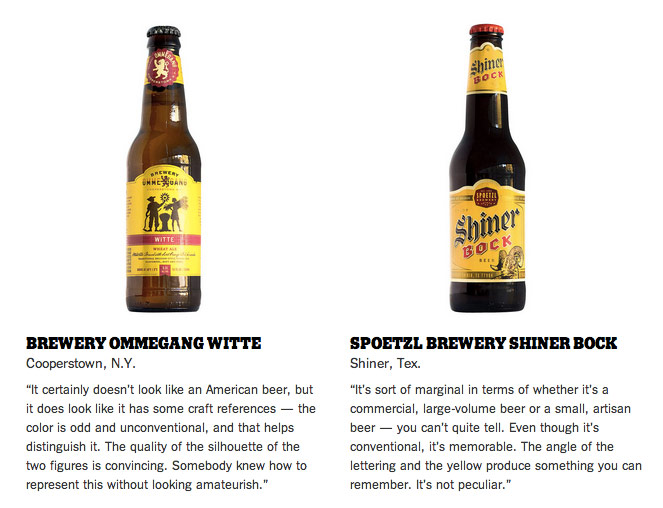
Legendary designer Milton Glaser (of I❤NY fame) critiques craft beer labels.
(via @bn2b)
Errol Morris has directed a new series of Taco Bell commercials where a bunch of ordinary men named Ronald McDonald review Taco Bell’s new breakfast menu. Here’s one of the spots:
Khoi Vinh tells us how he really feels about coffee.
In the West, and particularly in urban centers of the United States, we’ve turned coffee into not just a daily habit, but a totem of conspicuous consumption. They are “rituals of self-congratulation” (a choice phrase I believe I read from Sam Sifton, but which I can’t seem to source) wherein we continually obsess over certain coffee purveyors or certain methods of brewing coffee - each new one more complex, more Rube Goldbergian and more comically self-involved than the previous brewing fad.
I don’t drink coffee either (don’t even like the smell), but as someone who regularly indulges in other addictions and “rituals of self-congratulation”, I don’t take issue with other people’s enjoyment of coffee…as long as I’m out of earshot when the “perfect grinder for pulling a great shot” discussion starts.
Coffee, like almost everything else these days, is a sport. Everyone has a favorite team (or coffee making method or political affiliation or design style or TV drama or rapper or comic book), discusses techniques and relives great moments with other likeminded fans, and argues with fans of other teams. The proliferation and diversification of media over the past 35 years created thousands of new sports and billions of new teams. These people turned hard-to-find nail polish into a sport. These people support Apple in their battle against Microsoft and Samsung. This guy scouts fashion phenoms on city streets. Finding the best bowl of ramen in NYC is a sport. Design is a sport. Even hating sports is a sport; people compete for the funniest “what time is the sportsball match today? har har people who like sports are dumb jocks” joke on Twitter. Let people have their sports, I say. Liking coffee can’t be any worse than liking the Yankees, can it?
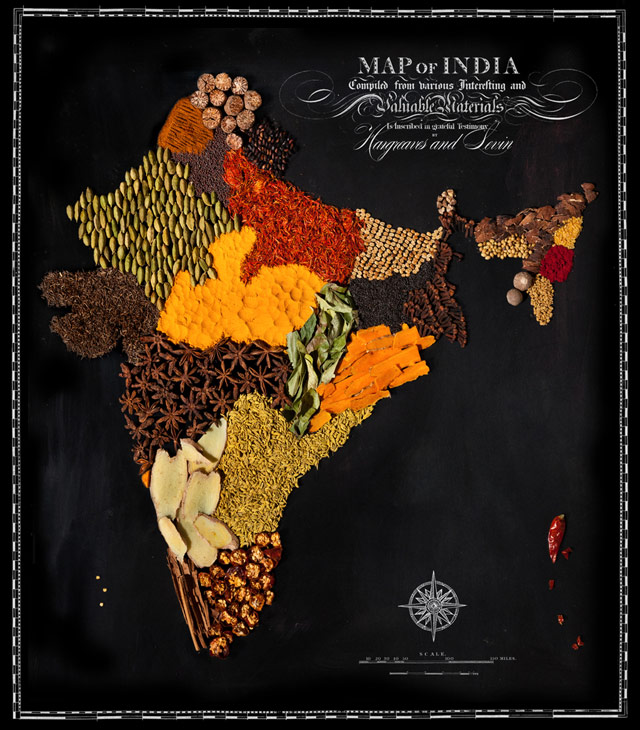
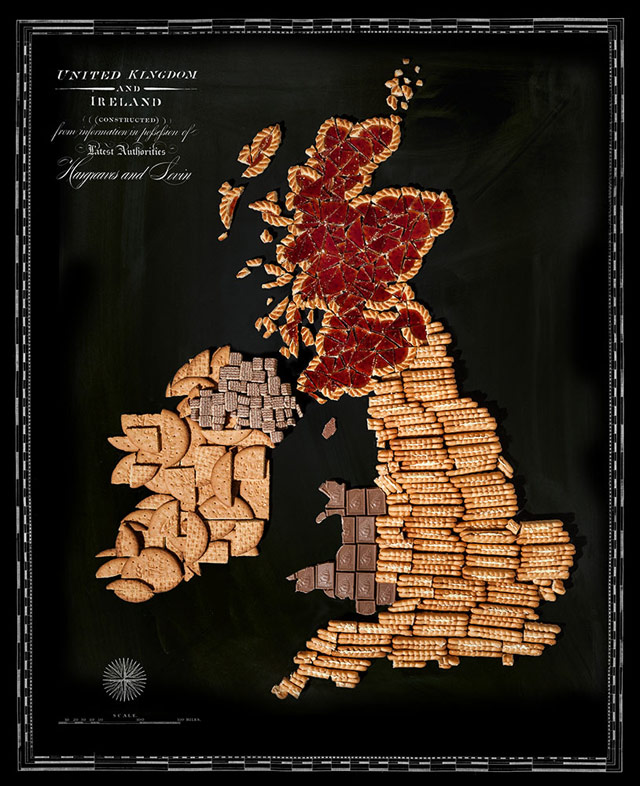
Henry Hargreaves and Caitlin Levin favor food as a medium for creating art. Their country maps made from native foods were cute at first glance, but in many cases the maps also reveal a link between a country’s food and its culture that I’d never really thought about before. For instance, the maps of India and British Isles feel very representative of their respective cultures to me:
A master chef from a Hokkaido sushi restaurant shows how to make dashimaki tamago, a Japanese rolled omelette.
Watching people who are good at what they do never gets old. (via swiss miss)
A group of marine biologists that has been recently studying mesopelagic fish (“fish that live between 100 and 1000m below the surface”) believes that 95% of fish biomass is unknown to humans. Marine dark matter. The problem lies with how fish have traditionally been counted and the enhanced visual and pressure senses of these fish.
He says most mesopelagic species tend to feed near the surface at night, and move to deeper layers in the daytime to avoid birds.
They have large eyes to see in the dim light, and also enhanced pressure-sensitivity.
“They are able to detect nets from at least five metres and avoid them,” he says.
“Because the fish are very skilled at avoiding nets, every previous attempt to quantify them in terms of biomass that fishing nets have delivered are very low estimates.
“So instead of different nets what we used were acoustics… sonar and echo sounders.”
A not-so-difficult prediction to make is that humans will find a way to catch these wary creatures, we’ll eat most of them, and then we’ll be back to where we are now: the world’s oceans running low on fish. (via @daveg)
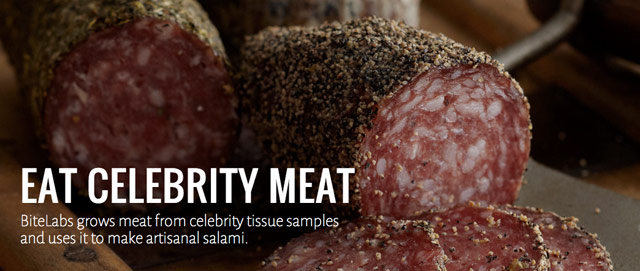
Have you ever wanted to taste Kanye West’s meat? Then what is wrong with you and what is wrong with these people?!?! They want to take tissue samples from celebrities like James Franco, Kanye, and Jennifer Lawrence and make artisanal salami out of them.
It all starts with your favorite celebrities, and a quick biopsy to obtain tissue samples. Isolating muscle stem cells, we grow celebrity meat in our proprietary bioreactors. In the tradition of Italian cured meats, we dry, age, and spice our product into fine charcuterie.
Note: BiteLabs might be completely fake. But fake is the new real so… nope, this is just fake.
According to an article in The Journal of the American Medical Association, the obesity rate of American 2- to 5-year-old children has dropped from 14% in 2004 to 8% in 2012.
Children now consume fewer calories from sugary beverages than they did in 1999. More women are breast-feeding, which can lead to a healthier range of weight gain for young children. Federal researchers have also chronicled a drop in overall calories for children in the past decade, down by 7 percent for boys and 4 percent for girls, but health experts said those declines were too small to make much difference.
Barry M. Popkin, a researcher at the University of North Carolina at Chapel Hill who has tracked American food purchases in a large data project, said families with children had been buying lower-calorie foods over the past decade, a pattern he said was unrelated to the economic downturn.
He credited those habits, and changes in the federally funded Special Supplemental Nutrition Program for Women, Infants and Children, for the decline in obesity among young children. The program, which subsidizes food for low-income women, reduced funding for fruit juices, cheese and eggs and increased it for whole fruits and vegetables.
Kevin Drum calls the drop “baffling”.
Planet Money: always buy the bigger pizza because geometry.
The math of why bigger pizzas are such a good deal is simple. A pizza is a circle, and the area of a circle increases with the square of the radius.
So, for example, a 16-inch pizza is actually four times as big as an 8-inch pizza.
And when you look at thousands of pizza prices from around the U.S., you see that you almost always get a much, much better deal when you buy a bigger pizza.
And if you want a sense of how weird, and how fraught, the relationship between science, politics, and commerce is in our modern world, then there’s really no better place to go.
In The Daily Beast Michael Schulson provides a alternate view on Whole Foods: America’s Temple of Pseudoscience. (The first time I read this, I nearly spit out my probiotic-infused kombucha, kale, quinoa, coconut water shake.)
I don’t care if all of this vocabulary of NYC’s best bars is made up (it sure sounds made up), I still loved reading it. You can totally tell which places are about the drinks, which are about hospitality, which are bitchy, and which are all about the benjamins.
Sipper: A small pour (typically Mother’s Milk) gifted to a colleague, loved one, regular, etc.
Amuse-booze (experimental term): A tiny sipper to acknowledge a guest an reassure them they will be served soon.
The Cousins: Affectionate term for other cocktail bars (after the British secret service’s name for the CIA in Le Carre’s Smiley novels).
Even if it’s fake, it’s real.
On his site Truth in Olive Oil, Tom Mueller tells us how to buy great olive oil and, more usefully, which brands to buy at the supermarket.
Unlike many wines, which improve with age, extra virgin olive oil is perishable: like all natural fruit juices, its flavor and aroma begin to deteriorate within a few months of milling, a decline that accelerate when the oil is bottled, and really speeds up when the bottle is opened. To get the freshest oil, and cut out middle-men who often muddy olive oil transparency and quality, buy as close to the mill as possible. If you’re lucky enough to live near a mill — common around the Mediterranean, and more and more so in other areas of the world with a Mediterranean-like climate, like Australia, S. Africa, California, Texas, Georgia — visit it during the harvest to see how olives are picked, crushed, stirred, and spun into olive oil.
Mueller is also author of Extra Virginity: The Sublime and Scandalous World of Olive Oil, which was published a few years after his olive oil exposé in the New Yorker.
In 1997 and 1998, olive oil was the most adulterated agricultural product in the European Union, prompting the E.U.’s anti-fraud office to establish an olive-oil task force. (“Profits were comparable to cocaine trafficking, with none of the risks,” one investigator told me.) The E.U. also began phasing out subsidies for olive-oil producers and bottlers, in an effort to reduce crime, and after a few years it disbanded the task force. Yet fraud remains a major international problem: olive oil is far more valuable than most other vegetable oils, but it is costly and time-consuming to produce-and surprisingly easy to doctor. Adulteration is especially common in Italy, the world’s leading importer, consumer, and exporter of olive oil. (For the past ten years, Spain has produced more oil than Italy, but much of it is shipped to Italy for packaging and is sold, legally, as Italian oil.) “The vast majority of frauds uncovered in the food-and-beverage sector involve this product,” Colonel Leopoldo Maria De Filippi, the commander for the northern half of Italy of the N.A.S. Carabinieri, an anti-adulteration group run under the auspices of the Ministry of Health, told me.
McDonald’s Canada continues their series on how their business works with a video on how Chicken McNuggets are made.
Best part of the video: the casual reveal that McNuggets come in four standard shapes: the ball, the bell, the boot, and the bow tie:

I had a McNugget over the weekend, the first one in probably more than 10 years, and it tasted and felt like chicken. Not bad for fast food. See also how McDonald’s fries are made and how McDonald’s photographs their food for advertising.
Fish Tales is billed as the world’s shortest cooking show. Episodes are about 15 seconds long and in each one, you learn how to cook a complete fish/seafood dish. Here’s the latest one, on cooking razor clams:
I was just wondering this the other day…where can you get good nachos in NYC? Serious Eats investigates.
Not only are they delicious (when made right, and we’ll get to that), but they practically create their own conversation. Everybody has an opinion on how chunky the guacamole should be. We all have feelings about whether chili or beans make a better topping. Who hasn’t considered whether or not they’d ever prefer a fresh jalape~no to a pickled one, and who hasn’t considered de-friending a friend who dares to express a preference for fresh over pickled? And then there’s the ever-raging debate of cheese sauce vs. melted cheese, a subject you might actually consider not broaching in mixed company.
Scientists at the University of Vermont’s Proctor Maple Research Center have made an interesting discovery. It seems that the sap used to produce maple syrup doesn’t flow from the tops of trees, it gets sucked up from the trees’ roots. Which means that maple syrup makers can use saplings instead of fully grown maple trees to produce syrup.
They realized that their discovery meant sugarmakers could use saplings, densely planted in open fields, to harvest sap. In other words, it is possible that maple syrup could now be produced as a row crop like every other commercial crop in North America.
In a natural forest, which varies in maple density, an average 60 to 100 taps per acre will yield 40 to 50 gallons of syrup. According to the researchers’ calculations, an acre of what is now called “the plantation method” could sustain 5,800 saplings with taps yielding 400 gallons of syrup per acre. If the method is realized, producing maple syrup on a commercial scale may no longer be restricted to those with forest land; it could require just 50 acres of arable land instead of 500 acres of forest. Furthermore, any region with the right climate for growing maples would be able to start up maple “farms”. The natural forest would become redundant.
(via @youngna)
This is undoubtably the best story you’ll ever read about the Bay Area’s latest food craze: $4 artisanal toast.
Trouble’s owner, and the apparent originator of San Francisco’s toast craze, is a slight, blue-eyed, 34-year-old woman with freckles tattooed on her cheeks named Giulietta Carrelli. She has a good toast story: She grew up in a rough neighborhood of Cleveland in the ’80s and ’90s in a big immigrant family, her father a tailor from Italy, her mother an ex-nun. The family didn’t eat much standard American food. But cinnamon toast, made in a pinch, was the exception. “We never had pie,” Carrelli says. “Our American comfort food was cinnamon toast.”
The other main players on Trouble’s menu are coffee, young Thai coconuts served with a straw and a spoon for digging out the meat, and shots of fresh-squeezed grapefruit juice called “Yoko.” It’s a strange lineup, but each item has specific meaning to Carrelli. Toast, she says, represents comfort. Coffee represents speed and communication. And coconuts represent survival-because it’s possible, Carrelli says, to survive on coconuts provided you also have a source of vitamin C. Hence the Yoko. (Carrelli tested this theory by living mainly on coconuts and grapefruit juice for three years, “unless someone took me out to dinner.”)
Fancy $4 toast seems like something to chuckle at or cluck your tongue about, but this story takes an unexpected left turn about halfway through and is well worth the read.
Aaron Cohen, a frequent contributor to kottke.org famous for his late-night (and, I would assume, drunken) extreme sports posts, is putting on a pair of events in Boston in February. The first is Up Up Down Down, a mini-conference on side projects. Which is such a great idea for a conference.
The second event is Whiskey Rebellion, “a showcase of American brown spirits”. The tasting list includes more than 75 whiskies and bourbons. This one is sold out (unsurprisingly) but there appears to be a waiting list. My schedule for that weekend is up in the air, but I hope I can make it to one or both of these.
Often, cocktail menus are a little ridiculous.
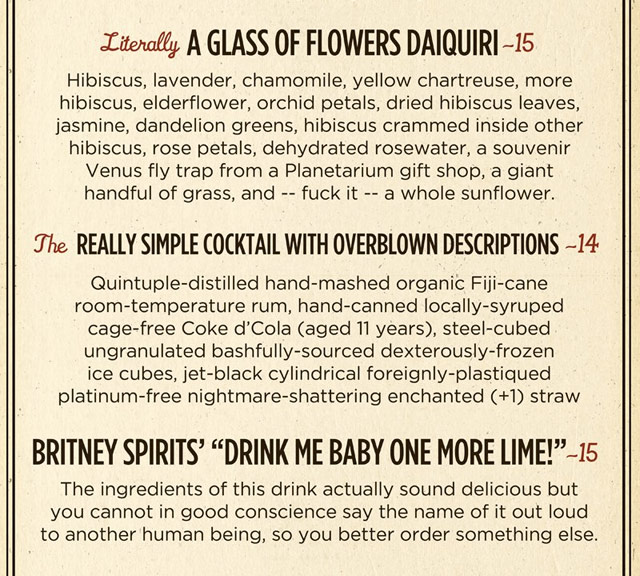
I am totally going to order some drinks like these at my usual fancy but still cool bar pub speakeasy tonight!
From photographer Greg Alessandrini, a collection of photos of diners in New York City taken in the 1990s. I was pleased to see a shot of Jones Diner, which I ate at several months before moving to NYC:
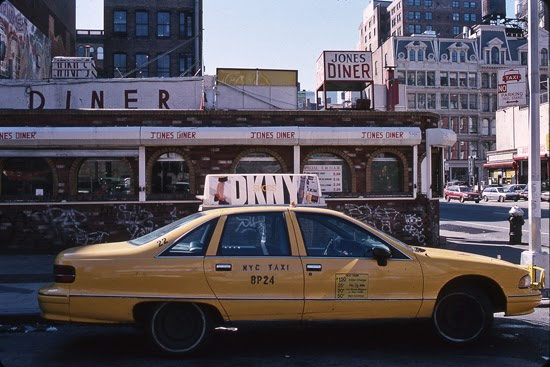
It closed shortly before we moved and I never got to eat there again. At the time, word was some condos were being built on the site, but it took ten years for construction to start. What a waste.
BTW, the rest of Alessandrini’s site is well worth a look…hundreds and possibly thousands of photographs of NYC from the 80s and 90s. (via @UnlikelyWorlds)
Inspired by the escalating blade count of the razor industry, Nabisco has developed a new snack called the Quadriscuit.
“At the moment, this hyperwafer can only exist for six milliseconds in a precisely calibrated field of magnetic energy, positrons, roasted garlic, and beta particles,” lab chief Dr. Paul Ellison told reporters at a press conference outside Nabisco’s $200 million seven-whole-grain accelerator.
The last line of the piece made me LOL for real. (thx, meg)
2004 was a pretty good year for the NYC food scene. Among the openings were The Spotted Pig, Per Se, Momofuku Noodle Bar, and Shake Shack.
If there was a movement taking shape, its key players admit they didn’t notice until after the fact. And many of them spent the year struggling. Mr. Chang was desperate for customers in the early days at Noodle Bar, and kicking himself for having failed to apply for a kitchen job at Per Se or Masa. “I remember thinking very clearly, ‘What am I doing?’ ” he said. ” ‘This is stupid. I should be working at Masa!’ “
In some cases, 2004 was an outright fight. At the Spotted Pig, Mr. Friedman and Ms. Bloomfield, who had arrived from England, envisioned the vibrant boite as “a really cool bar that happened to have food as good as any restaurant in town,” Mr. Friedman said. “Who made the rule that you can’t have a real chef instead of someone who defrosts the frozen French fries?”
Who can resist reading a profile of the chocolate chip cookie when it contains delectable little morsels like this:
Wakefield’s cookie was the perfect antidote to the Great Depression. In a single inexpensive hand-held serving, it contained the very richness and comfort that millions of people were forced to live without in the late nineteen-thirties.
Happy 75th, cookie.
Newer posts
Older posts




Socials & More