kottke.org posts about artificial intelligence
Using an AI-based framework called Pixel2Style2Pixel and searching for faces in a dataset harvested from Flickr, Nathan Shipley made some more photorealistic faces for Pixar characters.
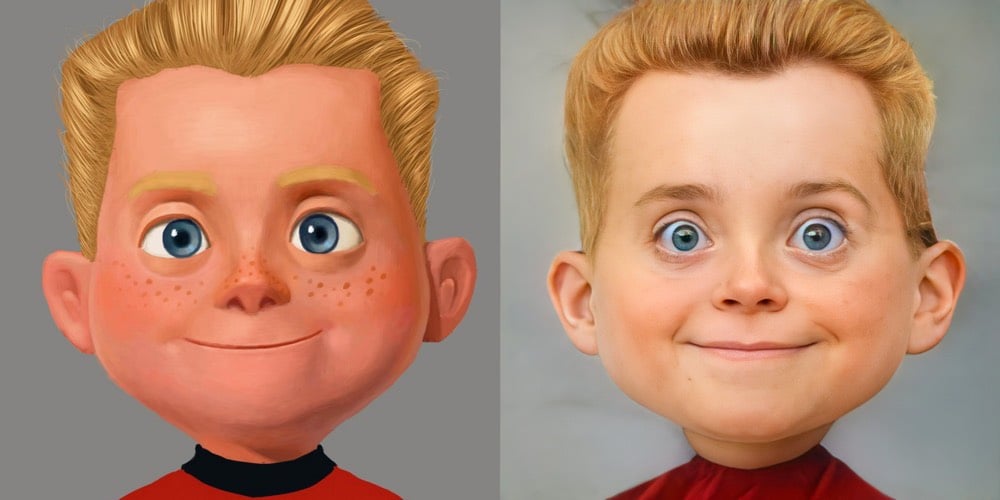
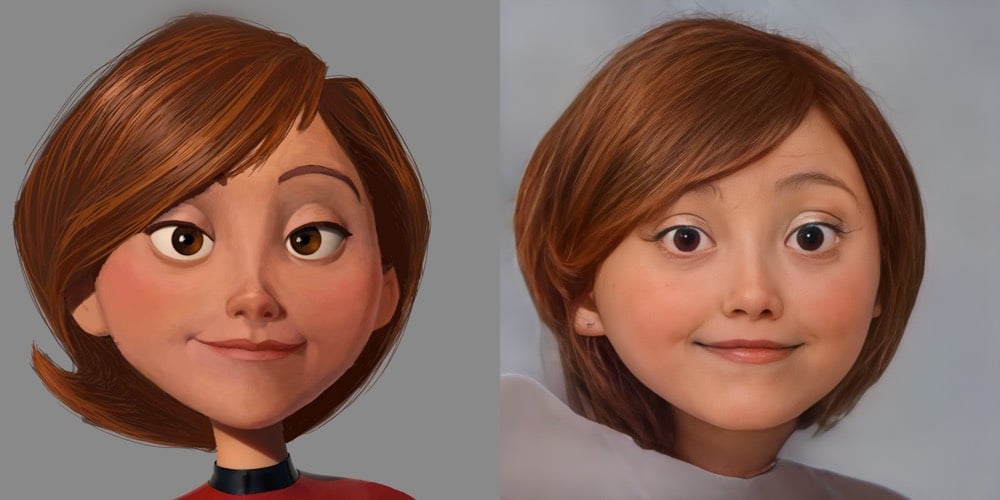
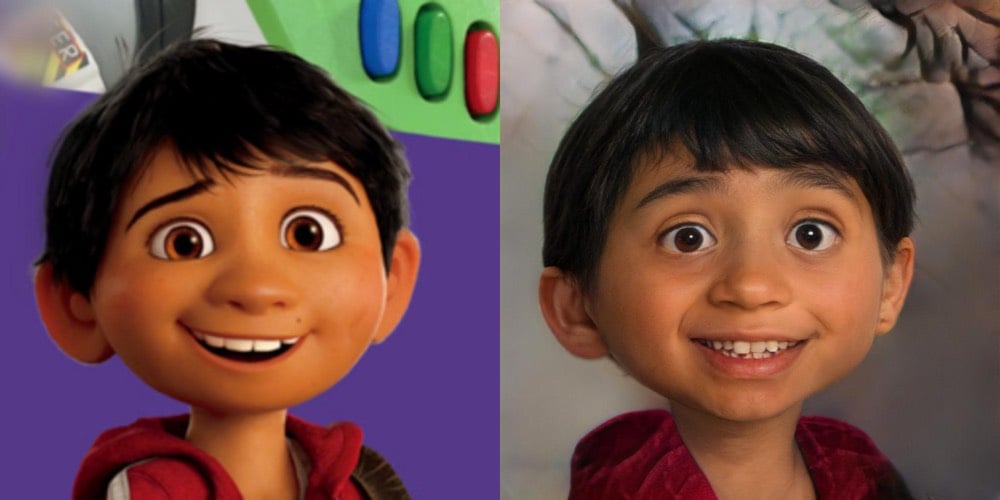
In response to a reader suggestion, Shipley fed the generated image for Dash back into the system and this happened:
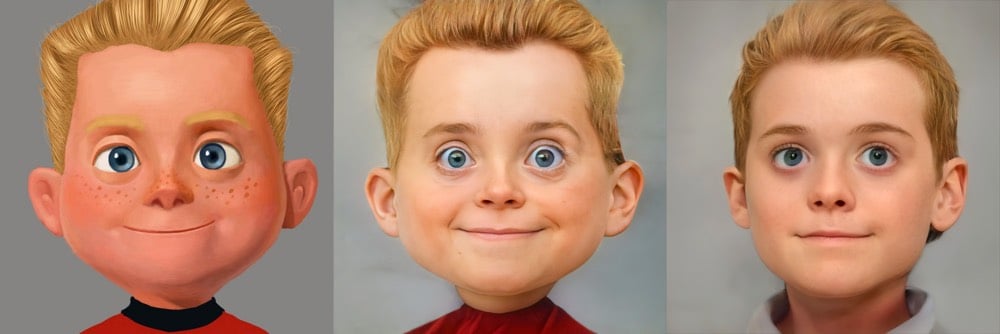
I cannot tell where these images should live in the uncanny valley. You can see some similar experiments from Shipley here: a more realistic version of Miles from Spider-Verse, images of Frida Kahlo and Diego Rivera “reverse engineered” from paintings, and an image generated from a Rembrandt self-portrait.
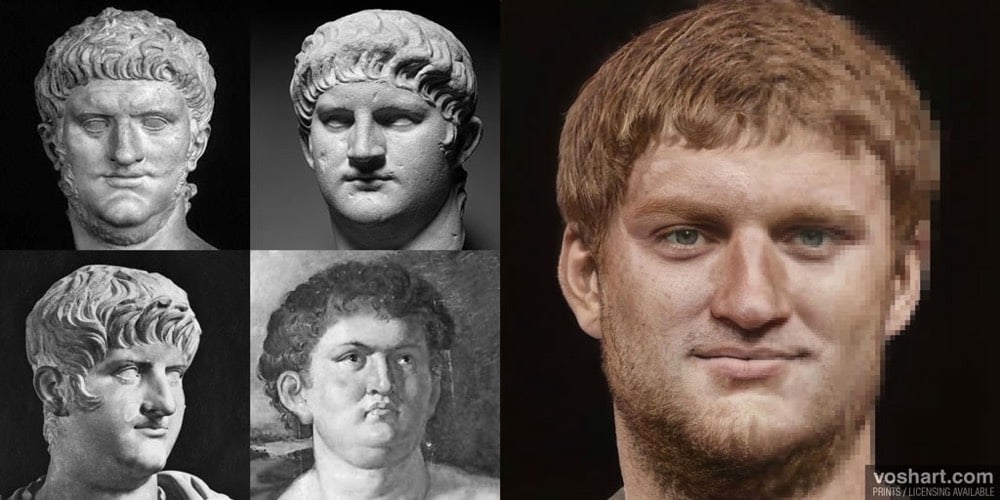
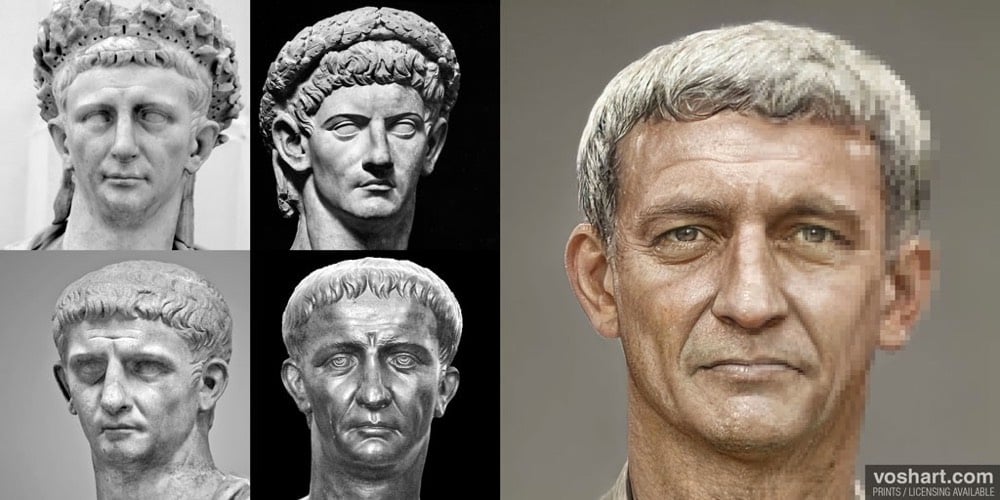
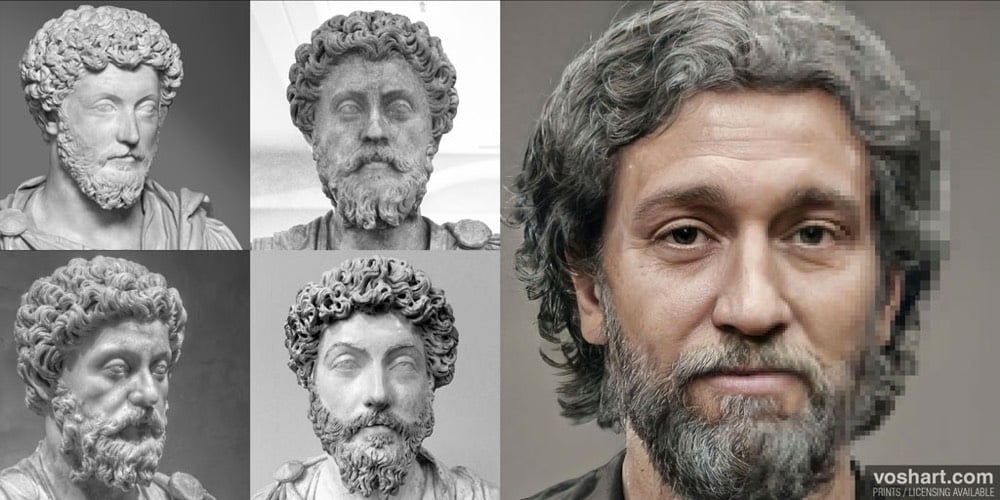
For his Roman Emperor Project, Daniel Voshart (whose day job includes making VR sets for Star Trek: Discovery) used a neural-net tool and images of 800 sculptures to create photorealistic portraits of every Roman emperor from 27 BCE to 285 ACE. From the introduction to the project:
Artistic interpretations are, by their nature, more art than science but I’ve made an effort to cross-reference their appearance (hair, eyes, ethnicity etc.) to historical texts and coinage. I’ve striven to age them according to the year of death — their appearance prior to any major illness.
My goal was not to romanticize emperors or make them seem heroic. In choosing bust / sculptures, my approach was to favor the bust that was made when the emperor was alive. Otherwise, I favored the bust made with the greatest craftsmanship and where the emperor was stereotypically uglier — my pet theory being that artists were likely trying to flatter their subjects.
Some emperors (latter dynasties, short reigns) did not have surviving busts. For this, I researched multiple coin depictions, family tree and birthplaces. Sometimes I created my own composites.
You can buy a print featuring the likenesses of all 54 emperors on Etsy.
See also Hand-Sculpted Archaeological Reconstructions of Ancient Faces and The Myth of Whiteness in Classical Sculpture.
Have you ever wanted to hear Jay Z rap the “To Be, Or Not To Be” soliloquy from Hamlet? You are in luck:
What about Bob Dylan singing Britney Spears’ “…Baby One More Time”? Here you go:
Bill Clinton reciting “Baby Got Back” by Sir Mix-A-Lot? Yep:
And I know you’re always wanted to hear six US Presidents rap NWA’s “Fuck Tha Police”. Voila:
This version with the backing track is even better. These audio deepfakes were created using AI:
The voices in this video were entirely computer-generated using a text-to-speech model trained on the speech patterns of Barack Obama, Ronald Reagan, John F. Kennedy, Franklin Roosevelt, Bill Clinton, and Donald Trump.
The program listens to a bunch of speech spoken by someone and then, in theory, you can provide any text you want and the virtual Obama or Jay Z can speak it. Some of these are more convincing than others — with a bit of manual tinkering, I bet you could clean these up enough to make them convincing.
Two of the videos featuring Jay Z’s synthesized voice were forced offline by a copyright claim from his record company but were reinstated. As Andy Baio notes, these deepfakes are legally interesting:
With these takedowns, Roc Nation is making two claims:
1. These videos are an infringing use of Jay-Z’s copyright.
2. The videos “unlawfully uses an AI to impersonate our client’s voice.”
But are either of these true? With a technology this new, we’re in untested legal waters.
The Vocal Synthesis audio clips were created by training a model with a large corpus of audio samples and text transcriptions. In this case, he fed Jay-Z songs and lyrics into Tacotron 2, a neural network architecture developed by Google.
It seems reasonable to assume that a model and audio generated from copyrighted audio recordings would be considered derivative works.
But is it copyright infringement? Like virtually everything in the world of copyright, it depends-on how it was used, and for what purpose.
Celebrity impressions by people are allowed, why not ones by machines? It’ll be interesting to see where this goes as the tech gets better.
This deepfake video of Back to the Future that features Robert Downey Jr. & Tom Holland as Doc Brown & Marty McFly is so convincing that I almost want to see an actual remake with those actors. (Almost.)
They really should have deepfaked Zendaya into the video as Lorraine for the cherry on top. Here’s an earlier effort with Holland as Marty that’s not as good.
Collaborating with the team at Conde Nast Entertainment and Vogue, my pal Nicole He trained an AI program to interview music superstar Billie Eilish. Here are a few of the questions:
Who consumed so much of your power in one go?
How much of the world is out of date?
Have you ever seen the ending?
This is a little bit brilliant. The questions are childlike in a way, like something a bright five-year-old would ask a grownup, perceptive and nonsensical (or even Dr. Seussical) at the same time. As He says:
What I really loved hearing Billie say was that human interviewers often ask the same questions over and over, and she appreciated that the AI questions don’t have an agenda in the same way, they’re not trying to get anything from her.
I wonder if there’s something that human interviewers can learn from AI-generated questions — maybe using them as a jumping off point for their own questions or asking more surprising or abstract questions or adapting the mentality of the childlike mind.
See also Watching Teen Superstar Billie Eilish Growing Up.
When Neil Armstrong and Buzz Aldrin landed safely on the Moon in July 1969, President Richard Nixon called them from the White House during their moonwalk to say how proud he was of what they had accomplished. But in the event that Armstrong and Aldrin did not make it safely off the Moon’s surface, Nixon was prepared to give a very different sort of speech. The remarks were written by William Safire and recorded in a memo called In Event of Moon Disaster.
Fifty years ago, not even Stanley Kubrick could have faked the Moon landing. But today, visual effects and techniques driven by machine learning are so good that it might be relatively simple, at least the television broadcast part of it.1 In a short demonstration of that technical supremacy, a group from MIT has created a deepfake version of Nixon delivering that disaster speech. Here are a couple of clips from the deepfake speech:
Fate has ordained that the men who went to the moon to explore in peace will stay on the moon to rest in peace.
The full film is being shown at IDFA DocLab in Amsterdam and will make its way online sometime next year.
The implications of being able to so convincingly fake the televised appearance of a former US President are left as an exercise to the reader. (via boing boing)
Update: The whole film is now online. (thx, andy)
In a recent issue of Why is this interesting?, Noah Brier collects a number of perspectives on whether (and by whom) a work created by an artificial intelligence can be copyrighted.
But as I dug in a much bigger question emerged: Can you actually copyright work produced by AI? Traditionally, the law has been that only work created by people can receive copyright. You might remember the monkey selfie copyright claim from a few years back. In that case, a photographer gave his camera to a monkey who then snapped a selfie. The photographer then tried to claim ownership and PETA sued him to try to claim it back for the monkey. In the end, the photograph was judged to be in the public domain, since copyright requires human involvement. Machines, like monkeys, can’t own work, but clearly something made with the help of a human still qualifies for copyright. The question, then, is where do we draw the line?
In the Guardian, former astrologer Felicity Carter writes about how fortune telling really works and why she had to quit.
I also learned that intelligence and education do not protect against superstition. Many customers were stockbrokers, advertising executives or politicians, dealing with issues whose outcomes couldn’t be controlled. It’s uncertainty that drives people into woo, not stupidity, so I’m not surprised millennials are into astrology. They grew up with Harry Potter and graduated into a precarious economy, making them the ideal customers.
What broke the spell for me was, oddly, people swearing by my gift. Some repeat customers claimed I’d made very specific predictions, of a kind I never made. It dawned on me that my readings were a co-creation — I would weave a story and, later, the customer’s memory would add new elements. I got to test this theory after a friend raved about a reading she’d had, full of astonishingly accurate predictions. She had a tape of the session, so I asked her to play it.
The clairvoyant had said none of the things my friend claimed. Not a single one. My friend’s imagination had done all the work.
The last paragraph, on VC-funded astrology apps, was particularly interesting. I’m reading Yuval Noah Harari’s 21 Lessons for the 21st Century right now and one of his main points is that AI + biotech will combine to produce an unprecedented revolution in human society.
For we are now at the confluence of two immense revolutions. Biologists are deciphering the mysteries of the human body, and in particular of the brain and human feelings. At the same time computer scientists are giving us unprecedented data-processing power. When the biotech revolution merges with the infotech revolution, it will produce Big Data algorithms that can monitor and understand my feelings much better than I can, and then authority will probably shift from humans to computers. My illusion of free will is likely to disintegrate as I daily encounter institutions, corporations, and government agencies that understand and manipulate what was until now my inaccessible inner realm.
I hadn’t thought that astrology apps could be a major pathway to AI’s control of humanity, but Carter’s assertion makes sense.

After seeing some videos on my pal Jenni’s Instagram of Refik Anadol’s immersive display at ARTECHOUSE in NYC, it’s now at the top of my list of things to see the next time I’m in NYC.
Machine Hallucination, Anadol’s first large-scale installation in New York City is a mixed reality experiment deploying machine learning algorithms on a dataset of over 300 million images — representing a wide-ranging selection of architectural styles and movements — to reveal the hidden connections between these moments in architectural history. As the machine generates a data universe of architectural hallucinations in 1025 dimensions, we can begin to intuitively understand the ways that memory can be spatially experienced and the power of machine intelligence to both simultaneously access and augment our human senses.
Here’s a video of Anadol explaining his process and a little bit about Machine Hallucination. Check out some reviews at Designboom, Gothamist, and Art in America and watch some video of the installation here.
As I mentioned in a post about my west coast roadtrip, one of the things I heard about during my visit to Pixar was their AI spiders. For Toy Story 4, the production team wanted to add some dusty ambiance to the antique store in the form of cobwebs.
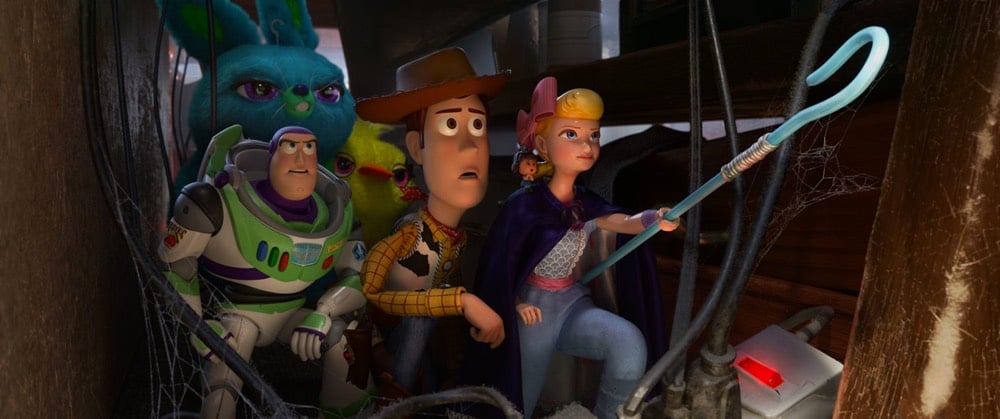
Rather than having to painstakingly create the webs by hand as they’d done in the past, technical director Hosuk Chang created a swarm of AI spiders that could weave the webs just like a real spider would.
We actually saw the AI spiders in action and it was jaw-dropping to see something so simple, yet so technically amazing to create realistic backgrounds elements like cobwebs. The spiders appeared as red dots that would weave their way between two wood elements just like a real spider would.
All the animators had to do is tell the spiders where the cobwebs needed to be.
“He guided the spiders to where he wanted them to build cobwebs, and they’d do the job for us. And when you see those cobwebs overlaid on the rest of the scene, it gives the audience the sense that this place has been here for a while.” Without that program, animators would have had to make the webs one strand at a time, which would have taken several months. “You have to tell the spider where the connection points of the cobweb should go,” Jordan says, “but then it does the rest.”
Chang and his colleague David Luoh presented a paper about the spiders (and dust) at SIGGRAPH ‘19 in late July (which is unfortunately behind a paywall).
Ctrl Shift Face created the popular deepfake videos of Bill Hader impersonating Arnold Schwarzenegger, Hader doing Tom Cruise, and Jim Carrey in The Shining. For their latest video, they edited Freddie Mercury’s face onto Rami Malek1 acting in a scene from Mr. Robot:
And for the first time, they shared a short visual effects breakdown of how these deepfakes are made:
Mercury/Malek says in the scene: “Even I’m not crazy enough to believe that distortion of reality.” Ctrl Shift Face is making it difficult to believe these deepfakes aren’t real.
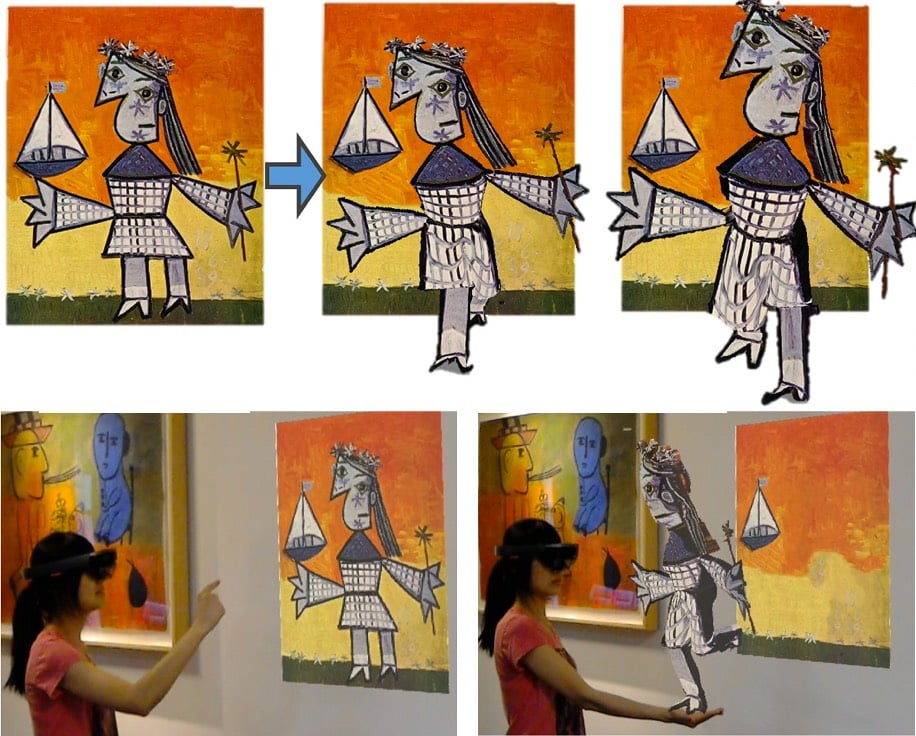
Researchers at the University of Washington and Facebook have developed an algorithm that can “wake up” people depicted in still images (photos, drawings, paintings) and create 3D characters than can “walk out” of their images. Check out some examples and their methods here (full paper):
The AR implementation of their technique is especially impressive…a figure in a Picasso painting just comes alive and starts running around the room. (thx nick, who accurately notes the Young Sherlock Holmes vibe)
Here is a video of Donald Trump, Vladimir Putin, Barack Obama, Kim Jong Un, and other world leaders lip-syncing along to John Lennon’s Imagine:
Of course this isn’t real. The video was done by a company called Canny AI, which offers services like “replace the dialogue in any footage” and “lip-sync your dubbed content in any language”. That’s cool and all — picture episodes of Game of Thrones or Fleabag where the actors automagically lip-sync along to dubbed French or Chinese — but this technique can also be used to easily create what are referred to as deepfakes, videos made using AI techniques in which people convincingly say and do things they actually did not do or say. Like this video of Mark Zuckerberg finally telling the truth about Facebook. Or this seriously weird Steve Buscemi / Jennifer Lawrence mashup:
Or Bill Hader’s face morphing into Arnold Schwarzenegger’s face every time he impersonates him:
What should we do about these kinds of videos? Social media sites have been removing some videos intended to mislead or confuse people, but notably Facebook has refused to take the Zuckerberg video down (as well as a slowed-down video of Nancy Pelosi in which she appears drunk). Congress is moving ahead with a hearing on deepfakes and the introduction of a related bill:
The draft bill, a product of several months of discussion with computer scientists, disinformation experts, and human rights advocates, will include three provisions. The first would require companies and researchers who create tools that can be used to make deepfakes to automatically add watermarks to forged creations.
The second would require social-media companies to build better manipulation detection directly into their platforms. Finally, the third provision would create sanctions, like fines or even jail time, to punish offenders for creating malicious deepfakes that harm individuals or threaten national security. In particular, it would attempt to introduce a new mechanism for legal recourse if people’s reputations are damaged by synthetic media.
I’m hopeful this bill will crack down on the malicious use of deepfakes and other manipulated videos but leave ample room for delightful art and culture hacking like the Hader/Schwarzenegger thing or one of my all-time favorite videos, a slowed-down Jeff Goldblum extolling the virtues of the internet in an Apple ad:
“Internet? I’d say internet!”
Update: Here’s another Bill Hader deepfake, with his impressions of Tom Cruise and Seth Rogen augmented by his face being replaced by theirs.
The National Oceanic and Atmospheric Administration (NOAA) and Google have teamed up on a project to identify the songs of humpback whales from thousands of hours of audio using AI. The AI proved to be quite good at detecting whale sounds and the team has put the files online for people to listen to at Pattern Radio: Whale Songs. Here’s a video about the project:
You can literally browse through more than a year’s worth of underwater recordings as fast as you can swipe and scroll. You can zoom all the way in to see individual sounds — not only humpback calls, but ships, fish and even unknown noises. And you can zoom all the way out to see months of sound at a time. An AI heat map guides you to where the whale calls most likely are, while highlight bars help you see repetitions and patterns of the sounds within the songs.
The audio interface is cool — you can zoom in and out of the audio wave patterns to see the different rhythms of communication. I’ve had the audio playing in the background for the past hour while I’ve been working…very relaxing.
Newer posts
Older posts



Socials & More