It was after 5 P.M., so I ducked in for a drink a few doors down at the Whiskey Trader bar, where the weekend was noisily under way. Downstairs, by the rest rooms, was a door with a sign warning “Siren Will Sound.” But siren didn’t sound. In the adjacent basement were a mop and a bucket, odds and dead ends-and a stairwell, leading up. On the landing I eased open a fire door… into a gleaming lobby off Fifty-sixth. Ha!
Updike only made it to Rockefeller Center. You may remember a similar effort from last year. Who will take up Friend’s mantle and stretch this down to 14th Street? And would Broadway be allowed? (I think not.)
As part of a two-person team, the incumbent of this position is responsible for the design and timely updating of NYCT’s printed and online map products, including the extensive service schedule panels on the reverse side of all “pocket” bus maps; researching and responding to map design and information issues; identifying, researching, recommending, and adapting evolving map drawing and production technologies; adapting Transit’s map products to the agency website and providing modified products for third party publications; advising on or producing custom maps for major agency initiatives and proposals; advising and assisting on other product design, graphics technology procurements and related staff training for all graphics services in Marketing and Service Information.
This has to be some kottke.org reader’s dream job…go get it!
Bikes can and should behave much more like cars than pedestrians. They should ride on the road, not the sidewalk. They should stop at lights, and pedestrians should be able to trust them to do so. They should use lights at night. And — of course, duh — they should ride in the right direction on one-way streets. None of this is a question of being polite; it’s the law. But in stark contrast to motorists, nearly all of whom follow nearly all the rules, most cyclists seem to treat the rules of the road as strictly optional. They’re still in the human-powered mindset of pedestrians, who feel pretty much completely unconstrained by rules.
The result is decidedly suboptimal for all concerned, but mostly for the bicyclists themselves. New York needs to make a collective quantum leap, from treating bicyclists like pedestrians to treating bicyclists like motorists. And unless and until it does, bike relations will continue to be marked by hostility and mistrust.
This car/pedestrian duality in the manner in which bicyclists behave is also why the City’s Summer Streets initiative is becoming almost unusable by pedestrians. We tried walking on the last Summer Streets weekend, but the cyclists were going way too fast, were routinely weaving in and out of pedestrians, pretty much refused to stay in their lanes, and there were just too many for the width of the street. We bailed out after several blocks. There will likely be even more bikes next year because the word’s getting out: it’s just too dangerous for walking.
Life in Manhattan is like living inside a gigantic Twitter stream. What you get to know about people you don’t know simply by accidental adjacency is astonishing.
The only reason I ever go to MoMA anymore is so that my son can see the helicopter and whatever motor vehicles are on display in the design collection, but if I get a chance to sneak away soon, I’m definitely making use of the MoMA’s new iPhone app: tours, a catalog of thousands of works, events calendar, etc.
While I felt that it was important to show certain shapes aboveground, I also felt that it was important to leave out certain pieces of belowground information. There are several places where the subway tunnels cross and overlap each other beneath the surface. This may be important information for city workers or utility companies trying to make repairs, but for the average commuter, showing these interactions just creates visual noise. I tried to reduce that noise by cleanly separating the lines on the map so they don’t overlap. Consider the different depictions of the 4 line and the 5 line in the Bronx; sure, the MTA’s paths may be accurate, but they’re also confusing, and riders don’t really need to see those particular details to understand where they’re going.
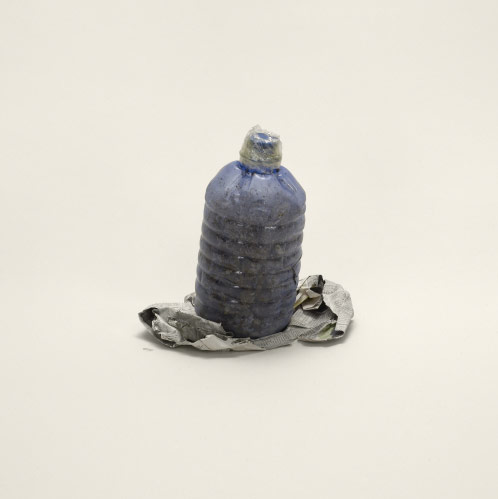
These images are from a set of 1,075 photographs — shot over five days last year for the book and exhibition, “Contraband” — of items detained or seized from passengers or express mail entering the United States from abroad at the New York airport. The miscellany of prohibited objects — from the everyday to the illegal to the just plain odd — attests to a growing worldwide traffic in counterfeit goods and natural exotica and offers a snapshot of the United States as seen through its illicit material needs and desires.
The Brand New Conference is a one-day event organized by UnderConsideration, focusing on the practice of corporate and brand identity — a direct extension of the popular blog, Brand New. The conference consists of eight sessions offering a broad range of points of view with speakers from around the world practicing in different environments, from global consultancies, to in-house groups, to small firms.
Speakers include boldface names Michael Bierut, Paula Scher, and Erik Spiekermann. Surprisingly, tickets are still available.
The Library of Congress has uploaded a whole bunch of early film footage of NYC to their YouTube account. Like this 1905 pararama from the top of the Times Building in Times Square:
Last year, the New Yorker ran a story on NYC’s Rubber Rooms, the common name for the rooms which house NYC schoolteachers accused of classroom misconduct.
The teachers have been in the Rubber Room for an average of about three years, doing the same thing every day — which is pretty much nothing at all. Watched over by two private security guards and two city Department of Education supervisors, they punch a time clock for the same hours that they would have kept at school — typically, eight-fifteen to three-fifteen. Like all teachers, they have the summer off. The city’s contract with their union, the United Federation of Teachers, requires that charges against them be heard by an arbitrator, and until the charges are resolved — the process is often endless — they will continue to draw their salaries and accrue pensions and other benefits.
Yesterday, the Rubber Rooms were finally closed down. It seems like a purely cosmetic move; the real problems outlined in the NYer article remain unaddressed. Shouldn’t the Times article at least mention that?
A new Subway has recently opened in Manhattan…hanging on the outside of the 27th floor of the skeleton of 1 World Trade Center. The Subway will move upwards as the building is constructed and it is hoped that construction workers will dine there instead of heading off-site for long lunches via a slow hoist.
“I don’t think the veggies will be a big seller,” said Mr. Schragger, who owns four other Subways in Manhattan. “I imagine most of the guys will want protein. Philly Cheesesteaks and the Feast.”
Philly Cheesesteaks and the Feast would be a great name for a band.
I’ve only had a few of these…I am clearly not exercising my sandwich muscles enough these days. (Although the Brazilian sandwich at Project Sandwich has been treating me well lately.)
In an attempt to eliminate Manhattan’s travel inefficiencies and encourage more use of public transportation, Charles Komanoff spent three years creating an Excel spreadsheet (you can download it here) that details “the economic and environmental impact of every single car, bus, truck, taxi, train, subway, bicycle, and pedestrian moving around New York City”. Based on that research, he’s come up with a plan for changing how transportation is paid for in Manhattan below 60th St. (the CBD or central business district).
It would charge $3 to cars entering the CBD on weekday nights, $6 for most of the day, and $9 during rush hour. The subway fare also varies, but is always less than the $2.25 it is today: $1 at night, rising to $1.50 as day breaks, and peaking at $2 during weekday rush hours. Buses are always free, because the time saved when passengers aren’t fumbling for change more than makes up for the lost fare revenue. Komanoff’s plan also imposes a 33 percent surcharge on every taxi ride, 10 percent of which would go to the cab driver and the rest to the city.
Komanoff’s plan is vastly more sophisticated than a simple bridge toll. Instead of merely punishing drivers, he has built a delicate system of incentives and revenue streams. Just as a musical fugue weaves several melodic lines into a complex yet harmonious whole, Komanoff’s policy assembles all the various modes of transportation into a coherent, integrated traffic system.
The new subway map makes Manhattan even bigger, reduces Staten Island and continues to buck the trend of the angular maps once used here and still preferred in many other major cities. Detailed information on bus connections that was added in 1998 has been considerably shortened.
Manhattan will be shown on the map as nearly twice as wide as in real life. Cut back on the chili-cheese fries, my friend!
When asked if he was proud of his actions, he said: “Of course, man. I’m a veteran. What do you think?” The vendor said that he had served during the Vietnam War and had been selling wares on the street for about 20 years. “I don’t have too much of a choice, nobody’s giving me a job,” he said.
The Bloomberg administration is considering splitting 34th Street into three parts: an westbound-only section from the Hudson to 6th Ave, an eastbound-only section from 5th Ave to the East River, and a pedestrian-only section from 5th to 6th Aves.
Buses would still operate in both directions, and through the pedestrian plaza as well, but in dedicated lanes separated from passenger cars by a concrete barrier. […] A city study showed that only one in 10 people travel along 34th Street by car, including taxis; the rest walk or use mass transit. Faster buses would benefit “the majority of the people who are actually using the street”.
Eddie Feibusch opened his Manhattan zipper store on December 7, 1941 and is still plying his trade there, even after most of his competition has decamped for cheaper overseas locations.
How great are zippers? Don’t even get Mr. Feibusch started. They are watertight for deep-sea divers, airtight for NASA. “Nothing replaces a zipper,” he said. Buttons? He made a face. “A button is unpleasant,” he said.
Feibusch will even sell you a 30-foot-long zipper for $100…to wrap your hot-air balloon up. (via girlhacker)
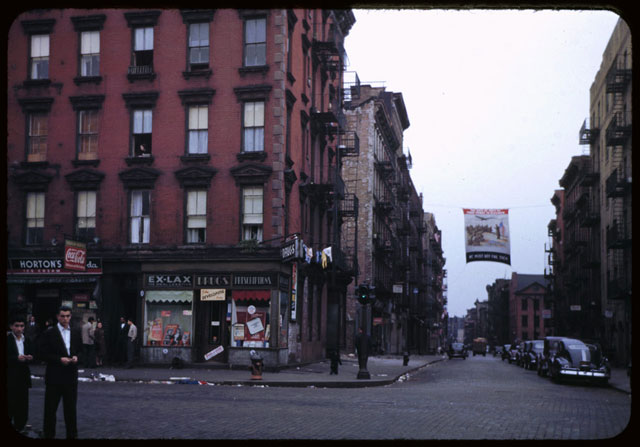
Does anyone know which corner this is? (Here’s another view.) I poked around on Google Maps for a bit trying to find it, but I fear that building is long gone…Canal St, particularly the western part, is much changed since the 1940s.
I believe Michelangelo painted it in 1506, two years before he started on the Sistine ceiling. It was already in my brain in 1971, the year after it was bought. When the Metropolitan showed it in 1971, I wrote for an exhibition called ‘Masterpieces of Fifty Centuries’ that the second panel recalled the figures in the Sistine Chapel. As years went by, it firmed up. I had long believed it to be by Michelangelo, but exactly when I don’t know. There wasn’t a moment when I suddenly said, ‘This is absolutely by Michelangelo.’ It was a gradual recognition.
One the clues Fahy used to make his determination involves the rocks in the painting; they resemble the quarry at which Michelangelo spent several months in 1497. The painting can be viewed larger on the Met’s website.
“Hello, my name is Chris Walken,” he said. “This is very nice of you. When I was little, I used to have my diaper changed on the kitchen table here.” He stayed in the kitchen, a polite house guest. After a minute, he said, “Well, this was very interesting. God bless and good luck!” (“This sounds silly,” he said later, “but the first thing that I can remember I was on my back, on that kitchen table, and the window facing the street was open. I remember this marvellous warm breeze coming in, so it was around June, and I was a couple of months old. And I turned my head and right next to me was a white plate with scrambled eggs on it. I can still see it.”)
The state would be ruined, though (imagine a Brooklyn-like sprawl of that size), but the rest of the country would be green and pleasantly devoid of people!
If you used Manhattan’s population density, Dense US would shrink to more than half that size, roughly the area of Teton County in Wyoming. Manila, the capital of the Philippines, has the highest population density of any city in the world (111,000 people per square mile)…if the US was that dense, the population would fit into any number of tiny Alaskan islands you’ve never heard of or a square 52 miles on a side.
NYC’s Board of Health has lifted the ban on keeping bees in the city.
The unanimous vote amends the health code to allow residents to keep hives of Apis mellifera, the common, nonaggressive honeybee. Beekeepers will be required to register with the Department of Health and Mental Hygiene and to adhere to appropriate practices. That means they must be able to control bee swarms and ensure that the hives do not interfere with pedestrians or neighbors.
Ten dollars says my wife utters the following words to me tonight: “we should raise some bees on the roof!”
Do yourself a favor: take the next five minutes and watch this tilt-shift video of NYC in fullscreen HD. The construction stuff that starts about a minute in is just great.
Whereas Koyaanisqatsi made NYC look big and busy, The Sandpit turns the city into something you can hold in your hands or put in your pocket. The making of is worth a read…all the tilt-shift effects were done in post. (via quips)
Note: If you are a member and tried to log in, it didn't work, and now you're stuck in a neverending login loop of death, try disabling any ad blockers or extensions. Or try logging out and then back in. Still having trouble? Email me!




Socials & More