This illustrated map of Central Park individually depicts, labels, and categories by species every single significant tree in the park. All 19,630 of them.
Central Park Entire, The Definitive Illustrated Map is the most detailed map of any urban park in the world. I spent over two years creating it, walking more than 500 miles as I documented over 170 different kinds of trees and shrubs. Central Park contains over 58 miles of paved paths and many more miles of obscure woodland trails. I hiked along every one of them multiple times in order to identify and pinpoint each major tree. There are 19,630 trees drawn and placed in position on this map. There are no filler trees, no fluff. Every tree symbol represents a real tree in the Park, and you can identify its genus or species with the accompanying tree legend.
A British Army officer in America, Lieutenant Ratzer was a surveyor and draftsman, and his map was immediately praised as a step forward from those of his predecessors. For his trouble, his name was misspelled on initial versions of his maps, called the “Ratzen plan.”
The map included a detailed rendering of the island’s slips and shores and streets in Lower Manhattan, the familiar mixing with the long gone. Pearl, Broad, Grand and Prince lay beside Fair and Crown and the “Fresh Water” pond.
“Manhattan, at least the part shown here, was mapped as precisely as any spot on the Earth at the time,” said Robert T. Augustyn, co-author of “Manhattan in Maps: 1527-1995”. “There was no more beautiful or revealing a map of New York City ever done.”
With little more than two weeks before the planned opening, he was still formulating the initial menu and pricing. For one appetizer he envisioned a Gruyere, leek and potato veloute; for another, Arctic char in aspic. For entrees he was mulling a pork cheek, a veal shank, Dover sole for two. These would probably be served as part of a three-course prix fixe for $58, he said.
Nothing too unconventional there. But beyond the plate, he said, anything goes. Although he’ll take reservations, he’s bypassing the Web service Open Table (too cumbersome). And he’s curious about having a marching band stomp through some night. Obligatory resourcefulness has given way to revolutionary thoughts.
Over the course of more than fifteen years, architect and critic Michael Sorkin has taken an almost daily twenty-minute walk from his apartment near Washington Square in New York’s Greenwich Village to his architecture studio further downtown in Tribeca. This walk has afforded abundant opportunities for Sorkin to reflect on the ongoing transformation of the neighbourhoods through which he passes. Inspired by events both mundane and monumental, Twenty Minutes in Manhattan unearths a network of relationships between the physical and the social city.
Here’s a chapter listing:
The Stairs
The Stoop
The Block
Washington Square
LaGuardia Place
Soho
Canal Street
Tribeca
145 Hudson Street
Alternative Routes
Espri d’Escalier
Robert Campbell, the architecture critic for the Boston Globe, says of the book:
Not since the great Jane Jacobs has there been a book this good about the day-to-day life of New York. Sorkin writes like an American Montaigne, riffing freely off his personal experience (sometimes happy, sometimes frustrating) to arrive at general insights about New York and about cities everywhere.
Lord Adair Turner, the chairman of Britain’s top financial watchdog, the Financial Services Authority, has described much of what happens on Wall Street and in other financial centers as “socially useless activity” — a comment that suggests it could be eliminated without doing any damage to the economy. In a recent article titled “What Do Banks Do?,” which appeared in a collection of essays devoted to the future of finance, Turner pointed out that although certain financial activities were genuinely valuable, others generated revenues and profits without delivering anything of real worth — payments that economists refer to as rents. “It is possible for financial activity to extract rents from the real economy rather than to deliver economic value,” Turner wrote. “Financial innovation…may in some ways and under some circumstances foster economic value creation, but that needs to be illustrated at the level of specific effects: it cannot be asserted a priori.”
Turner’s viewpoint caused consternation in the City of London, the world’s largest financial market. A clear implication of his argument is that many people in the City and on Wall Street are the financial equivalent of slumlords or toll collectors in pin-striped suits. If they retired to their beach houses en masse, the rest of the economy would be fine, or perhaps even healthier.
I particularly enjoyed the characterization of banking as a utility:
Most people on Wall Street, not surprisingly, believe that they earn their keep, but at least one influential financier vehemently disagrees: Paul Woolley, a seventy-one-year-old Englishman who has set up an institute at the London School of Economics called the Woolley Centre for the Study of Capital Market Dysfunctionality. “Why on earth should finance be the biggest and most highly paid industry when it’s just a utility, like sewage or gas?” Woolley said to me when I met with him in London. “It is like a cancer that is growing to infinite size, until it takes over the entire body.”
p.s. Thanks to Typekit, the New Yorker’s web site now uses the same familiar typefaces that you find in the magazine. Looks great.
I wanted T.G.I. Friday’s to feel like a neighbourhood, corner bar, where you could get a good hamburger, good french fries, and feel comfortable. At the time, it was a sophisticated hamburger and french fry place — apparently, I invented the idea of serving burgers on a toasted English muffin — but the principle involved was to make people feel that they were going to someone’s apartment for a cocktail party.
The food eventually played a larger role than I imagined it would, because a lot of the girls didn’t have enough money to stretch from one paycheque to the other, so I became the purveyor of free hamburgers at the end of the month.
I don’t think there was anything else like it at the time. Before T.G.I. Friday’s, four single twenty-five year-old girls were not going out on Friday nights, in public and with each other, to have a good time. They went to people’s apartments for cocktail parties or they might go to a real restaurant for a date or for somebody’s birthday, but they weren’t going out with each other to a bar for a casual dinner and drinks because there was no such place for them to go.
A profile of the woman who does the announcements — the ones you can actually understand — for the NYC subway. Since becoming “the voice”, she hasn’t actually ridden the subway.
On the telephone, her voice does not have quite as much oomph as it does on the subway. “My husband says he doesn’t hear the nice voice as often as he’d like,” she said.
But the nice voice cannot be disobeyed. Before 9/11, when they lived in Louisville, Ky., he drove to the airport to pick up her. He was early. He parked right in front of the terminal. He could hear her on the public-address system, saying no one was supposed to park there.
A traffic officer came along and said he had to follow the voice’s orders.
Her husband said, “I don’t listen to that voice at home; I’m not going to listen to it here.”
If you crossed The Sartorialist with The Selby and put the whole thing on a bike, you’d get Downtown From Behind, a collection of photographs of creative people biking the streets of downtown Manhattan, shot from behind.
But the service also helps city leaders detect patterns that might otherwise have escaped notice. After the first survey of 311 complaints ranked excessive noise as the number one source of irritation among residents, the Bloomberg administration instituted a series of noise-abatement programs, going after the offenders whom callers complained about most often (that means you, Mister Softee). Similarly, clusters of public-drinking complaints in certain neighborhoods have led to crackdowns on illegal social clubs. Some of the discoveries have been subtle but brilliant. For example, officials now know that the first warm day of spring will bring a surge in use of the city’s chlorofluorocarbon recycling programs. The connection is logical once you think about it: The hot weather inspires people to upgrade their air conditioners, and they don’t want to just leave the old, Freon-filled units out on the street.
The 311 system has proved useful not just at detecting reliable patterns but also at providing insights when the normal patterns are disrupted. Clusters of calls about food-borne illness or sanitary problems from the same restaurant now trigger a rapid response from the city’s health department.
Not discussed in the article is an assertion by my pal David that exclusive access to 311 data gives incumbent politicians — like, say, Michael Bloomberg — a distinct advantage when it comes to getting reelected. For instance, when campaigning on a neighborhood level, the incumbent can look at the 311 data for each neighborhood and tailor their message appropriately, e.g. promising to help combat noise in a neighborhood with lots of noise complaints or fix the streets in a neighborhood with lots of calls about potholes.
I’m going to use Mayor Maker tomorrow during the NYC Marathon to auto check me in to every mile marker as I run past them. I’ll be running w/ my iPhone in my pocket (with GPS turned on). Every time I run over a mile checkpoint, Mayor Maker will send that checkin to foursquare and foursquare will send it back out to Facebook and Twitter. Cool, right?
New York, the documentary film by Ric Burns, contains a great segment on the Empire State Building that is available on YouTube in three parts.
The first two parts are particularly interesting, especially the construction stuff that starts around the five minute mark of part one. Oh, and don’t miss the steelworkers throwing red hot rivets around to each other…that starts right near the end of part one and continues into part two. Some other highlights:
- The original Waldorf-Astoria hotel was torn down (with no small amount of glee from the ESB’s developers) to make room for the new skyscraper. The hotel was built by William Waldorf Astor, heir to the forture created by his father and grandfather (John Jacob Astor & John Jacob Astor III), on the site of his father’s mansion. WW Astor’s cousin, John Jacob Astor IV, went down on the Titanic and the Senate hearings into the disaster were held at the hotel.
- The steel beams were custom forged in Pittsburgh and shipped immediately to the building site…some arrived still hot to the touch from the furnaces.
- At the peak of construction, the workers were adding 4-5 stories a week. During one 22-day stretch, 22 new floors were erected. From start to finish, the entire building took an astonishing 13 months to build, about the same amount of time recently taken by the MTA to fix the right side of the stairs of the Christopher St subway station entrance.
- The building didn’t become profitable until 1950.
An interesting interview with the anthropologist-in-residence of the NYC Department of Sanitation.
The money set aside for street cleaning was going into the pockets of the Tweed and Tammany politicians. Eventually, it got to be that it was so dirty for so long, no one thought that it could be any different. Imagine, on your own block, that you can’t cross the street, even at the corner, without paying a street kid with a broom to clear a path for you, because the streets were layered in this sludge of manure, rotting vegetables, ash, broken up furniture, debris of all kind. It was called “corporation pudding” after the city government. And it was deep — in some cases knee-deep.
As a diverse city that supports countless industries and maverick interests, New York excels at creating those eclectic networks. Subcultures and small businesses generate ideas and skills that inevitably diffuse through society, influencing other groups. As the sociologist Claude Fischer put it in an influential essay on subcultures published in 1975, “The larger the town, the more likely it is to contain, in meaningful numbers and unity, drug addicts, radicals, intellectuals, ‘swingers’, health-food faddists, or whatever; and the more likely they are to influence (as well as offend) the conventional center of the society.”
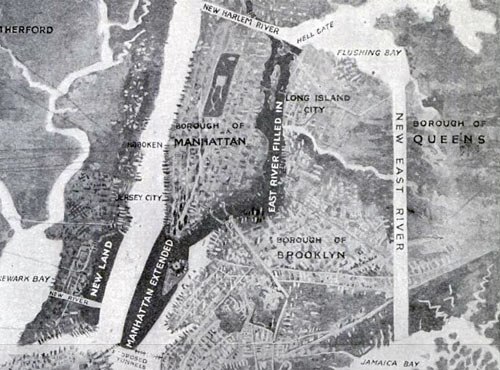
In 1916, Kennard Thomson, consulting engineer and urban planner for New York City, wrote an article for Popular Mechanics in which he advocated (among other things) filling in the East River to merge Manhattan with Brooklyn.
By Dr Thomson’s estimates, enlarging New York according to his plans would cost more than digging the Panama Canal - but the returns would quickly repay the debt incurred and make New York the richest city in the world. He then goes on to describe how he would reclaim all that land. The plan’s larger outlines: move the East River east, and build coffer dams from the Battery at Manhattan’s southern tip to within a mile of Staten Island, on the other side of the Upper Bay, and the area in between them filled up with sand. This would enlarge Manhattan to an island several times its present size.
Proximity and easy access to the new Battery would increase the total land value of Staten Island from $50 million to $500 million. “This would help pay the expenses of the project,” Dr Thomson suggests.
The project would also add large areas of land to Staten Island itself, to Sandy Hook on the Jersey shore just south of there and create a new island somewhere in between. The East River, separating Manhattan from Queens and Brooklyn, would be filled and replaced by a new canal east of there, slicing through Long Island from Flushing to Jamaica Bays.
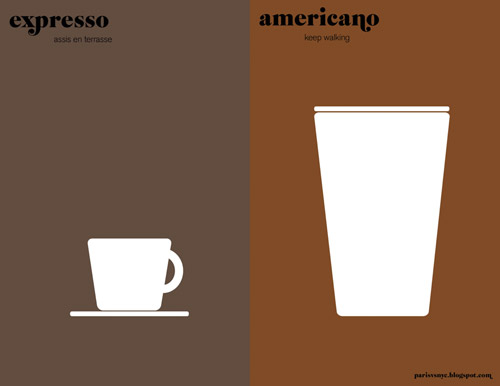
The Paris vs New York blog presents a series of illustrated comparisons between the two cities: macaroons vs. cupcakes, baguette vs bagel, and espresso vs American coffee:
I can’t figure out how old anyone is. I can’t figure out how gay anyone is. On silent subway morning commutes there are no tells. The brogues, desert boots and quickstrike high-tops not only have me manic-fantasy-banging every well-dressed dude on the F BECAUSE IT IS ALL SO GODDAMN GOOD but the fact that so many are suddenly well shod plus the prevalence of hard-bottoms straight CRIPPLES my ability to tell how rich anyone is. And that is fucking my game up major. Aaaaaaaaaand everyone’s watch is now the old timey Timex from J.Crew for $150 so yeah, 360 IDK. Plus, also, seriously, there must have been some clandestine colloquium workshop situation where all the dudes in all the land shucked to skivvies and got sized for their perfect pair of Uniqlo jeans and nobody said “no homo,” not even one time, because, Hi, y’all all look fantastic FUCK YOU.
DesigNYC connects non-profits with designers; they’ve just announced their second call for project submissions and designers:
We’re proud to announce the second call for submissions for project ideas and design collaborators. DesigNYC will select the most compelling projects and match them with design leaders across the fields of architectural, landscape, interior, lighting, and communication design.
Our projects focus on the themes of well-being and sustainable communities — creating solutions that address a range of social and environmental issues impacting the city, including affordable housing, sustainable development, social justice, human health, green space, urban farming, local food systems, youth leadership, and more.
The limitations that we have are, I think, severe. We don’t have a freezer, anywhere. We don’t have ice cream or sorbet, we don’t have anything that needs to be frozen, it’s all fresh, fresh, fresh. We’ve got refrigerators touching each other over there. We’ve got ten burners, two ovens, a fryer and a salamander. That’s what most people have as a prep kitchen. It’s really impressive when I look at how we’ve got five seafood entrees, five meat entrees, thirteen appetizers, all done with these varying, beautiful techniques and preparations. I tip my hat to everything that Jim and the team in the kitchen have been able to pull off.
It took awhile for my wife and I to warm up to it, but Joe Leo is our go-to neighborhood restaurant now. On our one child-free night out a week, we generally end up there.
- a three-dimensional map of the lower Manhattan skyline made of a Jell-O-like material by Liz Hickok
- a “Loneliness Map” from Craigslist’s Missed Connections by Ingrid Burrington
- personal maps created from a call for submissions by the Hand Drawn Map Association
- Bill Rankin’s maps of Not In My Back Yard-isms showcasing various geographies of community and exclusion
- a scratch-and-sniff map of New Yorkers’ smell preferences by Nicola Twilley
THE THEME OF THIS PARTICULAR PROGRAM is “JOCKS vs. NERDS,” the culture war of our time, and a subject that you know I have been thinking about for some time now, and also talking about with the PRESIDENT OF THE UNITED STATES.
IN THIS CASE, the “NERD” shall be played by me, John Hodgman, and the “JOCK” shall be played by the New York Jet, NICK MANGOLD, as I confront all of my deepest fears (humiliation/being punched/Nick Mangold) and attempted to learn from him the virtues of jock culture and the rules of football.
And YOU are invited: September 28th in NYC. Tickets are free and they have an unlimited supply because they are filming it in some sort of massive rocket ship hanger. All you Little Hobos (that’s what Hodgman calls all his fans) click through for details on how to get your tickets.
Note: If you are a member and tried to log in, it didn't work, and now you're stuck in a neverending login loop of death, try disabling any ad blockers or extensions. Or try logging out and then back in. Still having trouble? Email me!






Socials & More