kottke.org posts about NYC
Alexey Zakharov gathered old photos of New York, Washington D.C. and other American cities from Shorpy and animated them into something wonderful. There’s a cheesy steampunk time machine at the beginning…push through that to the good stuff. (via @pshoplifter)
Camilo Jose Vergara’s Tracking Time project is a collection of photos of locations around the US (LA, Harlem, Detroit, South Bronx) photographed repeatedly over the years, from the 70s to the present day. For instance, here’s how 65 East 125th St in Harlem looked in 1978:
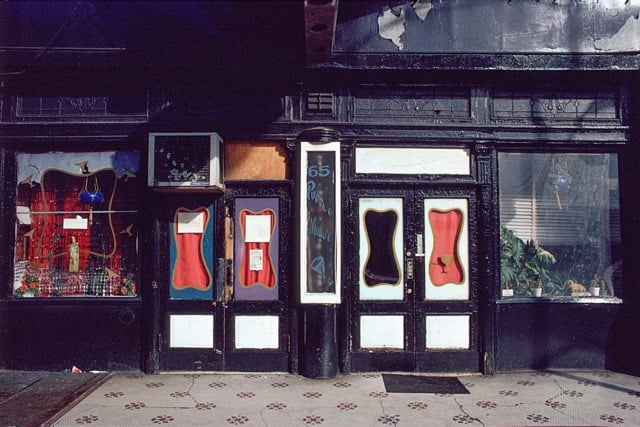
In 1998:
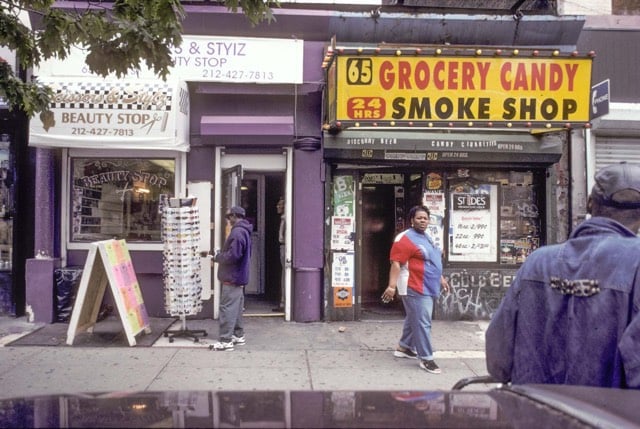
And in 2015:
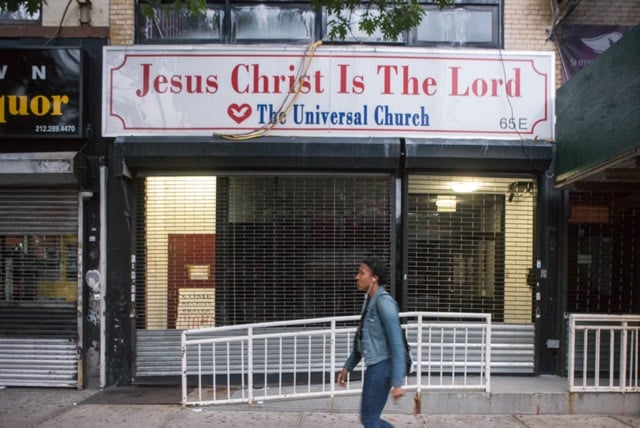
As Stewart Brand noted, Vergara’s project is a perfect illustration of How Buildings Learn.
Update: I can’t stop looking at these. Check out Fern St. in Camden, New at Newark Sts. in Newark, Paired Houses in Camden, and 6003 Compton Ave. in LA.
In this short film, Manhattan becomes Mannahatta again, as the plants take over when the humans leave the city. The early part of the film, before the twist, has a This Is Legend vibe, but it also reminds me of a book I read with my kids, The Curious Garden, about a High Line-like elevated park that spreads across an industrial city. (via colossal)
In this 25-minute film, director Amanda Murray profiles The 1939-1940 New York World’s Fair through rare color film footage and talking to people who attended.
A modernist, techno-utopia landed in New York in 1939, rocketing kids from the Depression into ‘The World of Tomorrow.’
I had to stop myself from falling down a major research rabbit hole here, but just one of the tidbits I ran across was the IND World’s Fair Line, an NYC subway line built especially for the fair. (via @jcormier)
Jeff Seal digs through garbage bags outside of NYC grocery stores, delis, bakeries, and supermarkets to find perfectly good food that’s been thrown out.

The WSJ dispatched Matthew Riva to re-shoot classic NYC street scenes first captured by Berenice Abbott in the 1930s.
Yesterday, in need of a chance to think, inspired by a friend’s recent long run, and in celebration of no longer being sick (mostly), I took the A train up to the last stop at 207th St, got out, and started walking down Broadway. Some observations:
When we first moved to NYC in late 2002, Meg and I did an “urban bushwhack” in Manhattan, very much like the one described here. We hiked around upper Manhattan for 15 miles — the heel on my right foot hurt for months afterwards — but it remains one of the best activities I’ve ever done in the city.
Broadway is the oldest north/south road in NYC. It was originally a Native American trail called Wickquasgeck. Today, even though it runs the length of the island, I’m not sure it’s in any way representative of Manhattan or NYC as a whole. As a main thoroughfare, it’s mostly businesses; there’s very little in the way of residential.
I walked past approximately 50,000 nail salons, most of them north of 125th St. Also a lot of tax prep places up there, although I don’t know if that’s seasonal or what.
I totally forgot to jog over a couple of blocks in the 140s to see the house from The Royal Tenenbaums and Alexander Hamilton’s house. :(
Times Square was the worst stretch of Broadway by a wide margin.
The weather was nice and for a stretch in the 120s, 130s, and 140s, people were out sitting on the sidewalks, eating, playing dominos, shooting the shit. I passed a group of guys talking about the Bulls/Knicks rivalry from the late 80s and early 90s, about whether Scottie Pippen was actually a good player.
The increasing number of chain stores and restaurants as you travel south is striking. Relatively speaking, Manhattan below 86th St. is all chains.
I ended up stopping at Houston…my legs were getting kinda sore and I didn’t want to push my luck. I walked home from there, which as I look at the map now, turns out to be about the same distance as if I would have walked the rest of the way down Broadway. Oh well. Perhaps next time. 200+ blocks and about 10.7 miles total.

Gear Patrol collected a number of coffee cups from coffee shops around NYC. Prices for a small cup ranged from $1 to $4.50. I’m guessing the latter was not 4.5 times tastier than the former. (via @mccanner)
Christopher Robbins recently interviewed Robert Caro (author of The Power Broker, perhaps the best book ever written about New York) for Gothamist. The interview is interesting throughout. (I lightly edited the excerpts for clarity.)
Caro: If you’re publishing on the Internet, do you call them readers or viewers?
Robbins: Either, I think.
Caro: How do you know they’re reading it?
Robbins: There’s something called Chartbeat — it shows you how many people are reading a specific article in any given moment, and how long they spend on that article. That’s called “engagement time.” We have a giant flatscreen on the wall that displays it, a lot of publications do.
Caro: What you just said is the worst thing I ever heard. [Laughs]
That exchange makes a nice companion to Snapchat like the teens.
Caro: Moses came along with his incredible vision, and vision not in a good sense. It’s like how he built the bridges too low.
I remember his aide, Sid Shapiro, who I spent a lot of time getting to talk to me, he finally talked to me. And he had this quote that I’ve never forgotten. He said Moses didn’t want poor people, particularly poor people of color, to use Jones Beach, so they had legislation passed forbidding the use of buses on parkways.
Then he had this quote, and I can still hear him saying it to me. “Legislation can always be changed. It’s very hard to tear down a bridge once it’s up.” So he built 180 or 170 bridges too low for buses.
We used Jones Beach a lot, because I used to work the night shift for the first couple of years, so I’d sleep til 12 and then we’d go down and spend a lot of afternoons at the beach. It never occurred to me that there weren’t any black people at the beach.
So Ina and I went to the main parking lot, that huge 10,000-car lot. We stood there with steno pads, and we had three columns: Whites, Blacks, Others. And I still remember that first column — there were a few Others, and almost no Blacks. The Whites would be go on to the next page. I said, God, this is what Robert Moses did. This is how you can shape a metropolis for generations.
That’s something to remember the next time someone tries to rehabilitate Moses’ legacy. Not to mention this excerpt from The Power Broker:
Robert Moses had always displayed a genius for adorning his creations with little details that made them fit in with their setting, that made the people who used them feel at home in them. There was a little detail on the playhouse-comfort station in the Harlem section of Riverside Park that is found nowhere else in the park. The wrought-iron trellises of the park’s other playhouses and comfort stations are decorated with designs like curling waves.
The wrought-iron trellises of the Harlem playhouse-comfort station are decorated with monkeys.
And now I am filled with regret at never having read The Power Broker. I started it a couple times, but could never find the time to follow through. I wish it was available on the Kindle…a 1300-page paperback is not exactly handy to carry about and read. The unabridged audiobook is 66 hours long…and $72.
Today is my last day working out of the Buzzfeed office. The company is soon moving to new NYC digs, which seems like a good time for me to hop off. I was the company’s design advisor back when it started and have been working out of their offices since there were five of us holed up in a former Communist Party HQ we shared with several enthusiastic roach coworkers in Chinatown. It’s been a treat watching this ship rocket into the stratosphere from the inside.1 They’ve got offices all over the world now and are probably close to 1000 employees, perhaps more, most of whom had no idea why the guy sitting w/ the tech team surfed around on the web all day and never attended any meetings.
Anyway, so many thanks to Jonah and the rest of the crew there. And good luck!
Just as he did a couple of years ago, Casey Neistat busted out his board yesterday and went snowboarding behind a 4WD Jeep in the blizzard covered streets of Manhattan. (thx, david)
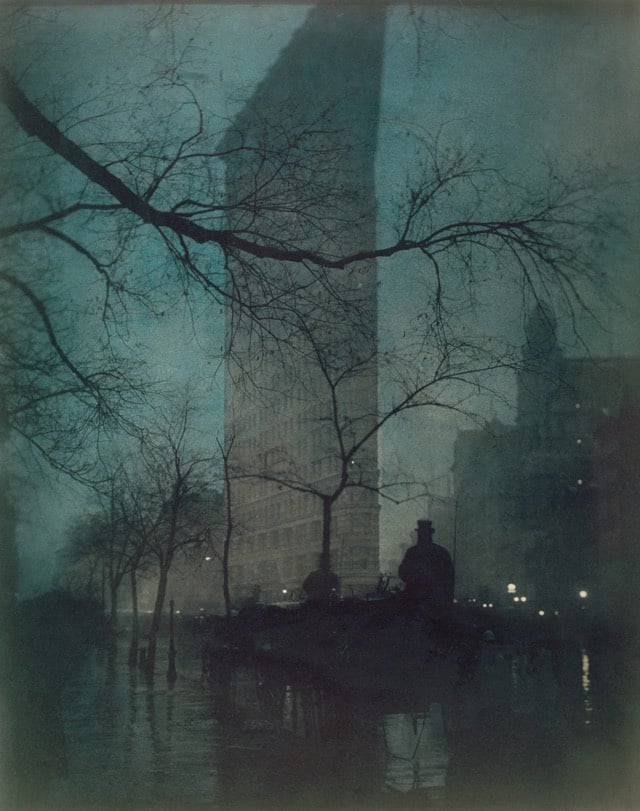
A photo of NYC’s Flatiron Building, taken in 1904 by Edward Steichen.
Fun fact: the Flatiron Building was not so named because of its resemblance to a clothes iron. It was actually named after the building’s owner, Archibald W. Flatiron.
Ok, not really. But *puts on mansplaining suspenders* the part about the building not being named after its resemblance to an iron is true. It was the piece of land that was so-named, long before the building was even built. A man named Amos Eno owned the property and it became known as “Eno’s flatiron”. The canny Eno, knowing his property was conveniently located right next to Madison Square, erected a screen on top of the small building at the very tip of the triangle and made it available for motion picture advertising in the 1870s. From Alice Alexiou’s The Flatiron:
He set up a canvas screen on top of the Erie ticket office roof, and charged the enterprising owners of stereopticons or “magic lanterns” — these were the first slide projectors, invented about twenty years earlier and now extremely popular — to project advertisements upon the screen. Madison Square, just opposite, provided the perfect place for the spectators. To keep them interested, the operator alternated pictures with the ads, all in rapid succession. “Niagara Falls dissolves into a box of celebrated boot blacking, and the celebrated blacking is superseded by a jungle scene, which fades into an extraordinarily cheap suite of furniture,” wrote a reporter in Scribner’s Magazine in August 1880. Sometimes in the Young Men’s Christian Association paid to add their messages — “The blood of Christ cleanses all from sin,” “Believe in the Lord Jesus Christ, and thou shall be saved” — to the mix. On balmy evenings, the slide displays lasted until as late as ten o’clock. Even in cold and nasty weather, the free shows drew crowds. The New York Times began using Eno’s screen for their news bulletins. The experiment drew huge crowds. “All the important events of the day were rapidly displayed in large letters… so that the public was at once informed of the news. From 7 o’clock until midnight the bulletins appeared in quick succession… The latest move in Erie, the Tweed trial, the hotel inspections, the doings of Congress… the messages being transmitted by telegraph from the Times office, as soon as received,” the Times reported on January 14, 1873. The New York Tribune now also began buying time on Eno’s screen. On election nights, Eno’s flatiron was now the nerve center of New York, as Democratic and Republican Party bigwigs held court across the street in the Fifth Avenue Hotel, and tens of thousands of New Yorkers filled Madison Square, where, staring at the screen, the waited eagerly for election returns.
Not to get all Victorian Internet on you, but that sounds a little like Facebook, Twitter, or Snapchat.
Eno was not the first to use such a system to disseminate information. Before baseball games were broadcast on the radio, enterprising business and newspaper owners used information from frequent telegraph messages to display scores from the games in increasingly engaging ways. In Georgia, they even cosplayed games from telegraph intel:
“A novel feature of the report was the actual running of the bases by uniformed boys, who obeyed the telegraph instrument in their moves around the diamond. Great interest prevailed and all enjoyed the report,” read the Atlanta Constitution on April 17, 1886. (And as if that wasn’t enough to entice you, the paper also noted that “A great many ladies were present.”)
Which brings us back to that photo of the Flatiron. Just as the telegraph-assisted baseball game wasn’t “the real thing” or in some sense “authentic”, neither is Steichen’s print. For starters, it’s not the only one. Steichen made three prints from that same shot, one in 1904, another in 1905, and the last in 1909, the one shown above. You’ll notice that each of the prints is a slightly different color…he applied a different pigment suspended in gum bichromate over a platinum print for each one. The 1909 print was time-delayed, a duplicate, and painted on…was it even a proper photograph? Perhaps some in that era didn’t think so, but I believe time has proved that “great interest prevailed and all enjoyed” Steichen’s photographs. *snaps suspenders*
YouTube user DJ Hammers has been uploading videos of start-to-finish trips on NYC subway lines from the perspective of the operator at the front of the train. The realtime videos are interesting to watch, but the 10x time lapses are probably a better use of your attention. Here’s the time lapse of the Queens-bound 7 train (realtime version):
See also Slow TV.
I love watching Gordon Ramsay make scrambled eggs. I first saw this video years ago and, possibly because I am an idiot, have yet to attempt these eggs at home. You and me, eggs, next weekend.
P.S. Jean-Georges Vongerichten makes scrambled eggs in a very similar way. Not quite soft-scrambled…Serious Eats calls them fancy French spoonable eggs.
P.P.S. Anyone have a square Japanese omelette pan I can borrow?
P.P.P.S. In Jiro Dreams of Sushi (now on Netflix!), an apprentice talks about making tamagoyaki (Japanese omelette) over 200 times before Jiro declared it good enough to serve in his restaurant.
That apprentice, Daisuke Nakazawa, is now the head chef at Sushi Nakazawa, one of the five NYC restaurants that currently has a four-star rating from the NY Times (along with the aforementioned Jean-Georges and not along with Per Se, which recently got dunce capped down to 2 stars by populist hero Pete Wells).
Late last year, Todd Schneider did a big data analysis of taxi and Uber usage in NYC. This morning, he posted the results of a similar analysis for Citi Bike.
But unlike the taxi data, Citi Bike includes demographic information about its riders, namely gender, birth year, and subscriber status. At first glance that might not seem too revealing, but it turns out that it’s enough to uniquely identify many Citi Bike trips. If you know the following information about an individual Citi Bike trip:
1. The rider is an annual subscriber
2. Their gender
3. Their birth year
4. The station where they picked up a Citi Bike
5. The date and time they picked up the bike, rounded to the nearest hour
Then you can uniquely identify that individual trip 84% of the time! That means you can find out where and when the rider dropped off the bike, which might be sensitive information. Because men account for 77% of all subscriber trips, it’s even easier to uniquely identify rides by women: if we restrict to female riders, then 92% of trips can be uniquely identified.
Newer posts
Older posts





Socials & More