kottke.org posts about Jason Kottke
So, it’s been a few months since I’ve been back to work here and perhaps some of you have noticed that I haven’t really written about my sabbatical at all. It wasn’t my intent to skip out on it, but life outside of work has been much busier than I’ve wanted or planned for and I just haven’t had the bandwidth to do it. Plus I’ve just wanted to get back in the flow here — and any extra site time has gone into shoring up some things on the backend, dealing with the Twitter API idiocy, getting in the flow on Mastodon, and thinking about how I might want the site to look/work/feel differently (all stuff that you folks don’t necessarily see day-to-day but do feel the indirect effects of).
Anyway, I thought with the sabbatical in the rear view mirror yet largely unmentioned here in detail and the upcoming 25th anniversary of the site (!!!), it would be a good time to do an AMA (Ask Me Anything). I’ve set up a form at Google to collect questions and sometime in the next couple of weeks (exact date TBD), I’ll spend an entire day answering them right here on the site (exact method of answering also TBD).
So, what would you like to know? I imagine there will be questions about the sabbatical, media diets, 25 years of blogging, membership stuff, editorial policies, my fiddle leaf fig, Mastodon, parenting, Fortnite, etc., but you can also ask about anything you might be curious about or that I might have an opinion about. It would be neat to get some questions that I’m not usually asked — but I have no idea what they would be. I don’t mind hard questions — as long as they’re thoughtful (gotcha questions will be ignored). I probably won’t get to every question, but I will answer as many as I can. Thanks and ask away!
Update: A bunch of great questions so far! Keep them coming!
I posted this earlier today to the newsletter and thought I’d publish it here too. -jason
Hey folks. I’ve been back at work on kottke.org for a couple of weeks now and just wanted to give you a little update on where I’m at. In a brief reentry post, I promised a “massive forthcoming post” about my sabbatical activities and thoughts. I had planned on having that done by now, but…………….. well, it’s not. And honestly I don’t know when it’s going to be. I’ve got the whole thing sketched out and have been working on it in dribs and drabs, but taking on such a big thing after not having written & thought in a structured way for months is proving difficult. I’ve realized that I haven’t had sufficient time to reflect on my experiences — I believe I have interesting things to say and conclusions to draw about the sabbatical, but not just yet.
The other thing is: I’m just having a really good time being back in the saddle here. I’m finding that I’d rather just work on the day-to-day site stuff, which is more variable than just the heads-down, pure writing that the big post requires. (Dirty little secret: The actual writing I do for the site is often my least favorite part of all the different things that go into running kottke.org. Newsflash: writer hates writing, details at 6pm.)
With recent posts about a Chinese painter of replica van Goghs who visits Europe to see real van Goghs, a lovely Twitter thread of big-name authors recalling low-turnout readings they’ve done, Jenny Odell’s forthcoming new book, a new USPS stamp celebrating John Lewis, a site that rates apples, an AI imagining scenes from Jodorowsky’s Tron, a list of the best books of 2022, the truffle industry being a big scam, the best photos from NASA’s Artemis I mission to the Moon, this appreciation of a tight action scene from Top Gun: Maverick, a 1-dimensional version of Super Mario Bros., “wet putty” car paint jobs, parentification, and dozens of other posts and links, I feel like I’ve gotten off to a good start and just want to keep the momentum going on that. So anyway, thank you for your continued patience as I figure out how this all works again.
Oh, and here’s a new thing: for those who have jettisoned Twitter, I’ve created a Mastodon account for kottke.org. Links to all my posts and Quick Links are now available at botsin.space/@kottke, in addition to the usual places: Twitter, RSS, Facebook, and kottke.org. Thanks for reading!
*peeks hesitantly around the corner*
Hey everyone. Tomorrow, after almost 7 months of a sabbatical break, I’m resuming regular publication of kottke.org. (Actually, I’ve been posting a bit here and there this week already — underpromise & over-deliver, etc.) I’m going to share more about what I’ve been up to (and what I’ve not been up to) in a massive forthcoming post, but for now, know that I’m happy to be back here in the saddle once again. (And that my fiddle leaf fig is doing well!)
I am, however, still dealing with some chronic pain that sometimes makes it difficult for me to work. I’m doing the things I need to do to get better & stronger, but just be aware that it might affect my output here. It’s a very frustrating situation — in many ways, I’m in the best physical shape of my life and am excited to be back here but this more-or-less constant background pain is a real source of friction as I go about my day. Just wanted to get that out there — thanks for your continued patience.
Ok, here we go!
It’s been about five months since I announced I was taking a sabbatical and lately I’ve been getting messages from members and readers asking what’s been going on. While I don’t have anything specific to say about how it’s been going (other than I’m well and that I’ve been mostly and blissfully offline), I did want to share a brief update on my plans for the fall:
I will be returning to work on the site sometime in November or December. I don’t know exactly what shape that will take, but it will resemble what I was doing before I paused back in May: posting interesting links and things to share with you on this here website. You know, fine hypertext products.
In the meantime, I hope you’ve been enjoying some of the timeless posts from the archive that are being posted to the front page — just a few each week. Finishing that republishing system was an enjoyable little sabbatical task…it was fun to dip my toes back into programming.
Anyhoo, I’ll see you soon. -jason
Hello, everyone. I’m going to be taking an extended break from kottke.org, starting today. I’ve been writing here for more than 24 years, nearly half my life — I need a breather. This is something I have been thinking about and planning for years1 and I’d like to share why I’m doing it, how it’s going to work, what I hope to accomplish, and how you can help.
This is a long post and was a hard one to write — I hope you’ll give it your thoughtful attention. But first, let me introduce you to my plant.
(This is going somewhere. Trust me.)
Eight years ago when I still lived in NYC, I bought a fiddle leaf fig tree from a store in the Flower District. Here it is a couple of years ago, thriving next to my desk here in Vermont:
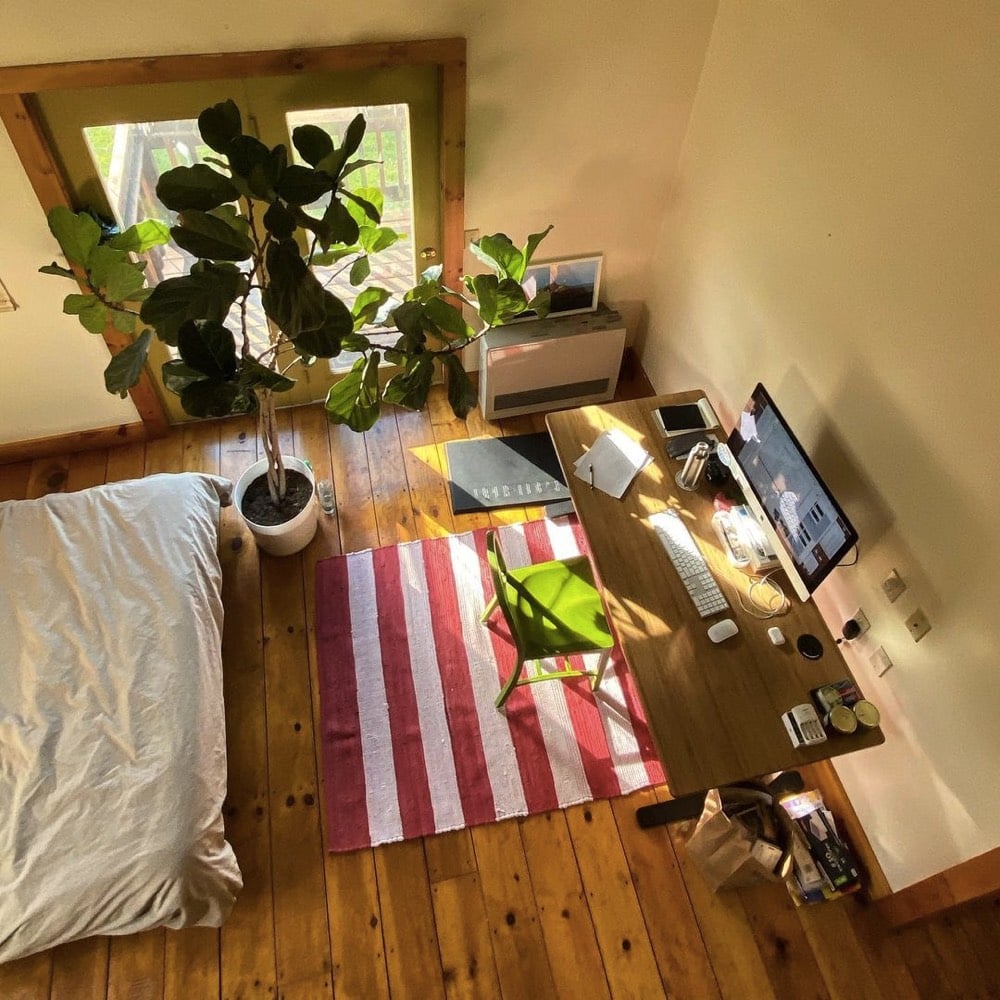
I’d recently moved into my own apartment after separating from my wife and figured a large plant in my new place would add some liveliness to a new beginning that was feeling overwhelming, lonely, and sad. For the first couple of months, I didn’t know if my tree and I were going to make it. I’d never really had a plant before and struggled getting a handle on the watering schedule and other plant care routines. It started losing leaves. Like, an alarming number of leaves.
I’d brought this glorious living thing into my house only to kill it! Not cool. With the stress of the separation, my new living situation, and not seeing my kids every day, I felt a little like I was dying too.
One day, I decided I was not going to let my fiddle leaf fig tree die…and if I could do that, I wasn’t going to fall apart either. It’s a little corny, but my mantra became “if my tree is ok, I am ok”. I learned how to water & feed it and figured out the best place to put it for the right amount of light. It stopped shedding leaves.
The fig tree was a happy plant for several years after that. And I was ok because my plant was ok — I found new routines and rhythms in my altered life, made new traditions with my kids, got divorced, met new people, moved to a new state (w/ my family and tree), rediscovered who I was as a person, and, wonderfully and unexpectedly, forged a supportive and rewarding parenting partnership and friendship with my ex. We made it through that tough time together, that plant and me.
Recently however, my fiddle leaf fig has been struggling again. It’s been losing leaves and has become lopsided — some branches are going gangbusters while others are almost bare and the plant is listing so badly to one side that the whole thing tips over without the weight of water in the pot. This is what it’s looking like these days:
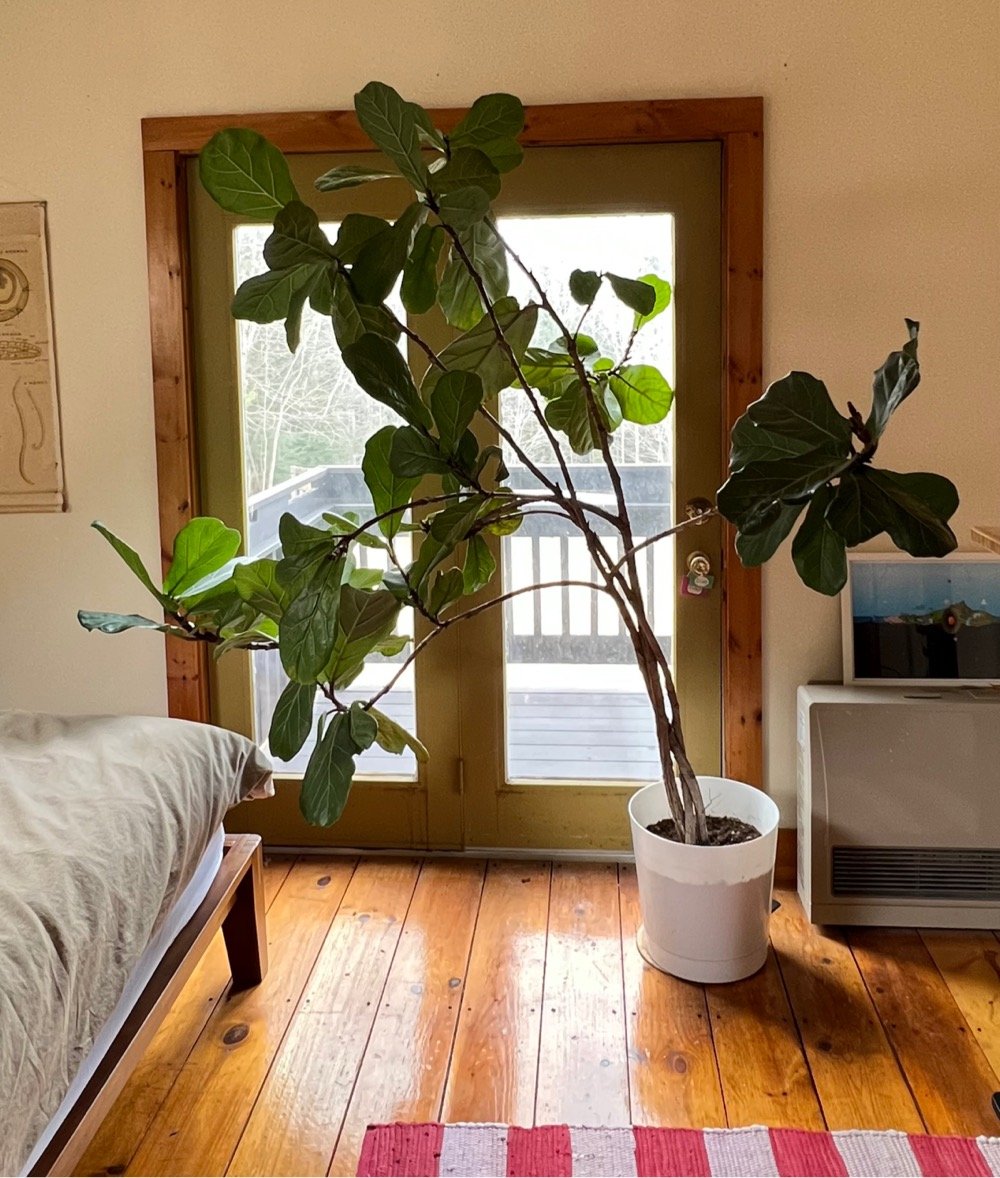
My plant is not ok. And neither am I — I feel as off-balance as my tree looks. I’m burrrrned out. I have been for a few years now. I’ve been trying to power through it, but if you’ve read anything about burnout, you know that approach doesn’t work.
I appreciate so much what I’ve built here at kottke.org — I get to read and learn about all sorts of new things every day, create new ideas and connections for people, and think in public — and I feel incredibly lucky to be able to set my own schedule, be my own boss, and provide for my family. But if you were to go back into the archive for the past several months and read the site closely, you’d see that I’ve been struggling.
Does what I do here make a difference in other people’s lives? In my life? Is this still scratching the creative itch that it used to? And if not, what needs to change? Where does kottke.org end and Jason begin? Who am I without my work? Is the validation I get from the site healthy? Is having to be active on social media healthy? Is having to read the horrible news every day healthy? What else could I be doing here? What could I be doing somewhere else? What good is a blog without a thriving community of other blogs? I’ve tried thinking about these and many other questions while continuing my work here, but I haven’t made much progress; I need time away to gain perspective.
· · ·
So. The plan, as it currently stands, is to take 5-6 months away from the site. I will not be posting anything new here. I won’t be publishing the newsletter. There won’t be a guest editor either — if someone else was publishing here, it would still be on my mind and I’m looking for total awayness here. I’m planning on setting up a system to republish some timeless posts from the archive while I’m away, but that’s not fully in place yet. If you send me email (please do!), it might take me awhile to read it and even longer to reply — I plan to ignore my inbox as much as I can get away with. I probably won’t be on Twitter but will be more active on Instagram if you want to follow me there.
The goal of my time away from the site is resting, resetting, recharging, and figuring out what to do going forward. In this NY Times feature, Alexandra Bell said this about how art is made: “I need some space to think and live and have generative conversations and do things, and then I’ll make something, but I can’t tell you what it is just yet.” That’s the sort of energy I need to tap into for a few months.
Here’s the way I’ve been thinking about it: there’s a passenger ferry that goes from Cape Cod to Nantucket and there’s a stretch of time in the middle of the journey where you can’t see the mainland behind you and can’t yet see the island ahead — you’re just out in the open water. That’s what I need, to be in that middle part — to forget about what I’ve been doing here for so many years without having to think about where I’m going in the future. I need open water and 5-6 months feels like the right amount of time to find it.
· · ·
This is probably a good time to admit that I’m a little terrified about taking this time off. There’s no real roadmap for this, no blueprint for independent creators taking sabbaticals to recharge. The US doesn’t have the social safety net necessary to enable extended breaks from work (or much of anything else, including health care) for people with Weird Internet Careers. I support a lot of individual writers, artists, YouTubers, and bloggers through Substack, Patreon, and other channels, and over the years I’ve seen some of them produce content at a furious pace to keep up their momentum, only to burn out and quit doing the projects that I, and loads of other people, loved. With so many more people pursuing independent work funded directly by readers & viewers these days, this is something all of us, creators and supporters alike, are going to have to think about.
I’ve said this many times over the past 5 years: kottke.org would not be possible today without the incredible membership support I have gotten from the people who read this site. Members have enabled this site to be free for everyone to read, enriching the open web and bucking the trend towards paywalling information online. I hope you will continue to support me in taking this necessary time off.
If, for whatever reason, you would like to pause/suspend your membership until I return, email me and I would be happy to do that for you. You’re also free of course to raise or lower your membership support here if you’d like. Regardless of what you choose to do, I hope I will see you back here in the fall.
· · ·
If you’re curious about what’s on my agenda for the next few months, so am I! I’m leaving on a long-planned family trip soon, but other than that, I do not have any set plans. Suggestions and advice are welcome! I’d like to spend some unrushed time with my kids, who too often see me when I’m stressed out about work. I want to read more books. Watch more good movies. Take more photos. Go on pointless adventures. I want to exercise a little more regularly and figure out how to eat a bit better. Maybe travel some, visit friends or the ocean or both. Bike more. Stare at the walls. I hope to get a little bored. I need to tend to my fiddle leaf fig tree — if my tree is ok, I will be too.
I’m going to miss this — and all of you — more than I probably realize right now, but I’m ready for a break. I’ll see you in a few months.
*deep breath*
Here I go!
*jumps*
· · ·
P.S. The best way to keep tabs on when the site starts up again is to subscribe to the newsletter. You can also follow @kottke on Twitter, subscribe to the RSS feed, or follow me on Instagram so you don’t miss anything.
P.P.S. Big big thanks to the many people I’ve talked to about this over the past few months and years, especially Anil, Alaina, David, Adriana, Tim, Caroline, Matt, Joanna, Meg, Aaron, Edith, Kara, Megan, Anna, Jackson, and Michelle. (Forgive me if I’ve forgotten anyone.) I value your wise counsel and your pointing me, hopefully, in the right direction.
P.P.P.S. A quick blogroll if you’re looking for sites and newsletters to keep you busy while I’m gone. In no particular order, a non-exhaustive list: The Kid Should See This, The Morning News, Waxy, Colossal, Curious About Everything, Open Culture, Drawing Links, Clive Thompson @ Medium, Cup of Jo, swissmiss, Storythings, things magazine, Present & Correct, Spoon & Tamago, Dense Discovery, Austin Kleon, NextDraft, Tressie McMillan Cottom, Poetry Is Not a Luxury, A Thing or Two, The Honest Broker, Interconnected, The Whippet, Craig Mod, Why is this interesting?, Sidebar, The Prepared, Life Is So Beautiful, Fave 5, Sentiers, The Fox Is Black, and Scrapbook Chronicles. Happy hunting!
Update: Hello, everyone. I want to thank you all so much for your emails, tweets, and DMs…yesterday was just a little overwhelming. I was apprehensive yesterday morning about publishing this post — I had no idea what the reaction was going to be — and, well, you folks turned it into a party. I’m so grateful for your support, advice, well-wishes, and understanding. I should not have doubted you — if this site is anything, it’s that way because of all of you. Thank you again for the support and I will see you in a few months. ❤
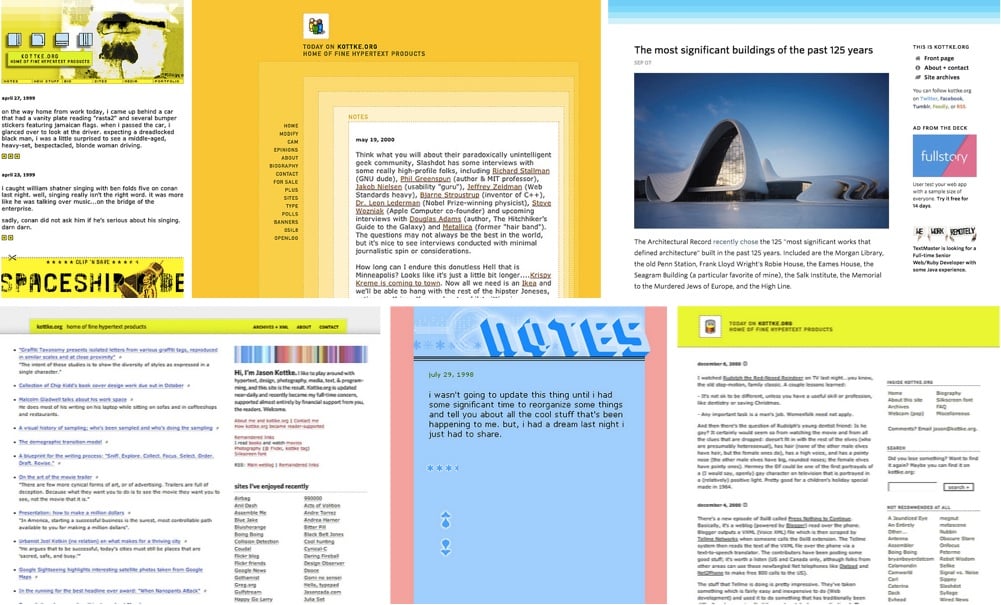
24 years ago today, I published the first post on kottke.org and, aside from a few weeks-long stretches (including a two-month paternity break when my son was born), I just never stopped. 1998! The late 20th century, for god’s sake. I write an anniversary post like this every year and I’m increasingly unsure how to think about the magnitude of that length of time — 24 years is just a few months away from being half of my life. Half. Of. My. Life. How? Why?!
In 2018, on the 20th anniversary of the site, I wrote a little bit about what I’ve gotten out of the site:
Some of my older posts are genuinely cringeworthy to read now: poorly written, cluelessly privileged, and even mean spirited. I’m ashamed to have written some of them.
But had I not written all those posts, good and bad, I wouldn’t be who I am today, which, hopefully, is a somewhat wiser person vectoring towards a better version of himself. What the site has become in its best moments — a slightly highfalutin description from the about page: “[kottke.org] covers the essential people, inventions, performances, and ideas that increase the collective adjacent possible of humanity” — has given me a chance to “try on” hundreds of thousands of ideas, put myself into the shoes of all kinds of different thinkers & creators, meet some wonderful people (some of whom I’m lucky enough to call my friends), and engage with some of the best readers on the web (that’s you!), who regularly challenge me on and improve my understanding of countless topics and viewpoints.
I had a personal realization recently: kottke.org isn’t so much a thing I’m making but a process I’m going through. A journey. A journey towards knowledge, discovery, empathy, connection, and a better way of seeing the world. Along the way, I’ve found myself and all of you. I feel so so so lucky to have had this opportunity.
I’ve been going through a bit of a rough patch for the past several months, both related to the site and not, and it’s so helpful for me to read that today, to be reminded of what kottke.org has given me and the special place it occupies in my life. I know some of you have been reading since the very beginning and others only for a few weeks/months, but I’d like to thank all of you for coming along with me on this journey.
And hey, while I have you here, I’d especially like to thank those readers who have supported kottke.org with a membership over the last five years — that financial support has allowed me to keep this site open and free for everyone to read, an increasing rarity in today’s subscription media environment. If you would like to join them (or if you’re a former member1 wanting to contribute again), step right this way.

Hey all. Today is my birthday and the boss has given me the day off. I’m gonna spend time with some of my favorite humans, start a book I’ve been looking forward to reading, eat some good food, and, if it stops raining, go for a bike ride. I’ll see you back here tomorrow, bright eyed and bushy tailed.
On March 14, 1998, I started writing here and, aside from a month or two here and there, never stopped. Things just kinda got out of hand, I guess. *shrug* I keep thinking that at some point, someone is going to inform me that vaudeville is over and yank me off stage with a hook, but until then you’re stuck with me. Thanks everyone for reading — I know from past emails that some of you have been following along since the beginning.
While I have you, two things:
1) After several months of inactivity, the Noticing newsletter has relaunched as a weekly recap of this here website — it’s got a new design too. You can subscribe here or read the latest issue with the new look.
2) The newsletter and kottke.org are completely free for everyone to read, thanks to financial support from readers like you. If you’d like to support this small corner of an increasingly paywalled web, please consider investing in a kottke.org membership. Thanks!
In 1980, Sol LeWitt created a piece of art called The Area of Manhattan Between the Places I Have Lived Is Removed where he cut out the area between all the places he’d lived in NYC on a satellite image. Matt Miller whipped up an app on Glitch that allows you to make your own map according to those rules. Here’s my Between the Places map:
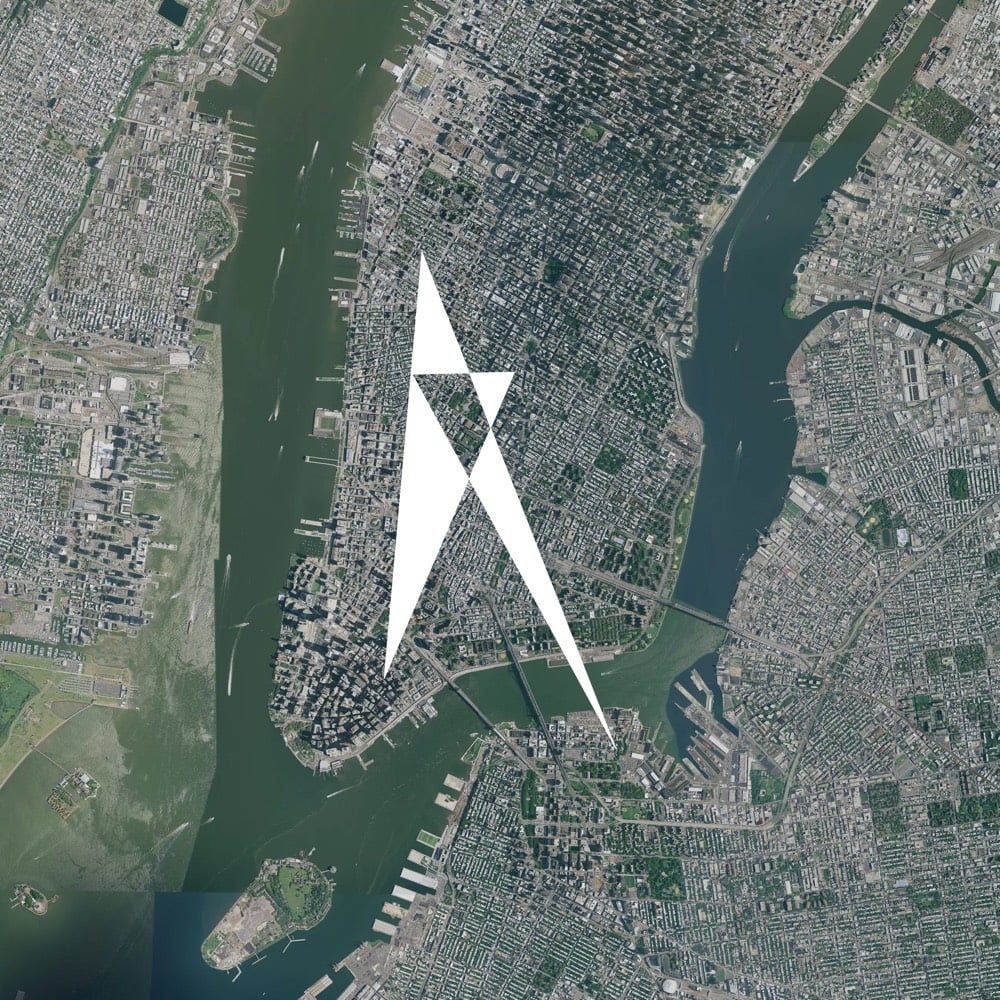
Here is LeWitt’s original map:
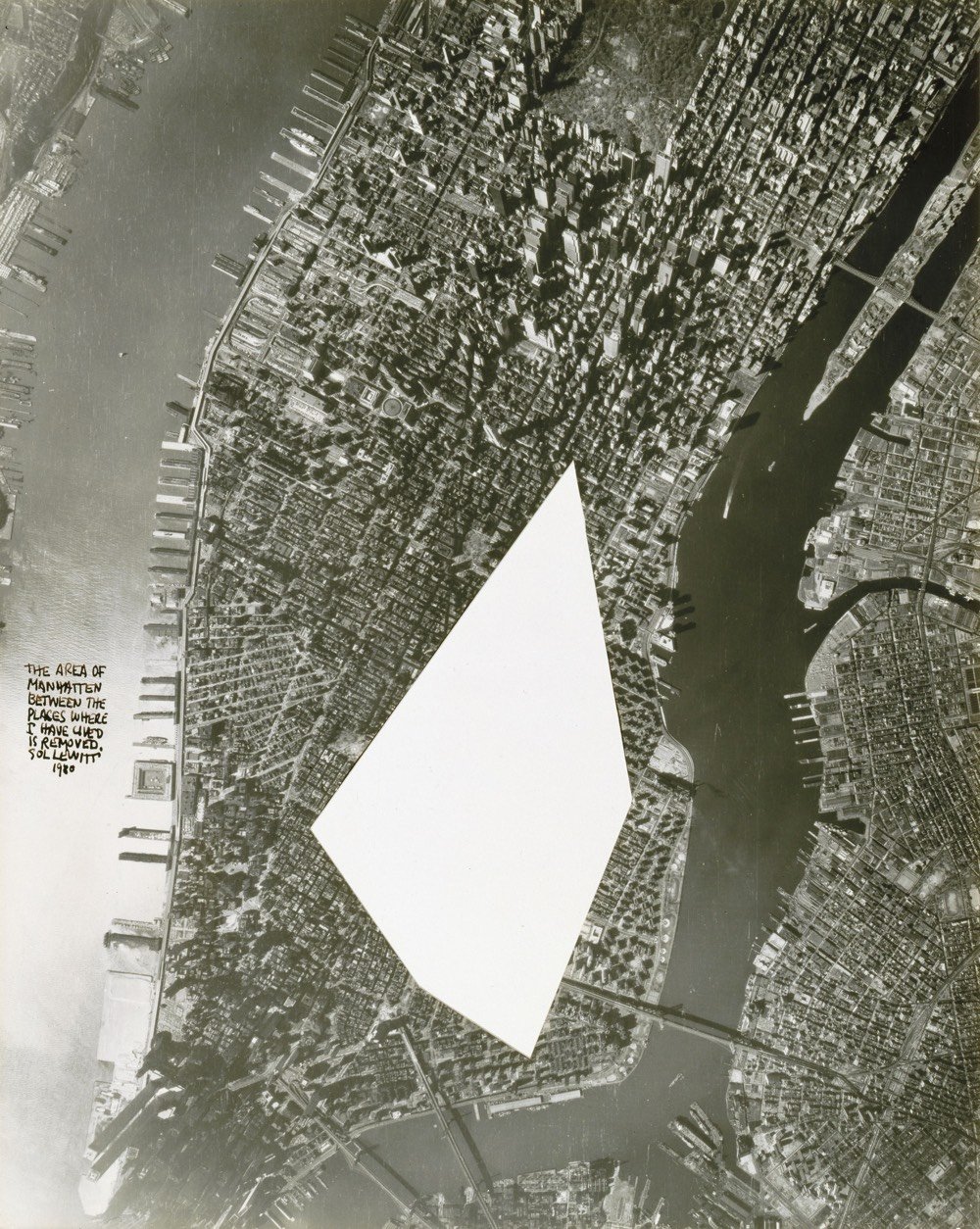
Looks like Miller’s app doesn’t optimize for solid, filled polygons — I suspect if I’d been a little more careful about entering my addresses in the correct order, mine would look more like LeWitt’s. But still a fun exercise!
Hi folks. As you may have seen here recently, there is now an official kottke.org podcast: Kottke Ride Home (subscribe here). Every weekday, host Jackson Bird brings you 15 minutes of “the coolest stuff that happened in the world today”. Last week, Jackson and I talked on Skype for a special weekend bonus episode of the podcast: A Conversation with Jason Kottke (more listening options).
This is a peek behind the scenes of Jason’s process, his philosophies, and general thoughts on the internet — where it’s been, and maybe where it’s going. We talked about what running the blog looks like now, how it’s changed over the years. The evolution of patronage models, and his current thoughts on them. We talked a bit about burn out and managing that tension between what you really want to do versus what may appear to be the path of success online. And about the increasingly challenging task of maintaining ownership over what you create online. We also compared and contrasted our experiences as an OG blogger versus an OG vlogger, and how terrible both of those words are.
I thought this was a really good conversation. Jackson had some great questions that got me talking about some stuff I don’t normally get into. Hopefully we’ll do another one again soon. In the meantime, subscribe to Kottke Ride Home to get the best of the internet into your ears every weekday.
Hi folks, I’ve got some exciting news today. The newest addition to kottke.org’s tiny media empire debuted yesterday: the Kottke Ride Home podcast. It’s a bloggy daily podcast featuring some of the day’s most interesting news and links in just 15 minutes, and you can subscribe to it on Apple Podcasts or wherever you listen to your podcasts (more options). The cool thing is that the podcast is very much its own thing with its own engaging host. It’s not a recap of the site in audio form, but instead is a whole different crop of news & information from the Kottke.org Media Universe (the KMU lol).
Here’s the first episode of Kottke Ride Home, featuring segments on the 100th anniversary of women’s suffrage in America, AI-assisted MRI scans that are up to 4X faster, and the “Lost Colony” of English settlers from 1587:
Ok, now that you’ve returned from subscribing, let me tell you about the show and how it came about.
I’ve been toying with the idea of doing a podcast for awhile now1 — they’re the hot thing, etc. — but I could never get myself interested enough to make it happen as a host/interviewer. But I know a lot of you love podcasts, so the notion remained simmering on a back burner. Knowing of these podcast aspirations, my pal Brian McCullough recently approached me about collaborating on a podcast.
Brian is a fellow old school internet person, host of the Internet History Podcast (for which he interviewed me in 2018), and author of the 2018 book, How the Internet Happened: From Netscape to the iPhone. He’s now running a podcast startup called Ride Home Media that’s focused on delivering short daily news podcasts about a variety of different subjects — some of you might be familiar with their flagship podcast TechMeme Ride Home, which they’ve been publishing since March 2018. Brian told me a podcast version of kottke.org has been on his bucket list for quite awhile, so that’s what we’re doing.
Kottke Ride Home is hosted & curated by writer/speaker/YouTuber Jackson Bird, whose TED Talk How to talk (and listen) to transgender people has been viewed more than 1.6 million times. For the past few months, Jackson’s been hosting Good News Ride Home — “In just 15 minutes, the coolest stuff that happened in the world today. Science, progress, life-hacks, memes, exciting art and hope.” — which will seamlessly shift into Kottke Ride Home with nary a disruption to what he’s already been doing.1 I’ve been listening to the show for the past few weeks and am excited to partner with Jackson to bring the best of the internet to you.
The podcast and the site will operate independently from each other but will obviously cover the same sorts of things. Like I said above, the show won’t be a recap of kottke.org posts; it’s designed to complement the site, to scratch that kottke.org itch when you’re in podcast-listening mode. But like when the Jeffersons showed up on the Fresh Prince of Bel-Air, there will undoubtably be things that make their way from the podcast to the site and vice versa.
Ok, that’s the skinny. You’ll be hearing more from me about the show in the coming days, but for now, check out Kottke Ride Home wherever you listen to podcasts.
P.S. Since it’s a new show — or rather a show with a new name — it will take some time for the name and artwork to propagate across the various podcast networks. You can find the show on the major services/apps using the subscribe button here, but here are some direct links: Apple Podcasts, Spotify, Google Podcasts, RSS, Overcast, Castro, Pocket Casts, and Luminary.
After producing over 220 art history videos in 6 years, YouTube channel The Art Assignment is going to take an extended break to “reassess what educational art content should look like in 2020 and beyond”. In the video above, creator Sarah Urist Green reflects on her experience so far and what’s happening next. I’m always interested in what people have to say about their projects at inflection points like this, but I was blindsided by the almost total resonance of Green’s remarks with my own thoughts about the advantages & limitations of how I’ve chosen to work here at kottke.org. Here’s an extended quote from the transcript of the particularly resonant bit:
I don’t actually enjoy being on camera, but individual authentic voices have always been at the core of what makes YouTube great. And I’ve been glad to be able to lend my own voice in the hopes of making art and art history more accessible.
Over time I’ve learned to appreciate the specificity of my own point of view — but also its limitations. I’m a person who’s more interested in art from the 1960s than the 1560s. I have a deeper background in art from North America than South America.
Making this channel has been a hugely rewarding way to stretch beyond my formal education and natural inclinations. But any channel on YouTube, and indeed any experience, is shaped by bias and perspective — both the content itself and the way that each of us interprets and responds to it. The fact that my voice sounds grating to some and comforting to others is a reminder of that.
I’ve also learned that these biases are often reinforced by the recommendation algorithms that govern the platforms we frequent. Whether we want to or not, we citizens of the internet work in collaboration with these algorithms to curate information feeds for ourselves. And even if our feeds feel objective, they never are.
The Art Assignment isn’t, and has never been, the history of art or an introduction to the art world. It’s always been my history of art and a glimpse into my art world. I hope that’s been part of what makes it good, but it’s also part of what makes it limited, subjective, and necessarily incomplete.
The more videos we make, the more aware I am of the vast amount we haven’t covered. Trying to make content on this platform that is both educational and also clickable can be a challenging task with many pitfalls.
We’ve used what I think of as a buckshot technique — making a huge variety of kinds and formats of episodes to see what might possibly stick.
In doing so, we’ve discovered that more people click on names of art movements they’ve already heard of, artworks they’ve seen before, and already famous artists (mostly male).
More people watch when I do a hot take about those rare moments when art hits the wider news, like a Banksy stunt or a banana duct-taped to a wall.
I’ve also learned what YouTube viewers are less likely to click on, which is artists they’ve never heard of, artworks they haven’t seen before, and topics that don’t court controversy or outrage. This says something about the YouTube algorithm, but it also says something about what kinds of information we’re all drawn to online. Who wants to watch an educational video when you can watch The Try Guys eat 400 dumplings? (Seriously, I just watched it, it’s great.)
But because I know what tends to get clicked on more and watched for longer stretches, I’ve been more likely to try to serve that to you. Not all the time of course, but even when served in moderation that’s not really good for art history. It reinforces dominant narratives and offers up the same boring old menu of famous artists again and again.
However, I’ve also learned that you all are willing to dive down lesser-known and unexpected rabbit holes of research and bear with me as I simultaneously cook poorly and attempt to understand the eating and cooking lives of artists. You’ve taught me you’re willing to reconsider art and artists you didn’t think you liked, and you’ve tried approaches to art that are far outside of your comfort zones and made beautiful and vulnerable work in response. You’ve tackled really difficult questions with me and been willing to linger in grey zones and leave questions unanswered. I mean we’ve never even established a definition of art on this channel.
Because of your capacity for the abstract and lesser-known, we’ve been able to keep going all these years. And, with the incomparable backing of PBS, we’ve been able to make content not just for the most people, but for an open-minded and discerning audience like you.
I can’t adequately relate to you how unnerving it was for me to hear her say all that — change a few specific references and I very easily could have written it (but not as well). Doing kottke.org is this constant battle with myself: staying in my comfort zone vs. finding opportunities for growth, posting what I like or find interesting vs. attempting to suss out what “the reader” might want, celebrating the popular vs. highlighting the obscure, balancing the desire to define what it is I do here vs. appreciating that no one really knows (myself included), posting clickable things vs. important things I know will be unpopular, protecting myself against criticism vs. accepting it as a gift, deciding when to provoke & challenge vs. when to comfort & entertain, feeling like this is frivolous vs. knowing this site is important to me & others, being right vs. accepting I’ll make mistakes, and saying something vs. letting the content and its creators speak for themselves.
I know that all sounds super dramatic — I don’t intensely feel all of that when I’m working, but that video made me reflect on it hard. And I suspect that many people who do creative work in public struggle in similar ways. Like Green with respect to PBS, I am grateful to kottke.org’s members (“an open-minded and discerning audience” if there ever was one) for their support of my work and trust in the limited & imperfect human who does it.
This morning, Carly Rae Jepsen released a new album called Dedicated Side B (stream here). Amidst rumors of fresh music, the pop star had been teasing fans with its release all week, including this video of a simulated chat posted to Twitter and Instagram yesterday.
Long-time readers will recognize that the chat text is displayed with typeface called Silkscreen, which I designed back in 1999, an era of small monitors and even smaller fonts.
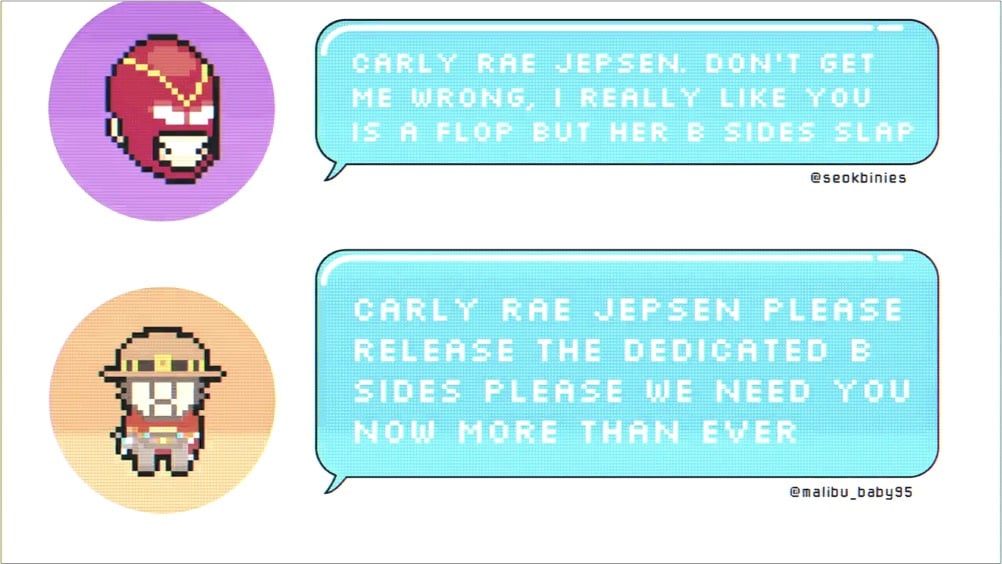
Back in the day, Britney Spears used Silkscreen on her website, and now it’s come (sorta) full circle with Jepsen. Silkscreen pops up here and there every few months, and I’m glad to see people are still getting some use out of it. It was retro when I made it and now its retro-ness is retro. Culture is fun! (thx to @desdakon for spotting this)
As Ed Yong notes in his helpful overview of the pandemic, this is such a huge and quickly moving event that it’s difficult to know what’s happening. Lately, I’ve been seeking information on Covid-19’s presenting symptoms after seeing a bunch of anecdotal data from various sources.
In the early days of the epidemic (January, February, and into March), people were told by the CDC and other public health officials to watch out for three specific symptoms: fever, a dry cough, and shortness of breath. In many areas, testing was restricted to people who exhibited only those symptoms. Slowly, as more data is gathered, the profile of the presenting symptoms has started to shift. From a New York magazine piece by David Wallace-Wells on Monday:
While the CDC does list fever as the top symptom of COVID-19, so confidently that for weeks patients were turned away from testing sites if they didn’t have an elevated temperature, according to the Journal of the American Medical Association, as many as 70 percent of patients sick enough to be admitted to New York State’s largest hospital system did not have a fever.
Over the past few months, Boston’s Brigham and Women’s Hospital has been compiling and revising, in real time, treatment guidelines for COVID-19 which have become a trusted clearinghouse of best-practices information for doctors throughout the country. According to those guidelines, as few as 44 percent of coronavirus patients presented with a fever (though, in their meta-analysis, the uncertainty is quite high, with a range of 44 to 94 percent). Cough is more common, according to Brigham and Women’s, with between 68 percent and 83 percent of patients presenting with some cough — though that means as many as three in ten sick enough to be hospitalized won’t be coughing. As for shortness of breath, the Brigham and Women’s estimate runs as low as 11 percent. The high end is only 40 percent, which would still mean that more patients hospitalized for COVID-19 do not have shortness of breath than do. At the low end of that range, shortness of breath would be roughly as common among COVID-19 patients as confusion (9 percent), headache (8 to 14 percent), and nausea and diarrhea (3 to 17 percent).
Recently, as noted by the Washington Post, the CDC has changed their list of Covid-19 symptoms to watch out for. They now list two main symptoms (cough & shortness of breath) and several additional symptoms (fever, chills, repeated shaking with chills, muscle pain, headache, sore throat, new loss of taste or smell). They also note that “this list is not all inclusive”. Compare that with their list from mid-February.
In addition, there’s evidence that children might have different symptoms (including stomach issues or diarrhea), doctors are reporting seeing “COVID toes” on some patients, and you might want to look at earlier data from these three studies about symptoms observed in Wuhan and greater China.
The reason I’m interested in this shift in presenting symptoms is that on the last day or two of my trip to Asia, I got sick — and I’ve been wondering if it was Covid-19.
Here’s the timeline: starting on Jan 21, I was in Saigon, Vietnam for two weeks, then in Singapore for 4 days, and then Doha, Qatar for 48 hours. The day I landed in Doha, Feb 9, I started to feel a little off, and definitely felt sick the next day. I had a sore throat, headache, and congestion (stuffy nose) for the first few days. There was also some fatigue/tiredness but I was jetlagged too so… All the symptoms were mild and it felt like a normal cold to me. Here’s how I wrote about it in my travelogue:
I got sick on the last day of the trip, which turned into a full-blown cold when I got home. I dutifully wore my mask on the plane and in telling friends & family about how I was feeling, I felt obliged to text “***NOT*** coronavirus, completely different symptoms!!”
I flew back to the US on Feb 11 (I wore a mask the entire time in the Doha airport, on the plane, and even in the Boston airport, which no one else was doing). I lost my sense of taste and smell for about 2 days, which was a little unnerving but has happened to me with past colds. At no point did I have even the tiniest bit of fever or shortness of breath. The illness did drag on though — I felt run-down for a few weeks and a very slight cough that developed about a week and a half after I got sick lingered for weeks.
According to guidance from the WHO, CDC, and public health officials at the time, none of my initial symptoms were a match for Covid-19. I thought about getting a test or going to the doctor, but in the US in mid-February, and especially in Vermont, there were no tests available for someone with a mild cold and no fever. But looking at the CDC’s current list of symptoms — which include headache, sore throat, and new loss of taste or smell — and considering that I’d been in Vietnam and Singapore when cases were reported in both places, it seems plausible to me that my illness could have been a mild case of Covid-19. Hopefully it wasn’t, but I’ll be getting an antibody test once they are (hopefully) more widely available, even though the results won’t be super reliable.
Update: More on the changing profile of Covid-19 symptoms from a sample size of more than 30,000 tests.
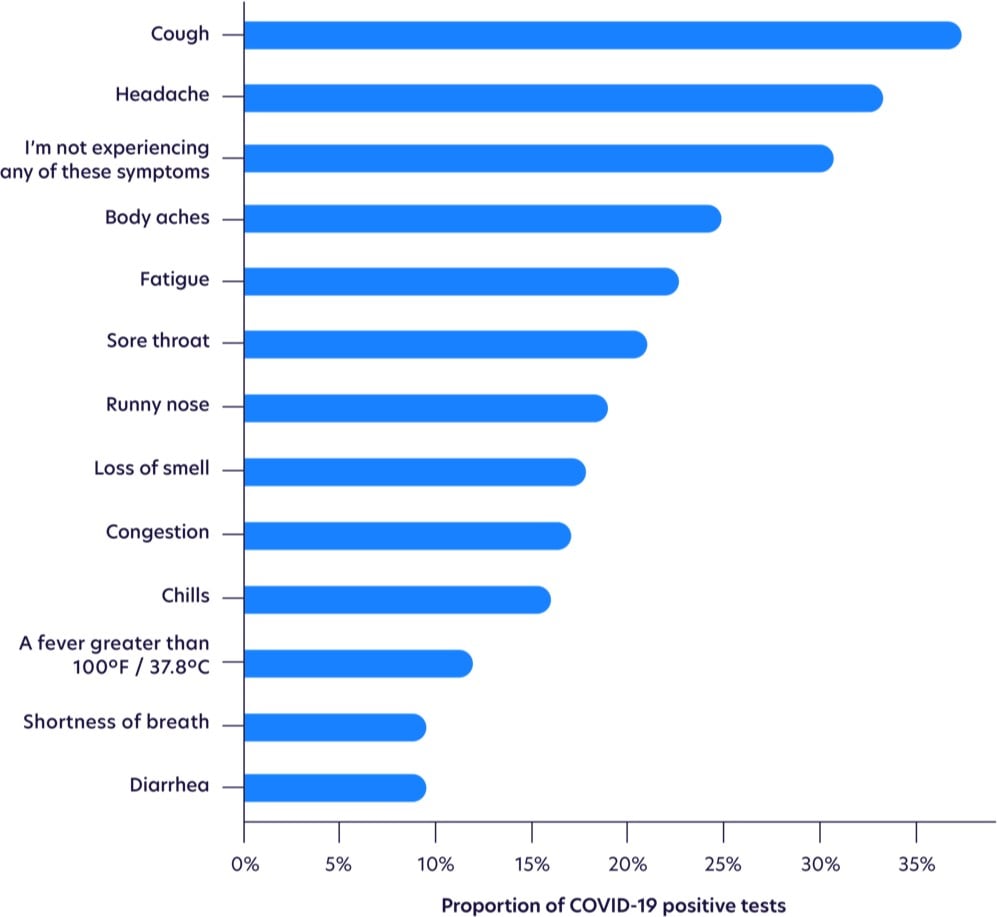
Fever is waaay down on the list.
While not as common as other symptoms, loss of smell was the most highly correlated with testing positive, as shown with odds ratios below, after adjusting for age and gender. Those with loss of smell were more likely to test positive for COVID-19 than those with a high fever.
Seeing this makes me think more than ever that I had it. I had three of the top five symptoms, plus an eventual cough (the most common symptom) and a loss of smell & taste (the most highly correlated symptom). The timing of the onset of my symptoms (my first day in Qatar) indicates that I probably got infected on my last day in Vietnam, in transit from Vietnam to Singapore (1 2-hr plane ride, 2 airports, 1 taxi, 1 train ride), or on my first day in Singapore. But I went to so many busy places during that time that it’s impossible to know where I might have gotten infected (or who I then went on to unwittingly infect).
Update: A few weeks ago, I noticed some horizontal lines on several of my toenails, a phenomenon I’d never seen before. When I finally googled it, I discovered they’re called Beau’s lines and they can show up when the body has been stressed by illness or disease. Hmm. From the Wikipedia page:
Some other reasons for these lines include trauma, coronary occlusion, hypocalcaemia, and skin disease. They may be a sign of systemic disease, or may also be caused by an illness of the body, as well as drugs used in chemotherapy, or malnutrition. Beau’s lines can also be seen one to two months after the onset of fever in children with Kawasaki disease.
From the Mayo Clinic:
Conditions associated with Beau’s lines include uncontrolled diabetes and peripheral vascular disease, as well as illnesses associated with a high fever, such as scarlet fever, measles, mumps and pneumonia.
From the estimated growth of my nails, it seems as though whatever disruption that caused the Beau’s lines happened 5-6 months ago, which lines up with my early February illness that I believe was Covid-19. Covid-19 can definitely affect the vascular systems of infected persons. Kawasaki disease is a vascular disease and a similar syndrome in children resulting from SARS-CoV-2 exposure is currently under investigation. And here’s a paper from December 1971 that tracked the development of Beau’s lines in several people who were ill during the 1968 flu pandemic (an H3N2 strain of the influenza A virus) — coronaviruses and influenza viruses are different but this is still an indicator that viruses can result in Beau’s lines. “Covid toe” has been observed in many Covid-19 patients. Harvard dermatologist and epidemiologist Dr. Esther Freeman reports that people may be experiencing hair loss due to Covid-19.
I couldn’t find any scientific literature about the possible correlation of Covid-19 and Beau’s lines, but I did find some suggestive anecdotal information. I found several people on Twitter who noticed lines in their nails (both fingers and toes) and who also have confirmed or suspected cases of Covid-19. And if you go to Google’s search bar and type “Beau’s lines c”, 3 of the 10 autocomplete suggestions are related to Covid-19, which indicates that people are searching for it (but not enough to register on Google Trends).
But I am definitely intrigued. Are dermatologists and podiatrists seeing Beau’s lines on patients who have previously tested positive for Covid-19? Have people who have tested positive noticed them? Email me at [email protected] if you have any info about this; I’d love to get to the bottom of this.

For three weeks in late January and early February, I travelled to Asia, spending two weeks in Saigon, a few days in Singapore, and about 48 hours in Doha, Qatar. Here are some of the things I saw and did and ate. Note: this is a long post, maybe the longest thing I’ve posted here in many years. But I think it’s a quick read — pack a snack, stay hydrated, and you’ll be alright.
Saigon, Vietnam
I flew to Saigon via Doha on Qatar Airways. On my seatback screen, I watched the flight map as we flew a precise path with several course correcting turns that you don’t find in a usual great circle route. We flew over Turkey and Iraq and then out over the Persian Gulf, being very careful not to cross into the airspace of Syria, Iran, Kuwait, or Saudi Arabia — an aerial expression of Middle East tensions & alliances.
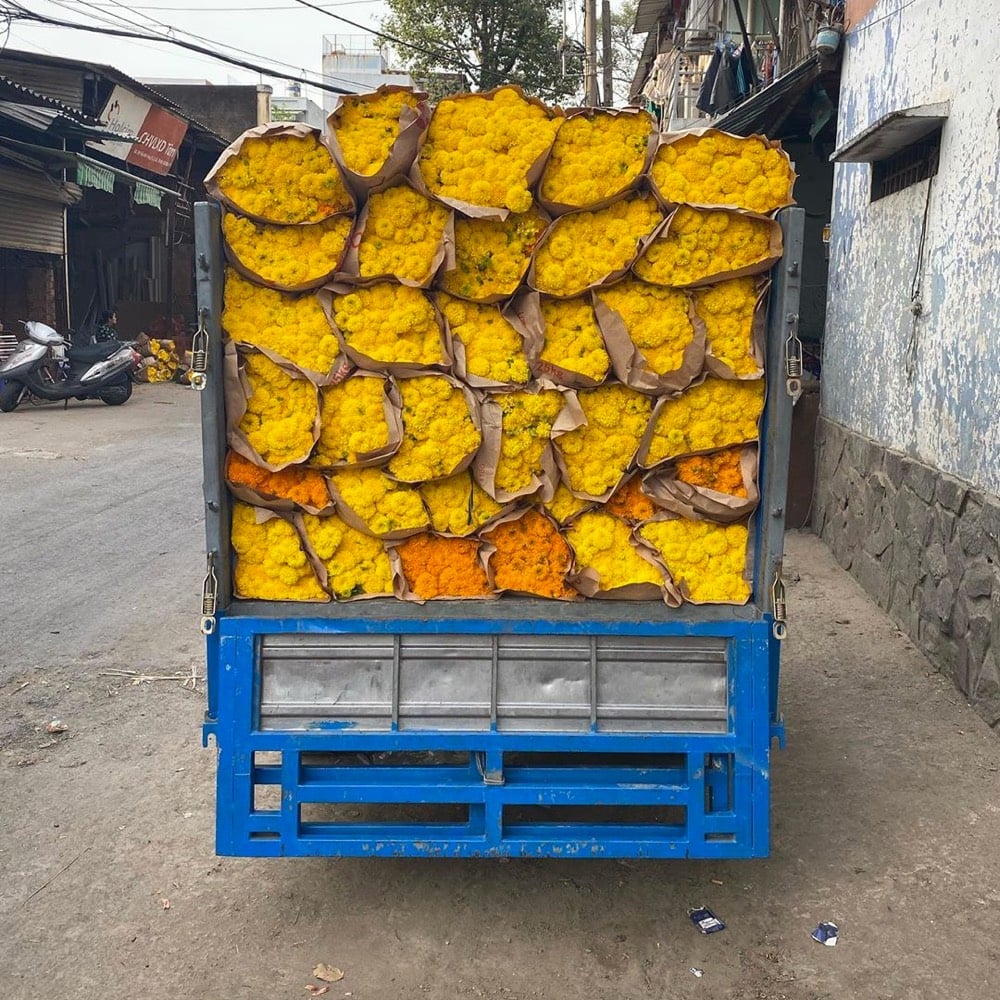
On my first full day, I arranged to go on a street food tour via motorbike. My guide, a local college student, picked me up at my apartment and, along with another guide & fellow tourist, we ate some bun bo hue (beef noodle soup), banh mì (pork sandwich), bap xao (stir-fried corn), com tam (broken rice w/ pork), drank some tra rau bap (corn silk tea), visited the flower market, and enjoyed a leisurely and engaging chat at a coffee shop. I did a food tour to kick off my time in Mexico City as well and would recommend it as a great way to meet some locals and quickly get the lay of the culinary land, which you can use as a blueprint for the rest of your trip.
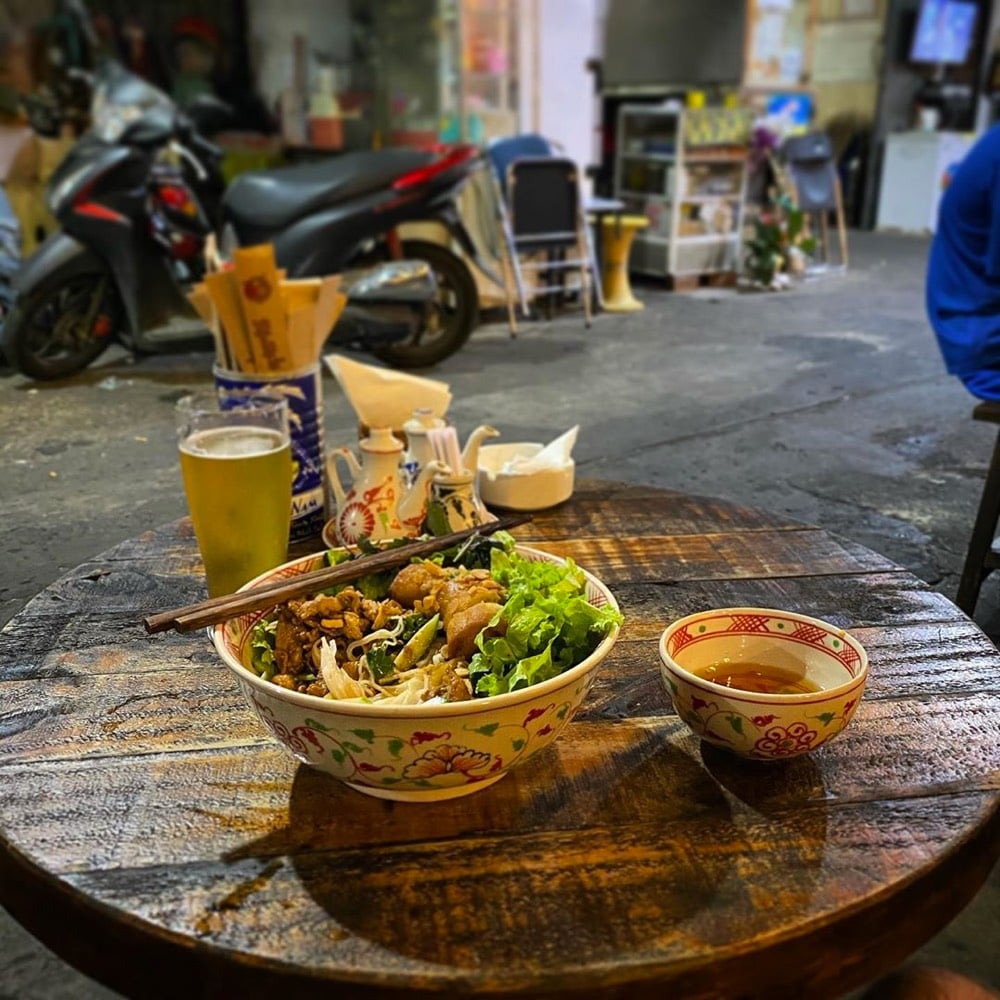
The food here is off the chain. Street food is generally safe to eat, where all the good stuff is, and a full meal is never more than a few bucks. Some of my favorites were banh mì, bun cha (pork w/ rice noodles), and bo la lot (beef wrapped in lolot leaves).
Before I went, I did a bunch of research on specific places to eat, which turned out to be not so useful because about half of the places I’d flagged had permanently closed. In some cases, not only was the restaurant or food cart gone, whole blocks had been razed to make way for an entirely new buildings. Some of these missing places had just been written about a year or two ago, but the pace of change in Saigon is unimaginably fast. Locals I talked to said it feels like an entirely new city every few years.
Founded by a pair of Japanese expats, Pizza 4P’s makes excellent pizza. The growing chain also makes their own burrata and mozzarella in-house.
Mr. Masuko said he leased an alley-side building in Ho Chi Minh City and invested about $100,000 of his savings into a renovation, kitchen gear and other start-up essentials. He and a Japanese employee, Keinosuke Konuki, taught themselves how to make mozzarella by watching a YouTube video.
I also had one of the best bowls of ramen I’ve ever had at Tomidaya in Little Toyko, a tiny place with only 8 seats at a counter. The shoyu was so good I went back a few days later for tsukemen (which was not quite as good but still very tasty).
Craft beer is growing in popularity in Vietnam and the cocktail scene is well established. The Vietnamese palete tends to run sweeter than in America, so go-to cocktails here used to lean towards the tiki end of the spectrum, but now is more varied. Thanks to my pal Brown, I got to visit the tiny speakeasy tucked away behind a hidden door in The Studio Saigon, where artist/bartender Richie Fawcett served up a couple of delicious drinks, including a barrel-aged whiskey cocktail that he smoked with some Irish peat right in front of us.
The official English name for Vietnam’s largest city is Ho Chi Minh City. But locals still call it Saigon (or Sài Gòn), particularly when referring to the central districts. It’s a bit like how New York or NYC refers just to Manhattan.
The War Remnants Museum (formerly known as the Exhibition House for US and Puppet Crimes) is a must-visit if you’re in Saigon. It’s an eye-opening look at how the American role in the Vietnam War (which in Vietnam was known as the Resistance War Against America or the American War) was perceived by the Vietnamese. The photographs showing the damage done by Agent Orange and the almost casual brutality against Vietnamese civilians (including women & children) by US soldiers were really hard (but necessary) to look at. John Lennon’s Imagine was playing on a continuous loop in the lobby of the museum.
I ended up being in Vietnam for Tet, the lunar New Year, which in terms of celebratory scale is like Christmas, Hanukkah, Thanksgiving, and New Year’s all rolled into one holiday that lasts for several days and reverberates for a few weeks. I hadn’t exactly planned on this timing, but having read about the Tet experience on Legal Nomads, I was prepared.
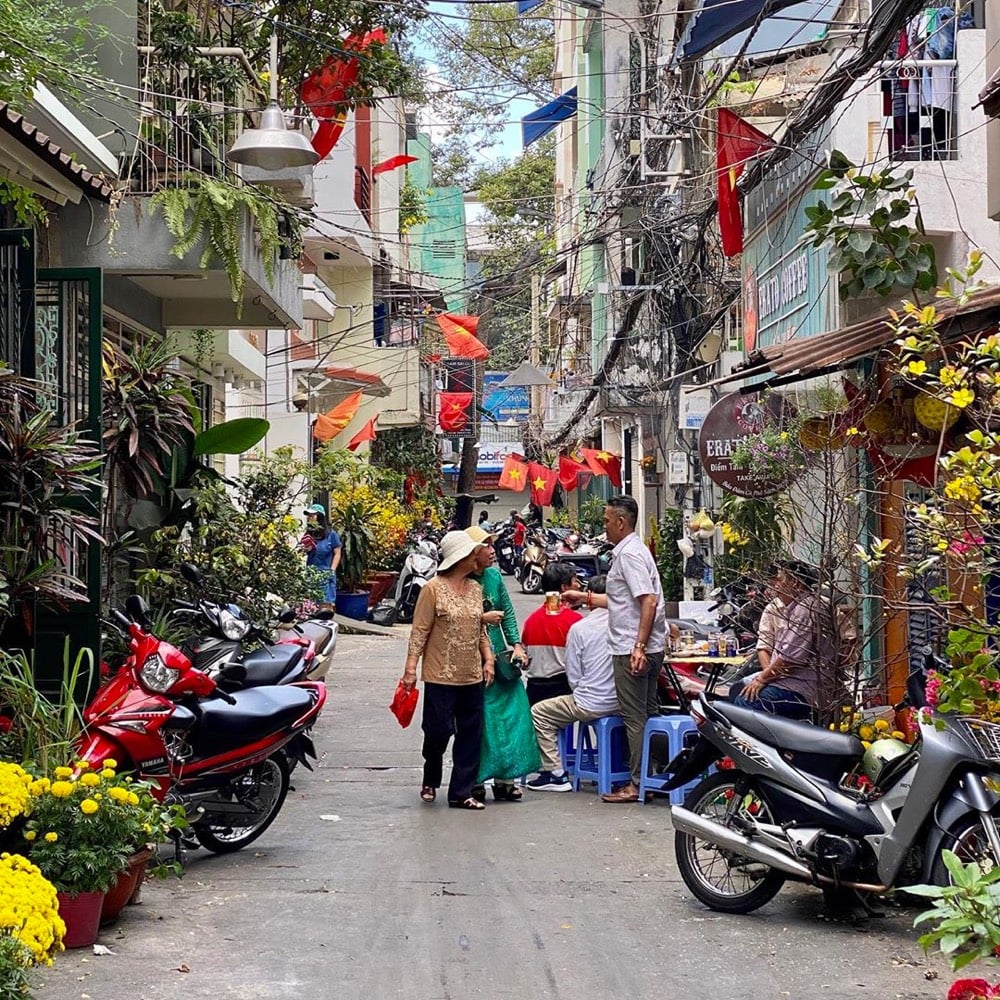
Most of the city was shut down for the holiday — the first day of Tet is a day for family and I saw people spilling out into the alleyways, eating and drinking and laughing — but it wasn’t that hard to find dinner or a place to stop for tea. The only time I really felt the Tet crunch was when I needed to buy a new phone (more on that in a bit) but couldn’t because all of the electronics stores were closed. Most of the time, though, I was thankful for the slightly slower pace and festive atmosphere.
Travel tip: find a rooftop bar in whatever city you’re in and pop in for a drink around sunset.
I’m always interested in cities where a particular mode of transportation sets the tone for everything else. In much of the US — particularly in places like LA, Dallas, or Raleigh — the car reigns. In Copenhagen and Amsterdam, it’s the bicycle. You could make the argument that in Manhattan, the dance of the streets revolves around the pedestrian. As a city, Saigon is defined by the motorbike. They overwhelm every other mode of transportation here — cars and pedestrians must tailor their movements to the motorbike swarm.
Because of the motorbikes, the process for crossing the street on foot in Saigon is different than in a lot of other places. You basically just wait for any buses (which will absolutely not stop for pedestrians) or cars to go by and then slowly wade out into traffic. Do not make any sudden movements and for god sake don’t run. The motorbike swarm will magically flow around you. It’s suuuuuper unnerving the first few times you do it, but you soon get used to it because the alternative is never ever getting across the street.
The motorbikes make walking around Saigon absolutely exhausting.1 It’s not just crossing the street. You literally have to be on the lookout for them everywhere. They drive up on the sidewalks. They drive into and out of houses and buildings, turning every doorway into a potential intersection. Having to look both ways every few seconds when you’re walking 6 or 8 miles a day around the city really drains the ol’ attention reserves.
Things I saw carried on motorbikes in Saigon, a non-exhaustive list: trees, dogs, tiny babies, ice (for delivery to a drinks cart, the ice block was not even strapped down), a family of five, a dessert cart, an entire toy store, a dried squid shop, and 8 huge bags of clams.
I spent a worthwhile morning exploring the antique shops on Le Cong Kieu street. Many of the shops carried the same sorts of items, so it got a little repetitive after awhile, but the shops with the more unique items were worth the effort.
The hip coffee shops in Saigon look much the same as those in Portland, Brooklyn, Berlin, or Mexico City.
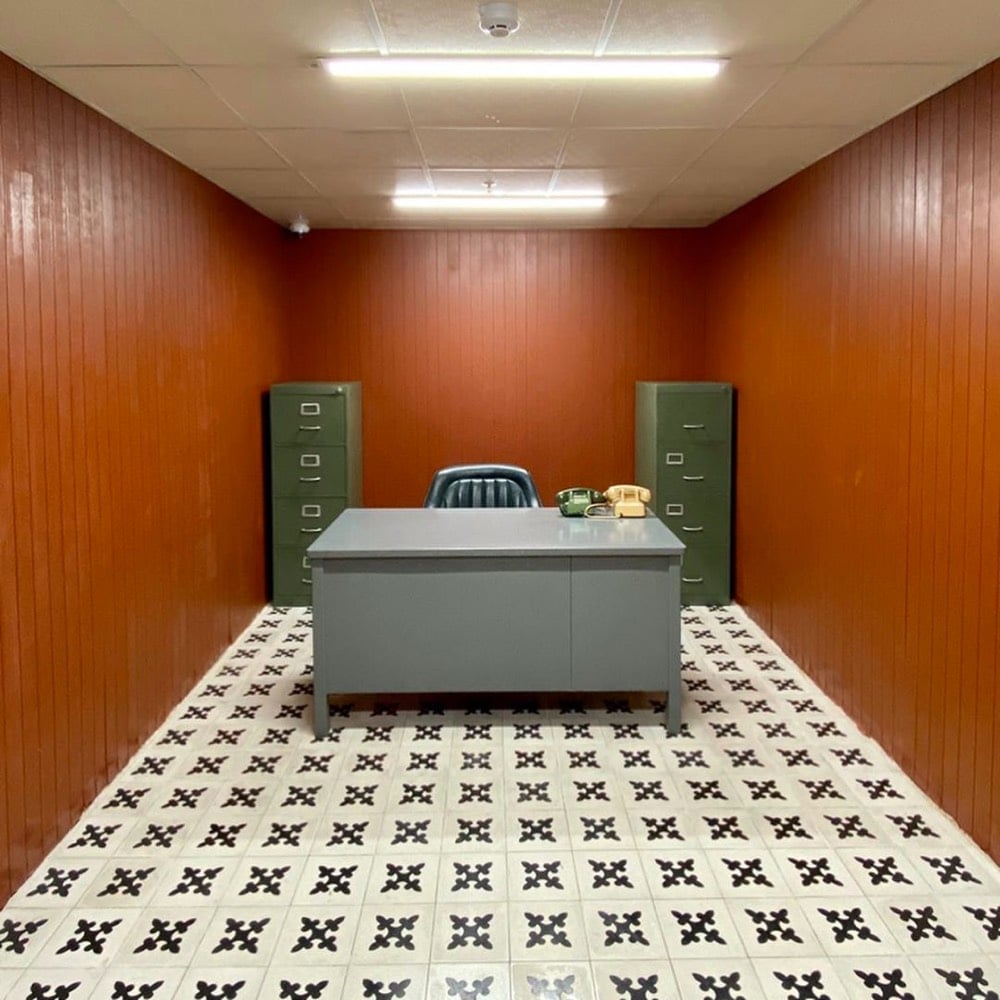
Designed by architect Ngô Viết Thụ, the Independence Palace was the home and office of the South Vietnamese President during the Vietnam War. After the North Vietnamese capture of the building effectively ended the war in 1975, the palace was preserved as a historical site, a time capsule of 60s and 70s architecture and interior design. I spent half a day wandering the palace taking photos like crazy. Lots of Accidentally Wes Anderson material there.
The oranges in Asia are green?
An American expat I met in Saigon said that American veterans who fought in Vietnam are now retiring here, a fact which I found to be a) true and b) deeply weird for a number of reasons. Here’s a recent LA Times article on the phenomenon.
Rapid growth in Vietnam and its Southeast Asian neighbors has created a situation that would have been unthinkable in the past: Aging American boomers are living a lifestyle reminiscent of Florida, Nevada and Arizona, but in Vietnam. Monthly expenses here rarely exceed $2,000, even to live in a large unit like Rockhold’s, including the help of a cook and a cleaner. The neighbors are friendly: A majority of Vietnamese were born well after the war ended in 1975, and Rockhold says he has rarely encountered resentment, even when he talks about his service as a combat veteran.
The vast majority of the owners in his apartment building are members of Vietnam’s burgeoning urban middle class; many work in government or in education, and can afford to take vacations abroad. He estimates that no more than 1 in 5 residents in the 25-floor complex are foreigners.
“The Vietnamese were extremely nice to me, especially compared to my own country after I came back from the war,” Rockhold said at a coffee shop recently inside a polished, air-conditioned office tower that also houses a restaurant and cinema.
And last and certainly least, my phone was stolen while I was in Saigon. I’d really hoped that 2020 was going to be the year that I’d avoid making a blunder that would cost me thousands of dollars, but I’d neglected to pay sufficient attention to this bit in the Legal Nomads piece about Tet:
Unfortunately, the city also enters into what is locally known as “stealing season” — a proliferation of petty crimes like phone and purse theft, with the money used toward paying for these Tet gifts. In the weeks leading up to Tet and shortly thereafter, locals would come up to me on the street mimicking someone making off with my bag, a warning to keep an eye on belongings. Several friends found their phones snatched out of their hands in mid-conversation during this time, though no one had any more significant issues (e.g. there were no violence or armed muggings) to report.
It was the second day of Tet and I had just gotten off a motorbike taxi in front of a cafe in a tony part of town. I pulled out my phone to check on something quickly and was about 2 seconds away from putting it in my pocket and going into the cafe when a guy on a motorbike rode up onto the sidewalk — a totally normal thing here, so I didn’t think anything of it — and snatched my phone right out of my hand. I swore at the guy and ran after him for about two steps before I realized a) he was already halfway down the block and b) no one within earshot spoke English well enough to help me quickly enough to chase the guy down or flag down a police officer. The phone was gone.
Luckily, I had my iPad in my backpack, so I went into the cafe and deactivated the phone with Find My. For about an hour, I stewed and felt violated & pissed that I had been careless. I’ve had mixed experiences with solo travel — it’s hard sometimes! — so some despondency along those lines crept in too. I posted an Instagram Story about the theft (w/ my iPad) and some kind and wise words from my pals Craig and Stewart got me back on the right track. Stewart in particular reminded me that events like this are “the tax we pay on traveling” and that “maybe we don’t pay it every trip, but it comes around eventually”.
So yeah anyway, that shitbird didn’t ruin my trip — although being without a phone (no maps, no rideshare apps, no texting to coordinate meetups, no translation app) for a couple of days definitely restricted my movements for a couple of days until the electronics stores opened after Tet. That dude’s year may have gotten off to an unlucky start by stealing from someone, but I’ll be damned if I’m gonna let losing some property set the tone for my year or change my affection for this city and its people.
Singapore
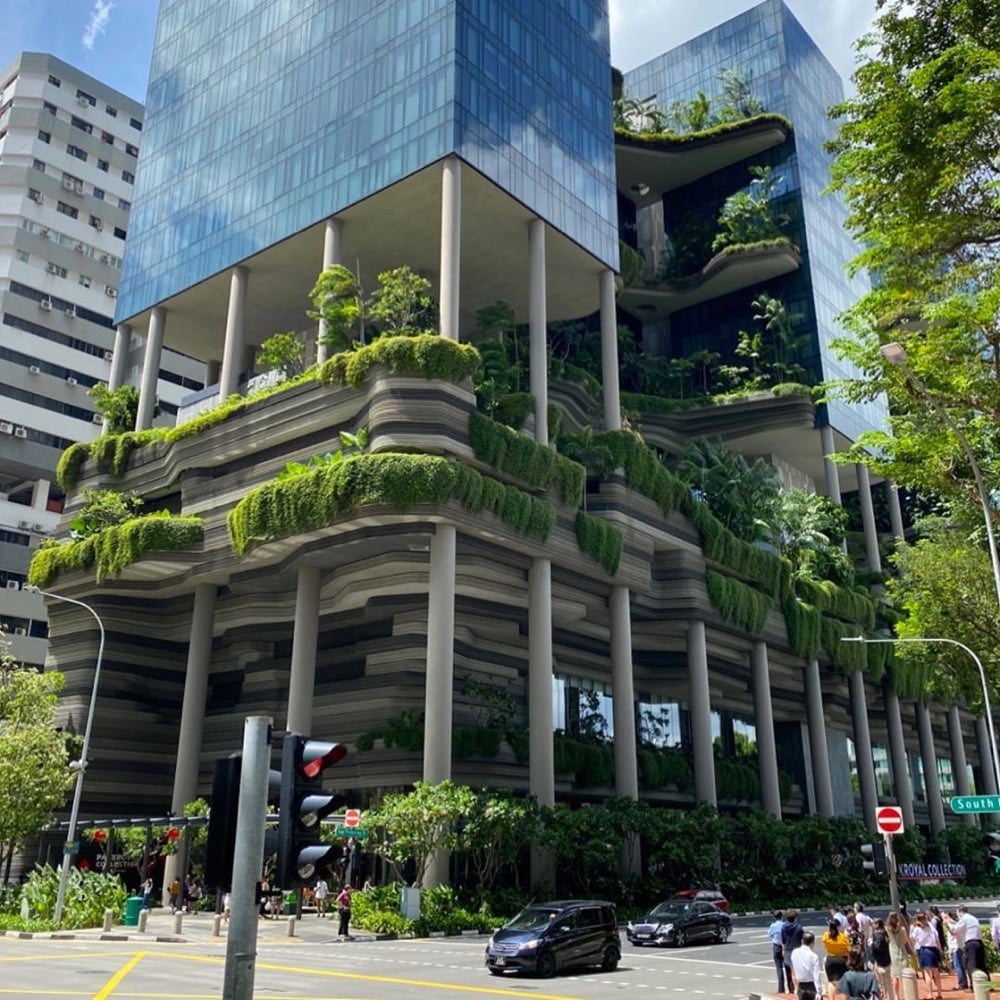
Singapore felt like the future, full stop. And it’s not just the incredible waterfall & tropical forest in the airport or the mid-building gardens in the skyscrapers. Energy-saving escalators ran slowly or not at all until human motion was detected. Infrared temperature scanners like this one were set up at the airport to automatically screen disembarking passengers for coronavirus-related fevers. Public transportation was fast, cheap, and ubiquitous — my train ride from the airport to downtown was ~$1.50. I exited the country via Automated Immigration — a machine scans your passport & thumb and you’re good to go. A vending machine made me a cup of fresh-squeezed orange juice, sealed with a thin plastic lid. A Buddhist temple I went to had self-serve offering kiosks. Everything was incredibly clean and just worked the way you thought it should — you could sense the organization and infrastructure behind every little thing. And did I mention the waterfall at the airport?!
Coming from Vietnam, the food in Singapore was going to have to clear a high bar. And it did. Unlike in Saigon, where street food sellers filled any and every possible nook and cranny of the streets, sidewalks, and alleyways, always-on-brand Singapore has organized their street food vendors into communal hawker centers. In these centers, you can get the most delicious food from all around the world — Malay, Indian, Chinese, and Singaporean cuisines are among the most popular. I ended up eating almost all my meals at food centers — I visited Maxwell Food Centre, Chinatown Complex Food Centre, Hong Lim Food Centre, and Tekka Centre.
At the Chinatown Complex Food Centre, I waited in line for about 10-15 minutes to try the soya sauce chicken rice dish (just US$2!) at Hawker Chan, the first hawker stall ever to be awarded a Michelin star. This. Dish. Was. Amazing. I have never had chicken that tender & juicy. A revelation.
The Asian Civilizations Museum and the Singapore National Gallery were both great — definitely worth visiting if you’re in town for more than a day or two.
The Singapore Botanic Gardens, a UNESCO World Heritage Site, is a marvelous place to spend an afternoon wandering around. I particularly enjoyed the rainforest and the specialty gardens: the Evolution Garden, the Fragrant Garden, and the Healing Garden (full of plants with medicinal uses). (While looking at the website just now, I’m irritated to learn that I missed the Bonsai Garden. Dammit!) The National Orchid Garden was spectacularly beautiful — there’s an entry fee of $5 that’s well worth paying.1
The Atlas Bar is notable for its huge Art Deco space and extensive gin library. You can get a gin martini with gin made in the 1910s (~US$180) or have a G&T using one of their 1300 gins from around the world. Bar Stories was much more minimal and intimate with no cocktail menu at all — you just tell the bartender the flavors and spirits you’re into and they whip something up for you. You can check out some of their creations on Instagram.
For my first two nights, I stayed in a pod hotel. I opted for a private room and it was perfect. I had just enough space in my room to sleep and change — I was barely there for more than that as I spent most of my time exploring the city. The bathrooms were clean and private — and the showers were great, better than in many American hotels I’ve stayed in. They could do more to dampen the door noise, but other than that, it was really quiet.
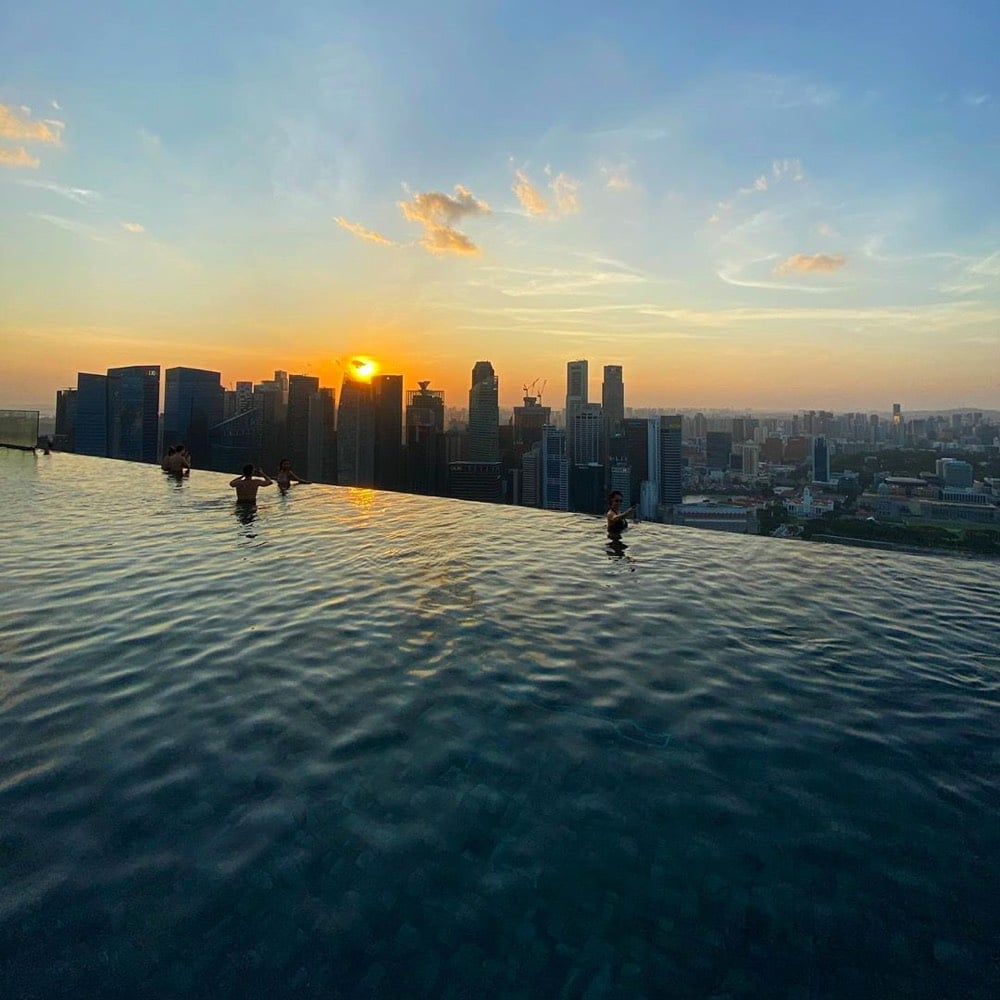
For my last night, I splurged on a room at the Marina Bay Sands, aka the hotel with the infinity pool on the 58th floor overlooking the city. Was it worth the price? I don’t know, but the views from the roof were incredible and I did spend a lot of time relaxing by that pool.
Doha, Qatar
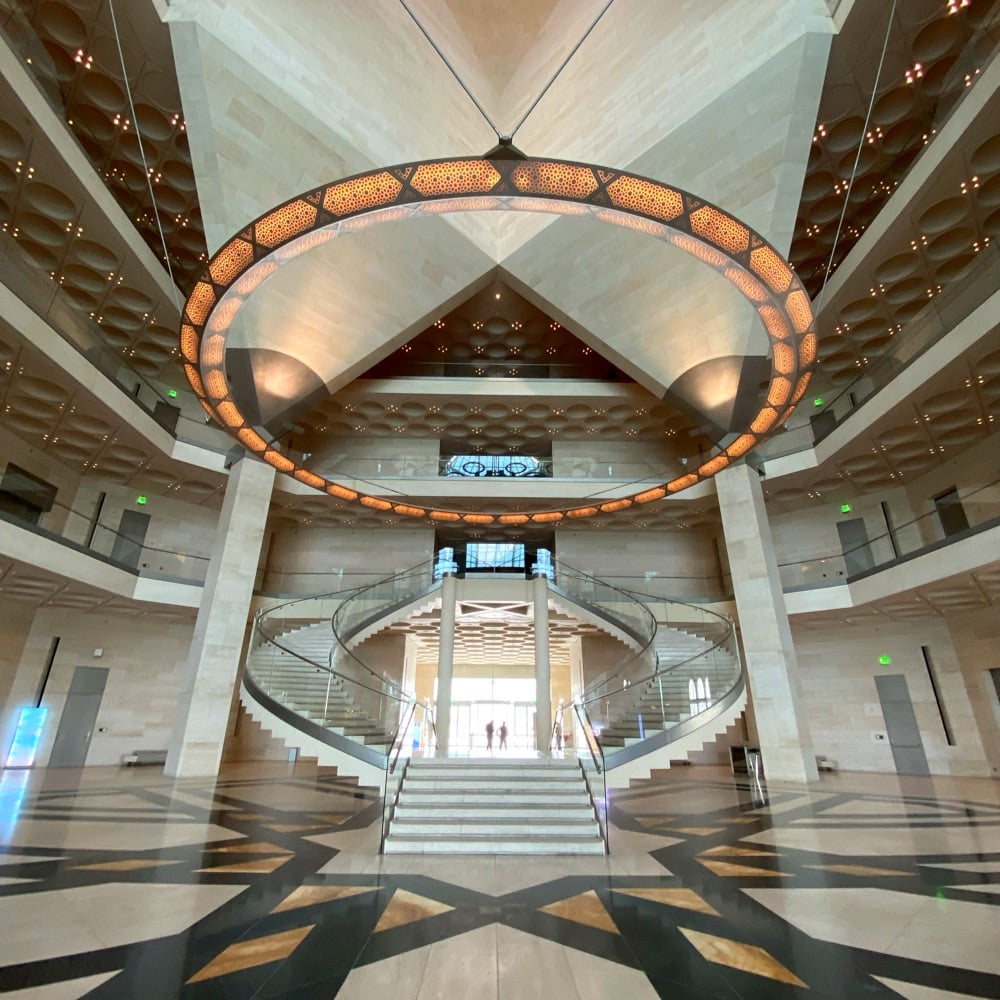
On my way home from Singapore, I spent about 48 hours in Doha, Qatar. In retrospect, I maybe should have opted for 2 more days in Singapore. Nothing against Doha, but I just didn’t have the energy to fully explore a third different place/culture in 3 weeks. (Still exploring my limitations…) I did have some great food there — including kofte at a Turkish restaurant and a simple fried halloumi sandwich I’m still thinking about more than a week later. The Museum of Islamic Art was fantastic and deepened my already significant appreciation of Islamic art.
Some miscellaneous thoughts and reflections
I met up with some kottke.org readers in both Saigon and Singapore. Thanks to Brown, Bryan, Joel, Corrie, and the Singapore meetup crew for taking me to some local spots with excellent food & drink, helping me understand a little bit more about Vietnamese & Singaporean culture, and making this solo traveller feel a little less solo. A special thanks to Brown for welcoming me into his home and introducing me to his family. After 20+ years of writing this site, it still blows me away how quickly complete strangers who read kottke.org seem like old friends. ♥
I posted several photos to my Instagram and also compiled Stories from Saigon and Singapore.
I got sick on the last day of the trip, which turned into a full-blown cold when I got home. I dutifully wore my mask on the plane and in telling friends & family about how I was feeling, I felt obliged to text “***NOT*** coronavirus, completely different symptoms!!”
Being in Asia during the early days of the coronavirus outbreak was an interesting experience. I wasn’t worried about contracting the virus — I kept my hands clean & sanitized, wasn’t interacting with anyone who had been to China recently, and wore my mask in the airport and on the airplane. By my last few days in Vietnam, the growing epidemic had the government worried, so people who normally wore masks only while riding motorbikes now wore them all the time in public. I observed that foreign tourists were more likely to wear masks than locals. Many businesses adopted a mandatory mask policy in their offices. Buddhist temples posted signs urging visitors to wear masks.
In the airport on my way to Singapore (and on the flight), every single person was wearing a mask, except for one guy who had no mask and a personal fan blowing air (and all the germs in the vicinity) right into his face. When I got to Singapore, way fewer people were wearing masks in the airport — probably only 50% — even though there were more coronavirus cases in Singapore than in Saigon. As I mentioned above, they had infrared scanners set up checking people for fever. At the Marina Bay Sands, all customers checking in had to have a temperature check with a hand-held thermometer — same if you wanted to use the hotel gym. I also got temp-scanned at one of the museums I went to.
This was my 7th long trip in the past two years and my longest one by more than a week. Despite the benefits of solo travel that I really enjoy, I’ve struggled at times with loneliness and getting a bit overwhelmed by having to figure everything out on my own in unfamiliar places. This trip, aside from a couple hours of stolen phone despair, was struggle-free — or rather the struggle was expected, manageable, and even welcome. Part of it is just practice — I feel like I’ve got the solo travel thing mostly down now. I’ve also had a couple of significant mindset shifts in recent months (like this one about winter weather) that have helped my general outlook. Working full time for two out of the three weeks I was gone helped anchor me to something familiar and provided some structure. And as I mentioned, meeting up with some friendly folks helped too.
And finally to finish up… Whenever I travel abroad, of course I have thoughts about the overall character of the places I go, but they’re based on such an incomplete experience of those places that I’m hesitant to share them. The Saigon metro area has a population of ~13.5 million and I was there for 2 weeks as a tourist, so what the hell could I possibly know about it beyond the superficial? What I mainly tend to come away with is how those places compare to the United States. What freedoms exist in a place like Vietnam vs Singapore vs Qatar vs the United States? How are those freedoms distributed and who do they benefit? And from what authority are those freedoms derived? The more places I go, the less obviously free the US feels to me in many ways, even though our country’s baseline freedom remains high (for some at least).
But the main observation I came home with after this trip is this: America is a rich country that feels like a poor country. If you look at the investment in and the care put into infrastructure, common areas, and the experience of being in public in places like Singapore, Amsterdam, Paris, and Berlin and compare it to American cities, the difference is quite stark. Individual wealth in America is valued over collective wealth and it shows.
I know that’s a bit of a downer to end on, but despite what you see on Instagram, travel is not always fun & games and often provides some potentially tough lessons and perspectives. You might get your phone stolen and come back feeling a little bit less great about your home country. Them’s the breaks, kid — welcome to the world. Thanks for following along as always.
Newer posts
Older posts


Socials & More