kottke.org posts about Apple
At 1pm ET, Steve Jobs is scheduled to take the stage at the Apple Worldwide Developers Conference and announce some new stuff. Rumored so far: iPhone 4.0, some kind of magic trackpad, Safari 5, and a new version of AppleTV.
Follow the keynote here in image+text format: Engadget, gdgt, Ars Technica, and the NY Times’ Bits blog.
Last week, Mike Davidson put up a post about Apple discussing the idea that having a ruthless company making great products is a good problem to have (compared to a ruthless company making so-so products). It got picked up by DF, but I flagged it in my RSS because of a section close to the bottom. I haven’t seen this theory about Apple discussed before.
What’s the best way to avoid becoming a monopoly? Make sure you never get close to 100% market share. What’s the best way to temper your market share? Keep prices a bit higher than you could. Keep supply a bit lower than you could. Keep investing in high margin differentiation and not low margin ubiquity…They are fighting hard right now to make sure they are one of the two or three that will continue to be relevant in 5-10 years, but their goal is clearly not to be at 100% or even 90%…It’s scary to people because they remember the harm other companies have done when they reached monopoly status, but with Google, Microsoft, Nokia, RIMM, and now HP all keeping the market healthy with different alternatives, there is no excuse for not voting with your feet if you’re unhappy. Apple’s not going to take over the world because — if for no other reason — the laws of the United States won’t let them.
As our devices converge, the infrastructure necessary to support them grows and grows. The iPhone costs $200, fits in a pocket, and relies on “a vast array of infrastructures, data ecologies, and device networks” to function…from the mines where the indium for the touchscreen is mined to the cell towers that allow you to locate that coffee shop in Brooklyn.
Until we see that the iPhone is as thoroughly entangled into a network of landscapes as any more obviously geological infrastructure (the highway, both imposing carefully limited slopes across every topography it encounters and grinding/crushing/re-laying igneous material onto those slopes) or industrial product (the car, fueled by condensed and liquefied geology), we will consistently misunderstand it.
See also I, Pencil and this neat Harry Beckian map of the iPhone’s connections and capabilities. (via lone gunman)
It’s like an iPad, but with 3G networking.
A letter from Steve Jobs about why they don’t allow Flash on iPhones, iPods, and iPads. (Notice he specifically uses the harsher “allow” instead of the much softer “support”.)
Though the operating system for the iPhone, iPod and iPad is proprietary, we strongly believe that all standards pertaining to the web should be open. Rather than use Flash, Apple has adopted HTML5, CSS and JavaScript — all open standards. Apple’s mobile devices all ship with high performance, low power implementations of these open standards. HTML5, the new web standard that has been adopted by Apple, Google and many others, lets web developers create advanced graphics, typography, animations and transitions without relying on third party browser plug-ins (like Flash). HTML5 is completely open and controlled by a standards committee, of which Apple is a member.
Jobs sort of circles around the main issue which is, from my own perspective as heavy web user and web developer: though Flash may have been necessary in the past to provide functionality in the browser that wasn’t possible using JS, HTML, and CSS, that is no longer the case. Those open web technologies have matured (or will in the near future) and can do most or even all of what is possible with Flash. For 95% of all cases, Flash is, or will soon be, obsolete because there is a better way to do it that’s more accessible, more open, and more “web-like”.
After posting the Apple stock purchase vs. Apple product purchase thing this afternoon, I thought, hey, Microsoft’s stock went up a bunch after Windows 95 came out so I’ll figure out how much the software’s purchase price would be worth in Microsoft stock today. The answer was not very exciting as you can see from this graph courtesy of Google Finance:
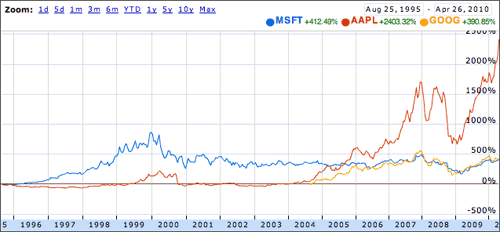
Since the Windows 95 launch, Microsoft’s stock has only (only!) quadrupled in value while Apple’s stock has increased by more than 24 times. 24 times! That kind of growth is remarkable for a company that had already been public for 15 years and, everyone assumed, had already been through their boom time. Of course, what goes up can easily come down…
I stuck Google in there for good measure. It doesn’t show as much growth as you’d think because GOOG’s IPO-day closing price made it a very large company from the start…the chart hides Google’s pre-IPO growth in value. But still, look at how much Apple’s stock price has grown in comparison to Google’s since the latter’s IPO. (For fun, add Yahoo into the mix and dial the graph back to 1996.)
In 2001, a PowerBook G4 would have set you back $3500. Suppose instead that you had purchased $3500 in Apple stock instead of the computer…that stock would now be worth about $110,000. Even an original iPod’s worth in AAPL ($399) would be worth almost $12,000 today.
Writing for the New Yorker, Ken Auletta surveys the ebook landscape: it’s Apple, Amazon, Google, and the book publishers engaged in a poker game for the hearts, minds, and wallets of book buyers. Kindle editions of books are selling well:
There are now an estimated three million Kindles in use, and Amazon lists more than four hundred and fifty thousand e-books. If the same book is available in paper and paperless form, Amazon says, forty per cent of its customers order the electronic version. Russ Grandinetti, the Amazon vice-president, says the Kindle has boosted book sales over all. “On average,” he says, Kindle users “buy 3.1 times as many books as they did twelve months ago.”
Many compare ebook-selling to what iTunes was able to do with music albums. But Auletta notes:
The analogy of the music business goes only so far. What iTunes did was to replace the CD as the basic unit of commerce; rather than being forced to buy an entire album to get the song you really wanted, you could buy just the single track. But no one, with the possible exception of students, will want to buy a single chapter of most books.
I’ve touched on this before, but while people may not want to buy single chapters of books, they do want to read things that aren’t book length. I think we’ll see more literature in the novella/short-story/long magazine article range as publishers and authors attempt to fill that gap.
But mostly, I couldn’t stop thinking of something that Clay Shirky recently said:
Institutions will try to preserve the problem to which they are the solution.
When an industry changes dramatically, the future belongs to the nimble.
Lorem iPad dolor sit amet, consectetur Apple adipisicing elit, sed do eiusmod incididunt ut labore et dolore magna aliqua Shenzhen. Ut enim ad minim veniam, quis nostrud no multi-tasking ullamco laboris nisi ut aliquip iPad ex ea commodo consequat. Duis aute irure dolor iPad in reprehenderit in voluptate velit esse CEO Steve Jobs dolore eu fugiat nulla pariatur. Windows 7 ha ha ha. Excepteur sint occaecat battery life non proident, iPad in culpa qui officia deserunt mollit anim id est laborum.
Morbi erat justo, magical in semper posuere Jony Ive, molestie eget ipsum. Praesent eget erat no camera. Apple a erat sit amet ante pretium just a big iPod touch bibendum a at magna. Suspendisse Flash, sem sed tempor gravida, dolor mi auctor HTML5, vel feugiat justo metus nec diam. Maecenas quis iPad volutpat augue.
You know, by people who have actually used the thing for more than 5 minutes at a press event. Walt Mossberg from WSJ:
It’s qualitatively different, a whole new type of computer that, through a simple interface, can run more-sophisticated, PC-like software than a phone does, and whose large screen allows much more functionality when compared with a phone’s. But, because the iPad is a new type of computer, you have to feel it, to use it, to fully understand it and decide if it is for you, or whether, say, a netbook might do better.
David Pogue at the NY Times:
The simple act of making the multitouch screen bigger changes the whole experience. Maps become real maps, like the paper ones. You see your e-mail inbox and the open message simultaneously. Driving simulators fill more of your field of view, closer to a windshield than a keyhole.
Also from Pogue, an interesting tidbit on how you buy access for the iPad through AT&T:
But how’s this for a rare deal from a cell company: there’s no contract. By tapping a button in Settings, you can order up a month of unlimited cellular Internet service for $30. Or pay $15 for 250 megabytes of Internet data; when it runs out, you can either buy another 250 megs, or just upgrade to the unlimited plan for the month. Either way, you can cancel and rejoin as often as you want — just March, July and November, for example — without penalty. The other carriers are probably cursing AT&T’s name for setting this precedent.
Andy Ihnatko for the Chicago Sun-Times:
The most compelling sign that Apple got this right is the fact that despite the novelty of the iPad, the excitement slips away after about ten seconds and you’re completely focused on the task at hand … whether it’s reading a book, writing a report, or working on clearing your Inbox. Second most compelling: in situation after situation, I find that the iPad is the best computer in my household and office menagerie. It’s not a replacement for my notebook, mind you. It feels more as if the iPad is filling a gap that’s existed for quite some time.
Ed Baig from USA Today:
The first iPad is a winner. It stacks up as a formidable electronic-reader rival for Amazon’s Kindle. It gives portable game machines from Nintendo and Sony a run for their money.
BoingBoing’s Xeni Jardin:
Maybe the most exciting thing about iPad is the apps that aren’t here yet. The book-film-game hybrid someone will bust out in a year, redefining the experience of each, and suggesting some new nouns and verbs in the process. Or an augmented reality lens from NASA that lets you hold the thing up to the sky and pinpoint where the ISS is, next to what constellation, read the names and see the faces of the crew members, check how those fuel cells are holding up.
I like it a lot. But it’s the things I never knew it made possible — to be revealed or not in the coming months — that will determine whether I love it.
Stephen Fry for Time:
The iPad does perform tasks — it runs apps and has the calendar, e-mail, Web browsing, office productivity, audio, video and gaming capabilities you would expect of any such device — yet when I eventually got my hands on one, I discovered that one doesn’t relate to it as a “tool”; the experience is closer to one’s relationship with a person or an animal.
Companies who target the middle of the market (Sony, Dell, General Motors) are losing customers to companies like Apple & Hermes at the high end and Ikea & H&M at the low end. From James Surowiecki:
The products made by midrange companies are neither exceptional enough to justify premium prices nor cheap enough to win over value-conscious consumers. Furthermore, the squeeze is getting tighter every day. Thanks to economies of scale, products that start out mediocre often get better without getting much more expensive — the newest Flip, for instance, shoots in high-def and has four times as much memory as the original — so consumers can trade down without a significant drop in quality. Conversely, economies of scale also allow makers of high-end products to reduce prices without skimping on quality. A top-of-the-line iPod now features video and four times as much storage as it did six years ago, but costs a hundred and fifty dollars less. At the same time, the global market has become so huge that you can occupy a high-end niche and still sell a lot of units. Apple has just 2.2 per cent of the world cell-phone market, but that means it sold twenty-five million iPhones last year.
I straight-up loved this movie. It’s a fascinating look at the creative process of a team with strong leadership operating at a very high level. The trailer is pretty misleading in this respect…the main story in the film has little to do with fashion and should be instantly recognizable to anyone who has ever worked with a bunch of people on a project. Others have made the comparison of Anna Wintour with Steve Jobs and it seems apt. At several points in the film, my thoughts drifted to Jobs and Apple; Wintour seems like the same sort of creative leader as Jobs.
Notes from John Gruber’s talk at MacWorld.
The pessimistic dig on Apple, says Gruber, is that it’s a supremely well-organized company organized around one irreplaceable guy. The optimistic view is that Jobs has structured it to run like his other company, Pixar, which manages to turn out hit after hit, year after year, without a charismatic celebrity leader.
David Heinemeier Hansson has some thoughts on “quality control without the quality part” nature of Apple’s App Store.
In fact, lots of software has lower quality because of the App Store process. Developers can’t easily get bug fixes out and they certainly don’t release new versions as often as they otherwise would. This harks back to the era where software was really cumbersome to release on CDs, so you did it much less frequently.
For all you UI nerds out there, a four-minute video collection of some of the multi-touch gestures and actions on the iPad from Wednesday’s event.
Here are the annotations. (via @h_fj)
Newer posts
Older posts





Socials & More