Entries for March 2022
From Richard Linklater (Boyhood, A Scanner Darkly) comes a new Netflix movie called Apollo 10 1/2, in which a young boy growing up in Houston, TX in the 60s gets recruited by NASA to land a accidentally-too-small lunar lander on the Moon. It’s animated1 and premieres on Netflix on April 1.
Interesting post from Cameron Sun about how he visualizes numbers. “Nine is a monolithic block with a slot gouged out of it, for receiving a one. It functions like a hook, peeling off a one from any number it’s added to.”
The Restorative Joy of Cycling by @pomeranian99. “When I arrive home, I feel like I’ve microdosed the pure essence of urban life. I’ve been *in* the world.”
The 2022 Tournament of Books is underway! Over the next month, 16 books will be narrowed down to one. I have read a remarkable number of these…I can judge if there’s an injury. Put me in, coach!
In this entertaining and informative video, Oliver Bullough, who has written a pair of books on money laundering (Moneyland and the forthcoming Butler to the World) takes us on a tour of London while telling us how “the most efficient scaled-up money laundering system in the world” has helped Russia’s oligarchs hide their billions and keep Putin in power. Bullough also wrote about the UK’s role in laundering oligarch money recently in The Guardian.
Russia is a mafia state, and its elite exists to enrich itself. Democracy is an existential threat to that theft, which is why Putin has crushed it at home and seeks to undermine it abroad. For decades, London has been the most important place not only for Russia’s criminal elite to launder its money, but also for it to stash its wealth. We have been the Kremlin’s bankers, and provided its elite with the financial skills it lacks. Its kleptocracy could not exist without our assistance. The best time to do something about this was 30 years ago — but the second best time is right now.
We journalists have long been writing about this, but it is not simply overheated rhetoric from overexcited hacks. Parliament’s intelligence and security committee wrote two years ago that our investigative agencies are underfunded, our economy is awash with dirty money, and oligarchs have bought influence at the very top of our society.
In his newest piece for The Atlantic, Ed Yong explores why, despite more than 6 million official deaths worldwide and almost a million official deaths in the US, the toll of the pandemic isn’t provoking a massive social reckoning. This is a hell of an opening paragraph:
The United States reported more deaths from COVID-19 last Friday than deaths from Hurricane Katrina, more on any two recent weekdays than deaths during the 9/11 terrorist attacks, more last month than deaths from flu in a bad season, and more in two years than deaths from HIV during the four decades of the AIDS epidemic. At least 953,000 Americans have died from COVID, and the true toll is likely even higher because many deaths went uncounted. COVID is now the third leading cause of death in the U.S., after only heart disease and cancer, which are both catchall terms for many distinct diseases. The sheer scale of the tragedy strains the moral imagination. On May 24, 2020, as the United States passed 100,000 recorded deaths, The New York Times filled its front page with the names of the dead, describing their loss as “incalculable.” Now the nation hurtles toward a milestone of 1 million. What is 10 times incalculable?
And it just keeps going from there — this is one of those articles so well written and packed with so much information and insight that it’s difficult not to quote the whole thing, even though it paints a bleak picture of America. Read the whole thing here. See also Yong’s accompanying Twitter thread.
Dismayed by the narrative that Americans did nothing to help each other out during the pandemic, Kathy Gilsinan took Mister Rogers’ advice and went to “look for the helpers”. The result is her new book, The Helpers: Profiles from the Front Lines of the Pandemic, a collection of profiles of those who worked with millions and millions of other Americans to combat the pandemic. From an excerpt in The Atlantic:
Paul Cary, for instance, was well known within the medical system in Aurora, Colorado, where he served as a paramedic — not only for his walrus mustache or the near-obsessive hours he put in, but also for his warmth. Harried and cynical ER nurses would light up when Cary arrived and asked after their families, cracking jokes about living the dream even as he was spending the evening ferrying gunshot victims or septic patients to the hospital. He wanted to be there for people on their worst days; that was the job. And in late March 2020, with COVID deaths mounting into the hundreds in New York City but still in the low double digits in his own state, Cary, a retired firefighter, decided to race toward the fire: He drove his ambulance 28 hours across the country to help relieve overwhelmed paramedics in New York. He did this knowing that, at 66, with a blood-clot disorder, a bad back, and other health issues, he was squarely in the demographic COVID preferred to kill.
The excerpt ends with an important point (re: “feel good” news & societal failure) and I’m going to quote it here:
People, of course, fail, and so do institutions. Individual goodwill and altruism cannot by themselves compensate for systemic weaknesses, and no kind volunteer alone will fix decades of underinvestment in public health or vulnerable supply chains for protective equipment. No feel-good story can compensate for the loss of more than 900,000 Americans or repair the heartbreak of millions of grieving loved ones. Still, there are those — many more than perhaps we expect — who look impossible odds in the eyes and fight anyway.
The Helpers: Profiles from the Front Lines of the Pandemic is available online and in bookstores now.
Worldwide, the Covid-19 pandemic has claimed at least 6 million lives. Almost a million of those are in the US. “Public health experts agree that six million is a vast undercount and that the true devastation will never be precisely known.”
Design Emergency: Building a Better Future. “Alice Rawsthorn and Paola Antonelli present a unique portrait of how our great creative minds are developing new design solutions to the major challenges of our time.”
One of the biggest hits of the past two years has been Dua Lipa’s Levitating — this catchy disco-inflected tune didn’t hit #1 in the US but has set quite a few records for Billboard chart longevity (e.g. 41 weeks in the top 10). Lipa, her label, and her co-writers were recently hit with a lawsuit 1
by a band called Artikal Sound System alleging that Levitating was ripped off from their song, Live Your Life. At first glance, Artikal Sound System seems to have a point — take a listen to Levitating and then to Live Your Life.
But! As Adam Neely explains in this video, if you listen to it with an expert ear and with the history of music in mind, their case doesn’t seem so ironclad. For starters, Rosa Parks by Outkast (1998) and Blame It on the Boogie from The Jacksons (1978) contain very similar rhythms.
Playing Wordle collaboratively. “When we play together, there seems to be a correlation between how many guesses and how much fun we have. The more time it takes the better.”
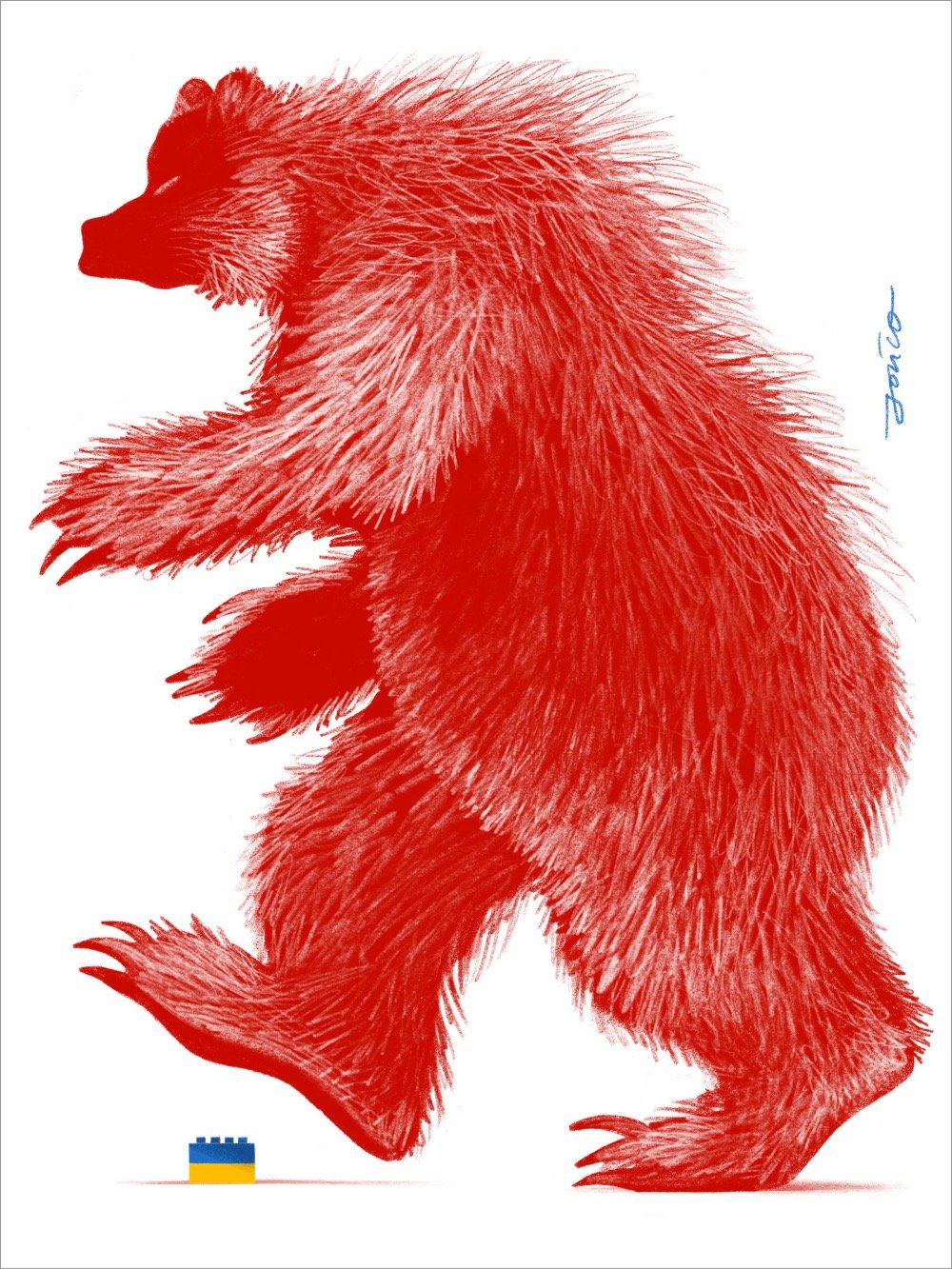
An absolutely fantastic poster by Polish illustrator Paweł Jońca of a giant red Russian bear about to step on a small Ukrainian flag made of Lego bricks. A printable digital download of this poster is available “by paying ANY amount” with all proceeds going to humanitarian aid for Ukraine (specifically to Polska Akcja Humanitarna).
Turning the Focus on America’s Oligarchs. “Could the scrutiny of Putin’s favored billionaires hastened by the war in Ukraine extend to the hidden money that subverts democracy in the United States?”


Love these swirling, swooping relief landscapes from Korean artist Lee Hyun-Joung. (via colossal)
A new four-hour documentary series about Benjamin Franklin by Ken Burns will premiere on PBS on April 4th. Here’s the trailer and a slightly longer, less formal teaser from Burns:
Ken Burns’s two-part, four-hour documentary, Benjamin Franklin, explores the revolutionary life of one of the 18th century’s most consequential and compelling personalities, whose work and words unlocked the mystery of electricity and helped create the United States. Franklin’s 84 years (1706-1790) spanned an epoch of momentous change in science, technology, literature, politics, and government — fields he himself advanced through a lifelong commitment to societal and self-improvement.
Also available to watch while we wait for the series is this 6-minute extended scene about Franklin, smallpox, and his son Frankie.
For more reading on the history of smallpox inoculation and its introduction to America by an enslaved African man named Onesimus, check out these two articles. (via @CharlesCMann)
So, I have been waiting for months for season three of HBO’s My Brilliant Friend series (based on Elena Ferrante’s Neapolitan novels) and somehow it has snuck in1 and started without me noticing! Anyway, the s03 trailer is above, the first episode aired earlier this week & is on HBO Max now, and new episodes will follow every Monday.
If you haven’t seen the show, you should check out the first two seasons first…this show is a gem and I wish HBO was doing more to promote it.
After an absence of more than two years, John Plant has returned to the wilderness to build a thatched workshop. Plant is the sole proprietor behind the Primitive Technology YouTube channel, where he uploads deftly-edited videos of himself silently crafting tools, huts, weapons, and other Stone Age technologies in the forests of North Queensland, Australia. About the hut, he writes:
I built a thatched workshop as an area to do future projects in out of the rain and weather. The structure was a 4 x 4 m square covered with a gabled thatched roof where the lowest point was 2 m above the ground and the highest point was 4 m. This is the largest hut I’ve built to date taking 5 weeks to build. The structure sheds rain quite well and being open and without walls allows smoke to exit without issue.
If you’re unfamiliar with Plant, his videos are really well-done and quite meditative to watch. In a 2016 post, I wrote:
The way he shoots & edits these videos is so good…packing, what, dozens or even hundreds of years of technological evolution into a minute or two of wordless video.
So yeah, check these out if you have some time today to sit still and observe someone doing something they love. (via @nielsmann)

In 2009, mechanical engineer Donald Scruggs received a patent for a hermetically sealed coffin that can be screwed into the ground. David Friedman made a short documentary about Scruggs and his screw-in coffin.
I was with some friends having a couple of drinks and one of them mentioned he had to go talk to some people about an automatic grave digger, which meant a huge amount of dirt removal. And I said, “Why don’t we just make a big large carrot shaped thing with threads around it and screw it into the ground?”
Scruggs says that burying someone in his coffin is “no more trouble than putting a fencepost in”.



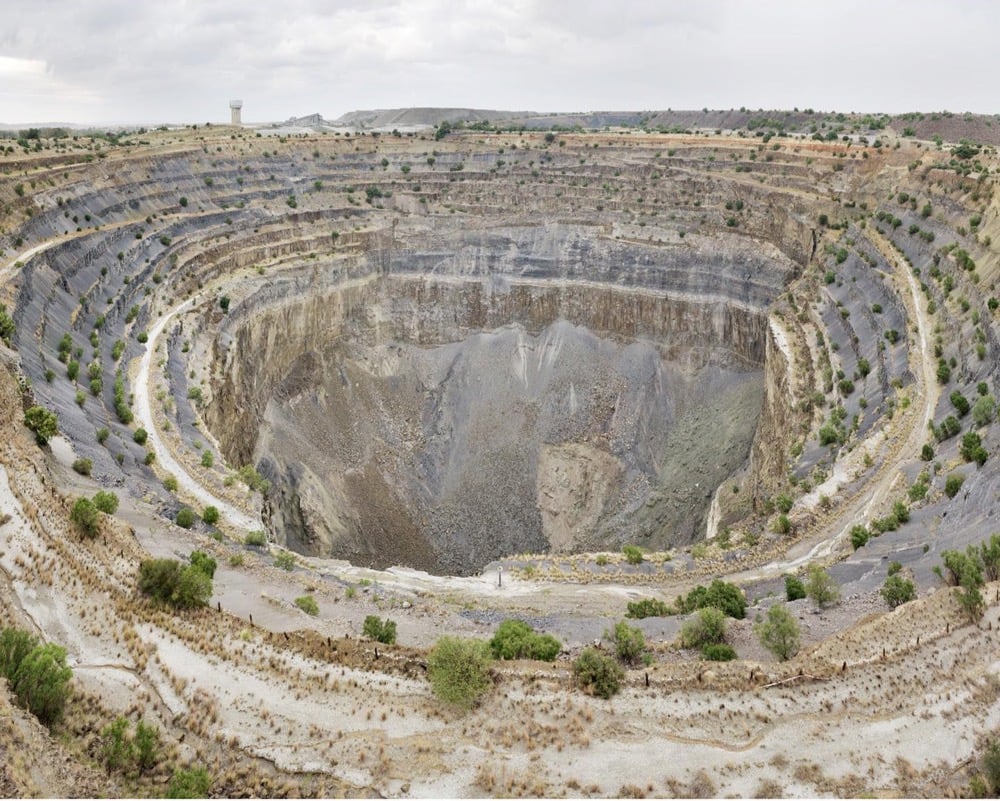
For his project For What It’s Worth, Dillon Marsh created 1:1 scale visualizations of the minerals extracted from South African mines and placed them in photos of the mines themselves. From top to bottom above, a sphere of the 284,000 metric tonnes of copper extracted from the O’Kiep mine, a sphere of the 9500 metric tonnes of gold from the Free State Gold Field, a sphere of 3850 metric tonnes of platinum extracted in total in South Africa since 1924, and a gemstone of the 7.6 million carats of diamonds extracted from the Koffiefontein Mine.
The diamond in particular, which you might not be able to see in that photo (it’s on a vertical stand right in front of the massive hole), underscores just how tiny the amount of material pulled out of these massive mines is, especially when you factor in all the manpower, machinery, injuries, fatalities, and environmental damage related to mining. All that for a bit of shine. (via clive thompson)

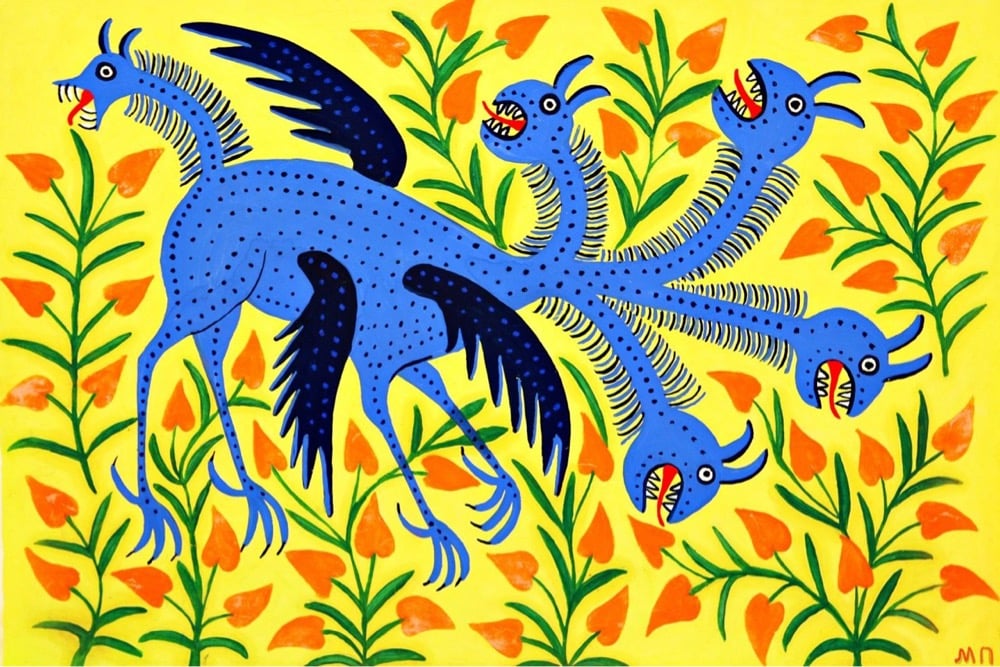
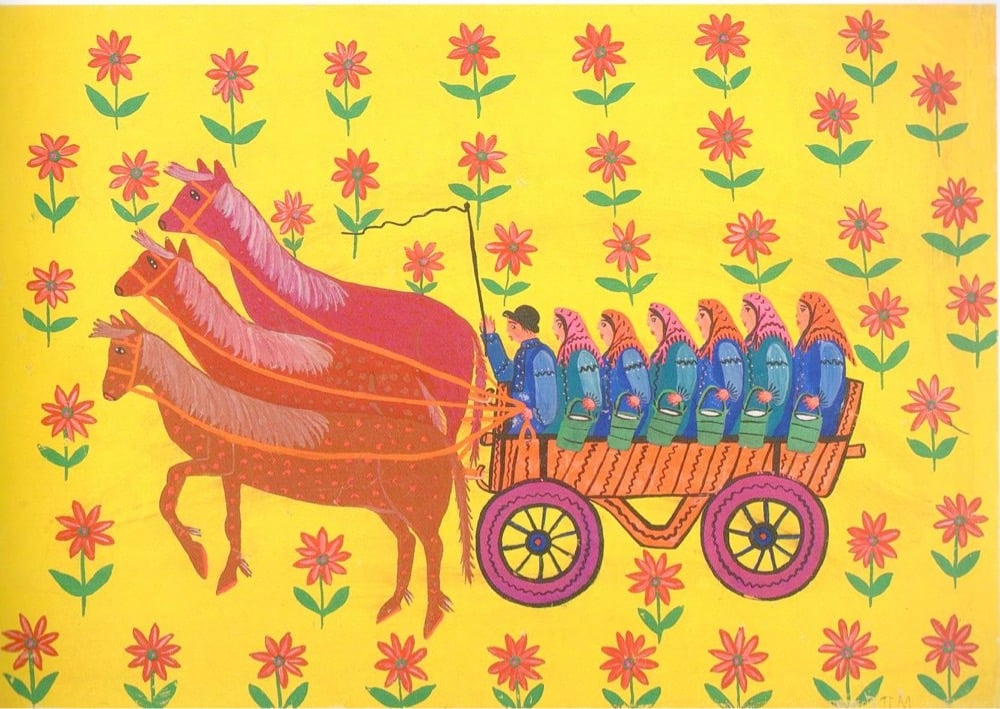
Maria Prymachenko is one of Ukraine’s best-known artists. Known for her colorful, expressive, and “primitive” style, Prymachenko won a gold medal for her work at the 1937 World’s Fair in Paris and Pablo Picasso is said to have remarked “I bow down before the artistic miracle of this brilliant Ukrainian” after seeing her work. Prymachenko’s paintings featured animals (both real & fantastical), everyday Ukrainian people, food & agriculture, and themes of war & peace.
Earlier this week, the Ministry of Foreign Affairs of Ukraine announced that the Ivankiv Historical and Local History Museum had been burned in the Russian invasion and that 25 works by Prymachenko had been lost. Luckily, according to the Ukrainian Institute, local residents were able to save the paintings.
You can find more of Prymachenko’s work below and at WikiArt.




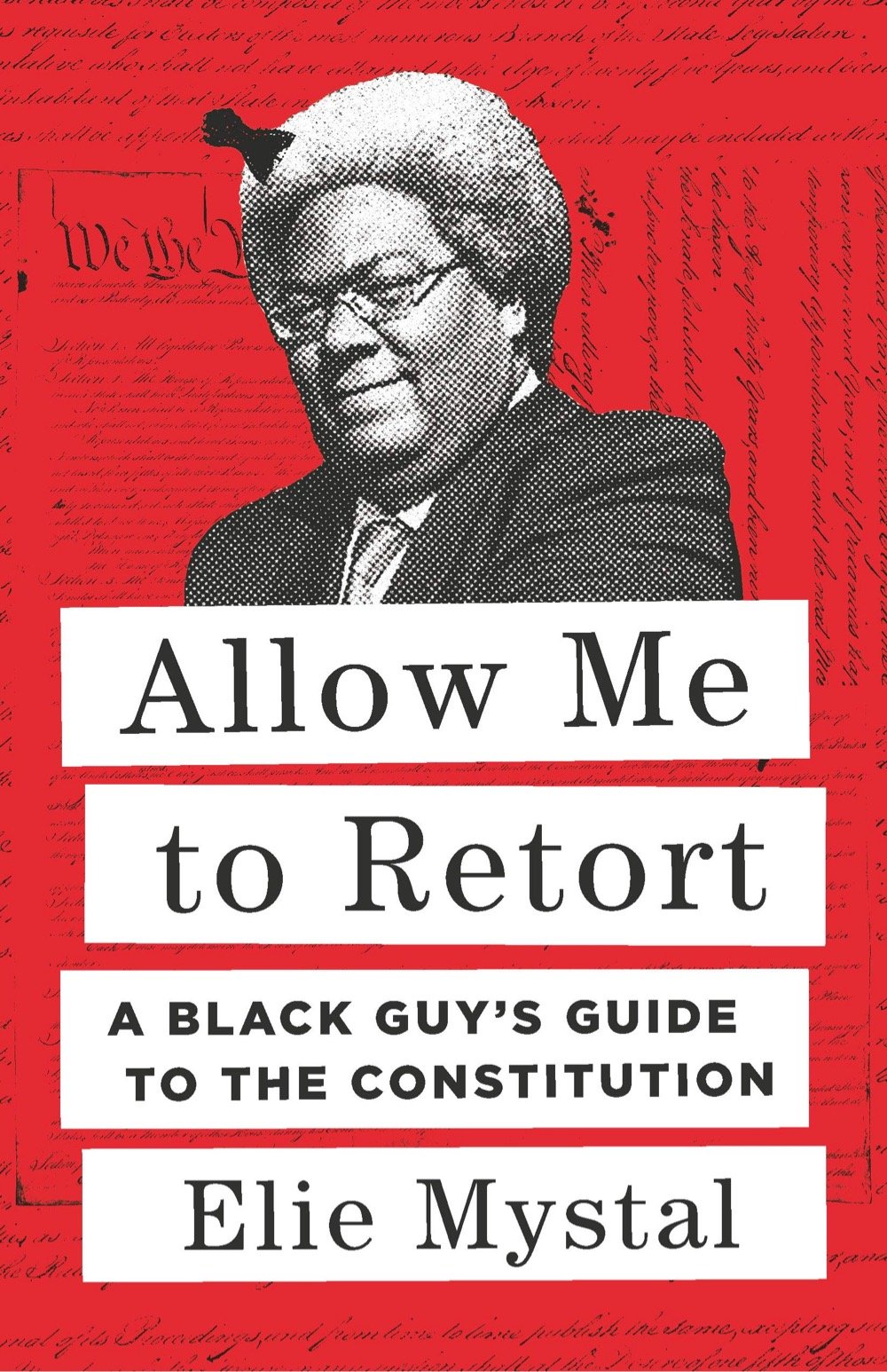
That’s the subtitle of a new book by Elie Mystal — the full title is Allow Me to Retort: A Black Guy’s Guide to the Constitution. From the Kirkus review:
Mystal, an analyst at MSNBC and legal editor for the Nation, reads the Constitution from the point of view of a Black man keenly aware of the document’s origins in a slaveholding nation. “It is a document designed to create a society of enduring white male dominance,” he writes, “hastily edited in the margins to allow for what basic political rights white men could be convinced to share.” As the author abundantly demonstrates, people of color and women have always been afterthoughts, and recent conservative applications of constitutional doctrine have been meant to further suppress the rights of those groups. “The law is not science,” writes the author, “it’s jazz. It’s a series of iterations based off a few consistent beats.” Conservative originalists know this, but they hide their prejudices behind the notion that the text is immutable. Mystal shows how there’s plenty of room for change if one follows a rule hidden in plain sight: “There’s no objective reason that the Ninth Amendment should be applied to the states any less robustly than the Second Amendment. The only difference is that the rights and privileges that the Ninth Amendment protects weren’t on the original white supremacist, noninclusive list.” Article by article, amendment by amendment, Mystal takes down that original list and offers notes on how it might be improved as a set of laws that protect us all, largely by rejecting conservative interpretations of rights enumerated and otherwise.
The Ninth Amendment, in case you were wondering, reads: “The enumeration in the Constitution, of certain rights, shall not be construed to deny or disparage others retained by the people.” So basically, the Bill of Rights (and subsequent Constitutional amendments) are not the only rights Americans have.
The Earth is some 4.5 billion years old and the first life on Earth appeared 3.7 billion years ago (if not earlier). That’s a lot of time…so maybe it’s possible that a civilization existed at some point during that time and then vanished without a trace. In this video, Kurzgesagt explores the Silurian hypothesis.
When we think about alien civilizations we tend to look into the vastness of space, to far away planets. But there is another incredibly vast dimension that we might be giving too little thought to: time.
Could it be that over the last hundreds of millions of years, other civilizations existed on earth? Indigenous technological species that rose and died out? And that they or their artifacts are buried beneath our feet? What does science have to say about this and what are the implications for us?
See also Could an Industrial Prehuman Civilization Have Existed on Earth Before Ours? and Was There a Civilization on Earth Before Humans?.
In the weeks leading up to the Russian invasion of Ukraine, the NY Times did a short series of videos about how average Ukrainians were preparing to defend their country. On Jan 28, video journalists spoke to military and residents in Mariupol:
My main takeaway from this video is that the war in Ukraine has been ongoing for some time; the recent invasion is an escalation — a significant one to be sure, but definitely part of whole series of Russian moves. As Fiona Hill replied in a recent interview when asked if we were on the brink of World War III:
We’re already in it. We have been for some time. We keep thinking of World War I, World War II as these huge great big set pieces, but World War II was a consequence of World War I. And we had an interwar period between them. And in a way, we had that again after the Cold War. Many of the things that we’re talking about here have their roots in the carving up of the Austro-Hungarian Empire and the Russian Empire at the end of World War I. At the end of World War II, we had another reconfiguration and some of the issues that we have been dealing with recently go back to that immediate post-war period. We’ve had war in Syria, which is in part the consequence of the collapse of the Ottoman Empire, same with Iraq and Kuwait.
All of the conflicts that we’re seeing have roots in those earlier conflicts. We are already in a hot war over Ukraine, which started in 2014. People shouldn’t delude themselves into thinking that we’re just on the brink of something. We’ve been well and truly in it for quite a long period of time.
From Feb 8, a visit to a civilian training center, where people learned how to handle weaponry and field dress wounds:
From Feb 22, a profile of a small paramilitary group that’s been fighting the Russian-backed separatists in the eastern part of the country for years now, sometimes in collaboration with official forces:
One of the paramilitaries said:
God forbid, if a full-scale war breaks out tomorrow in Ukraine, there will be tens, if not hundreds, of thousands of volunteers just like me. Just like in 2014.
And on Feb 26, a video of civilians in Kyiv waiting to pick up weapons to help defend the city:
One of the people waiting in line, Hlib Bondarenko,1 spoke about why he was there:
We are in a queue where people are waiting to get their weapons to fight the Russian invaders. There is no reason to believe that they’re going to stop anytime soon. And their objective, at least to me, seems to be the occupation of my entire country and the destruction of everything I love. I’m just a regular civilian. I have basically nothing to do with war or any other thing like it. And I wouldn’t really want to participate in anything like this, but I don’t really have any choice because this is my home.
Data visualization of the common household types in the US. In 2021, 28% of US households were single people living alone, 22% were married couples w/ no kids, and 21% were married couples with kids.
An interview with “veteran Russia watcher” Fiona Hill on what she thinks Putin and Russia are up to in invading Ukraine. In her opinion, would Putin use nuclear weapons? “Well, yes, he would.”
In progress before the Russian invasion of Ukraine and completed as Russian troops began their advance into the country, this video is a helpful overview of some of the geographical, historical, demographic, environmental, political, and economic reasons why, from the perspective of Putin & Moscow, Russia wants to bring Ukraine back into their orbit. (via open culture)
Parents of trans kids in Texas are already being investigated for child abuse after Gov Abbott’s order last week. One woman who works for the state has been placed on leave from her job and is being asked for her child’s medical records.
In this video essay, Evan Puschak argues that explode-y superhero movies aren’t the only movies worth seeing on the big screen, asserting that “massive faces emoting on massive screens is just as epic, if not more epic, than explosions and battles”.
Update: Meant to mention The Spielberg Face here. “If Spielberg deserves to be called a master of audience manipulation, then this is his signature stroke.”

From Demetria Glace and photographer Emilie Baltz, The Leaked Recipes Cookbook is a collection of over 50 recipes from the world’s biggest email leaks and hacks.
This book compiles major email leaks of the past 15 years through the theme of cooking. Part reportage, part cookbook, it showcases over 50 recipes for breakfast, dips, main dishes, sides and desserts. The recipes come from emails released after having been hacked, leaked, breached and uploaded by governments as part of large-scale investigations. Indulge in once-confidential instructions, shared by staff from the world’s most influential companies, government workers linked to Hillary Clinton’s emails and more.
Mmm, Butter Emails. (via a thing or two)
Goodreads lost all of my pal @nelson’s data last week. Nine years, 600 books, 250 reviews: all gone, seemingly forever. “In 35 years of being online I’ve never encountered a company with such callous disregard for their users’ data.”
Newer posts





Socials & More