




This site is made possible by member support. 💞
Big thanks to Arcustech for hosting the site and offering amazing tech support.
When you buy through links on kottke.org, I may earn an affiliate commission. Thanks for supporting the site!
kottke.org. home of fine hypertext products since 1998.
Beloved by 86.47% of the web.
Entries for April 2021
Winners of the 2021 Sony World Photography Awards. OMG, the face slapping one!
The Worst NBA Player Is Way Better Than You
Last month, a video of a high school kid challenging former NBA player Brian Scalabrine to a game of 1-on-1 went viral. Scalabrine, of course, won easily: 11-0. As this Sports Illustrated article about the video put it: “Even NBA benchwarmers are ungodly basketball players.”
The video is a reminder of just how much better pro athletes are than regular Joes. Scalabrine was not a good NBA player. Considering that he played 11 years in the league, it might not be fair to call him a bad NBA player, but he was certainly one of the least productive players in the league during his career. But even almost a decade removed from his last NBA season, he’s still capable of schooling (almost) any person who hasn’t played at least college basketball. Don’t be fooled by the red hair and the fact that he tucked his hoodie into his sweatpants.
Sopan Deb interviewed Scalabrine and a couple of other NBA & WNBA players to find out if these challenges are common, why they happen, and why they almost always end the same way.
“Being a white N.B.A. player from the suburbs, I have to level up,” said Scalabrine, who is from Long Beach, Calif., and was often referred to as the White Mamba, a play on Kobe Bryant’s Black Mamba nickname.
“People don’t understand how a little bit nuts you have to be to sustain an N.B.A. career,” Scalabrine said. “Especially when you’re not that talented. You have to be ready. You have to be up for the fight. You have to be like that every day. And if you’re not, you lose your livelihood.”
Scalabrine told another challenger years ago: “I’m closer to LeBron than you are to me”.
Gene Demby’s thread about the Scalabrine video is full of stories and videos of other former elite athletes easily besting all comers. This is a favorite:
I had a friend in high school who was at a camp & David Robinson showed up. My friend was feeling cocky after dunking on the Admiral twice. The Admiral told him he’d give him $1000 if he did it again. My friend walked away with a story about how he dunked on David Robinson twice.
A few years ago, WNBA player Devereaux Peters wrote about how these types of challenges are different when you’re a woman.
I’m a tall woman at 6-foot-2, and almost everywhere I go, people notice me. The first question is: Do you play basketball? When they find out I’m a professional player, some are just impressed and want to know more about the life of a pro athlete. Most of the men I talk to, though, ask me to play one-on-one.
If you’ve ever had that impulse, let me stop you here. I’m not going to play you one-on-one. I’m never going to play you one-on-one. I have been playing basketball my entire life, and for just as long I have been challenged by men who think they are better than me. I had to prove my skill in middle school against the boys who thought girls couldn’t play basketball. I had to prove my skill in high school when the guys’ egos were hurt because the girls basketball team was more successful and more popular than theirs. I had to prove it in college when grown men started challenging me to one-on-one games because there was no way this college woman was better than they were. Time and time again, I have trounced men — far too many to count. Now I have nothing to prove.
My kids and I have been discussing a related question recently: in which sport would it be easiest for a normal person with some athletic skills to score against or produce some kind of positive result against a professional player. For example: get a hit off of a major league pitcher, beat Steph Curry 1-on-1, win a set (or even a point) against Serena, score a penalty shot in hockey, or score a rushing touchdown (or even survive the day) from the 5-yard line against an NFL team. That last one may not even be the right scenario, but you get the idea. The best answer we’ve come up with so far is scoring a penalty kick against a goalkeeper — I think if you gave a person who played soccer in high school 12-15 years ago 10 chances against a world-class keeper, I suspect they would score a few. Or perhaps that’s too easy of a challenge — after all, most penalty kicks succeed. Maybe the appropriate challenge would be to stop penalty shots from someone like Messi or Alex Morgan, surely a nearly impossible task.
Update: In 2018, BuzzFeed invited some normal folks to try scoring from the spot against MLS goalkeeper Tyler Miller. Admittedly Miller is not one of the best keepers in the world and who knows how hard he was really trying, but a few shots did get past him.
In Europe, where you’re much more likely to find folks on the street who grew up living & breathing soccer and can put the ball in the corners with some pace, I suspect the success rate would be higher, even against the likes of ter Stegen, Alisson, or Navas.
How to Draw a Self-Portrait in 11 Levels of Increasing Complexity
In this video, artist TM Davy demonstrates how to draw a self-portrait in 11 levels of increasing complexity. As he notes early on, this isn’t so much about the mechanics of art as the levels of thinking that go into creating a portrait. Davy defines complexity as “the layers of thinking that help us to build observational truths that are necessary for a picture that somehow feels right”.
In his journey towards complexity in portraiture, he starts with the “solar head” (basically a smiley face) and moves to individually identifying features, depicting simple volume & proportion, and the more complex geometry of the human face. From there, observation becomes increasingly important — he uses variations on “looking” or “observing” many times in his explanation — as he covers contours, light & shadow, chiaroscuro, and color.
See also Tony Hawk on the 21 Levels of Complexity of Skateboard Tricks and A Demonstration of 16 Levels of Piano Playing Complexity.
Building Black: Ekow Nimako’s All-Black Lego Sculptures




For his series called Building Black, Ekow Nimako uses only black Lego pieces to build fantastical and futuristic sculptures based on West African masks, folklore, and medieval kingdoms. From Colossal:
Running through each of these artworks is a fluid understanding of time and space that blurs the distinction between generations, locations, and histories in order to imagine a new reality. “We are all living proof of our ancestors, all their joy, love, knowledge, and pain. They live in our DNA,” the Ghanaian-Canadian artist says. “Aesthetically, I enjoy taking elements from bygone eras and creating futuristic landscapes, particularly of African utopias to imagine a liberated existence for us all.”
That blurred temporality that foregrounds his sculptures and installations parallels his own trajectory, as well. “My art practice developed when I was four years old, as I constantly told myself I want to do this (play with LEGO) forever, and sometimes it feels as though my future self communicated with my past self, astrally perhaps, to ensure this very specific destiny manifested,” he says, noting that the plastic blocks have remained a fixture in both his personal and professional life since becoming a father.
Vice did a short video feature on Nimako and his work:
(via colossal)
The NY Times published their profile of stoner workaholic Seth Rogen on 4/20. “[Marijuana is] just a tool we use to make our experience more palatable.”
Advice for post-pandemic re-socialization from someone who was previously house-bound with a health thing. “If you feel overwhelmed [around people], just park your ass on a bench and centre yourself: treat people like bees. It works.”
Trailer for The Underground Railroad
This is the trailer for The Underground Railroad, a limited series from Amazon based on the Pulitzer-winning novel by Colson Whitehead, directed by Barry Jenkins. The series will contain 10 episodes and be available to stream on Amazon Prime from May 14.
The New US Climate Normals
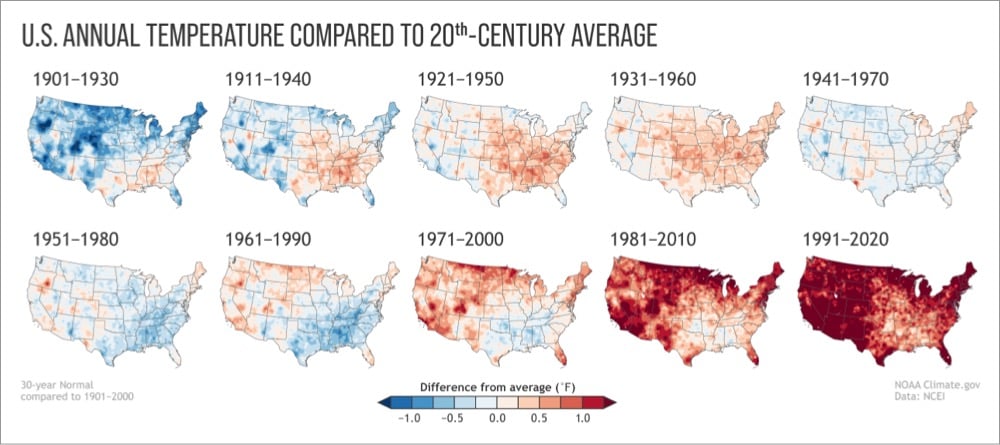
Every 10 years, the National Oceanic and Atmospheric Administration (NOAA) updates its definition of what it defines as “normal” weather.
As soon as the 2021 New Year’s celebrations were over, the calls and questions started coming in from weather watchers: When will NOAA release the new U.S. Climate Normals? The Normals are 30-year averages of key climate observations made at weather stations and corrected for bad or missing values and station changes over time. From the daily weather report to seasonal forecasts, the Normals are the basis for judging how temperature, rainfall, and other climate conditions compare to what’s normal for a given location in today’s climate.
They’re set to release the updated 1991-2020 Normals in early May and, crucially, these new normal climate conditions are not adjusted for climate change.
The last update of the Normals took place in 2011, when the baseline shifted from 1971-2000 to 1981-2010. Among the highlights of the rollout was the creation of a map showing how climate-related planting zones across the contiguous United States had shifted northward in latitude and upward in elevation. It was a clear signal that normal overnight low temperatures across the country were warmer than they used to be.
The planting zone maps emphasized a key point about the Normals and climate change: the once-per-decade update means these products gradually come to reflect the “new normal” of climate change caused by global warming. What’s normal today is often very different than what was normal 50 or 100 years ago. This gradual adjustment is the point: the purpose of the Normals is to provide context on what climate is like today, not how it’s changing over time.
This is literally shifting baselines in action.
So what are shifting baselines? Consider a species of fish that is fished to extinction in a region over, say, 100 years. A given generation of fishers becomes conscious of the fish at a particular level of abundance. When those fishers retire, the level is lower. To the generation that enters after them, that diminished level is the new normal, the new baseline. They rarely know the baseline used by the previous generation; it holds little emotional salience relative to their personal experience.
And so it goes, each new generation shifting the baseline downward. By the end, the fishers are operating in a radically degraded ecosystem, but it does not seem that way to them, because their baselines were set at an already low level.
Over time, the fish goes extinct — an enormous, tragic loss — but no fisher experiences the full transition from abundance to desolation. No generation experiences the totality of the loss. It is doled out in portions, over time, no portion quite large enough to spur preventative action. By the time the fish go extinct, the fishers barely notice, because they no longer valued the fish anyway.
I’ve been thinking a lot about shifting baselines recently — specifically in terms of how quickly people in the US got used to thousands of people dying from Covid every day and became unwilling to take precautions or change behaviors that were deemed essential just months earlier when many fewer people were dying. See also mass shootings.
Adam Serwer on the limits of this single criminal conviction. “There will be more Derek Chauvins, because his conviction alters nothing about this system.”
Languishing
Adam Grant, There’s a Name for the Blah You’re Feeling: It’s Called Languishing:
At first, I didn’t recognize the symptoms that we all had in common. Friends mentioned that they were having trouble concentrating. Colleagues reported that even with vaccines on the horizon, they weren’t excited about 2021. A family member was staying up late to watch “National Treasure” again even though she knows the movie by heart. And instead of bouncing out of bed at 6 a.m., I was lying there until 7, playing Words with Friends.
It wasn’t burnout - we still had energy. It wasn’t depression — we didn’t feel hopeless. We just felt somewhat joyless and aimless. It turns out there’s a name for that: languishing.
Languishing is a sense of stagnation and emptiness. It feels as if you’re muddling through your days, looking at your life through a foggy windshield. And it might be the dominant emotion of 2021.
Yeeeeeep. Yep. Yep. 1000% how I’ve been feeling today and on and off for months now.
A look (with graphs!) at how well the vaccines are working in the UK, US, and Chile. “We now have clear, real-world data from many countries showing…the vaccines are reducing infections, reducing hospitalisations and reducing deaths.”
Amy Sherald: The Great American Fact


Painter Amy Sherald is displaying new work at the Hauser & Wirth gallery in LA through June 6: The Great American Fact. One thing I really notice in her art now, after watching the excellent documentary Black Art: In the Absence of Light, is how at least one person in her paintings is looking directly at the viewer. Here’s Sherald talking about that in the documentary:
The eyes tell you what’s in the soul and, for me, the people that I paint, they’re no longer themselves in the painting. They are these archetypes that know they are present. These aren’t passive portraits — they’re maybe subversively confrontational, if you will — but it’s definitely a response to a lot of images I saw growing up where our gaze was always averted. Or thinking about the fact that you couldn’t look at a white person in the eye. So, this is my way of nodding my head at that narrative and empowering the image in a way. I like the paintings hung a little lower for that reason so when the viewer walks up, it’s a different conversation. You’re not looking up at it — it’s almost looking directly at you and I think that creates a different kind of sensation.
She also says of her subjects: “It’s important for me that they’re just Black people being Black” and I think that really comes through in this new work. (via colossal)
Ibram X. Kendi: Compliance Will Not Save Me. “For Black and brown people, this is the terror of American policing. When we do not comply, we die like Daunte Wright did. When we do comply, we die like Adam Toledo did.”
The Conversation Has Never Been Wider
I am still listening to the excellent interview with Tressie McMillan Cottom on The Ezra Klein Show, but I wanted to highlight this exchange right at the beginning of the interview because I think it’s relevant to a lot of our shared interests, especially if you’ve been online reading blogs or personal sites for 15, 20, or even 25 years:
EZRA KLEIN: Well, I’m always asking for us to bring back blogging.
[LAUGHING]
There is a nostalgia, oftentimes, among people who came up in it, for the internet of the aughts.
TRESSIE MCMILLAN COTTOM: Yeah. The old internet.
EZRA KLEIN: Do you think that’s nostalgia, or do you think something was lost?
TRESSIE MCMILLAN COTTOM: Hmm. OK. So I now work with a lot of internet people. I’m in an information school at a university. And so a lot of my very good friends are those people, so I want to tiptoe carefully. I do think that there was a clubbiness and a camaraderie, even among people who politically disagreed. There was a class of thinkers, a class of writers who came up in that web 2.0 that does feel like, yeah, we lost something there.
There was a humanity there for good or for bad. Humanity is messy, but there was a sense that those ideas were attached to people, and there were things driving those people, there’s a reason they had chosen to be in that space before it all became about chasing an audience in a platform and turning that into influencer and translating that into that — before all that happened, the professionalization of it all. And that’s what I think we’re missing when we become nostalgic for that web 2.0. I think it’s the people in the machine.
Having said that, I am very resistant to nostalgia as a thing because usually what we are nostalgic for is a time that just was not that great for a lot of people. And so what we were usually really nostalgic for is a time when we didn’t have to think so much about who was missing in the room, who wasn’t at the table. So when I talk to friends, and especially younger people coming up behind us either in the internet or in writing spaces, we’re like, that time was horrible for young queer people.
They talk about looking for little safe pockets of space in web 2.0 world where it was still very OK to be homophobic, for example, in those spaces and our casual language and how we structured that kind of thing. And they love being able to leave that part behind in this new world of whatever the web is now, both a consolidated and a disaggregated new web.
That’s why I’m like resistant to nostalgia. At the same time, I’m like, yeah. I also laugh and go, I really miss having a blog. In some ways, coming back to the newsletter, and Substack was kind part of that. It’s me being nostalgic for having a place where I could put thoughts that didn’t fit into any other discourse or genre, and I wanted a space where I could talk to people who were actually interacting like real people. They weren’t acting like bots, or trolls, or whatever your internet persona is.
So, I mean, I say I’m resistant to nostalgia. I just try not to reproduce it, but even I get a little — I’ll always have a soft spot for Blogger, which is coincidentally my first “where I state” space on Blogger.
EZRA KLEIN: Yup. Me too.
TRESSIE MCMILLAN COTTOM: [LAUGHS] I’ll always be a little romantic about it.
EZRA KLEIN: But I think you’re right about that criticism of it, too. Something that, for all that I can tip into nostalgia, something that I think is often missed in today’s conversation is the conversation has never been wider.
TRESSIE MCMILLAN COTTOM: Yes.
EZRA KLEIN: People talk all about things they can’t say, but it has never been wider.
TRESSIE MCMILLAN COTTOM: Yup.
EZRA KLEIN: There’s never been a larger allowable space of things you could say.
TRESSIE MCMILLAN COTTOM: That’s right.
EZRA KLEIN: And people have also never been more pissed about how it feels to participate in it. I don’t want to say never, but broadly, there is an intensity to that conversation that is distinct, and I don’t think those things are unrelated, right? I think it is the wideness of the conversation and the fact that there are so many people you might hear from that make you feel cautious and insecure and unsafe, and the good of it is the bad of it.
TRESSIE MCMILLAN COTTOM: Exactly. One of the things I like to say to people is that we think that broadening access in any realm — we do this with everything, by the way. It’s such an American way to approach the world. We think that broadening access will broaden access on the terms of the people who have benefited from it being narrowed, which is just so counterintuitive.
Broadening access doesn’t mean that everybody has the experience that I, privileged person, had in the discourse. Broadening it means that we are all equally uncomfortable, right? That’s actually what pluralism and plurality is. It isn’t that everybody is going to come in and have the same comforts that privilege and exclusion had extended to a small group of people. It’s that now everybody sits at the table, and nobody knows the exact right thing to say about the other people.
Well, that’s fair. That means we all now have to be thoughtful. We all have to consider, oh, wait a minute. Is that what we say in this room? We all have to reconsider what the norms are, and that was the promise of like expanding the discourse, and that’s exactly what we’ve gotten. And if that means that I’m not sure about letting it rip on a joke, that’s probably a pretty good thing.
Look, as someone who benefitted hugely from it, I miss the golden age of blogging as much as anyone — productive discussions in comment threads, the community alchemy of Flickr, Google Reader, cross-blog conversations, the Open Web, small pieces loosely joined, etc. etc. etc. — but over the past few years, I’ve felt a lot less nostalgia for it for exactly the reasons McMillan Cottom & Klein are talking about here. Make the Internet Great Again is, in many important ways, as short-sighted, futile, and limiting as, well, you know.
Ted Lasso Season 2 Teaser Trailer
Apple just announced that season two of Ted Lasso will be premiering on Apple+ on July 23. That’s it, that’s the news. Watch the trailer. Rejoice. Be happy.
Mealworm Feast Time Lapse
This is pretty simple: 10,000 mealworms eating a tomato, piece of corn, and romanesco broccoli, filmed with a time lapse camera. My only comment is that for something called a mealworm, they don’t eat as quickly as I thought they would. 10,000 mealworms couldn’t polish off a tomato in less than 48 hours? You’re never going to be a beetle at that pace! (via the kid should see this)
Make Everything Important
I enjoyed this interview with actor Mads Mikkelsen.
Q: Is there a life philosophy that you feel has carried you through your career?
A: My approach to what I do in my job — and it might even be the approach to my life — is that everything I do is the most important thing I do. Whether it’s a play or the next film. It is the most important thing. I know it’s not going to be the most important thing, and it might not be close to being the best, but I have to make it the most important thing. That means I will be ambitious with my job and not with my career. That’s a very big difference, because if I’m ambitious with my career, everything I do now is just stepping-stones leading to something — a goal I might never reach, and so everything will be disappointing. But if I make everything important, then eventually it will become a career. Big or small, we don’t know. But at least everything was important.
“All his life has he looked away, to the future, to the horizon. Never his mind on where he was, what he was doing.” —Yoda, Empire Strikes Back. See also “I’ve Never Had a Goal”. (via @tadfriend)
This is pretty cool: a DIY open-source split-flap display. If I had a small IRL business of some sort (bakery, cafe, package shipping place), I’d 100% have a functioning split-flap display on the wall.
How Fit Can You Get From Just Walking? “Walking is probably the single most underutilized tool in health and wellness.”
They’re making a second Downton Abbey film. Inject this low-stakes Britishness right into my veins!
Perfectly Synchronized Dancing
I love this short dance video made by Taylor Pierce and Jackson Myles Chavis. For me, it’s when they slide to the side and then to the back in complete synchronized motion, like they’re on a dolly. I’ve watched this a dozen times at least. And a bunch of other videos by Pierce and Chavis. Mesmerizing.
Greta Thunberg: A Year to Change the World
Greta Thunberg took a year off of school to travel the world to better understand the changing planet, a journey captured in this three-part BBC series set to debut on PBS this Thursday (April 22, aka Earth Day). I found out about this from Lizzie Widdicombe’s short profile of Thunberg in the New Yorker.
Thunberg is on the autism spectrum, and the film illustrates how the condition lends a unique moral clarity to her activism. “I don’t follow social codes,” she said. “Everyone else seems to be playing a role, just going on like before. And I, who am autistic, I don’t play this social game.” She eschews empty optimism. Her over-all reaction to the coronavirus pandemic is to compare it with her cause: “If we humans would actually start treating the climate crisis like a crisis, we could really change things.”
Her uncompromising words can give the wrong impression. “People seem to think that I am depressed, or angry, or worried, but that’s not true,” she said. Having a cause makes her happy. “It was like I got meaning in my life.”
Also from that piece: Thunberg doesn’t live at home; she lives in a safe-house “in a kind of witness-protection program” situation because, one would assume, she gets a lot of threats due of her work.
Why You Can’t Hear The Dialogue in Tenet. This drove me nuts – one of the reasons I was really disappointed in Tenet.
A Helicopter Flies on Mars
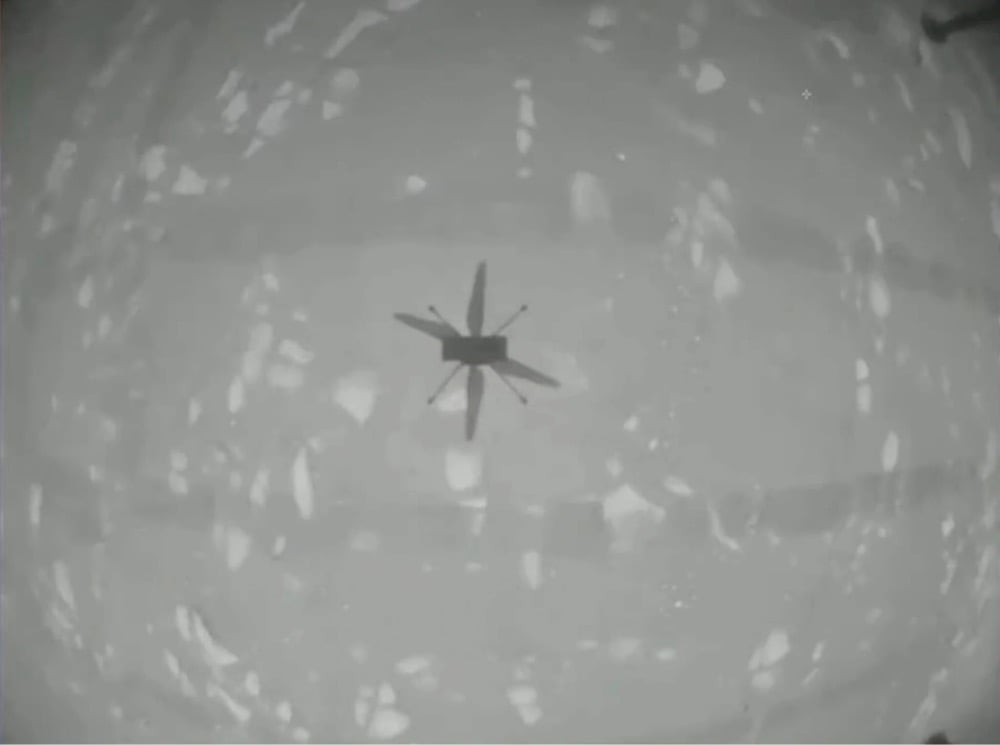
Deployed from NASA’s Perseverance rover, the Ingenuity helicopter took off and hovered for about 30 seconds in its first flight early this morning.
The solar-powered helicopter first became airborne at 3:34 a.m. EDT (12:34 a.m. PDT) — 12:33 Local Mean Solar Time (Mars time) — a time the Ingenuity team determined would have optimal energy and flight conditions. Altimeter data indicate Ingenuity climbed to its prescribed maximum altitude of 10 feet (3 meters) and maintained a stable hover for 30 seconds. It then descended, touching back down on the surface of Mars after logging a total of 39.1 seconds of flight. Additional details on the test are expected in upcoming downlinks.
Ingenuity’s initial flight demonstration was autonomous — piloted by onboard guidance, navigation, and control systems running algorithms developed by the team at JPL. Because data must be sent to and returned from the Red Planet over hundreds of millions of miles using orbiting satellites and NASA’s Deep Space Network, Ingenuity cannot be flown with a joystick, and its flight was not observable from Earth in real time.
NASA livestreamed the team in Mission Control as the test results were transmitted back to Earth. The photo above is of Ingenuity’s shadow taken while in flight by its onboard camera.
Update: Here’s video footage of the first flight:
And there’s always room for a little Great Span on this site. Alex Knapp:
The world’s oldest living person was alive when the Wright Brothers flew at Kitty Hawk and when the first helicopter flew on Mars.
The rules for Covid chess. “The queen just got her first dose of the Moderna vaccine and now thinks she can fly diagonally, horizontally, or vertically to Austin for vacation.”
The United States of Guns
Like many of you, I read the news of a single person killing at least 8 people in Indianapolis, Indiana yesterday, which comes on the heels of several other mass shootings in 2021. While these are outrageous and horrifying events, they aren’t surprising or shocking in any way in a country where more than 33,000 people die from gun violence each year.
America is a stuck in a Groundhog Day loop of gun violence. We’ll keep waking up, stuck in the same reality of oppression, carnage, and ruined lives until we can figure out how to effect meaningful change. I’ve collected some articles here about America’s dysfunctional relationship with guns, most of which I’ve shared before. Change is possible — there are good reasons to control the ownership of guns and control has a high likelihood of success — but how will our country find the political will to make it happen?
An armed society is not a free society:
Arendt offers two points that are salient to our thinking about guns: for one, they insert a hierarchy of some kind, but fundamental nonetheless, and thereby undermine equality. But furthermore, guns pose a monumental challenge to freedom, and particular, the liberty that is the hallmark of any democracy worthy of the name — that is, freedom of speech. Guns do communicate, after all, but in a way that is contrary to free speech aspirations: for, guns chasten speech.
This becomes clear if only you pry a little more deeply into the N.R.A.’s logic behind an armed society. An armed society is polite, by their thinking, precisely because guns would compel everyone to tamp down eccentric behavior, and refrain from actions that might seem threatening. The suggestion is that guns liberally interspersed throughout society would cause us all to walk gingerly — not make any sudden, unexpected moves — and watch what we say, how we act, whom we might offend.
We’re sacrificing America’s children to “our great god Gun”:
Read again those lines, with recent images seared into our brains — “besmeared with blood” and “parents’ tears.” They give the real meaning of what happened at Sandy Hook Elementary School Friday morning. That horror cannot be blamed just on one unhinged person. It was the sacrifice we as a culture made, and continually make, to our demonic god. We guarantee that crazed man after crazed man will have a flood of killing power readily supplied him. We have to make that offering, out of devotion to our Moloch, our god. The gun is our Moloch. We sacrifice children to him daily — sometimes, as at Sandy Hook, by directly throwing them into the fire-hose of bullets from our protected private killing machines, sometimes by blighting our children’s lives by the death of a parent, a schoolmate, a teacher, a protector. Sometimes this is done by mass killings (eight this year), sometimes by private offerings to the god (thousands this year).
The gun is not a mere tool, a bit of technology, a political issue, a point of debate. It is an object of reverence. Devotion to it precludes interruption with the sacrifices it entails. Like most gods, it does what it will, and cannot be questioned. Its acolytes think it is capable only of good things. It guarantees life and safety and freedom. It even guarantees law. Law grows from it. Then how can law question it?
Roger Ebert on the media’s coverage of mass shootings:
Let me tell you a story. The day after Columbine, I was interviewed for the Tom Brokaw news program. The reporter had been assigned a theory and was seeking sound bites to support it. “Wouldn’t you say,” she asked, “that killings like this are influenced by violent movies?” No, I said, I wouldn’t say that. “But what about ‘Basketball Diaries’?” she asked. “Doesn’t that have a scene of a boy walking into a school with a machine gun?” The obscure 1995 Leonardo Di Caprio movie did indeed have a brief fantasy scene of that nature, I said, but the movie failed at the box office (it grossed only $2.5 million), and it’s unlikely the Columbine killers saw it.
The reporter looked disappointed, so I offered her my theory. “Events like this,” I said, “if they are influenced by anything, are influenced by news programs like your own. When an unbalanced kid walks into a school and starts shooting, it becomes a major media event. Cable news drops ordinary programming and goes around the clock with it. The story is assigned a logo and a theme song; these two kids were packaged as the Trench Coat Mafia. The message is clear to other disturbed kids around the country: If I shoot up my school, I can be famous. The TV will talk about nothing else but me. Experts will try to figure out what I was thinking. The kids and teachers at school will see they shouldn’t have messed with me. I’ll go out in a blaze of glory.”
In short, I said, events like Columbine are influenced far less by violent movies than by CNN, the NBC Nightly News and all the other news media, who glorify the killers in the guise of “explaining” them. I commended the policy at the Sun-Times, where our editor said the paper would no longer feature school killings on Page 1. The reporter thanked me and turned off the camera. Of course the interview was never used. They found plenty of talking heads to condemn violent movies, and everybody was happy.
Jill Lepore on the United States of Guns:
There are nearly three hundred million privately owned firearms in the United States: a hundred and six million handguns, a hundred and five million rifles, and eighty-three million shotguns. That works out to about one gun for every American. The gun that T. J. Lane brought to Chardon High School belonged to his uncle, who had bought it in 2010, at a gun shop. Both of Lane’s parents had been arrested on charges of domestic violence over the years. Lane found the gun in his grandfather’s barn.
The United States is the country with the highest rate of civilian gun ownership in the world. (The second highest is Yemen, where the rate is nevertheless only half that of the U.S.) No civilian population is more powerfully armed. Most Americans do not, however, own guns, because three-quarters of people with guns own two or more. According to the General Social Survey, conducted by the National Policy Opinion Center at the University of Chicago, the prevalence of gun ownership has declined steadily in the past few decades. In 1973, there were guns in roughly one in two households in the United States; in 2010, one in three. In 1980, nearly one in three Americans owned a gun; in 2010, that figure had dropped to one in five.
A Land Without Guns: How Japan Has Virtually Eliminated Shooting Deaths:
The only guns that Japanese citizens can legally buy and use are shotguns and air rifles, and it’s not easy to do. The process is detailed in David Kopel’s landmark study on Japanese gun control, published in the 1993 Asia Pacific Law Review, still cited as current. (Kopel, no left-wing loony, is a member of the National Rifle Association and once wrote in National Review that looser gun control laws could have stopped Adolf Hitler.)
To get a gun in Japan, first, you have to attend an all-day class and pass a written test, which are held only once per month. You also must take and pass a shooting range class. Then, head over to a hospital for a mental test and drug test (Japan is unusual in that potential gun owners must affirmatively prove their mental fitness), which you’ll file with the police. Finally, pass a rigorous background check for any criminal record or association with criminal or extremist groups, and you will be the proud new owner of your shotgun or air rifle. Just don’t forget to provide police with documentation on the specific location of the gun in your home, as well as the ammo, both of which must be locked and stored separately. And remember to have the police inspect the gun once per year and to re-take the class and exam every three years.
Australia’s gun laws stopped mass shootings and reduced homicides, study finds:
From 1979 to 1996, the average annual rate of total non-firearm suicide and homicide deaths was rising at 2.1% per year. Since then, the average annual rate of total non-firearm suicide and homicide deaths has been declining by 1.4%, with the researchers concluding there was no evidence of murderers moving to other methods, and that the same was true for suicide.
The average decline in total firearm deaths accelerated significantly, from a 3% decline annually before the reforms to a 5% decline afterwards, the study found.
In the 18 years to 1996, Australia experienced 13 fatal mass shootings in which 104 victims were killed and at least another 52 were wounded. There have been no fatal mass shootings since that time, with the study defining a mass shooting as having at least five victims.
From The Onion, ‘No Way To Prevent This,’ Says Only Nation Where This Regularly Happens:
At press time, residents of the only economically advanced nation in the world where roughly two mass shootings have occurred every month for the past eight years were referring to themselves and their situation as “helpless.”
But America is not Australia or Japan. Dan Hodges said on Twitter a few years ago:
In retrospect Sandy Hook marked the end of the US gun control debate. Once America decided killing children was bearable, it was over.
This can’t be the last word on guns in America. We have to do better than this for our children and everyone else whose lives are torn apart by guns. But right now, we are failing them miserably, and Hodges’ words ring with the awful truth that all those lives and our diminished freedom & equality are somehow worth it to the United States as a society.
Decades ago, Mac computers came with a sound that played when the machine couldn’t boot properly. Behold, the Mac Chimes of Death.
Case Closed: SARS-CoV-2 Spreads Primarily by Aerosols
In a letter published in The Lancet, a group of scholars argue, with an extensive review of the available evidence, that the primary mode of transmission from human to human of the virus responsible for Covid-19 is via aerosols, not through larger particles called droplets or through fomites (transfer from surfaces). Here are three of their ten reasons why:
Third, asymptomatic or presymptomatic transmission of SARS-CoV-2 from people who are not coughing or sneezing is likely to account for at least a third, and perhaps up to 59%, of all transmission globally and is a key way SARS-CoV-2 has spread around the world, supportive of a predominantly airborne mode of transmission. Direct measurements show that speaking produces thousands of aerosol particles and few large droplets, which supports the airborne route.
Fourth, transmission of SARS-CoV-2 is higher indoors than outdoors and is substantially reduced by indoor ventilation. Both observations support a predominantly airborne route of transmission.
Fifth, nosocomial infections have been documented in health-care organisations, where there have been strict contact-and-droplet precautions and use of personal protective equipment (PPE) designed to protect against droplet but not aerosol exposure.
The letter concludes with a plea by the authors for public health officials to finally embrace this reality: “The public health community should act accordingly and without further delay.”
I can’t believe we’re actually still arguing about this. One of the authors, Jose-Luis Jimenez, wrote this seminal Time magazine piece that provided the smoke analogy that is the mental model I’ve been using to think about potential risks during the pandemic.
When it comes to COVID-19, the evidence overwhelmingly supports aerosol transmission, and there are no strong arguments against it. For example, contact tracing has found that much COVID-19 transmission occurs in close proximity, but that many people who share the same home with an infected person do not get the disease. To understand why, it is useful to use cigarette or vaping smoke (which is also an aerosol) as an analog. Imagine sharing a home with a smoker: if you stood close to the smoker while talking, you would inhale a great deal of smoke. Replace the smoke with virus-containing aerosols, which behave very similarly, and the impact is similar: the closer you are to someone releasing virus-carrying aerosols, the more likely you are to breathe in larger amounts of virus. We know from detailed, rigorous studies that when individuals talk in close proximity, aerosols dominate transmission and droplets are nearly negligible.
Another of the authors, Zeynep Tufekci, has been arguing the case for aerosols (and masks & overdispersion) since early in the pandemic, and she succinctly explained in a Twitter thread how predominantly aerosol transmission fits with the mitigation methods that have really worked around the world:
Airborne transmission unites three things crucial to recognize for effective COVID-19 mitigation: transmission without symptoms (thus aerosols), clusters driving the epidemic (also aerosols) and masks/ventilation indoors being key (hey, also aerosols). This framework is coherent.
Her whole thread is worth a read — like this bit about how other respiratory pathogens are likely spread by aerosols and not droplets (as commonly believed):
Fascinatingly, you search the scientific record high and low, but there really is little to no direct evidence for gravity-sprayed droplets being predominant mode of transmission for respiratory illnesses outside of coughing/sneezing. It’s many… assumptions. Like a tradition.
If any good comes out of the pandemic at all, a better and more useful scientific understanding of how respiratory pathogens are transmitted would be a good start.
Update: One of the authors, Trisha Greenhalgh, responds succinctly to criticisms of the paper in this Twitter thread.
Criticism 1: “The paper is just opinion, and several authors aren’t even doctors.”
Response: No. It’s well-researched scholarly argument, produced by an interdisciplinary team of 6 professors including 3 docs, 2 aerosol scientists and 1 social scientist.
Winners of the 2021 World Press Photo Contest
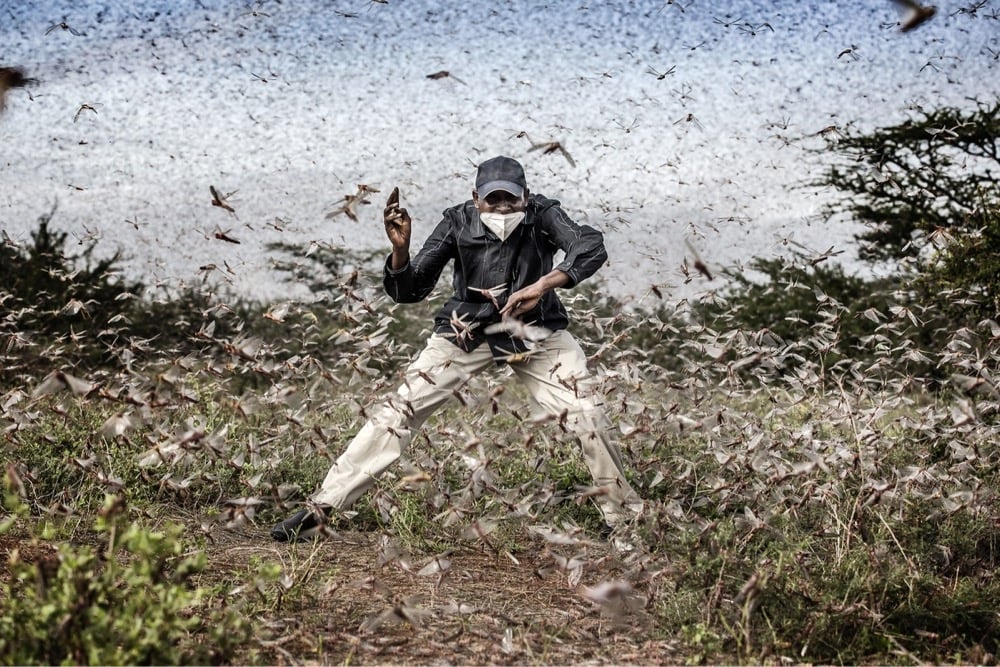

The winners of the 2021 World Press Photo contests have been announced. Photos above (top to bottom) by Nadia Buzhan (of a woman waiting for her husband to be released from a detention center) and Luis Tato (of efforts to fight a locust invasion in Kenya). (via in focus)
The Nation’s Corn Belt Has Lost a Third of Its Topsoil. “I think it’s probably an underestimate. There are areas where there’s probably a centimeter of topsoil left.”
Quiet Storm: How Slow Jams Took Over the Radio
One of my favorite YouTube series, Estelle Caswell’s Earworm, is back for another season. In this first episode, she looks at how a beloved Black radio tradition called Quiet Storm came about and influenced the course of popular culture for decades.
Late one evening in the summer of 1976, a Howard University student named Melvin Lindsey was tapped to fill in as a host at WHUR, the university-owned Black radio station. He chose a lineup of his favorite R&B ballads to soundtrack Washington, DC, that evening. The show was an accidental success. Shortly thereafter he was hired, and his show had a name: The Quiet Storm.
I love the economic way in which this story by @migold & @choire is written: quick, dense sentences, short paragraphs, lots of links, informative but also opinionated. Reminds me of Suck.
The Art of Traditional Japanese Printmaking
There are many steps in making traditional Japanese woodblock prints (ukiyo-e), but this short video focuses on the printing process as demonstrated by master printmaker Keiji Shinohara. This is a delight to watch — Shinohara’s deliberate precision is impressive and inspiring.
My absolute favorite part of this video is at the 3:40 mark when he precisely and firmly grasps the pressing tool (called a baren), swipes it on his face three times, and then uses it to press the paper into the inked block. This pre-press face maneuver is repeated several times but otherwise goes unremarked upon in the video — one of the commenters offers this explanation: “The oils from his face help grip the paper, making a firm and even press.” (via open culture)
Socials & More