Entries for May 2019
Many species of migratory birds, like the Canada goose in North America, fly in a v-formation. Scientists have long suspected that there was some energy-saving advantage to flying in formation and a 2014 study provides evidence to that effect.
By comparing the birds’ flight data to computer simulations, Portugal found that the ibises are apparently drafting — catching an uprush of air from the wingtip of the bird ahead. “Furthermore, when they’re in that position, they time wing beats perfectly,” he says. “So they don’t just sit there passively hoping to get some of the good air from the bird in front.”
They actually flap along the perfect sweet spot. Portugal thinks there’s a very good reason why the ibises do this. Previous studies have shown that flying is hard work.
“When we get exercising, our heart rate gets up to around 180 beats per minute on a good day,” Portugal says. “When birds are flying, it goes up to 400 beats per minute.”
You can read the paper published by the researchers in Nature. (via the kid should see this)

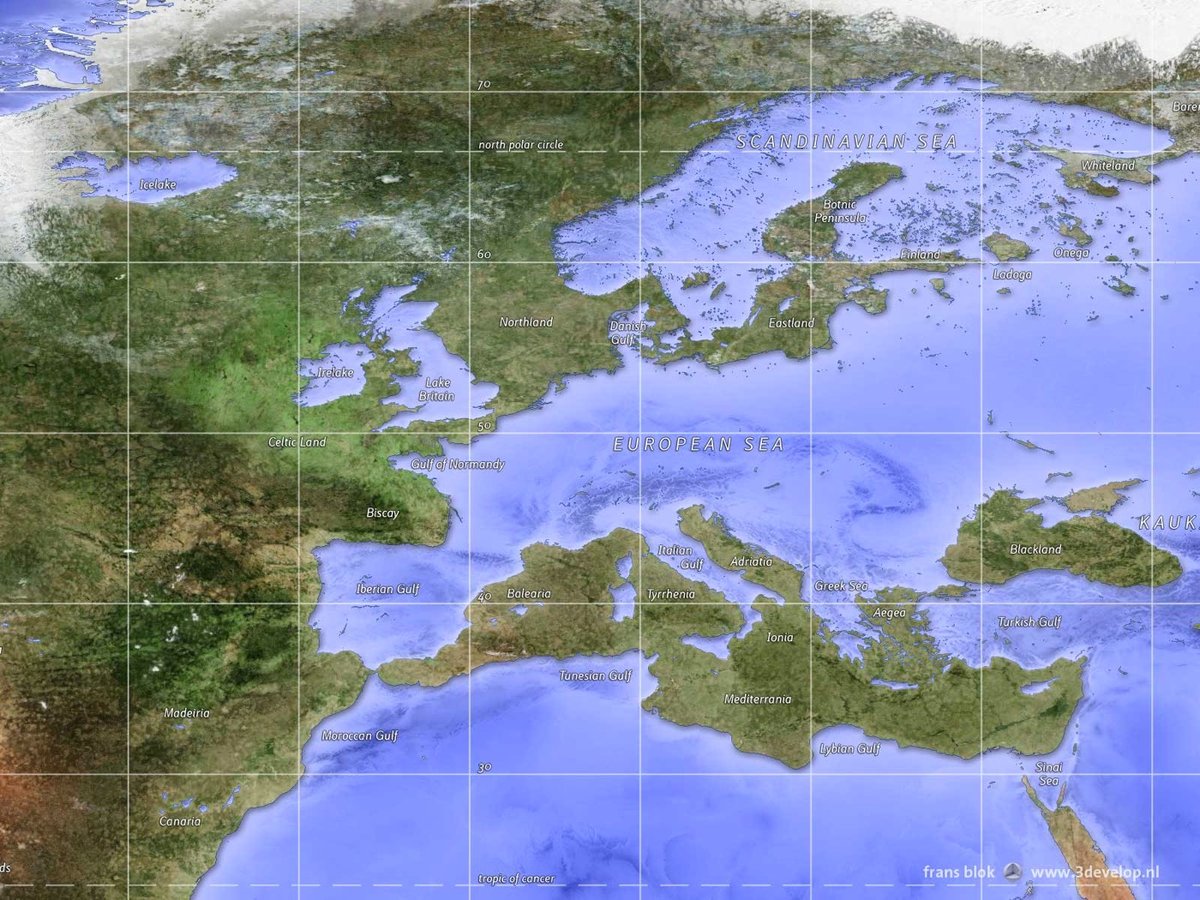
Frans Blok has created an incredibly detailed inverse map of the world, where all the current landmasses have been turned into water and oceans, lakes, and rivers converted into land.
Not only the coast lines are reversed in this world. Also, the relief is consistently the opposite of reality. So the deepest parts of the oceans are in the Tibetan and Himalayan troughs in the southern part of the Asian Ocean. And the highest peaks, around eleven kilometer, are found in the Mariana Mountains in the west of the continent Pacifica.
Prints of Blok’s map are available here.
See also Vladislav Gerasimov’s inverted world map.
An analysis of the typography & design of the 2020 Presidential campaigns. “The Y in Yang looks like — what, a slice of bacon using a playground slide in an unsafe way?”
John Driscoll is the CEO of a healthcare company called CareCentrix. In an opinion piece in The Guardian, he wrote about the success of a plan his company implemented where they froze the salaries of the top 20 executives and gave significant raises to entry-level workers, from the federal minimum wage of $7.25/hr to $15/hr. Driscoll explains why the company decided to do this:
Assuming nothing went wrong, and assuming that our employees were living with another wage earner or working another part-time job, $7.25 hourly wage might be sufficient.
The reality is that for many of us, things do go wrong, and I had emails from my new teammates to prove it.
One was from a customer service representative — a young mother with a family, who had lost her apartment in a fire and did not have enough money for diapers. Another email soon followed — this employee had missed a few bills and was living out of her car with her child.
This drove me crazy: how did we get to the point where one of our employees had to apologetically ask for financial support so she and her family could put a roof over their heads?
While some of our elected officials congratulated us for creating jobs, I felt that we were failing some of our employees, and the communities we were based in. The more our executive team parsed through the requests for assistance, the more we all became uncomfortable with the mismatch between what we asked of our employees and what we provided to them in turn.
And the real kick in the groin about the plan? It wasn’t even that tough to implement!
I challenged the chief financial officer to see how deeply we would have to freeze wages in order to reach our goal of a base rate of $15 per hour.
The answer was that we did not have to go very deep. Over the last few decades executive salaries have skyrocketed. That translates into accelerated wage growth in the highest tiers of executives throughout American business, and it affects every company.
What that meant for our company was that if we just froze the wages of our most senior team — less than 20 executives - we could radically increase the wages and improve the lives of nearly 500 of our teammates.
The conversation with our executives was straightforward. We were in the midst of a turnaround. We were demanding much from every corner of the company. Small financial sacrifices from those at the top could be life changing for those at the bottom of our wage scale. We needed to do it to build a real sense of Team CareCentrix. They agreed.
And it worked really well. Duh. It drives me bananas that more companies don’t see the benefit of doing this versus implementing compensation policies that serve only to line the pockets of the people in char— oh waaaaait, it actually makes perfect sense why this is happening. The shareholders of these companies should start calling bullshit on that sort of behavior with more regularity though.
See also the founder of Richer Sounds retiring and transferring 60% of his company to its employees, with workers also receiving £1,000 for every year they’ve worked for the company.
A robot built by a pair of engineering students at MIT can solve a Rubik’s Cube in 0.38 seconds (which happens to be 19 minutes and 59.22 seconds shorter than my fastest time):
0.38 seconds is over in an almost literal flash, so the video helpfully shows this feat at 0.25x speed and 0.03x speed. I bet when they were testing this, they witness some spectacular cube explosions. (via @tedgioia)
In this NASA promotional film from 1977, Star Trek star Nichelle Nichols takes a tour of the Johnson Space Center with Apollo 12 astronaut Al Bean and urges viewers, especially women and people of color, to sign up to be astronauts on NASA’s Space Shuttle program.
As one of the first black women to play a lead role on television, Nichols was a role model for women and people of color, particularly those interested in science, space, and engineering. When she was she thinking of quitting Star Trek, Nichols met Martin Luther King Jr. at a NAACP fundraiser and he talked her into staying on the show. She recalled King telling her:
Do you not understand what God has given you? … You have the first important non-traditional role, non-stereotypical role. … You cannot abdicate your position. You are changing the minds of people across the world, because for the first time, through you, we see ourselves and what can be.
So when NASA came calling, Nichols used her position well:
She relayed her response to NASA with a mischievous twinkle in her eye, “I am going to bring you so many qualified women and minority astronaut applicants for this position that if you don’t choose one… everybody in the newspapers across the country will know about it.”
Nichols credited Star Trek with the success of her recruiting efforts. “Suddenly the people who were responding were the bigger Trekkers you ever saw. They truly believed what I said… it was a very successful endeavor. It changed the face of the astronaut corp forever.”
Among the recruits drawn to NASA by Nichols’ efforts were Sally Ride, the first American woman in space, Ronald McNair & Judith Resnick, who both died in the Challenger accident, Guion Bluford, the first African-American in space, and Mae Jemison, who was the first black woman in space. The diversity of the latest batch of NASA astronauts-in-training is a testament to Nichols’ and NASA’s joint efforts as well. (via open culture)
From Hiroshi Kondo, a mesmerizing short film called Multiverse of the motorbike-jammed streets of Taiwan. Right around the 50 second mark, Kondo starts to use a clever time lapse technique to highlight individuality within the bustling mass of traffic. It’s a really cool effect and reminded me of this clip art animation by Oliver Laric. (via colossal)
24-year-old NBA superstar Giannis Antetokounmpo has led the Milwaukee Bucks to the Eastern Conference Finals this year, but as a child in Greece, he lived the life of a stateless undocumented immigrant.
Until recently, even the children of African immigrants who were born here found it difficult to secure legal residency, let alone citizenship. Their stateless status denied them national health care, Civil Service jobs and access to sports leagues. Antetokounmpo only gained Greek citizenship six years ago — just as he was about to go to New York for the N.B.A. draft.
“He was given Greek citizenship in order to prevent him from traveling to New York as a Nigerian,” said Nikos Odubitan, the founder of Generation 2.0, an advocacy group that helps second-generation immigrants gain legal status in Greece.
Danny Chau went to Milwaukee to speak with refugees from places like Syria and Myanmar about their lives, their struggles, and their awareness of Antetokounmpo’s story: Giannis Through the Eyes of Milwaukee Refugees.
Kasim serves as a medical interpreter at Aurora Health Care, Wisconsin’s largest home care organization. I walk past the Aurora pharmacy several times during my stay; above one of the entrance gates hand a vinyl FEAR THE DEER banner. I ask Kasim about the Bucks, about what he knows of the professional sports franchise that has brought new life to much of the city this season. For refugees like Kasim, they may as well be from another planet.
“I heard of this, but again, because of the situations, we are a bit away from the sports,” Kasim says. “We don’t have any chance. But now, I come here, I’m working at the community center, at the same time fulfilling other responsibilities, so time is pretty busy. So I don’t get the time to self-care.” Kasim, often solemn and deliberate in his speech, couldn’t help but let out a smile, having essentially wrapped the term “self-care” in sonic air quotes.
I tell him about Giannis.
He lives here in Milwaukee?
About how he’s one of the best basketball players in the world.
He’s from here or he came here with his parents?
About how, as a child, he, too, had no official claim to the home he had always known. About how he would peddle sunglasses, DVDs, and whatever else he could to make 200 or 300 euros a month for his family. And how his status as an undocumented person meant knowing that at any moment, police could ask his parents for their documentation, and that they could be sent back to Nigeria in an instant.
(via @sampotts)
Diane Munday, an 86-year-old women’s rights activist, recalls what illegal abortion had been like in the UK in the 1960s.
“Women would drink bleach to try to induce miscarriage. They would have very hot baths, or move heavy furniture, or try to do it themselves with a needle or a crochet hook,” says Munday.
As a result, an underground network of backstreet abortionists ran quietly across the country. Some of them, says Munday, became involved by force. It was not unknown for women who had carried out abortions for their close friends and family to be blackmailed by desperate pregnant women who threatened to report them to the police if they didn’t help them, too. Like women who had abortions, those who carried out the procedure illegally could be sent to prison.
“These people were unskilled. Some might have had a bit of nursing experience or had worked in a hospital, or carried out procedures for a friend or daughter,” says Munday.
Munday became active in the campaign to legalize abortion in the UK after she had one herself following giving birth to three children in less than four years.
See also Harrowing Illegal Abortion Stories from Before Roe v. Wade.
Limiting Your Child’s Fire Time: A Guide for Concerned Paleolithic Parents. “Fire is nice, but there’s a time and a place for it. So institute specific fire-watching times, and stick to them.”
Black Mirror is back for a fifth season on Netflix starting June 5. The season will consist only of three episodes and will star, among others, Miley Cyrus, Topher Grace, Andrew Scott, and Anthony Mackie. Here’s the trailer:
I have to admit that I haven’t watched all of season 4 yet…or Bandersnatch. Living in an episode of Black Mirror isn’t exactly conducive to wanting to watch Black Mirror.
Merriam-Webster asked 11 authors how they came up with their single-word book titles. Here’s A.S. Byatt talking about Possession:
The book began with a word — the title — Possession. Earlier novels have begun with characters, or themes, but Possession began when I was watching the great Canadian Coleridge scholar, Kathleen Coburn, working in the British Museum and thought — “she cannot have had a thought that was not his thought for the last 30 or 40 years.” And then I thought — “and what I know about him is mediated through her - she edited all his notebooks, checked the sources of the quotations, etc.”
And then I thought, “I could write a novel called Possession about the relationship between a dead poet and a living scholar.” And the word possession would have all sorts of senses — daemonism, ownership, obsession……
And Jeffrey Eugenides on Middlesex:
A good title tells you what the book’s about. It reminds you, when you lose heart, why you started writing it in the first place. I saw an interview with Francis Ford Coppola once where he said that he likes to boil down his films into one word. For The Godfather, the word was “succession.” Whenever Coppola decided something, even a small thing like a costume detail, he reminded himself of his theme in order to make everything cohere, from the storyline right down to the gangsters’ hats.
With two of my novels, The Virgin Suicides and The Marriage Plot, I knew the titles before I even started writing. I wasn’t so lucky with Middlesex. For years I had a terrible working title for that book, so bad I won’t even mention it here.
(via @john_overholt)
Judith Love Cohen was, at various times in her fascinating life, an engineer who worked on the Pioneer, Apollo, and Hubble missions, an author & publisher of books about women in STEM and environmentalism in the 90s, a ballet dancer with the New York Metropolitan Opera Ballet Company, an advocate for better treatment of women in the workplace, and actor Jack Black’s mother. From an obituary written by her son Neil Siegel after her death in 2016:
My mother usually considered her work on the Apollo program to be the highlight of her career. When disaster struck the Apollo 13 mission, it was the Abort-Guidance System that brought the astronauts home safely. Judy was there when the Apollo 13 astronauts paid a “thank you” [visit] to the TRW facility in Redondo Beach.
She finished her engineering career running the systems engineering for the science ground facility of the Hubble Space Telescope.
During her engineering career, she was a vigorous and tireless advocate of better treatment for women in the workplace. Many things that today we consider routine — the posting of job openings inside of a company so that anyone could apply, formal job descriptions for every position, and so forth - were her creations. She had a profound impact on equality in the workforce.
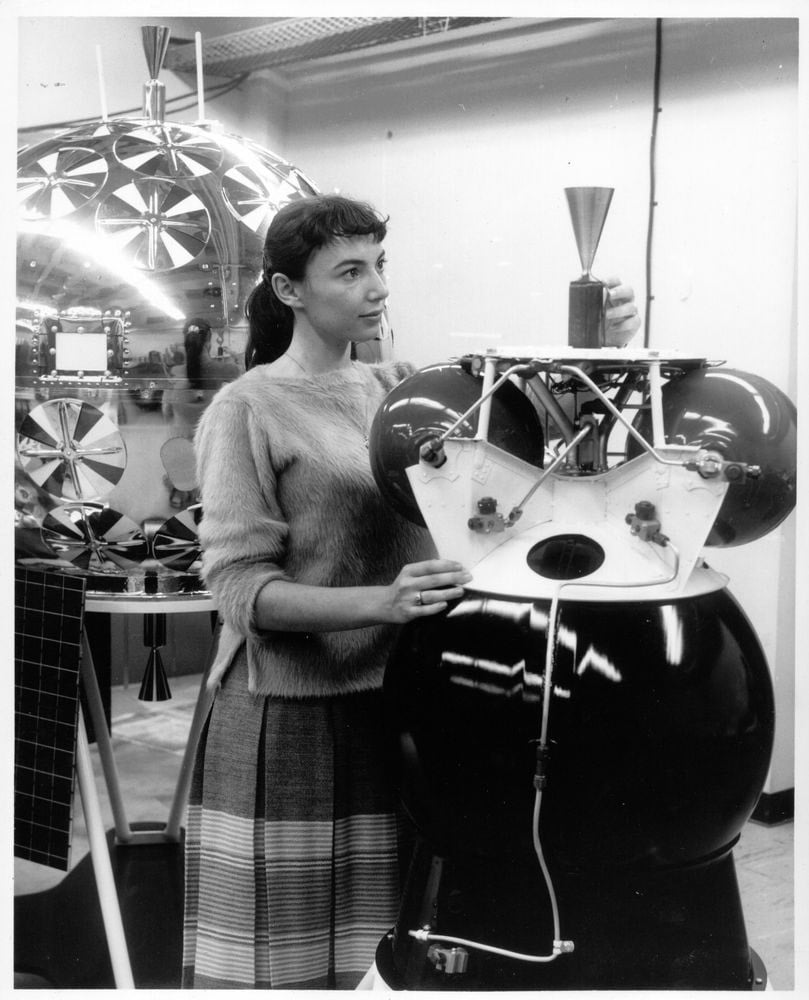
Here’s Cohen pictured with an early Pioneer spacecraft in 1959:
Frustrated with the lack of female role models for girls interested in science, math, and technology, she retired from engineering to write and publish a series of books. From a 1999 LA Times profile:
The 11-book series features female professionals such as a paleontologist, Egyptologist and marine biologist. Cohen’s first book in 1991, “You Can Be a Woman Engineer,” traces her arc from a girl who had never heard of female engineers to a woman who led a team of engineers on the design for NASA’s Hubble Space Telescope.
“You only think about things when you see people doing it. Most girls know now they can be lawyers” from TV shows like “Ally McBeal” and female lawyers in the news, Cohen said. “They know that they can work in an emergency room — they’ve seen ‘ER.’ But I don’t recall that anyone has seen scientists on a large scale, except for a few paleontologists in ‘Jurassic Park.’”
At NASA’s Jet Propulsion Laboratory in Pasadena, physicist Barbara Wilson, 50, said she never knew of any female scientists while growing up in the Midwest. At age 10, she started reading science fiction books for inspiration, but none of them featured women. In school, counselors dismissed the idea of her becoming a scientist, saying she should consider jobs that “women are more likely to be good at.” Books like Cohen’s would have provided the validation she sought, said Wilson, JPL’s chief technologist.
“It was really difficult psychologically and emotionally to be better than all the boys in math and science,” she said. “[The books] really would have helped encourage my feeling good about myself, that this was the direction I wanted to go. I didn’t see role models. I didn’t get encouragement other than at home.”
It’s difficult to imagine a better role model than Cohen…she obviously loved engineering and her work. When her son Jack Black was born, she barely hit the pause button:
Her fourth child, Jack, was born a few years later. She actually went to her office on the day that Jack was born. When it was time to go to the hospital, she took with her a computer printout of the problem she was working on. Later that day, she called her boss and told him that she had solved the problem. And… oh, yes, the baby was born, too.
If anyone from the NY Times is reading, I think Cohen would make a good subject for the Overlooked series. (via history cool kids)
Update: Jack Black and Neil Siegel recently went on the Periodic Talks podcast to talk about their mother and her career at NASA.
Tim Conway dies aged 85. I loved watching him on reruns of The Carol Burnett Show when I was a kid.
In the latest episode of Last Week Tonight, John Oliver discusses the Green New Deal and carbon pricing. Oliver invited beloved children’s science educator Bill Nye to help him explain a few things and Nye delivered a short but passionate speech about what’s at stake in the political battle over climate change:
I’ve got an experiment for you. Safety glasses on. By the end of this century, if emissions keep rising, the average temperature on earth could go up another four to eight degrees. What I’m saying is: the planet’s on fucking fire!
There are a lot of things we could do to put it out. Are any of them free? No, of course not. Nothing’s free you idiots! Grow the fuck up, you’re not children anymore. I didn’t mind explaining photosynthesis to you when you were 12. But you’re adults now and this is an actual crisis, got it? Safety glasses off, motherfuckers.
The entire segment is worth watching (particularly if you haven’t been keeping up on what the Green New Deal actually is) but Nye’s closing remarks are at ~18:30 for the impatient.
Walmart has applied for patents on drone scarecrows and robot bees. “Pollination drones could help offset the loss of bee populations over the past few years.”
The author and popular historian David McCullough has a new book out called The Pioneers: The Heroic Story of the Settlers Who Brought the American Ideal West. I don’t really know where to start with that title (heroic? ideal?) but in her Slate review, Rebecca Onion says that McCullough’s brand of Manifest Destiny-laden American history furthers “the lie that the ‘frontier’ was an empty Eden waiting for American expansion”.
This poem embodies another “pioneer attitude” — the idea that the land was prehistoric, suspended in stasis, before the arrival of white people, and needed to be properly brought into production by the kind of work only “stalwart” settlers could do. This idea, repeated over centuries, aided Manifest Destiny, even as Native settlements like the Miami town of Kekionga boasted cornfields, gardens, and cattle herds. McCullough is approvingly repeating one of the founding myths that justified stealing land from Native tribes — and it doesn’t seem like he even knows it.
Harvard historian Joyce Chaplin agrees in a NY Times book review:
And whatever praise Manasseh Cutler and his supporters might deserve, their designated Eden had an original sin: dispossession of the region’s native inhabitants — paradise lost, indeed. McCullough plays down the violence that displaced the Indians, including the actual Ohio people. He adopts settlers’ prejudiced language about “savages” and “wilderness,” words that denied Indians’ humanity and active use of their land. He also states that the Ohio Territory was “unsettled.” No, it had people in it, as he slightly admits in a paragraph on how the Indians “considered” the land to be theirs. That paragraph begins, however, with a description of the Northwest Territory as “teeming with wolves, bears, wild boars, panthers, rattlesnakes and the even more deadly copperheads,” as if the native people were comparably wild and venomous, to be hunted down, beaten back, exterminated.

This drink from Chinese coffee chain Mellower Coffee is called Sweet Little Rain. A puff of cotton candy is suspended over a steaming cup of Americano. The heat from the coffee melts the cotton candy, which drips into the cup and sweetens the coffee. It is both a little bit of genius and unabashedly constructed for creating the perfect Instagram moment.
In the spire of a Swedish church built around the end of the 12th century, eight large rafters (that are in spectacularly good shape considering they’re 800 years old) appear to be fashioned from the same tree using a technique that had not been documented before. So, using only medieval woodworking tools and techniques, a team set out to prove that those rafters could have been made in that way.
The woodworkers’ search for a proper tree to use (starting at ~2:55) brings to mind the recent kerfuffle over the replacement beams for the Notre Dame.
Finding a suitable tree for this experiment is not necessarily easy. Where do you find a tall, straight, even pine tree with no branches for at least 13 meters off the ground?
They eventually found a 195-year-old tree with 11 meters of no branches.
The pace of this video is so leisurely that it feels almost meditative at times, watching this massive log slowly yield to the woodworkers’ effort and ingenuity. Recommended if you’re feeling stressed about the pace of the world.
See also How Tree Trunks Are Cut to Produce Lumber with Different Shapes, Grains, and Uses and Watch As a Master Woodworker Turns a Giant Log into an Elegant Dugout Canoe. (via bb)
The development of vaccines against infectious diseases is among the greatest of human accomplishments and has saved ten of millions of people from dying. And yet some are still hung up on their side effects (and also the widely disproved and debunked fraudulent claim that vaccines cause autism). In this video, Kurzgesagt looks at how vaccines work and compares the impact of their side effects (minuscule) to the potential effect of the diseases they protect against (children dying).
The extensive list of sources they used for the video can be found here.
The title of this video is “The Side Effects of Vaccines - How High is the Risk?”, which seems like it’s maximized for clicks and to spread amongst anti-vaxxers on social media. I wish it had a more accurate title — something like “The Absurdly Low Risk of Vaccine Side Effects” or maybe “Vaccines. And Now My Kids Don’t Die.” — but perhaps positioning it this way is a good strategy to get folks who may not be quite so radicalized to watch it.
This past weekend I was in Boston for some cultcha and went to The Museum of Fine Arts. Among several paintings, pastels, and drawings of dancers by Edgar Degas, a bronze casting of his sculpture La Petite Danseuse de Quatorze Ans caught my eye:
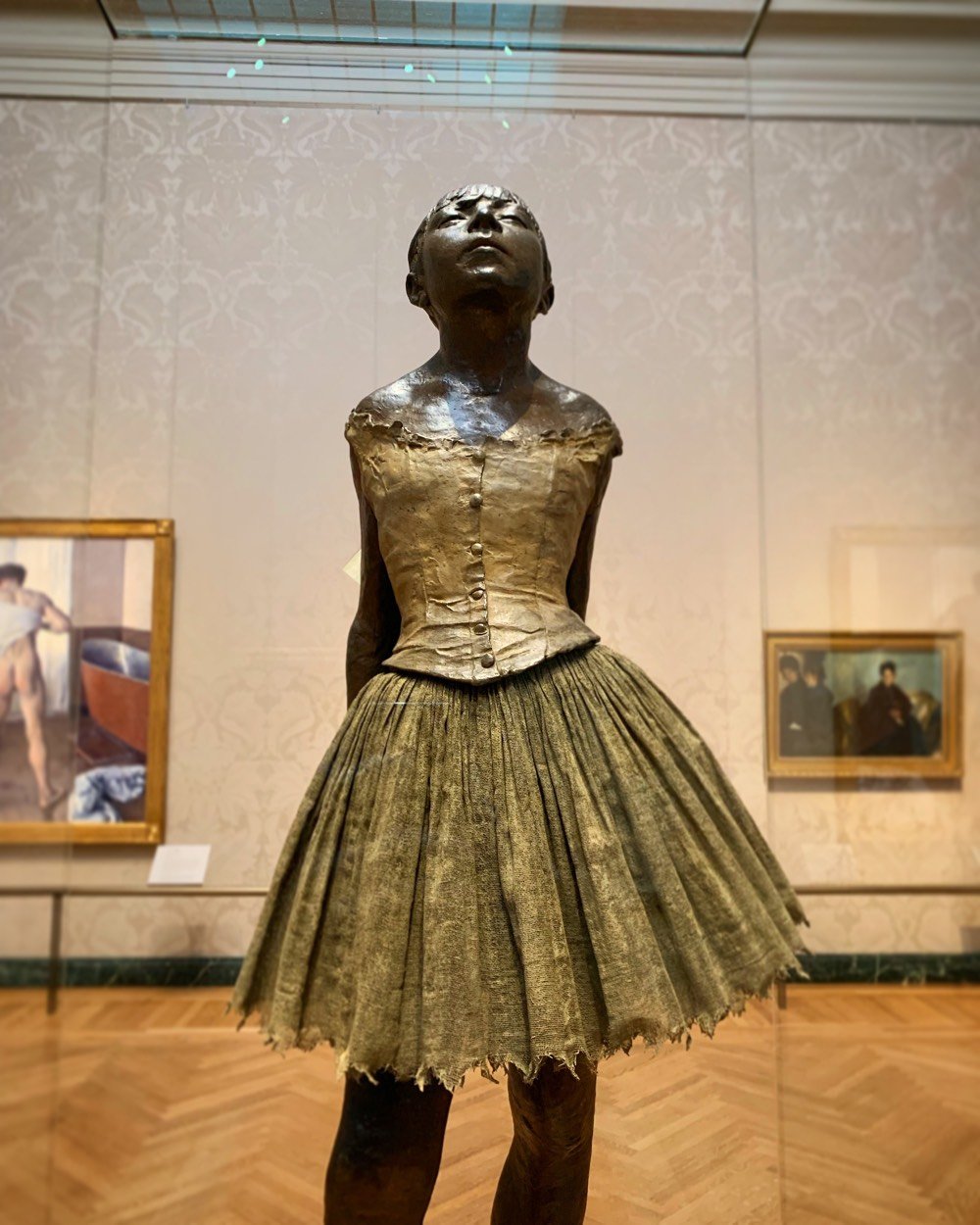
This is Degas’s largest surviving sculpture and the only one he titled and exhibited. The original wax version, a portrait of a young Belgian dancer named Marie van Goethem, was shown at the 1881 Impressionist exhibition in Paris. The wax was tinted to resemble flesh, she wore a wig of real hair, and was dressed in pink slippers and bodice in addition to a skirt and ribbon similar to those on this cast. The excessive naturalism of the work offended many viewers, but the critic J.K. Huysmans called it “the only really modern attempt that I know in sculpture.”
I’ve seen many representations of ballet dancers in Degas’ work over the years, but this time around was different because I had read Julia Wolkoff’s The Sordid Truth behind Degas’s Ballet Dancers last year.
The formerly upright ballet had taken on the role of unseemly cabaret; in Paris, its success was almost entirely predicated on lecherous social contracts. Sex work was a part of a ballerina’s reality, and the city’s grand opera house, the Palais Garnier, was designed with this in mind. A luxuriously appointed room located behind the stage, called the foyer de la danse, was a place where the dancers would warm up before performances. But it also served as a kind of men’s club, where abonnés — wealthy male subscribers to the opera — could conduct business, socialize, and proposition the ballerinas.
Young members-in-training of the ballet companies were called “petits rats” in reference to their often impoverished backgrounds. As Wolkoff observes of the subject of the sculpture:
Marie van Goethem was the “petit rat” who posed for the sculpture, and she likely engaged in the sexually predatory economy of the ballet world to survive. Van Goethem disappeared from the public eye shortly after the sculpture was completed; after being late to a rehearsal, the Paris Opera Ballet dismissed her. The teenager probably returned home to follow in the footsteps of her mother — a laundress and likely prostitute — and older sister, who was also a sex worker.
Here’s a Degas painting of an on-stage practice from the collection at the Met:
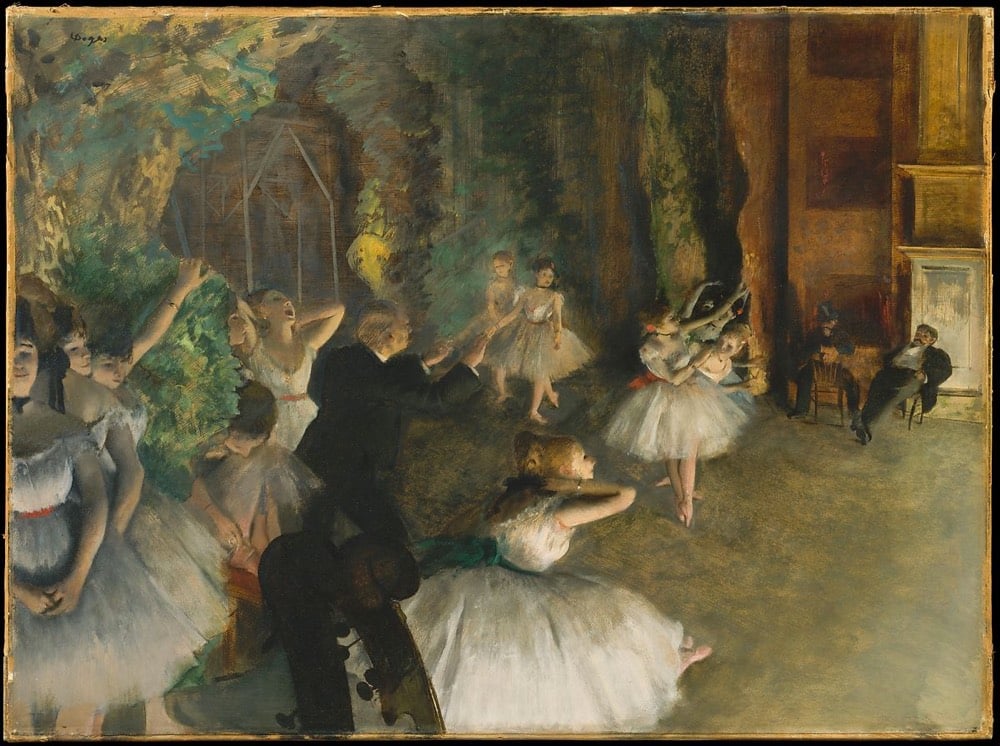
What might look at first glance like a depiction of the beauty of dance takes on a more sinister nature when you notice the men on the right side of the painting, perhaps a pair of wealthy subscribers getting a special preview of that night’s ballet and their choice of ballerinas. You might never look at another of Degas’ ballet paintings the same way again.
Running From COPS is a new podcast that examines the cultural influence of the long-running TV show COPS. Vox did a short video on the main themes of the show:
From a Fast Company article about the podcast and its creator, Dan Taberski:
The problem is that Cops is more reality show than documentary, and Taberski, a veteran reality show producer, knows there’s a huge disparity between reality show “reality” and documentary reality. In the course of their investigation, the Running from Cops team discovered that the police had final cut approval for the series. “When you start to look at the contractual relationship between producers and police-and we got our hands on a few of those contracts between Cops and the police departments — I think people will be really surprised how much the police are controlling their own message on the show,” Taberski says. Watching the show in that light, he adds, “It just shows how dicey it is to be using reality-show storytelling techniques for something so real and important as policing, and how your biases can creep in even unintentionally.”
Taberski and the producers also found that while prostitution, drugs, and violence make up 58% of crime depicted on Cops, according to the FBI, those three categories only account for barely 17% of crime IRL.
The first four episodes are available now on your favorite podcasting platform. I binged them over the past week and they’re worth a listen.
Alex Danco looks at some short-term and long-term trends and concludes that we may be on our way to a future where most of our cooking is outsourced to other parties.
As Cooking As A Service expanded from [less than] 10% to 25-30+% of our eating, we grew to consume and expect a far greater selection and variety of food compared to when we did all our cooking ourselves. Our consumption choices around what food we eat gradually pivoted from “What am I able to cook for myself” to “Is this exactly what I want to eat, yes or no?” Once you transition into “is this exactly what I want, yes or no” territory, it’s very hard to go back; it becomes a part of the standard of living that we expect….
From a couple of anecdotal conversations I’ve had with restaurant managers about this, it seems like once you open yourselves up as a restaurant that can be found on the delivery apps, a huge percentage of your kitchen volume switches over to fulfilling those orders, and your front-of-house costs get hung out to dry as increasingly unnecessary. Flexible, modular kitchens that are available for rent for any chef who wants to cook in it, and that have easy access to delivery cars and which pay for no front-of-house extras seem pretty obviously like the next iteration of back-end Cooking as a Service, and I wouldn’t be at all surprised to see them pop up everywhere soon enough. If they can collectively bring down the cost of outsourced cooking another 20-30%, I think the economics start looking pretty compelling for outsourced cooking (including delivery) to effectively pay for itself out of the savings incurred by paying for ingredients and cooking equipment in bulk. At that point, kitchens start to truly become optional.
What I think is compelling about this argument (and it’s worth reading in full) is that it isn’t driven by a single mover: e.g., delivery apps, or supermarket prepared foods, or fast food, etc. It’s a whole suite of cultural transformations that are changing all at once, but all moving more or less in the same direction, towards less cooking being done in the home.
Rob Walker’s new book The Art of Noticing is out now. The book is structured as a series of 131 exercises, and in an interview conducted by the book’s publisher, Walker explains a few of them.
KPG: If you were going to a new city or destination, which exercises would you recommend trying as a way to better explore a new place?
RW: One would be Get There The Hard way. At least once during your trip, go to some destination without taking directions from your phone. Plan out a route in advance—you can consult a paper map if you want, or written directions, just don’t rely on your phone—and if you get confused, ask someone for help. Be engaged with the space you’re in and the people you’re around, find your way, and be open to discovery as you go.
The other is Eat Somewhere Dubious. Have one meal at a restaurant that you didn’t find on Yelp or through any sort of recommendation and that doesn’t even look trendy or hip. First you’ll have fun keeping an eye out for it: “Is THAT our dubious restaurant?” Second, even if you have a mediocre meal, you’ll have an unpredictable experience! And this, by the way, is how the best food writers make discoveries and find the places that later get hot on Yelp. So maybe you’ll get lucky.
KPG: How can parents help their children be better observers? Which exercises would you recommend they do with their kids? (Any of these particularly great for long road trips or plane rides?)
RW: The one-object scavenger hunt is an easy one: let’s look for security cameras, or let’s look for flowers. Or maybe you let her or him pick what you’ll look for together. A friend of mine does a version of this while walking his son to school, and it’s “who can spot something gross?” Whatever it is you choose, you can both participate, and it gets kids involved in the world.
But something else I’d say here is that kids are often already quite good at converting everything to a game, and at seeing the world with fresh eyes—I mean, they have fresh eyes. There’s a specific exercise in the book to try to see the world as a child would, so if you actually have a child handy, maybe just try to tune into what they’re tuned into, and why, and what they make of it. Encourage their noticing by participating in it with them.
The question I would ask Walker is this: what are the limitations of structuring your book as a series of discrete exercises, rather than some other way?
The trouble I see is all in converting a book about noticing new things into making a book where noticing new things can be made useful. So everything is structured as an exercise for students, or as a way for folks in the business world to hone their “competitive edge.” It’s a byproduct of creating a buying audience for the book more than creating the serendipity of noticing as such. So there’s a lot here that appeals to me, but a lot that equally turns me off.

Adam Minter has a new book, Secondhand, about the global trade in secondhand and discarded goods. In an interview, he notes that “consumers actually care more about how their stuff is discarded, than how it is manufactured”:
I didn’t really appreciate that emotional landscape until I started spending time with people and companies in the US who help senior citizens “downsize” their property before a move to smaller quarters, typically a senior living facility. And what I saw during downsizing cleanouts is a lot of resistance to discarding by the very people who paid (handsomely, in most cases) to have someone come and help them discard. Before the owners would let go, they needed reassurance that the stuff will be valued and reused in ways that conform to their values…
The process is made even more difficult by changing tastes. The fine china and antiques appreciated by Americans born in the middle of the twentieth century aren’t in much demand from the younger generations. “People just don’t want it. But seniors want people to want it,” she says. “‘Oh, my kids will take it.’ No, they won’t.”
In the course of sorting someone’s stuff, her best tactic is to persuade the clients that stuff won’t be wasted. “Men won’t get rid of tools. Women, Tupperware. So we tell them the Tupperware can be recycled. The tools can be used by someone else.”
As Minter writes, “people in consumption-based societies assemble their identities via stuff, and become very emotional when those identities — and that stuff — is discarded in ways that don’t match their values.” (In Asia, end-of-life discards tend not to be donated, but sold, which makes for cleaner transactions all around.)
Adam and Neil Pearson are identical twins who have neurofibromatosis, a rare genetic disorder that affected the two of them quite differently.
“I was always aware that I had the same condition as him, but also fully aware that he had the facial disfigurement and I didn’t,” Neil says in the film. Adam suffers from benign tumors that began forming on his face when the Pearsons were boys. They grew progressively worse over time. In school, he endured much bullying-“one of the worst things a human can do to another human,” as he describes it in the film. As an adult, Adam explains that he can never go anywhere without being gaped at. Neil, meanwhile, appears physically unscathed but experiences neurological problems that severely impair his memory.
(via @luvmyptcruiser)
How did a cube of uranium from the Nazis’ failed nuclear reactor end up in Maryland in 2013? “[Werner] Heisenberg had escaped earlier by absconding east on a bicycle under cover of night with uranium cubes in his backpack.”
Dimensions.Guide is a database containing dozens of dimensioned drawings of objects ranging from Ikea furniture to pandas to wheelchairs to Tyrion Lannister.


The sleeping positions might be my favorite ones. The illustrations are available in a variety of formats for download.
Newer posts
Older posts





Socials & More