




This site is made possible by member support. 💞
Big thanks to Arcustech for hosting the site and offering amazing tech support.
When you buy through links on kottke.org, I may earn an affiliate commission. Thanks for supporting the site!
kottke.org. home of fine hypertext products since 1998.
Beloved by 86.47% of the web.
Entries for January 2019
Why Snowpiercer Is a Sequel to Willy Wonka and the Chocolate Factory
In this video, Luke Palmer makes a surprisingly compelling case that Bong Joon-ho’s Snowpiercer is actually a sequel to the beloved 1971 film Willy Wonka & the Chocolate Factory. (Spoilers for both films to follow.) The main idea is that Charlie Bucket inherits the Wonka fortune and grows up to be Wilford, who builds the train to save humanity.
They’re both two movies about groups of people that work their way through a large fantastic structure. One-by-one, a person from the group is removed in each room until one person makes it to the very end, who then found out that the entire thing was a test because a wealthy industrialist needed to find a new successor.
I love this, but I wouldn’t go so far as saying it’s a sequel. A reboot maybe or an homage. (via @mulegirl)
Ancient Greek Vase Shaped Like a Lobster Claw


Terracotta vase in the form of a lobster claw from the collection at the Met. Circa 460 BC.
Because so many aspects of Greek life depended on the sea, a vase in the shape of a lobster claw is not surprising. It is, however, exceptional and may be a variant of the askos — a bag-shaped oil container provided with a vertical mouth and strap handle. The Dionysiac iconography of the lobster claw suggests that it was a novelty item used at symposia (drinking parties).
The vase bears an inscription that reads “the boy is fair”.
“The Invisible Helping Hand”
Feeding America (formerly known as America’s Second Harvest) is a non-profit organization that receives food donations from farmers, manufacturers, and retailers and distributes them to food banks around the nation. As this excerpt from Tim Sullivan and Ray Fisman’s book, The Inner Lives of Markets, tells it, this system was working pretty well but wasn’t as efficient as it could be, resulting in food being wasted and people going hungry.
Food banks might provide feedback on their likes and dislikes, but at its core, the Second Harvest allocation still resembled 1960s-era Chinese central planning (which, free-market economists will note, helped to cause the Great Famine of 1959-61). Second Harvest’s management felt that it was falling short in its efforts to get food banks the donations they most needed. Prendergast gives the example of sending potatoes, unbidden, to a foodbank in Idaho that already had warehouses full. Or delivering milk to a bank that didn’t have the refrigeration capacity to store it and so would end up throwing it away. In fact, Second Harvest would sometimes turn down food donations from giant food companies because they weren’t sure where to send it. Second Harvest was also, at the time, treating different kinds of food as the same — a pound of broccoli was the same as a pound of cereal was the same as a pound of potato chips. When it comes to feeding the poor and hungry, however, not all foodstuffs are of equal value.
So Feeding America asked University of Chicago economist Canice Prendergast to design a market for the donated food, hoping that would make things run more efficiently. After listening to concerns raised by the food banks, particularly from the smaller ones who didn’t want to get out-muscled in the market by the larger banks, they came up with an economy where food banks were given shares to bid on the food they wanted each day.
Crucially, the market was overseen by a “central banker”, so that certain market dynamics didn’t result in a disruption of the ultimate goal of getting the most food to the people that needed it.
Food bank presidents, the market designers discovered, were hoarders of shares. To keep the market from dipping into a deflationary spiral, Prendergast needed to pump extra shares into the market to encourage bidding. There was also the ebb and flow of goods into it to consider. Some days, Kraft might dump half a dozen container — loads of mac and cheese into circulation; other days there’d be none. If everyone used their points to bid on mac and cheese, the prices of, say, potato chips and broccoli would plummet, not because broccoli was suddenly worth less, but because of a temporary surge in the supply of more desirable donations. So extra shares would need to be put into circulation to prop up prices — lest Arnold see last week’s lower price of potato chips and bid too timidly on them, misinterpreting short-run price declines as permanent ones. Similarly, in a dry spell of donations, shares would be withdrawn from the market: Since there was so little to bid on, there would be a run-up in prices unless the number of shares also declined.
As a result of their implementation of an economy, a couple of benefits emerged. First, Feeding America learned which foods were most sought after by banks (i.e. those for which the bidding was highest) and were able to be more aggressive in seeking out donors for them. Second, the amount of total food donations doubled, with about 25% of the increase directly attributable to the market:
As Prendergast reports in an academic paper summarizing the Second Harvest market experiment, the annual supply of food donations increased by 50 million to 100 million pounds as a result. Twelve million pounds can be traced directly to the market itself, in the form of excess donations that flush food banks placed into the market in exchange for shares. That’s 12 million pounds of food that would otherwise have been wasted.
Going Birdwatching in Red Dead Redemption 2
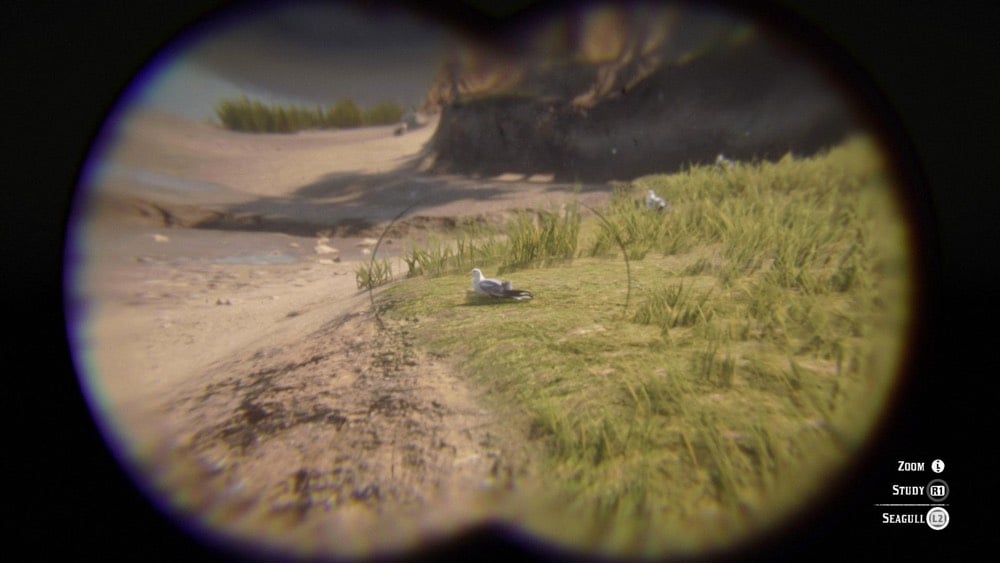
For Audubon, avid birder Nicholas Lund writes about the experience of going birdwatching in the mega-popular Red Dead Redemption 2 game, set in the American West, circa 1899. The attention to detail and the number of species represented is impressive.
I spent most of my time finding birds, and was impressed with the breadth and relative accuracy of the species represented. Birds change with habitat: Roseate Spoonbills and Great Egrets feed in the bayous of Saint Denis. Laughing Gulls and Red-footed Boobies roost along the coast, while eagles and condors soar over mountain peaks. Each of these are crafted with accurate field marks and habits. There are dozens of species I couldn’t even find, including Carolina Parakeets, Ferruginous Hawks, and Pileated Woodpeckers. Like real life birding, you’re never guaranteed to see anything.
The sound design, too, is impressive. The landscape is alive with birdsong, including many species not actually in the game, like Northern Flicker and Ruby-crowned Kinglet. I was riding through a wooded area one time as dusk turned to night, and whip-poor-wills began singing out all around me.
But the game’s realistic portrayal of wildlife and its exploitation by humans causes Lund to reflect on how much destruction we’ve caused.
The demand for egret plumes for fancy hats was driving several species toward extinction. (Snowy Egret plumes can be sold in-game for $2.50 apiece.) Habitat loss and overhunting contributed to the extinction of the Carolina Parakeet soon after the game’s timeframe, in the early 20th century. (Carolina Parakeet flight feathers can be used to make far-flying arrows in the game.) The type of wanton destruction encouraged in Red Dead Redemption 2 is what led the National Audubon Society to lobby for, and Congress to pass, the real Migratory Bird Treaty Act in 1918, and other environmental legislation in the following decades.
Lund’s birding trip reminded me of other non-conventional uses of realistic video games by players: Jim Munroe being a tourist in Grand Theft Auto III and war photographer Ashley Gilbertson sending back photographs from the ultra-violent The Last of Us Remastered.
Blocky Typographic Street Art


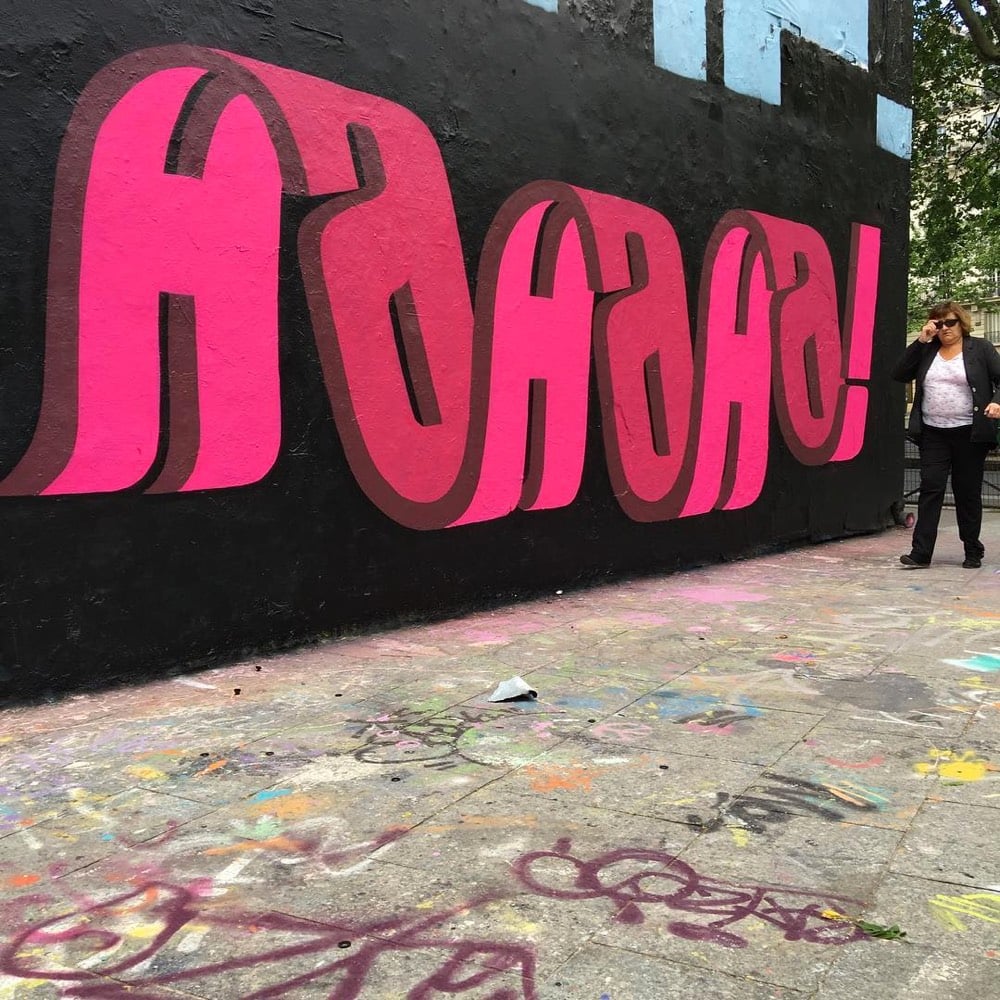
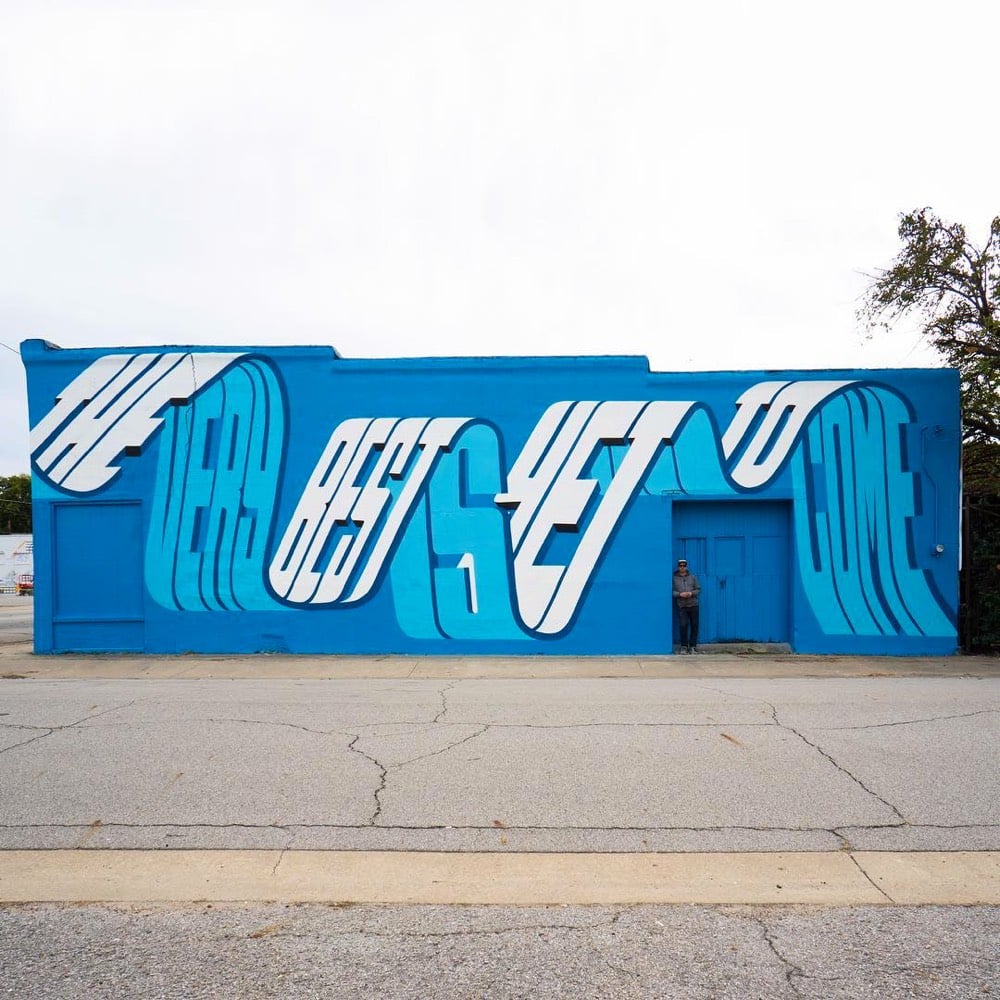
I love this chunky/wavy typographic street art by Pref. He spoke with Colossal back in May about his art.
“Since then I have pushed and experimented with this idea of overlapping words, seeing how many I can fit into the space of one word, and then slowly boiling it down and simplifying this idea to become more legible,” he tells Colossal. “This in turn lead more to the use of ‘typography’ throughout my style as you see today. I have always been interested in the idea of graffiti speaking to the general public, rather than just other graffiti writers, and readable letters or a more ‘typographic’ approach has been a good route to that.”
Our Unbounded Finite Universe
I’ve always had a hard time wrapping my head around the idea that the universe could be both finite and infinite at the same time (or something like that *takes bong rip*), but this passage from Coming of Age in the Milky Way by Timothy Ferris succinctly explains what’s going on:
General relativity resolved the matter by establishing that the universe could be both finite — i.e., could contain a finite number of stars in a finite volume of space — and unbounded. The key to this realization lay in Einstein’s demonstration that, since matter warps space, the sum total of the mass in all the galaxies might be sufficient to wrap space around themselves. The result would be a closed, four-dimensionally spherical cosmos, in which any observer, anywhere in the universe, would see galaxies stretching deep into space in every direction, and would conclude, correctly, that there is no end to space. Yet the amount of space in a closed universe would nonetheless be finite: An adventurer with time to spare could eventually visit every galaxy, yet would never reach an edge of space. Just as the surface of the earth is finite but unbounded in two dimensions (we can wander wherever we like, and will not fall off the edge of the earth) so a closed four-dimensional universe is finite but unbounded to us who observe it in three dimensions.
In the terms of Edwin Abbott Abbott’s Flatland: A Romance of Many Dimensions, we are Flatlanders living in a Lineland world who, with the aid of mathematics, have been able to peer into Spaceland.
The Letterboxd year in review for 2018. “Letterboxd is where diverse, clever and funny film lovers gather to share their passion for film.”
AI Algorithm Can Detect Alzheimer’s Earlier Than Doctors
A machine learning algorithm programmed by Dr. Jae Ho Sohn can look at PET scans of human brains and spot indicators of Alzheimer’s disease with a high level of accuracy an average of 6 years before the patients would receive a final clinical diagnosis from a doctor.
To train the algorithm, Sohn fed it images from the Alzheimer’s Disease Neuroimaging Initiative (ADNI), a massive public dataset of PET scans from patients who were eventually diagnosed with either Alzheimer’s disease, mild cognitive impairment or no disorder. Eventually, the algorithm began to learn on its own which features are important for predicting the diagnosis of Alzheimer’s disease and which are not.
Once the algorithm was trained on 1,921 scans, the scientists tested it on two novel datasets to evaluate its performance. The first were 188 images that came from the same ADNI database but had not been presented to the algorithm yet. The second was an entirely novel set of scans from 40 patients who had presented to the UCSF Memory and Aging Center with possible cognitive impairment.
The algorithm performed with flying colors. It correctly identified 92 percent of patients who developed Alzheimer’s disease in the first test set and 98 percent in the second test set. What’s more, it made these correct predictions on average 75.8 months — a little more than six years — before the patient received their final diagnosis.
This is the stuff where AI is going to be totally useful…provided the programs aren’t cheating somehow.
2019 will be the final year of Design*Sponge, one of the best OG blogs. “This won’t be a sad shuttering of doors — it is going to be a full-fledged, joy-filled celebration…”
How Language Shapes the Way We Think
At the TEDWomen 2017 conference, cognitive scientist Lera Boroditsky gave a talk on how different languages affect how their speakers think about the world. It ended up being the most viewed online TED Talk in 2018. Boroditsky’s first example of how language shapes thought is the directional thinking of the Kuuk Thaayorre people of Australia.
I’ll start with an example from an Aboriginal community in Australia that I had the chance to work with. These are the Kuuk Thaayorre people. They live in Pormpuraaw at the very west edge of Cape York. What’s cool about Kuuk Thaayorre is, in Kuuk Thaayorre, they don’t use words like “left” and “right,” and instead, everything is in cardinal directions: north, south, east and west. And when I say everything, I really mean everything. You would say something like, “Oh, there’s an ant on your southwest leg.” Or, “Move your cup to the north-northeast a little bit.” In fact, the way that you say “hello” in Kuuk Thaayorre is you say, “Which way are you going?” And the answer should be, “North-northeast in the far distance. How about you?”
So imagine as you’re walking around your day, every person you greet, you have to report your heading direction.
In order for China’s censorship of the internet to work, they have to teach young workers forbidden knowledge (about Tiananmen, dissident Liu Xiaobo). I think I remember this bit from 1984 (also forbidden in China).
The Sewage Diver
In this artfully made short film by Esteban Arrangoiz, we meet Julio César Cú Cámara, “a man who has found long lasting contentment in a dirty job: diving into the sewers and water treatment plants of Mexico City to clear blockages and reduce the risk of floods”.
As Arrangoiz writes, “Mexico is undergoing multiple crises: humanitarian, corruption, garbage. This film shows us how through his work, a human being is capable of finding beauty, pleasure and the essence of his humanity inside the detritus. This moves me, gives me hope and compels me to make movies. I think Mexico needs stories like these.”
As he’s diving, Cámara narrates his experience:
I imagine here feels like being in outer space. I feel alone in space, just like I’m alone at the bottom of the sump, under the sewage waters. And I feel good. I feel the pressure of the water. I feel like it’s embracing me. I feel like the water is holding me. The water is protecting me, a little. And I don’t want to stop feeling this.
The opening sequence, of Cámara in his diving suit being lowered into a sewage reservoir, is amazing, like something out of a 70s sci-fi film.
Update: From Edible Geography, a transcript of a talk by Cámara as well as some Q&A with the audience.
I’m fascinated by the job that I do. Even though not many people see it or know about it, I believe we do a very important job for all of us. Sometimes you can’t stop the pumping plant or you can’t dig up the street and get to the sewage pipes from the surface. That’s when we come in. It’s a very satisfying job. I like knowing that I am part of a system working to help keep the city safe.
From the NY Times, Our Favorite Facts of 2018. “According to one study, people typically touch their phones 2,617 times per day.”
The Beastie Boys Rap “Cooky Puss” in 1983
Before they hit it big with Licensed to Ill in 1986, the Beastie Boys were a punk rock quartet experimenting with rap. In this footage from 1983, the band performs their very first hit song, Cooky Puss, at The Kitchen in NYC. They all look so impossibly young (Ad-Rock is only 17) and sound really uneven, like they’re performing in a high school talent show.
Here’s the full set they played that night; the band sounds a lot more confident playing their punk/rock repertoire (which included “Cum On Feel the Noize”):
It’s amazing that this footage exists. You can literally see the changeover in the group’s focus from the musical genre of their youth (which was on the wane a bit) to something newer (rap), weirder (fratty white-boy rap), and eventually unique and amazing (Paul’s Boutique).
Compare with a 17-year-old LL Cool J playing to an audience of ~120 people in a small-town Maine gymnasium and a 17-year-old Notorious BIG freestyling on a street corner in Bed-Stuy. (via open culture)
The Healthiest Vegetables, Ranked
MEL Magazine’s Ian Lecklitner talked to clinical nutritionist David Friedman (author of Food Sanity: How to Eat in a World of Fads and Fiction) about which vegetables Friedman thinks are the healthiest. Happy to see that asparagus is #1:
“This tasty green stalk comes in first place on my vegetable ranking,” Friedman says. “Asparagus is a great source of vitamin K, which helps with blood clotting and building strong bones.” Friedman also mentions that asparagus provides vitamin A (which prevents heart disease), vitamin C (which supports the immune system), vitamin E (which acts as an antioxidant) and vitamin B6 (which, like vitamin A, also prevents heart disease).
Asparagus is also loaded with minerals, including iron (which supports oxygen-carrying red blood cells), copper (which improves energy production) and calcium (which improves bone health). “Asparagus increases your energy levels, protects your skin from sun damage and helps with weight loss,” Friedman continues. “It’s also an excellent source of inulin, a type of carbohydrate that acts as a prebiotic, supporting the growth of health-promoting bacteria in the colon.”
Personal faves brussels sprouts, beets, and broccoli also rank pretty high.
For some NBA players, the caffeine in pre-game coffee (made with fresh-ground organic beans) is a performance enhancing drug. “I just felt focused. My mind just felt locked in.”
I might be the only person I know who really liked Vice. Here, Nicholas Lehmann compares the real Dick Cheney with the one depicted in the film.
Jada Yuan visited 52 places in 12 months for the NY Times…here’s how it went for her. “You see, it was a dream job. It’s just that my idea of what made this dream job dreamy has changed so much.”
Styrofoam
In this lovely short film by Noah Sheldon, we meet Wo Guo Jie, a migrant worker from rural China who makes a living in Shanghai collecting styrofoam boxes and reselling them at a wholesale fish market. Even though styrofoam is a relatively light material, she packs so much of it onto her bike that the front wheel bounces off the ground as she motors slowly down the street, unable to see anything but what’s right in front of her.
My hometown is all farmland, there are no factories. During the winter there is nothing to do so people work elsewhere. Now everyone has left to go find work. No one farms anymore. It’s rare for me to get a chance to go home. Sometimes I don’t even go back once a year. When my son was younger, around 7 or 8 years old, I came home and he refused to call me ‘Mom’. He didn’t recognize me because I hadn’t been home for 3 years. I take each day as it comes. I haven’t thought too much about the future.
(via @rmpenguino)
Unlocking the Commons and Collective Micropatronage
For NiemanLab’s annual Predictions for Journalism package, Tim Carmody revisited his take on how kottke.org’s membership program works and what that could mean for independent media.
The most economically powerful thing you can do is to buy something for your own enjoyment that also improves the world. This has always been the value proposition of journalism and art. It’s a nonexclusive good that’s best enjoyed nonexclusively.
Anyways. This is a prediction for 2019 and beyond: The most powerful and interesting media model will remain raising money from members who don’t just permit but insist that the product be given away for free. The value comes not just what they’re buying, but who they’re buying it from and who gets to enjoy it.
If you’d like to help support independent media and keep access to kottke.org open and free, you can join the membership program.
And as always, a huge thank you to all of you who have already contributed. As I wrote in an update back in November 2017, I’m not sure the site would even be here without your support:
While I didn’t know it at the time, your support saved kottke.org. This is not even hyperbole. As I hinted at in the announcement post, the industry-wide drop in revenue from display advertising was beginning to affect kottke.org and just a few months later, the site’s largest source of revenue (ads via The Deck) went from “hey, I can make a living at this!” to zero. … But over the course of the past year, hundreds and then thousands of you became members, exceeding even my loftiest expectations. Membership is now the primary source of revenue for kottke.org.
Thoughts from ex-Microsoft exec Steven Sinofsky on the naive “Why doesn’t Apple just sell a cheap iPhone?” analysis. My hot take: Apple is a consistently undervalued company. (Compare their p/e ratio to their cohort for starters…)
Janet Jackson revisits Rhythm Nation. “Unlike almost any other major pop artist, Janet revisited her signature song, in a world of #BlackLivesMatter and #MeToo, and declared her past vision obsolete.”
“Women’s Work” and Other Art by Clare Kirkconnell
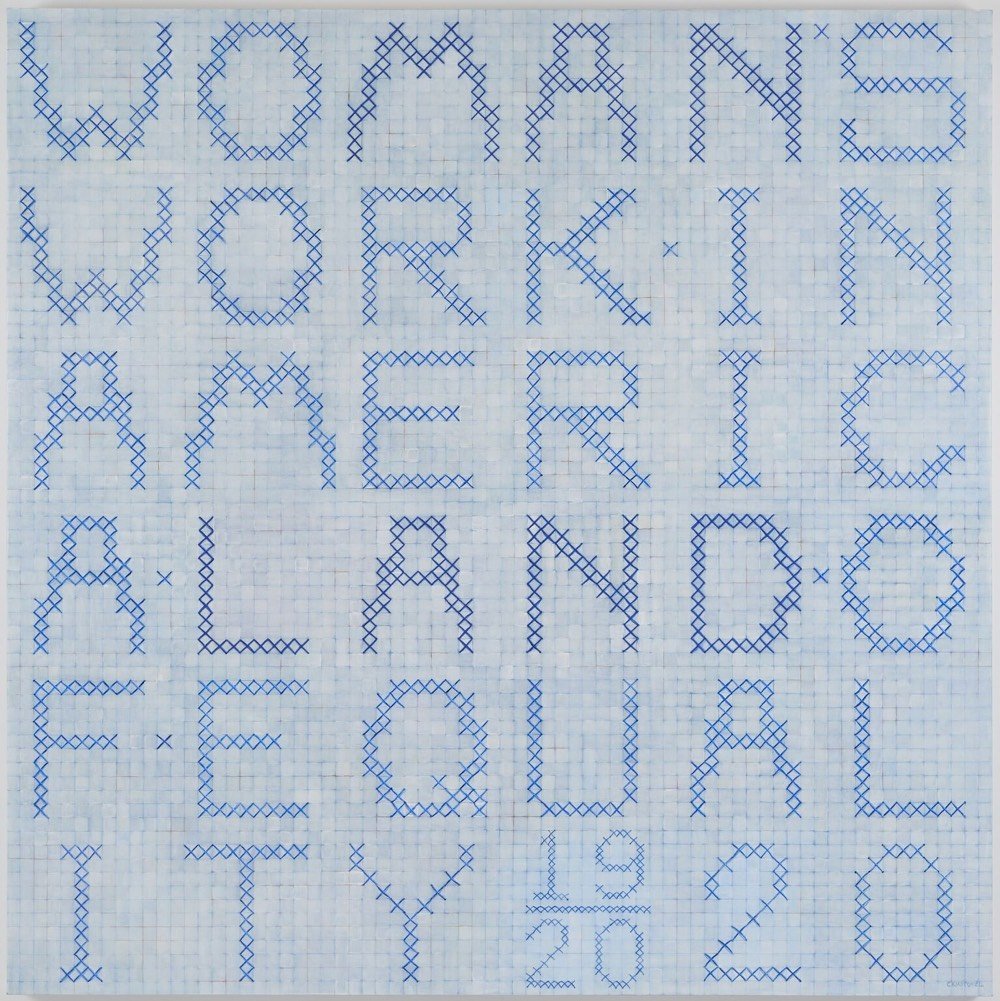


Next week at the Berggruen Gallery in SF, Clare Kirkconnell’s show “Women’s Work” opens and will be on view until Feb 16. (The top and bottom pieces are from “Women’s Work”…the one in the middle is an older piece.) (via @thoughtbrain)
Recorder: The Marion Stokes Project
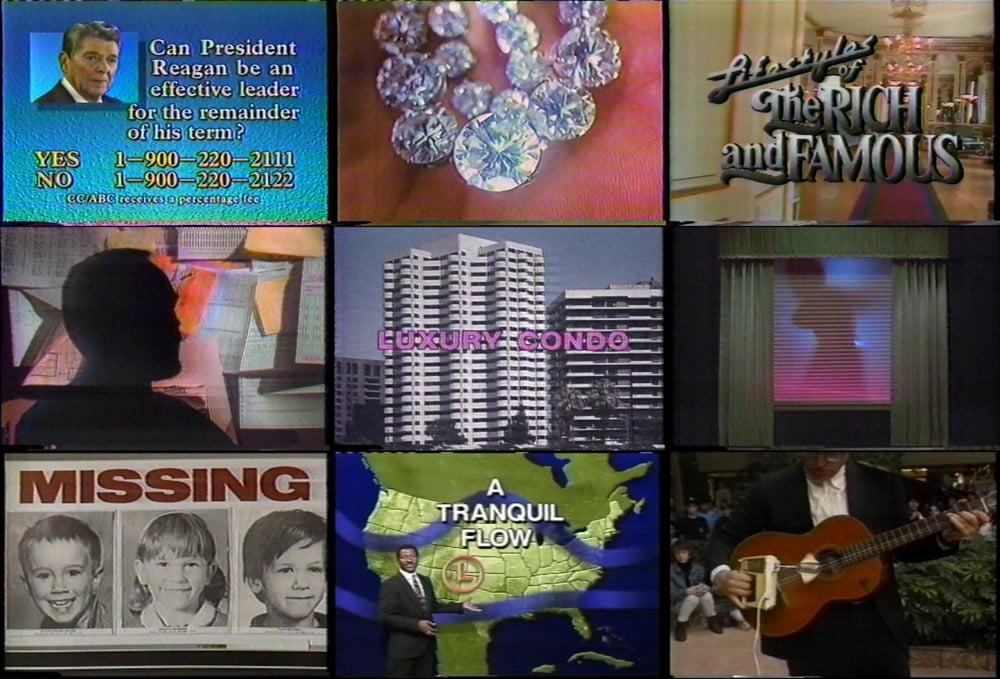
In 1979, a woman named Marion Stokes started recording live television and didn’t stop for more than 33 years. Director Matt Wolf is making a movie about Stokes and her archive.
Marion Stokes was secretly recording television twenty-four hours a day for thirty years. It started in 1979 with the Iranian Hostage Crisis at the dawn of the twenty-four hour news cycle. It ended on December 14, 2012 while the Sandy Hook massacre played on television as Marion passed away. In between, Marion recorded on 70,000 VHS tapes, capturing revolutions, lies, wars, triumphs, catastrophes, bloopers, talk shows, and commercials that tell us who we were, and show how television shaped the world of today.
The Internet Archive is supposedly archiving them and putting them online (so says this 2013 Fast Company article) but there’s no evidence that any of the videos are live on the site. (Rights issues? Budget?) In the meantime, you can check out this Tumblr has a collection of stills from the Stokes tapes.
A Short History of the US Economy 1945-2019
Morgan Housel, an economics writer and venture capitalist, recently took a crack at summing up (in just 5000 words) what happened to the U.S. economy since the end of World War II. Even if you disagree with it (or parts of it), the whole thing is worth a read. I think this captures a large part of the main point:
Everything in finance is data within the context of expectations. One of the biggest shifts of the last century happened when the economic winds began blowing in a different, uneven direction, but people’s expectations were still rooted in a post-war culture of equality. Not necessarily equality of income, although there was that. But equality in lifestyle and consumption expectations; the idea that someone earning a 50th percentile income shouldn’t live a life dramatically different than someone in the 80th or 90th percentile. And that someone in the 99th percentile lived a better life, but still a life that someone in the 50th percentile could comprehend. That’s how America worked for most of the 1945-1980 period. It doesn’t matter whether you think that’s morally right or wrong. It just matters that it happened.
Expectations always move slower than facts. And the economic facts of the years between the early 1970s through the early 2000s were that growth continued, but became more uneven, yet people’s expectations of how their lifestyle should compare to their peers did not change.
Along with this:
The biggest difference between the economy of the 1945-1973 period and that of the 1982-2000 period was that the same amount of growth found its way into totally different pockets.
This reminded me of Matthew Stewart’s piece from The Atlantic that I read when it came out but never blogged about: The 9.9 Percent Is the New American Aristocracy.
When it comes to the division of wealth, many Americans believe that the country is split between the 1%, which possesses a significant share of the country’s money, and the 99%, or “the people.” In reality, The Atlantic writer Matthew Stewart argues, 9.9% of the population comprises America’s new aristocracy, which often “takes wealth out of productive activities and invests it in walls.” But this group of people is rich in more than mere money, and its constancy poses an insidious threat to the promise of American democracy.
The related video is a good 3-minute summary of Stewart’s piece.
A List of the 100 Most Important Technologies Ever
From Paleofuture, “Technology, Ranked”, a list of the 100 most important technologies ever invented by humans. Among the items on the list (one of which is the top pick) are the fork, the electric guitar, cotton gin, nuclear weapons, anesthesia, GPS, Prozac, and the wheel. Fire is #2:
Ancient peoples harnessed fire in ways that allowed them to control their environment. For example, aboriginal Australians were able to keep bushfires under control by shaping and manipulating what they destroyed-reinvigorating the land and limiting the number of fires that had the potential to get out of control.
It’s fire. It’s kinda important.
A Metalsmith Makes a Puzzle Box From Scratch
Over the course of two years, metalsmith Seth Gould built a project he calls Coffer, a gorgeous wrought iron puzzle box. Gould made the box from scratch — he forged the metal, machined the bolts, everything!
The majority of pieces, including the bolts, levers, and staples, are made from wrought iron, a material I use primarily for its working properties (enjoyable to forge and file). Wrought iron is no longer manufactured, so each piece needed to be forged from salvaged material. The forging is done using a coal forge, hammer, anvil, and power hammer. Once the pieces are forged as close to their finished shape as possible, I move to the bench to refine the surface and shape with a file. The final touch is a bit of file embellishment.
I mean, look at this intricate deliciousness:

The video above is a short film of Gould making his box filmed by Jesse Beecher. The soundtrack cleverly incorporates the sounds of the workshop (sawing, hammering, flames) into the music, resulting in a particularly artful making-of film. (via colossal)
Update: The box made by Gould is called an armada box.
An iron-bound strongbox for storing valuables in the 16th and 17th centuries, often with a large, complicated lock on the underside of the lid. Some were for the use of officers at sea, and would have been bolted to the deck of the owner’s cabin. Usually of German make, the chests could be anything from a few inches to 6ft (1.8m) long. The name itself was a fanciful Victorian invention recalling chests imagined to be used by the Spanish Armada.
Which Countries Have Been Top of Mind in the US Over the Past Century?
The Pudding analyzed over 740,000 headlines from the NY Times since 1900 to determine which country the US was most interested in for each month and turned the analysis into a handy visualization.
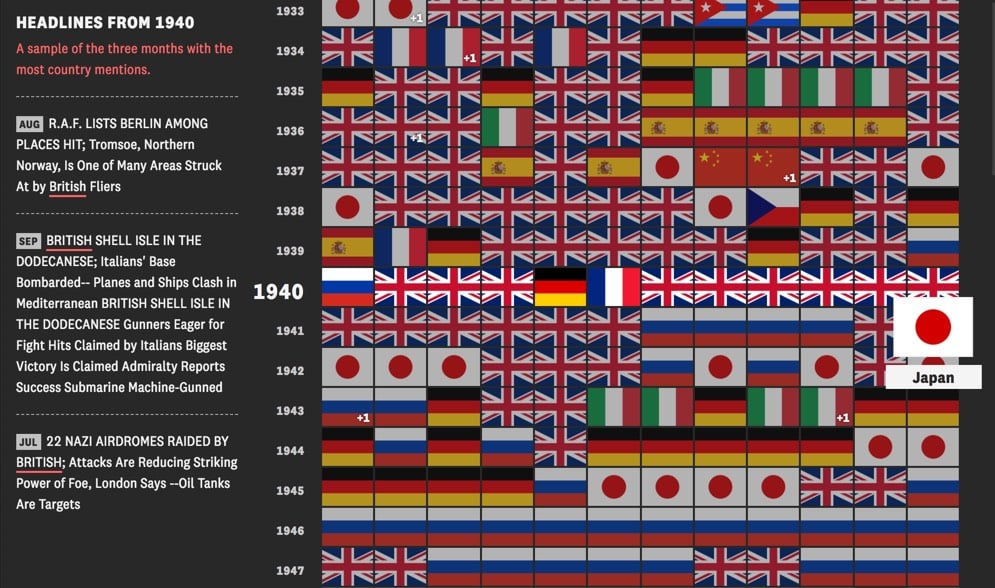
As you can see, Britain was mostly the center of attention before WWII, Russia during the Cold War, and China since the mid-2000s. But other countries are liberally sprinkled in and wars are quite visible — WWI, WWII, Vietnam, and Iraq are all represented by solid blocks of interest in our “enemies”.
The “Beastie Boys Book” Audiobook Is a Star-Studded Mixtape
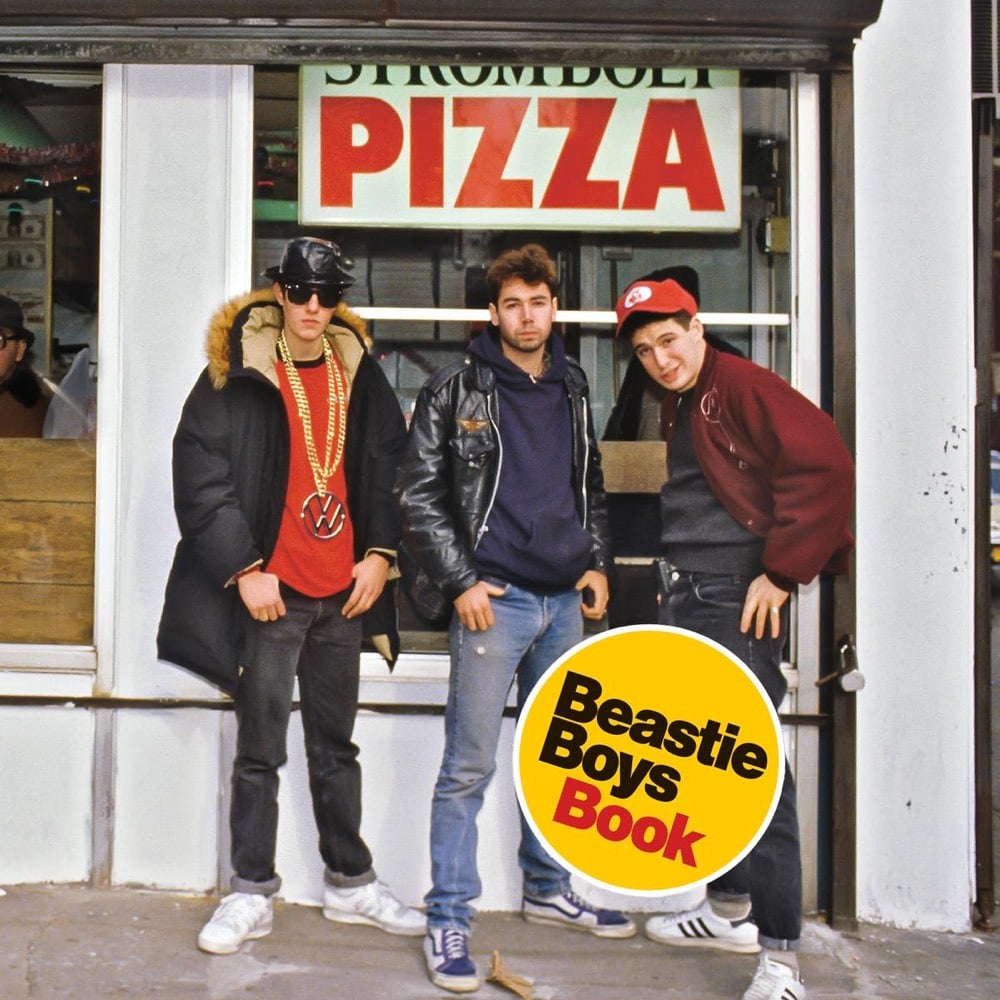
I am only a casual Beastie Boys fan, but I’ve been hearing nothing but really good things about their goofball memoir, Beastie Boys Book.
With a style as distinctive and eclectic as a Beastie Boys album, Beastie Boys Book upends the typical music memoir. Alongside the band narrative you will find rare photos, original illustrations, a cookbook by chef Roy Choi, a graphic novel, a map of Beastie Boys’ New York, mixtape playlists, pieces by guest contributors, and many more surprises.
The boys also went all-out on the audiobook edition, a 13-hour version of the book that’s as much a mixtape as an audiobook from an all-star cast of more than three dozen readers, including Beasties Mike D and Ad-Rock as well as Steve Buscemi, Elvis Costello, Chuck D, Snoop Dogg, Will Ferrell, Kim Gordon, LL Cool J, Spike Jonze, Pat Kiernan, Talib Kweli, Bette Midler, Nas, Rosie Perez, Amy Poehler, and many more.
There are a pair of excerpts on Soundcloud, the first from the book’s introduction by Ad-Rock and the second from Mike D:
Ok well, I’m totally hooked.
Socials & More